Effectiveness of Data Mining - based
E-learning system (DMBELS)
M.Prema
M.Phil (CS) Research Scholar SCSVMV University Enathur, Kanchipuram
S.Prakasam,
Ph.D Asst .ProfessorDepartment of CSA, SCSVMV University Enathur, Kanchipuram
ABSTRACT
E-learning is emerging as the new paradigm of modern education. Most of the e-learning systems have limitations such as scarcity of content, lack of intelligent search and context sensitive personalization problems, which are the challenging tasks for researchers. This motivated the author to take up this problem and the method implemented through this work suggests the instructors to use the combination of the data mining based e-learning system (DMBELS) was designed. The main aim of the model developed is to get consistency in content delivery, quality content in learning materials, students self-learning concept, and performance improvement in their examination. A study has been conducted to measure the effectiveness of data mining technique based e-learning system (DMBELS) among the students of SCSVMV University in concepts of First Aid awareness course.
1.
INTRODUCTION
E-Learning is the use of telecommunication technology to deliver information for education and training. With the progress of information and communication technology development, e-Learning is emerging as the paradigm of modern education. The great advantages of e-Learning include liberating interactions between learners and instructors, or learners and learners, from limitations of time and space through the asynchronous and synchronous learning network model (Katz, 2000; Katz, 2002; Trentin, 1997). E-learning’s characteristics fulfill the requirements for learning in a modern society and have created great demand for e-Learning from businesses and institutes of higher education.
In the following sections, previous research, related literatures are discussed. A study has been conducted to measure the effectiveness of data mining technique based e-learning system (DMBELS) among the students of SCSVMV University in concepts of First Aid awareness course Finally, the results are analyzed and presented.
2.
PRIOR STUDIES OF E-LEARNING
E-Learning is basically a web-based system that makes information or knowledge available to users or learners and disregards time restrictions or geographic proximity. Although online learning has advantages over traditional face-to-face education (Piccoli et al., 2001), concerns include time, labor intensiveness, and material resources involved in running e-Learning environments. The costly high failure rate of e-Learning implementations discussed by Arbaugh and
Duray(2002) deserves attention from management and system designers.
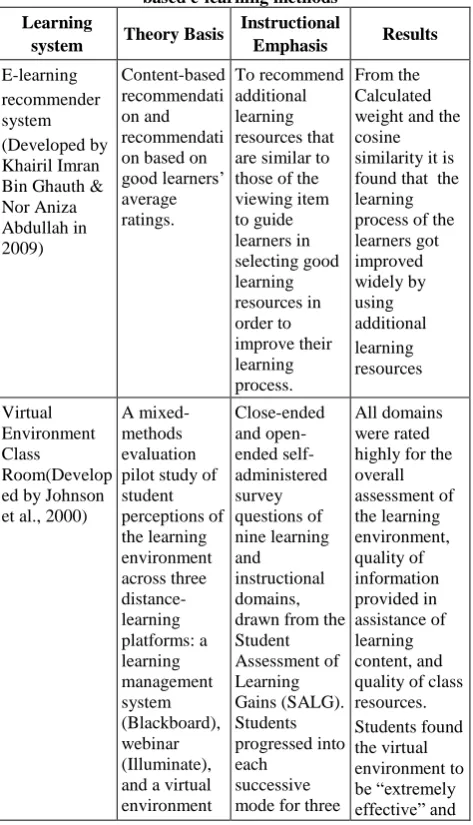
[image:1.595.308.545.355.768.2]Many researchers from psychology and information system fields have identified important variables dealing with e-Learning. Among them, the technology acceptance model (Ajzen & Fishbein, 1977; Davis, Bagozzi, & Warshaw, 1989; Oliver, 1980), and the expectation and confirmation model (Bhattacherjee, 2001; Lin, Wu, & Tsai, 2005; Wu et al., 2006) have partially contributed to understanding e-Learning success. Table 1.1 shows the Comparative study of existing Data mining based e-learning methods
Table 1.1 Comparative study of existing Data mining based e-learning methods
Learning
system Theory Basis
Instructional
Emphasis Results
E-learning recommender system (Developed by Khairil Imran Bin Ghauth & Nor Aniza Abdullah in 2009)
Content-based recommendati on and recommendati on based on good learners’ average ratings.
To recommend additional learning resources that are similar to those of the viewing item to guide learners in selecting good learning resources in order to improve their learning process.
From the Calculated weight and the cosine similarity it is found that the learning process of the learners got improved widely by using additional learning resources
Virtual Environment Class Room(Develop ed by Johnson et al., 2000)
A mixed-methods evaluation pilot study of student perceptions of the learning environment across three distance-learning platforms: a learning management system (Blackboard), webinar (Illuminate), and a virtual environment
Close-ended and open-ended self-administered survey questions of nine learning and
instructional domains, drawn from the Student Assessment of Learning Gains (SALG). Students progressed into each
successive mode for three
Learning
system Theory Basis
Instructional
Emphasis Results
(Second Life). weeks. helped increase participation, interaction with others, and the number of classroom discussions. Adaptive and Intelligent Web-based Educational Systems (Developed by Peter Brusilovsky & Christoph Peylo) Grouping together similar AIWBES technologies and identifying the roots of these technologies
Building a
model of the goals, preferences and knowledge of each individual student AIWBES with their simplicity of access and visibility have much greater chances to influence practitioners working in the field of Web-based education
Online automatic recommendati on system ( Developed by Jemni and Nasraoui in 2009) Nutch’s automated crawling and indexing techniques, standardized educational content metadata to build content models, and Web usage mining techniques (clustering and association rule mining) to build learner profiles To provide online automatic recommendati ons for active learners without requiring their explicit feedback The enrichment of the learner’s model increased the quality of learning object recommendati ons especially from an instructional point of view to a greater degree. Smart E-Learning Using Recommender System (Developed by Soonthornphis aj et al. 2006)
collaborative filtering approach To aggregate recommended materials from other e-learning web sites and predict more suitable materials for learners. The developed system greatly allows all learners to collaborate their expertise and effective in predicting the most suitable Learning Material to Learning
system Theory Basis
Instructional Emphasis Results each Learner. E-learning recommender system (Developed by Liang et al. in 2006) Discovery technique, and a combination of content-based filtering and collaborative filtering To generate personalized recommendati ons for a courseware selection module
Experiment shows that the algorithm used is able to reflect users’ interests with high efficiency Open Source LMS (Developed by Kerkiri et al. in 2007) Description and reputation metadata Recommend personalized learning resources Experiment proved that the use of reputation metadata augmented learner’s satisfaction by retrieving those learning materials which were evaluated positively
3.
ARCHITECTURE OF E-LEARNING
SYSTEM
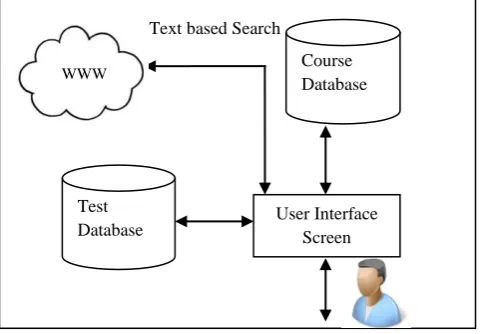
In this work, architecture of e-Learning the data mining technology through the text based search engine is used. The text based search engine is capable of retrieving computer application based databases from the www and they are clustered based on the relativeness of the document to the user search. Clustering is based on page ranking which represents the level of relativeness for the retrieved clustered documents. Document retrieval is based on the occurrence of the computer application based terminologies and keywords based on the user search text.
[image:2.595.315.556.573.740.2]Fig 1.1 Architecture of e-learning system
Text based Search
Course Database
Test
Database User Interface Screen WWW
The text based search engine is created, which is capable of extracting the documents from open source learning objects. Document retrieval is based on the occurrence of computer application based terminologies and keywords based on the user search text. The below is the algorithm for Text based Search engine used in the Architecture of e-learning system
Algorithm - Text based Search engine
Step 1: Enter Search Text
Step 2: Extract Keyword & Terminology from Text Step 3: Through Word Net extract alternate Keyword
&Terminology and store it in Relation List
Step 4: Based on Relation List, Related DOCs are extracted from OSDBs
Step 5: Extracted DOCs are stored in Temp Folder and Listed 42 by Doc Lister
Step 6: Using Doc Lister, the Organizer ranks & Cluster the DOCs Based on Rank Score
Step 7: Graph Tree will be constructed for extracted DOCs and it will be displayed to learners based on the Cluster Priority Level
3.1 IMPLEMENTING THE ARCHITECTURE OF E-LEARNING SYSTEM
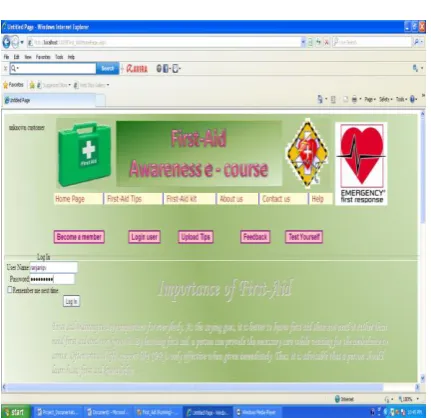
This work constructed an e-learning that enables the management and facilitation of a range of learning and teaching activities and services. E-learning can save costs and time. It helps to improve the speed and effectiveness of the educational processes, communication among learners, and also staff and students.
This learning system consists of various functional units listed below.
User Management � Content Management o Course Management
o Table of Content Management o Sub Table of Content Management o Learner’s Content Management etc � Online Test Management
[image:3.595.312.547.509.712.2]� Search � Feedback
Fig 1.2 First- Aid Awareness E-Course
4.
PERFORMANCE EVALUATION OF
E-LEARNING
Data mining-based e-learning system environment combined the pedagogical, communication and software tools integrated into one system that is used to promote learning. This helps to create an optimal knowledge building and learning environment for students.
A study has been conducted to measure the effectiveness of Data mining-based e-learning system among the students of SCSVMV University in concepts of First Aid awareness course.
The purpose of the study was twofold: (i) to measure the effectiveness of Data mining-based e-learning system (ii) To find the student effectiveness (test mark) of Data mining-based e-learning system among the students of SCSVMV University in concepts of First Aid awareness course based on their marks beforeand after the e-learning course. This paper presents how the collected data are analyzed through appropriate statistical techniques and the results of data analysis.
4.1
E-learning system – population and
sample
To find the student effectiveness (test mark) of Data mining-based e-learning system among the students of SCSVMV University in concepts of First Aid awareness course based on their marks before and after the e-learning course during November 2012 to March – 2013, the author collected samples of 304 from first year students of BE and BCA student trained through e-learning system architecture. The details given in From the above given table, the number of respondents for different courses BE(CSE), BE(EEE), BE(ECE), BE(MECH), BCA, MCA (Integrated) are 68, 58, 71, 73,3, 31 respectively.
Table 1.2 Number of respondents based on Course
Course No. of
respondents Percentage
BE(CSE) 68 22.4
BE(EEE) 58 19.1
BE(ECE) 71 23.4
BE(MECH) 73 24.0
BCA 3 1.0
MCA(INTEGRATED) 31 10.2
Total 304 100.0
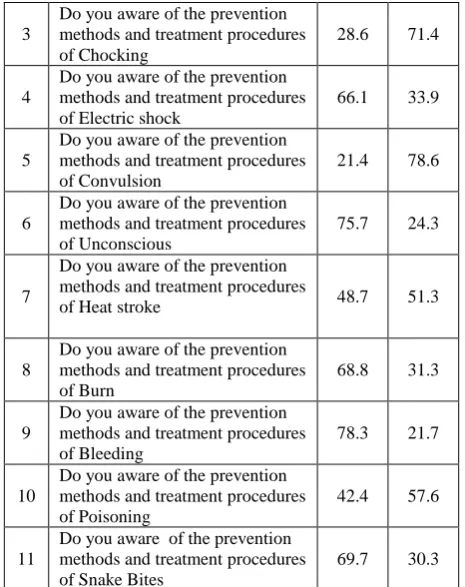
Table 1.3 Awareness of the prevention Methods before E-Learning
S. No
Awareness of the prevention
Methods before E-Learning Yes % No %
1
Do you aware of the prevention methods and treatment procedures of Diabetic
39.1 60.9
2
Do you aware of the prevention methods and treatment procedures of Heart attack
[image:3.595.60.276.529.738.2]3
Do you aware of the prevention methods and treatment procedures of Chocking
28.6 71.4
4
Do you aware of the prevention methods and treatment procedures of Electric shock
66.1 33.9
5
Do you aware of the prevention methods and treatment procedures of Convulsion
21.4 78.6
6
Do you aware of the prevention methods and treatment procedures of Unconscious
75.7 24.3
7
Do you aware of the prevention methods and treatment procedures
of Heat stroke 48.7 51.3
8
Do you aware of the prevention methods and treatment procedures of Burn
68.8 31.3
9
Do you aware of the prevention methods and treatment procedures of Bleeding
78.3 21.7
10
Do you aware of the prevention methods and treatment procedures of Poisoning
42.4 57.6
11
Do you aware of the prevention methods and treatment procedures of Snake Bites
[image:4.595.51.284.71.365.2]69.7 30.3
Fig 1.3 Awareness of the prevention methods
4.2 Hypothesis Tested
4.2.1 Research Hypothesis (H
1)There is an association between the No. of hours spent on Online for Learning based on their studying course
Null Hypothesis (H
0) [image:4.595.313.544.71.219.2]There is no association between the No. of hours spent on Online for Learning based on their studying course.
Table 1.4 No. of hours spent per week on Online based on Course
From the above table 1.4, the number of hours spent on online learning for various courses were tabulated in the following manner. BE (CSE) count was found to be 5.3% of the respondent for not using online learning, 11.5% for respondent using 1- 5 hours. 3.9% for the respondents using 6 – 10 hours, 1.6% for the respondent using 15 – 20 hours. BE (ECE) count was found to be 6.6% of the respondent for not using online learning, 9.2% for respondent using 1- 5 hours. 5.9% for the respondents using 6 – 10 hours, 1.6% for the respondent using 15 – 20 hours. BE (EEE) count was found to be 6.6 % of the respondent for not using online learning, 8.6% for respondent using 1- 5 hours. 2.6% for the respondents using 6 – 10 hours, 1.3% for the respondent using 15 – 20 hours. BE (MECH) count was found to be 6.6 % of the respondent for not using online learning, 12.2% for respondent using 1- 5 hours. 3.3% for the respondents using 6 – 10 hours, 2.0% for the respondent using 15 – 20 hours. Other courses were spent minimum hours for using online learning.
4.2.2 Research Hypothesis (H
1)There is a significant difference in the opinions of students about the effective learning through E- course based on their gender.
Null Hypothesis (H
0)There is no significant difference in the opinions of students about the effective learning through E- course based on their gender.
The independent sample T- test for the above observance table shows that there is a significant difference between the prevention methods of treatment instruction for bleeding. It is inferred that the 95% confidence interval of the difference was 0.004. Hence null hypothesis is rejected. Also there is a No of hours spent per week on
Online * Course Cross tabulation
Course Total
BE (CSE)
BE (EEE)
BE (ECE)
BE (MECH)
BCA MCA(INTEGR
ATED)
NIL Count 16 20 20 20 3 13 92
% of Total 5.3% 6.6% 6.6% 6.6% 1.0% 4.3% 30.3%
1-5 Count 35 26 28 37 0 14 140
% of Total 11.5% 8.6% 9.2% 12.2% .0% 4.6% 46.1%
6-10 Count 12 8 18 10 0 4 52
% of Total 3.9% 2.6% 5.9% 3.3% .0% 1.3% 17.1%
15-20 Count 5 4 5 6 0 0 20
% of Total 1.6% 1.3% 1.6% 2.0% .0% .0% 6.6%
Total Count 68 58 71 73 3 31 304
[image:4.595.45.535.422.566.2]significant difference between the prevention method and treatment instructions for snakebites. Since, the obtained significant value is 0.02. This is less than the fixed significant value (0.05). So that null hypothesis is rejected
4.2.3 Research Hypothesis (H
1)The awareness about first aid tips before and after E- Learning differs significantly.
Null Hypothesis (H
0)The awareness about first aid tips before and after E- Learning do not differs significantly.
The objective type test was designed to measure the student effectiveness (test mark) of Data mining-based e-learning system among the students of SCSVMV University in concepts of First Aid awareness course based on their marks beforeand after the e-learning course. The difference between the student effectiveness (test mark) of Data mining-based e-learning system among the students of SCSVMV University in concepts of First Aid awareness course based on their marks beforeand after the e-learning course on aware of the prevention methods and treatment procedures of Diabetic , Heart attack, Chocking, Electric shock, Convulsion, Heat stroke , Burn, Bleeding, Poisoning, Snake Bites. The Table 1.5 and Fig 1.4 Shows the student effectiveness Overall Pass Percentage before and after E- Learning Course in the concepts of First Aid awareness course
Table 1.5 Overall Pass Percentages before and after E- Learning Course
Course Overall Pass
Percentage Test Marks before
E- Learning Course in the concepts of First
Aid awareness course
%
Overall Pass Percentage Test Marks after
E- Learning Course in the concepts of First
Aid awareness course
%
BE(CSE) 74 92
BE(EEE) 78 91
BE(ECE) 82 93
BE(MECH) 84 96
BCA 81 93
MCA(INTEG RATED)
78 92
Fig 1.4 Overall Pass Percentages before and after E- Learning Course
[image:5.595.314.543.84.221.2]T-Test
Table 1.6 Paired Samples Statistics
Mean N Std.
Deviation Std. Error Mean Test Marks before
E- Learning 11.86 304 3.488 .200 Test Marks after E-
[image:5.595.312.541.92.344.2]Learning 17.35 304 3.270 .188
Table 1.7 Paired Samples Correlations
N Correlation Sig. Test Marks before
E-Learning & Test Marks after E- Learning
304 .619 .000
Table 1.8 Paired Samples Test
Paired Differences t D f Sig.
(2-tailed) Mean Std.
Devia tion
Std. Error Mean
95% Confidence Interval of the
Difference
Lower Upper
Test Marks before E- Learning –
Test Marks after E- Learning
[image:5.595.50.287.425.601.2]The parity test has been applied in order to understand the effectiveness of first aid awareness before and after through e-learning system. Here the level of awareness about first aid tips before and after e-learning has been taken as experimental variable. Awareness before e-learning has been considering variable x and Awareness after e-learning has been taken as variable y by applying parity test (dependent test). It is inferred that there is a significant difference exist about the possession awareness about first aid tips before undertake e-learning program.
Since the null hypothesis is rejected, the obtained significant value is 0.000. This is less than the fixed significant value (0.05). It is inform that e-learning plays a significant rule to provide awareness about health tips.
5.
CONCLUSION
The basic concepts of e-learning system have been outlined. E-learning is considered in the context of formally and systematically organized teaching and learning activities, in which the instructor and the learner(s) use ICT to facilitate their interaction and collaboration. The use of data mining based e-learning system will definitely impact the quality of the education that is delivered and the deliverability of information through knowledge and information sharing. In spite of some obstacles and limitations in the immediate implementation,. The study intends to analyze and find out the the effectiveness of data mining based e-learning system (DMBELS) among the students of SCSVMV University in concepts of First Aid awareness course. The study results show that the systematic use of Data mining based e-learning system as a part of the instructional design process has improved the quality of teaching and learning.
6.
REFERENCES
[1] Ajzen, I., & Fishbein, M. (1977). Attitude–behavior
relations: a theoretical analysis and review of empirical research. Psychological Bulletin, 84, 888–918.
[2] Arbaugh, J. B., & Duray, R. (2002). Technological and structural characteristics, student learning and satisfaction with web-based courses – An exploratory study of two on-line MBA programs. Management Learning, 33(3), 331–347.
[3] Aronen, R., & Dieressen, G. (2001). Improvement equipment reliability through e-Learning. Hydrocarbon Processing, 47–57.
[4] Bhattacherjee, A. (2001). Understanding information systems continuance: an expectation confirmation model. MIS Quarterly, 25(3), 270–351.
[5] Katz, Y. J. (2000). The comparative suitability of three ICT distance learning methodologies for college level instruction. Educational Media International, 37(1), 25– 30.
[6] Katz, Y. J. (2002). Attitudes affecting college students’ preferences for distance learning. Journal of Computer Assisted Learning, 18,2–9
[7] Lewis, C. (2002). Driving factors for e-Learning: an organizational perspective. Perspectives, 6(2), 50–54. Lin, Cathy S., Wu, S., & Tsai, R. J. (2005). Integrating perceived playfulness into expectation-confirmation model for web portal context. Information & Management, 42, 683–693.
[8] Piccoli, G., Ahmad, R., & Ives, B. (2001). Web-based virtual learning environments: a research framework and a preliminary assessment of effectiveness in basic IT skill training. MIS Quarterly, 25(4), 401–426.
[9] Wu, J. P., Tsai, R. J., Chen, C. C., & Wu, Y. C. (2006). An integrative model to predict the continuance use of electronic learning systems: hints for teaching. International Journal on E-Learning, 5(2), 287–302.
[10]Khairil Imran Ghauth and, Nor Aniza Abdullah, (2009) An Empirical Evaluation Of Learner Performance In E-Learning Recommender Systems And An Adaptive Hypermedia System, pp 141-152.
[11]Jonassen, D. H., Computers in the Classroom, Englewood Cliffs, NJ:Merrill, Keefe, J. W. (1987), in "Learning Style”.
[12]Peters, J., Jarvis, P. et al., Adult Education, San Francisco, CA, Ed Rogers, A., Teaching Adults, Buckingham: Open University Press
[13]Jemni, M., & Nasraoui, O. (2009). Automatic recommendations for e-learning personalization based on web usage mining techniques and information retrieval. Educational Technology & Society, 12(4), 30–42.
[14]Liang, G., Weining, K. & Junzhou, L. (2006). Courseware recommendation in e-learning system. Advances in Web Based Learning – ICWL2006, Springer Berlin/Heidelberg, 10-24.