Munich Personal RePEc Archive
Poverty and Inequality
Wodon, Quentin and Velez, Eduardo
World Bank
September 2001
Online at
https://mpra.ub.uni-muenchen.de/12307/
I. Introduction
While there are different estimates of poverty in Mexico, there is general agreement that poverty is widespread, and that the reduction of poverty should be a key area of focus for the new Administration. Beyond lack of income, poverty is a complex and multidimensional phenomena which affects many areas of the life of the poor. As a result, a wide range of public policies have been implemented in Mexico, as else-where, to reduce poverty and improve the well-being of the population.
It is difficult to organize into a coherent overall strategy the many policies neces-sary for the reduction of poverty. Substantial progress has been achieved over the last six years in this respect, with the Zedillo Administration relying on both broad-based social policies and targeted programs for the reduction of poverty. In the framework of that Administration (Figure 1), broad-based social expenditures are devoted to social security and healthcare, education, job training, and housing. Tar-geted programs focus on investing in the human capital of the poor, promoting income and employment opportunities for the poor, and improving the physical infrastructure of poor areas. Importantly, funding for basic education, healthcare for the population without formal coverage, and targeted poverty programs was increased in recent years, despite the fiscal discipline maintained for the budget as a whole.
This Thematic Chapter has two objectives. First, it briefly presents an alter-native framework that could be used by the new Administration to prepare its own coherent strategy for poverty reduction. Second, it provides a synthesis of eight background chapters devoted to government programs, social protection, education, health, urban labor markets, rural development, indigenous peoples, and gender.
Poverty and Inequality
This Thematic Chapter was written by Quentin T. Wodon and
Eduardo Velez with the valuable input of Marcelo Giugale
and Adolfo Brizzi.
To classify the policies which are necessary for reducing poverty, this Chapter uses the security, opportunity, and empowerment trilogy from the World Bank’s
World Development Report 2000 on poverty (Figure 2).
[image:3.612.69.368.118.284.2]• Providing security. The poor suffer from shocks induced by microeconomic events, macroeconomic events, and natural disasters. More broadly, the poor face a number of risks, from malnutrition in the first few years of life to a 86 MEXICO—A COMPREHENSIVEDEVELOPMENTAGENDA FORTHENEWERA
Figure 1. Broad-based and Targeted Policies
Social Policy
Broad Policies
(General Population)
Social Security Health Education Job Training Housing
Targeted Policies
(Extreme Poor)
Development of Human Capital
(health, nutrition, education)
Opportunities for Income
Development of Physical Capital
(basic social infrastructure)
Figure 2. An Alternative Framework for Poverty Reduction
Security
(Protection of the poor from income shocks and various risks during the life cycle through social insurance and assistance)
Opportunity
(Investments in the human capital of the poor through education and health, and reforms of urban and rural factor markets)
Empowerment
[image:3.612.82.355.431.601.2]lack of resources at an older age. Public policies can help in providing secu-rity for the poor in order to help them deal with shocks and risks. These poli-cies are discussed in the chapters devoted to government programs and social protection.
• Building opportunity.Creating better opportunities for the poor requires eco-nomic growth and policies designed to ensure that the poor participate in the growth process. The policies necessary to promote economic growth in Mex-ico are discussed in other chapters. Here, we focus on the policies that can help in ensuring that the poor and the nonpoor benefit from growth. • Human capital (health, education, and nutrition).The level and quality of
public social expenditures for health, education, and nutrition are essential elements for the government to invest in the human capital of all its peo-ple, but especially the poor, who cannot afford privately provided services. • Factor markets (urban labor markets and rural development).Pro-growth
reforms in urban and rural factor markets can help in improving earnings and employment opportunities for those who are less skilled, thereby resulting in poverty reduction.
• Promoting empowerment.Finally, institutional reforms and special attention to disadvantaged groups such as indigenous peoples are important to give a voice to the poor and take into account their own priorities. Another cross-sectoral area where reforms could be implemented relates to gender issues.
There is an implicit hierarchy in Figure 2 that is worth commenting on. Because policies designed to provide security to the poor tend to be targeted, they immedi-ately come to mind as being essential for a poverty reduction strategy. Yet, while these policies are important, they do not suffice. They represent the tip of the ice-berg, because they often help when something has gone wrong—when individuals and families are already in poverty and at serious risk. Moreover, targeted policies tend to rely on redistribution mechanisms, so that they are not the primary engine for growth, without which long-term poverty reduction cannot be achieved. To pro-mote broad-based growth, and to prevent individuals and families from falling into poverty, investments in the human capital of the poor and in reforms to enhance the functioning of factor markets are the key. While investments in human capital tend to have an impact on poverty only in the long run (for example, when healthy and better-educated children reach adulthood), factor market policies may have more immediate beneficial impacts. Finally, empowerment is necessary for enacting poli-cies for opportunity and security. Without empowerment, the poor tend to have lit-tle voice in the political economy process, and this often implies that they are not well served. Empowerment also helps in reducing discrimination, which is one cause of exclusion.
pop-ulation should be monitored over time using a battery of indicators, rather than poverty measures alone. Reducing the share of the population living in poverty or extreme poverty by, say, one-fifth, should be high on the list of targets of the new Administration. Beyond a reduction in poverty and extreme poverty, a reduction in inequality should also be a key objective, simply because people tend to assess their level of well-being not only in comparison to absolute thresholds (as measured by poverty), but also in comparison with others (as measured by inequality).
Beyond monetary indicators of well-being such as poverty and inequality, non-monetary indicators in health (malnutrition, infant mortality, etc.), education (enrollment, assistance, repetition, dropout, etc.), and basic infrastructure services (sewerage, sanitary installation, access to safe water, etc.) matter as well. In some cases, it is feasible to put a monetary value on non-monetary indicators, and this can be useful for the analysis of trade-offs between policies. For example, one can assess the income gains from education and employment, or the value of having access to basic infrastructure services such as electricity, water, and sanitary installations. Yet this will never capture the full cost or benefit of non-monetary indicators. There is an intrinsic value in being well educated or in having a good job that goes beyond the monetary income provided by education and employment. To give a less obvi-ous and more controversial example, there is an intrinsic merit in having public poli-cies that promote better access to culture and art for the poor, even if this does not bring monetary benefits. The poor are not only hungry for food—they are also hun-gry for creativity, expression, and full participation in the life of society.
Although it is difficult to define what quality services are, it is necessary to focus on delivering quality inputs and programs, and adequate definitions must include outcomes and the value added of the intervention (for example, learning gain, and increased probability of income-earning activities), and that the value added needs to be compared with the cost of the intervention. At this stage it is important for the new Administration to consider cost-effectiveness criteria as a key element to iden-tify programs. An orientation toward outcomes means that priorities in poverty pro-grams and interventions are determined through economic analysis, standard set-ting, and measurement of the attainment of standards.
Finally, it is necessary to work for maximum efficiency in the allocation and use of resources so as to improve the quality and increase the quantity of inputs to fight poverty. For this it is important to pay attention to policy environment and to insti-tutional strengthening. It is necessary to focus on the federalization process to con-solidate it and give local authorities (state, municipal, and community) the incen-tives to contribute to autonomy and accountability. This does not happens automatically, and it is necessary for the central government to help improve the local capacity by setting standards, supporting inputs known to decrease poverty, adopting flexible strategies for the acquisition and use of inputs, and monitoring performance. The possibility of increasing local and private resources for the expan-sion of some programs should also be considered, together with more involvement of civil society as part of the monitoring process at the local level.
II. Providing Security
Evaluating Government Programs
[image:6.612.56.377.200.372.2]Funding for poverty programs has increased (Figures 3 and 4). In 2000, the expen-ditures for targeted programs will reach MXP$53 billion, an increase in real terms of 20 percent since 1994. Among the MXP$53 billion devoted to targeted poverty
Figure 3. Resources Channeled to Poverty Alleviation Programs
(millions of pesos of 2000)
0 10,000 20,000 30,000 40,000 50,000 60,000
0 200,000 400,000 600,000 800,000 1,000,000 1,200,000
Spending in Poverty Programs Total Programmable Spending
Spending in Extreme Poverty Alleviation
Total Programmable Spending
1989 1990 1991 1992 1993 1994 1995 1996 1997 1998 1999 2000
Figure 4. Government Spending for Poverty Alleviation
(2000 pesos in billions)
1998 1999 2000
21.7 15.3 7.4 44.3
23.2 16.9 8.6 48.8
25.9 18.2 8.8 52.9
Human Capital Physical Capital
of Poor Areas Employment
Opportunities
[image:6.612.59.375.457.600.2]programs, MXP$26 billion are for investments in the human capital of the poor, MXP$9 billion are for income opportunities for the poor, and MXP$18 billion are for investments in the physical capital of poor areas. Together these programs repre-sent 11 percent of social spending, 6 percent of programmable spending, and 1 per-cent of GDP. Apart from targeted programs, the government is also running large job training programs (discussed below) and agricultural programs (discussed in the section on rural development), which have an impact on the poor.
Investing in Human Capital for the Poor
Human capital programs for the poor include PROGRESA, food subsidies and other programs, compensatory education programs, and basic healthcare programs.
PROGRESA. Begun in 1997, PROGRESA (MXP$9.6 billion) provides inte-grated support for education, health, and nutrition to poor households living in poor rural areas. Conditional on good attendance, the program provides upper primary and lower secondary school stipends and subsidies for school supplies. It also provides free basic healthcare, health education, a cash transfer for nutrition, and nutritional supplements for pregnant and breast-feeding women and for chil-dren under age 5. The program reaches 2.6 million families. Evaluations suggest a 22 percent decrease in morbidity for children below age 2, a 21 percent increase in female enrollment in lower secondary schools, an 18 percent increase in atten-dance at health clinics, and an increase in schooling of one year among the target population. PROGRESA is a good program with some areas for improvement as follows.
• Supply-side. By raising the demand for schooling and healthcare, PROGRESA is generating tensions on the supply side. To avoid these tensions, close coor-dination with SEP and SSA is needed, and efforts have been made in that direction (for example, the teacher-student ratio in telesecundary, a program for which the demand has increased substantially thanks to PROGRESA, has been kept constant). Still, more generally, there remains an uncertainty as to the relative impact of demand and supply-side programs on improving edu-cation and health outcomes among the rural poor.
most of the population is poor and where the population is highly marginal-ized, it may be better not to use means-testing to avoid tensions between ben-eficiaries and nonbenben-eficiaries. In some areas, the individual-based logic of PROGRESA may not mesh well with traditional communal values. At the same time, not implementing the targeting of the program in small and highly marginalized communities would imply that two families living in different areas but otherwise identical might not be treated in the same way by the pro-gram, which could generate fairness issues.
FOODPROGRAMS. The resources allocated to food subsidies remain twice as large as
those allocated to PROGRESA (MXP$16 billion). Two positive changes have been made by the Zedillo Administration. First, the share of targeted (as opposed to uni-versal) food subsidies has increased from 39 percent in 1994 to 95 percent in 2000. Second, the share of subsidies devoted to rural areas has increased from 31 percent to 76 percent, which better corresponds to the country’s distribution of poverty. Issues remain however:
• Food subsidies.Because they are means-tested, LICONSA (subsidized milk) and TORTIBONO (subsidized tortilla) have larger impacts on poverty and inequal-ity than the former universal subsidy for tortilla. Still, leakage remains high. As for DICONSA (subsidized stores in poor rural areas), few evaluation results are available, but one issue is that the stores tend not to reach the poorest areas. • DIF programs. DIF provides school breakfasts, food support for families with
small children, and community kitchens (the agency has a number of other programs, but these are not discussed here). DIF’s school breakfasts tend to be better targeted than means-tested food subsidies, and they appear to increase schooling among children aged 8 to 14. Since DIF functions in a more decen-tralized and community-based way than PROGRESA, with lower-cost inter-ventions, it would be interesting to conduct a comparative cost-benefit–impact analysis of the two programs (while this would not be easy given the fact that the programs are different, it is important to try to estab-lish comparable cost-benefit figures for alternative programs in order to facil-itate the establishment of priorities for funding).
COMPENSATORY EDUCATION. Programs such as PROGRESA and DIF’s school
PAC ANDIMSS-SOLIDARIDAD. The Programa de Ampliación de Coberturaprovides a
basic healthcare package of 13 interventions for those who do not have other health-care coverage in rural areas. Two-thirds of PAC beneficiaries are indigenous. The program is discussed in the health section of this chapter, as is IMSS-Solidaridad.
Promoting Income Opportunities for the Poor
Half the funds for income generation are devoted to the Programa de Empleo Tem-poral(PET). The rest are devoted to a large number of smaller programs. In addi-tion, PROBECAT is functioning as a safety net, even though it is not officially part of targeted programs.
PET. The program provides off-season temporary employment in poor rural areas. It is self-targeted through below-minimum-wage pay. Household data indicate that program participants do need PET more than nonparticipants in that they do not have as much access to occupations providing work all year long. Within partici-pating communities, PET participants are also poorer than nonparticipants. Yet PET does not reach the smallest and most isolated communities of the countryside.
• Evaluating impacts and assessing needs.Rough appraisal methods suggest that the cost of generating one peso in additional income for the poor through PET is 3.5 pesos, which is in line with estimates for other countries (this does not take into account the benefits from PET’s investments). A more in-depth evaluation, however, is needed to measure PET’s impact, assess the demand for the program, and evaluate the role of the various ministries involved. • Improving design.In Argentina’s Trabajar, among the projects passing a
tech-nical feasibility test, funding is allocated according to a points system, reward-ing projects which are located in poorer areas, yield larger public benefits, are sponsored by well-regarded groups (local community groups, NGOs, and municipalities), and reduce labor costs further below the minimum wage.
PROBECAT. The access of the poor to training remains both limited (less than 2 percent of those in the poorest decile get training, versus 32 percent among the rich-est decile) and costly (49 percent of those who get training in the poorrich-est decile pay for their training, versus 25 percent of the rich). PROBECAT’s objective has been to provide training and income support to the urban unemployed. But a new eval-uation of data gathered in 1994 suggests that the program increases neither wages nor the probability of employment. The program functions (rather well) more as a self-targeted safety net. Some areas still need reviewing:
• Collecting new data for an evaluation.New data should be collected for a thor-ough assessment of the program, in order to evaluate the impact of both its traditional and new modules.
• A double vocation. There may be a tension between the dual objectives of training and income supplementation. While the program need not be strong on both at the same time, it could focus on training during periods of expan-sion, and income supplementation during recessions.
OTHER PROGRAMS. Some programs for the rural poor focus on providing various
forms of employment, credit, and other support (for example, Credito a la Palabra, FONAES, Apoyos Productivasof INI, and Alianza Para el Campo). Other programs provide infrastructure and amenities for communities or for selected rural groups, such as migrants (for example, Jornaleros Agricolas and CONAZA). All these pro-grams should be evaluated.
Improving the Physical and Social Infrastructure of Poor Areas
Most of the funds in this category (at least 80 percent) are distributed through the decentralized FAIS, but there are some broader issues as well.
FAIS. Funds for new social infrastructure (for example, in education and health) are now distributed through FAIS according to a needs-based formula. This has helped the poorest states increase their share of transfers. The FAIS allocation formula could be improved at the margin, but this would not make a large difference because the various indicators on which the formula is based are highly correlated.
FAEB ANDFASSA. More problematic are the decentralized allocations for basic
education (FAEB) and health (FASSA), both of which account for three-fourths of Ramo 33’s budget. These allocations are not based on need, but on past expen-ditures and existing costs. Hence, states that are already well endowed continue to receive more funds. Without putting in jeopardy the maintenance and opera-tion of existing infrastructure, alternative ways to disburse these funds should be examined.
MANAGEMENT ISSUES. Mexico’s decentralization has taken place so rapidly that local
governments have not had time to fully adapt. Management issues remain out-standing. International experience suggests that there may be a risk with devolution, in that local levels of government may feel less favorable toward social spending than federal governments. Federal and civil society controls may help in protecting the poor, but these controls should not prevent innovation at the local level.
DISPERSION AND MIGRATION. Despite valuable initiatives to experiment with
analysis of the costs and benefits of migration for the poor, and of its policy impli-cations, is also lacking.
A priority for the next Administration should be to evaluate government inter-ventions fully, fairly, and publicly. There are two recent examples of progress toward a culture of evaluation and transparency in Mexico. The first example is PROGRESA, which has been evaluated thoroughly and for the most part publicly, with the support of international experts. The second example is the use of trans-parent poverty formulas for the allocation of FAIS decentralized funds. Beyond these two salient examples, however, other efforts at evaluating programs have been rare, and when available, have not been made public, thereby weakening the demo-cratic debate about what a poverty reduction strategy in Mexico should consist of.
Identifying Key Risks and Gaps in Coverage
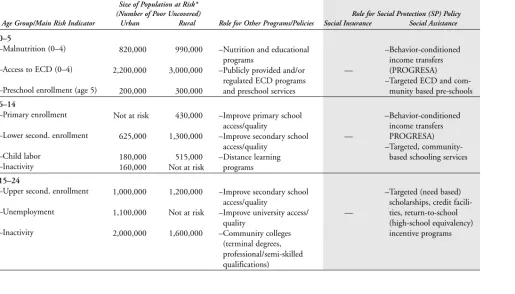
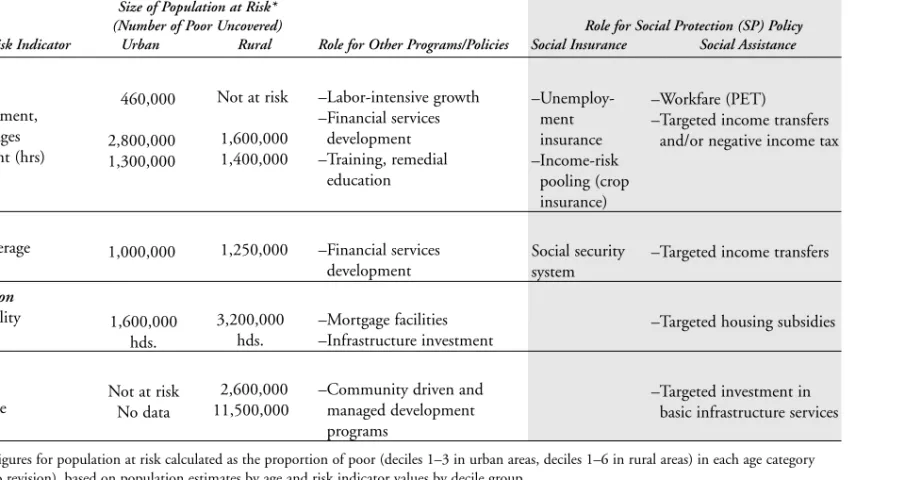
In the previous section, the policy framework of the current Administration was used to classify targeted programs for the poor. A number of alternative frameworks could be used, and one of these frameworks relies on the concepts of life cycle, social protection, and risks. The idea is to identify the key risks faced by various age groups, and to recommend best practice policies to deal with these risks. Social pro-tection interventions can then be designed to broaden access to existing social insur-ance mechanisms and to improve the impact and efficiency of social assistinsur-ance inter-ventions in favor of the poor. In the case of Mexico, the analysis yields the following risk exposure and policy options (see Table 1):
• 0-to-5-year-olds. The key risks for the poor are infant (and maternal) mortal-ity, malnutrition, and a lack of access to preschools and Early Child Develop-ment (ECD) programs. Best practice interventions include behavior-condi-tioned transfers and support for ECD services in order to expand supply and ensure affordability.
• 6-to-14-year-olds. The key risk is the pocket of low primary school attendance among the rural poor. The issue is complex since many of the children not attending school are indigenous and live in isolated communities. Programs focusing on preschools and primary schools, with a bilingual component for indigenous populations, and working through community-based education, can help. In Honduras’ PROHECO, the state transfers the funding for the program directly to the community, which is in charge of hiring the teacher. The use of houses, churches, and other buildings greatly reduces infrastructure costs. In Mexico, CONAFE’s Escuelas Comunitariasis another example. • 15-to-24-year-olds. The main risks are low secondary school enrollment
youth-at-risk programs, complemented by sectoral policies to raise education access and quality. Norms-based training to match industry needs is also an option.
• 25-to-64-year-olds.The main risks are full-time employment at below-poverty wages, underemployment (as measured by the number of hours worked), and unemployment. Best practice policy options includes social insurance (for example, unemployment insurance) and social assistance (for example, work-fare through public works such as Mexico’s PET and other targeted income-support mechanisms), combined with macro, labor market, and financial sec-tor policies promoting labor-intensive growth.
• Over 65.The main risk is low pension coverage of the elderly poor. Best prac-tice policy options include broadening social security access to include infor-mal sector workers, and combining the contributory pension system with means-tested, noncontributory income transfer for the elderly.
• General Population.The main risks are poor quality of housing and lack of access to basic infrastructure services, such as water and sewerage. Best prac-tice policy options (discussed in the chapters devoted to infrastructure) include targeted housing subsidies and programs facilitating access to credit. • Special groups.Special at-risk groups include households living in remote rural
villages (many programs do not reach these households) and indigenous peo-ples, in both urban and rural areas. One of the chapters reviewed in this The-matic Chapter is devoted to indigenous peoples.
According to data provided by the Government, a large number of programs, many of which were introduced in the past 5 years, deal with social protection issues. While the merits of each particular program warrant closer examination, an area of concern is the possible proliferation of programs of varied effectiveness and with overlapping target groups, complex administrative procedures, and cumbersome institutional arrangements. This may signal a dispersion of efforts and a reduced effectiveness of each peso spent on interventions in favor of vul-nerable groups. Again, as mentioned previously, a priority for the next Adminis-tration should be to evaluate these interventions not only fully and fairly, but also publicly.
III. Building Opportunities
96 M EXICO — A C OMPREHENSIVE D E VEL OPMENT A GENDA FOR T HE N EW E RA
Table 1. Managing Social Risk in Mexico: Main Risk Indicators, Size of At-Risk Groups, and Best Practice Policy Responses
Size of Population at Risk*
(Number of Poor Uncovered) Role for Social Protection (SP) Policy Age Group/Main Risk Indicator Urban Rural Role for Other Programs/Policies Social Insurance Social Assistance
0–5
–Malnutrition (0–4)
–Access to ECD (0–4)
–Preschool enrollment (age 5)
6–14
–Primary enrollment
–Lower second. enrollment
–Child labor –Inactivity
15–24
–Upper second. enrollment
–Unemployment –Inactivity 990,000 3,000,000 300,000 430,000 1,300,000 515,000 Not at risk
1,200,000
Not at risk
1,600,000 820,000
2,200,000
200,000
Not at risk
625,000 180,000 160,000 1,000,000 1,100,000 2,000,000
–Nutrition and educational programs
–Publicly provided and/or regulated ECD programs and preschool services
–Improve primary school access/quality
–Improve secondary school access/quality
–Distance learning programs
–Improve secondary school access/quality
–Improve university access/ quality –Community colleges (terminal degrees, professional/semi-skilled qualifications) — — — –Behavior-conditioned income transfers (PROGRESA)
–Targeted ECD and com-munity based pre-schools
–Behavior-conditioned income transfers PROGRESA) –Targeted,
community-based schooling services
I NEQ U ALIT Y 97
(Number of Poor Uncovered) Role for Social Protection (SP) Policy Age Group/Main Risk Indicator Urban Rural Role for Other Programs/Policies Social Insurance Social Assistance
25–64
–Unemployment –Full-time employment,
below poverty wages –Underemployment (hrs)
65 and Over
–Low pension coverage
•General Population
–Low housing quality
•Special Groups
–Isolated villages –Indigenous people
Note: * Preliminary figures for population at risk calculated as the proportion of poor (deciles 1–3 in urban areas, deciles 1–6 in rural areas) in each age category
uncovered (subject to revision), based on population estimates by age and risk indicator values by decile group.
Source: Social Protection Policy Chapter.
Not at risk
1,600,000 1,400,000 1,250,000 3,200,000 hds. 2,600,000 11,500,000 –Labor-intensive growth –Financial services development –Training, remedial education –Financial services development –Mortgage facilities –Infrastructure investment
–Community driven and managed development programs –Unemploy-ment insurance –Income-risk pooling (crop insurance) Social security system –Workfare (PET) –Targeted income transfers
and/or negative income tax
–Targeted income transfers
–Targeted housing subsidies
–Targeted investment in basic infrastructure services 460,000 2,800,000 1,300,000 1,000,000 1,600,000 hds.
[image:14.612.110.563.74.314.2]beyond funding, the next administration will have to address issues of overall coher-ence and sustainability in health, and issues of quality in education, in order to raise the level of human capital and contribute to poverty reduction.
Poverty reduction cannot be achieved only through targeted and social spending. Poverty reduction results first and foremost from earnings opportunities through the private use of labor and other production factors. The role of the government in labor, credit, and other markets is to ensure that they function adequately (that is, with appropriate incentives) to foster growth and help those who are less well endowed.
Health
Mexico’s past progress in health (for example, lower maternal and infant mortality, higher vaccination rates, and higher life expectancy) was achieved through the use of centralized institutions and vertical programs to control infectious diseases and increase prevention and education. Today, however, as in other middle-income coun-tries, the epidemiological profile is changing. Chronic diseases and injuries are becoming the main causes of death and disability, and the country is facing emerg-ing problems such as AIDS and the health effects of pollution. These trends will result in an increase in the demand for specialized healthcare. A better-informed pop-ulation will also be requesting higher quality services, especially in urban areas. The command-and-control approach that succeeded in reducing infectious diseases is not adapted to the new epidemiological profile. Substantive reforms are therefore needed.
Moving from Fragmentation to Integration
The pillar of Mexico’s healthcare system is a mandatory social insurance program funded out of contributions from formal sector employees, employers, and the gov-ernment. The main institutions are IMSS and ISSSTE, but PEMEX, the Distrito Fed-eral government, the police, the metro, and the armed forces also have their own sys-tems. In total, these social insurance organizations cover just over half of the population. Healthcare services for the rest of the population are provided by SSA and IMSS-Solidaridad. In theory, each institution assumes responsibility for a specific pop-ulation group. In practice, the system leads to duplication among providers and excess capacity. The fragmentation drains resources and prevents improvements in efficiency and quality. Multiple public and private institutions are operating independently, and the creation of the National Health Council has not filled the leadership vacuum. There is a need for competition and at the same time better integration.
HELPING SSA ESTABLISH A NATIONAL POLICY. SSA should lead in setting national
licensing procedures for medical and pharmaceutical activities; (g) financing and coor-dinating medical research; (h) organizing state sanitary and epidemiological services; and (i) implementing disaster relief. With states now assuming responsibility for implementing health and disease prevention, technical assistance should be provided to the states by the federal government. In addition, while SSA services have been decentralized to states, little progress has been made at the hospital level to improve efficiency, responsiveness to consumers, and quality. Hospital inefficiencies and duplicity between SSA and other public sector institutions will need to be addressed.
REFORMINGIMSS AND CREATING ANATIONALHEALTHFUND(NHF). Traditionally,
the government has both financed and operated the health system using its own facilities and physicians, instead of identifying areas of market or public failure and finding ways to address them. The vertical segmentation of health sector institutions and financing creates an inefficient risk-pooling mechanism that inhibits the devel-opment of a strong purchasing organization to provide universal access. Separating the provision of services from financing should help resource allocation be respon-sive to needs as determined by epidemiological and demographic characteristics, rather than ability to pay. To promote the participation of the private sector, the gov-ernment could increase the pooling of resources under a universal national health fund, which would purchase services from public and private managed care organi-zations. This new framework would promote greater transparency and competition between public and private providers. In the first two to five years, the NHF would operate as a virtual fund, establishing the overarching framework for financing and purchasing without consolidating financial resources for healthcare services. In the long term, the NHF could merge all mandatory health financing contributions and evolve into a national health insurance fund.
DEALING WITH THE RISKS OF REFORM. Managed care could rapidly attract 10
mil-lion people without severe financial implications for IMSS, but two issues would have to be considered with the new system:
• Cream-skimming.Financing and regulations should be designed to avoid the incentives under a capitation-based provider reimbursement system or pri-vate managed care market to “cream-skim” and offer low-quality care. Pay-ment mechanisms should allow providers to be paid on the basis of output and population covered, and stop-gap loss previsions should help guard providers against catastrophic risks, thereby reducing incentives to avoid high-risk individuals.
Ensuring Equity
Issues of coverage, capitated payment, and funding priorities must be considered.
COVERAGE IN RURAL AREAS. For the rural poor, PAC and the Programa de
Consoli-dación de la Cobertura(PCC) use mobile healthcare units to provide a basic health-care package of 13 cost-effective interventions. While PCC is a pilot project which does not operate in rural areas, PAC is now a large program. More than 65 percent of PAC beneficiaries are indigenous. PAC also promotes coordination and integra-tion at the local level of other rural programs with a health component, such as PROGRESA, Health Care for Indigenous Zones, Intersectoral Program for Peasant Workers, and Ambulatory Surgery Program. PAC and other programs have reduced the rural uncovered population from over 10 million to 0.5 million, but efforts will have to be made to take care of the remaining gap in coverage within the next few years at a cost of up to US$600 million per year.
COVERAGE IN URBAN AREAS. The IMSS reform to create new publicly subsidized
insurance schemes for the informal sector (that is, the Family Insurance and the Voluntary Insurance programs) was designed to allow those employed in the informal sector in urban areas to obtain social security coverage. Efforts to imple-ment the program should continue, within the context of a sustainable financing framework.
CAPITATED PAYMENT. In IMSS, budget decentralization introduced the
implementa-tion of a capitated budget system, dividing the country into 139 Medical Area Units. Similar efforts have been made by SSA for the allocation of resources to states under Ramo 33. The capitated budget is adjusted for risk defined by age and sex, making it necessary to improve the capitation formula to incorporate additional variables and provide a greater degree of equity in the allocation of resources based on need and cost of care. The implementation of a capitated payment in IMSS and SSA is an important step in smoothing differences in financing between regions and public institutions. The extension of the capitated financing to other public providers should provide the basis to establish the NHF, which would use homoge-neous allocation criteria to transfer funds to managed care organizations.
SUSTAINABILITY AND FUNDING PRIORITIES. The 1995 Social Security Law is expected
financing and efforts to extend access, increase efficiency, and improve the quality of healthcare services and user satisfaction.
The result of the reform process should be a model in which (a) an essential health package is accessible to all; (b) the role of government is redirected to ensure that the health sector as a whole is structured to provide cost-effective care and to guarantee the provision of public goods; (c) a universal health insurance fund receiv-ing fundreceiv-ing from all sources (government contributions, employers and employees, social security institutions) transfers these resources to regulated managed care organizations and health plans on a capitated basis, which is adjusted for risk; (d) the regulated institutions bear the risk of delivering the services, and rules are defined to resolve market failures; (e) the regulated institutions purchase services from public and private providers, which comply with minimum accreditation cri-teria and standards for service delivery; (f ) there is supervisory capacity to ensure that the services are delivered adequately and that the regulations are being complied with; (g) mechanisms are set up to ensure access to services (secondary and tertiary) beyond those defined in the essential health package; and (h) there is a voluntary market for improved quality and service through supplementary, mostly private health insurance.
Education
Except for selected poor rural areas, enrollment in primary education is nearly uni-versal, and progress is being made in ensuring that the children pursue their tion through lower secondary school. The challenges facing Mexico in using educa-tion policy as a key element for poverty reduceduca-tion and social equality are to (a) selectively expand at the initial and preschool and higher education levels; (b) improve the quality of education throughout the system; and (c) invest in the skills and education of the labor force to adapt to the rapid economic and technical changes, which demand a human resource policy that aims to create a qualified and flexible labor force that will reinforce the country’s economic competitiveness. Train-ing issues for the labor force are discussed separately. Below we focus on quality and equity.
Improving Quality
To improve quality, it will be necessary to deal with (a) teacher training; (b) the cur-riculum; (c) pedagogical supervision; (d) the school environment; and (e) time spent on task.
TEACHER TRAINING. Teaching qualifications in the classroom are progressively
teacher-centered model emphasizing memorization, to the detriment of comprehension. Mexico’s frontal model cannot respond well to diversity of age, interest, ability, and prior experience. Designed for the average student, it has not proved effective in promoting achievement. One exception to the standard model is the child-oriented, participation-based informal method developed by CONAFE.
CURRICULUM. To increase relevance and flexibility, and to take into account people’s
views on priorities, SEP has introduced topics such as sexual education in primary school, and the study of values, civic life, and ethics (Formación Cívica y Etica) in lower secondary school. Improvements in materials and textbooks for mathematics, geography, and Spanish in primary, and Spanish, biology, and physics in lower sec-ondary, have been made. Other efforts designed to improve learning achievement are the reading corner (Rincones de Lectura) and the program for writing and read-ing (Programa Nacional para el Fortalecimiento de la Lectura y la Escritura en la Edu-cación Básica). Still, more needs to be done to introduce active learning into the cur-riculum and to change the role of teachers from that of a source of knowledge and custodial controller of students to that of a facilitator. In this new role, the teacher must ensure that the students understand the instructions and do extra work. The teacher must also counsel students with problems and help all students learn through cooperative learning interaction (group work), using peer teaching to fos-tera spirit of self-reliance.
PEDAGOGICAL SUPERVISION. The lack of good teacher supervision and
administra-tive oversight result in a lack of feedback for teachers, in teacher absenteeism, and in a chasm between what the curriculum defines and what is actually taught. CONAFE’s compensatory programs have tested with some success ways to improve supervision by providing training and incentives to supervisors with the involve-ment of parents and communities. It is also necessary to use multicultural approaches in order to attend to indigenous groups, and to use the now standard education assessment being applied in most states for quality assurance. Establish-ing clearer standards (that is, standards of what students should learn at the end of various levels and modalities of education, and standards for teachers and teacher development) will be beneficial not only to monitor quality, but also to facilitate effective decentralization.
QUALITY OF THE SCHOOL ENVIRONMENT. The school environment includes, among
other things, the textbooks, the school infrastructure, the teaching material, and the experimental science facilities. Despite a good distribution system (160 million free textbooks for preschool, primary, and lower secondary education in 1999), the qual-ity of the textbooks could be improved, especially in science. Some textbooks have been revised and published in indigenous languages. But the government has kept an important role in textbook production. More competition could have a positive impact on quality.
TIME ON TASK. The actual number of days and hours per day spent by teachers in
the classroom is well below the norm in rural and poor urban areas. Out of the 810 hours a teacher is supposed to be in the classroom, less than half may actually be spent teaching in rural areas. Another issue is that too much time is spent on class-room organization and mechanical repetition with little pedagogical value.
Ensuring Equity
A number of programs are being implemented by the government to promote the access to and quality of education for the poor. The main ones are:
EARLY CHILDHOOD DEVELOPMENT. The Initial Education Program (PRODEI),
with a per capita cost of about US$50 a year, is a home-based program delivered by community educators who train parents to stimulate their children. The parents’ education is developed through periodic group meetings supplemented by home vis-its. The program promotes the physical, emotional, intellectual, and social develop-ment of infants and toddlers, and improves the school-readiness skills of children. There is empirical evidence that the program is effective in increasing returns on pri-mary education. The program also creates job opportunities for young graduates (of primary education) in poor areas. The program also increases women’s self-esteem, and provides opportunities for parents to socialize, thereby fostering community development. PRODEI coverage is limited and should be extended.
COMPENSATORY EDUCATION. These programs, operated by CONAFE, a special
agency within SEP, reach more than 4 million poor and indigenous children. The first such program was PARE. It focused on physical facilities, books and materials, teacher performance incentives, school management and supervision, and teacher training in the four poorest states. Another program, the CONAFE community schools, relies on specially trained lower secondary graduate volunteers to teach in schools built and maintained by the communities themselves, in return for scholar-ships to continue their own education. The community schools have been designed to overcome the problem of maintaining and staffing schools in remote areas where it is difficult to attract and retain teachers and where, given the small size of the com-munity, it would not be cost effective to establish regular schools. CONAFE recently launched PAREIB to support a gradual decentralization in the operation of compensatory programs, through a strengthening of the states’ institutional capac-ity and an increased participation of communities and school associations in school management. PAREIB also promotes a better quality of education and increased learning through teacher training, provision of standards for targeted schools, and national evaluation, as a tool to increase accountability at all levels.
CARRERAMAGISTERIAL. This is an innovative program promoting a voluntary “merit
schools, and better working conditions. The initiative recognizes the important con-tribution not only of teachers, but also of parents, in providing a good education to children. One component of the program is the training of teachers; another is a merit pay system in which professional staff on a voluntary basis are evaluated and rewarded with salary increases for their performance as classroom teachers, school directors, and supervisors. Although the program’s effectiveness and adequacy have yet to be assessed, some preliminary results are good. More training in active peda-gogy could be provided as part of the program.
TELESECUNDARIA. The program was created 30 years ago to respond to the needs of
rural communities where a regular lower secondary school would not be feasible. It has a single teacher who teaches all disciplines for all three grades. In the 1990s, with the introduction of satellite transmission, enrollment increased to about 1 million students in about 14,000 schools today. Lessons are delivered by means of television programs broadcast on EDUSAT, Mexico’s educational broadcast system. Research in the 1970s and more recently in the 1990s shows the cost-effectiveness of the program. Students graduating from Telesecundaria get scores in language similar to those of general lower secondary graduating students, in spite of having a more rural background. But the program is still not accessible in the smallest and most remote areas.
TRAINING AND TECHNICAL EDUCATION. The Sistema Normalizado de Competencias
Laborales (SNC) has provided an objective set of standards, similar to some that already existed in OECD countries, by which to evaluate worker skills and set cur-riculum for training programs. The Consejo de Normalización y Certificación de Competencia Laborales, which was created to oversee the process of establishing the SNC, has also ensured coherence and consistency across competency standards of different occupations by certifying agencies whose main function is to certify that workers have mastered competencies in the standards for occupational clusters.
AFFORDABILITY ISSUES. The main program ensuring affordability for the poor in
basic education is PROGRESA, as discussed earlier. Another important policy for affordability is the student loan programs for technical and especially higher educa-tion, such as the ones offered by the ICEE and by SOFE, which improve access to education, particularly for academically qualified but financially needy students. At the same time, these programs develop more effective and financially sustainable student loan institutions.
Urban Labor Markets
observed even in periods of crisis reflect the relative ease of adjusting real wages. Downward wage adjustments are also facilitated by the fact that the minimum wage is not binding—in fact, it is so low today as to be irrelevant. From a policy point of view, progress was made over the last sexenioin the reforms of both the social secu-rity and health systems. Not only were the systems put on a more secure fiscal foot-ing, but contributions were brought more in line with benefits. Still, there are long-term gains to be made by both workers and firms from increasing the flexibility of labor markets and making additional progress in aligning payroll taxes with worker benefits. This should in turn help in reducing the high level of informality.
Increasing Flexibility
While wage flexibility should remain over the medium term, numerous factors, including the fall in inflation, greater openness to trade, and the weakening of labor unions may lead in the future to more frequent labor market adjustments through unemployment. The objective of the next government should be to minimize labor market transaction costs and other barriers to more rapid quantity adjustments by firms, and to better job matches for workers. Three areas for reform stand out.
DISMANTLING EXISTING JOB SECURITY REGULATIONS AND REPLACING THE CURRENT SEVERANCE-PAY SCHEME WITH AN UNEMPLOYMENT SUPPORT SYSTEM. The absence of
any system of unemployment insurance and the lack of portability in some pension funds (particularly in the public sector) have led to an excessive emphasis on job sta-bility, very costly severance payments, a system prone to involved litigation, and inadequate protection of workers. This discourages job creation and better job matches, and it inhibits productivity growth. To avoid these problems, the govern-ment could institute a system of individualized accounts leading to a pago a todo eventothat would allow for separations for economic reasons, reduce litigation costs, encourage better voluntary job matches, and maximize incentives to find work. Clearly defined reasons for termination should be established and monitored by independent dispute resolution authorities. However, in order to protect workers who do not have other means of subsistence from more flexibility at the microeco-nomic level and more openness at the macroecomicroeco-nomic level, workfare programs such as the PET, training programs such as Probecat, and human development programs such as Progresa should be reinforced.
MODERNIZING THE INDUSTRIAL RELATIONS AND COLLECTIVE BARGAINING FRAME -WORK. The current system for collective bargaining is not flexible, is poorly suited
central-ized bargaining). The clausula de exclusión, which mandates union membership for new hires in unionized firms, and the patrón indirecto relationship, which raises transaction costs, weaken supplier linkages, and penalize small firms should both be reconsidered. Restrictions on the use of temporary or fixed-term contracts should be eliminated in favor of two-to-four-month contratos a prueba, and tem-porary contrato por tiempo determinado, in order to help firms cover increases in business demand. More generally, the government should encourage in the busi-ness community and in its own ranks the introduction of flexible job ladders and assignments, and the elimination of rigid provisions on seniority-based promotion, compensation, and training. These provisions inhibit the optimal matching of skills to job, and they impede individual performance and investment in training, since neither the employer nor the worker can fully recover the cost of those investments through higher pay and productivity, or other rewards. Finally, if the minimum wage is to have any relevance, its level should be raised, but not necessarily auto-matically indexed to inflation, in order to maintain some level of downward mobil-ity in the event of a crisis.
IMPROVING TRAINING. Survey, anecdotal, and statistical evidence suggests that there
is a growing demand for skilled labor that is not being met by the existing labor sup-ply. To deal with this mismatch, the government could modify the Ley de Capac-itaciónto relax the obligation of firms to register their training programs while main-taining the right to training. If programs such as Probecat are to contribute to a better-trained workforce, they should be thoroughly redesigned, given that the evi-dence suggests a lack of impact on wages and employment (even though the pro-gram works well as a safety net). Strictly from a poverty point of view, it is unclear whether programs such as CIMO have large benefits. The government could also consider using vouchers to allow trainees to choose among training modalities pro-vided privately and outside of the firm. Such training could be broken down into part-time modules to enable workers to remain employed. Youth training programs could also be considered, and apprenticeship contracts could be reintroduced into the legislation to facilitate the school-to-work transition, as is done in Germany and Chile (for example, Chilejoven).
Aligning Payroll Taxes and Benefits
Informal sector workers are heterogeneous. They can be classified into those who are informal out of choice, and those who would prefer to work in the formal sector. The incidence of poverty is larger in the second group. Indeed, part of those who are informal by choice do so to avoid taxes, that is, they are relatively well-off in the informal sector.
INFORMAL WORKERS BY CHOICE. Workers who choose to be informal tend to be
the formal sector), and it is motivated by the weak linkages between payroll contri-butions and subsequent benefits. When workers value a benefit less than they pay for it, they have the incentive to become informal and to remain uncovered by the social security system. To encourage these workers to join the formal sector, the pay-roll taxes must be reduced or, equivalently, the benefits for the workers from paying the taxes must be increased. In other words, the objective should be to bring explicit and implicit worker contributions in line with benefits by pursuing the reform of mandated social security contributions. On the tax side, mandated proportional contributions could be substituted with fixed-quota contributions that would enti-tle the employee to minimum benefits. The planned transition to cuota únicain the health program could also be pursued, and a competitive rate of return should be ensured for individual accounts. On the benefits side, progress should be made in raising IMSS efficiency and service quality, and in reforming INFONAVIT, whose benefits for Mexican society remain to be demonstrated.
INFORMAL SECTOR WORKERS WHO WOULD PREFER TO BE FORMAL. Roughly 30
per-cent of informal workers enter the sector involuntary, would prefer to be formal, and earn substantially less than those voluntarily in the sector. Facilitating the transition of this group to the formal sector would reduce the undesirable risks they face, and give them the protections they desire in terms of access to healthcare and other ben-efits. To this end, the cost of formality for firms should be reduced. Importantly, reducing informality among this group, which has high rates of poverty, would also facilitate the completion of the government’s transition from old-style policies, such as food subsidies, to modern, better targeted, and more efficient OECD-type poli-cies. Completely dismantling food subsidies in urban areas today would contribute to higher poverty in the absence of an alternative way to transfer resources to the informal poor. That is, the fact that many of the informal poor in urban areas are out of reach for the Government reduces the choices of policy instruments that can be used to help them.
Ensuring Equity
Rural Development*
The era of government-led agriculture is over. CONASUPO has been dismantled. Land reform has been enacted and land titling promoted. Agricultural trade restric-tions and regularestric-tions are being eliminated under NAFTA. The reforms imple-mented over the last 10 years have led to the emergence of a largely liberalized, market-oriented, and private-sector-driven rural economy. However, while the reforms were necessary to promote future growth, they have not yet reduced poverty. The reforms have neither resolved decades of structural and cultural limitations in the capacity of poor farmers to access production factors and markets, nor addressed the heterogeneity of the rural sector and its regional variations. While helping export-oriented commercial agriculture, the reforms have not prevented stagnation for small-scale producers of domestically consumed and subsistence commodities. As a result, poverty remains widespread, especially in the ejido, sector which accounts for three-quarters of Mexico’s producers.
Accompanying the Reforms
To contribute to poverty reduction, the agricultural sector will need to generate employment in both the farm and the nonfarm sectors through productivity increases and better access to markets and technology. A number of initiatives from the government could facilitate this:
• Pro-poor rural growth.The objective should be to reduce the productivity gap between the agriculture sector and other sectors by investing in technology generation and development that is better tailored to the need of smallholder poor producers (for example, those involved in nontradable commodities and coffee). This touches on a large set of issues including rural roads programs, technical assistance to promote farmer organizations and marketing coopera-tive structures, better access to capital and land markets, and the provision of matching grants for investments as a temporary measure. Mexico should also strive at pursue better access to other countries’ markets and the elimination of export subsidies in developed countries through bilateral and multilateral trade negotiations.
• Efficient markets.The objective should be to reduce the transaction costs of doing business. The government could (a) promote better-integrated price and market information systems that build on the mechanisms established by SNIM, CEA, and PROFECO; (b) develop appropriate regulatory frame-works and enforcement capacity aimed at increasing the perception by the private sector that the judicial system works (this is critical in securing trans-actions for inventory-based financing for agricultural crops, regional 108 MEXICO—A COMPREHENSIVEDEVELOPMENTAGENDA FORTHENEWERA
exchanges, weather and price insurance, nonbank financial institutions, con-tract farming, collateralization of assets, etc.); (c) facilitate the development of commodity quality standards based on industry participation and needs, and the development of food safety norms; and (d) establish clear rules with regard to the amount and timing of duty-free imports of maize and beans, including an open auction to allocate quotas efficiently.
• Less distortion through subsidies. Remaining subsidy mechanisms should be revisited with a view to their modernization to allow for an efficient and com-petitive intervention of the private sector and functioning markets. Income support subsidies are less distorting, and therefore should be preferred to price, input, or marketing support, an area where the government should refrain from intervening.
• Regional development plans.By associating urban centers and rural areas on a continuum of mutually reinforcing activities, regional development plans could help integrate agriculture with off-farm activities, production with mar-keting, productivity with welfare, and individual interest with ethnically cohe-sive populations. Regional plans could also help accompany the integration of labor markets through migration and the diversification of the rural sector. Natural resources and environmental issues, including competition for water, energy, and waste management, require that urban growth be addressed from a joint rural–urban perspective. The decentralization process should facilitate establishment of regional development plans rooted in the historic, cultural, economic, and agro-ecological characteristics of the various regions. The Regional Councils established as part of the Marginal Areas Rural Develop-ment program include public institutions, producer representatives, and municipalities, and they could serve as models for participation in regional plans.
Improving Rural Programs
Large sector interventions are implemented by SAGAR, including PROCAMPO and Alianza para el campo, and programs for irrigation, credit, and infrastructure also affect the poor.
higher local consumption, employment, and again income. It may also be due to the producers taking more risks with higher-yielding investments thanks to the security provided by the transfer. Several improvements could be brought to the program:
• Pay the transfer earlier in the crop cycle or announce the amount of payment prior to planting to facilitate the purchase of inputs and to encourage invest-ments by providing a more secure expected income; and facilitate and pro-mote the use by ejidatariosof the transfer as a collateral for loans. The possi-bility should be studied of letting farmers cash the totality (or part) of the income payment over the remaining period of entitlement (10 years) at a dis-counted rate through banks.
• Change the structure of payments to give higher payments per hectare to farmers cultivating smaller pieces of land (a large proportion of the transfers are captured by large land owners).
• Abandon the requirement to plant in order to transform PROCAMPO into a pure entitlement. This would lower the administrative cost of the annual requalification process, provide more certainty to the producers’ income stream, facilitate collateralization, and ease shifts from one activity to another.
ALIANZA PARA ELCAMPO. Alianzawas introduced in 1996 to foster agricultural
pro-ductivity through investments and the provision of support services for a wide range of agricultural subprograms (for example, ferti-irrigation, mechanization, rural equipment, pasture improvement, and kilo for kilo, which provides growers with one kilo of certified seeds for the price of one kilo of normal seeds). Alianzais decentral-ized, with administration and decisionmaking delegated to the states. One million producers participated in Alianzain 1997. So far, there is no evidence that Alianza
contributes significantly to poverty reduction, in part because poor farmers lack resources to provide the counterpart funding necessary for participation in many sub-programs, which consist of matching grants. A greater emphasis must be placed on supporting and targeting the program to low-income farmers, thereby avoiding the subsidy being captured by a few providers, deterring entry into the market and estab-lishing rents. Some steps toward improving the program would be to:
• Improve awareness of the program, with an active process of technology gen-eration and diffusion and the program’s professionalization (private service providers and counselors could accompany program beneficiaries to promote competitiveness and diversification to higher-value crops).
• Shift toward vouchers to facilitate consumer choice and support the develop-ment of private wholesale channels and retail markets for agricultural inputs and technology (allow participants to purchase inputs from local distributors rather than government-certified distributors).
• Reduce administrative complexity by having fewer, more encompassing sub-programs, with an integrated regional approach limiting overlaps (and inter-nal competition) among subprograms.
IRRIGATION PROGRAMS. The thrust of the next generation of irrigation programs
should be to support an integrated approach that improves the efficiency of water resources and promotes their sustainable management. The government should (a) increase the attention given to agricultural competitiveness and promote more effi-cient cropping patterns; (b) improve institutional efficiency through better coordi-nation among the government institutions responsible for water resources manage-ment, irrigation, and agriculture; (c) further development of water markets and decentralize water management to local users (Water Users Associations and River Basin Councils) in the context of hydrographic basins; and (d) help irrigation sys-tem improvements through matching grants with Water Users Associations defined according to a sustainable target of consumptive use.
SOCIAL AND RURAL INFRASTRUCTURE. With decentralization, municipalities are
receiving substantial federal transfers for social and rural infrastructure, with wide autonomy in the use of the funds. There is a risk of atomization in funding which may limit economies of scale. The federal government also lacks the means to eval-uate the use of the funds, and capacity is lacking in small municipalities to manage the funds. To improve the use of the funds, the federal government could provide matching grants to municipalities to reward good management, intermunicipal projects with economies of scale, and investments cofinanced by the private sector or public agencies. An institutional strengthening program should also be estab-lished with the participation of the states.
FINANCIAL SERVICES. The government should promote a level playing field among
the different actors providing financial services (commercial banks, specialized institutions, NGOs, cooperatives, cajas populares,and savings and loans). Techni-cal assistance could be developed for social groups and nonbank intermediaries. There is also a need for a revamped legal and regulatory framework to promote the enforcement of contracts and the use of nontraditional collateral, and to establish an effective supervision system that ensures compliance and promotes savings mobilization.
IV. Empowering Specific Groups
Indigenous Peoples
agrarias, and improvement in the enforcement of indigenous land rights, indigenous peoples continue to be overwhelmingly poor, and they perceive widespread and deeply rooted discrimination from mainstream society. To empower indigenous peo-ples, the government will need to help change perceptions about indigenous peoples in society at large by promoting multiculturalism and strengthening indigenous organizational structures, so that they have a stronger voice in the local and national political arena. The government will also need to find ways to better respect indige-nous values when providing social services and programs for poverty reduction.
CHANGING PERCEPTIONS IN SOCIETY. A strategy of promoting indigenous
develop-ment cannot rely only on the promotion of better access to resources and opportu-nities to earn a reasonable livelihood. It must also build a political space for indige-nous peoples to ensure their cultural survival and economic improvement, thereby building a multiethnic society in which “success” can be measured in more diverse ways than at present. Government intervention could be improved in a number of areas:
• Promoting a multiethnic society.Developing a healthy society and economy in which 10 percent of the population have different aspirations and values requires a broad view of indigenous peoples issues. Focusing on the problems of indigenous peoples does not help in assessing why solutions to poverty among indigenous groups are so difficult to identify and implement. What is required is an analysis of both the “indigenous” and “non-indigenous” sides of the equation, and initiatives involving both “indigenous” and “non-indigenous” actors in the solution. Experience in other multiethnic countries has shown that discrimination is not necessarily solved when the economic status of the discriminated group improves. To fight persistent discrimination, multiculturalism must be promoted, for example in the education system, as was done in Canada. Strong institutions are needed to do this, and it is unclear whether the National Indigenous Institute has the clout necessary to do more than just promote the integration and acculturation of indigenous peoples into the Mexican mainstream.
ensure that sectoral interventions (for example, in education and health) are better adapted to indigenous needs (CIESAS and other similar institutes could help in developing culturally sensitive curriculums). When building capacity for joint action among different indigenous communities, it is also important to recognize the long-term process required for collaboration among histori-cally isolated communities to develop in an organic manner.
ADAPTING GOVERNMENT INTERVENTIONS. Many government programs and services
do not have the desired impact among indigenous peoples because they are not adapted to their needs and preferences. This can be illustrated with education, health, poverty programs, agricultural programs, and land issues.
• Education.The government has been experimenting with a variety of bilingual and mobile education programs to target indigenous populations, including agricultural migrant laborers. Unfortunately, the evidence so far is that many of these programs are not adapted to indigenous needs and are much too cen-tralized in philosophy, control of resources, and staffing. Parents and local governments should have a larger say in how schools are run. Bilingual teach-ers should be recruited with community ovteach-ersight to ensure that they are truly committed and understand the local language. Nationally, as already men-tioned, the curriculum is still geared to an ideal Mexican mainstream cultural type. It does not routinely include multicultural material that would make education a source of societal evolution for urban and rural residents of var-ied backgrounds.
• Health.Medical services tend not to be tailored to indigenous customs and preferences, with negative results as to the demand for modern healthcare among indigenous peoples. For example, many women deliver their children at home to avoid the culturally inappropriate rules imposed in clinics and hos-pitals. Moreover, while there are health programs that support indigenous medical systems and the use of medicinal plants, there has been little system-atic effort to find ways to integrate the Western and indigenous systems into effective health services delivery systems. Some traditional practitioners are excellent (and there exists a directory of traditional practitioners by ethnic group), but there is little integration of these practitioners into the formal medical network.
commu-nities suggested that the program has improved the use of schools and clinics and increased disposable income in poor families for food and other necessi-ties. But on the downside, these subsidies have not been spent in the local economy (most cash is spent for goods purchased in the municipal seat, and they have undermined or distorted local governance structures (for example, when targeting is deficient, when no local capacity for service delivery is cre-ated, or when communal labor-sharing systems break down because nonben-eficiaries will no longer contribute free labor). A more recent and more repre-sentative survey suggests however that 40 percent of the households benefiting from PROGRESA buy their food in their own locality, and one objective of providing cash transfers through PROGRESA has precisely been the develop-ment of the local economy.
• Agricultural programs.The policy framework within which PROCAMPO was designed included the national fund for productive rural investments from SAGAR. But few indigenous communities have accessed the SAGAR pro-gram or have been able to provide the capital match for significant invest-ments, such as expanding access to irrigation, community storage or process-ing facilities, or creatprocess-ing a significant source of revolvprocess-ing funds. PROCAMPO absorbs a large share of the resources allocated to the rural sector by the gov-ernment with insufficient leverage of SAGAR and SEDESOL funds, the (sometimes considerable) flow of remittances, or other capital sources. While the program has helped farmers, the individual payments have been used in some cases to maintain unprofitable subsistence production, without opening farm households to fundamental change. For example, when the vocation of communities under subsidy is forestry instead of agriculture, there is a need for incentives that foster alternative livelihood models. Given the nature of common natural resources, most enterprises would require collective action and investment and, therefore, support for organizational capacity building at the community and regional level. Programs based on individual decision-making are ill-equipped for such tasks. There is a need for programs to better promote opportunities that are community based, such as coffee associations, forestry enterprises, organic agriculture, tourism enterprises, marketing of
artesanía, and cultural-heritage-based employment generation.