Munich Personal RePEc Archive
Backtesting VaR Models: A wo-Stage
Procedure
Angelidis, Timotheos and Degiannakis, Stavros
Department of Economics, University of Peloponnese, Department
of Statistics, Athens University of Economics and Business
2007
Online at
https://mpra.ub.uni-muenchen.de/80418/
Backtesting VaR Models: A
Τwo
-Stage Procedure
Timotheos Angelidis, Department of Economics, University of Peloponnese
Stavros Degiannakis, Department of Statistics, Athens University of Economics and Business
Abstract
Academics and practitioners have extensively studied Value-at-Risk (VaR) to propose a
unique risk management technique that generates accurate VaR estimations for long and short
trading positions. However, they have not succeeded yet as the developed testing frameworks have
not been widely accepted. A two-stage backtesting procedure is proposed in order a model that not
only forecasts VaR but also predicts the loss beyond VaR to be selected. Numerous conditional
volatility models that capture the main characteristics of asset returns (asymmetric and leptokurtic
unconditional distribution of returns, power transformation and fractional integration of the
conditional variance) under four distributional assumptions (normal, GED, Student-t, and skewed
Student-t) have been estimated to find the best model for three financial markets (US stock, gold and
dollar-pound exchange rate markets), long and short trading positions, and two confidence levels. By
following this procedure, the risk manager can significantly reduce the number of competing models.
Keywords: Backtesting, Value-at-Risk, Expected Shortfall, Volatility Forecasting, Arch Models.
1. Introduction
The need of major financial institutions to measure their risk started in 1970s after an increase
in financial instability. Baumol (1963) first attempted to estimate the risk that financial institutions
faced. He proposed a measure based on standard deviation adjusted to a confidence level parameter that reflects the user’s attitude to risk. However, this measure is not different from the widely known Value-at-Risk (VaR), which refers to a portfolio's worst outcome that is likely to occur at a given
confidence level. According to the proposal of Basle Committee, the VaR methodology can be used
by financial institutions to calculate capital charges in respect of their financial risk and, hence,
academics and practitioners were triggered to find the best-performing risk management technique.
However, even now, the results are conflicting and confusing.
Giot and Laurent (2003a) calculated VaR for long and short equity trading positions and
proposed the APARCHi model with skewed Student-t conditionally distributed innovations (APARCH-skT) as it had the best overall performance in terms of the proportion of failure test. In a
similar study, Giot and Laurent (2003b) suggested the same model to the risk managers, even if a
simpler model (ARCH-skT) generated accurate VaR forecasts. Huang and Lin (2004) argued that for
the Taiwan Stock Index Futures, the APARCH model under the normal (Student-t) distribution must
be used by risk managers at the lower (higher) confidence level.
Although the APARCH model comprises several volatility specifications, its superiority has not been proved by all researchers. Angelidis and Degiannakis (2005) opined that “a risk manager must employ different volatility techniques in order to forecast accurately VaR for long and short trading positions”, whereas Angelidis et al. (2004) argued that “the Arch structure that produces the most accurate VaR forecasts is different for every portfolio”. Furthermore, Guermat and Harris
(2002) applied an exponentially weighted likelihood model in three equity portfolios (US, UK, and
Japan) and proved its superiority to the GARCH model under the normal and the Student-t
distributions in terms of two backtesting measures (unconditional and conditional coverage).
Moreover, Degiannakis (2004) studied the forecasting performance of various risk models to
estimate the one-day-ahead realized volatility and the daily VaR. He proposed the fractional
integrated APARCH model with skewed Student-t conditionally distributed innovations
(FIAPARCH-skT) that efficiently captures the main characteristics of the empirical distribution.
Focusing only on VaR forecasts, So and Yu (2006) argued, on the other hand, that it was more
important to model the fat tailed underlying distribution than the fractional integration of the
volatility process. The two papers, one by Degiannakis (2004) and the other by So and Yu (2006),
among many others, highlight that different volatility techniques must be applied for different
Contrary to the contention of the previous authors that the most flexible models generate the
most accurate VaR forecasts, Brooks and Persand (2003) pointed out that the simplest ones, such as
the historical average of the variance or the autoregressive volatility model, achieve an appropriate
out-of-sample coverage rate. Similarly, Bams et al. (2005) argued that complex (simple) tail models
often lead to overestimation (underestimation) of VaR.
VaR, however, has been criticized on two grounds. On the one hand, Taleb (1997) and Hoppe
(1999) argued that the underlying statistical assumptions are violated because they could not capture
many features of the financial markets (e.g. intelligent agents). Under the same framework, many
researchers (see for example Beder, 1995 and Angelidis et al., 2004) showed that different risk
management techniques produced different VaR forecasts and therefore, these risk estimates might
be imprecise.
On the other hand, even if VaR is useful for financial institutions to understand the risk they
face, it is now widely believed that VaR is not the best risk measure. Artzner et al. (1997, 1999)
showed that it is not necessarily sub-additive, i.e., the VaR of a portfolio may be greater than the sum
of individual VaRs and therefore, managing risk by using it may fail to automatically stimulate
diversification. Moreover, it does not indicate the size of the potential loss, given that this loss
exceeds VaR. To remedy these shortcomings, Delbaen (2002) and Artzner et al. (1997) introduced
the Expected Shortfall (ES), which equals the expected value of the loss, given that a VaR violation
occurred. Furthermore, Basak and Shapiro (2001) suggested an alternative risk management
procedure, namely limited expected losses based risk management (LEL-RM), that focuses on the
expected loss also when (and if) losses occur. They substantiated that the proposed procedure
generates losses lower than what VaR-based risk management techniques generate.
ES is the most attractive coherent riskii measure and has been studied by many authors (see Acerbi et al. 2001; Acerbi, 2002; and Inui and Kijima, 2005). Yamai and Yoshiba (2005) compared
the two measures—VaR and ES—and argued that VaR is not reliable during market turmoil as it can
mislead investors, whereas ES can be a better choice overall. However, they pointed out that gains on
efficient management by using the ES measure are substantial whenever its estimation is accurate. In
other cases, they advise the market practitioners to combine the two measures.
The study sheds light on the issue of volatility forecasting under risk management
environment and on the evaluation procedure of various risk models. It compares the performances
of the most well known risk management techniques for different markets (stock exchanges,
commodities, and exchange rates) and trading positions. Specifically, it estimates the VaR and the
ES by using 11 ARCH volatility specifications under four distributional assumptions, namely
following a two-stage backtesting procedure to assess the forecasting power of each volatility
technique and to select one model for each financial market. In the first stage, to test the statistical
accuracy of the models in the VaR context, we examined whether the average number of violations is
statistically equal to the expected one and whether these violations are independently distributed. In
the second stage, we employed standard forecast evaluation methods by comparing the returns of a
portfolio with the ES, whenever a violation occurs.
The results of this paper are important for many reasons. VaR summarizes the risk exposure
of an investor in just one number, and therefore portfolio managers can interpret it quite easilyiii. Yet, it is not the most attractive risk measure. On the other hand, the use of ES in evaluating the risk
models can be rewarding. Currently, however, most researchers judge the models only by calculating
the average number of violations. Moreover, even if the risk managers hold both long and short
trading positions to hedge their portfolios, most of the research has been applied only on long
positions. Therefore, it is interesting in investigating if a model can capture the characteristics of both
tails simultaneously.
This study, to best of our knowledge, is the first that estimates VaR and ESiv for three different markets simultaneously and therefore, we can infer if these markets share common features
in risk management framework. Therefore, we combined the most well-known and concurrent
parametric models with four distributional assumptions to find out which model has the best overall
performance. Even though we did not include all ARCH specifications available in the literature, we
estimated the models that captured the most important characteristics of the financial time series and
those that were already used or were extensions of specifications that were implemented in similar
studies. Finally, we employed a two-stage procedure to investigate the forecasting power of each
volatility technique and to guide on VaR model selection process. Following this procedure, the
selected risk model predicts VaR accurately and minimizes, if a VaR violation occurs, the difference
between the realized and the expected loss. In contrast to this, earlier research focused mainly on the
unconditional and conditional coverage of the models.
To summarize, this study juxtaposes the performance of the most well-known parametric
techniques, and shows that for each financial market, there is a small set of models that accurately
estimate VaR for both long and short trading positions and two confidence levels. Moreover,
contrary to the findings of the previous research, the more flexible models do not necessarily
generate the most accurate risk forecasts, as a simpler specification can be selected regarding two
dimensions: (a) distributional assumption and (b) volatility specification. For distributional
specifications perform better than symmetric ones, and in most cases, fractional integrated
parameterization of volatility process is necessary.
The rest of the paper is organized as follows: Section 2 describes the ARCH models and
presents the calculation of VaR and ES, whereas section 3 describes the evaluation framework of
VaR and ES forecasts. Section 4 presents preliminary statistics for the dataset, explains the
estimation procedure, and presents the results of the empirical investigation. Section 5 presents the
conclusions.
2. ARCH Volatility Models
To fix notation, let
t t
Tt Tt
t p p
y 0 ln 1 0 refer to the continuously compounded return
series, where pt is the closing price at trading day t. The return series follows the stochastic
process:
, ; 1 , 0 ~ 1 1 2 . . . 1 1 1 0 t t t t d i i t t t t t t t t t I g z V z E f z z y c c c y (1)where E
yt |It1
t
denotes the conditional mean, given the information set available at time1
t , It1,
T t t 0
is the innovation process with unconditional variance V
t 2 and conditionalvariance
2
1| t t t I
V , f
. is the density function of
zt tT0, g
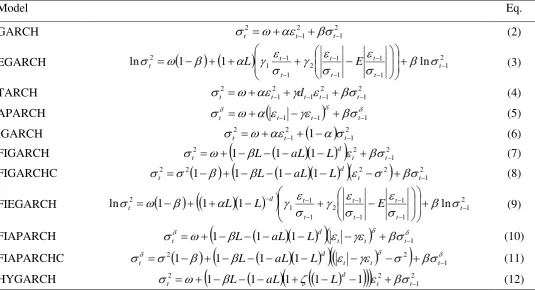
. is any of the functionalforms presented in Table 1 and is the vector of the unknown parameters. [Insert Table 1 about here]
We take into consideration the following conditional volatility specifications: GARCH
p,qof Bollerslev (1986), EGARCH
p,q of Nelson (1991), TARCH
p,q of Glosten et al. (1993),APARCH
p,q of Ding et al. (1993), IGARCH
p,q of Engle and Bollerslev (1986),FIGARCH
p,q of Baillie et al. (1996), FIGARCHC
p,q of Chung (1999), FIEGARCH
p,q ofBollerslev and Mikkelsen (1996), FIAPARCH
p,q of Tse (1998), FIAPARCHC
p,q of Chung(1999), and HYGARCH
p,q of Davidson (2004). To summarize, the selected volatility modelsinclude, besides others, the simplest GARCH model as also the most complex ones, such as
FIAPARCHC and HYGARCH. All the selected models reflect the most recent developments in
Similarly, the chosen density functions of
zt Tt0 are widely applied in finance. In seminalEngle’s (1982) paper, the standard normal density function was used:
22
2
1 zt
t e
z
f
. (13)
However, as the empirical distribution of financial assets is fat-tailed, Bollerslev (1987) introduced
the Student-t distribution:
2 1 2 2 1 2 2 2 1 ; v t t v z v v v v z f , (14)
where
. is the gamma function. As v tends to infinity, the Student-t tends to the normaldistribution. Since Student-t is not the only fat tailed distribution available, we also considered the
generalized error distribution (GED), which is more flexible than the Student-t as it can include both
fat and thin tailed distributions. It was introduced by Subbotin (1923) and applied in ARCH
framework by Nelson (1991). Its density function is given in the following equation:
1 1 1 2 5 . 0 exp , ; v z v v z f v v t t , (15)
where 2
1 13
2
v v
and v0 are the tail-thickness parameters (i.e. for v2, zt is
standard normally distributed and for v2, the distribution of zt has thicker tails than the normal
distribution). Finally, given that both the long and short trading positions are important, the skewed
Student-t distributionvi is also applied:
, 2 1 2 2 2 2 1 , ; 2 1 1 v d t t t g v m sz g g s v v v g v z f (16)where g is the asymmetry parameter, v2 denotes the degrees of freedom of the distribution,
.is the gamma function, dt 1 if zt m/s, and dt 1 otherwise. 1
2 2
2
m g g
s and
1
1
2 2
2
1
v v v g g
m are the standard deviation and the mean, respectively.
Having estimated the vector of the unknown parameters, it is straightforward to calculate
VaR using the following equation:
t tt t
t t
t F a
VaR1| 1| ; 1| , (17)
where t1|t and t1|t are the conditional forecasts of the mean and the standard deviation at time
1
t , given the information at time t, and
t
a
F ; is the th
a quantile of the assumed distribution,
As we have already mentioned, ES is defined as the conditional expected loss, given a VaR
violation. Specifically, for long trading positions, it is calculated as
t t t t
t
t E y y VaR
ES 1| 1| 1 1| . (18)
In particular, ES is a probability-weighted average of tail loss and therefore, to calculate it, we follow Dowd (2002) who suggested that for any distributional assumption “slice the tail into a large number of slices, each of which has the same probability mass, estimate the VaR associated with each slice and take the ES as the average of these VaRs”. To implement this approach, we set 5000 to increase the accuracy.
3. Evaluate VaR and ES Forecasts
Having presented various risk management techniques, we now discuss their formal
statistical evaluation. Given that VaR is never observed, not even after violation, we have to first
calculate it and then rank the risk models by examining the statistical properties of the forecasts.
Specifically, in the first stage, a model is deemed adequate only if it has not been rejected by both the
unconditional and the independence hypotheses. The first hypothesis examines if the average number
of violations is statistically equal to the excepted one and the second hypothesis if these violations
are independent. However, risk managers who use these tests cannot rank the adequate models,
because a model with greater p-value is not superior to its competitors and, hence, cannot be the
best-performing model.
We extended the forecast evaluation approach of Lopez (1999) and Sarma et al. (2003) as
the ES was introduced in the second stage by creating a loss function that calculated the difference
between the actual and the expected loss when a violation occurred. For all the best-performing
models of the first stage, we implemented Hansen’s (2005) superior predictive ability (SPA) test to
evaluate their differences statistically. As Yamai and Yoshiba (2005) pointed out, the two risk
measures must be combined and hence, under the proposed backtesting framework, the selected
models not only calculate VaR accurately but also minimize the difference between the actual loss
and the ES.
3.1. First Stage Evaluation
The most widely used test, developed by Kupiec (1995), examines whether the observed
exception rate is statistically equal to the expected one. Under the null hypothesis that the model is
21 ~ ~ ~ -1 2ln -~ ~ 1 ln 2 X T N T N
LR T N N
N N T
uc
, (19)
where N is the number of days over a period T~ that a violation occurred and is the desired
coverage rate. Therefore, the risk model is rejected if it generates too many or too few violations, but
based on it, the risk manager can accept a model that generates dependent exceptions.
Christofersen (1998) proposed a more elaborate criterion, which simultaneously examines if
(i) the total number of failures is equal to the excepted one and (ii) the VaR failure process is
independently distributed. The appropriate likelihood ratio test of the first hypothesis is given by
equation (19) and that of the second one by the following equation:
21 0 0 11 11 01
01 1- -ln 1- ~
-1 ln
2 00 01 10 11 00 10 01 11
X
LRin n n n n n n n n , (20)
where nij is the number of observations with value i followed by j, for i,j 0,1 and
j ij ij ij n n are the corresponding probabilities. i,j1 denotes that a violation has been made, whereas i,j 0
indicates the opposite, which implies that the process of VaR failures must be spread over the entire
samplevii. The main advantage of using these two tests is that the risk managers can reject a VaR model that generates too few or too many clustered violations and thereby identify the reason for its
failure. However, they cannot rank the models based only on the p-values of these tests.
3.2. Second Stage Evaluation
The statistical adequacy of the VaR forecasts is obtained by the previous backtesting tests:
the unconditional coverage (equation 19) and the independence test (equation 20). If a model is not
rejected, it forecasts VaR accurately. However, in most cases, more than one model can be deemed
as adequate and hence, the risk manager cannot select a unique risk management technique.
To overcome this shortcoming of the backtesting measures, Lopez (1999) proposed a
forecast evaluation framework based on a loss function. The loss function enables the researcher to
rank the models and specify a utility function that accommodates the specific concerns of the risk
manager. Specifically, he suggested the following loss function:
else, 0 occurs violation if1 1| 1 2
which accounts for the magnitude of the tail losses
VaRt1|t yt1
2
and adds a score of onewhenever a violation is observed. The model that minimizes the total loss
T t t 1
, is preferred to
other models.
Nevertheless, his approach has two drawbacks. First, if the risk management techniques are
not filtered by the aforementioned unconditional or conditional coverage procedures, a model that
does not generate any violation is deemed as the most adequate as t1 0. Second, the return, yt1,
should be better compared with the ES measure and not with the VaR, as VaR does not give any
indication about the size of the expected loss. Therefore, with these limitations in mind, in order to
judge the models in the second stage, we computed for each model i the mean absolute error
(MAE),
T
t i t T ~ 1 , 1 1 ~
, and the mean squared error (MSE),
T
t i t T ~ 1 , 2 1 ~ , where: else, 0 occurs violation if | 1 1 1 , 1 i t t t i t ES y (22) and
else. 0 occurs violation if 2 | 1 1 1 , 2 i t t t i t ES y (23)According to the two-stage backtesting procedure, the best performing model will (i)
calculate VaR accurately, as it will satisfy the prerequisite of correct unconditional and conditional
coverage and (ii) forecast the expected loss, given a VaR violation, as it minimizes the total loss
value,
T t i t l ~ 1 , .
The statistical significance of the volatility forecasts is investigated by using Hansen’s (2005)
Superior Predictive Ability (SPA) test. For i t l i t l i i t l
X ,, , , , the null hypothesis, that the
benchmark model *
i is not outperformed by competing models i, for i1,...,M, is investigated
against the alternative hypothesis that the benchmark model is inferior to one or more of the
competing models. The null hypothesis,
. . . ,
0, 1 , , * * M i t l i t l X X
E , is tested with the statistic
li
i l M i SPA l X M Var X M T , , ,..., 1 max
, where
T t i i t l i
l T X
X ~ 1 , , 1 , ~
. The estimation of Var
MXl,i
and the p-values of the SPA l
T statistic are obtained by using the stationary bootstrap of Politis and Romano
Under the proposed backtesting environment, the risk manager achieves three goals: forecasts
VaR accurately and thus satisfies the prerequisites of the Basel Committee for Banking Supervision;
selects one model or a family of models among various candidates following a statistical inference
procedure; and finally knows in advance the amount that may be needed if a VaR violation occurs,
and therefore is better prepared to face the future losses by forecasting ES accurately. The next figure
briefly demonstrates the two-stage backtesting procedure. In the first stage, the investor can work
with fewer than the available models by applying the two tests (equations 19 and 20). In the next
stage, according to the developed loss functions (equations 22 and 23), the ES measure is used to
evaluate statistically the best-performing models.
4. Empirical Analysis
To evaluate all the available volatility models, we generated out-of-sample VaR and ES
forecasts for S&P500 equity index, Gold Bullion $ per Troy Ounce commodity and US dollar/British
[image:11.595.161.438.257.387.2]pound exchange rate, obtained from Datastream for the period April 4th 1988 to April 5th 2005. The daily prices, the log-returns, and the autocorrelations for the absolute log-returns are presented in
Figure 1. Volatility clustering is clearly visible and suggests the presence of heteroskedasticity. The
absolute log-returns are significantly positive serial autocorrelated over long lags, whereas the
sample autocorrelations decrease too fast at the first lags; at higher lags however, the decrease
becomes slower, indicating the long-memory property of volatility process and the need to use
fractionally integrated volatility specifications.
[Insert Figure 1 about here]
In the conditional volatility specifications, we choose to set pq1, given that in the
majority of empirical volatility forecasting studies, the order of one lag has proven to work
effectively. Based on a T3000 rolling sample, we generated T~1435viii out-of-sample forecasts (the parameters are re-estimated each trading day) to calculate the 95% and 99% VaR and ES values
for long and short trading positions. The parameters of the models were estimated using the G@RCH
[Insert Table 2 about here]
[Insert Table 3 about here]
[Insert Table 4 about here]
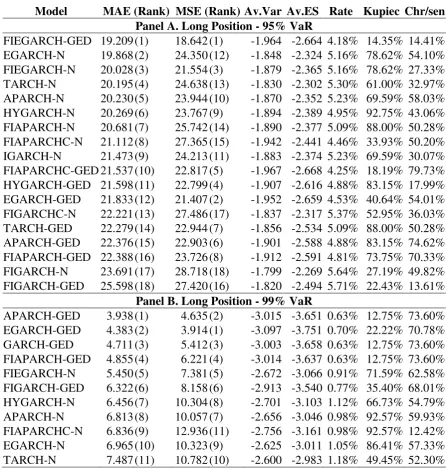
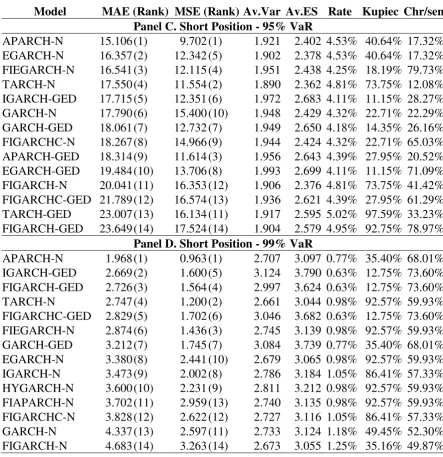
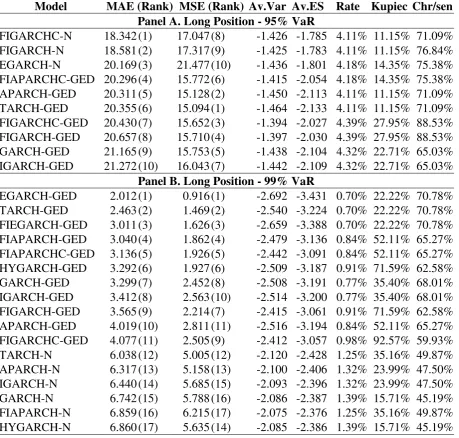
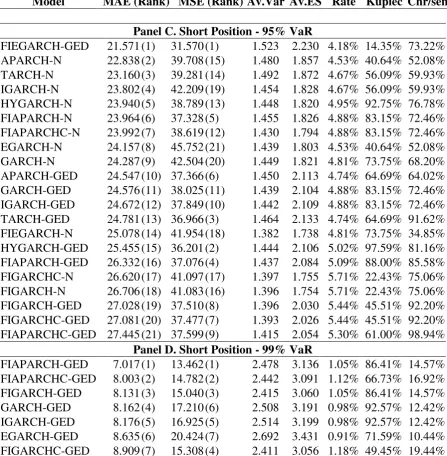
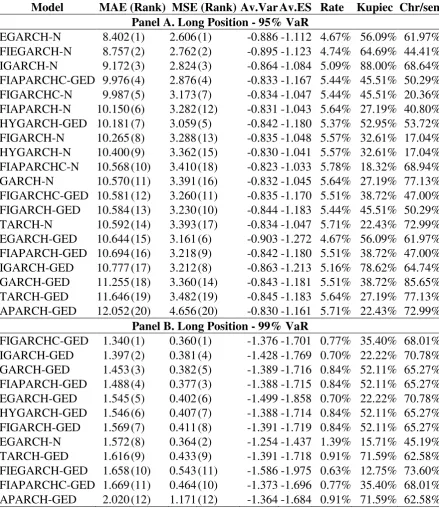
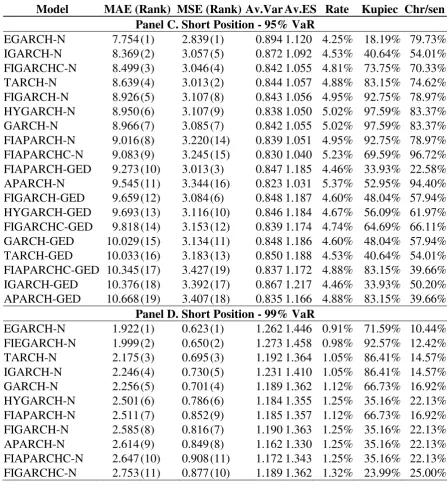
The MAE and MSE (equations 22 and 23), the average values of VaR and ES, the exception
rates, and the p-values of the two backtesting measures are presented in Tables 2 to 4 for all the
models that survived the first evaluation (equations 19 and 20)ix.
Irrespective of the volatility models and the financial assets, ARCH specifications under the
Student-t distribution and its corresponding skewed version overestimate VaR at both confidence
levels. A similar observation was made in several earlier studies (see Guermat and Harris, 2002 and
Billio and Pelizzon, 2000 among others). Even at a 99% confidence level, they did not show any
major improvement, as the average realized exception rates were significantly lower than the
expected ones. The introduction of the asymmetry parameter
g in the underlying distribution didnot make any significant difference. In most cases, they were overestimated, mainly because ln
gwas close to zero and therefore, the two distributions in the VaR context, were similarx.
For each financial asset appears to be a different model that forecasts VaR accurately. So and
Yu (2006) favored different models for stock indexes and exchange rates. Specifically, for stock
indexes, they favored an asymmetric specification and for exchange rates, a symmetric function was
preferred.
In our dataset and for the S&P500 index, five models (FIEGARCH-N, EGARCH-N,
APARCH-N, TARCH-N, and FIGARCH-GED) generate adequate VaR forecasts, as the p-values of
the backtesting measures are greater than 10% for both confidence levels and both trading positions.
Even if the more complex models generate, in some cases, the most accurate VaR forecasts (i.e.
FIEGARCH-GED for 95% confidence level and long trading position), they do not give the best
overall performance. This finding is in line with that of Brooks and Persand (2003) but not with the
argument of Mittnik and Paolella (2000) that more general ARCH structures are needed.
Highlighting this conclusion is the observation that the IGARCH-GED model generates exception
rates that are close to the expected ones only for the short trading positions, whereas it is rejected for
the long trading positions, because either the model generates clustered violations or the model
misestimates the true VaR. As far as the underlying distribution is concerned, there are indications
that standard normal is the best overall choice, as four out of five models are normally distributed.
The GED and normal distribution are the best overall choices for Gold. Between the two,
GED is considered more appropriate for the commodity market. For example, if the risk manager is
interested only in the higher confidence level and for short trading positions, he/she should use the
models (GARCH-GED, IGARCH-GED, FIAGARCH-GED, FIAGARCHC-GED, and
FIAPARCHC-GED) generated accurate predictions for both confidence levels and both trading
positions. The risk manager can select any of these models, irrespective of the trading position, and,
hence, satisfy the requirements of the Basel Committee.
For $/£ exchange rate, the choice of the most appropriate distribution is not straightforward,
even if the Student-t and skewed Student-t distributions are rejected. For long (short) trading position
and at 99% confidence level, the best overall distribution is the GED (normal), whereas for the other
two cases, the results are mixed. EGARCH under the normal distribution appears to have the best
overall performance, as only this model generates adequate VaR forecasts for long and short trading
positions and for both confidence levels. At the lower confidence level and for long (short) trading
position, the exception rate of the model equals to 4.67% (4.25%), whereas the corresponding rates at
the higher confidence level are 1.39% (0.91%). Furthermore, according to the two loss functions, the
EGARCH under the normal distribution model is always ranked first except for the higher
confidence level and the long trading position. Therefore, it is plausible to consider this model as the
most appropriate, as it forecasts VaR accurately for the two trading positions and confidence levels.
Τhe difference among the VaR models cannot be evaluated statistically as neither the greatest
p-value of the backtesting criteria nor the lowest value of the loss functions indicates the superiority
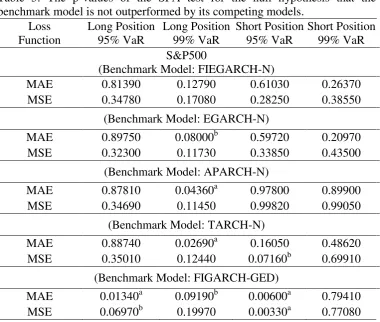
of a model. Therefore, to evaluate the reported differences statistically, we implemented the SPA test
taking the following as benchmark models: FIEGARCH-N, EGARCH-N, APARCH-N, TARCH-N,
and FIGARCH-GED for S&P500, GARCH-GED, IGARCH-GED, FIGARCH-GED,
FIGARCHC-GED, and FIAPARCHC-GED for Gold and EGARCH-N for US dollar to British pound. These
models predicted VaR accurately for all cases (long and short trading positions, and at 95% and 99%
confidence levels).
[Insert Table 5 about here]
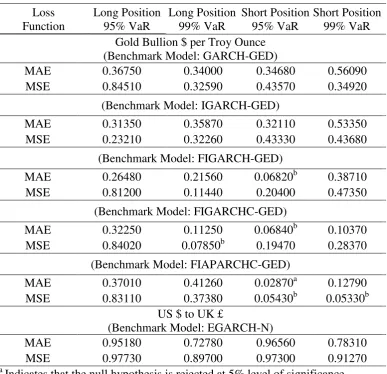
Table 5 presents the p-values of the SPA test for the null hypothesis that the benchmark
model *
i is not outperformed by its competing models. For example, in S&P500 index, the
benchmark model (FIEGARCH-N) has superior forecasting ability, as the p-value of the test is
greater than 10% in any case. All other benchmark models are outperformed, at least in one case, and
therefore, there are indications that among the various candidate techniques only one survived the
proposed evaluation framework. In the case of Gold, the GARCH-GED and the IGARCH-GED
models are not outperformed by their competitors, whereas at least for 95% confidence level and
short trading position, FIGARCH-GED, FIGARCHC-GED, and FIAPARCHC-GED models do not
generate significantly better forecasts. Finally, for the US $ to UK £ exchange rate, the forecasting
evaluation of the models is robust to the choice of the used loss function, because irrespective of the
measurement method, we select the same models as the most appropriates
According to the two-stage backtesting procedure, the risk manager has two choices: (a) to
select one model for each trading position and each confidence level from those models that have not
been rejected by the backtesting measures and (b) to use the model that forecasts VaR accurately for
both trading positions and both confidence levels. Naturally, the second choice is better, because it
reduces the complexity and computational costs. Consequently, the researcher focuses only on one
model for each financial asset. Moreover, by employing the two-stage backtesting procedure, the
researcher evaluates statistically the differences between the models, and selects, in most cases, only
one volatility specification.
In summary, only some models can forecast VaR accurately in all cases. Specifically, in the
case of S&P500 index, the FIEGARCH-N generates adequate forecasts for both confidence levels
and both trading positions, whereas in the case of Gold, two models (GARCH-GED and
IGARCH-GED) give the best overall performance. Lastly, for the US $ to UK £ exchange rate, EGARCH-N is
considered the best specification.
5. Conclusions
The performance of the most recently developed risk management techniques is examined.
The paper proposes a two-step backtesting procedure where in the first step all the models, which are
rejected by univariate VaR backtests, are discarded, whereas, in the second step a multivariate
superior predictive ability test is run taking as a benchmark model each of the models which were not
rejected in the first step for any of 95% long/short and 99% long/short VaRs. Specifically, for
S&P500 equity index, Gold commodity and US $ to UK £ exchange rate, the VaR and ES were
computed for two confidence levels (95% and 99%) and for two trading positions. We investigated
whether the models forecast accurately the expected number of violations, generate independent
violations, and predict the ES. As Hansen (2005) rightly suggested, a filtering procedure must be
accounted for the full data exploration, before a legitimate statement of the statistical differences
among the candidate models. The reduction of the under consideration models was achieved because
the evaluation was made in two stages. In the first stage, the framework developed by Kupiec (1995)
and Christofersen (1998) was implemented and in the second, the SPA hypothesis testing was
applied.
As multiple risk management techniques exhibit unconditional and conditional coverage, the
utility function of risk management must be brought into picture to evaluate statistically the
VaR violation, we introduce the ES to the loss function. According to the SPA test, the risk manager
can select, for each financial asset, a model that forecasts both the risk measures accurately.
Therefore, the number of under consideration techniques is reduced to a smaller set of competing
models.
Different volatility models achieve accurate VaR and ES forecasts for each dataset. In
summary, the proposed models are the following:
Market Model
S&P500 FIEGARCH-N
Gold Bullion $ per Troy Ounce GARCH-GED/ IGARCH-GED US dollar / British pound EGARCH-N
Although the most appropriate conditional volatility models are not the same for the three financial
assets, they share some common characteristics. The normal distribution is often a better choice than
more highly parameterized distributions. The Student-t and skewed Student-t distributions
overestimate the true VaR. Asymmetry in volatility specification is inevitable, as all the selected
models incorporate some form of asymmetry, whereas fractional integration is also important in
forecasting VaR and ES. This is potentially important as the normal is more parsimonious than the
other distributions and so this finding suggests that risk managers may be able to focus less on the
appropriate distributional assumptions and more on the appropriate functional form or degree of
long-memory. These findings are interesting in their own right and important for risk management as
they help to narrow the field of empirically relevant VaR models.
Acknowledgement
We would like to thank Peter R. Hansen for the availability of his program codes.
References
Acerbi, C. (2002). Spectral Measures of Risk: A Coherent Representation of Subjective Risk
Aversion. Journal of Banking and Finance, 26(7), 1505-1518.
Acerbi, C., Nordio, C., Sirtori, C. (2001). Expected Shortfall as a Tool for Financial Risk
Management. Working Paper, http://www.gloriamundi.org/var/wps.html.
Angelidis, T. and Degiannakis, S. (2005). Modeling Risk for Long and Short Trading Positions.
Journal of Risk Finance, 6(3), 226-238.
Angelidis, T., Benos, A. and Degiannakis, S. (2004). The Use of GARCH Models in VaR
Estimation. Statistical Methodology, 1(2), 105-128.
Artzner, P., Delbaen, F., Eber, J.-M. and Heath, D. (1999). Coherent Measures of Risk.
Mathematical Finance, 9, 203-228.
Baillie, R.T., Bollerslev, T. and Mikkelsen, H.O. (1996). Fractionally Integrated Generalized
Autoregressive Conditional Heteroskedasticity. Journal of Econometrics, 74, 3-30.
Bali, T. and Theodossiou, P. (2006). A Conditional-SGT-VaR Approach with Alternative GARCH
Models. Annals of Operations Research, forthcoming.
Bams, D., Lehnert, T. and Wolff, C.C.P. (2005). An Evaluation Framework for Alternative
VaR-Models. Journal of International Money and Finance, 24, 944-958.
Basak, S., and Shapiro, A. (2001). Value-at-Risk-Based Risk Management: Optimal Policies and
Asset Prices. Review of Financial Studies, 14, 371-405.
Baumol, W.J. (1963). An Expected Gain Confidence Limit Criterion for Portfolio Selection.
Management Science, 10, 174-182.
Beder, T. (1995). VaR: Seductive but Dangerous. Financial Analysts Journal, 51, 12-24.
Billio, M. and Pelizzon, L. (2000). Value-at-Risk: A Multivariate Switching Regime Approach.
Journal of Empirical Finance, 7, 531-554.
Bollerslev, T. (1986). Generalized Autoregressive Conditional Heteroskedasticity. Journal of
Econometrics, 31, 307–327.
Bollerslev, T. (1987). A Conditional Heteroskedastic Time Series Model for Speculative Prices and
Rates of Return. Review of Economics and Statistics, 69, 542-547.
Bollerslev, T. and Mikkelsen, H.O. (1996). Modeling and Pricing Long-Memory in Stock Market
Volatility. Journal of Econometrics, 73, 151-184.
Brooks, C. and Persand, G. (2003). Volatility Forecasting for Risk Management. Journal of
Forecasting, 22, 1-22.
Christoffersen, P. (1998). Evaluating Interval Forecasts. International Economic Review, 39,
841-862.
Chung, C.F. (1999). Estimating the Fractionally Integrated GARCH Model. National Taiwan
University, Working paper.
Davidson, J. (2004). Moment and Memory Properties of Linear Conditional Heteroscedasticity
Models, and a New Model. Journal of Business and Economic Statistics, 22(1), 16-29.
Degiannakis, S. (2004). Volatility Forecasting: Evidence from a Fractional Integrated Asymmetric
Power ARCH Skewed-t Model. Applied Financial Economics, 14, 1333-1342.
Delbaen, F. (2002). Coherent Risk Measures on General Probability Spaces. Advances in Finance
and Stochastics. Essays in Honour of Dieter Sondermann, in: K. Sandmann and P. J.
Ding, Z., Granger, C.W.J. and Engle, R.F. (1993). A Long Memory Property of Stock Market
Returns and a New Model. Journal of Empirical Finance, 1, 83-106.
Doornik, J.A. (2001). Ox: Object Oriented Matrix Programming, 3.0. Timberlake Consultants Press,
London.
Dowd, K. (2002). Measuring Market Risk. John Wiley & Sons Ltd., New York.
Engle, R.F. (1982). Autoregressive Conditional Heteroskedasticity with Estimates of the Variance of
U.K. Inflation. Econometrica,50, 987-1008.
Engle, R.F. and Bollerslev, T. (1986). Modelling the Persistence of Conditional Variances.
Econometric Reviews, 5(1), 1-50.
Fernandez, C. and Steel, M. (1998). On Bayesian Modelling of Fat Tails and Skewness. Journal of
the American Statistical Association, 93, 359–371.
Giot, P. and Laurent, S. (2003a). Value-at-Risk for Long and Short Trading Positions. Journal of
Applied Econometrics, 18, 641-664.
Giot, P. and Laurent, S. (2003b). Market risk in Commodity Markets: A VaR Approach. Energy
Economics, 25, 435-457.
Glosten, L., Jagannathan, R. and Runkle, D. (1993). On the Relation Between the Expected Value
and the Volatility of the Nominal Excess Return on Stocks. Journal of Finance, 48, 1779-1801.
Guermat, C. and Harris, R.D.F. (2002). Forecasting Value-at-Risk Allowing for Time Variation in
the Variance and Kurtosis of Portfolio Returns. International Journal of Forecasting, 18,
409-419.
Hansen, P.R. (2005). A Test for Superior Predictive Ability. Journal of Business and Economic
Statistics, 23, 365-380.
Hansen, P.R. and Lunde, A. (2006). Consistent Ranking of Volatility Models. Journal of
Econometrics, 131, 97-121.
Hoppe, R. (1999). Finance is not Physics. Risk Professional, 1(7).
Huang, Y.C and Lin, B-J. (2004). Value-at-Risk Analysis for Taiwan Stock Index Futures: Fat Tails
and Conditional Asymmetries in Return Innovations. Review of Quantitative Finance and
Accounting, 22, 79-95.
Inui, K. and Kijima, M. (2005). On the Significance of Expected Shortfall as a Coherent Risk
Measure. Journal of Banking and Finance,29, 853–864.
Kuester, K., Mittnik, S. and Paolella, M.S. (2006). Value-at-Risk Prediction: A Comparison of
Alternative Strategies.Journal of Financial Econometrics, 4 (1), 53-89.
Kupiec, P.H. (1995). Techniques for Verifying the Accuracy of Risk Measurement Models. Journal
Lambert, P. and Laurent, S. (2000). Modelling Skewness Dynamics in Series of Financial Data.
Institut de Statistique, Louvain-la-Neuve, Discussion Paper.
Laurent, S. and Peters, J.-P. (2002). G@RCH 2.2: An Ox Package for Estimating and Forecasting
Various ARCH Models. Journal of Economic Surveys, 16, 447-485.
Lopez, J.A. (1999). Methods for Evaluating Value-at-Risk Estimates. Federal Reserve Bank of New
York, Economic Policy Review, 2, 3-17.
Mittnik, S. and Paolella, M.S. (2000). Conditional Density and Value-at-Risk Prediction of Asian
Currency Exchange Rates. Journal of Forecasting, 19, 313-333.
Nelson, D. (1991). Conditional Heteroskedasticity in Asset Returns: A New Approach.
Econometrica, 59, 347-370.
Patton, A.J. (2005). Volatility Forecast Evaluation and Comparison Using Imperfect Volatility
Proxies, London School of Economics, Working Paper.
Politis, D.N. and Romano, J.P. (1994). The Stationary Bootstrap. Journal of the American Statistical
Association, 89, 1303-1313.
Sarma, M., Thomas, S. and Shah, A. (2003). Selection of VaR models. Journal of Forecasting,
22(4), 337–358.
Schwert, G.W. (1989). Why Does Stock Market Volatility Change Over Time? Journal of Finance,
44,1115-1153.
So, M.K.P. and Yu, P.L.H. (2006). Empirical analysis of GARCH models in Value at Risk
Estimation. Journal of International Markets, Institutions and Money, 16(2), 180-197.
Subbotin, M.T. (1923). On the Law of Frequency of Error. Matematicheskii Sbornik, 31, 296-301.
Taleb, N. (1997). Against VaR. Derivatives Strategy, April.
Taylor, S. (1986). Modeling Financial Time Series. John Wiley & Sons Ltd., New York.
Tse, Y.K. (1998). The Conditional Heteroskedasticity of the Yen-Dollar Exchange Rate. Journal of
Applied Econometrics, 193, 49-55.
Yamai,Y. and Yoshiba, T. (2005). Value-at-risk Versus Expected Shortfall: A Practical Perspective.
Figures and Tables
Table 1. Conditional volatility model specifications.
Model Eq.
GARCH 21
2 1 2
t t
t
(2)
EGARCH
211 1 1 1 2 1 1 1 2 ln 1 1 ln t t t t t t t
t L E
(3)
TARCH t2 t21dt1t21t21 (4)
[image:19.595.30.566.134.425.2]APARCH t
t1 t1
t1 (5)IGARCH
212 1 2 1
t t
t
(6)
FIGARCH
21 2
2
1 1
1
d t t
t L aL L
(7)
FIGARCHC
21 2 2 2 2 1 1 1
1
t t
d
t L aL L
(8)
FIEGARCH
211 1 1 1 2 1 1 1 2 ln 1 1 1 ln t t t t t t t d
t L L E
(9)
FIAPARCH
1
1
1
t t
t1d
t L aL L (10)
FIAPARCHC 2
2
11 1
1
1
t t t
d
t L aL L (11)
HYGARCH
21 2 2 1 1 1 1
1
d t t
t L aL L
(12)
Table 2. The S&P500 case. Column 1 presents the models that have not been rejected by the backtesting criteria (unconditional coverage and the independence test). Columns 2 and 3 present the values of the MAE and the MSE loss functions multiplied by 103 (in parentheses the ranking of the models is presented). The average values of the VaR and ES forecasts are presented in 4th and 5th columns, respectively. The percentage of violations is presented in 6th column, whereas the 7th and 8th columns present the Kupiec’s and Christofersen’s p-values, respectively.
Model MAE (Rank) MSE (Rank) Av.Var Av.ES Rate Kupiec Chr/sen
Panel A. Long Position - 95% VaR
[image:20.595.73.520.181.653.2]FIEGARCH-GED 19.209 (1) 18.642 (1) -1.964 -2.664 4.18% 14.35% 14.41% EGARCH-N 19.868 (2) 24.350 (12) -1.848 -2.324 5.16% 78.62% 54.10% FIEGARCH-N 20.028 (3) 21.554 (3) -1.879 -2.365 5.16% 78.62% 27.33% TARCH-N 20.195 (4) 24.638 (13) -1.830 -2.302 5.30% 61.00% 32.97% APARCH-N 20.230 (5) 23.944 (10) -1.870 -2.352 5.23% 69.59% 58.03% HYGARCH-N 20.269 (6) 23.767 (9) -1.894 -2.389 4.95% 92.75% 43.06% FIAPARCH-N 20.681 (7) 25.742 (14) -1.890 -2.377 5.09% 88.00% 50.28% FIAPARCHC-N 21.112 (8) 27.365 (15) -1.942 -2.441 4.46% 33.93% 50.20% IGARCH-N 21.473 (9) 24.213 (11) -1.883 -2.374 5.23% 69.59% 30.07% FIAPARCHC-GED 21.537 (10) 22.817 (5) -1.967 -2.668 4.25% 18.19% 79.73% HYGARCH-GED 21.598 (11) 22.799 (4) -1.907 -2.616 4.88% 83.15% 17.99% EGARCH-GED 21.833 (12) 21.407 (2) -1.952 -2.659 4.53% 40.64% 54.01% FIGARCHC-N 22.221 (13) 27.486 (17) -1.837 -2.317 5.37% 52.95% 36.03% TARCH-GED 22.279 (14) 22.944 (7) -1.856 -2.534 5.09% 88.00% 50.28% APARCH-GED 22.376 (15) 22.903 (6) -1.901 -2.588 4.88% 83.15% 74.62% FIAPARCH-GED 22.388 (16) 23.726 (8) -1.912 -2.591 4.81% 73.75% 70.33% FIGARCH-N 23.691 (17) 28.718 (18) -1.799 -2.269 5.64% 27.19% 49.82% FIGARCH-GED 25.598 (18) 27.420 (16) -1.820 -2.494 5.71% 22.43% 13.61%
Panel B. Long Position - 99% VaR
Table 2. Continued
Model MAE (Rank) MSE (Rank) Av.Var Av.ES Rate Kupiec Chr/sen
Panel C. Short Position - 95% VaR
[image:21.595.74.518.91.549.2]APARCH-N 15.106 (1) 9.702 (1) 1.921 2.402 4.53% 40.64% 17.32% EGARCH-N 16.357 (2) 12.342 (5) 1.902 2.378 4.53% 40.64% 17.32% FIEGARCH-N 16.541 (3) 12.115 (4) 1.951 2.438 4.25% 18.19% 79.73% TARCH-N 17.550 (4) 11.554 (2) 1.890 2.362 4.81% 73.75% 12.08% IGARCH-GED 17.715 (5) 12.351 (6) 1.972 2.683 4.11% 11.15% 28.27% GARCH-N 17.790 (6) 15.400 (10) 1.948 2.429 4.32% 22.71% 22.29% GARCH-GED 18.061 (7) 12.732 (7) 1.949 2.650 4.18% 14.35% 26.16% FIGARCHC-N 18.267 (8) 14.966 (9) 1.944 2.424 4.32% 22.71% 65.03% APARCH-GED 18.314 (9) 11.614 (3) 1.956 2.643 4.39% 27.95% 20.52% EGARCH-GED 19.484 (10) 13.706 (8) 1.993 2.699 4.11% 11.15% 71.09% FIGARCH-N 20.041 (11) 16.353 (12) 1.906 2.376 4.81% 73.75% 41.42% FIGARCHC-GED 21.789 (12) 16.574 (13) 1.936 2.621 4.39% 27.95% 61.29% TARCH-GED 23.007 (13) 16.134 (11) 1.917 2.595 5.02% 97.59% 33.23% FIGARCH-GED 23.649 (14) 17.524 (14) 1.904 2.579 4.95% 92.75% 78.97%
Panel D. Short Position - 99% VaR
Table 3. The Gold Bullion $ per Troy Ounce case. Column 1 presents the models that have not been rejected by the backtesting criteria (unconditional coverage and the independence test). Columns 2 and 3 present the values of the MAE and the MSE loss functions multiplied by 103 (in parentheses the ranking of the models is presented). The average values of the VaR and ES forecasts are presented in 4th and 5th columns, respectively. The percentage of violations is presented in 6th column, whereas the 7th and 8th columns present the Kupiec’s and Christofersen’s p-values, respectively.
Model MAE (Rank) MSE (Rank) Av.Var Av.ES Rate Kupiec Chr/sen
[image:22.595.71.531.179.617.2]Panel A. Long Position - 95% VaR
FIGARCHC-N 18.342 (1) 17.047 (8) -1.426 -1.785 4.11% 11.15% 71.09% FIGARCH-N 18.581 (2) 17.317 (9) -1.425 -1.783 4.11% 11.15% 76.84% EGARCH-N 20.169 (3) 21.477 (10) -1.436 -1.801 4.18% 14.35% 75.38% FIAPARCHC-GED 20.296 (4) 15.772 (6) -1.415 -2.054 4.18% 14.35% 75.38% APARCH-GED 20.311 (5) 15.128 (2) -1.450 -2.113 4.11% 11.15% 71.09% TARCH-GED 20.355 (6) 15.094 (1) -1.464 -2.133 4.11% 11.15% 71.09% FIGARCHC-GED 20.430 (7) 15.652 (3) -1.394 -2.027 4.39% 27.95% 88.53% FIGARCH-GED 20.657 (8) 15.710 (4) -1.397 -2.030 4.39% 27.95% 88.53% GARCH-GED 21.165 (9) 15.753 (5) -1.438 -2.104 4.32% 22.71% 65.03% IGARCH-GED 21.272 (10) 16.043 (7) -1.442 -2.109 4.32% 22.71% 65.03%
Panel B. Long Position - 99% VaR
Table 3. Continued
Model MAE (Rank) MSE (Rank) Av.Var Av.ES Rate Kupiec Chr/sen
Panel C. Short Position - 95% VaR
[image:23.595.73.521.101.558.2]FIEGARCH-GED 21.571 (1) 31.570 (1) 1.523 2.230 4.18% 14.35% 73.22% APARCH-N 22.838 (2) 39.708 (15) 1.480 1.857 4.53% 40.64% 52.08% TARCH-N 23.160 (3) 39.281 (14) 1.492 1.872 4.67% 56.09% 59.93% IGARCH-N 23.802 (4) 42.209 (19) 1.454 1.828 4.67% 56.09% 59.93% HYGARCH-N 23.940 (5) 38.789 (13) 1.448 1.820 4.95% 92.75% 76.78% FIAPARCH-N 23.964 (6) 37.328 (5) 1.455 1.826 4.88% 83.15% 72.46% FIAPARCHC-N 23.992 (7) 38.619 (12) 1.430 1.794 4.88% 83.15% 72.46% EGARCH-N 24.157 (8) 45.752 (21) 1.439 1.803 4.53% 40.64% 52.08% GARCH-N 24.287 (9) 42.504 (20) 1.449 1.821 4.81% 73.75% 68.20% APARCH-GED 24.547 (10) 37.366 (6) 1.450 2.113 4.74% 64.69% 64.02% GARCH-GED 24.576 (11) 38.025 (11) 1.439 2.104 4.88% 83.15% 72.46% IGARCH-GED 24.672 (12) 37.849 (10) 1.442 2.109 4.88% 83.15% 72.46% TARCH-GED 24.781 (13) 36.966 (3) 1.464 2.133 4.74% 64.69% 91.62% FIEGARCH-N 25.078 (14) 41.954 (18) 1.382 1.738 4.81% 73.75% 34.85% HYGARCH-GED 25.455 (15) 36.201 (2) 1.444 2.106 5.02% 97.59% 81.16% FIAPARCH-GED 26.332 (16) 37.076 (4) 1.437 2.084 5.09% 88.00% 85.58% FIGARCHC-N 26.620 (17) 41.097 (17) 1.397 1.755 5.71% 22.43% 75.06% FIGARCH-N 26.706 (18) 41.083 (16) 1.396 1.754 5.71% 22.43% 75.06% FIGARCH-GED 27.028 (19) 37.510 (8) 1.396 2.030 5.44% 45.51% 92.20% FIGARCHC-GED 27.081 (20) 37.477 (7) 1.393 2.026 5.44% 45.51% 92.20% FIAPARCHC-GED 27.445 (21) 37.599 (9) 1.415 2.054 5.30% 61.00% 98.94%
Panel D. Short Position - 99% VaR
Table 4. The US $ to UK £ case. Column 1 presents the models that have not been rejected by the backtesting criteria (unconditional coverage and the independence test). Columns 2 and 3 present the values of the MAE and the MSE loss functions multiplied by 103 (in parentheses the ranking of the models is presented). The average values of the VaR and ES forecasts are presented in 4th and 5th columns, respectively. The percentage of violations is presented in 6th column, whereas the 7th and 8th columns present the Kupiec’s and Christofersen’s p-values, respectively.
Model MAE (Rank) MSE (Rank) Av.Var Av.ES Rate Kupiec Chr/sen
Panel A. Long Position - 95% VaR
[image:24.595.77.517.178.687.2]EGARCH-N 8.402 (1) 2.606 (1) -0.886 -1.112 4.67% 56.09% 61.97% FIEGARCH-N 8.757 (2) 2.762 (2) -0.895 -1.123 4.74% 64.69% 44.41% IGARCH-N 9.172 (3) 2.824 (3) -0.864 -1.084 5.09% 88.00% 68.64% FIAPARCHC-GED 9.976 (4) 2.876 (4) -0.833 -1.167 5.44% 45.51% 50.29% FIGARCHC-N 9.987 (5) 3.173 (7) -0.834 -1.047 5.44% 45.51% 20.36% FIAPARCH-N 10.150 (6) 3.282 (12) -0.831 -1.043 5.64% 27.19% 40.80% HYGARCH-GED 10.181 (7) 3.059 (5) -0.842 -1.180 5.37% 52.95% 53.72% FIGARCH-N 10.265 (8) 3.288 (13) -0.835 -1.048 5.57% 32.61% 17.04% HYGARCH-N 10.400 (9) 3.362 (15) -0.830 -1.041 5.57% 32.61% 17.04% FIAPARCHC-N 10.568 (10) 3.410 (18) -0.823 -1.033 5.78% 18.32% 68.94% GARCH-N 10.570 (11) 3.391 (16) -0.832 -1.045 5.64% 27.19% 77.13% FIGARCHC-GED 10.581 (12) 3.260 (11) -0.835 -1.170 5.51% 38.72% 47.00% FIGARCH-GED 10.584 (13) 3.230 (10) -0.844 -1.183 5.44% 45.51% 50.29% TARCH-N 10.592 (14) 3.393 (17) -0.834 -1.047 5.71% 22.43% 72.99% EGARCH-GED 10.644 (15) 3.161 (6) -0.903 -1.272 4.67% 56.09% 61.97% FIAPARCH-GED 10.694 (16) 3.218 (9) -0.842 -1.180 5.51% 38.72% 47.00% IGARCH-GED 10.777 (17) 3.212 (8) -0.863 -1.213 5.16% 78.62% 64.74% GARCH-GED 11.255 (18) 3.360 (14) -0.843 -1.181 5.51% 38.72% 85.65% TARCH-GED 11.646 (19) 3.482 (19) -0.845 -1.183 5.64% 27.19% 77.13% APARCH-GED 12.052 (20) 4.656 (20) -0.830 -1.161 5.71% 22.43% 72.99%
Panel B. Long Position - 99% VaR
Table 4. Continued
Model MAE (Rank) MSE (Rank) Av.Var Av.ES Rate Kupiec Chr/sen
Panel C. Short Position - 95% VaR
[image:25.595.72.520.94.579.2]EGARCH-N 7.754 (1) 2.839 (1) 0.894 1.120 4.25% 18.19% 79.73% IGARCH-N 8.369 (2) 3.057 (5) 0.872 1.092 4.53% 40.64% 54.01% FIGARCHC-N 8.499 (3) 3.046 (4) 0.842 1.055 4.81% 73.75% 70.33% TARCH-N 8.639 (4) 3.013 (2) 0.844 1.057 4.88% 83.15% 74.62% FIGARCH-N 8.926 (5) 3.107 (8) 0.843 1.056 4.95% 92.75% 78.97% HYGARCH-N 8.950 (6) 3.107 (9) 0.838 1.050 5.02% 97.59% 83.37% GARCH-N 8.966 (7) 3.085 (7) 0.842 1.055 5.02% 97.59% 83.37% FIAPARCH-N 9.016 (8) 3.220 (14) 0.839 1.051 4.95% 92.75% 78.97% FIAPARCHC-N 9.083 (9) 3.245 (15) 0.830 1.040 5.23% 69.59% 96.72% FIAPARCH-GED 9.273 (10) 3.013 (3) 0.847 1.185 4.46% 33.93% 22.58% APARCH-N 9.545 (11) 3.344 (16) 0.823 1.031 5.37% 52.95% 94.40% FIGARCH-GED 9.659 (12) 3.084 (6) 0.848 1.187 4.60% 48.04% 57.94% HYGARCH-GED 9.693 (13) 3.116 (10) 0.846 1.184 4.67% 56.09% 61.97% FIGARCHC-GED 9.818 (14) 3.153 (12) 0.839 1.174 4.74% 64.69% 66.11% GARCH-GED 10.029 (15) 3.134 (11) 0.848 1.186 4.60% 48.04% 57.94% TARCH-GED 10.033 (16) 3.183 (13) 0.850 1.188 4.53% 40.64% 54.01% FIAPARCHC-GED 10.345 (17) 3.427 (19) 0.837 1.172 4.88% 83.15% 39.66% IGARCH-GED 10.376 (18) 3.392 (17) 0.867 1.217 4.46% 33.93% 50.20% APARCH-GED 10.668 (19) 3.407 (18) 0.835 1.166 4.88% 83.15% 39.66%
Panel D. Short Position - 99% VaR
Table 5. The p-values of the SPA test for the null hypothesis that the benchmark model is not outperformed by its competing models.
Loss Function
Long Position 95% VaR
Long Position 99% VaR
Short Position 95% VaR
Short Position 99% VaR S&P500
(Benchmark Model: FIEGARCH-N)
MAE 0.81390 0.12790 0.61030 0.26370 MSE 0.34780 0.17080 0.28250 0.38550
(Benchmark Model: EGARCH-N) MAE 0.89750 0.08000b 0.59720 0.20970
MSE 0.32300 0.11730 0.33850 0.43500 (Benchmark Model: APARCH-N) MAE 0.87810 0.04360a 0.97800 0.89900
MSE 0.34690 0.11450 0.99820 0.99050 (Benchmark Model: TARCH-N) MAE 0.88740 0.02690a 0.16050 0.48620
MSE 0.35010 0.12440 0.07160b 0.69910 (Benchmark Model: FIGARCH-GED) MAE 0.01340a 0.09190b 0.00600a 0.79410
[image:26.595.109.490.81.403.2]
Table 5. Continued
Loss Function
Long Position 95% VaR
Long Position 99% VaR
Short Position 95% VaR
Short Position 99% VaR
Gold Bullion $ per Troy Ounce (Benchmark Model: GARCH-GED)
MAE 0.36750 0.34000 0.34680 0.56090 MSE 0.84510 0.32590 0.43570 0.34920
(Benchmark Model: IGARCH-GED) MAE 0.31350 0.35870 0.32110 0.53350
MSE 0.23210 0.32260 0.43330 0.43680 (Benchmark Model: FIGARCH-GED) MAE 0.26480 0.21560 0.06820b 0.38710
MSE 0.81200 0.11440 0.20400 0.47350 (Benchmark Model: FIGARCHC-GED) MAE 0.32250 0.11250 0.06840b 0.10370
MSE 0.84020 0.07850b 0.19470 0.28370 (Benchmark Model: FIAPARCHC-GED) MAE 0.37010 0.41260 0.02870a 0.12790
MSE 0.83110 0.37380 0.05430b 0.05330b US $ to UK £
(Benchmark Model: EGARCH-N)
MAE 0.95180 0.72780 0.96560 0.78310 MSE 0.97730 0.89700 0.97300 0.91270
a
Indicates that the null hypothesis is rejected at 5% level of significance.
b
Figure 1. Daily closing prices, log-returns and the lag 1 through 1000 autocorrelations for the absolute
log-returns from April 4th, 1988 through April 5th, 2005.
S&P500 Gold Bullion $ per Troy Ounce US $ to UK £
Daily closing prices
200 400 600 800 1000 1200 1400 1600
1000 2000 3000 4000
240 280 320 360 400 440 480
1000 2000 3000 4000
1.3 1.4 1.5 1.6 1.7 1.8 1.9 2.0 2.1
1000 2000 3000 4000
Daily log-returns -8 -6 -4 -2 0 2 4 6
1000 2000 3000 4000
-8 -4 0 4 8
1000 2000 3000 4000
-4 -2 0 2 4
1000 2000 3000 4000
Sample autocorrelations for the absolute daily log-returns, Cor
yt,yt
, for 1,...,1000.* -.04 .00 .04 .08 .12 .16 .20
250 500 750 1000
-.08 -.04 .00 .04 .08 .12 .16 .20
250 500 750 1000
-.04 .00 .04 .08 .12 .16
250 500 750 1000
* The vertical lines present the 95% confidence interval of no serial dependence,
[image:28.595.34.561.117.443.2]
iMittnik and Paoella (2000) also used the APARCH model to accommodate the time varying skewness of the exchange rate market. iiA coherent risk measure is defined as the one that satisfies the following four properties: (a) sub-additivity, (b) homogeneity, (c)
monotonicity, and (d) risk-free condition. These are described in the following equations: (a) (x)(y)(xy), (b)
) ( )
(tx t x
, (c) (x)(y)if xy, and (d) (xn)(x)-n. For more details on coherent risk measures, see Artzner et al. (1997).
iiiAs the 4:15 report JP Morgan did.
ivBali and Theodosiou (2006) suggested either the TS-GARCH, proposed by Taylor (1986) and Schwert (1989), or the EGARCH
model, introduced by Nelson (1991), as the VaR and ES measures were estimated accurately.
v This is potentially important as it suggests that risk managers must focus less on the appropriate distributional assumptions and more
on the appropriate volatility functional form.
viThe skewed Student-t distribution was introduced by Fernandez and Steel (1998) and was applied by Lambert and Laurent (2000) in
ARCH framework. Moreover, Kuester et al. (2006) argued that compared to the normal distribution, substantial improvement in predicting VaR was achieved when asymmetrical fat tailed distribution was used.
viiThe log-likehood ratio statistic of the combined hypothesis is computed as:
22 11 11 01
01 N
-T
~
-1
-1 ln 2 1
ln 2
- 00 01 10 11
X
LR N n n n n
cc , under the null hypothesis of an independence
failure process with failure probability .
viii
T T T~.
ixWe set the cut off point to 10% to ensure that the successful models will neither over nor underestimate the true VaR and the
sequence of violations will be independent. Detailed results for all the models are available upon request.