Munich Personal RePEc Archive
One or Two Monies?
Janet Hua, Jiang and Mei, Dong
University of Manitoba, Simon Fraser University
21 September 2008
One or Two Monies?
Mei Dong
Simon Fraser University
[email protected]
Janet Hua Jiang
University of Manitoba
[email protected]
September 21, 2008
Abstract
We investigate whether money constitutes a perfect substitute for the miss-ing record-keepmiss-ing technology in a quasi-linear environment, where private in-formation and limited commitment are present. We adopt the mechanism de-sign approach and solve a social planner’s problem subject to the resource constraint, the incentive constraints imposed by the existing frictions, and the available memory technologies. The result is that when money is divisible, con-cealable and in variable supply, a single money may or may not be su¢cient to replace the record-keeping technology. We further show that two monies serve as a perfect substitute for the record-keeping technology so that there is no need for a third money.
JEL Categories: E40, F30, D82
Keywords: Record-keeping, Money, Private Information, Limited Commit-ment, Mechanism Design
1
Introduction
Micro-founded monetary theory explains how an intrinsically useless object can be valued in exchange. Recent advances in the literature seem to have reached a consen-sus that the role of money is to make up for the missing memory or the record-keeping technology, i.e., see Kocherlakota (1998a; b): A natural question to follow is whether money constitutes a perfect substitute for the record-keeping technology. Most micro-founded monetary models feature one single money and there is no welfare-enhancing role for a second money. In this paper, we show that when money is divisible, conceal-able and in variconceal-able supply, a single money may or may not be su¢cient to replace the record-keeping technology. We then show that in the latter case, introducing a second money improves welfare, and that two monies act as a perfect substitute for the record-keeping technology.
We construct a heterogeneous agent model in a quasilinear environment as intro-duced by Lagos and Wright (2005). There are two types of agents and two locations indexed by a and b: In every period, a location/preference shock randomly assigns agents to one of the two locations and determines their marginal utilities from con-sumption. Type a (b) agents have high marginal utilities at location a (b) and low marginal utilities at location b (a). Since agents at the same location are endowed with the same amount of goods, the …rst-best allocation requires that agents with low marginal utilities transfer some of their endowment to agents with high marginal utilities.
condi-We …rst analyze mechanisms with a perfect record-keeping technology. The mech-anism can directly record nonparticipation and impose perpetual autarky as the pun-ishment.1 With regard to private information, the mechanism asks agents to report their types, records the information and uses it later on to infer agents’ marginal util-ities. Due to the symmetry structure of the preferences, agents have the incentive to truthfully report their typesex ante(we call this ‘early-sorting’ because the incentive is aligned before the realization of the location shock) at the …rst-best allocation. The …rst-best allocation can be achieved as long as the participation constraint is satis…ed, or agents are patient enough.
Next, we assume that the record-keeping technology is not available, but the society has access to one …at money. By rewarding participants with more money and requiring an ever increasing amount of money for future participation, one-money mechanisms can deal with limited commitment as e¤ectively as mechanisms with the record-keeping technology. However, one-money mechanisms are not as powerful in dealing with private information. With a single concealable money, encoding and passing information onex antetype reporting becomes problematic. Di¤erent reports can only be encoded into di¤erent money balances, which however, can be hidden to prevent credible information communication. In this case, the only e¤ective way to deal with private information is to induce agents to reveal their types/marginal utilities after the period location shock (we call this ‘late-sorting’).
Due to quasilinearity, the late-sorting mechanism involves noex antewelfare cost; it, however, imposes an extra constraint on the patience parameter. As a result, the restriction on the patience parameter to implement the …rst-best allocation is more stringent than with the record-keeping technology. There exists a positive measure of the patience parameter such that the …rst-best allocation can be achieved with the record-keeping technology, but not with one money. Hence, one money is not a
perfect substitute for the record-keeping technology in the quasilinear environment that we consider.
We then investigate mechanisms when a second money is introduced. We …nd that having two monies allows the mechanism to use monetary portfolios and total money balances to record ex ante reporting about types. Moreover, the information can be credibly passed into the future. It follows that two monies act as a perfect substitute for the record-keeping technology. We also extend the above results to an environment with more than two types of agents. We argue in general that two monies are a perfect substitute for the record-keeping technology so that there is no need for a third money.
Our work is most closely related to Kocherlakota and Krueger(1999), and Kocher-lakota (2002)which also study the essentiality of multiple monies.2
Kocherlakota and Krueger (1999) share with us a common feature that a second money improves welfare in that a second money serves as a signalling device to deal with private information. Their model, however, builds on Trejos and Wright(1995)
with indivisible money. The result that there is no need for a third money cannot be extended to multiple-type-agent models. Moreover, the quasilinear preferences in our model introduce an additional way (the late-sorting mechanism) to align incentives. It follows that a second money is inessential if agents are patient enough (because late-sorting is powerful enough to deal with both private information and limited commitment).
Kocherlakota (2002) correctly points out that when money is concealable, it is necessary to establish a monotonic relationship between ‘proper’ behavior and money
balances. In Kocherlakota (2002);limited commitment makes it impossible to estab-lish such a relationship and renders the need for a second money. This conclusion, however, hinges critically on the assumption of a …xed money supply. When money supply is …xed, the only way to record whether an agent behaves properly is to transfer some money to him from somebody else (who might also behave properly). Agents’ money holdings will di¤er in general. The …rst-best allocation, however, requires that future allocation should not discriminate those with less money balances. The mechanism that we propose circumvents the problem by increasing money supply to reward all properly behaved participants. Limited commitment thus does not justify a role for a second money if money supply is allowed to change.
The rest of the paper proceeds as follows. Section 2 lays out the physical en-vironment and characterizes the …rst-best allocation. Section 3 introduces private information and limited commitment. We solve for the condition to achieve the …rst-best allocation when the society has access to a record-keeping technology. Section
4 studies the optimal monetary mechanisms when the record-keeping technology is absent, and establishes the condition under which a second money is essential. Sec-tion 5 extends the results to a multi-type-agent model. Section 6 argues in general that two monies constitute a perfect substitute for the record-keeping technology. We conclude and suggest directions for future research in section 7.
2
The Physical Environment
The framework that we adopt is the quasi-linear environment suggested by Lagos and Wright (2005) without the search friction. Time is discrete and runs from 0 to 1:
Each period consists of two stages: day and night. There are two locations a and b:
three non-storable goods, one day good and two location-speci…c night goods indexed by1 and 2:Good 1 is local to locationa and good 2 is local to locationb: There are two types of agents – each is of measure 1:
During the day, all agents can produce or consume the day good. They have the same linear preference over the good. Letzbe the amount of production (consumption if z is negative). The disutility of production (utility of consumption if z is negative) is z:
At night, agents consume one of the two night goods. The two types of agents are distinguished by their preferences over the two night goods. Type a value good
1 more than good 2;and type b value good2 more than good 1. It might be helpful to think of type a as local consumers of good 1 and foreign consumers of good 2; similarly, think of typeb as local consumers of good2and foreign consumers of good
1:The utility of a local consumer is u(c)and the utility of a foreigner is u(c);where
Typea u(c1), >1
Typeb u(c1)
1/2
Night Typea: -z
(Measure1)
Typeb: -z
(Measure1)
Day
Locationa
Figure1: Environment
1/2
1/2
1/2
Typea u(c2)
Typeb u(c2), >1
Locationb
The life-time expected utility of a type a agenti2(0;1)is:
E0 1 X t=0 t za t(i) +
1
2 u(c
a
1;t(i)) +u(c a
2;t(i)) :
where 0 < < 1 is the discount factor, za
t(i) is the production (consumption if
negative) of the day good;and ca
1;t(i)and ca2;t(i)are the consumption of (night) good
1 and 2respectively.
Similarly, the life-time expected utility of a type b agentj 2(0;1)is:
E0
1
X
t=0
t
ztb(j) +
1
2 u(c
b
2;t(j)) +u(c b
1;t(j)) :
The resource constraints are given by:
Z 1
0
za
t(i)di+
Z 1
0
zb
t(j)dj = 0
Z 1
0
ca
1;t(i)Ita(i)di+
Z 1
0
cb
1;t(j)Ita(j)dj = 2y at locationa;
Z 1
0
ca2;t(i)I b
t(i)di+
Z 1
0
cb2;t(j)I b
t(j)dj = 2y at locationb;
at the night stage for all t 0: Ik
t( )is an indicator function and is equal to 1 if the
agent is at locationk 2 fa; bg at date t:
We will focus on symmetric stationary allocations where for all i and j 2 (0;1)
and k 2 fa; bg;
ca
1;t(i) = cb2;t(j) =ch, ca2;t(j) = cb1;t(i) =c` with ch+c` = 2y for t 0;
za
0(i) = z0b(j) = 0;
zk t( ) =
8 > > < > > :
zh; if the agent consumedch at the night stage of time t 1;
z`; if the agent consumedc` at the night stage of time t 1;
with zh+z` = 0 for t 1.
The social planner’s problem is to choose (ch; c`; zh; z`) to maximize the ex ante
utility:
W(ch; c`; y) =
1 2
1
1 [ u(ch) +u(c`)] ; (1)
subject to
ch+c` = 2y:
u0(ch) = u0(c`);
ch+c` = 2y;
W = 1
2 1
1 [ u(ch) +u(c`)]:
Note that since > 1; ch > y > c`: The planner can instruct the night stage low-valuation agents to ‘lend’ y c` units of his endowment to high-valuation agents. For the day stage allocation, note that sincezt enters linearly in preferences,
any za
t(i) and zbt(j) that satisfy E0zta(i) = E0ztb(j) = 0 would satisfy the day stage
resource constraint and entail no ex ante welfare loss. In the current context, one such allocation is za
t(i) =zbt(j) = 0 for all i and j and t 0:
The …rst-best allocation can be achieved if agents’ types are public information, and agents are able to commit to sticking with the allocation.
3
Limited Commitment and Private Information
Assume that agents cannot commit, and agents’ types and thus their valuations of the night goods are private information. In this case, a record-keeping technology becomes essential to overcome the frictions caused by limited commitment and private information (see Kocherlakota,1998a; b).
In the presence of limited commitment and private information, an implementable allocation must satisfy individual rationality or participation constraints (so that indi-viduals have the incentive to stick with the mechanism), and the incentive constraints (so that individuals have the incentive to truthfully reveal their private information).3
When agents cannot commit, the allocation (ch; c`; z) must respect ex post
ratio-nality. Assuming that the punishment for nonparticipation is autarky, the welfare is
W0 =
1 2
1
1 [ u(y) +u(y)]: (2)
It is straightforward that W > W0. At the night stage, there are two individual
rationality conditions: one for high-valuation agents and one for low-valuation agents,
u(ch) + ( zh+W) u(y) + W0; (3)
u(c`) + ( z`+W) u(y) + W0; (4)
whereW is as de…ned in(1). At the day stage, there are also two individual rationality conditions:
zh+W W0; (5)
z`+W W0: (6)
Note that ifch > c`;for night stage high-valuation agents, the day stage individual
rationality condition (5) implies the night stage individual rationality condition (3). For night stage low-valuation agents, the night stage individual rationality condition (4) implies the day stage individual rationality condition (6). An implementable allocation withch > c` must satisfy (5) and (4), which we rewrite and label as (IRH)
z W W0; (IRH)
z W0 W +
u(y) u(c`)
; (IRL)
If a mechanism prescribes higher night consumption for high-valuation agents (which is the case at the …rst-best allocation), low-valuation agents will have the in-centive to claim to be high-valuation agents. Private information about types implies that agents can potentially lie about their valuations of the night goods.
Due to the structure of the preference shocks, there are two ways to deal with the incentive problem caused by private information. Since the two types of agents always value the same night good di¤erently, the planner can induce agents to truthfully reveal their types at the day stage and use the information to infer an agent’s valuation of the night good. For example, if an agent reports to be a type a agent and shows up at location b; the planner can infer that the agent is a low-valuation agent. Note that since recorded information can be passed into the in…nite future, the mechanism only needs to ask agents to report their types once at the day stage of periods0:The information will then be used in all the following periods.4 We call this mechanism the early-sorting mechanism because information used to identify agents’ valuations is revealed before the realization of the preference shocks. To use the early-sorting mechanism, the following constraint needs to be satis…ed:
1 1
u(ch) zh
2 +
u(c`) z`
2
1 1
u(c`) z`
2 +
u(ch) zh
2 ;
(ICT) which holds ifch > c`:5
4This explains why we use life-time utilities in theICT. 5Ifc
h> c`;usingICT does not impose extra constraints on the day stage allocationzother than
Alternatively, the planner can skip type reporting and try to induce the agents to truthfully report their valuations of the night goods by resorting to variations in production/consumption at the following day stage. We call this the late-sorting mechanism, which is e¤ective if and only if the following two conditions are satis…ed:6
u(ch) + ( zh+W) u(c`) + ( z`+W);
u(c`) + ( z`+W) u(ch) + ( zh+W):
We can rearrange the two incentive constraints as (again, letz =zh = z` to simplify
notation):
z [u(ch) u(c`)]
2 ; (ICH)
z u(ch) u(c`)
2 : (ICL)
The …rst constraint ensures that high-valuation agents do not want to imitate low-valuation agents (note that this means that typeaagents do not want to imitate type
b agents at location a; and that type b agents do not want to imitate type a agents at location b): The second constraint ensures that low-valuation agents do not want to imitate high-valuation agents.7
Proposition 1 states the condition under which the …rst-best allocation can be achieved when the planner has access to a record-keeping technology,
Proposition 1 When agents lack commitment and hold private information about
their types, a record-keeping technology can achieve the …rst-best allocation if and
6We call this ‘late sorting’ because information used to identify agents’ valuations is revealed after the realization of the preference shocks.
only if 0 where 0 is de…ned as:
0 =
u(y) u(c`) [u(ch) u(y)]:
Proof. With a record-keeping technology, the planner can use ICT to deal with private information. Sincech > c`;the …rst-best allocation meetsICT automatically. The …rst-best can be achieved if and only if there exists az such thatIRH andIRL
are satis…ed, or
W0 W +
u(y) u(c`)
W W0;
which, with some manipulation, can be rewritten as:
1u(y) u(c`) u(ch) u(y) 0:
Proposition 1 states that the …rst-best allocation is implementable when agents are patient enough. Andolfatto (2008) has a similar result. The key friction that generates this result is limited commitment. Private information can be overcome since the …rst-best allocation entails ch > c`. As long as a record-keeping technology
is available, ICT is automatically satis…ed. There is no need to use ICH and ICL.
4
Monetary Mechanisms
Now suppose that the society has no access to the record-keeping technology. Then it is impossible to directly pass information across time. In this case, the planner uses tokens – which we call money – as a substitute for the missing record-keeping technology to communicate information across stages.8 We assume that money is
perfectly divisible, concealable and in variable supply.
4.1
One-Money Mechanisms
We …rst assume that there is a single money available and study if one money is a perfect substitute for the record-keeping technology. One-money mechanisms can deal with limited commitment as follows. By rewarding participants with money and increasing the amount of money required for future participation, a one-money mech-anism can e¤ectively catch nonparticipants and cast them into perpetual autarky. The individual rationality constraints remain the same as in the case with a record-keeping technology. Note that the concealability of money balances does not pose a problem here since the proposed mechanism establishes a monotonically increasing relationship between participation and money balances so that people do not have the incentive to hide money.
Now we show how one-money mechanisms deal with private information. The question we ask is whether the planner can encode type reports into money holdings and use them later on to identify agents’ valuations of the night goods. The answer is no. It means that early-sorting cannot be used in one-money mechanisms.
With one money, the only way to encode type reports is to associate di¤erent types with di¤erent money balances. For example, the planner can give those who report to be type a more money. To use early-sorting, the planner is supposed to give high consumption to those with more money (or those reported to be type a)
at locationa; and those with less money (or those reported to be type b) at location
All agents will hold the same amount of money. The planner will not be able to infer agents’ valuations of the night goods based on their money holdings.
h c M,
l c m,
Night )
(M a
) (m b
Day
Locationa
l c M,
h c m,
Locationb
Figure2: Early sorting ineffective with a single concealable money (M>m)
To induce agents to truthfully reveal their valuations of the night goods, the planner must rely on the late-sorting mechanism. The planner can give all agents the same amount of money at the day stage of period0:High-valuation agents can choose to consume more at the night stage, but they need to work more in the future. They will leave the night stage with less money and work more in the following day stage to accumulate more money. In this case, we need to replace ICT byICH and ICL.
Proposition2states the condition under which one-money mechanisms can achieve the …rst-best allocation.
Proposition 2 When agents lack commitment and hold private information about
their types, one-money mechanisms can achieve the …rst-best allocation if and only if
1; with 1 given by:
1 =
u(ch) u(c`)
( + 1)[u(ch) u(y)] > 0:
At date 0 day stage, the mechanism endows each agent with one unit of money
($).
At date 0 night stage, after preference shocks are realized, the mechanism o¤ers agents the following choices:
Show 1 $; 8 > > <
> > :
use good (1or 2) to exchange for ` $; or
receive good (1 or2) and h $:
With this mechanism, non-participants leave with 1 $and participants leave with more than 1 $: Participants receiving transfers consume more and leave with lower money balances; those giving up endowment consume less and leave with higher balances.9
At date 1 day stage, the mechanism o¤ers agents the following options:
Show (1 + h) $; use z day good to exchange for (1 h) $; Show (1 + `) $; receive z day good and (1 `) $;
With this mechanism, all participants leave the stage with 2 units of money and non-participating agents leave with less than2 units of money. Participants entering with lower balances work to earn extra money.
At date 1 night stage, the choices are:
Show 2 $; 8 > > <
> > :
use good (1or 2) to exchange for ` $; or
receive good (1 or2) and h $:
At date t 2 day stage, the choices are:
Show (t+ h) $; usez day good to exchange for(1 h) $;
Show (t+ `) $; receivez day good and(1 `) $;
At date t 2 night stage,the choices are:
Show (t+ 1) $; 8 > > <
> > :
use good (1 or 2) to exchange for h $; or
receive good (1or 2)and ` $;
Note that under this mechanism, if an agent skips a stage, his money balance will fall short of the required balances to participate in all of the following stages. The mechanism e¤ectively catches non-participants and casts them into perpetual autarky. The individual rationality conditions thus remain the same as in the case with the record-keeping technology.
The …rst-best allocation can be achieved if and only if there exists a z such that at
(ch; c`; z); ICH, ICL, IRH and IRL are satis…ed, or
u(ch) u(c`)
2 z
[u(ch) u(c`)]
2 ; (IC)
u(y) u(c`)
+W0 W z W W0: (IR)
z is non-empty if and only if
u(ch) u(c`)
2 W W0;
which can be rearranged as:
u(ch) u(c`)
( + 1)[u(ch) u(y)] 1:
If follows from u(ch) +u(c`)>(1 + )u(y) that 1 > 0:
per-petual autarky. By requiring previous high-valuation agents to work for previous low-valuation agents at the day stage, the mechanism induces agents to truthfully re-veal private information and signal preferences by choosing di¤erent money balances at the night stage. The …rst-best allocation can be implemented if and only if 1. When 0 < < 1, the one-money mechanism cannot implement the …rst-best al-location, while the mechanism with a record-keeping technology can. In this sense, the one-money mechanism is less powerful in dealing with private information about types.
4.2
Two-Money Mechanisms
Given that one-money mechanisms cannot fully replicate the allocations that are implementable with a record-keeping technology, we introduce a second money in this subsection and show that two monies constitute a perfect substitute for the record-keeping technology.
Label the two monies as "red" and "green". Similar to the one-money mecha-nism, the two-money mechanism can reward participants with more money balances and e¤ectively exclude nonparticipants from the mechanism forever. The individ-ual rationality conditions thus stay the same as in the case with the record-keeping technology.
for high consumption at location b: By requesting all agents to show the same total money balances, agents will not be able to juggle their portfolios to renege on their earlier reports. The early-sorting mechanism is thus reinstated (see Figure 3): As in the case with record-keeping technology, the …rst-best allocation can be achieved if and only if 0:
h a a g c
r, ), (
l
c g rb, b), (
Night )
, (ra ga
a
) , (rb gb
b Day Locationa l c g ra, a), (
h b b g c
r, ), (
Locationb
Figure3: Early sorting effective with two monies
(ra+ga=rb+gb, ra>rb)
Proposition 3 When agents lack commitment and hold private information about
their types, two monies act as a prefect substitute for the record-keeping technology
and can achieve the …rst-best allocation if and only if 0.
Proof. Call the two monies red(R)and green(G):Consider the following mechanism.
At date 0 day stage, the mechanism asks agents to choose from two monetary portfolios: 1 R or1 G:
At date 0 night stage, after the shocks are realized, the mechanism o¤ers agents
the following choices:
At location a,
Show R; receive good 1 and R; where 0< <1;
Show G;receive good 2 and G;
Show R; use good 2to exchange for G;
With this mechanism, non-participants leave the night stage with1unit of money and participants leave with more than 1 unit of money: Participants with higher consumption leave the night stage with a single type of money (i.e., 1 + units ofR
at location a); participants with lower consumption leave with two types of money (for example, 1 unit of G and units of R at location a). All participants exit the night stage with the same total money balances 1 + .
At date 1 day stage,
Show (1 + ) R; usez day output to exchange for (1 )R;
Show (1 + ) G;use z day output to exchange for (1 ) G;
Show R+ G;use Gto exchange for z day output and1 R;
Show G+ R; use R to exchange forz day output and 1 G; At date 1 night stage,
At location a,
Show 2R; receive good 1and R;
Show 2G; use good 1to exchange for R; At location b,
Show 2G; receive good 2 and G;
Show 2R; use good2 to exchange for G; At date t 2 daystage,
Show (t+ )R; usez day output to exchange for (1 ) R;
Show (t+ )G; usez day output to exchange for (1 )G;
Show t G+ R; use R to exchange for z day output and 1 G; At date t 2 night stage,
At location a:
Show (t+ 1) R; receive good 1 and R;
Show (t+ 1) G; use good1 to exchange for R; At location b:
Show (t+ 1) G; receive good 2and G;
Show (t+ 1) R; use good 2 to exchange for G:
The two-money mechanism described here rewards participants with more money balances, e¤ectively catches non-participants and bars them from participating in the mechanism forever. The individual rationality conditions thus stay the same as in the case with the record-keeping technology.
The expected life-time utility from holding the red money is:10
Wa
r =
1 2
1
1 [ u(ch) +u(c`)];
and the expected utility from holding the green money is:
Wa
g =
1 2
1
1 [ u(c`) +u(ch)]:
It is straightforward that Wa
r > Wga so that type a agents prefer holding the red
money.
The mechanism outlined above can achieve the …rst-best allocation if the allocation
(ch; c`; z)satis…esICT,IRH andIRLat(ch; c`):As in the case with a record-keeping
technology, the …rst-best allocation can be achieved if and only if 0:
The two-money mechanism induces the two types of agents to hold di¤erent mon-etary portfolios. Since the two portfolios feature the same total balances, it is im-possible to juggle one’s portfolio to renege on earlier type reports. The early-sorting mechanism(ICT)is thus reinstated and two monies provide a perfect substitute for the record-keeping technology. The introduction of a second money improves welfare when < 1:11
10Note that under the proposed mechanism, agents hold the same color of money while entering all night stages; they basically make only one type reporting choice when they decide what portfolio to hold at the day stage of period 0: This is why we compare the life-time utilities from holding di¤erent monetary portfolios.
11Note that when <
0;the …rst-best allocation cannot be achieved even with a record-keeping
5
Extension to Multi-type-agent Models
In this section, we show that as in Townsend(1987), two monies consist of a perfect substitute for the record-keeping technology even when there are more than two types of agents.12 The optimal two-money mechanism is to let di¤erent types hold di¤erent combinations of the red and green monies, with all combinations giving the same total money balances.
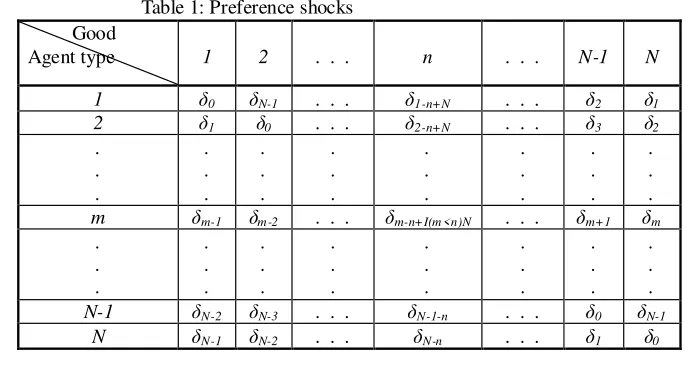
There are N < +1 symmetric locations and N location speci…c night goods. There are N types of agents distinguished by their preferences over the night goods. A type m 2 f1;2; :::; Ng agent derives utility mnu(cmn) from consuming cmn units
of night good n 2 f1;2; :::; Ng; where mn = m n+I(m<n)N, 0 > 1 > 2 > ::: >
N 1 > 0; and I(m < n) = 1 if m > n and 0 otherwise. For example, type 1 agents
derive utility 0(c)from goods at location1, N 1u(c)from goods at location2,..., and 1u(c) from goods at location N; type N agents derive utility 0u(c) from goods at
location N; N 1u(c) from goods at location1, ..., and 1u(c)from goods at location
[image:24.612.99.443.461.648.2]N 1. See table1 for an illustration of the structure of the preferences.
Table 1: Preference shocks Good
Agent type 1 2 . . . n . . . N-1 N
1 0 N-1 . . . 1-n+N . . . 2 1
2 1 0 . . . 2-n+N . . . 3 2
. . . . . . . . . . . . . . . . . . . . . . . .
m m-1 m -2 . . . m-n+I(m <n)N . . . m+1 m
. . . . . . . . . . . . . . . . . . . . . . . .
N-1 N-2 N-3 . . . N-1-n . . . 0 N-1
N N-1 N-2 . . . N-n . . . 1 0
During the day, all agents can produce and consume the day good. At night, each agent is subject to a preference shock and goes to each of the N locations with the same probability 1=N: After agents are relocated, at location n 2 f1;2; :::; Ng; all agents are endowed withy units of goodn, but they di¤er in their valuations of the good. Agents cannot commit and agents’ types and thus their valuations of the night goods are private information.
We focus on symmetric stationary allocations where all agents with the same valuations of night goods consume the same amount, or for anym; n2 f1;2; :::; Ng;
cmnt =cmn =cm n+I(m<n)N for t 0 wherecmnt is the consumption of type m
agents at locationn in period t night stage;
zm0 = 0;
zmnt=zm n+I(m<n)N if the agent consumed cmn at the night stage of time t 1
for t 1;
The …rst-best night stage consumption is characterized by
qu0(cq) = q0u0(cq0)for all q6=q0 2 f0;1; :::; N 1g;
NX1
q=0
cq = N y:
Any day stage allocation(z0; z1; ::; zN 1)satisfying
PN 1
q=0 zq = 0satis…es the resource
constraint and is consistent with the …rst-best allocation. The …rst-best life-time welfare of a representative agent is:
WN = 1
N 1 1
"N 1 X
q=0
qu(cq)
when the planner has access to a record-keeping technology. Suppose thatc0 > c1 > ::: > cB 1 > y > cB > ::: > cN 1 so that at the …rst-best allocation,B types of agents are borrowers who consume more than their endowment, and N B types of agents are lenders who consume less than their endowment.
To deal with limited commitment, the following 2N individual rationality condi-tions must be satis…ed: for all q; q0 2 f0;1; :::; N 1g and q6=q0;
qu(cq) + ( zq+WN) qu(y) + W0N;
zq+WN W0N;
where
WN = 1
N 1 1
"N 1 X
q=0
qu(cq)
#
and
W0N = 1
N 1
1 u(y)
NX1
q=0
q:
There are two ways to deal with the friction caused by private information. If early-sorting is used, the following (N2 N) constraints must be satis…ed:
1 N 1 1 " N X n=1
mnu(cmn)
# 1 N 1 1 " N X n=1
mnu(cm0n)
# ;
for allm; m0 2 f1;2; :::; Ngandm0 6=m:If late-sorting is used, the following (N2 N)
constraints must be satis…ed:
qu(cq) + ( zq+WN) qu(cq0) + ( zq0 +WN);
Following the steps in section 3, it can be shown that the ICTs hold at the …rst-best allocation. When there is a record-keeping technology, the …rst-…rst-best allocation can be achieved if and only if
N
0 =
PN 1
q=B q u(y) u(cq)
PB 1
q=0 q u(cq) u(y)
:
In the absence of a record-keeping technology, one-money mechanisms must resort to late-sorting to align incentives, and the …rst-best allocation can be achieved if and only if
N
1 =
PN 1
q=1 (N q) q u(cq 1) u(cq)
PN 1
q=1 (N q) q u(cq 1) u(cq) +
PN 1
q=0 q u(cq) u(y)
N
0 :
The following proposed mechanism with two monies (R and G) shows that two monies act as a perfect substitute for the missing record-keeping technology. Two-money mechanisms improve welfare over one-Two-money mechanisms when < N1 :
At the day stage of date 0, the mechanism asks agents to choose from N
monetary portfolios:
rm R+ (1 rm) G;
with 0< rm <1 for all m2 f1;2; :::; Ng and rm 6=rm0 for all m6=m0:
At the night stage of date 0,after the shocks are realized, the planner o¤ers each agent the following choices:
At locationn 2 f1;2; :::; Ng,
Show rm R+ (1 rm) G; get cmn = cm n+I(m<n)N good n and "[rn R+ (1 rn)
G] where0< " < min
m6=m02f1;2;:::;Ngfjrm rm0jg;
by agents. The mechanism rewards participating agents with " units of money, the composition of which di¤ers across locations. We restrict " to ensure that agents of di¤erent types and consuming at di¤erent locations exit the night stage with di¤erent monetary portfolios.
At the day stage of the t 1 period,
Show t[rm R+ (1 rm) G] +"[rn R+ (1 rn) G]; use zmn =zm n+I(m<n)N day
output and "[rn R+ (1 rn) G]to exchange for [rm R+ (1 rm) G];
At the night stage of the t 1 period,
At locationn,
Show(t+1)[rmR+(1 rm)G];getcmn =cm n+I(m<n)N goodnand"[rnR+(1 rn)
G]:
The two-money mechanism outlined here deals with limited commitment and private information exactly the same way as the two-money mechanism with two types of agents. As long as N is …nite, we can see that two monies are always a perfect substitute for the record-keeping technology. If money is indivisible as in Kocherlakota and Krueger (1999), we will need at least N monies to replace the record-keeping technology when there are N types of agents.
6
Two Monies as A Perfect Substitute for the
Record-Keeping Technology
for a third money.
If money balances are not concealable, there is a one-to-one match between records and money balances, money balances will thus carry the relevant information into future periods. When money balances are concealable, however, the one-to-one match will be destroyed since individuals can change balances by hiding money. Or, the concealability of money balances makes it possible for individuals to change records to their own bene…ts. The introduction of a second money solves the problem by encoding records into di¤erent monetary portfolios with the same total balances and di¤erent compositions of the two monies. Agents will not be able to juggle their monetary portfolios to mimic other portfolios by concealing money. Note that when money is divisible, it is possible to encode any …nite number of records into di¤erent monetary portfolios so a third money will not be needed.
7
Conclusion
In this paper, we show in a quasi-linear environment that in the presence of private information and limited commitment, a second money can potentially improve welfare by providing an e¢cient way to pass information across time.
In the absence of a record-keeping technology, monetary mechanisms (with either a single money or two monies) can e¤ectively deal with limited commitment by re-warding participants with more money balances and requiring ever increasing money for future participation. The individual rationality conditions stay the same as in the case with the record-keeping technology where defectors are directly caught and forced into perpetual autarky.
preference shocks and use the information later on to infer agents’ valuations of the night goods. We call this early-sorting. The second option is to induce agents to report their valuations after the realization of the preference shocks, and use the day stage consumption/production to align the incentives. We call this late-sorting.
Mechanisms with a single concealable money rule out early-sorting. When agents are patient enough, the late-sorting mechanism e¤ectively aligns the incentive by inducing agents to leave the night stage with di¤erent money balances and pro-duce/consume di¤erent amounts in the following day stage. When agents are not patient enough, the late-sorting mechanism is not powerful enough to align incen-tives. The introduction of a second money permits the early-sorting mechanism and allows agents to signal their preferences by holding di¤erent monetary portfolios (with the same total money balances).
References
Andolfatto, David (2008), "The Simple Analytics of Money and Credit in a Quasi-linear Environment," Manuscript, Simon Fraser University.
Camera, Gabriele, Ben Craig and Christopher J. Waller, (2004), "Currency Com-petition in a Fundamental Model of Money,"Journal of International Economics, 64, 521-544.
Camera, Gabriele and Johannes Winkler, (2003), "International Monetary Trade and the Law of One Price," Journal of Monetary Economics, 50, 1531-1553.
Craig, Ben and Christopher J. Waller, (2004), "Dollarization and Currency Ex-change," Journal of Monetary Economics, 51, 671-689.
Kocherlakota, Narayana (1998a), "The Technological Role of Fiat Money,"Federal Reserve Bank of Minneapolis Quarterly Review, 22 (3), 2–10.
Kocherlakota, Narayana (1998b), "Money is Memory,"Journal of Economic The-ory, 81(2), 232–251.
Kocherlakota, Narayana and Thomas Krueger (1999), "A Signaling Model of Mul-tiple Currencies", Review of Economic Dynamics, 2, 231-244.
Kocherlakota, Narayana (2002). "The Two-money Theorem," International Eco-nomic Review, 43(2), 333-346.
Lagos, Ricardo and Randall Wright (2005), "A Uni…ed Framework for Monetary Theory and Policy Analysis," Journal of Political Economy, 113(3), 463-484.
Townsend, Robert M. (1987), "Economic Organization with Limited Communi-cation",The American Economic Review, 77(5), 954–971.
Prices," Journal of Political Economy, 103, 118-141.
Trejos, Alberto and Randall Wright (2001), "International Currency," Advances in Macroeconomics, Vol 1, Issue 1, Article 3.