STUDENT-CENTERED LEARNING: AN APPROACH IN PHYSICS
LEARNING STYLE USING PROBLEM-BASED LEARNING (PBL)
METHOD
Ahmad Hadi Ali and Siti Nur Kamariah Rubani, Department of Science, Faculty of Science, Arts and Heritage and Faculty of Technical Education, Universiti Tun Hussein Onn Malaysia, 86400 Parit Raja, Batu Pahat, Johor, Malaysia. [email protected]
Abstract
The motivation in implementing problem-based learning (PBL) in Physics education was started since 2007. It is one of the university aspirations to educate students using the student-centered learning (SCL) approach. Since Physics is said as one of the toughest subject, and most of the students feel ‘fear’ to learn physics. Hence it is better for the students to learn physics using hands-on method. This paper will discuss the implementation of PBL in physics and student perception on the learning method. The study was performed on engineering students taking Physics 1 subject in the first semester. They were learned the physics topics for some weeks as a part of their learning method. The test on the perception of the students was carried out by distributing questionnaire at the end of PBL session. The results were analyzed using SPSS software. From the observation results it shows that most of the students, with 92% of them agree the PBL method provide some benefits to them. In addition, the students show excellent improvement after the PBL program. They are able to work as a good team member, excellent presenter, improved interpersonal communication and critical thinking.
INTRODUCTION
Problem-Based Learning (PBL) is very active, interactive and collaborative based education. The students are learning from a real-world problem similar to one they might encounter as they a practitioner of the discipline. Teaching content through skills is one of the primary distinguishing features of PBL with conventional method. In PBL, the students are more inductive. They will actively try to solve a real-world problem based on their experiences and skill. They will learn actively the content of subject during solving the problem. In contrast, the traditional method is just educating student in a class; where the lecturer giving lecture and the students are passively sit on their chair and learn from the lecture. Then they try to solve the question given by the lecturer at the end of the topic.
from the teacher to the student as the heart of the learning process. It is the process of keeping students mentally, and often physically, active in their learning through activities that involve them in gathering information, thinking, and problem solving.
Student centered teaching’s dependence on group effectiveness may lie at the heart of the difficulty for researchers to prove that student centered teaching improves learning. Traditional lecture or textbook generated learning is at the core of education from elementary school through many graduate level programs. These habits, however, differ from student to student. Some may try to take control of the group, others will become passive, and still others will become overly verbose, while others will shy away from commenting [4]. Observers of student group interaction often find that students do not work productively, waste time, repeat old information, or become confrontational. Regardless of the problem posed to a group of students, learning is proportional to the ability of that group to work effectively together. But PBL points toward the organization of the structure of the student’s knowledge in respect to problems, in such a way that allows the student to find significance in the already existing scientific explanations, to find the feasibility of a technique in order to solve a problem, and also, a much clearer relation between theory and practice in order to face the necessary interdisciplinary method demanded by any solution of a real problem. In addition, the context within which problems are solved forces the student to solve them in teams. If teamwork is adequately guided by the instructor, the team also becomes a space for developing skills such as communication, leadership, team working and punctuality [5].
These three pillars of problem-based learning: student questioning, interdisciplinary method and team work has influenced the development and implementation of problem-based learning in Universiti Tun Hussein Onn Malaysia (UTHM). This method is in line with the philosophy of education of this university that states that “The education and training in this university is a continuous effort to lead in market oriented academic programmes which are student-focused through experiential learning to produce well trained human resource and professionals who are catalysts for a sustainable development”. This education method is hope can improve the teaching standard and most importantly produce graduates who are competent not only in the core discipline or subject matter of expertise but the generic skill (GS) that is greatly lacking among the students [6].
This paper will present the outcome of the implementation of problem-based learning in physics subject at UTHM as part of student learning method. Some result and suggestion are also included.
METHOD
part, lecturer act as a facilitator for reference or discussing problem arises during the PBL session.
Basically the problem solving process includes a discussion of facts – what is known about the problem, information gaps – what information are needed but known, hypotheses – a list of possible causes or explanations of the problem and learning issues – areas where learners lack knowledge.
Briefing/ brainstorming session
Forming groups/ Ground rules
Discussion/ Investigating problem
Analysis and Result
Report and Presentation
Final Evaluation
Individual/ Grou
p
Asse
ssme
n
t
[image:3.612.196.397.191.373.2]Read the problem
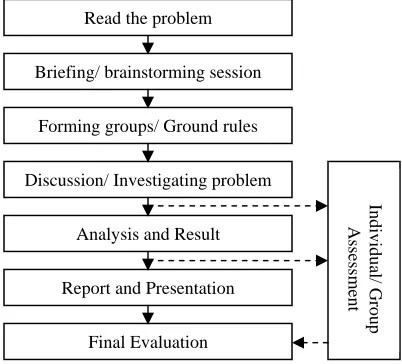
Figure 1.0 Flowchart of entire PBL process.
Figure 1.0 shows the processes in PBL physics implemented to engineering students in UTHM [7].
1. Read the problem: Understand the situation.
2. Briefing/brainstorming session: Lecturer as facilitator or tutor gives their briefing about the topic was given.
3. Forming groups / Ground rules: Facilitator divided student into small groups. Student has given their opinion and receives feedback towards one another which is supportive and constructively critical.
4. Discussion/Investigating problem: Each group will seat together and discuss the problem. Students can searching for information from various kind resource including books, journal, notes, manual and internet.
5. Analysis and result: Students gather all information and findings from their problem solving activity to determine the result.
6. Report and presentation: Each group drafting their full report and also presentation in front of their friends and facilitator, so they can improve their communication skill.
Sample
A total of 26 students were selected from physics classes taught in the Faculty of Science, Arts and Heritage, UTHM. They were taking Physics 1 in the first semester 2008/2009. They were divided into groups containing from four to five members for each groups. The students are allocated four weeks for the PBL session. During this session the students will work in their group to solve the real world problem.
Trigger/ Problem
Figure 2.0 shows the real world problem as well the trigger for the students to solve base on their skill and knowledge.
Trigger
The main injuries that occur to a person hitting the interior of the car in a crash are brain damage, bone fracture, and trauma to the skin, blood vessels, and internal organs. The threshold for damage to skin, blood vessels and internal organs may be estimated from whole-body impact data, where the force is uniformly distributed over the entire front surface area of 0.7 m2 to 0.9 m2. These data show if the collision lasts for less than about 70 milliseconds, a person will survive if the whole-body impact pressure (force per unit area) is less than 1.0 x 10⁵ N/m2. Death results in 50% of cases in which the whole-body impact pressure reaches 3.4 x 10⁵ N/m2.
Consider a typical collision involving a 75-kg passenger not wearing a seat belt, traveling at 60 km per hour who comes to rest in about 0.010 second after striking an unpadded dashboard. If we assume the passenger crashes into the dashboard and windshield so that the head and the chest, with a combined surface area of 0.5 m2, experience the force.
Will the passenger survive in this collision?
[hint: i) calculate the average force. What can this force do to our body? ii) calculate the acceleration and what can it cause to the passenger
iii) calculate the whole-body impact pressure. Compare this value with the data above]
What can be done to reduce or eliminate the chance of dying in a car crash?
Figure 2.0 Real world problem for PBL session.
The following elements are normally considered when designing the problems [5]:
Environment
level of comprehension reached or used by the student, such as the possible strategies through which the problem can be solved, and the levels at which the problem is expected to be understood by the students.
Curriculum
The contents on which the activity is centered and for which it is basically created.
In other words, the contents that the students are expected to learn while solving the problems. The curriculum is the traditional nucleus of learning; however, in a problem-solving activity it must be subordinated to other elements.
Analytic point of reference
Refers to previous (retrospective) and future (prospective) contents and objectives of the courses integrated, with the purpose of refocusing and enriching the problem in order to foment a long-term retention and to stimulate the building of new questions by the students.
Use of technology
The technological elements (software, laboratory, media, electronic communication tools, etc.) involved in the problem-solving activity. One of the tasks students must cope with by using technology for solving problems is the identification and assessment of its plausibility, its significance and the role it plays in the process of solving the problem.
Development of formative objectives
This dimension deals with the statement in which abilities, attitudes and values are involved or promoted by the problem-solving activity.
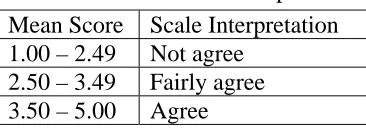
The instruments used to determine acquire information and student feedback on their perception of PBL. It is a quantitative approach where questionnaires were given to each student. The questionnaires were divided into six sections. Researcher uses mainly a Likert scale questionnaire. It is interpreted according to the mean score computed as shown in Table 1.0.
Table 1.0 Mean score interpretation
Mean Score Scale Interpretation 1.00 – 2.49 Not agree
[image:5.612.215.398.581.645.2]RESULT AND DISCUSSION
The questionnaires contain three sections consisting seven items in each section. The first section is about The Relevancy of Teaching and Learning (T & L) Method Using PBL in Physics Syllabus.Based on the finding, 73% of the students on the whole agree with the PBL method and viewed PBL positively. The students like to learn physics using the PBL method. They found it is easier to understand physics when using the PBL than the conventional method in the class. In addition they are able to finish the PBL in the time given.
For the second section the student were asked on their method to solve the physics problem using PBL method. To solve the problem, 88.5% are agreeing use the methods as follows:
(i) Visiting to government/private agencies to get useful information.
(ii) Doing some references from books, magazines, newspaper, journals related to PBL.
(iii) Searching information from internet. (iv) Referring to lecture notes/module.
(v) Interviewing other lecturers/ technician to ask their opinion on the PBL problem.
(vi) Doing simple experiment to study/ solve the PBL problem.
For the third section the students were asked the benefit they get from the PBL method. It is found that 92% of the students agree get useful benefits from the PBL methods as follow:
(i) The relationship among friends becomes better. (ii) Improve understanding in Physics.
(iii) Improve leadership skill.
(iv) Improve in communication style.
(v) More confident when were asked about topics in physics.
(vi) Learn new knowledge out of physics syllabus as well new experiences. (vii) Learn to solve problems in more systematic ways.
CONCLUSION
REFERENCES
Barrows, H. S. (1986) A taxonomy of problem based learning methods, Medical Education,20, 481–486.
Barrows, H. S. & Tamblyn, R. M. (1980), Problem based learning: an approach to medical education, (New York, Springer).
Achike, F. I. and Nain, N., 2005 “Promoting problem-based learning (PBL) in nursing education: A Malaysian experience”, Nurse Education in Practice 5, 302–311, Elsevier Ltd.
Mihyar Hesson and Kaneez Fatima Shad, A Student-Centered learning Model, American Journal of Applied Sciences 4 (9): 628-636, 2007.
Rodrigo Polanco, Patricia Calderón and Francisco Delgado, (2004), Effects of a problem-based learning program on engineering students’ academic achievements in a Mexican university, Innovations in Education and Teaching InternationalVol. 41, No. 2, May 2004
Berhannudin Mohd Salleh (2007), Adopting Problem-based Learning in the Teaching of Engineering Undergraduates: A Malaysian Experience, Proceedings of International Conference on Engineering Education – ICEE 2007, September 3-7 2007, Coimbra Portugal.