88
THE EVALUATION OF THE QUALITIES OF THINKING SKILLS MODULE FOR TECHNICAL SUBJECT
Tee Tze Kiong1,Jailani Md Yunos2, Baharom Mohamad3, Widad Othman4 dan Yee Mei Heong5
1
Universiti Tun Hussein Onn Malaysia, [email protected] 2
Universiti Tun Hussein Onn Malaysia, [email protected] 3
Universiti Malaysia Sabah, [email protected] 4
Open University Malaysia, [email protected] 5
Universiti Tun Hussein Onn Malaysia, [email protected]
ABSTRACT
Rajendran (2008) claimed that models, strategies, techniques, and activities, model lesson plans showing how thinking skills could be taught together with subject matter using the infusion approach were been implemented in the school system in Malaysia since 1993. But, using self-instructional modules can be an alternative approach and make significant contributions. Moreover, modules are self-paced and they can cater to an extent for individual differences in the learner‟s abilities, interest and degrees of application. Furthermore, modules are largely self-instructional, specific basic study programmes can be run either as a pre-requisites as part of a total structure programme of technical and vocational education. An attempt to develop and implement a modular approach on thinking skills was made in the secondary school. This paper will discuss various components of this modular approach by referring to Meyer Model. Fleiss‟s Kappa was used to determine the degree to which consensus agreement ratings vary from the rate expected by chance, with values greater than .60 indicating substantial non-chance agreement (Brown, Glasswell & Harlan,, 2004). Fleiss‟s Kappa for the inter-rater reliability score was κ = .6357, S.E. = .0990, 95% C.I. = .4416 to .8298, which can be taken to represent constant agreement among raters. Eight raters (content and design experts) used the instrument to rate the qualities of the module. Analysis of the raters showed an agreement on satisfactory level and above on all 34 items.
Keywords: Self-Instructional Module, Thinking Skills, Quality
INTRODUCTION
89
1993). Although individualized instruction may appear to be an easy solution, but there are many constraints within the school context. Therefore, using modules as a strategy for teaching and learning within the technical education can be an alternative approach and make significant contributions.
Meyer (1988) had succinctly argued that modules are not just ―job sheets‘ or ―old style work units‖ or ―chapters of books‖ with questions added. Module is a planned series of learning activities designed carefully to assist the learners to accomplish certain specific objectives (Klingstedt, 1971). In this case, our job in education is to provide both the contexts for developing thinking, and the confidence and competence in using knowledge tools.
A revised on Taxonomy Bloom had been done by Bloom‘s students, Anderson and Krathwohl in the year of 2001. There are six type of thinking skills based on the cognitive domain in the taxonomy table, namely remember, understand, apply, analysis, evaluate and create. The major differences in the updated version is in the more useful and comprehensive additions of how the taxonomy intersects and acts upon different types and levels knowledge -- factual, conceptual, procedural and metacognitive (Tee, et al., 2010).
TAXONOMY OF ANDERSON AND KRATHWOHL (2001)
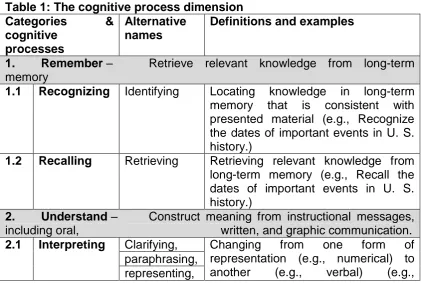
[image:2.595.80.502.485.768.2]Bloom‘s taxonomy was revised by his former students, Lorin Anderson, working with one of his partners in the original work on cognition, David Krathwohl. The group redefining Bloom's original concepts, worked from 1995-2000. The group was assembled by Anderson and Krathwohl and included people with expertise in the areas of cognitive psychology, curriculum and instruction, and educational testing, measurement, and assessment (Tee, et al., 2010). Table 1 shows the cognitive process dimension.
Table 1: The cognitive process dimension Categories &
cognitive processes
Alternative names
Definitions and examples
1. Remember – Retrieve relevant knowledge from long-term memory
1.1 Recognizing Identifying Locating knowledge in long-term memory that is consistent with presented material (e.g., Recognize the dates of important events in U. S. history.)
1.2 Recalling Retrieving Retrieving relevant knowledge from long-term memory (e.g., Recall the dates of important events in U. S. history.)
2. Understand – Construct meaning from instructional messages,
including oral, written, and graphic communication.
2.1 Interpreting Clarifying, Changing from one form of representation (e.g., numerical) to another (e.g., verbal) (e.g., paraphrasing,
90
translating Paraphrase important speeches and documents.)
2.2 Exemplifying Illustrating, Finding a specific example of illustration of a concept or principle (e.g., Give examples of various artistic painting styles).
instantiating
2.3 Classifying Categorizing, Determining that something belongs to a category (e.g., concept of principle) (e.g., Classify observed or described cases of mental disorders). subsuming
2.4 Summarizing Abstracting, Abstracting a general theme or major point(s) (e.g., Write a short summary of the events portrayed on a videotape).
generalizing
2.5 Inferring Concluding, Drawing a logical conclusion from presented information (e.g., In learning a foreign language, infer grammatical principles from examples).
extrapolating, interpolating, predicting
2.6 Comparing Contrasting, Detecting correspondences between two ideas, objects, and the like (e.g., Compare historical events to contemporary situations).
mapping, matching
2.7 Explaining Constructing models
Constructing a cause-and-effect model of a system (e.g., Explain the causes of important 18th-century events in France).
3. Apply – Carry out or use a procedure in a given situation
3.1 Executing Carrying out Applying a procedure to a familiar task (e.g., Divide one whole number by another whole number, both with multiple digits).
3.2 Implementing Using Applying a procedure to an unfamiliar task (e.g., Use Newton‘s Second Law in situations in which it is appropriate.) 4. Analyze – Break into its constituent parts and determine how the parts relate to one another and to an overall structure and purpose.
4.1 Differentiating Discriminating, Distinguishing relevant from irrelevant parts or important from unimportant parts of presented material (e.g., Distinguish between relevant and irrelevant numbers in a mathematical word problem).
91 4.2 Organizing Finding
coherence,
Determining how elements fit or function within a structure (e.g., Structure evidence in a historical description into evidence for and against a particular historical explanation).
integrating, outlining, parsing, structuring
4.3 Attributing Deconstructing Determine a point of view, bias, values, or intent underlying presented material (e.g., Determine the point of view of the author of an essay in terms of his or her political perspective).
5. Evaluate – Make judgments based on criteria and standards
5.1 Checking Coordinating, Detecting inconsistencies or fallacies within a process or product; determining whether a process or product has internal consistency; detecting the effectiveness of a procedure as it is being implemented (e.g., Determine if a scientist‘s conclusions follow from observed data).
detecting, monitoring, testing
5.2 Critiquing Judging Detecting inconsistencies between a product and external criteria, determining whether a product has external consistency; detecting the appropriateness of a procedure for a give problem (e.g., Judge which of two methods is the best way to solve a given problem.)
6. Create – Put elements together to form a coherent or functional whole, reorganize elements into new pattern or structure.
6.1 Generating Hypothesizing Coming up with alternative hypothesis based on criteria (e.g., Generate hypothesis to account for an observed phenomenon).
6.2 Planning Designing Devising a procedure for accomplishing some task (e.g., Plan a research paper on a given historical topic).
6.3 Producing Constructing Inventing a product (e.g., Build habitats for a specific purpose).
(Anderson and Krathwohl, 2001)
THE NEED OF TEACHING THINKING SKILLS IN SECONDARY SCHOOL
92
dialogue. Therefore, a self-instructional module is important here to help every single student to study on their own pace (Meyer, 1988). The Outline Perspective Plan, which was tabled and approved in Parliament in April 2001, required the Education System to be reviewed to ensure that Malaysian students are taught explicitly to acquire and use several of thinking skills (Rajendran, 2008). Research findings support the teaching and learning of thinking skills. Based on research findings, thinking skills instruction enhances academic achievement (Rajendran, 2008).
Deficiency model
Meyer (1988) identified there are three widely used ways (Deficiency model, Competency model and Conceptual model) to determine need in education and all are relevant to the design of modules. Deficiency model was been applied in this research. This approach stresses the noun rather than the verb, is to define need as a gap between ―what is‖ and ―what should be‖, or expressed in another way, as the gap between what is observed and what is desired.
The deficiency model is useful in the design of modular programmes to help with the selection of a subject or subjects to be modularized or to identify special areas of need within a subject to establish priorities for developing specific modules. An analysis of need using the deficiency model involves the following steps.
(i) Identification and description of the optimal results, products or outputs expected of a particular situation, organization, institution or programme. (ii) Investigation and description of the present products.
(iii) Identification of the ―gaps‖ between present and optimally desired products.
(iv) Selection of the most critical gap for closure.
A preliminary research with the purpose to identify the level of higher order thinking skills among lower secondary students on Living Skills subject in Malaysia was been carried out. The higher order thinking skills test (SEA test) was modified and distributed to 384 students throughout the whole country to access the higher order thinking skills level as defined by the upper three categories of the Bloom‘s Taxonomy of Educational Objectives: Analysis, Synthesis and Evaluation. The results showed that all three higher order thinking skills levels among the students were at low level (analysis = 27.34%, synthesis = 28.64% and evaluation = 30.31%). Due to the low level of higher order thinking skills among lower secondary students in technical subject, we proposed a new approach by using instructional module for individualized learning to deliver the thinking skills learning task due to many limitations on teachers and schools.
MEYER MODEL FOR DEVELOPING MODULE
93
Partial or Complete Systems
While some programmes may be completely modular and others may be only partially taught by means of modules instruction (Meyer, 1988). Several approaches are possible:
(i) Completely modularized programmes: It is possible to organize a complete programme of training by means of modular instruction. The advantage is that students take responsibilities for their learning across the total programme and have a standardized approach to organizing their studies. In such a course it frequently occurs that each module is to be covered by the average student in a given time – say one module per week. Students do not proceed to a new module until they have mastered the previous one in the series. This can be accommodated provided students are retested for mastery as frequently as needed and only on those specific elements which they fail to master on an earlier try.
(ii) Partially modularized programmes: In spite of the obvious advantages if a fully modularized programme, difficulties of initial production may make this impractical at first. A compromise is to start by modularizing only one or two subjects within a total certificate or diploma course or even to produce modules for selected topics within a single subject. When partially modularizing it is important to choose the subjects or topics to be modularized only after undertaking a careful analysis of need.
(iii) Compulsory versus elective units: Some courses may contain key subjects or selected subjects may include units of work which are basic, and so must be made compulsory for all students. These courses, however, may also provide optional electives to cater for individual differences in say interest or aptitude. Some of the electives may provide extension or enrichment experiences and some may be remedial. Modules can cater for this core plus elective type structure in two ways. Firstly, the ―core‖ elements can be modularized to ensure uniform standards, and secondly, the range of electives can be broadened by offering a wider choice of modules as parallel alternatives.
The Fundamental Characteristics of Modules
Based on Meyer (1988), modules meet the conditions necessary for effective learning. This occurs because modules have certain fundamental design characteristics which have emerged through the application of ideas from the theory of learning. In summary these characteristics are as follows:
(i) Essentially self-contained (ii) Self-instructional
(iii) Concern for individual differences (iv) Statement of objectives
(v) Optimal association, sequence and structure of knowledge (vi) Utilization of a variety if media and methods
94 (viii) Immediate reinforcement of responses (ix) Active participation by the learners (x) Mastery evaluation strategy
The Components of a Module
Most modules are designed on similar principles and Meyer (1988) listed the components of a module as bellow:
(i) Instructional on how to use the module (ii) Statement of purpose and aim
(iii) List of pre-requisite skills
(iv) List of instructional objectives expressed in performance terms (v) Diagnostic pretest
(vi) List of equipment and other resources required (vii) Sequenced instructional activities
(viii) Mastery post test
Steps in Design and Development
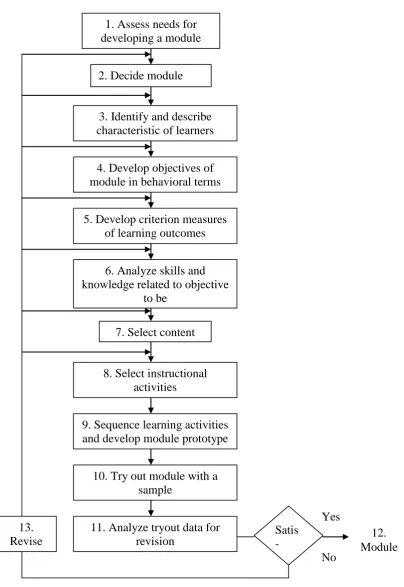
Figure 1 shows the steps in design and development of a module.
Evaluation, Trialing and Validation of Modular Materials
In spite of the care taken in the initial design of a module no one can be certain of its true educational effectiveness until it has been tried out with representative students (Meyer, 1988).
Overall Steps in the Trailing Procedure
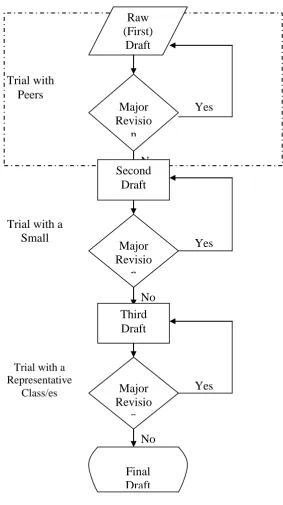
The trailing and validation of draft learning materials, including modules, usually follow a three steps process including Step 1: Judgment by peers; Step 2:Trail with small group of students, and Step 3: Trail with a representative class or classes. At each stage data are collected and used to modify the material. The data may suggest the need for a total rewrite which implies the preparation of what is virtually a new draft which needs to be put through one or more phases of the process a second time. More often, however, the data indicate where amendments need to be made before the process proceeds to the second or third stage. Figure 2 shows the steps in trialing a draft module. In this paper, discussion will be focused on step 1: Judgment by peers only.
RELIABILITY
95
Figure 1: A Flow Chart for the Design and Development of a Module 13.
Revise
Satis -facto ry 1. Assess needs for
developing a module
2. Decide module format
3. Identify and describe characteristic of learners
4. Develop objectives of module in behavioral terms
5. Develop criterion measures of learning outcomes
6. Analyze skills and knowledge related to objective
to be
included in the module
7. Select content
8. Select instructional activities and media
9. Sequence learning activities and develop module prototype
10. Try out module with a sample
of target group
11. Analyze tryout data for revision
of module
Yes
No
96 Figure 2: Steps in Trialing a Draft Module
Raw (First)
Draft
Major Revisio
n
Yes
No Second
Draft
Major Revisio
n
Yes
No
No Third Draft
Yes Major
Revisio n
Final Draft Trial with
Peers
Trial with a Small Group
Trial with a Representative
97 FINDINGS
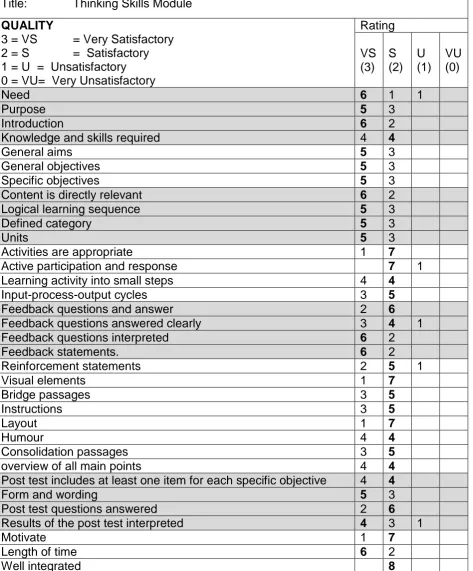
Table 1: Rating scale for the evaluation of the qualities of Thinking Skills Module
Title: Thinking Skills Module QUALITY
3 = VS = Very Satisfactory 2 = S = Satisfactory 1 = U = Unsatisfactory 0 = VU= Very Unsatisfactory
Rating
VS (3)
S (2)
U (1)
VU (0)
Need 6 1 1
Purpose 5 3
Introduction 6 2
Knowledge and skills required 4 4
General aims 5 3
General objectives 5 3
Specific objectives 5 3
Content is directly relevant 6 2
Logical learning sequence 5 3
Defined category 5 3
Units 5 3
Activities are appropriate 1 7
Active participation and response 7 1
Learning activity into small steps 4 4
Input-process-output cycles 3 5
Feedback questions and answer 2 6
Feedback questions answered clearly 3 4 1
Feedback questions interpreted 6 2
Feedback statements. 6 2
Reinforcement statements 2 5 1
Visual elements 1 7
Bridge passages 3 5
Instructions 3 5
Layout 1 7
Humour 4 4
Consolidation passages 3 5
overview of all main points 4 4
Post test includes at least one item for each specific objective 4 4
Form and wording 5 3
Post test questions answered 2 6
Results of the post test interpreted 4 3 1
Motivate 1 7
Length of time 6 2
98
Eight raters (content and design experts) used the instrument to rate the qualities of the Thinking Skills Module. Analysis of the raters showed an agreement on satisfactory level and above on all 34 items.
CONCLUSION
Self-instructional modules are very useful to educators and students. By using this Thinking Skills Module, students are able to learn the six thinking skills and apply it in study especially while taking tests and examinations. Moreover, students could learn on their own pace by using this self-instructional module.
ACKNOWLEDGEMENTS
The authors would like to thank the Ministry of Higher Education, Malaysia for supporting this research under the Fundamental Research Grant Scheme (FRGS).
REFERENCE
Anderson, L. W. & Krathwohl D. R. Eds. (2001). A Taxonomy for Learning, Teaching, and Assessing: A Revision of Bloom's Taxonomy of Educational Objectives, New York, Longman. 28-29, 43, 46, 67-68, 305- 310.
Brown, G. T. L., Glasswell, K. & Harland, D. (2004). Accuracy in The Scoring of Writing: Studies of Reliability and Validity using a New Zealand Writing Assessment System. Assessing Writing, 9, 105-121.
Klingstedt, J. L. (1971). Developing Instructional Modules for Individualized Learning. Educational Technology/ October.
Landis, J. R. & Koch, G. G. (1977). The Measurement of Observer Agreement for Categorical Data. Biometrics, 33, 159-174.
Meyer, G. R. (1988). Modules from Design to Implementation. 2nd Ed. Filipina: Colombo Plan Staff College for Technician Education. pp. 5-6, 19, 22, 46, 49, 63-64, 274, 277, 279, 282-284.
Rajendran, N. S. (2008). Teaching and Acquiring Higher Order Thinking Skills Theory and Practice. Perak, UPSI. pp. 53, 59, 60.
Noordin, S. & Yap, K. C. (1993). A Modular Approach in Physics for The Secondary Schools: Investigating Alternative Conceptions and Conceptual Change in A Pilot Study. Makalah UTM: Skudai UTM.
Tee, T. K., Md Yunos, J., Mohamad, B., Othman, W. & Yee, M. H. (2010). Kepentingan Peta Minda Sebagai Alat Berfikir Dalam Mengambil Nota.
International Conference on Education, Brunei (ICE 2010).
Wilson, J. & Murdoch, K. (2008). Helping Your Pupils to Think for Themselves. Australia: Curriculum Corporation. pp. 1.