Solution of Problem of Sound Scattering on Bodies of
Non-analytical Form with Help of Method
of Green’s Functions
S. L. Ilmenkov, A. A. Kleshchev
*Saint-Petersburg State Navy Technical University, Saint-Petrsburg, Lotsmanskaya 3, St. Petersburg, 190008, Russia *Corresponding Author: [email protected]
Copyright © 2014 Horizon Research Publishing All rights reserved.
Abstract
The real scatterers have non – analytical formand therefore, the method of separation of variables for calculation of the reflected sound field does not apply to them. In the article is presented the method of Green’s functions for the solution of the problem of the sound diffraction on the ideal non – analytical scatterers. In detail is giving the analysis of the solutions and are calculating the modules of the angular characteristics of the sound scattering.
Keywords
Diffraction, Green’s Functions, Non –Analytical Form, Boundary Conditions
1. Introduction
There are quite a number of task solving methods for reflecting and scattering of sound bodies with non – analytical surface. Let's call the most well-known and frequently used in studies of these methods: methods of finite and boundary elements, method Kupradze, method of the T - matrix, the method of geometrical theory of diffraction, method of integral equations, method of Green's functions and so on [1 – 24]. In this paper the method of Green's functions to applies [22 – 24].
2. The Ideal Scatterer of the
Non-analytical Form
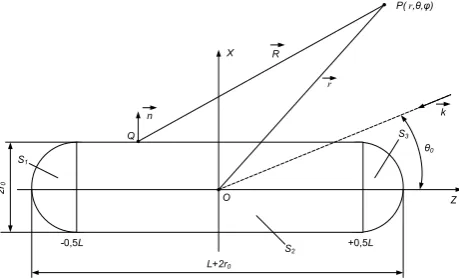
We consider non-analytical body, the surface of which does not apply to coordinate systems ones with divided variables in the scalar Helmholtz equation. We examine this non-analytical scatterer in the form of a finite circular cylinder, bounded on the sides of the hemispheres (Fig.1).
Sound pressure, scattered by this body, can be found one of the numerical methods for the solution of diffraction problems [1 - 24]. The method of Green’s f functions [22 -
24], based on the use of mathematical formulation of the principle of Helmholtz-Huygens (Kirchhoff integral), one of the most convenient methods [25 – 27]. The algorithm of calculation requires knowledge of the amplitude-phase distribution of the sound pressure and the normal component of oscillatory velocity on some closed surface integration of
S, that includes the lateral surface of the cylinder S2 and the surface of hemispheres S1 and S3 (Fig. 1):
P( r,θ,φ)
X
Q
R
O
θ0
k
Z S3
S1
S2
L+2r0
+0,5L -0,5L
n
r
2r0
Figure 1. Non-analytical scatterer in the form of a cylinder with hemispheres.
( ) 1
( ) [ ( ) ( , ) ( , )]
4
S
S S S
p Q
p P p Q G P Q G P Q dS
n n
π
∂
− ∂
= −
∂ ∂
∫
(1)where 𝑝𝑝𝑠𝑠(𝑃𝑃) – the sound pressure scattered by the body, P –the point of observation, which has a spherical coordinates: 𝑟𝑟, 𝜃𝜃, 𝜑𝜑; 𝑄𝑄 – the point of the surface S; 𝑝𝑝𝑠𝑠(𝑄𝑄) - the sound pressure in the point 𝑄𝑄; 𝐺𝐺(𝑃𝑃, 𝑄𝑄) - Green's function of the free space, satisfying the inhomogeneous Helmholtz equation.
In the (1) Green's function is selected as a potential point source:
[image:1.595.318.548.389.529.2]between the points P and Q.
Using relative arbitrariness of the choice of green's function, you can get the Kirchhoff formula options, consisting of a single member:
(1) 1
( ) ( ) ( , )
4
S S S
p P p Q G P Q dS
n
π
− ∂
=
∂
∫
(3)(2) ( ) 1 ( ) ( , ) 4 S S S p Q
p P G P Q dS
n
π
∂ =
∂
∫
(4)In the system of circular cylindrical and spherical coordinates connected with the corresponding parts of the surface S (Fig.1), the expressions for the Green's functions
𝐺𝐺(1)(𝑃𝑃, 𝑄𝑄) and 𝐺𝐺(2)(𝑃𝑃, 𝑄𝑄) can be written as [28]:
𝐺𝐺ц(2),𝜕𝜕𝐺𝐺ц (1)
𝜕𝜕𝑟𝑟ц′ (𝑟𝑟, 𝑧𝑧, 𝜑𝜑, 𝑟𝑟
′, 𝑧𝑧′, 𝜑𝜑′) =
𝑒𝑒𝑖𝑖𝑖𝑖 (𝑖𝑖−𝑧𝑧′ 𝑐𝑐𝑐𝑐𝑠𝑠𝜃𝜃 )
𝑖𝑖 ∑ 𝑒𝑒𝑖𝑖𝑖𝑖�𝜑𝜑−𝜑𝜑 ′−𝜋𝜋 2� � 𝑖𝑖=+∞
𝑖𝑖=−∞ �𝐽𝐽𝑖𝑖(𝑖𝑖𝑟𝑟′𝑠𝑠𝑖𝑖𝑖𝑖𝜃𝜃) −
Ω𝐽𝐽𝑖𝑖𝑖𝑖𝑟𝑟0𝑠𝑠𝑖𝑖𝑖𝑖𝜃𝜃Ω𝐻𝐻𝑖𝑖1𝑖𝑖𝑟𝑟0𝑠𝑠𝑖𝑖𝑖𝑖𝜃𝜃𝐻𝐻𝑖𝑖1𝑖𝑖𝑟𝑟′𝑠𝑠𝑖𝑖𝑖𝑖𝜃𝜃, (5)
𝐺𝐺сф(2),𝜕𝜕𝐺𝐺сф(1)
𝜕𝜕𝑟𝑟сф′ (𝜃𝜃, 𝑖𝑖, 𝜑𝜑, 𝜃𝜃′, 𝑟𝑟′, 𝜑𝜑′) = 𝑖𝑖𝑖𝑖 ∑∞𝑖𝑖=0(2𝑖𝑖 +
1𝑚𝑚=−𝑖𝑖𝑖𝑖𝑖𝑖−𝑚𝑚!𝑖𝑖+𝑚𝑚!𝑒𝑒𝑖𝑖𝑖𝑖𝜑𝜑−𝜑𝜑′𝑃𝑃𝑖𝑖𝑚𝑚𝑐𝑐𝑐𝑐𝑠𝑠𝜃𝜃𝑃𝑃𝑖𝑖𝑚𝑚𝑐𝑐𝑐𝑐𝑠𝑠𝜃𝜃′𝑗𝑗𝑖𝑖𝑖𝑖𝑟𝑟′− Ω𝑗𝑗𝑖𝑖𝑖𝑖𝑟𝑟0Ωℎ𝑖𝑖1𝑖𝑖𝑟𝑟0ℎ𝑖𝑖1𝑖𝑖𝑟𝑟′ℎ𝑖𝑖1𝑖𝑖𝑖𝑖, (6)
Ω = � 𝜕𝜕 1, для 𝐺𝐺ц,сф. 𝜕𝜕𝑟𝑟ц,сф′ � 𝑟𝑟′ = 𝑟𝑟0, для
𝜕𝜕𝐺𝐺ц,сф 𝜕𝜕𝑟𝑟ц,сф′
� (7)
By using formulas (3), (4) is considerably simplified computational procedure: you want to define only one of the parameters ( 𝑝𝑝𝑠𝑠(𝑄𝑄) or 𝜕𝜕𝑝𝑝𝑠𝑠(𝑄𝑄)/𝜕𝜕𝑖𝑖) on the surface S. However, in this case, the match of the surface S with a coordinate the surface one of coordinate systems in which it is possible separation of variables is necessary. Thus, application of Green's functions for analytical surfaces (infinite cylinder and sphere) faces of these surfaces, interconnected is the main feature of this method.
The possibility of such a method and test calculations of the scattered field were considered in [29, 30]. For example, an experiment at the decision of a test problem [29] for the calculation of the far field of a point source (group of point sources) directly and through (3), (4) has shown that in the considered range of wave sizes of the results obtained by these two methods, good enough coincide. When solving the problem of diffraction to determine the values of 𝑝𝑝𝑠𝑠(𝑄𝑄) and
𝜕𝜕𝑝𝑝𝑠𝑠(𝑄𝑄)/𝜕𝜕𝑖𝑖 on the surface S you can use the following expression:
1. for the homogeneous Dirichlet conditions (ideally soft body), pressure scattered waves on the surface S has the form :
𝑝𝑝𝑠𝑠(𝑄𝑄) = − 𝑝𝑝𝑖𝑖(𝑄𝑄) , (8) 2. for the homogeneous Neumann conditions (ideally
rigid body):
𝜕𝜕 𝑝𝑝𝑠𝑠(𝑄𝑄) 𝜕𝜕𝑖𝑖 = −
𝜕𝜕 𝑝𝑝𝑖𝑖(𝑄𝑄)
𝜕𝜕𝑖𝑖 , (9) where 𝑝𝑝𝑖𝑖(𝑄𝑄) – the sound pressure of the incident wave in point Q. When determining the values 𝑝𝑝𝑖𝑖(𝑄𝑄) you can use the expression for the scalar potential of the plane monochromatic wave single amplitude of the incident on the body from a source located at infinity.
This potential for a perfectly reflective sphere is natural functions in solving the Helmholtz equation in a spherical coordinate system has the following form [13]:
𝑝𝑝𝑖𝑖(𝑟𝑟, 𝜃𝜃, 𝜑𝜑) =
∑∞𝑖𝑖=0∑𝑖𝑖𝑚𝑚=0𝜀𝜀𝑖𝑖𝑖𝑖−𝑖𝑖(2𝑖𝑖 + 1)(𝑖𝑖−𝑚𝑚)!(𝑖𝑖+𝑚𝑚)!𝑐𝑐𝑐𝑐𝑠𝑠𝑚𝑚𝜑𝜑𝑃𝑃𝑖𝑖𝑚𝑚(𝑐𝑐𝑐𝑐𝑠𝑠𝜃𝜃)𝑗𝑗𝑖𝑖(𝑖𝑖𝑟𝑟); (10)
𝜀𝜀𝑖𝑖= 1(𝑖𝑖 = 0); 𝜀𝜀𝑖𝑖 = 2(𝑖𝑖 ≠ 0);
The expression (10) is simplified when considering the axis-symmetric problem (dependence on the coordinate φ missing):
𝑝𝑝
𝑖𝑖(𝑟𝑟, 𝜃𝜃) = ∑
∞𝑚𝑚=0𝑖𝑖
−𝑚𝑚(2𝑚𝑚 + 1)𝑃𝑃
𝑚𝑚(𝑐𝑐𝑐𝑐𝑠𝑠𝜃𝜃)𝑗𝑗
𝑚𝑚(𝑖𝑖𝑟𝑟);
(11) For scatterer in the form of a perfectly reflecting cylinder scalar potential incident plane harmonic waves unit amplitude of the wave vector 𝑖𝑖�⃗, aimed at the angle 𝜃𝜃0to the
z axis of the cylinder, folding natural functions solutions to the Helmholtz equation in a circular cylindrical coordinate system:
𝑝𝑝𝑖𝑖(𝑟𝑟, 𝜑𝜑, 𝑧𝑧) =
−𝑒𝑒𝑖𝑖𝑖𝑖𝑐𝑐𝑐𝑐𝑠𝑠 𝜃𝜃0𝑧𝑧0∑ 𝜀𝜀𝑚𝑚(−𝑖𝑖)𝑚𝑚𝐻𝐻𝑚𝑚(1)(𝑖𝑖𝑟𝑟)𝑐𝑐𝑐𝑐𝑠𝑠𝑚𝑚𝜑𝜑Ω𝐽𝐽𝑚𝑚(𝑖𝑖𝑟𝑟0 𝑠𝑠𝑖𝑖𝑖𝑖 𝜃𝜃0) Ω𝐻𝐻𝑖𝑖(1)(𝑖𝑖𝑟𝑟0𝑠𝑠𝑖𝑖𝑖𝑖 𝜃𝜃0); ∞
𝑚𝑚=0
(12) In the case of the plane problem of the wave vector 𝑖𝑖�⃗
perpendicular to the z axis of the cylinder and expression (12) is simplified [13]:
𝑝𝑝
𝑖𝑖(𝑟𝑟, 𝜑𝜑) =
− ∑
𝜀𝜀
𝑚𝑚(−𝑖𝑖)
𝑚𝑚𝐻𝐻
𝑚𝑚(1)(𝑖𝑖𝑟𝑟)𝑐𝑐𝑐𝑐𝑠𝑠𝑚𝑚𝜑𝜑
Ω𝐻𝐻Ω𝐽𝐽𝑚𝑚(𝑖𝑖𝑟𝑟0)𝑖𝑖(1)(𝑖𝑖𝑟𝑟0)
;
∞
𝑚𝑚=0
(13)
3. The Results of Numerical Experiment
for Determination of the Angular
Characteristics of the Sound
Scattering
For calculation of integrals (3.3), (3.4) on the surface S the quadrature formulas is used. Step integration over the surface S in the axial and circumferential directions
(𝑑𝑑𝑧𝑧0, 𝑑𝑑𝜑𝜑0, 𝑑𝑑𝜃𝜃0) in the system of nodal points must not exceed 0,5 𝜆𝜆 (Fig. 2, 3).
In numerical integration over the surface S2 element
surface of a cylinder with a radius 𝑟𝑟0will be equal 𝑑𝑑𝑑𝑑 =
𝑟𝑟0𝑑𝑑𝜑𝜑0𝑑𝑑𝑧𝑧0 (see Fig. 2), item surface hemispheres S1 and S3 in
z x
r0
dφ0
L dz0
[image:3.595.89.266.81.198.2]dS
Figure 2. The coordinate system associated with the cylinder.
z dΘ0
dφ0
r0
dφ0∙r0
[image:3.595.321.549.89.213.2]dS
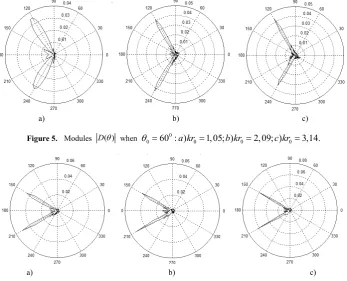
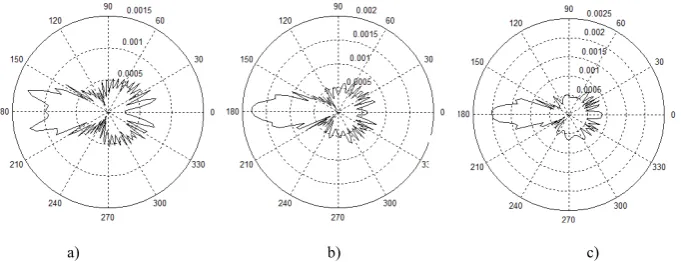
Figure 3. The coordinate system associated with the hemispheres. In the figures 4 - 7 for the non – analytical scatterer with the ratio of body length L with the radius
r
0equal to 25.8 at different angles of incidence of a plane wave and different wave sizes of the scatterer modules angular characteristics of scattering shows.a) b)
Figure 4. Modules ( )Dθ when 0
0 90 : )a kr0 1,05; )b kr0 2,09.
θ = = =
At all figures clearly observed diffraction (shadow) petal, and it grows and shrinks with increasing frequency. On the Fig. 4 - 6 the mirror petal is shows, which is similar to the shadow petal with increasing frequency, but in contrast, limited asymptotically. You may notice that the angular diagrams of the non – analytical scatterer are very similar to the angular characteristics of the scattering elongated spheroids (ideal and elastic) with the ratio of the semi-axes 1:10 [13, 24, 30, 31]. In contrast to works [12 - 14], which used a method of integral equations and were calculated for non – analytical body with short cylindrical insert, in this study cylindrical insert was much longer.
[image:3.595.124.232.226.363.2]a) b) c)
Figure 5. Modules ( )Dθ when θ =0 60 : )0 a kr0=1,05; )b kr0=2,09; )c kr0=3,14.
[image:3.595.130.478.457.738.2]a) b) c)
Figure 6. Modules D( )θ when 0
0 30 : )a kr0 4,19; )b kr0 5, 24; )c kr0 6, 28.
[image:3.595.133.482.459.581.2]a) b) c)
Figure 7. Modules D( )θ when 0
0 0 : )a kr0 4,19; )b kr0 5, 24; )c kr0 6, 28.
θ = = = =
4. Conclusions
Based on the method of Green's functions for the solution of problems of sound diffraction on bodies with mixed boundary conditions, in this work the problem of sound scattering on an elongated ( with a ratio of length of a body to its radius) ideal non – analytical forms body is solved. In addition to the analytical solution is made by calculation of the angular scattering characteristics of a wide frequency range (wave sizes) and angles of a plane wave on a non – analytical body.
Acknowledgments
The work was supported as part of research under State Contract no P242 of April 21, 2010, within the Federal Target Program “Scientific and scientific – pedagogical personnel of innova-tive Russia for the years 2009 – 2013”.
REFERENCES
[1] Ionov A.V., Mayorov V. S. Sonar investigation characteristics of underwater objects. Publ. house of the Krylov shipbuilding research
[2] Institute. Saint-Petersburg. 2011. P. 326.
[3] Seybert A. F., Wu T. W. and Wu X. F. Radiation and scattering of acoustic waves from elastic solids and shells using the boundary element method. // J. A. S. A. 1988. V. 84. № 5. P. 1906 – 1912.
[4] Varadan V. V., Varadan V. K., Dragonette L. R. C. Computation of a rigid body scattering by prolate spheroids using the T – matrics approach. // J. A. S. A. 1982. V. 84. № 1. P. 22 – 25.
[5] Brebbia K.,Walker C. Application of the boundary element method in engineering. Moscow, Mir, 1982. P.248.
[6] Aben M. Kh., Lage A. Ya.Calculation of diffraction of elastic shells in a liquid by the methods of boundary and finite elements. // Pro- ceedings of the Symposium “Interaction of acoustic waves with elastic bodies”. Tallinn.
1989. P. 7 – 10.
[7] Cyaes А. L. Diffraction of sound on the shells of complicated shape. // Proceedings of the Symposium “Interaction of acoustic waves with elastic bodies”. Tallinn. 1989. P. 127 – 130.
[8] Lahe A. Ya. Algorithm of the finite element method for calculation of echo signals from the shells in the liquid. // Proceedings of the Tallinn Polytechnic Institute.1984. № 575. P. 65 – 67.
[9] Kupradze V.D. Methods of potentials in the theory of elasticity. Moscow, Fizmatgiz, 1963. P.472.
[10] Tetuchin М. U., Fedoryc М. V. Diffraction of a plane of the sound wave on the prolate a rigid body in a fluid. // Acoustical journal. 1989. V. 35. № 1. P. 126 – 131.
[11] Su J.-H., Varadan V. V., Varadan V. K., Flax L. Acoustic wave scattering by a finite elastic cylinder in water. // J. A. S. A. 1980. V. 68. № 2. P. 685 – 691.
[12] Dushin A. Yu., Ilmenkov S.L., Kleshchev A. A. Postnov V.A. Application of the finite element method for solving the problem of sound radiation elastic shells. // Proceedings of the Symposium “Interaction of acoustic waves with elastic bodies”. Tallinn. 1989. P. 89 – 91. [13] Kleshchev A. A. Sound scattering perfect bodies of the
non-analytical form. // Publ.house of the Saint-Petersburg State Navy Technical University, Ship systems. 1989. P. 95 – 99.
[14] Kleshchev A. A. Acoustic Scatterers//The second publication. Saint-Petersburg. Prima, 2012. P. 267.
[15] Kleshchev A. A. Method of Integral Equations in Problem of Sound Diffraction on Bodies of Non – analytical Form. // MECH. 2012. V. 2. № 6. P. 124 – 128.
[16] Peterson B., Strom S. Matrix Formulation of Acoustic Scattering from Multilaytred Scatterers. // J. A. S. A. 1975. V. 57. № 1. P. 2 – 13.
[17] Numrich S. K., Varadan V. V., Varadan V. K. Scattering of acoustic waves by a finite elastic cylinder immersed in water. // J. A. S. A. 1981. V. 70. № 5. P. 1407 – 1411.
[18] Babich V. М., Buldyrev V. S. Asymptotic methods in problems of diffraction of short waves. The method of reference tasks. Moscow, Nauka, 1972. P.456.
heterogeneous mediums. Moscow, Nauka, 1980. P.304. [20] Kaminetzky L., Keller J. B. Diffraction coefficients for
higher order edges and vertices. // SLAM. J. Appl. Math. 1972. V. 22. № 1. P. 109 – 134.
[21] Keller J. B. Diffraction by smooth cylinder. // Trans. IRE AP-4. 1956. № 3. P. 312 – 321.
[22] Keller J. B., Lewis R. M., Secler B. D. Asymptotic solution of some diffraction problems. // Comm. Pure and Appl. Math. 1956. V. 9. № 2. P. 207 – 265.
[23] Kleshchev A. A. Diffraction of sound on bodies with mixed boundary conditions. // Acoustical journal. 1974. V. 20. № 4. P. 632 – 634.
[24] Kleshchev A. A. About the precision of the method of Green’s functions. // Publ. house of the Saint-Petersburg State Navy Technical University, Acoustics of ships and oceans.1984. P. 19 – 24.
[25] Kleshchev A. A., Klyukin I. I. Fundamentals of hydro-acoustics, Leningrad: Shipbuilding, 1987. P.224. [26] Shenderov E.L. Wave problems of hydro-acoustic. L.:
Shipbuilding, 1972.P.350.
[27] Baker D. D. Determination of Far – Field Characteristics of Large Underwater Sound Transducers from Near – Field Measurements. // J. A. S. A. 1962. V. 34. № 11. P. 1737. [28] Morse P., Feshbach H. Methods of theoretical physics. V. 1,
2. Moscow: Foreign literature. 1958, 1960.
[29] Ilmenkov S.L. About using the method of Green’s functions for the calculation of sound fields. // Proceedings of the IV Far Eastern conference on acoustics. Vladivostok, 1986. P. 73 – 75.
[30] Kleshchev A. A. Method of integral equations in the problem of diffraction of sound on an elastic shell non-analytical form. // Journal of technical acoustics. 1993. V. 2. № 4(6). P.65 – 66.
[31] Kleshchev A. A. Diffraction and propagation of waves in the elastic mediums and bodies.// Saint-Petersburg: Vlas, 2002. P.156 .