Solution of DGLAP Evolution Equation for
𝒙𝒙𝑭𝑭
𝟑𝟑
Structure Function in Leading and Next-to-Leading
Order at Small-
𝒙𝒙
N. M. Nath
1, 2,*, N. Baruah
1, J. K. Sarma
1, M. K. Das
11HEP Laboratory, Department of Physics, Tezpur University, Napaam-784028, Tezpur, Assam, India
2Department of Physics, Rajiv Gandhi University, Rono Hills, Doimukh, Itanagar-791112, Arunachal Pradesh, India
*Corresponding Author: [email protected]
Copyright © 2014 Horizon Research Publishing All rights reserved.
Abstract
This report attempts to the phenomenological study of the charged-current neutrino deep-inelastic scattering (DIS) within the perturbative QCD framework. The study is based on the solution of the Dokshitzer-Gribov-Lipatov-Altarelli-Parisi (DGLAP) evolution equation in leading and next-to-leading order at small-x for parity-violating DIS structure function𝑥𝑥𝐹𝐹3(𝑥𝑥, 𝑄𝑄2) by means of Taylor expansion method. The solutions are analyzed phenomenologically in comparison with the experimental data taken from CCFR, NuTeV, CHORUS and CDHSW collaborations.
Keywords
Neutrino-Nucleon Scattering, DGLAP Evolution Equation, 𝑥𝑥𝐹𝐹3(𝑥𝑥, 𝑄𝑄2) Structure Function1. Introduction
Considerable effort has been devoted to obtain clear and reliable quantitative information about the QCD observables such as scaling violation, strong coupling constant, QCD sum rules and distribution of quarks and gluons in the nucleons by means of lepton-nucleon deep inelastic scattering (DIS) for the last three decades. Leptons used in deep inelastic processes are either charged leptons (electron or muon) or neutrinos which scatter off the target nucleons via the electromagnetic or weak interactions respectively. As neutrinos interact weakly with other particles, due to parity violation in the weak interaction the 𝑥𝑥𝐹𝐹3(𝑥𝑥, 𝑄𝑄2) structure function appears in neutrino DIS. The 𝑥𝑥𝐹𝐹3(𝑥𝑥, 𝑄𝑄2) structure function receives contributions from non-singlet part of the co-efficient function only and reflects only the valence quark distributions. It is free from sea quark and gluon densities about which we have very poor information in particular in the small-x region [1, 2]. So it helps in proper interpretation of experimental data which can provide valuable insights in
to the origin of nuclear force and helps us to understand various nuclear effects[1-7]. Therefore the studies on neutrino-DIS as well as 𝑥𝑥𝐹𝐹3(𝑥𝑥, 𝑄𝑄2) structure function have been the most active frontiers in both theoretical and experimental particle physics. Recently available differential cross-sections and structure functions in neutrino-DIS experiments are from the experiments in CCFR [8] and NuTeV [9] at Fermilab, and CHORUS [10] and CDHSW [11] at CERN. These measurements have been done for heavy nuclear targets of iron and lead. Theoretically there are various QCD evolution equations to obtain the quark and gluon distribution functions such as Dokshitzer-Gribov-Lipatov-Altarelli-Parisi (DGLAP), Balitsky-Fadin-Kuraev-Lipatov(BFKL), Ciafaloni-Catani- Fiorani-Marchesini (CCFM), Balitsky-Kovchegov (BK), Gribov-Levin-Ryskin (GLR) etc., in different kinematical regions. Among these evolution equations, BFKL or GLR equations are more appealing at small-x, but still the DGLAP evolution equation is used to study various structure functions because this equation is a simple perturbative tool which is relevant for the presently accessible x-Q2 range of structure functions. In this paper we have obtained the
𝑥𝑥𝐹𝐹3(𝑥𝑥, 𝑄𝑄2) structure function by solving the DGLAP evolution equation analytically in leading-order (LO) and next-to-leading order (NLO) at small-x using the Taylor series expansion method which was developed in Ref. [17-23]. Application of Tailor series expansion method reduces the integro-differential DGLAP equation to the first-order linear differential equation, which in turn can be solved easily. The solutions are then analyzed in comparison with experimental data taken from CCFR, NuTeV and CHORUS collaborations. It is observed that our theoretical results agree well with these experimental data. The agreement of the theoretical as well as experimental data reflects that the Taylor series method is a significant method in order to study the small- 𝑥𝑥 behavior of the
2. Theory
The DGLAP evolution equation for 𝑥𝑥𝐹𝐹3(𝑥𝑥, 𝑄𝑄2) = 𝐹𝐹(𝑥𝑥, 𝑄𝑄2) structure function in standard form is given by 𝜕𝜕𝐹𝐹�𝑥𝑥,𝑄𝑄2�
𝜕𝜕𝑄𝑄2 = ∫ 𝑑𝑑𝑑𝑑
𝑑𝑑 𝐹𝐹 � 𝑑𝑑
𝑥𝑥, 𝑄𝑄2� 𝑃𝑃(𝑑𝑑) (1) where𝑃𝑃(𝑑𝑑) is the splitting function defined by
𝑃𝑃(𝑑𝑑) =𝛼𝛼(𝑄𝑄2𝜋𝜋 𝑃𝑃2) 0(𝑑𝑑) + �𝛼𝛼(𝑄𝑄2)
2𝜋𝜋 �
2
𝑃𝑃1(𝑑𝑑) + ⋯
Here 𝑃𝑃0(𝑑𝑑) and𝑃𝑃1(𝑑𝑑)are the splitting functions in LO and NLO respectively [24, 25]. Substituting the splitting functions in “(1)”, the DGLAP equation in LO and NLO becomes
𝜕𝜕𝐹𝐹(𝑥𝑥,𝑡𝑡 ) 𝜕𝜕𝑡𝑡 =
𝛼𝛼�𝑄𝑄2� 2𝜋𝜋 �
2
3{3 + 4 ln(1 − 𝑥𝑥)}𝐹𝐹(𝑥𝑥, 𝑡𝑡) + 𝐼𝐼1(𝑥𝑥, 𝑡𝑡)�(2a) and
𝜕𝜕𝐹𝐹(𝑥𝑥,𝑡𝑡 ) 𝜕𝜕𝑡𝑡 =
𝛼𝛼�𝑄𝑄2� 2𝜋𝜋 �
2
3{3 + 4 ln(1 − 𝑥𝑥)}𝐹𝐹(𝑥𝑥, 𝑡𝑡) + 𝐼𝐼1(𝑥𝑥, 𝑡𝑡)� + � 𝛼𝛼(𝑡𝑡)
2𝜋𝜋� 2
𝐼𝐼2(𝑥𝑥, 𝑡𝑡) (2b) respectively. Where 𝑡𝑡 = ln𝑄𝑄Λ22and Λ is the QCD cut-off parameter. The integral functions are given by
𝐼𝐼1(𝑥𝑥, 𝑡𝑡) = � (1 − 𝑑𝑑) �𝑑𝑑𝑑𝑑 1 + 𝑑𝑑 2
𝑑𝑑 𝐹𝐹 � 𝑥𝑥
𝑑𝑑, 𝑡𝑡� − 2𝐹𝐹(𝑥𝑥, 𝑡𝑡)�
1
𝑥𝑥 and
𝐼𝐼2(𝑥𝑥, 𝑡𝑡) = 𝑘𝑘. 𝐹𝐹(𝑥𝑥, 𝑡𝑡) + � 𝑑𝑑𝑑𝑑𝑑𝑑 𝑓𝑓(𝑑𝑑)𝐹𝐹 �𝑑𝑑𝑥𝑥, 𝑡𝑡� 1
𝑥𝑥 with
𝑘𝑘 = �𝐶𝐶𝐹𝐹2�38−12𝜋𝜋2+ 𝜍𝜍(3) − 8𝑆𝑆̃(∞)� +12𝐶𝐶𝐹𝐹𝐶𝐶𝐴𝐴�1217− 119 𝜋𝜋2− 𝜍𝜍(3) + 8𝑆𝑆̃(∞)� + 𝐶𝐶𝐹𝐹𝑇𝑇𝑅𝑅𝑁𝑁𝐹𝐹�16+29𝜋𝜋2�� and
𝑓𝑓(𝑑𝑑) = �𝐶𝐶𝐹𝐹2{𝑃𝑃𝐹𝐹(𝑑𝑑) − 𝑃𝑃𝐴𝐴(𝑑𝑑)} +12𝐶𝐶𝐹𝐹𝐶𝐶𝐴𝐴{𝑃𝑃𝐺𝐺(𝑑𝑑) + 𝑃𝑃𝐴𝐴(𝑑𝑑)} + 𝐶𝐶𝐹𝐹𝑇𝑇𝑅𝑅𝑁𝑁𝐹𝐹𝑃𝑃𝑁𝑁𝐹𝐹(𝑑𝑑)�, which are obtained from the splitting functions [24, 25].
Now let us consider a new variable 𝑢𝑢 such that 𝑢𝑢 = 1 − 𝑑𝑑 and 𝑑𝑑𝑥𝑥 =1−𝑢𝑢𝑥𝑥 = 𝑥𝑥 +1−𝑢𝑢𝑥𝑥𝑢𝑢 = 𝑥𝑥 + 𝑥𝑥 ∑∝ 𝑢𝑢𝑖𝑖
𝑖𝑖=0 as discussed elsewhere earlier [17-23]. we can expand the term 𝐹𝐹 �𝑑𝑑𝑥𝑥, 𝑡𝑡� applying Taylor expansion method as
𝐹𝐹 �𝑑𝑑𝑥𝑥, 𝑡𝑡� = 𝐹𝐹 �1 − 𝑢𝑢𝑥𝑥 , 𝑡𝑡� = 𝐹𝐹 �𝑥𝑥 +1 − 𝑢𝑢𝑥𝑥𝑢𝑢 , 𝑡𝑡�
= 𝐹𝐹 �𝑥𝑥 + 𝑥𝑥 � 𝑢𝑢𝑖𝑖 ∝
𝑖𝑖=0
, 𝑡𝑡�
= 𝐹𝐹(𝑥𝑥, 𝑡𝑡) + �𝑥𝑥 � 𝑢𝑢𝑖𝑖 ∝
𝑖𝑖=1
�𝜕𝜕𝐹𝐹(𝑥𝑥, 𝑡𝑡 )𝜕𝜕𝑥𝑥 + �𝑥𝑥 � 𝑢𝑢𝑖𝑖 ∝
𝑖𝑖=1
�
2
𝜕𝜕2𝐹𝐹(𝑥𝑥, 𝑡𝑡 )
𝜕𝜕2𝑥𝑥 + ⋯ … … ….
= 𝐹𝐹(𝑥𝑥, 𝑡𝑡) + �𝑥𝑥1 − 𝑢𝑢𝑢𝑢 �𝜕𝜕𝐹𝐹(𝑥𝑥, 𝑡𝑡 )𝜕𝜕𝑥𝑥 + �𝑥𝑥1 − 𝑢𝑢𝑢𝑢 �2𝜕𝜕2𝐹𝐹(𝑥𝑥, 𝑡𝑡 )𝜕𝜕2𝑥𝑥 + ⋯ … … ….
Again it has been observed that when we solve DGLAP evolution equation like second order partial differential equation by Monges method, which is produced by introducing the second order term in Taylor expansion above, it becomes ultimately the first order partial differential equation as before due to the form of the DGLAP equation[23]. Similarly by introducing more terms of Taylor expansion, we hope the same. Moreover, for the smaller values of x, the terms in the expansion containing 𝑥𝑥2 and higher powers of 𝑥𝑥 can be neglected [17-23]. Thus using the first two terms of the Taylor expansion series we can write
Substituting this expansion in “(2a)” and “(2b)” and performing u-integrations we get these equations as 𝜕𝜕𝐹𝐹(𝑥𝑥,𝑡𝑡 )
𝜕𝜕𝑡𝑡 = 𝑎𝑎
𝑡𝑡�𝑃𝑃(𝑥𝑥)𝐹𝐹(𝑥𝑥, 𝑡𝑡) + 𝑄𝑄(𝑥𝑥) 𝜕𝜕𝐹𝐹(𝑥𝑥,𝑡𝑡 )
𝜕𝜕𝑥𝑥 � (3a) 𝜕𝜕𝐹𝐹(𝑥𝑥,𝑡𝑡 )
𝜕𝜕𝑡𝑡 = 𝑎𝑎 𝑡𝑡�1 − 𝑏𝑏
ln 𝑡𝑡
𝑡𝑡 � �𝑅𝑅(𝑥𝑥)𝐹𝐹(𝑥𝑥, 𝑡𝑡) + 𝑆𝑆(𝑥𝑥) 𝜕𝜕𝐹𝐹(𝑥𝑥,𝑡𝑡 )
𝜕𝜕𝑥𝑥 � (3b) Where,
𝑃𝑃(𝑥𝑥) = 23(1 + 2𝑥𝑥 − 2 ln 𝑥𝑥 + 4 ln(1 − 𝑥𝑥)),
𝑄𝑄(𝑥𝑥) = 43(1 − 𝑥𝑥2),
𝑅𝑅(𝑥𝑥) = 𝑃𝑃(𝑥𝑥) + 𝑇𝑇0��∫𝑥𝑥1𝑑𝑑𝑑𝑑𝑑𝑑 𝑓𝑓(𝑑𝑑)� + 𝑘𝑘�,
𝑆𝑆(𝑥𝑥) = 𝑄𝑄(𝑥𝑥) + 𝑇𝑇0𝑥𝑥 ��∫ 𝑓𝑓(𝑑𝑑)(1 − 𝑑𝑑)𝑥𝑥1 𝑑𝑑𝑑𝑑𝑑𝑑2��,
𝑎𝑎 = 𝛽𝛽2
0, and 𝑏𝑏 = 𝛽𝛽1
𝛽𝛽02. Here 𝛽𝛽0= 11 − 2
3𝑁𝑁𝐹𝐹 and 𝛽𝛽1= 34
3 𝐶𝐶𝐺𝐺2− 10
3 𝐶𝐶𝐺𝐺𝑁𝑁𝐹𝐹− 2𝐶𝐶𝐹𝐹𝑁𝑁𝐹𝐹 are the one-loop and two-loop corrections to the QCD 𝛽𝛽 function with 𝐶𝐶𝐺𝐺= 𝐶𝐶𝐴𝐴= 𝑁𝑁𝐶𝐶 = 3, 𝐶𝐶𝐹𝐹=43, 𝑇𝑇𝐹𝐹 =12𝑁𝑁𝐹𝐹, 𝑁𝑁𝐹𝐹 being the number of flavor. Here we have considered 𝑁𝑁𝐹𝐹 = 3.
Again, here we have considered a numerical (not arbitrary) parameters 𝑇𝑇0such that 𝑇𝑇2(𝑡𝑡) = 𝑇𝑇0. 𝑇𝑇(𝑡𝑡) with 𝑇𝑇(𝑡𝑡) =𝛼𝛼(𝑡𝑡)2𝜋𝜋 (see [17-23] for more details). The values of the parameters 𝑇𝑇0 is chosen such that the differences between 𝑇𝑇2(𝑡𝑡) and
𝑇𝑇0. 𝑇𝑇(𝑡𝑡)is very small in the range of consideration. Within the range 0 < 𝑄𝑄2≤ 30 of our consideration it is observed to be
𝑇𝑇0= 0.05. Due to the introduction of these parameters the numerical error is very much less as compared to other errors especially in NLO.
The general solution of “(3a)”is (𝑈𝑈, 𝑉𝑉) = 0, where 𝐹𝐹(𝑈𝑈, 𝑉𝑉) is an arbitrary function. Here 𝑈𝑈�𝑥𝑥, 𝑡𝑡, 𝐹𝐹(𝑥𝑥, 𝑡𝑡)� = 𝐶𝐶1 and
𝑉𝑉�𝑥𝑥, 𝑡𝑡, 𝐹𝐹(𝑥𝑥, 𝑡𝑡)� = 𝐶𝐶2 are two independent solutions of the Lagrange’s equation 𝑑𝑑𝑥𝑥
𝑎𝑎𝑄𝑄(𝑥𝑥)= 𝑑𝑑𝑡𝑡 −𝑡𝑡=
𝑑𝑑𝐹𝐹(𝑥𝑥,𝑡𝑡)
−𝑎𝑎 𝑃𝑃(𝑥𝑥) 𝐹𝐹(𝑥𝑥,𝑡𝑡) (4a) which are given by
𝑈𝑈�𝑥𝑥, 𝑡𝑡, 𝐹𝐹(𝑥𝑥, 𝑡𝑡)� = 𝑡𝑡. 𝑒𝑒𝑥𝑥𝑒𝑒 ��1𝑎𝑎 𝑄𝑄(𝑥𝑥)1
𝑥𝑥 𝑑𝑑𝑥𝑥�
and
𝑉𝑉�𝑥𝑥, 𝑡𝑡, 𝐹𝐹(𝑥𝑥, 𝑡𝑡)� = 𝐹𝐹(𝑥𝑥, 𝑡𝑡) 𝑒𝑒𝑥𝑥𝑒𝑒 �∫𝑥𝑥1𝑃𝑃(𝑥𝑥)𝑄𝑄(𝑥𝑥) 𝑑𝑑𝑥𝑥� respectively. It is known that the “(4a)” has no unique solution and the simplest possible solution is the linear combination 𝛼𝛼 𝑈𝑈 + 𝛽𝛽 𝑉𝑉 = 0 satisfying 𝐹𝐹(𝑈𝑈, 𝑉𝑉) = 0, where 𝛼𝛼, 𝛽𝛽 are two arbitrary constants. Thus the simplest solution can be written as
𝐹𝐹(𝑥𝑥, 𝑡𝑡) = 𝑥𝑥𝐹𝐹3(𝑥𝑥, 𝑡𝑡 ) = 𝛾𝛾 𝑡𝑡 𝑒𝑒𝑥𝑥𝑒𝑒 �∫ �𝑥𝑥1 𝑎𝑎 𝑄𝑄(𝑥𝑥)1 −𝑃𝑃(𝑥𝑥)𝑄𝑄(𝑥𝑥)� 𝑑𝑑𝑥𝑥� (5) with 𝛾𝛾 = −𝛼𝛼𝛽𝛽. Now defining an input point
𝑥𝑥𝐹𝐹3(𝑥𝑥, 𝑡𝑡0) = 𝛾𝛾 𝑡𝑡0 𝑒𝑒𝑥𝑥𝑒𝑒 �� �𝑎𝑎 𝑄𝑄(𝑥𝑥) −1 𝑄𝑄(𝑥𝑥)� 𝑑𝑑𝑥𝑥𝑃𝑃(𝑥𝑥) 1
𝑥𝑥 �
at 𝑄𝑄2= 𝑄𝑄
02, for which 𝑡𝑡 = 𝑡𝑡0, we get from “(5)”
𝑥𝑥𝐹𝐹3(𝑥𝑥, 𝑡𝑡 ) = 𝑥𝑥𝐹𝐹3(𝑥𝑥, 𝑡𝑡0) �𝑡𝑡𝑡𝑡0� (6a) This gives the 𝑡𝑡- evolution of 𝑥𝑥𝐹𝐹3(𝑥𝑥, 𝑡𝑡 )structure function in LO.
Proceeding in the same manner, the solution of the Lagrange’s equations
𝑑𝑑𝑥𝑥 𝑎𝑎𝑆𝑆(𝑥𝑥) =
𝑑𝑑𝑡𝑡
−𝑡𝑡 �1 − 𝑏𝑏 ln 𝑡𝑡𝑡𝑡 �=
𝑑𝑑𝐹𝐹(𝑥𝑥, 𝑡𝑡) −𝑎𝑎 𝑅𝑅(𝑥𝑥) 𝐹𝐹(𝑥𝑥, 𝑡𝑡)
obtained from the “(3b)” lead towards the t-evolution of 𝑥𝑥𝐹𝐹3(𝑥𝑥, 𝑡𝑡 )structure function in NLO which is given by
𝑥𝑥𝐹𝐹3(𝑥𝑥, 𝑡𝑡 ) = 𝑥𝑥𝐹𝐹3(𝑥𝑥, 𝑡𝑡0) �𝑡𝑡�1+𝑏𝑏𝑡𝑡� 𝑡𝑡0�1+ 𝑏𝑏𝑡𝑡0�
� 𝑒𝑒𝑥𝑥𝑒𝑒 �𝑏𝑏 �1𝑡𝑡−𝑡𝑡1
3. Result and Discussion
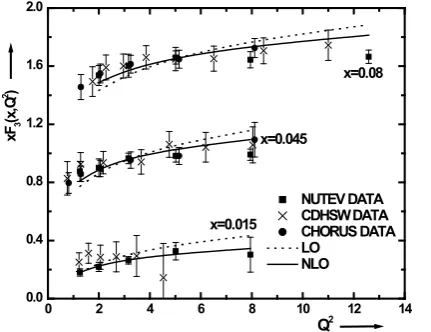
[image:4.595.77.280.254.415.2]The results of the calculation of𝑥𝑥𝐹𝐹3(𝑥𝑥, 𝑡𝑡 ) structure function using“(6a)” and “(6b)” are depicted in figures Fig.1 and Fig. 2 in comparison with the experimental data taken from CCFR[8], NuTeV[9], CHORUS[10] and CDHSW[11] collaborations. As NuTeV, CHORUS and CDHSW data have the similar x bins (within our range 𝑥𝑥 < 0.1 of consideration), therefore they are combined in Fig. 2, and the CCFR data, at different x, plotted separately in Fig. 1. One important point to be noted is that one cannot make absolute predictions for structure functions in QCD. The DGLAP equation can only be solved once an initial distribution or an input point is given [26] i.e. if, for example,
Figure 1. 𝑄𝑄2-evolution of 𝑥𝑥𝐹𝐹
3(𝑥𝑥, 𝑄𝑄2)structure function in LO and NLO in comparison with experimental data taken from CCFR. For clarity, data are scaled up by +0.5i (i = 0, 1, 2 …) starting from the bottom of all graphs.
Figure 2. 𝑄𝑄2-evolution of 𝑥𝑥𝐹𝐹
3(𝑥𝑥, 𝑄𝑄2) structure function in LO, and NLO in comparison with experimental data taken from NuTeV, CHORUS and CDHSW collaborations. For clarity, data are scaled up by +0.5i (i = 0, 1, 2…) starting from the bottom.
𝑥𝑥𝐹𝐹3(𝑥𝑥, 𝑄𝑄02)is given for all values of x at a given 𝑄𝑄02, the
𝑥𝑥𝐹𝐹3(𝑥𝑥, 𝑄𝑄2) may be calculated by “(6a)”. Here we have considered the points with minimum experimental errors as input points at different values of x and evolved the
𝑥𝑥𝐹𝐹3(𝑥𝑥, 𝑡𝑡) structure functions against this points. Form Fig. 1 and Fig. 2, it is observed that our theoretical results,
particularly when NLO effect is considered, agree well with the experimental data for smaller values of 𝑥𝑥.
4. Conclusion
We have calculated the structure functions 𝑥𝑥𝐹𝐹3(𝑥𝑥, 𝑄𝑄2) in neutrino-nucleon DIS at small-x by solving the DGLAP evolution equation applying Taylor series expansion method and studied phenomenologically in comparison with experimental data taken from CCFR, NuTeV, CHORUS and CDHSW collaborations. As the applied method gives an arbitrary parameter free analytical solution of DGLAP evolution equation which agrees well with experimental results at small-x, it can be considered as an alternative among the various methods [27-29] in order to study the small-x behavior of the structure functions.
REFERENCES
[1] L. F. Abbott, and R Michael Barnett, The effect of 1/𝑄𝑄2 and
𝛼𝛼𝑠𝑠 correction on tests of QCD, Annals of Physics, Vol. 125, pp. 276-308, 1980 (and the references therein).
[2] Janet M. Conrad, Michael H. Shaevitz and Tim Bolton,
“Precision measurements with high-energy neutrino beams,” Review of Modern Physics, Vol. 70, 1341-1392, 1998 (and the references therein).
[3] S AKulagin, Nuclear effects in the F3 structure function for
finite and asymptotic Q2, Nuclear Physics AVol. 640, pp.
435-456, 1998.
[4] S A Kulagin, Nuclear effects and higher twists in F3 structure
function, European Physics Journal A Vol. 9, pp. 261-267, 2000.
[5] S A Kulagin and R Petti, Neutrino inclusive inelastic
scattering off nuclei, Phys. Rev. DVol. 76, pp. 094023(1-24), 2007.
[6] Athar M Sajjad et al, Nuclear effects in F3 structure function of nucleon, PhysicsLetters B, Vol. 668, pp. 133-142, 2008.
[7] M Hirai, S Kumano and K Saito, Nuclear effect in
neutrino-nucleus DIS,arxiv:hep-ph/0909.2329.
[8] W. G. Seligman et al., Improved determination of 𝛼𝛼𝑠𝑠 from neutrino nucleon scattering, Physical Review Letters, Vol. 79, pp. 1213-1216, 1997.
[9] M. Tzanov et al., Precise Measurement of neutrino and
anti-neutrino differential cross section, Physical Review D, Vol. 74, Article ID 012008, 16 pages, 2006.
[10] G. Onengut et al., Measurements of nucleon structure
functions in neutrino scattering, Physics Letters B, Vol. 632, pp. 65-75, 2006.
[11] J. P. Berge et al., A measurement of differential cross-sections and nucleon structure functions in charged current neutrino interactions on iron,𝑍𝑍𝑒𝑒𝑖𝑖𝑡𝑡𝑠𝑠𝑍𝑍ℎ𝑟𝑟𝑖𝑖𝑓𝑓𝑡𝑡 𝑓𝑓𝑢𝑢̈𝑟𝑟 𝑃𝑃ℎ𝑦𝑦𝑠𝑠𝑖𝑖𝑘𝑘 𝐶𝐶,Vol. 49, pp. 187-224, 1991.
0 3 6 9 12 15 18 21
0.0 0.5 1.0 1.5 2.0 2.5 3.0 3.5
x=0.07
x=0.05
x=0.035
x=0.025
x=0.0175
x=0.0125
xF3
(x,
Q
2)
Q2
CCFR DATA LO NLO
0 2 4 6 8 10 12 14
0.0 0.4 0.8 1.2 1.6 2.0
Q2
xF3
(x,
Q
2)
x=0.08
x=0.045
x=0.015
NUTEV DATA CDHSW DATA CHORUS DATA LO
[image:4.595.73.289.463.629.2][12] A D Martin, W J Stirling, R S Thorne and G Watt,Parton
distributions for the LHC,EuropeanPhysics Journal C, Vol.
63, p. 189, 2009.
[13] V. N. Gribov and L. N. Lipatov, Deep inelastic ep scattering in perturbation theory, Soviet Journal of Nuclear Physics, Vol. 15, p. 438, 1972.
[14] L. N. Lipatov, The parton model and perturbation theory,
Soviet Journal of Nuclear Physics, Vol. 20, p. 94, 1975. [15] Yu. L. Dokshitzer, Calculation of the structure functions for
deep inelastic scattering and e+ e− annihilation by
perturbation theory in Quantum Chromodynamics, Soviet
Physics Journal of Experimental and Theoretical Physics, Vol. 46, pp. 641–653, 1977.
[16] G. Altarelli and G. Parisi, Asymptotic freedom in parton
language, Nuclear Physics B, Vol. 126, no. 2, pp. 298–318,
1977.
[17] M. Devee, R. Baisya and J. K. Sarma, Evolution of singlet
structure functions from DGLAP equation at
next-to-next-to-leading order at small-x,EuropeanPhysics
Journal C,Vol. 72, Article ID. 2036, 11 pages, 2012.
[18] R. Baishya, U. Jamil, and J. K. Sarma, J. K. Evolution of
spin-dependent structure functionsfrom DGLAP equations in leadingorder and next to leadingorder,Physical Review D, Vol. 79, Article ID. 034030, 6 pages, 2009.
[19] R. Baishya, and J. K. Sarma,Method of characteristics and
solution of DGLAP evolutionequation in leading and next to leadingorderatsmallx, Physical Review D, Vol. 79, Article ID. 107702, 3 pages, 2006.
[20] J. Baishya, and J. K. Sarma, Semi numerical solution of
non-singlet Dokshitzer-Gribov-Lipatov-Altarelli-Parisi (DGLAP) evolutionequation up to
next-to-next-to-leadingorderatsmallx, EuropeanPhysics
Journal C,Vol. 60, pp. 585-591, 2009.
[21] D K Choudhury and Saiful Islam, An analysis of non-singlet
structure function in next-to-next-to-leading order at small-x,Indian Journal of Physics,Vol. 85, pp. 319-328, 2011.
[22] N. N. K. Borah, D. K. Choudhury, and P. K. Sahariah,
“Comparison of Analytical Solution of DGLAP Equations for
𝐹𝐹2𝑁𝑁𝑆𝑆(𝑥𝑥, 𝑡𝑡)at Small 𝑥𝑥 by Two Methods, Advances in High
Energy Physics, Vol. 2013, Article ID 829803, 10 pages, 2013.
[23] D. K. Choudhury, J. K. Sarma and G. K. Medhi, t and
x-Evolution of gluon structure functions at low-x, Gauhati University Journal of Science, Golden Jubilee volume, pp. 39-53, 1998.
[24] S. Moch, J. A. M. Vermaseren and A. Vogt, The three-loop
splitting functions in QCD: the non-singlet case,NuclearPhysics B,Vol. 688, pp. 101-134, 2004.
[25] R. T. Herrrod and S. Wada, Altarelli-Parisi Equation in the
Next-to-LeadingOrder,PhysicsLetters B, Vol. 96, p. 195,
1980.
[26] Y. L. Dokshitzer, V. A. Khoze, A. H. Mueller and S. I. Troyan, Basics of Perturbative QCD, Frontierseditions, 1991.
[27] R. Toldra, A C++ code to solve the DGLAP equations applied
to Ultra High Energy Cosmic Rays, Computational Physics
Communication, Vol. 143, pp. 287-304, 2002.
[28] N. Cabibbo and R. Petronzio, Two-stage model of hadron
structure: Parton distributions and their Q2 dependence,
Nucearl Physics B Vol. 137, pp. 395-412, 1978.
[29] M. Gluck, E. Reya, and A. Vogt, Radiatively generated parton distributions for high