University of Huddersfield Repository
Chrpa, Lukas, Vallati, Mauro, Kitchin, Diane E. and McCluskey, Thomas Leo
Generating Macrooperators by Exploiting Inner Entanglements
Original Citation
Chrpa, Lukas, Vallati, Mauro, Kitchin, Diane E. and McCluskey, Thomas Leo (2013) Generating
Macrooperators by Exploiting Inner Entanglements. In: Proceedings / The Tenth Symposium on
Abstraction, Reformulation, and Approximation (SARA 2013). AAAI Press, Palo Alto, Calif. ISBN
9781577356301
This version is available at http://eprints.hud.ac.uk/id/eprint/17367/
The University Repository is a digital collection of the research output of the
University, available on Open Access. Copyright and Moral Rights for the items
on this site are retained by the individual author and/or other copyright owners.
Users may access full items free of charge; copies of full text items generally
can be reproduced, displayed or performed and given to third parties in any
format or medium for personal research or study, educational or notforprofit
purposes without prior permission or charge, provided:
•
The authors, title and full bibliographic details is credited in any copy;
•
A hyperlink and/or URL is included for the original metadata page; and
•
The content is not changed in any way.
For more information, including our policy and submission procedure, please
contact the Repository Team at: [email protected].
Generating Macro-operators by Exploiting Inner Entanglements
Luk´aˇs Chrpa
and
Mauro Vallati
and
Thomas Leo McCluskey
and
Diane Kitchin
Knowledge Engineering and Intelligent Interfaces Research Group School of Computing and Engineering
University of Huddersfield
{l.chrpa, m.vallati, t.l.mccluskey, d.kitchin}@hud.ac.uk
Abstract
In Automated Planning, learning and exploiting ad-ditional knowledge within a domain model, in or-der to improve plan generation speed-up and increase the scope of problems solved, has attracted much re-search. Reformulation techniques such as those based on macro-operators or entanglements are very promis-ing because they are to some extent domain model and planning engine independent. This paper aims to ex-ploit recent work oninner entanglements, relations be-tween pairs of planning operators and predicates encap-sulating exclusivity of predicate ‘achievements‘ or ‘re-quirements’, for generating macro-operators. We pro-vide a theoretical study resulting in a set of conditions when planning operators in an inner entanglement rela-tion can be removed from a domain model and replaced by a macro-operator without compromising solvability of a given (class of) problem(s). The effectiveness of our approach will be experimentally shown on a set of well-known benchmark domains using several high-performing planning engines.
Introduction
Because even classical planning is intractable (up to PSPACE-complete (Bylander 1994)), exploiting additional knowledge which is somehow characteristic for a given class of planning problems is a promising way towards making the planning process more efficient. Since the 1970’s, and lately with the help of the Learning Track of the Inter-national Planning Competition (IPC)1, many such learning
techniques have been developed. One of the most studied is the generation and use of macro-operators (macros), en-coded in the same format as the operators forming the plan-ning domain model, but encapsulating a sequence of such (primitive) operators (Dawson and Sikl´ossy 1977; Botea et al. 2005; Newton et al. 2007; Chrpa 2010b). Macros, whose power lies in providing “shortcuts” in the search space, have always been hampered by the problem of utility: used naively, their addition to a domain model can cause an ex-plosion of operator instances.
The use of macros can be considered a technique for
planning problem reformulation, a domain and planner in-dependent way of preprocessing a planning problem (in
1
http://ipc.icaps-conference.org
PDDL (Mcdermott et al. 1998) defined by domain model and problem files) so that a planning engine may be able to solve the problem more efficiently. Another such technique isouter entanglements(Chrpa and Bart´ak 2009), which can be used to reformulate the domain model by effectively removing unpromising operator instances. Inner entangle-ments(Chrpa and McCluskey 2012) are relations between pairs of planning operators and predicates, denoting exclu-sivity of ‘achievement’ or ‘requirement’ of a predicate. That is, one operator achieves a predicate exclusively for an-other operator, or an operator requires a predicate exclu-sively from another operator.
This paper investigates how inner entanglements might be exploited to generate useful macros within a reformu-lation phase of a planning problem. After some theoretical background, we formulate and prove a theorem which en-capsulates a set of sufficient conditions for (i) creating a macro from two primitive operators in an inner entangle-ment relationship, and (ii) safely removing one or both of the primitive operators from the domain model of a given prob-lem. Being able to remove domain operators, while adding macros, ameliorates the main problem of macro utility. We present the results of an empirical evaluation of our inner entanglement-based technique on a set of well-know IPC benchmark domains using state-of-the-art planning engines, showing that in domains where such macros can replace both primitive operators, the reformulation is very effective.
Preliminaries
Classical planning (in state space) deals with finding a se-quence of actions transforming the static, deterministic and fully observable environment from some initial state to a de-sired goal state (Ghallab, Nau, and Traverso 2004).
In the set-theoretic representationatoms, which describe the environment, are propositions.Statesare defined as sets of propositions.Actionsare specified via sets of atoms defin-ing their preconditions, negative and positive effects (i.e.,
a= (pre(a),eff−(a),eff+(a))). An actionaisapplicablein a statesif and only ifpre(a)⊆s. Application ofains(if possible) results in a state(s\eff−(a))∪eff+(a).
In the classical representation atoms are predicates. A
(op nameis an unique operator name andx1, . . . xkare
vari-able symbols (arguments) appearing in the operator) and
pre(o),eff−(o) and eff+(o) are sets of (unground) predi-cates. A planning problemis specified via a planning do-main, initial state and set of goal atoms.
The set-theoretic representation can be obtained from the classical representation by grounding. Note that comparing predicates (needed for set operations) is done such that pred-icates are equal if they have the same name and their ar-guments (including their order) are identical. Hereinafter, we will assume that different operators have different argu-ments (unless otherwise stated).Substitutionswhich are sets of mappings from variable symbols to terms are used to de-termine which arguments operators or predicates share. A substitution isminimum(w.r.t. a class of substitutions) if it has the smallest number of elements.
Basic Relations between Actions and Operators
By analysing action or operator schema we can identify how these influence each other. As discussed in Chapman’s ear-lier work (Chapman 1987), an action having some atom in its positive effects is a possible achiever of that atom for some other action having that atom in its precondition. If an action achieves an atom for some other action in some plan, then the first action is a necessary achiever of the atom (hereinafter only achiever) for the other one. Note that be-ing ‘achiever’ refers to a notion “causal link” in plan-space planning. A notion of being a possible achiever can be easily extended for planning operators. Formally:
Definition 1. Letaiandaj be actions. We say thatai
pos-sibly achievesan atompforajif and only ifp∈eff+(ai)∩ pre(aj).
Letoiandojbe planning operators andΘbe a substitution. We say thatoipossibly achievesan atom (predicate)pfor
ojwith respect toΘif and only ifp∈eff+(oi)∩pre(ojΘ). Letha1, a2, . . . anibe a plan. We say that an actionai
nec-essarily achievesan atompfor an actionaj if and only if
i < j,p∈eff+(ai)∩pre(aj)and∀k∈ {i+ 1, . . . , j−1}:
pgnd6∈eff+(ak).
The opposite for being a (possible) achiever is being a (possible) ‘clobberer’ which means that action ai deletes
atom(s)ajhas in its precondition. Clearly, a notion of
nec-essary clobberer is meaningless unless negative precondi-tions are used. Note that being ‘clobberer’ refers to a no-tion “threat” in plan-space planning. A nono-tion of (possible) clobberer can be also easily extended for planning operators. Formally:
Definition 2. Letai andaj be actions. We say thatai is a
clobbererforajif and only if eff−(ai)∩pre(aj)6=∅. Letoiandojbe planning operators andΘbe a substitution. We say thatoiis aclobbererforojwith respect toΘif and only if eff−(oi)∩pre(ojΘ)6=∅.
Inner Entanglements
Inner Entanglements have been recently introduced as rela-tions between pairs of planning operators and atoms (pred-icates) (Chrpa and McCluskey 2012). Inner entanglements
stand for operator exclusivity of ‘achieving’ or ‘requiring’ predicates. In the BlocksWorld (Slaney and Thi´ebaux 2001) it may be observed, for instance, that operatorpickup(?x) achieves predicate holding(?x) exclusively for operator
stack(?x,?y) (and not for operatorputdown(?x)) because
putdown(?x)would just reverse the effects ofpickup(?x). This relation is denoted as an ‘entanglement by succeeding’. Similarly, it may be observed that predicate holding(?x) for operatorputdown(?x)is exclusively achieved by
oper-atorunstack(?x,?y)(and not by operatorpickup(?x))
be-cause againputdown(?x)would just reverse the effects of pickup(?x). This relation is denoted as an ‘entanglement by preceding’. Informally speaking, inner entanglements pro-vide constraints affecting ordering of operators’ instances in solution plans. If an operator o1 is entangled by a suc-ceeding operatoro2with a predicatepin a given planning
problem, then in some solution plan instances of o1 are at some point followed by corresponding instances of o2and no corresponding instance of other operator havingpin its precondition cannot be placed in between them. Similarly, if an operatoro2is entangled by a preceding operatoro1with a
predicatepin a given planning problem, then in some solu-tion plan instances ofo2are at some point preceded by
cor-responding instances ofo1and no corresponding instance of other operator havingpin its positive effects can be placed in between them. This is formalized in the following defini-tion (note that in (Chrpa and McCluskey 2012) the definidefini-tion below refers to strict inner entanglements).
Definition 3. LetP be a planning problem. Leto1 ando2
be planning operators, pbe a predicate (o1, o2 and pare
defined in a planning domain related toP) andΘbe a sub-stitution such thatp∈eff+(o1)andp∈pre(o2Θ). We say
thato1 isentangled by succeedingo2 withpif and only if there exists a solution planπofPand∀a1∈π, instances of o1,∃a2∈π, an instance ofo2Θ, such thata1achievespgnd
(pgndis a grounded instance ofp) fora2.
We also say thato2 isentangled by precedingo1 withpif and only if there exists a solution planπofPand∀a2∈π, instances ofo2Θ,∃a1 ∈π, an instance ofo1, such thata1
achievespgnd(pgnd is a grounded instance ofp) fora2.
Henceforth, entanglements by preceding and succeeding are
denoted asinner entanglements.
A single (inner) entanglement requires only the existence of one plan solving the given planning problem where the entanglement conditions are met and, therefore, different en-tanglements might be met in different solution plans. Aset of compatible entanglements ensures existence of at least one solution plan following all the entanglements in the set (Chrpa and McCluskey 2012). For example, both the BlocksWorld related entanglements mentioned throughout this section forms a set of compatible entanglements. Here-inafter, we will assume that multiple entanglements are a set of compatible entanglements unless stated otherwise.
Determining Macro-operators from Inner
Entanglements
planning operators. Entanglement by succeeding says that a predicate achieved by a given operator can be required only by instances of a specific operator. For a typical prob-lem in the Depots domain, we may observe that the op-erator lift(?hoist, ?crate, ?surface, ?place)is entangled by the succeeding operator load(?hoist, ?crate, ?truck, ?place)with the predicatelifting(?hoist,?crate). Hence, if an instance oflift(e.g.lift(h1,c1,c2,p1)) is executed at the
i-th step of some solution plan, then a corresponding in-stance of load (e.g.load(h1,c1,t1,p1)) is executed at the
j-th step of the plan, wherej > i. Also, no instance of an-other operator requiring (having in its precondition) or con-suming (having in its negative effects) lifting(h1,c1) (e.g.
drop(?hoist, ?crate, ?surface, ?place)) can be executed
in between. Similarly, we may observe that the operator
load(?hoist, ?crate, ?truck, ?place)is entangled by the
preceding operator lift(?hoist, ?crate, ?surface, ?place) with the predicate lifting(?hoist,?crate). Hence, if an in-stance of load (e.g.load(h1,c1,t1,p1)) is executed at the
i-th step of some solution plan, then a corresponding in-stance oflift(e.g.lift(h1,c1,c2,p1)) is executed at thej-th step of the plan, wherej < i. Also, no instance of other op-erator achievinglifting(h1,c1)(e.g.unload(?hoist, ?crate, ?truck, ?place)) can be executed in between. Analogously, we may observe entanglement by preceding and succeed-ing between the operators load(?hoist, ?crate, ?truck,
?place)andunload(?hoist, ?crate, ?truck, ?place)and
the predicatein(?crate,?truck).
Macros, on the other hand, encapsulate situations where corresponding instances of given planning operators are exe-cuted consecutively. For a typical problem in the Depots do-main, we may observe that the operatorsliftandloadcan be assembled (in this order) into a macro in such a way that the arguments?hoist,?crateare shared. However, in the case of the operatorsloadandunloadwe may observe that consec-utive application of instances of these operators results in a situation, where the crate is still at the same place. It is thus necessary to execute thedrive operator in between which moves the truck (and the crate which is loaded in it) from one place to another. Hence, it is not reasonable to assemble
loadandunloadinto a macro.
Inner entanglements indicate pairs of planning operators which are candidates for becoming macros and also deter-mine arguments the operators share since it is known which predicate or predicates are achieved by one operator exclu-sively for another operator or vice versa. Ifo1is entangled by succeeding o2 withp, oro2 is entangled by preceding o1 with p, then o1 ando2 are candidates for becoming a macro, and there is a minimum substitutionΘ (determin-ing which arguments are shared by o1 and o2) such that
p∈ eff+(o1)∩pre(o2Θ). In case the (inner) entanglement holds with more predicates, Θis determined analogously, i.e.,{p1, . . . , pk} ⊆eff+(o1)∩pre(o2Θ). Straightforwardly,
o1 must not be a clobberer foro2with respect toΘ,
other-wise the macro cannot be generated. Also, there must not be another operatorowhose instances must be executed in between instances ofo1ando2. There are two possibilities which have to be addressed (they are formalized in the fol-lowing theorem). Firstly, it might happen that not all the
predicates o2 requires are true after executing o1. Hence, some other operator(s) must achieve these predicates. By analysing inner entanglements we may find out that such operator(s) cannot be an achiever for o2. However, if such an operator is still a possible achiever foro2 and it is also
a clobberer foro1, then it cannot be executed (directly) be-foreo1and, hence, it might have to be executed in between o1 ando2. Secondly,o2 might clobber some predicateso1
achieved. If there exists some other operator which requires some of these predicates, it might be necessary to execute it in between o1 ando2. However, by analysing inner en-tanglements we may find out thato1cannot be an achiever
for such an operator and hence we do not have to consider a possibility of executing this operator in betweeno1ando2.
An inner entanglement between operators also indicates that there exists a solution plan of some planning problem where instances of one operator are always followed or pre-ceded by instances of the other operator. This information is useful because a macro generated from these operators may replace one or both of these operators without affect-ing completeness for that plannaffect-ing problem. Concretely, an entanglement by succeeding means that instances of one op-erator (o1) are always followed by corresponding instances of the other operator (o2) and therefore if a macro is
gen-eratedo2becomes unnecessary. Similarly, an entanglement by preceding means that instances of one operator (o2) are always preceded by corresponding instances of the other op-erator (o1) and therefore if a macro is generatedo1becomes unnecessary. If both inner entanglements hold between o1
ando2, then if a macro is generated botho1ando2becomes unnecessary. However, attention must be given to situations where a single instance of an operator achieve an atom for multiple instances of another operator. For instance, drive may achieve a predicateat(?truck, ?place)for multiple in-stances of theunloadoperator. In such a case, we do not have a one to one matching of operators’ instances and thus a macro cannot replace any of the operators.
These ideas are formalized in the following theo-rem. Keep in mind that since inner entanglements are problem-specific sort of knowledge, the theorem is also problem-specific. However, as it has been shown in earlier works (Chrpa and Bart´ak 2009; Chrpa and McCluskey 2012) we are able to find a set of compatible entanglements that applies for a whole class of ‘typical’ problems in a given domain.
Theorem 1. LetPbe a planning problem. Leto1ando2be planning operators,p∗be a set of predicates (defined inP) such that at least one of the following conditions is met.
(i) ∀p∈ p∗:o
1is entangled by succeedingo2withp
(ii) ∀p∈ p∗:o2is entangled by precedingo1withp
LetΘbe a minimum substitution such thatp∗⊆eff+(o1)∩ pre(o2Θ), and assumeo1is not a clobberer foro2with re-spect to the substitutionΘ. Further, assume that all the fol-lowing conditions hold:
(a) for each operator o in the domain model, and substitution ξ: {p0 | p0 ∈ (eff+(oξ) ∩
ois not entangled by succeedingo0 6= o2withp0 ∧
o2is not entangled by precedingo0 6=owithp0} 6=∅ impliesois not a clobberer foro1with respect toξ.
(b) for each operatoro6=o2, substitutionξand a predicate p0 ∈(pre(oξ)∩(eff+(o1)∩(eff−(o2Θ))), it is the case thato1is entangled by succeedingo0 6=owithp0orois
entangled by precedingo06=o1withp0.
(c) no instance of o1 achieves an instance of a predicate fromp∗for multiple instances ofo2.
Leto1,2be a macro generated fromo1ando2w.r.t.Θ. If the
domain ofPis modified in such a way thato1,2is added,o1
is removed if the condition (i) holds, ando2is removed if the condition (ii) holds, then there still exists a solution ofP.
Proof. Firstly, we have to show that there exists a solution plan forP such that corresponding instances ofo1 ando2
are always executed successively in that plan. The assump-tions of the theorem immediately eliminate cases where an instance ofo1achieves an atom for multiple instances ofo2, and whereo1 is a clobberer foro2 with respect toΘ. This
leaves the following two cases, where successive execution of the corresponding instances ofo1ando2may be hindered:
(1) some action other than the instance of o1 achieves an atom for the instance ofo2
(2) the instance ofo1 achieves an atom for an instance of
some other operator (excludingo2)
Regarding (1), it is clear that after executingo1atoms
(pred-icates) in(eff+(o1)∪(pre(o1)\eff−(o1)))must be true. For ensuring applicability of o2 atoms (predicates) in pre(o2) must be true. If some predicates inpre(o2Θ)(the
substitu-tionΘrefers to argumentso2 shares witho1) are not guar-anteed to be present after executingo1, then some other
op-eratoromust achieve them. Analysing inner entanglements relations might exclude some alternatives, i.e.,ocannot be entangled by succeedingo0 6=o2with these predicates oro2
cannot be entangled by precedingo0 6= owith these pred-icates. In other words, ifoexclusively achieve predicate(s) for a different operator thano2, or o2 exclusively requires predicate(s) from a different operator than o, then we do not have to consideroas an achiever foro2. According to the condition (a) if there exists at least one predicate thato
might possibly achieve foro2, thenois not a clobberer for
o1. Hence,ocan be applied beforeo1.
Regarding (2), it may happen that o1 possibly achieves some predicate(s) for some operator o whicho2 clobbers.
On the other hand, analysing inner entanglements may re-veal that these predicates are not achieved byo1foro.
Con-cretely, ifo1is entangled by succeedingo06=owithp0, then according to the entanglement conditiono1achievesp0only foro0and not foro. Similarly, ifois entangled by preceding
o0 6=o1withp0, then according to the entanglement condi-tion onlyo0can achievep0foro. Therefore,p0does not have to be considered as being possibly achieved byo1foro. The condition (b) excludes such predicatesp0 as predicates that
o1achieves foro. If no other predicate might be achieved by
o1foro, thenodoes not have to executed in betweeno1and o2.
Secondly, we have to show that operators can be removed from the problem’s domain model. Condition (i) asserts that
o1is entangled by succeedingo2with all the predicates from p∗. Together with the above, this means that in some solution plan ofP, instances ofo1are always immediately followed
by corresponding instances of o2 (no other action is exe-cuted in between them). Hence, no instance ofo1is executed
unless it achieves instances of predicates in p∗ to a corre-sponding instance ofo2. Introducing the macroo1,2into the
domain ofP ensures that pairs of corresponding instances ofo1ando2will be always adjacent. Therefore, if the con-dition (i) is met theno1can be removed from the domain of P after the macroo1,2is added there without affecting
solv-ability ofP. Analogously, the condition (ii) says thato2is
entangled by precedingo1 with all the predicates fromp∗. Together with the above, this means that in some solution plan ofP, instances ofo2are always immediately preceded by corresponding instances ofo1. Hence, no instance ofo2
is executed unless a corresponding instance ofo1achieves
its instances of predicates in p∗. So, if the condition (ii) is met theno2can be removed from the domain ofPafter the
macroo1,2is added there without affecting solvability ofP.
Note that if both the conditions (i) and (ii) are met, then both the operatorso1ando2can be removed after the macroo1,2
is added there without affecting solvability ofP.
Theorem 1 is not restricted to generating macros from only two operators. When a new macro o1,2 is generated,
one of or both operators o1 and o2 are removed. It may
be observed that an inner entanglement held between some other operatoroando1(oro2) becomes true betweenoand
the generated macroo1,2ifo1(o2) is removed. This is
be-cause the new macro encapsulated the primitive operators from which it was assembled, and when the primitive oper-ator is removed the new macro becomes its only ‘follower’. However, if the primitive operator is not removed the inner entanglement relation with it might be compromised since also the new macro consists of this primitive operator. Since macros are encoded in the same way as ordinary planning operators, then Theorem 1 can be applied recursively, which might result in generating ‘longer’ macros.
Indirect Inner Entanglements
Theorem 1 formally introduces under which conditions can-didates for macros determined by inner entanglements can be considered for macros and, moreover, which (primi-tive) operator can be replaced by a newly generated macro. However, the conditions (a)-(c) might be too restrictive and therefore some situations might be incorrectly con-sidered as negatives. For instance, in the Zeno domain, we may observe that the operator refuel(?aircraft, ?city,
?fuel1, ?fuel2) is entangled by the succeeding operator
refuel. In this case, the issue is that the entanglement in-dicates that only the ?aircraft and ?fuel2 arguments are shared byrefuel andfly. To overcome the issue we must unify the arguments?cityand?city1. In order to use The-orem 1 refuel must be entangled by succeeding fly also with the predicateat(?aircraft,?city). However, such a pred-icate is not present inrefuel’s positive effects. On the other hand, treating the persisting preconditionat(?aircraft,?city) as one ofrefuel’s positive effects will not affect soundness and enables the possibility to detect ‘indirect’ inner entan-glements. We generalise this idea with the following Re-mark:
Remark 1. Indirect inner entanglements are also rela-tions between pairs of operators and predicates. Leto1,o2
be planning operators andpbe a predicate such that p ∈ pre(o1). Leto01 = (name(o1),pre(o1),eff−(o1),eff+(o1)∪ {p}). If there is an inner entanglement (by preceding or suc-ceeding) betweeno01, o2andp, then we say that there is an
indirect inner entanglement relation betweeno1, o2andp.
Implementation Details
Detection and Use of Inner Entanglements
A method for detecting inner entanglements has recently been published (Chrpa and McCluskey 2012). This de-tects straightforward cases, where there is only one operator achieving or requiring a certain predicate. Detecting inner entanglements is believed to be intractable in general, how-ever, and therefore an approximation method was used. This method analyses a set of training plans, solutions of simpler planning problems, in order to identify a set of compatible (inner) entanglements which holds for every training prob-lem and then it is assumed that this set of compatible (inner) entanglements holds for a whole class of planning problems using the same domain model. Despite incompleteness of such an approach, it was shown empirically that only in a very few cases enforcing entanglements caused loss of solv-ability of the problem (Chrpa and McCluskey 2012).
Encoding Inner Entanglements into Domain and
Problem Models
Work (Chrpa and McCluskey 2012) utilized a planner-independent approach to enable the reformulation of do-mains and problems in order to enforce (inner) entangle-ments during the planning process. In other words, alterna-tives which do not follow exclusivity of ‘achieving’ and ‘re-quiring’ predicates between operators must be avoided. The idea behind the reformulation is in introducing specific pred-icates, ‘locks’, which prevents executing certain instances of operators in some stage of the planning process. An in-stance of an operator having a ‘lock’ in its precondition can-not be executed after executing an instance of acan-nother op-erator (‘locker’) having a ‘lock’ in its negative effects un-til an instance of some other operator (‘releaser’) having a ‘lock’ in its positive effects has been executed. For exam-ple, a situation wherepickup(?x)is ‘entangled by
succeed-ing’ stack(?x,?y) with holding(?x) is modeled such that
pickup(?x)is a ‘locker’ forputdown(?x)andstack(?x,?y)
Algorithm 1 A high-level description of our method for generating macros from inner entanglements
Require: Planning domain model with training planning problems and their solutions
Ensure: Reformulated domain model (added macros, re-moved some of primitive operators)
1: Determine a set of compatible inner entanglements 2: repeat
3: for allOperatorso1,o2having an inner entanglement
relation(s) between themdo
4: ifthe conditions of Theorem 1 are satisfiedthen
5: generate a new macroo1,2and removeo1,o2or
both (depends if (i), (ii) of Theorem 1 or both are satisfied)
6: update inner entanglement relations
7: break
8: else
9: ifonly the condition (a) of Theorem 1 is violated
then
10: if there are indirect inner entanglements
be-tween o1 and o2 with corresponding predi-catesthen
11: add the indirect inner entanglements into
the set of compatible entanglements 12: goto step 4
13: end if
14: end if
15: end if
16: end for
17: untilNo new macro has been generated 18: generate a reformulated domain model
is a ‘releaser’ forputdown(?x). For details about encoding inner entanglements, see (Chrpa and McCluskey 2012).
Note that ‘trivial’ inner entanglements, i.e., whether there is only one achiever for a certain predicate or a certain pred-icate is required by only one operator, do not have to be en-coded in the domain model since they do not provide any useful knowledge which can be used to prune some un-promising alternatives in the search.
Macro Generation
Our method is described in Algorithm 1. It utilises the original method for detection of inner entanglements (line 1), and then uses them to perform a macro generation phase (lines 2-17). The inner loop (lines 3-16) consists of consec-utively checking whether the macro candidates (pairs of op-erators in an inner entanglement relation) meet the condi-tions of Theorem 1 (line 4). If a candidate does meet the conditions, then a new macro is generated, one of or both (primitive) operators are removed (according to Theorem 1) and inner entanglement relations are updated (as already dis-cussed before). Then, we continue with the main loop (line 2). If no candidate meets the given conditions the macro gen-eration phase finishes and a reformulated domain model is generated (line 18).
does not directly lead to a conclusion that the candidate can-not be assembled into a macro. As discussed in the previous section indirect inner entanglements are then analysed which may eventually lead to fulfilling the condition (a) (lines 10-12).
Note that the condition (c) (Theorem 1) can be verified by checking whether the operator o2 is a clobberer for
it-self with respect toΘ (o2 andΘare as defined in Theo-rem 1) or whether multiple application of different instances of o2Θ will not bring any new information. For instance, in the Gold-miner domain, the operatorpick-goldachieves onlyholds-gold and thus it is not necessary to execute it more than once.
Experimental Evaluation
The goal of the experimental evaluation was to demonstrate the potential of reformulating problems by the replacement of original operators with inner entanglement-based macros, to compare this with inner entanglement reformulation, and to explore the range of domains and planners for which the techniques are successful. For evaluation purposes we chose several IPC benchmark domains (typed strips) from IPC-3, IPC-6 and 7 (learning track), where it was clear that this kind of reformulation would be applicable (for example, it would not be applicable to domains with one operator). The domains are BlocksWorld (BW), Depots, Zeno, DriverLog, Gold-Miner, Matching-BW, Satellite and TPP. As bench-marking planners we chose Metric-FF (Hoffmann 2003), LPG-td (Gerevini, Saetti, and Serina 2003), Probe (Lipovet-zky and Geffner 2011), LAMA 2011 (Richter and Westphal 2010), SatPlan 2006 (Kautz, Selman, and Hoffmann 2006) and Mp (Rintanen 2012). All the planners successfully com-peted in the IPCs. Timeout was set to 900s. The experiment
was performed on Intel XeonTM 3 GHz, 2 GB RAM. For
each benchmark we selected 5-7 easy problems as training problems and produced training plans by Metric-FF which were used to learn inner entanglements and generate macros from them. Metric-FF was selected due to the fact that it is usually fast, and provides good quality plans. Time spent on learning was usually in the order of tenths of seconds (rarely in the order of seconds) per one domain.
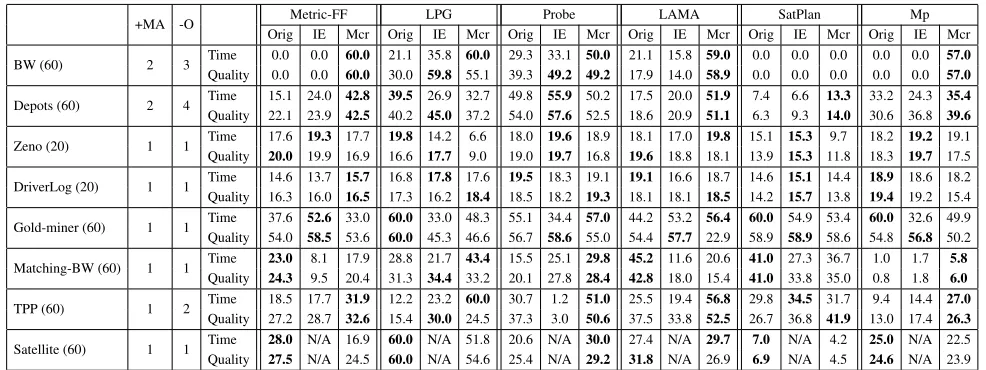
Cumulative results of the evaluation are presented in Ta-ble 1, with the macro technique compared to the existing re-formulation technique of inner entanglements, and the orig-inal problem formulation. Values are computed according to rules used in IPC-7 learning track2. The score for
ev-ery solved problem is computed according to the formula (1/(1 + log10(T /T∗)))for time or(N∗/N)for quality.Tis a running time of a certain planner for a certain (original or reformulated) problem,N is the length of the solution,T∗
is the minimum running time achieved by a certain planner on either the original problem or any of its reformulations. Similarly,N∗is the shortest solution. The score for unsolved problems is zero. Note that in the Satellite domain we iden-tified only ‘trivial’ inner entanglements, so the reformulated domain (and problems) model was the same as the original one, hence the ‘N/A’ value for inner entanglements.
2
http://www.plg.inf.uc3m.es/ipc2011-learning/Rules
Discussion of Results
It is well known that using macros tends to reduce the depth of the search at the cost of increasing the branching factor. In the BW, Depots and TPP domains, Generated macros al-ways replacedboththe primitive operators in the Depots and TPP domains, and in one case in the BW domain. Therefore, the branching factor did not increase much (note that macros often have more instances than the primitive operator it is as-sembled from), resulting in an overall improvement across those planning engines that could cope with the hard learn-ing track problems. Indeed, Metric-FF and Mp were able to find solutions to almost all the problems in the BW domain which was not previously possible without the aid of macro reformulation. In other cases macro reformulation achieved mixed results, often worse than original or inner entangle-ment encodings. In these cases, generated macros replaced only one of the primitive operators causing increase of the branching factor which often had a negative impact on plan-ners’ performance. The technique of using inner entangle-ments to reformulate domains can reduce the search branch-ing factor, but does so at the cost of introducbranch-ing supplemen-tary predicates, which causes an increase of the size of prob-lem representation. Using inner entangprob-lements brings some improvement against the original encodings in about half of the cases. However, using macros generated from inner en-tanglements outperforms the inner entanglement encodings in the majority of cases. Good results were achieved for this technique in the Zeno domain because the size of the rep-resentation increased only marginally. Interestingly, in some cases using the inner entanglements encodings resulted in getting much better plans (in terms of quality).
LPG uses greedy local search on the Planning Graph which might not work well in situations where the branching factor is large. Therefore, LPG seems to exploit more origi-nal or inner entanglement reformulations. On the other hand, LPG achieved very good results in BW, Matching-BW and TPP when using macro reformulation. Probe’s performance improves with either inner entanglement or macro reformu-lations. Probe uses ‘causal commitments’ which are simi-lar to ‘causal links’ in plan space planning and, therefore, it seems to better exploit inner entanglements which determine exclusivity of ‘causal links’ between operators. Probe also seems to be less vulnerable to larger branching factor, there-fore, it can exploit macros as well. Metric-FF and LAMA, which are based on heuristic search, tend to perform better with macros than inner entanglements (except Gold-miner). It seems that in this case, having more actions, which even-tually reduce the depth of the search, is better than having more atoms (facts). SatPlan and Mp, which are based on SAT, achieved mixed results. Mp seems to exploit macros better than SatPlan. In the SatPlan case, reformulations lead to more complex SAT formulae which might slow-down the planning process despite pruning some unpromising search alternatives. In the Mp case, it seems that more compact SAT formulae reduces the negative impact of having more opera-tor or predicate instances.
gen-+MA -O Metric-FF LPG Probe LAMA SatPlan Mp Orig IE Mcr Orig IE Mcr Orig IE Mcr Orig IE Mcr Orig IE Mcr Orig IE Mcr
BW (60) 2 3 Time 0.0 0.0 60.0 21.1 35.8 60.0 29.3 33.1 50.0 21.1 15.8 59.0 0.0 0.0 0.0 0.0 0.0 57.0 Quality 0.0 0.0 60.0 30.0 59.8 55.1 39.3 49.2 49.2 17.9 14.0 58.9 0.0 0.0 0.0 0.0 0.0 57.0
Depots (60) 2 4 Time 15.1 24.0 42.8 39.5 26.9 32.7 49.8 55.9 50.2 17.5 20.0 51.9 7.4 6.6 13.3 33.2 24.3 35.4 Quality 22.1 23.9 42.5 40.2 45.0 37.2 54.0 57.6 52.5 18.6 20.9 51.1 6.3 9.3 14.0 30.6 36.8 39.6
Zeno (20) 1 1 Time 17.6 19.3 17.7 19.8 14.2 6.6 18.0 19.6 18.9 18.1 17.0 19.8 15.1 15.3 9.7 18.2 19.2 19.1 Quality 20.0 19.9 16.9 16.6 17.7 9.0 19.0 19.7 16.8 19.6 18.8 18.1 13.9 15.3 11.8 18.3 19.7 17.5
DriverLog (20) 1 1 Time 14.6 13.7 15.7 16.8 17.8 17.6 19.5 18.3 19.1 19.1 16.6 18.7 14.6 15.1 14.4 18.9 18.6 18.2 Quality 16.3 16.0 16.5 17.3 16.2 18.4 18.5 18.2 19.3 18.1 18.1 18.5 14.2 15.7 13.8 19.4 19.2 15.4
Gold-miner (60) 1 1 Time 37.6 52.6 33.0 60.0 33.0 48.3 55.1 34.4 57.0 44.2 53.2 56.4 60.0 54.9 53.4 60.0 32.6 49.9 Quality 54.0 58.5 53.6 60.0 45.3 46.6 56.7 58.6 55.0 54.4 57.7 22.9 58.9 58.9 58.6 54.8 56.8 50.2
Matching-BW (60) 1 1 Time 23.0 8.1 17.9 28.8 21.7 43.4 15.5 25.1 29.8 45.2 11.6 20.6 41.0 27.3 36.7 1.0 1.7 5.8 Quality 24.3 9.5 20.4 31.3 34.4 33.2 20.1 27.8 28.4 42.8 18.0 15.4 41.0 33.8 35.0 0.8 1.8 6.0
TPP (60) 1 2 Time 18.5 17.7 31.9 12.2 23.2 60.0 30.7 1.2 51.0 25.5 19.4 56.8 29.8 34.5 31.7 9.4 14.4 27.0 Quality 27.2 28.7 32.6 15.4 30.0 24.5 37.3 3.0 50.6 37.5 33.8 52.5 26.7 36.8 41.9 13.0 17.4 26.3
[image:8.612.59.552.52.237.2]Satellite (60) 1 1 Time 28.0 N/A 16.9 60.0 N/A 51.8 20.6 N/A 30.0 27.4 N/A 29.7 7.0 N/A 4.2 25.0 N/A 22.5 Quality 27.5 N/A 24.5 60.0 N/A 54.6 25.4 N/A 29.2 31.8 N/A 26.9 6.9 N/A 4.5 24.6 N/A 23.9
Table 1: Cumulative results for typed strips IPC benchmarks (problem numbers are in brackets). +MA stands for the number of generated macros. -O stands for the number of removed primitive operators. Values are computed according to scoring in IPC learning track (2011). Orig - original PDDL domain encoding, IE - inner entanglements, Mcr - Macros
erated macros replace both the primitive operators, then the results suggest that this reformulation will outperform both original and inner entanglement encodings. Planners based on heuristic search (e.g. Metric-FF, LAMA) incline to exploit macros more efficiently than inner entanglements. Probe tends to perform better using either inner entangle-ments (except Matching-BW) or macros than in the original domain encodings.
Related Works
Synthesising macros to aid AI plan generation has been a popular research area dating back to 1970s, in systems such as STRIPS (Fikes and Nilsson 1971) and REFLECT (Daw-son and Sikl´ossy 1977). Some work has concentrated on “of-fline” problem independent macro generation using domain model analysis (McCluskey and Porteous 1997). A recent example of off-line macro generation is WIZARD (New-ton et al. 2007; New(New-ton and Levine 2010), which gener-ates a useful set of macros using genetic algorithms, with generation and validation time of several hours for a given domain. Work (Alhossaini and Beck 2009) learns a set of domain-specific macros by WIZARD and then selects the most promising ones for a given problem in this domain by analyzing problem features (e.g. numbers of objects). In fact, this approach provides problem-specific macros rather than domain specific which resulted in significant improve-ment of planning process in some domains. From this per-spective, it seems to be reasonable to consider such an idea for improving our method since (inner) entanglements are also problem-specific, although we can identify the same entanglements for a whole class of ‘typical’ problems in a given domain.
Another line of work concentrates on specific planning engine techniques, and treats macro-generation as integrated with the planning process itself. For instance Macro-FF (SOL-EP) (Botea et al. 2005) and Marvin (Coles, Fox, and
Smith 2007) exploit macros in order to help an FF-type plan-ner escape plateaus. Our work fits into this area of “online” macro generation, but is aimed at providing a reformulation stage for input domain and problem specification, acting as a preprocessor (or “wrapper”) for a range of planning engines and domains. The “CA-ED” technique of Macro-FF (Botea et al. 2005), involving learning macros via analysis of static predicates, is related but complementary to the inner entan-glement approach. It is potentially useful for unifying some arguments of operators before generating a macro (e.g.lift andloadare applied in the same location since the involved hoist can be only at one location), or by analysing succes-sive actions in plans. Later work by Chrpa (2010b) extended the idea of macro-generation from adjacent actions in a so-lution, to non-adjacent actions which can be made adjacent in some valid plan permutation. His work utilised the idea of removing unnecessary primitive operators, though in an ad-hoc manner. In future, we should provide a rigorous compar-ison of this and our method in order to identify whether and how much are these methods complementary or competitive.
‘Tunnel macros’ (Coles and Coles 2010) refers to situa-tions where given operators must be in a certain sequence. ‘Tunnel macros’ are related to ‘trivial’ inner entanglements, which can be easily determined without necessity for apply-ing the approximation method, as these provide connections which must hold between ‘adjacent’ operators in such a spe-cific sequence.
Combin-ing macros and outer entanglements, even done in an ad-hoc way, provided very promising results (Chrpa 2010a).
Conclusions
In this paper we studied how inner entanglements, relations capturing exclusivity of predicate achievement or require-ment between planning operators, can be exploited in order to generate macros. We provided a theoretical investigation resulting in a set of conditions under which operators in-volved in an inner entanglement relation can be assembled into macros and, moreover, which of the primitive operators (or both) can be removed. In doing this we also extended the original technique to include indirect inner entanglements.
Our approach was evaluated empirically with eight IPC benchmark domains, which lead to 400 problem instances, using six state-of-the-art domain-independent planning en-gines. The results show that while the technique is not suc-cessful across all domains, it shows potential to be used as a reformulation technique for domains where a macro can replace two operator schema.
In the future we plan to extend our approach with ideas which have been applied in related works on macros (see the previous section). In particular we aim to investigate the possibility of combining our technique with action pruning (e.g Expansion Cores, Outer Entanglements) which should prevent generation of unpromising instances of macros.
References
Alhossaini, M., and Beck, J. C. 2009. Learning
instance-specific macros. In ICAPS Workshop on Planning and
Learning.
Botea, A.; Enzenberger, M.; M¨uller, M.; and Schaeffer, J. 2005. Macro-FF: improving AI planning with automatically learned macro-operators. Journal of Artificial Intelligence Research (JAIR)24:581–621.
Bylander, T. 1994. The computational complexity of propo-sitional STRIPS planning. Artificial Intelligence 69:165– 204.
Chapman, D. 1987. Planning for conjunctive goals. Artifi-cial Intelligence32(3):333–377.
Chen, Y., and Yao, G. 2009. Completeness and optimality preserving reduction for planning. InProceedings of IJCAI, 1659–1664.
Chrpa, L., and Bart´ak, R. 2009. Reformulating planning problems by eliminating unpromising actions. In Proceed-ings of SARA, 50–57.
Chrpa, L., and McCluskey, T. L. 2012. On exploiting struc-tures of classical planning problems: Generalizing entangle-ments. InProceedings of ECAI, 240–245.
Chrpa, L. 2010a. Combining learning techniques for clas-sical planning: Macro-operators and entanglements. In Pro-ceedings of ICTAI, volume 2, 79–86.
Chrpa, L. 2010b. Generation of macro-operators via inves-tigation of action dependencies in plans. Knowledge Engi-neering Review25(3):281–297.
Coles, A. J., and Coles, A. I. 2010. Completeness-preserving pruning for optimal planning. InProceedings of ECAI, 965– 966.
Coles, A.; Fox, M.; and Smith, A. 2007. Online identifica-tion of useful macro-acidentifica-tions for planning. InProceedings of ICAPS, 97–104.
Dawson, C., and Sikl´ossy, L. 1977. The role of preprocess-ing in problem solvpreprocess-ing systems. InProceedings of IJCAI, 465–471.
Fikes, R., and Nilsson, N. J. 1971. STRIPS: a new approach to the application of theorem proving to problem solving.
Artificial Intelligence2(3/4):189–208.
Gerevini, A.; Saetti, A.; and Serina, I. 2003. Planning through stochastic local search and temporal action graphs.
Journal of Artificial Intelligence Research (JAIR)20:239 – 290.
Ghallab, M.; Nau, D.; and Traverso, P. 2004. Automated planning, theory and practice. Morgan Kaufmann Publish-ers.
Hoffmann, J. 2003. The Metric-FF planning system:
Translating ”ignoring delete lists” to numeric state variables.
Journal Artificial Intelligence Research (JAIR)20:291–341. Kautz, H.; Selman, B.; and Hoffmann, J. 2006. Satplan: Planning as satisfiability. InProceedings of the fifth IPC. Lipovetzky, N., and Geffner, H. 2011. Searching for plans with carefully designed probes. InProceedings of ICAPS. McCluskey, T. L., and Porteous, J. M. 1997. Engineering and compiling planning domain models to promote validity and efficiency. Artificial Intelligence95(1):1–65.
McCluskey, T. L. 1987. Combining weak learning heuristics in general problem solvers. InProceedings of IJCAI, 331– 333.
Mcdermott, D.; Ghallab, M.; Howe, A.; Knoblock, C.; Ram, A.; Veloso, M.; Weld, D.; and Wilkins, D. 1998. PDDL -The Planning Domain Definition Language. Technical Re-port TR-98-003, Yale Center for Computational Vision and Control,.
Newton, M. A. H., and Levine, J. 2010. Implicit learning of compiled macro-actions for planning. InProceedings of ECAI, 323–328.
Newton, M. A. H.; Levine, J.; Fox, M.; and Long, D. 2007. Learning macro-actions for arbitrary planners and domains. InProceedings of ICAPS, 256–263.
Richter, S., and Westphal, M. 2010. The LAMA planner: guiding cost-based anytime planning with landmarks. Jour-nal Artificial Intelligence Research (JAIR)39:127–177. Rintanen, J. 2012. Engineering efficient planners with SAT. InProceedings of ECAI, 684–689.
Slaney, J., and Thi´ebaux, S. 2001. Blocks world revisited.