2016 International Conference on Computer, Mechatronics and Electronic Engineering (CMEE 2016) ISBN: 978-1-60595-406-6
Kinect Gesture Recognition Method Using Track Sequence
Ying WANG and Zheng-dong LIU*
Computer Information Center, Beijing Institute of Fashion Technology, Beijing, China
*Corresponding author
Keywords: Gesture track recognition, Kinect.
Abstract. In order to recognize the trajectory of hand gesture based on image sequence, a method of gesture track recognition based on location relation was presented. First, use the Kinect sensor to extract track sequence, then math samples of hand's coordinate sequences to recognize track shape through the gold segmentation. Experimental results show that this method can effectively for identifying the gesture trajectory.
Introduction
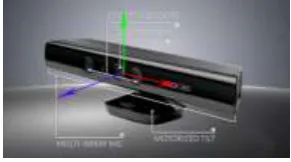
[image:1.595.224.370.531.612.2]Kinect [1, 2] is a new game controller technology introduced by Microsoft in November, 2010. Since its launch date, it was evident that Microsoft’s device is transformed not only in computer game but also in many other applications like robotics and virtual reality due to its ability to track movements and voices and even identify faces, all without the need for any additional devices [3]. Kinect (Figure 1) interprets 3D scenes from a continuously-projected infrared structure. It has a webcam like structure and allows users to control and interact with a virtual world through a natural user interface, using gestures, spoken commands or presented objects and images. The device includes a RGB color camera, a depth sensor and a multi-array microphone. It provides the full-body 3D motion capture and the facial and gesture recognition. The depth sensor consists of an infrared laser projector combined with a mono-chrome CMOS sensor, and allows the Kinect sensor to process 3D scenes in any ambient light condition [2]. The depth sensor technology was developed by Israeli Prime Sense [4]. It interprets 3D scene information from a continuously-projected infrared structured light. A variant of image-based 3D reconstruction was used to recover the depth of the observed points in the 3D scene [5]. Kinect is able to simultaneously recognize up to six people, including two moving players, for motion analysis with a feature extraction of 20 joints per active player.
Figure 1. The kinect device by Microsoft.
Pose and Gesture
Movement is dynamic while posture is static. Gesture and pose can be respectively understood as movement and posture. Gesture is made up of a series of continuous movement of a body part in the space, such as the act of waving and of swiping. The gesture of swiping will get the response in speed and direction in a Kinect system. To be specific, hands swiping overhead, the rolling direction and speed on the screen will be consistent with that of the hands. Pose is a static relationship of spatial layout of bodies’ different parts. The “universal pause” in the Xbox game which can be achieved by raising hands 45 degrees is the most well-known case.
For simple games, hands and fingers are the body parts which are used most frequently to control scene other than motion sensing games. Hand movement is of the greatest variety, of the easiest identification and of the highest recognition rate in all the body movements, thus becoming the first choice of interactive measure. Hand movement is characterized by nature, simplicity and richness. Gesture recognition can be divided into following categories:
Algorithm Matching
Match simple gesture by tracking the spatial relationship between the body parts with the knowledge of geometry and trigonometry.
Template Matching
Make a comparison between the sequence of gesture movement and the proposed movement template, and conduct recognition work by measuring their similarity.
Neutral Network and Support Vector Machine
Neutral network recognition technique is characterized by self-organizing ability, self-learning ability, the uniformity of the distribution and the mode generalization ability. It can effectively counter noise and solve incomplete mode. Support vector machine is developed based on statistical theory, having better inference ability than neutral network.
Statistical Analysis and Machine Learning
It is one of classification methods to train computer vision technology by collecting eigenvectors. It is also a classification method based on probability and Bayesian maximum similarity theory. This technology cannot be used for the direct recognition of original data. Instead, it can be used to extract specific eigenvectors from a large amount of data.
There are seven universal gestures in Kinect games and applications: wave, hover button, magnet hover button, swiping, slide unlock and universal pause. A train of thoughts on how these gestures’ recognition is realized are summed up.
Wave
Wave is usually a method to say hello in the real world. In Kinect games and applications, wave can be the cursor control to activate a screen.
Analyze the gesture of wave, and the motion rule of it can be found out.
Bending arms at the position of elbow, users move forward and backward forearms with elbow as an axis. This gesture is somewhat repetitive and time-continuous.
Wave recognition is judged based on the angle of the line crossing HandLeft (HandRight) and ElbowLeft (ElbowRight) off the plane. Triangular calculation is too complicated. Therefore, another method is used. In this method, the state is determined by comparing the coordinate along x-axis between HandLeft and ElbowLeft when the coordinate which is along y-axis of HandLeft is larger than that of ElbowLeft.
Hover Button
The mechanism for hover control is not complicated. Collide to determine whether it is on a button, and present the hover process with timer and cartoon. The click time is triggered when the threshold of the continuous time is reached.
Swiping
In the traditional window interface, a piece of information, if cannot be presented in a screen, is revealed with scroll bars. Whether in Metro Style or in UI style of iPad, touch can be used to switch display screens.
In interactive interface, the horizontal slide is a common gesture. But the vertical slide affords a better user experience, thus becoming a better tool to be used in interactive interface. And vertical scrollbars are well applied in the slide and touch interface.
Slide to Unlock
Hover button is a wonderful interactive design, but it has a disadvantage of requiring users to wait for two seconds. In Xbox games, no one likes waiting. Slide button can be regarded as the combination of hover button and slide gesture.
Slide button is also used for timer. It can lock the current operating target but not trigger any event; the next “slide” gesture will trigger events. It has a more flexible operation. And it can prevent users from waiting, thus providing a more comfortable user experience.
Push Button
Push button is first designed to copy the button on the traditional GUI interface in Kinect. As a similar action to the mouse click, press button can be simulated by a gesture of pushing hands forward.
The act of this gesture is opening palm and pushing it forward. The realization of the “push button” is not complicated. The core algorithm is to detect gestures along the negative direction of the Z-axis. A reference point, such as the coordinates of users’ heads, can be chosen for the calculation of the distance of the movement. When the distance of hand movement exceeds the preset threshold, an event like “mouse click” will be triggered.
Universal Pause
As is known to Windows users, the ESC key in the keyboard performs a function of universal pause. The gesture of universal pause is one of the guiding gestures offered by Microsoft. And this gesture is realized by raising one’s left arms at 45 degrees off his body. The algorism of universal pause is relatively simple. It can be determined based on the angle of one’s left arm off his body and the angle threshold.
Motion Detection Based on Samples
Suppose that movements can be recorded and serialized. If the ongoing movement is one of those that happened before, it can be detected. The main purpose is to quickly determine whether the data of the ongoing movement matches that of any previous movement [10, 11]. All movements are in the form of sets of coordinates. However, the coordinates only represent the distance from the sensor. Therefore, there is a need to propose an algorithm for data comparison. In addition, the data should be standardized and converted so that they are in the same reference space.
Suppose that the coordinate series is shown as follows:
} ,..., ,
{ 0 1 1
p p pn
p
Generate the Movement with a Specific Number of Coordinate Points
Suppose that the number of samples is M. The distance between two samples is defined as Lavg = (n
-1)/(M-1). The distance between pi-1 and pi is defined as Li,i-1. In the sampling process of coordinate
recalculated. The recalculation is implemented by traversing points corresponding to coordinate series. If the distance between the current point and the last sampling point cannot reach the sampling point, the traversal continues. If the distance reaches or exceeds the sampling point, the coordinate point needs to be recalculated. So a variable Lcur representing the accumulative distance
during the traversal needs to be defined. When Lcur+Li,i-1>=Lavg, the new coordinate point is shown
as follows:
) (
* ) /
( , 1 1
1 '
i avg cur ii i i
i p L L L p p
p (1) The new coordinate series is shown as follows:
} ,... ,
{ '
1 '
1 ' 0 '
p p pn
p
Rotate the Coordinate Point So That the First Point is at 0 Degree
In order that the two-matched series have the same starting point, the coordinate series are rotated until the first coordinate point is at 0 degree. Then the center coordinates of the coordinate series are calculated. The direction angle of the first coordinate point relative to center coordinates is obtained. A new coordinate series is generated by setting this angle as the direction angle and using the rotation matrix in the two-dimensional space.
Map the Coordinates to the Specified Coordinate Level [0, 1]
As the value range of the coordinate series has not been unified, inaccuracy may arise. So, the coordinates need to be set within the interval [0, 1].
Standardize the Origin of the Series of Movement Points
After this standardization, the matching will be performed. The coordinate series with the same length are resized in the unified scale, direction and centers.
Start the gesture:
(a)
generate a new gesture with a defined number of points:
(b)
rotate the gesture so that the first point is at 0 degree:
(c)
rescale the gesture to a 1x1 reference graduation:
(d)
center the gesture to origin:
[image:4.595.139.207.536.595.2](e)
Figure 2. Standardization of the gesture track.
Golden section search [15] is a technique for finding the extrema by successively narrowing the range of values of a monotone continuous function inside which the extremum is known to exist. The technique derives its name from the fact that the algorithm maintains the function values for triples of points whose distances form a golden ratio. Golden section search is more real-time and convenient than derivatives in finding the extremum of a function.
[a, b], then f(x) has only one minimum or maximum in [a, b]. The best way to find this extremum is to use the bisection method. Similar to the bisection method, GSS algorithm narrows down the interval in which the extremum exists by comparing function values. Two objectives must be fulfilled in designing the algorithm. First, the optimal interval narrowing factor can be found in the interval. Second, the number of function calls must be reduced.
Enlightened by the bisection method, one choice is to calculate the intermediate point m=(a+b)/2. Then find the values of x1 and x2, define x1=m-δ/2 and x2=m+δ/2. δ is a small parameter that makes f(x1)≠f(x2). If f(x1)<f(x2), we reserve [a, x1], otherwise we set [x2, b] as the new region of search.
However, two calculations need to be performed to solve the function in each narrowing operation. This is not the optimal method.
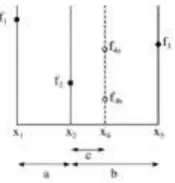
Figure III shows one step for finding the minimum. The function value of f(x) is on the vertical coordinate axis. The parameter x is on the horizontal coordinate axis. The values of three points on the function f(x) have been obtained. They are x1, x2 and x3. It’s thus clear that f(x2) is smaller than
f(x1) and f(x3). Obviously, the minimum exists between x1 and x3.
The next step is to calculate the value of the function at another point x4. It is more efficient to
choose x4 in the largest interval, for example, between x2 and x3. It can be seen from the figure that if the function value exists in f4a, the minimum will exist between x1 and x4, and a new group of
points will be x1, x2 and x4. If the function value is f4b, the new group of points will be x2, x4 and x3.
[image:5.595.255.343.351.443.2]So, in both cases, we can build a new narrower search interval that contains the function’s minimum.
Figure 3. Standardization of the gesture track.
Consider a function f over the interval [a, b]. We assume that f(x) is continuous over [a, b]; and that f(x) is unimodal over [a, b], i.e. f(x) has only one minimum in [a, b]. Note that the method applies as well to find the maximum [13, 14, 15].
The conditions above remind us to the bisection method and we will apply a similar idea: Narrow the interval that contains the minimum comparing function values. In designing the method, we seek to satisfy two goals. We want an optimal reduction factor for the search interval and minimal number of function calls. With these goals in mind, we are going to determine the location to evaluate the function.
One choice inspired by the bisection method would be to compute the midpoint m=(a+b)=2 and to evaluate at x1 and x2, defined by x1=m-δ/2 and x2=m-δ/2, for some small value δ for which f(x1)≠f(x2). If f(x1)<f(x2), then we are left with [a, x1], otherwise [x2, b] is our new search interval. While this halves the search interval in each step, we must take two new function evaluation in each step. Therefore, this is not optimal.
We only need to perform a new function evaluation in each step. Furthermore, we need a constant reduction factor c, for the size of the interval.
In order to increase the efficiency of the algorithm, the function solving process operation should be performed only once in each step. Be relative to the current search interval, a constant factor c is defined. And there are two cases for x1 and x2 in [a, b].
If f(x1)<f(x2), we make [a, b] = [a, x2] and make the following adjustment in the interval:
cb a c x
ca cb a x a
b c a x
) 1 (
) (
2
2 2
If f(x1) > f(x2), we make [a, b] = [x1, b] and make the following adjustment in the interval: b c ca x b ca cb x a b c x b ) 1 ( ) ( 1 1 1 (3)
So long as C is known, position x1 and x2 can be obtained. Without loss of generality, we consider the case f(x1) < f(x2). To simplify the calculation, we suppose that [a, b] = [0, 1].
If f(x1) < f(x2), we set x1=1-c repeatedly and determine whether the next value should be selected
from the left or right of 1-c.
Suppose that a function value is obtained from the left of x1=1-c, then x1 is the right boundary of [0, c]. The expression of x1 can be written in two forms. (a=0 and b=c in the expression where x2 is
used) 0 1 2 0 ) 1 (
1 c c cc c c (4)
The positive root c (1 5)/2) is approximately equal to 0.6180.
Suppose that a function value is obtained from the right of x1=1-c, then x1 is the left boundary of
[0, c]. The expression of x1 can be written in two forms. (a=0 and b = c in the expression where x1 is used): 0 ) 1 ( ) 1 ( 0
1c c cc c 2
(5) The root of equation (5) is 1. The interval is not narrowed down. This possibility is thus ruled out. Two rules are obtained: If f(x1) < f(x2), we reserve x1, make x2 and calculate a new value for x1
through using equation (3). If f(x1) > f(x2), we reserve x2, retain it as x1 and calculate a new value for
x2 through using equation (2).
Results
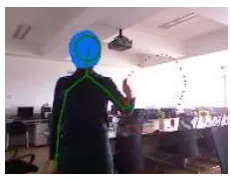
Two experiments are conducted using this algorithm to recognize two kinds of gestures, namely, left-right sway of hand and circular gesture. The gesture tracks are collected from five people. Each person repeats each gesture for ten times. As shown in Figure 4, the hand moving leftwards in the left picture represents a leftward sway and the red dots represent the moving track of the hand. The set of points is used as the sample for recognition. The left picture shows a circular gesture. It can be seen that the sample highly matches the gesture.
[image:6.595.364.480.548.637.2](a) Leftwards sway of hand. (b) Circular gesture recognition.
Figure 4. Recognition performance.
Table 1. Data analysis of the recognition of two gestures.
Gesture Leftwards sway Rightwards sway Circular gesture
Times of gesture 50 50 50
Times of recognition 50 49 46
Table 1 gives out the recognition rate of the two gestures by the five participants. The results show that this algorithm has a high recognition rate which is able to meet demands of practical use.
Conclusion
In recent years, gesture has increasingly become an important way of man-machine interaction for its ease of use. Based on certain rules, the meaning carried by a gesture track can be recognized. Therefore, the application of gesture track information is highly portable and expansible. The traditional gesture track recognition which is vision-based contains a variety of algorithms. This paper uses the Kinect sensors to obtain depth data and perform segmentation and recognition over depth images. As this method is free from the influence of light and background, it has increased the consistency and robustness of gesture track recognition.
Acknowledgment
This paper is sponsored by the Beijing Education Commission Scientific Research Support Program (KYJH02150201).
References
[1]Frati, V., & D. Prattichizzo. 2011. Using Kinect for hand tracking and rendering in wearable haptics. World Haptics Conference (WHC), IEEEIEEE, 2011:317-321.
[2]Wikipedia. 2011. Kinect — Wikipedia, the free encyclopedia.
http://en.wikipedia.org/wiki/Kinect, [Online; accessed 13-January-2011].
[3]J. Giles. 2010. Inside the race to hack the Kinect. The New Scientist, 208(2789):22-23.
[4]Prime Sense. Prime sense kinect’s hardware. http://www.primesense.com, 2010. [Online; accessed 8-January-2011].
[5]How kinect depth sensor works. stereo triangulation?
http://mirror2image.wordpress.com/2010/11/30/how-kinect-works-stereo-triangulation, Nov 2010.
[6]Kao M C, & Li T H S. 2010. Design and Implementation of Interaction System between Humanoid Robot and Human Hand Gesture. Proc of SICE Annual Conference. IEEE Press: 1616-1621.
[7]Li Qingshui, Fang Zhigang, & Shen Mowei et al. 2002. Application of Gesture Recognition in Man-machine Interaction [J]. Ergonomics, 8(1): 27-29.
[8]Urtasun R, & Fua P. 2004. 3D Human Body Tracking Using Deterministic Temporal Motion Models[C]. Proc of the 10th Asian Conference on Computer Vision. 92-106.
[9]Huang Kangquan, Chen Bijin, & Zheng Bo et al. 2011. Application of Kinect in the Video Conference System. Journal of Guangxi University: Natural Sciences, 36(z1): 308-313.
[10]Chen Qing, Georganas N D, & Petriu E M. 2007. Real-time Vision Based Hand Gesture Recognition Using Haar-like Features. Proc of IEEE Instrumentation and Measurement Technology Conference. IEEE Press, 1-6.
[11]Silanon K, & Suvonvorn N. 2011. Hand Motion Analysis for Thai Alphabet Recognition Using HMM. International Journal of Information and Electronics Engineering, 1 (1): 65-71.
[12]Ikemura S, & Fujiyoshi H. 2011. Real-time Human Detection Using Relational Depth Similarity Features. Proc of the 10th Asian Conference on Computer Vision: 25-38.
[14]Curtis F. 2004. Gerald and Patrick O. Wheatley. Applied Numerical Analysis. Seventh Edition, Addison Wesley.
[15]Floyd Hanson. MCS 471 Class Optimization Notes: Method of Golden Section Search. Available at http: //www.math.uic.edu/~hanson/mcs471/classnotes.html.