2017 International Conference on Computer, Electronics and Communication Engineering (CECE 2017) ISBN: 978-1-60595-476-9
Design and Implementation of an Intelligent Street Lamp Network Node
Based on 6LoWPAN Technology
Qing-hai ZHANG
*and Po LI
College of Electrical Engineering, Nanjing Institute of Industry Technology Nanjing, 210023, China *Corresponding author
Keywords: Intelligent street network, Smart city, 6LowPAN, Network node, Border router.
Abstract. To build an intelligent street lamp network, this paper analyzes the application of wireless sensor network, then, the network structure of intelligent street lamp network is realized based on 6LowPAN technology in the construction of smart city. Node controller and the border router of intelligent street lamp network are designed with respect to the hardware and software. Furthermore, after the network structure and communication system are accomplished, the IP of wireless intelligent street lamp network is also realized.
Introduction
Currently, smart city has attracted a lot of interest in various applications. In the process of building a smart city, a number of sub-systems such as intelligent transportation, smart security, smart environment, intelligent street lights have been relatively mature and self-contained. Various basic networks in the same system can connect each other based on the IP communication network, however, for different systems, due to various reasons, systems cannot be connected among them, as a result, different systems become information islands. With the development of cloud computing, big data and networking technologies, interconnection among smart city network is demanded urgently [1]. However, in the practical construction of wisdom urban, a variety of factors including power supply, transmission and installation conditions lead to the failure of installation for information equipment. Even the information equipment can be installed, the cost is very expensive. As one of main municipal facilities in the cities, street lamps occupy a special position in the urban planning and construction, and are also widely distributed. As a result, street lamps have attracted more and more attention in the construction of smart city. The street lamp not only functions as a simple illumination, but also an important modern information carrier, therefore, it can be used for the comprehensive application of various intelligent systems in the smart city [2].
The main technologies to support the last 100 meters networks among street lamps are ZigBee, 6LoWPAN, WLAN, etc. ZigBee is one of two-way short-range wireless communication technologies; its physical layer and MAC layer follow the IEEE802.15.4 protocol standard, and use the open 2.4G band. Since there are a lot of advantages such as low power consumption, low data rate, low cost, short delay, large network capacity and other characteristics in the Zigbee, for a period of time, people use Zigbee technology to realize the intelligent lighting network in the last 100 meters of access, but there is an overwhelming problem in the upper network: Today's Internet utilizes the TCP/IP protocol, but common ZigBee node has no IP address, any other agreement needs to be converted to TCP/IP, which makes the custom Zigbee require the gateway to realize network interoperability [3].
Zigbee obviously. Since the 6LoWPAN itself is a TCP/IP architecture, IP address of each node can be detected from the application server, which is the needed for intelligent street lamp network [4].
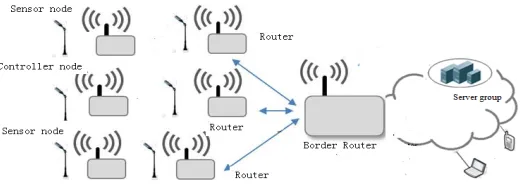
[image:2.612.176.436.245.337.2]Up till now, wisdom systems in the wisdom city's development commonly use IPV4 network but it will use IPv6 network gradually in the future. The network structure of intelligent street lamp adopts a typical layered structure of Internet of things, which is composed of physical layer, network layer and application layer. The physical layer is composed of a variety of sensor nodes and a actuator node, the 6LoWPAN node is installed on the lamppost to acquire various sensor information such as temperature, humidity, illumination, sound, video, or perform network instructions such as street lamp control switch, lamp information screen control. First, Network layer uses 6LoWPAN protocol to construct a network and then transforms it to IPV4 network in the short distance, second, long distance can be realized by the routing and communication bridge. The application layer performs various service functions, such as data storage, information transfer, management, and so on in the bundle of services. Figure 1 shows the typical intelligent street lamp network.
Figure 1. Typical intelligent street lamp network.
Hardware Design of Network Nodes
Design of Node Controller
Types of the network nodes in intelligent street lamp are mainly border router, common router, control or sensor node, etc.
Based on the TI 6LoWPAN complete solution [5], this paper designs the network node hardware of intelligent street lamp. Various functions including the common router, control node and sensor node can be realized by the software programming. The node controller is designed using the CC2538 module of TI company as the core chip. This device contains a powerful MCU system based on ARM Cortex M3, with up to 32KB on-chip RAM and 512KB on-chip flash as well as reliable IEEE802.15.4 RF function, thus can support 6LoWPAN technology well [6]. Node hardware of the controller is designed in the form of the bottom plate plus module, more detail, the CC2538 module, power supply and interface circuit board comprise the mainboard, and different modules are composed of a variety of sensors and controllers, in this way, it can be more suitable for different applications in the construction of smart city. For example, this design can be applied for the brightness sensor in the intelligent lighting system, current controller in intelligent environmental protection system, and sound, temperature and humidity sensor; and RFID in intelligent traffic system. The hardware structure of a typical 6LoWPAN node controller is shown in Figure 2.
[image:2.612.305.522.626.732.2]
Design of Boundary Router
The 6LoWPAN border router is connected to the server via WLAN or Ethernet, and it can also communicate with the network node through the wireless network. In order to simplify the design, the scheme of the border router still uses TI CC2538 chip as the main control. The border router should communicate with a number of nodes in the street network, requiring a large transmission power, thus, the RF part uses the CC2592 module to enhance the transmit power [7], and Ethernet module uses ENC28J60 as the main chip. The overall hardware structure is shown in Figure 3.
Software Design and Implementation
Development Environment
In this paper, the design of 6LoWPAN application software is based on Contiki operating system. Contiki is an open source and multi tasking operating system which is easy to be developed by C language. Contiki system integrates two types of wireless sensor network protocol stack: named uIP and Rime. UIP is a small RFC protocol with the TCP/IP protocol stack, so that Contiki can communicate directly with internet. UIP contains two versions of the IPv4 and IPv6 protocol stack, and can support TCP, UDP, ICMP and other protocols. Contiki provides a Cooja wireless sensor network simulation tools to simulate a variety of protocols on the computer. Contiki source files can be easily downloaded on the official website. Instant Contiki is an official good development environment based on Ubuntu. After downloading InstantContiki, one can open it directly using the virtual machine VMware [8].
Realization of Network Communication Function
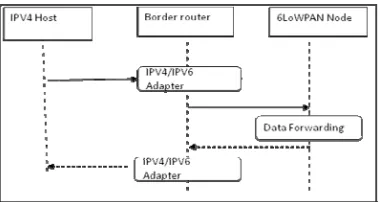
[image:3.612.212.402.458.559.2]The communication process of PC and 6LoWPAN nodes are as follows: If IPv4 host can send commands to the 6LoWPAN node, the information by IPv4 host must be transferred to the IPv4/IPv6 adapter boundary router, to make the protocol transformation so that 6LoWPAN node can recognize the information; the data collected by 6LoWPAN should be also transformed by through the IPv6/IPv4 adapter As shown in Figure 4, the message is connected to the IPv4 and 6LoWPAN networks via the 6LoWPAN border router.
Figure 4. Communication process between PC and node.
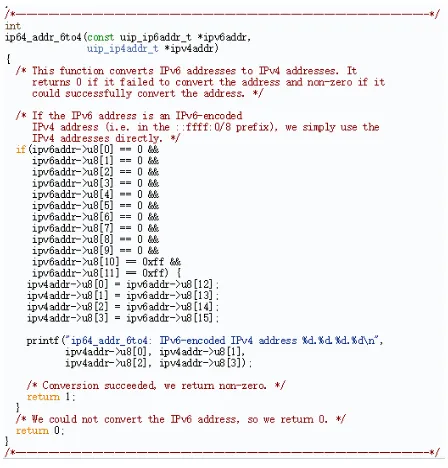
Figure 5. IPV4 and IPV6 address translation code.
Node network is realized based on 6LoWPAN neighbor discovery protocol by calling uip_ds6 file in the IPv6 folder in the Contiki system to complete the node registration. The code is shown in Figure 6.
After the 6LoWPAN node is successfully registered to the border router, the node controller has designed four LED indicator lights, when LED becomes a full bright state, the network is successful. Realization of Data Acquisition and Control Function
6LoWPAN can be used as a sensor node of intelligent lighting network to achieve a variety of data collection, such as temperature, humidity, brightness, power, voltage, it can be also used as a switch to control the lights and adjust the brightness. The following code to achieve the temperature and humidity data is shown in Figure 7.
Figure 6. Network establishment code. Figure 7. Temperature and humidity data acquisition code.
Network Function Verification
Network Authentication Environment
sokit software is installed for network data monitoring and the Wireshark capture software is installed for data capture analysis. The boundary router and 6LoWPAN node are arranged according to the actual distance between the lamp poles (about 40 m).
Network Data Monitoring
For the entire 6LoWPAN network, we need to get some equipment information, such as MAC address, IP address and other important information, which can be achieved through serial debugging. For 6LoWPAN networking, the border router obtains an IPv4 address 192.168.18.100 by the Ethernet router DHCP automatically
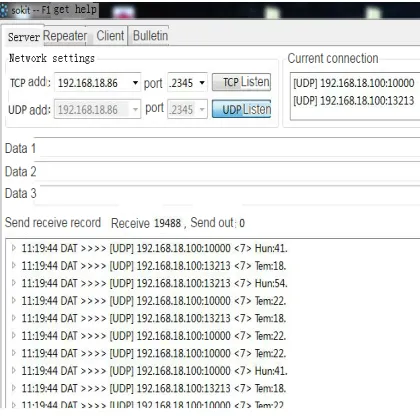
Network data monitors the data in transceiver records in the test network through socket debugging tools. The two 6LoWPAN nodes connect to the temperature and humidity sensor nodes, and download temperature measurement procedures. In the software program, the 6LoWPAN node sends the collected temperature and humidity data stream to PC in a certain time interval. As is shown in Figure 8, the current 6LoWPAN sensor network is connected to a total of two nodes, the address identifiers are 192.168.18.100:10000 and 192.168.18.100:13213 respectively. The temperature and humidity information collected by two nodes are displayed in the receiving and sending records.
Data Packet Analysis
After determining the existence of data exchange between 6LoWPAN nodes and PC, analysis can be further made by utilizing the software Wireshark, as is shown in Figure 9. We can see that in the process of sending data packets in 6LoWPAN node, protocol transport layer is UDP; it succeeds to grab the process of forwarding data packets, which indicates that 6LoWPAN played the role of protocol conversion to achieve the IP communication in wireless intelligent lighting network.
[image:5.612.307.531.368.580.2] [image:5.612.82.292.373.583.2]
Figure 8. Data interception test screenshot. Figure 9. Data packet analysis screenshot.
Summary
technology in the construction of smart city will speed up the realization of modern information network with wide coverage, low construction cost and high intelligence.
Acknowledgments
This work is supported by the Intelligent Sensor Network Open Foundation of Jiangsu Province (ZK15-02-11), (ZK14-02-06).
References
[1]Yang Zhenghong. Smart city: application of big data, Internet of things and cloud computing [M]. Beijing: Tsinghua University press, 2014: 13.
[2]Wu Guicai, Huang Yuehui, Yang Tong. A New Perspective of Smart City-Building the Internet of Things Based on Streetlight [J]. Urban development research, 2013, 20 (11): 4-7.
[3]Ge Guangying, Ge Jing, Zhao Yunlong. ZigBee principle, practice and comprehensive application [M]. Beijing: Tsinghua University press, 2015: 18-19.
[4]Zach Shelby, Carsten Bormann.6LoWPAN: The Wireless Embedded Internet [M]. A John Wiley Sons, Ltd, Publication. 2010: 4-8.
[5] http://www.ti.com.cn/lsds/ti_zh/wireless-connectivity/6LoWPAN /overview.page
[6]TI datesheet.CC2538 Powerful Wireless Microcontroller System-On-Chip for 2.4-GHz IEEE 802.15.4, 6LoWPAN, and ZigBee Applications (Rev. D).