2017 2nd International Conference on Artificial Intelligence: Techniques and Applications (AITA 2017) ISBN: 978-1-60595-491-2
Application of Deep Learning in Comprehensive Performance
Evaluation of Aero Engines
Shi-sheng Zhong
1,*, Song Fu
2and Xu-yun Fu
21
Harbin Institute of Technology, School of Mechatronics Engineering, Harbin 150000, China
2
Harbin Institute of Technology at Weihai, School of Naval Architecture and ocean Engineering, Weihai 264200, China
*Corresponding author
Keywords: Deep learning, Aero-engine, Performance evaluation, Fleet management.
Abstract. In view of the high dimension, large noise and large data of aero-engine condition data,
combining with the characteristics of deep learning, an aero-engine integrated performance evaluation model is established based on deep learning. The method is validated by the data of 17 JT9D-7R4 engines of an airline. And by comparative with single parameter method, EGT index method and principal component analysis method, this paper reaches the conclusion that deep learning has more advantages of performance evaluation, preventing information loss. It helps the fleet to evaluate the performance of the engine closely, and the result is more creditable.
Introduction
Aircraft engine is the heart and one of the most important components of the aircraft, so the health of the aeroengine is directly related to flight safety. Therefore, to conduct a comprehensive assessment of the wing engine based on performance parameters is an important issue of engine health management.
Currently two methods of queuing for performance are used in Airline—Exhaust gas temperature index method and single parameter method [1]. While these two performance evaluation methods are simply and easy to implement, they do not take into account other performance parameters, so reflecting the actual state of engine is not comprehensive. In addition, the performance parameters often appear to a certain degree of fluctuation, relying on one or two parameters to evaluate is prone to misjudgment.
In recent years, many researchers have conducted extensive research on multi-parameter performance evaluation methods. Tan Wei, etc., evaluate the comprehensive performance of the engine by fuzzy information entropy method to multiple parameters into one-dimensional parameters[2]. The reference [3]uses PCA (Principal Component Analysis) to evaluate engine performance. Cui Jianguo, etc., assessed the comprehensive health level evaluation by gray level analysis [4].Huang Xiaoyan, etc., put forward a performance evaluation method of aero engine based on improved TOPSIS[5]. Shi Zhihua, etc., proposed an improved information fusion method for engine health assessment[6]. Yi Hao, etc.,focus on the implement of fuzzy comentropy method which is combined of fuzzy mathematics and rough set theory in the practical performance evaluation of aeroengine[7].
Through the analysis of the aforementioned reference, the comprehensive performance evaluation have the following several problems based on multi-parameters: (1) the finally engine performance queued have serious subjectivity by the above method; (2) to evaluate the importance of a performance parameter on engine performance evaluation by calculating the weights, which ignores the smaller weight parameters may contain the important information in the sample difference. In order to evaluate the performance of engine accurately and reliably, this paper proposes a method of aero-engine comprehensive performance evaluation based on deep learning.
Section 3 is a case study which is used to verify the good performance of our method. At last, conclusion and future work is given in section 4.
Methodology
Stacked Denoising Autoencoders (SDAE)
SDAE was first introduced by Pascal Vincent et al. in 2010 [9]. It is a deep learning structure that has denosing auto-encoder (DAE), a variant of traditional auto-encoder (AE), as its shallow learning blocks. DAE is a symmetrical neural network that can learn the features in an unsupervised manner by minimizing reconstruction errors. Based on AE, a DAE is trained to reconstruct a clean “repaired” input from a corrupted version of it.
x z
h
x
D
q
f g
( , ) L x z
Encoding Decoding
Figure 1. Schematic diagram of DAE.
As shown in Figure 1, a DAE is composed of input data
x
, corrupted datax , intermediate feature representation h and reconstructed data z. It consists of two primary parts, the encoder and decoder. Firstly, the input datax
is corrupted toxby means of a stochastic mappingx~qD( / )x x . The degree of the corruption controls the degree of regularization. Currently, we choose the masking noise process which forces a fraction ν of the elements ofx
(chosen at random for each sample) to 0. Next, corrupted datax
is mapped, as with the basic AE, to a hidden representation h through an encoderf . In detail, it is a function f x( ) that maps an input x R∈ n to a hidden representationm
h∈R by (1)
( )
( ) 1/(1+e
Wx b)
h
=
f x
=
− + (1)Where Wis a
m n
×
weight matrix andb∈Rmis a bias vector. The latent representation h is then mapped back to the input space through a mapping decode function. The decode function g(x) maps the hidden representation h back to the reconstruction z by (2).' '
( )
( ) 1/ (1 e W h b )
z=g h = + − + (2) Where ' T
W =W is a n m× weight matrix and ' n
b ∈R is a bias vector. The objective function of the DAE is the sum of all reconstruction error between original input x and its reconstruction z, as shown in (3).
( ) ( , ( ( )))
DAE
x D
J θ L x g f x
∈
=
∑
(3)Where L is the reconstruction error. Typical choices include the squared error shown in (4).
n n
2 2
(
)
( ( ))
DAE
x x
J
W
x
z
x
g f x
∈ ∈
=
∑
−
=
∑
−
R R
(4)are usually better than feature extracted by basic AE in terms of robustness. The network structure of the SDAE is shown in figure 2, the final output is more abstract and more high level futures of original input data.
. . . .
W1 ..
. W2 ……… Wn
Input Hidden 1 Hidden n
[image:3.612.247.366.108.200.2]Output O
Figure 2. Schematic diagram of SDAE.
Case Study and Results
Data Description
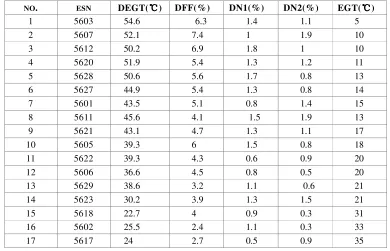
This paper selects an airline in 17 JT9D-7on-wing aircraft engine as the research sample. And the DEGT, DFF, DN1, DN2 and EGTM, these five kinds of parameter are used as the input. The sort for the engine as shown in table 1 was based on the experience of many years of practical operation scheduled renewal sequence by engine departments.
In this paper, the first 10 engines are taken as experimental samples, and the latter 7 engines are used as test samples. The weights and deviations of hidden layer are obtained by training SDAE model through experimental samples. Then, according to the above formula, the features of the test sample can be calculated.
Table 1. JT9D-7 engine condition monitoring data.
Model Design
For unsupervised feature learning, a 2-layer SDAE model was built. Based on many experiments’ results, the parameters of our model were determined. The parameters of SDAE are shown in table 2.
NO. ESN DEGT(℃℃℃℃) DFF(%) DN1(%) DN2(%) EGT(℃℃℃℃)
1 5603 54.6 6.3 1.4 1.1 5
2 5607 52.1 7.4 1 1.9 10
3 5612 50.2 6.9 1.8 1 10
4 5620 51.9 5.4 1.3 1.2 11
5 5628 50.6 5.6 1.7 0.8 13
6 5627 44.9 5.4 1.3 0.8 14
7 5601 43.5 5.1 0.8 1.4 15
8 5611 45.6 4.1 1.5 1.9 13
9 5621 43.1 4.7 1.3 1.1 17
10 5605 39.3 6 1.5 0.8 18
11 5622 39.3 4.3 0.6 0.9 20
12 5606 36.6 4.5 0.8 0.5 20
13 5629 38.6 3.2 1.1 0.6 21
14 5623 30.2 3.9 1.3 1.5 21
15 5618 22.7 4 0.9 0.3 31
16 5602 25.5 2.4 1.1 0.3 33
[image:3.612.110.500.401.652.2]Table 2.Parameters of SDAE.
Parameters SDAE
DAE1 DAE2
Input neurons 5 3
Hidden neurons 3 2
Output neurons 5 3
Activation function sigmoid sigmoid
Learning rate 1 1
Noise rate 0.05 0.05
Epochs 10 10
Batch size 1 1
Results
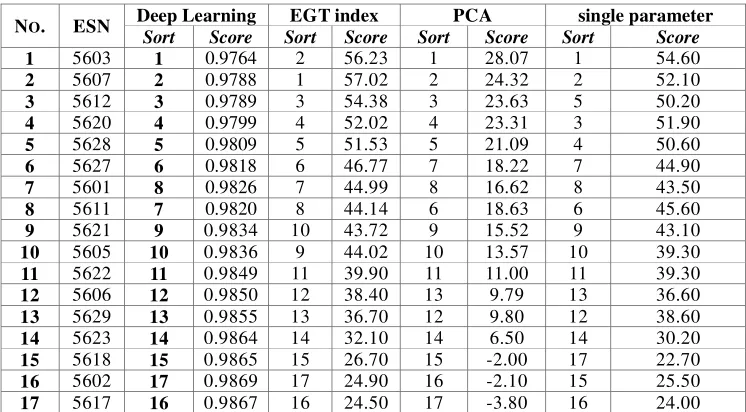
[image:4.612.169.443.264.403.2]The features obtained by proposed method are shown in Figure 3, than the engines are sorted by the features. To demonstrate the effectiveness of proposed method, we compared the result between our method and three traditional methods. The results are shown in table 3.
Figure 3. The features obtained by proposed method.
From table 3, it can be observed that our method have the highest precision. Compare with other methods, mining the original data by building a deep model change the dimension and does not change the information of the original data in our method. Finally, the extracted feature set contains all the useful information of the original data. The results indicate that our method is significant superior to other listed methods in aero-engine performance evaluation. In the future, we would try to collect more data to test our method.
Table 3.Results of different methods.
NO. ESN Deep Learning EGTindex PCA single parameter
Sort Score Sort Score Sort Score Sort Score
[image:4.612.119.492.526.732.2]Summary
Accurate and timely aero-engine performance evaluation is very crucial to the reliability and economy of engine operation. In this paper, an algorithm based on deep learning was proposed to solve the engine performance evaluation problem. We chose SDAE model in deep learning to learn robust features from input data unsupervised. Based on the learned features, the performance states of engine would be sorted. Through experiments on real OEM data, we found that our algorithm was superior in performance evaluation accuracy compared with other traditional methods. Thus, our algorithm has the potential to be an effective technique applied in the engineering practice of engine health management.
In future we would like to explore other deep learning models such as contractive autoencoder (CAE) and deep belief network (DBN) as well.
Acknowledgement
Thanks to the major national natural science foundation of China (No.U1533202) for providing support for this paper. The project also funded by the civil aviation administration of China (MHRD20150104) and Shandong independent innovation and achievements transformation fund (2014CGZH1101).
References
[1]Wang S, Xu C S. Engine fleet state sequencing technique [J]. Aviation maintenance and Engineering, 2004(6):33-35.
[2]Tan W, Li D, et al. Performance evaluation and reliability analysis of Aero Engines Based on fuzzy information entropy [J]. Aeroengine, 2011, 37(5):45-48.
[3]Huang Y Q, Qu H C, Zhao C C. Queuing study of aeroengine performance based on principal component analysis [J]. Aviation maintenance & Engineering, 2015, (01):75-77.
[4]Cui J G, Lin Z L et al. Integrated evaluation method of aircraft health status based on fuzzy grey clustering and combination weighting method [J]. Journal of Aeronautics, 2014, 03:764-772.
[5]Huang X Y. Aeroengine performance evaluation method based on improved TOPSIS method [J]. Manufacturing automation, 2014(8):73-77.
[6]Shi Z J, Wang H W. Aeroengine condition evaluation method based on improved information fusion [J]. Aeronautical computing technology, 2015(2):26-30.
[7][1]Yi Hao, Li Wang, Xuan Jiang. Multi-Parameter Methods of Comprehensive Performance Evaluation for Aero-Engine[J]. Advanced Materials Research, 2012, 1669(466):.