2017 2nd International Conference on Computer Engineering, Information Science and Internet Technology (CII 2017) ISBN: 978-1-60595-504-9
Research on the Application of Personalized
Customized Virtual Design Method in Clothing
QINGYAN ZHOU, LILI HE and RENWANG LI
ABSTRACT
In order to meet the different needs of customers at different stages of personalized customization of clothing, this paper analyzes the status quo of personalized customization of clothing under the "Internet +" environment, and puts forward the concept of ergonomics. Based on the dynamic holographic model of apparel 3D virtual design, real-time dynamic record of clothing modeling information in order to amend and improve. Based on the dynamic holographic product model of apparel products, the 3D virtual garment design method is applied in clothing personalized customization, and the clothing modeling based on physical-geometric mixed model is optimized; a skirt as an example of this study was analyzed. This paper summarizes the virtual design method, which makes the garment manufacturing industry realize the human-machine collaborative design on the basis of network technology, and the reality is stronger. This paper summarizes the virtual design method in the garment manufacturing industry based on the network technology to realize the human-machine co-design of clothing, the reality is stronger.
KEYWORDS
International Conference, International Conference, International Conference.
INTRODUCTION
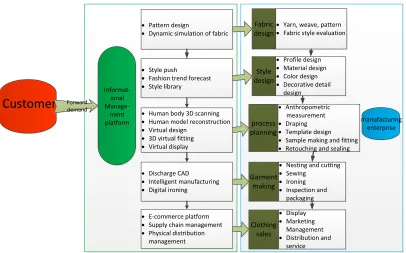
The core of personalized apparel informatization customization is "polymerization", which includes users, designers, apparel fabrics provider, garment production enterprises, logistics and other resources of all-round aggregation. Detailed flowchart diagram is shown as Fig.1.
Personalized Apparel Customization, it applies modern computer and network technology, the human body measurement, style selection, shape analysis, garment design and other links organically combine to achieve rapid personalized customized apparel production. But the customer's demand on the network is often not fast and accurate to the effect of rendering, so that customers see the effect of the picture can not really feel the effect of finished products, cannot be timely to modify the product design. Therefore, the key of garment network customization is virtual design method.
_________________________________________
Qingyan Zhou, Zhejiang Sci-Tech University, Hangzhou, China Lili He, Zhejiang Sci-Tech University, Hangzhou, China
Renwang Li, Zhejiang Sci-Tech University, Hangzhou, China
· Yarn, weave, pattern
· Fabric style evaluation
· Profile design
· Material design
· Color design
· Decorative detail design
· Anthropometric measurement
· Draping
· Template design
· Sample making and fitting
· Retouching and sealing
· Nesting and cutting
· Sewing
· Ironing
· Inspection and packaging
· Display
· Marketing Management
· Distribution and service
Customer
Fabric design
Style design
process planning
Garment making
Clothing sales
· Pattern design
· Dynamic simulation of fabric
· Style push
· Fashion trend forecast
· Style library
· Human body 3D scanning
· Human model reconstruction
· Virtual design
· 3D virtual fitting
· Virtual display
· Discharge CAD
· Intelligent manufacturing
· Digital ironing
· E-commerce platform
· Supply chain management
· Physical distribution management
Forward demand
Informat-ional
Manage-ment
platform manufacturing
[image:2.612.96.502.56.309.2]enterprise
Figure 1. Garment informationization Personalized Custom Flowchart.
RESEARCH ON VIRTUAL DESIGN METHOD IN GARMENT CUSTOMIZATION
In order to better design the needs of people's clothing, clothing design method of virtual application cannot be ignored. The research on the authenticity of the garment model and the rapid response of the system is lacking in the comprehensive various modeling methods. Therefore, this paper proposes the virtual design technology of garment 3D based on dynamic holographic product model.
Apparel Dynamic Holographic product model
The method of garment virtual design based on holographic product model combines the product and environment definition data, the interaction between the two is dynamic response, and the product information of "multi-dimensional" is obtained, and the efficiency of virtual design and development product is improved. Holographic product modeling is the product in the whole life cycle of various applications in the field of modeling and analysis, the product in the relative application of the domain of the definition of data and environmental data simulation technology. Using virtual reality technology to describe the image dynamic response of the product in each application field, and finally compare the knowledge base and rule base to this description.
Assuming the holographic product model is H
M , it appears as an "image" in an application domain. Order, the application of the i-field "image" is S
i
M , then the
holographic product model is
m
1 S i
H M
M
i
. Suppose the product definition data model
is P
model and the corresponding environment definition data model in the application of the i-field are P
i M , E
i
M . Set action operator to T , it represents the interplay between i products and environments, and each "image" includes the factors that interact with data, product definition data, and environment definition data. Then the mathematical expression of each "image" is:
E i i P i S
i M TM M
Considering the role of products and environments in the product lifecycle, and the interactions between "images", innovative designs are continually updated, and dynamic models are required to reflect these abstractions. Then, the holographic
product model of this time is
m
1 i
S i S i
H (M M )
M
, among them S
j ijM T
mi 1 j S iM
(mim, H
S
j M
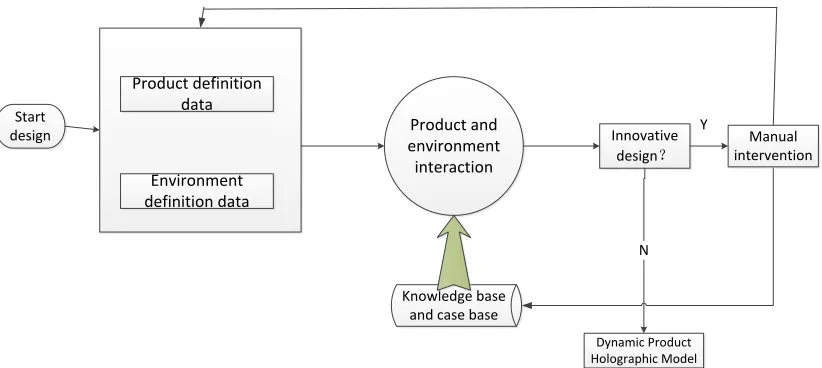
M )(T for each "image" interaction factor). The dynamic response of a ij dynamic holographic product model in an application environment is shown in Fig.2 below:
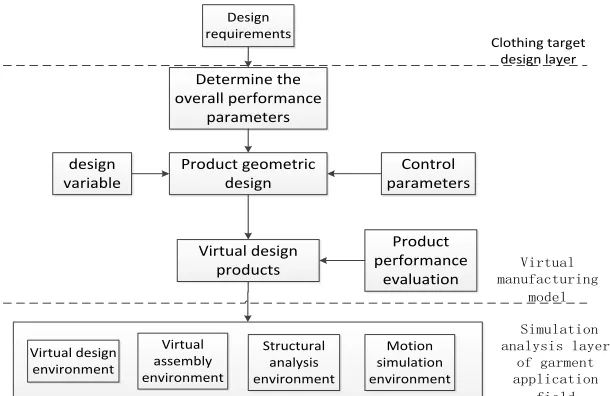
The development method of virtual costume design based on dynamic holographic product model is the application of the theory and method of holographic product model in the process of virtual costume design. The process can be divided into three layers: the garment target design layer, the garment virtual manufacturing model construction layer and the Garment Application field simulation analysis layer.
(1) The garment target design layer mainly includes the demand proposal, the plan design, the function analysis and so on several phases. Its main task is to establish a good garment design in the early stage of the virtual apparel to meet the needs of goals, apparel design drawings, clothing decorative pattern craft and garment production and manufacturing process, so as to establish a model for the definition of clothing data preparation. For the garment function analysis this stage, namely characteristic analysis, if is multi-characteristic, then the function breaks down into 1,2,...,n, then carries on the analysis to the structure element and the mechanism element corresponding to the function to determine the garment product structure form.
Product definition data
Environment definition data
Product and environment interaction
Knowledge base and case base
Innovative design?
Manual intervention Y
Dynamic Product Holographic Model
N Start
[image:3.612.98.509.513.697.2]design
(2) Garment virtual Manufacturing Model construction layer it is based on the target design layer to establish a definition of clothing product data model P
M , at the same time the definition of data for testing and analysis. It includes the establishment of three-dimensional geometric model of the definition data element in the garment structure in CAD software, defines the data element selection material for garment structure, associates the corresponding attribute data, and sets the data element of each structure definition. Then, according to the structure and functional characteristics of the garment, the structure of the movement constraint, rule constraint and knowledge constraint are imposed. Rule constraint and knowledge constraint are the embodiment of knowledge in costume design process, they make garments conform to all kinds of norms at the beginning of design, conform to the basic design principle, and the experience and wisdom of designers are also fused. The process of inspection and analysis is the consistency and interference inspection of all the defined data models of garments, and the SKU, category and color of the garment are analyzed to further optimize the garment structure form.
(3) The Garment Application field simulation analysis layer it refers to the garment fabrics in the corresponding application environment, style and process design, garment production process, garment production process, such as simulation analysis, in order to from the garment product application angle and production angle, the structure and performance of garment products to further validate and optimize. This has to be in each application area to establish the corresponding clothing definition data model and corresponding environment definition data model respectively P
i M , E
i M . P
i
M is the "materialization" of its application field on the basis
of P
M .MiE is the definition of the data model of the environment that the garment products will have in different fields of application. In the applications of performance simulation, virtual machining, virtual assembly and virtual testing, through the establishment of garment processing service Core ontology model (including equipment level, cutting sewing equipment, processing quality, processing cost, etc.), "Porter five forces" model, such as environmental model, so that the definition of apparel products and environment data interaction, so as to apparel fabrics, styles and process design processes, apparel production process, garment production process, clothing test process to wear dynamic simulation.
Virtual design of garment 3D based on dynamic holographic product model
Garment modeling is the key to virtual design technology. 3D Virtual reality technology is a kind of advanced man-machine interface, which is characterized by the rich effect of immersion in virtual reality, large display ability and strong interactivity. We have to rely on 3D human scanning system, using non-contact 3D human measurement technology to generate digitized human body surface data, so each customer has its own unique body model. Then, virtual map the human body data to the plane, design the contour of the garment, and then through the corner detection, contour lines and the determination of the intersection line, generate three-dimensional clothing data. Finally, customers can choose according to the clothing and their own body size to get their own model of three-dimensional clothing display, customers can see the full range of clothing wear effect.
human factor is the whole process of garment design. Using the dynamic holographic product model to make the 3d virtual design of the garment will include the human dynamic factors into consideration, the standard is to see whether the virtual garment products meet the human size, living habits. Living habits here, such as what kind of clothes the customer wears, what kind of tight clothes the customer wears, consider the collision factors of the human garment, and the speed and efficiency of the design system to respond quickly to human needs. Then, according to these factors, the conception of the garment 3d virtual design system based on the dynamic holographic product model is the following:
(1) Modeling with geometric-physical mixing. In the process of graph generation or simulation, the geometric method is used to obtain the approximate contour, then the physical constraint and parameter conditions are used to refine the local structure, thus obtaining the vivid and fast analog graph, and the garment layering is simulated according to the region in reference [9].
(2) Establishes geometric constraints and dimensional constraints. In order to realize the parametric design of 3D model, the structure of garment should be restrained and geometric constraint, the design object is analyzed systematically, so the design features and dimensions can reflect the corresponding design knowledge, and are encapsulated in the design product.
(3) Determine the design variable. The variable reflects the subjective factors and the dynamic influence factors of the holographic dynamic product model.
(4) According to various parts of garment products including clothing pocket, buttons, 3D printing and other design dimension attribution, step-by-step define assembly relations and order. The system can display the assembling position of each part on the screen according to the Assembly transformation matrix, so that the user can inspect the assembled model from the graph.
(5) The structural analysis of the key parts of garment products, such as shoulder seam, chest, waist section, armpit, and other need for kinematics and dynamics analysis.
The composition of 3D virtual garment design system based on holographic dynamic product model as shown in Fig.3:
Design requirements
Determine the overall performance
parameters
Product geometric design
Control parameters
Virtual design products
Product performance
evaluation
Virtual design environment
Virtual assembly environment
Structural analysis environment
Motion simulation environment design
variable
Clothing target design layer
Virtual manufacturing
model Simulation analysis layer
of garment application
[image:5.612.143.448.494.692.2]field
In practical applications, the development of virtual products based on holographic dynamic product model can be developed for all phases, from garment product design, process to performance simulation application process, can dynamically reflect product application domain image, then, the realization of data integration is conducive to the development of products after the establishment of product definition data model P
M , if the product function or response data is not satisfied, it can be traced back to the product definition data model P
M for correction or optimization. This way through the analysis, synthesis, deduction, such as a series of complex activities, the manufacturing of apparel systems, materials, equipment and innovation. Of course, clothing modeling is also a key link in the rapid response of garment virtual design.
Optimization of geometric-physical hybrid modeling of apparel
The State Key laboratory of Zhejiang University proposes a hybrid model of costume simulation for integrating geometric and physical deformations. According to the regional partitioning factor, it can be classified into tight layer, floating layer and loose layer three-layer costume model. Using the skin model to calculate the deformation of the tight layer, the loose layer adopts the spring-particle model, the deformation of floating layer is calculated by the near-rigid model after the tight layer and loose layer, so as to ensure the real-time computation efficiency of garment modeling.
The vertex motion of the garment model of the tights is relatively large in relation to the motion of human surface, thus adopting a local-based skin deformation algorithm, which can specify the corresponding skeleton and the corresponding weights for each skin vertex through the graphical interface. The algorithm is faster, but the joints of the human body such as elbow, armpit, knee bending, the skin is compressed, penetrating and so on, the emergence of "collapse", the skin algorithm simulation will produce distortion. Therefore, the fitting-layer garment modeling based on improved skin algorithm is proposed to increase the additional joints.
The skin is divided into variable and immutable regions, the current torsion angle of each joint in the variable region is i, the rotation angle of the binding position is
i i
, then the rotation angle of the joint point is: i i i i - .
The final torsion angle for the vertex Pi of the human model is: i 0 i i
.Rotate Transform angle: i i -
.
An additional matrix of variable regions of human body models:
1 0 0 0 0 cos sin 0 0 sin -cos 0 0 0 0 1M .
According to the change of the triangle position of each body, the coordinates of corresponding vertex of garment are calculated.
i p i i i i i i i p T p p p z p y p xp w w X Y Z
w O
M , , , ,
t 1
Among them, vi is a garment vertex, pi is the human body model Vertex,
Tpi isi
p adjacent triangle set,
Xpi,Ypi,Zpi
is the local coordinate system constructed byeach Tpi, Opi is the center of gravity of the triangle Tpi, i.e., the origin of the local
coordinate system.
This is based on the tensile skin technology, to add auxiliary joints to the skin variable area, greatly improved the deformation effect of joints, so that special joints such as elbow simulation smoother, 3D realism better effect.
The spring-particle model used in loose layer is to treat the fabric as a mass of virtual particles, and each particle has the corresponding quality and is connected with the particles around it to simulate different mechanical properties of the fabric by stretching, bending, shearing, and other springs. The particles are subjected to various forces including spring force and damping force formed by the internal force and gravity, joint forces and other external forces to deform the fabric. The implicit Euler algorithm is used in the literature [9], the method has high computational stability, and the costume simulation results are good, but the material performance of fabrics is simple. Since the mapping process of 2D to 3D can be viewed as a motion system with time change, the motion of particles can be determined by Newton's second law, as follows:
j i ij i i
i g f
t x
t x
2 2
m
Wherein, mi represents the mass of a particle, and xi denotes the position of the
particle, and indicates the resistance coefficient, and gij represents the elastic spring
of the particle i and j to the particle i, and fi denotes the external force acting on the
particle i.
In the spring-particle model, the deformation force of Springs is the internal force to consider, which is also the key to the performance of fabrics. Using Hooke law to calculate elastic deformation force of springs, set there is a particle P0, its adjacent particle set is Q, then the effect of the elastic deformation force felast of P0 has:
i
p p i
i Q
i e
elast C p p p p N
f
0 0 0 0
Among them, Ce is the spring deformation coefficient, is based on the material performance parameters of fabrics, p0pi refers to the distance p0pi 0 between p0 and pi in t time, p0pi
N is the unit vector of p0 pointing pi.
In general, the spring between p0 and pi adopts the same spring coefficient, so
EXAMPLE ANALYSIS OF COSTUME VIRTUAL DESIGN METHOD
Take a dance skirts for example. In the design of the concept of apparel products, the design of the uniform requirements can make employees to wear the comfort of work, then the design of the clothing to ensure the tensile deformation degree, clothing pressure. First, the requirements task is decomposed into, F1: the problem of tensile deformation of garment; F2: the problem of the pressure of clothing; then the paper analyzes the essential factors and structural elements of the uniform mechanism to solve the above problems, and determines the 3D model.
Next, the garment product model construction layer needs to establish the Uniform product definition data model and the environment data model, and simulate the working function of the uniform through the interaction between the two models. Considering the tensile deformation and pressure of garment, the main problems are embodied in the key nodes of garment clothing, such as shoulder, chest, waist section, etc. Product definition Data Meta identification for these key nodes (table 1).
Garment Product Definition Data Model consists of the product definition data element in the table above, which is composed of certain position constraint and motion constraint. Each product definition number element is assembled by the position constraint, then add the product's movement constraint, such as whether the sleeve can be disassembled, waist section whether to rope body and so on. And then we construct a dance skirt.
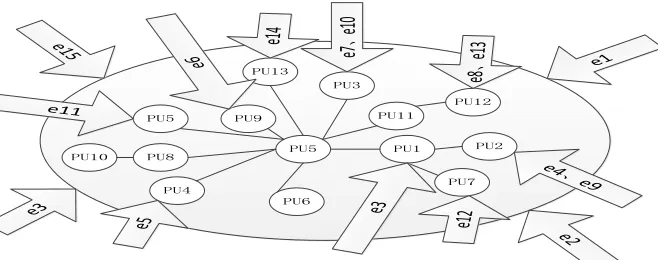
Clothing products in the circumstances of the incentive of objects, product definition data between the position constraints and movement constraints will be affected each other, the occurrence of incentive chain transmission, so the clothing tensile deformation, pressure response to the impact of the user's comfort. Here products are subjected to external incentives for garment modeling when the force, the use of spring-particle model, products will be subjected to their internal forces and action on the external force of the product. The internal force is naturally the elastic deformation force of garment e1, i. e., the tensile, shearing and bending stiffness of the material. The external force has gravity e2, the joint force e3...e8 exerted on the suture of six places such as coat, shoulder, armpit seam, clothing elbow, shoulder, BP point, garment chest, garment back, transverse gear and so on collision with human inverse collision force e9...e14 and resistance e15. The performance of garment products is embodied in the interaction of this product and environment, and the schematic diagram of its interaction is illustrated in Fig. 7.
TABLE 1. PRODUCT DEFINITION DATA META TAGS.
name PUj name PUj
Notch PU1 Button stand PU8
Shoulder PU2 Waist province PU9
BP PU3 Buttonhole PU10
Waistline PU4 princess seam PU11
Chest PU5 back seam PU12
Bottom PU6 crotch PU13
PU5 PU9 PU6 PU1 PU11 PU4 PU8 PU5 PU3 PU13 PU10 PU2 PU12 PU7 e1 e2 e3 e15 e3 e4、 e9 e5 e6 e7 、 e1 0 e8、 e13 e11 e12 e14
Figure 4. A schematic diagram of defining data and environment for garment products.
Application field simulation analysis layer of garment products is the application environment of apparel fabrics, apparel production and other apparel products performance simulation to achieve the user needs of the comfort degree. In the second chapter, the author introduces the expression of the garment's own internal force, and shows that the elastic deformation force of garment is decided by the elastic deformation coefficient Ce , whereas Ce according to the material performance parameters of the fabric, the smaller the garment distortion when the elastic properties of the fabrics are large. Similarly, the sewing force of the garment is applied to the stitching edge of the garment, and the distance between the suture points is linear function. j ip p j i s
sceam C p p N
f
When the suture coefficient Cs is bound, the greater the distance between the
suture point pi and pj, the greater the stitching force.
The collision force fpenalty of the garment with the human body is:
i p i
p
penalty C pp N
f
exp 1
The greater the inverse collision coefficient, the greater the inverse collision force. Damping force the velocity function that is subjected to a particle oscillation:
t x c f i d damp
When the faster the particle movement, the greater the resistance of the damping force, clothing will produce an unreal elongated deformation.
By formula (6) The analysis of the resultant force of the garment particles is:
a ) exp ( * * ) ( m 2 2 1 0 2 1 0 0 0 2 2 0 2 1 0
t x N pp C N p p C g m N p p p p C t x C t x i p p p p s i p p i i Q i e i d i i imore tensile performance is better. If the garment model distortion, then can also go back to the Garment product definition data link, product constraint information timely correction.
CONCLUSION
The management of personalized apparel products customized production has updated solutions, and in the virtual design implementation strategy, adopting the method of dynamic holographic product model, setting the dynamic factor, clothing personalized customization Whether in the garment product design, style design, craft design or effect display has important practical significance, can be based on the design effect, always retroactive to any issue and make changes. Using 3D virtual design technology based on the physical-geometric mixing model, the garment modeling from the perspective of network, at the same time to optimize the model, making the model more smooth, in addition to considering the performance of the fabric of the material is more realistic, so that the garment manufacturers to meet the requirements of collaborative design, can be more effective, faster, more economical to complete the development of apparel design, design show intuitive convenience.
ACKNOWLEDGMENTS
This work was financially supported by the National Natural Science Foundation of China for its financial support (No.51475434) and the Science and Technology Department of Zhejiang Province of China for its financial support (No.2015C03001).
REFERENCES
1. Ling Chen. Electronic tailored clothing eMTM oriented human body analysis system design and implementation of [R] Shanghai: Donghua University, 2005.
2. Sun Jian. Analyses the application of virtual reality technology in the clothing design [J]. Journal of textile review, 2013, (7):105-106.
3. Wu Hongfang, Sun Yufang. Shallow theory of garment digital education [J]. Journal of exam, 2008, (19):195-196.
4. Hao Yuntang, Jin Ye, Fan Xiumin, Pan Jun, Yan Juanqi. Virtual product development method based on the holographic product model [J]. - CIMS computer integrated manufacturing system, 2003, 9 (5): 357-362.
5. Xu Wenjing, Zhao Liangcai, Yi Hong. Dynamic holographic product conceptual design model [J]. Journal of East China Shipbuilding Institute (natural science edition), 2002 (5) : 61-66.
6. Ding Yulan editor.Ergonomics (Revised Edition) [M]. Beijing: Beijing Institute of Technology Press, 2005.
7. Liu Jionzhou, Li Jituo, Lu Guodong.3D Garment Physics-Geometry Real-Time Hybrid Simulation [J]. Computer-Aided Design and Graphics, 2014, 26 (12): 44-50.
8. Grovers CPM (1996) What and how about quality function deployment (QFD). Int J Prod Econ 46–47:575–585. Doi: 10.1016/09255273(95)00113-1.
9. Baraff D, Witkin A.Large steps in cloth simulation[C]// Proceedings of the 25th Annual Conference on Computer Graphics and Interactive Techniques. New York: ACM Press. 1998:43-54.
11. Sorkine O, Alexa M. As rigid as possible surface modeling [C]//Proceedings of the 5th Eurographics Symposium on Ueometry Processing. Aire-la-Ville: Eurographics Association Press, 2007:10 9-116.
12. Yao M, Zhou JF, Huang SZ, Shao LH, An Rl, Fan DX. Textile Materials Science. 2nd ed., Beijing: Textile Industry Press, 1993.518-532 (in Chinese).
13. Han Rong, Hu Kun, Wu Ge, Zhong Yueqi.Study on bending stiffness of fabrics using image method [J], Textile Research, 2016,37 (3): 41-46.
14. Fang Chao, Zhang Guoyou. Copper art value creation in the process of virtual design [J], E-commerce,2014, (12) : 50-53.