A SEMANTIC BASED FRAMEWORK FOR SOFTWARE PRIVACY BY
DESIGN
FATEMEH ZARRABI JORSHARI
A thesis submitted in partial fulfilment of the requirements of the University of East London for the degree of
Doctor of Philosophy
School of Architecture, Computing & Engineering
i
ABSTRACT
Software development market is currently witnessing an increasing demand for software applications conformance with the international regime of GRC for Governance, Risk and Compliance. In this thesis, we propose a compliance requirement analysis method for early stages of software development based on a semantically-rich model, where a mapping can be established from legal and regulatory requirements relevant to system context to software system goals and contexts. This research is an attempt to address the requirement of General Data Protection Regulation (GDPR, Article 25) (European Commission) for implementation of a "privacy by design” approach as part of organizational IT-systems and processes. It requires design of data protection requirements in the development of business processes for products and services. The proposed semantic model consists of a number of ontologies each corresponding to a knowledge component within the developed framework of our approach. Each ontology is a thesaurus of concepts in the compliance and risk assessment domain related to system development along with relationships and rules between concepts that compromise the domain knowledge. The main contribution of the work presented in this paper is a novel ontology-based framework that demonstrates how description-logic reasoning techniques can be used to simulate legal reasoning requirements employed by legal professions against the description of each ontology. The semantic modelling of each component of framework can highly influence the compliance of developing software system and enables the reusability, adaptability and maintainability of these components. Through the discrete modelling of these components, the flexibility and extensibility of compliance systems will be improved.
ii
ACKNOWLEDGEMENT
I have no words for thanking my director of studies, Professor Allan Brimicombe for his continued support and encouragement throughout delivering of this thesis to the end since working with him was a different and very useful experience for me. My Special thanks are for Dr. Abdel-Rahman Tawil for his supervisory during final stages of my PhD, also for all his guides, helps and leadership during my PhD. Also I am thankful to my previous team of supervisory for their introductory to this area of research, help and advices, especially to Professor David Preston.
Thanks to everyone in the University for helping to make a sufficient working environment for me. I’d particularly like to thank Professor Hassan Abdollah, Doctor Rabih Bashroush and Dr Hossein Saeidpour for their helpful feedback and comments on my work.
As importantly I would also like to thank my mother and father for their unflagging love, prayers and for the support I have received from them throughout has been overwhelming. I will be forever indebted with them.
iii
Contents
1.INTRODUCTION 1
1.1 Background and Motivation………..……….…………1
1.2 Aims and Objectives………...….…….……….………4
1.3 Research Contribution………..……….……….66
1.4 Thesis Overview………..…..….………..……..7
2 LITERATURE REVIEW 9
2.1International Organisation of Information Technology Laws…….………..………99
2.1.1 United Nation and IT Legislation Regime………...….100
2.1.2 European Union and IT Legislation Regime………...……….……….111
2.1.3 Asian Pacific and IT Legislation Regime ………...…..…….13
2.1.4OECD ….………..……….144
2.1.5International Regime on Data Protection Legislation………..….……..15
2.1.6 Future of Data Protection Legislation……….……….……..….…17
2.2 After-the-fact- Compliance………..……….………...…18
2.3 Before-the-Fact-Compliance …………………..……20
2.3.1Compliance to Data Protection……….………..23
2.3.2 Privacy by Design……….……….25
2.3.3Compliance Requirement Analysis………28
2.4 Law Analysis………….……….………...33
iv
2.6. Compliance to Standards………….……….………..39
2.7Advanced Software Engineering by Design Patterns:…………..………40
2.8Technical Aspects of Ontology & Semantic Web……….41
2.8.1Introduction………41
1.42.8.2Ontology and Semantic Web……….42
1.42.8.3Ontology Language………...45
1.42.8.4Resource Description Framework/Schema(RDF/S)…………..………45
1.42.8.5Ontology Web Language OWL………..……...47
1.42.8.6Semantic Web Rule Language (SWRL)………48
1.42.8.7OWL Reasoning using Pellet………49
1.42.8.8Data Representation using XHTML………..………49
2.9 Conclusion………….…….….……….49
3 RESEARCH DESIGN 53
3.1 Introduction……….………….…..…….…………..533
3.2 Research Methodology……….……….………..533
3.3 Research Approach……….………….54
3.4 Methods of Data Collection and Analysis………..….…………54
3.4.1 Collecting IT Laws and Regulations……….………….….55
3.4.2 Case study Selection………....………57
3.5 Ontology Based Compliance Framework Design and Specification…58 3.5.1 Analysis of Laws & Regulations……….………...611
3.5.2 Classical Methods of Law Analysis…………..…………...…………..622
3.5.3 Legal Reasoning Methods in Our work:…….…..…….………65
v
3.5.5 `Cellular Analysis of Legal Texts……….………..75
3.5.6 Compliance Ontology……….……79
3.5.6.1 Law Ontology………80
3.5..6.2 Rules in Compliance Ontology……….……..……..……833
3.5.7 Application of Law to System Context………..……….86
3.5.7.1 Modelling System by i* Modelling Language:……….86
3.5.8 i* Modelling Ontology……….……….……….……….921
3.5.9Legal Reasoning……….………….………..………..924
3.5.1Design Ontology….….……….…..………...1066
3.5.1.1Law Application by Ontological Individuating System and Reasoner10909 3.5.12 Laws Interpretation & Refinement………..………1111
3.5.13 Refinement and Interpretation by Standards………….………..1122
3.5.14.Standard Ontology……….………….……1302
3.5.15 Refinement and Definition of law by Authority Guidelines………...1343
3.5.16 ICO Ontology………….………...………..14948
3.5.17 Risk Analysis….………..……….…………..1520
3.5.18 Risk Ontology…………....…….….………...……….162
3.5.19 Refinement by Patterns………….…….………..……1687
3.6 Required Technologies for the Semantic Rule-Based Compliance Approach…...171
3.6..1 Data Modelling with OWL………..………….17171
3.6.2 Semantic Rules Using SWRL………..…….……….17271
3.6.3Individualling Process in Protégé………...172
vi 3. 7
Summary……….………..…..1733
4 EVALUATION 174
4.1 Methodology………..………..…………..1754
4. 2Case Study Evaluation………...178
4.2.1Non-transparent Policies, Terms and Conditions.………….………..1788
4.2.2 Easy to find……….……….……….………..1798
4.2.3, Fully Describing Data Processing………..…...……..………1809
4.2.4 Understandable for non-Lawyers………18180
4.2.5 Complete but KISS……….……….………1821
4.2.6 User Consent………..……….18281
4.2.7 User Language……….…………18382
4.2.8 Actively Communicated……….…..………..18382
4.2.9 Collected Data………1843
4.2.10 Readability Tester……….1843
4. 3 PRD Approaches ………...………….183
4. 4 Conclusion……….………..………..………….……….19190
5 CONCLUSION AND FUTURE WORKS 191
REFERENCES………...194
APPENDIX I: IT LAW LEGISLATION……….212
vii
APPENDIX III: AU-SoPD MANUAL………239
APPENDIX V. RDF REPRESENTATION OF KN-SOPD ONTOLOGIES………273
PUBLICATIONS………...278
List of Tables
Table1.1. Objectives of Ontology-based Compliance Framework Table3.1. Data Protection Legislation’s Principles Comparison Table3.2. ISO 27000 Series of Standards.
Table3.3. Comparing ISO/IEC 29100 and ISO/IEC 27000 concepts Table3.4. ISO 27005-Matrix with Predefined Values
Table4.1. Non-Transparent Policies, Terms & Conditions Table4.2. Easy to Find
Table4.3.Fully Describing Data Processing Table4.4. Understandable for Non-Lawyers Table4.5. Complete but KISS
Table4.6. User Consent
Table4.7.Actively Communicated Table4.8. Collected Data
Table4.9. Readability Tester
Table4.10. Comparing Approaches for PRD Table4.11. Comparing PRD Approaches
viii Table4.3. Fully Describing Data Processing Table4.44. Understandable for Non-Lawyers Table4.55. Complete but KISS
Table4.66. User Consent
Table4.77. Actively Communicated
List of Tables
Table4.88. Collected Data Table4.99. Readability Tester
Table4.100. Compliance Approaches for PRD Table4.111. Comparing PRD Approaches Table1.International IT Laws
ix List of Figures
Figure2.1. Semantic Web Stack
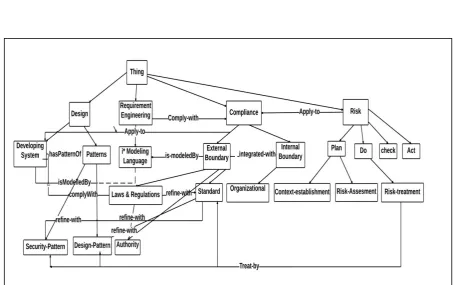
Figure3.1 .High Scheme of Privacy by Design Compliance Framework Figure3.2. Law Ontology
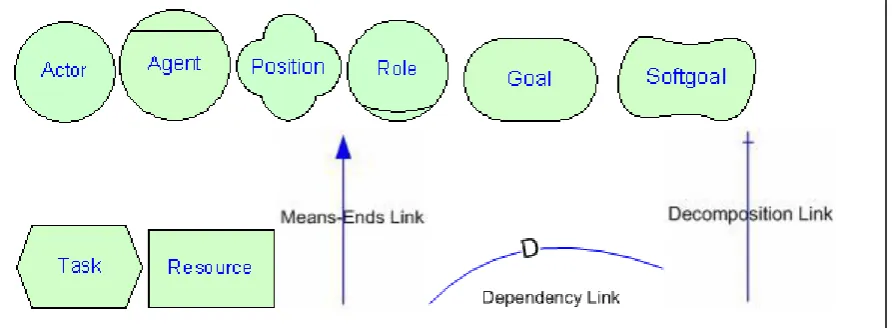
Figure3.3. Class Hierarchy in Data Protection Ontology Figure3.4.i* Concepts
Figure3.5. i* Dependency
Figure3.6. Means-end Decompositions Links Figure3.7. i* Contribution Links
Figure3.8. i* Actor Association Links Figure3.9. i* Soft-goal Contribution Link Figure3.10.i* Ontology Classes
Figure3.11. Application of GDPA Article 14 to Esilver Case Figure3.12. Developing System Ontology
Figure3.13. Standard Ontology
Figure3.14 .Standard Ontology Subclasses Figure3.15.ICO Ontology
Figure3.16.ICO Sub-classes Figure3.17. Risk Ontology
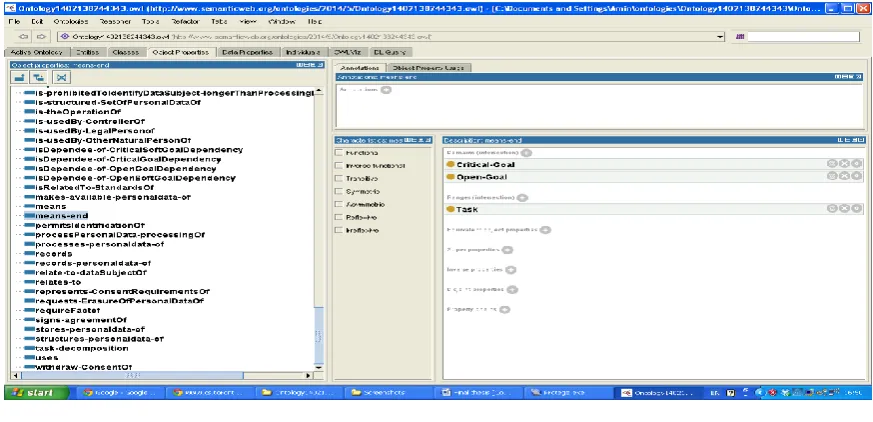
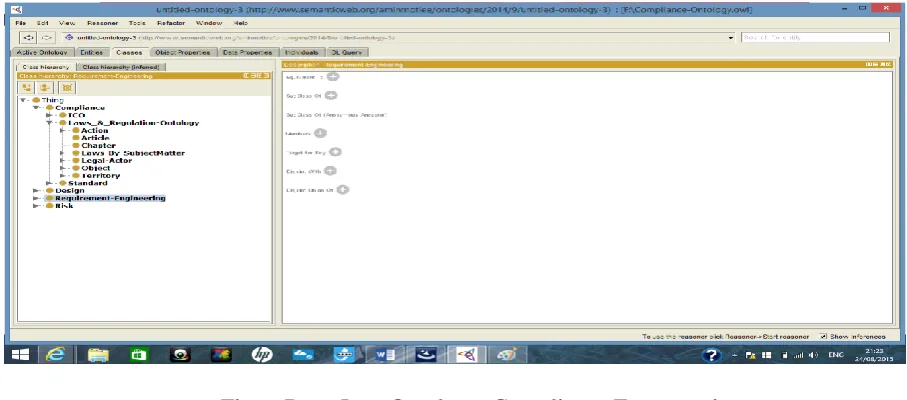
x Figure2 . i* Ontology. Protégé 3.4
Figure3 . i* ObjectProperties Figure4 . Relations in i* Ontology
Figure5 . Individual Construction in i* Ontology Figure6 . Means-end Relation in i* Ontology Figure7 . Law Ontology. Compliance Framework Figure8 . Law Ontology. Class of Subject-Matter Figure9 . Law Ontology. Class of Territory
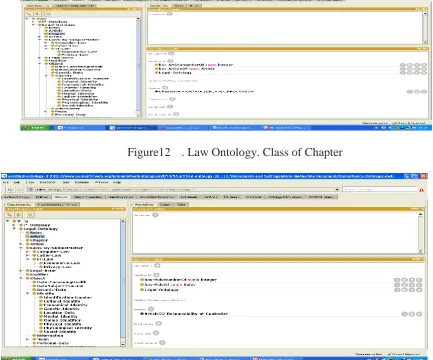
Figure10 . Law Ontology. Example of Territory Relation Figure11 . Law Ontology. Laws-By-SubjectMatter Property Figure12 . Law Ontology. Class of Chapter
Figure13 . Law Ontology. Class of Article Figure14 . Law Ontology. Class of Law-Actor Figure15 . Law Ontology. Class of Object Figure16 . Law Ontology. Operation Class Figure17 . Law Ontology. Process’ Rule
Figure18 . Legal Ontology. Individual of Process Figure19 . Law Ontology. Controller’s Rule
Figure20 . Law Ontology. Subclasses of Object Property determines-ProcessingCircumstancesOf
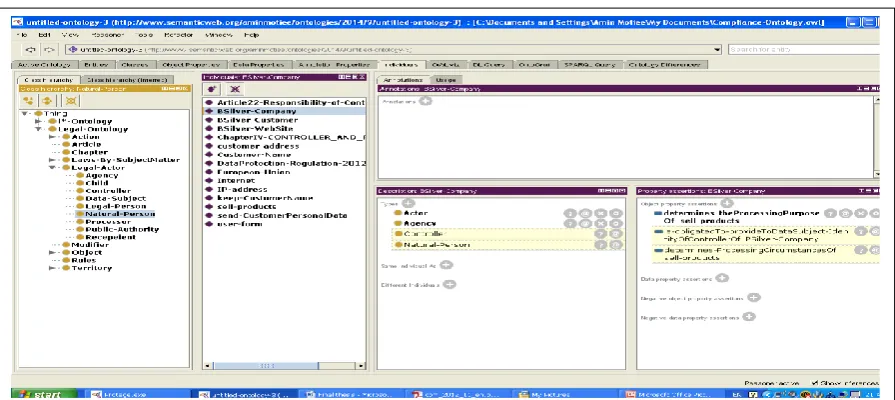
Figure21 . Law Ontology. Individual for Controller Figure22 . Law Ontology. Individual for Processor Figure23 . Law Ontology. Data-Subject Rule
xi
Figure25 . Law Ontology. Individual for Personal-Data Figure26 . Legal Ontology. Data Protection-Law’s Rule
Figure27 . Legal Ontology. Individual for DataProtection-Regulation-2012
List of Figures
Figure28 . Law Ontology. Processor’s Rules Figure29 . Law Ontology. Processor’Rules Figure30 . Law Ontology. Processor’Rules Figure31 . Law Ontology. Controller’Rules Figure32 . Standard Ontology. Facts Refinement Figure33 . Standard Ontology. Obligation Refinement Figure34 . Standard Ontology. Obligation Refinement Figure35 .ICO Ontology. Refinement Obligation Figure36 . ICO Ontology. Obligation Equivalency Figure37 . ICO Ontology. Permission Refinement Figure38 . Controller Rule
xii Abbreviations
NIST: National Institute of Standards and Technology EU: European Union
ICO: Information Commissioner’s Office GDPR: General Data Protection Regulation OCEG: Open Compliance and Ethic Group
ITechLAW: International Technology Law Association TTFL: Transatlantic Technology Law Forum
UN: United Nation
EDPS: European Data Protection Supervisor
UNCITRAL: Commissions of International Law, International Trade Law
UNICTTF: United Nation Information and Communication Technology Taskforce APEC: Asian Pacific Economic Cooperation
OECD: Organisation of Economic Co-operation and Development GRC: Governance, Risk & Compliance
ENISA: European Network and Information Security Agency ML: Modelling Language
ISO: International Organization for Standardization PCI DSS: Payment Card Industry Data Security Standard DPA: Data Protection Act
xiii
COBIT: Control Objectives for Information and Related Technologies KAOS: Keep All Objectives Satisfied
1 1. INTRODUCTION
1.1Background and Motivation
Software systems are now widely used for applications including financial services, industrial management, and medical information management. Such systems collect and process sensitive information including personal and financial data ( Breaux et al., 2008)
Therefore, safeguarding privacy and security of these data and also applications processing them, is one of the most critical consideration of the system developers and system users. Beside the technical safeguards and solutions for security and privacy, these subjects have also been considered in higher level of governments where laws and general policies are established. Governmental regulations that impact software systems are becoming ever-more prevalent in current legislative scenarios around the world. Therefore, it is now necessary that software for critical applications must comply with the relevant legislation. Particularly after the financial crisis of 2007-2008 (Kirpatrick, 2009) and considering the latest regulating climate, industries recognised the need to develop clear processes in order to improve their legal compliance process.
From another point of view, looking at software engineering and different activities of that, one of the initial stages is feasibility study or to be said system procurement. This is the place where decisions are made on the scope, budget and timescale and on whether the system should be procured. One of the main factors that is said to influence the decisions in this stage is “the need to comply with external regulations”. The reason behind this is the speed and completion of businesses through getting regulated with defined regulations. This has caused to a demand to replace noncompliant systems with the ones which make the compliance happen or monitor the compliance. ICT legal compliance has also been called as the marriage between business process management and information management (Rahmouni et al., 2009, Rifaut & Dubois, 2008, Roebuck & Dresner, 2005). It is where regulators preside, the organisation’s legal officers are witnesses and a guest list of middle managers, lawyers and other interested parties ensure that the couple’s brings up no nasty surprise!
2
£450k to £850k for large and £35k to £65k for small organisations which was almost tripled of the previous year rate. It is necessary to mention that also 85% of large organisations and 61% of smaller ones had been asked by their customers to comply with security standards such as the ISO 270001. According to the report 52% of organisations had a few experience of breach of data protection laws incidents during 2013, 25% had one incident during the year, 8% had about once a month, 12% once a day and 6% had several experiences of the incident during a day. These statistics also show that organisation had contingency plan for 50% of Infringement of laws or regulation incidents which were successful. But the legal actions that they took against the worst security breached only include 5% compared to their other security actions. These are proof on importance of legal compliance which is still being implemented. It also shows the importance of legal compliance as an integrated reference and a non-ignoring solution for security incidents.
3
In recent years, a large body of works have approached compliance as an early requirement of system and have aligned requirement engineering with compliance techniques. They mostly used goal-oriented methodologies of requirement engineering, taking law's rights as one of the main goal for the systems to be satisfied (Mouratidis et al., 2006; Houmb et al., 2010; Giorgini et al., 2005; Gangemi et al., 2003; Garzotto et al., 1999; Genesereth et al., 2014; Ghanavati et al., 2007; Gerber et al., 2008; Shamsaei et al., 2011). Various techniques to analyse and extract rights from legal texts have been researched by Breaux & Antón (2008) and Islam et al. (2010). The third type of works is those focusing on ontology techniques within the legal domain. Using semantic webs and developing ontology of legal concepts is also a well-known approach in the field of artificial intelligence. Authors in some surveys (Benjamin et al., 2005; Brekeur et al., 2003) have delivered a series of works providing legal ontology solutions for legal specialists. They have identified rich legal concepts in their taxonomies. Fenz et al. (2007), Gangemi et al. (2003), Ponoela et al. (2005) and Schmidt (2008) also proposed ontology and semantic web as solution for compliance. All mentioned works in requirement engineering have provided good efforts to address Privacy by Design. Ontology also was a great solution to provide knowledge repository for compliance. But still there are some points in compliance that should had been covered in future researches as being discussed in following.
First of all, governments and industries follow instruments from regulatory bodies and standardisation institutions to ensure information security. Thus, companies need to address compliance from two perspectives: IT compliance to industry best practice and guidelines and, on the other hand, compliance to laws. As discussed in previous paragraph, and also based on industry of compliance, standards such as ISO and Common Criteria and regulations such as Data Protection Act (Information Commission Office, 2012) and PCI DSS (PCI Security Standard Concil, 2016) play key role in compliance. This is a situation where an integrated and comprehensive solution for compliance is lacking that can cover different elements of compliance instead of providing isolated solution to one compliance element. Also According to OCEG a well-defined compliance is also augmented by an assessment of risk in order to safeguard the objectives of laws and policies (Open Compliance & Ethics Group (OCEG), 2009). In some situations, where a few of the elements of compliance are being overlooked or researched in isolation, new research is required to study compliance as an integrated concept in the area of software development.
4
laws, guidelines and standards which are linked together using ontological relationships. The result is a united and integrated compliance solution to different resources in compliance from laws to standards and also guidelines and best practices. The query-based system of semantic approach also provides a user friendly and automated environment for users who want to be informed about knowledge of compliance. Our approach enables machines to use conceptual semantic models and apply reasoning techniques to infer compliance. Rule-based reasoning technique in ontology, especially the platform which we are using, protégé, provides ability to perform legal reasoning task automatically. This is the task performed by legally specialise and compliance officer in order to apply a rule of law to scenarios of real world. The correlation between different concepts and components of the compliance framework with ontology also provide the ability for user to trace a refined compliance requirement to its base requirement from laws, regulation or system context. Tracing requirements is one of the sought factors in compliance. Also, mapping between corresponding concepts from different ontologies of synonym terminology between different components of compliance framework is an advantage here which makes the compliance to different resources easier. The ontology also provides formalisation to the context of law, regulation and generally official document rules and texts. Therefore, this thesis focuses on designing a suitable architecture for compliance in software development and also business process to address Privacy by Design by using ontology and semantic rule technologies.
1.2 Aims and Objectives
The aim of this thesis is to propose an ontology based approach for supporting compliance of a developing information system to its related domain of laws, standard and policies. To achieve this goal, our work proposes a framework which delivers number of objectives to the area of information system development compliance based on Table1.1:
Objective comments
Provide a repository of compliance knowledge using Ontology-Semantic web
Implement a compliance framework as a knowledge repository to automatically retrieve, add or change information on compliance knowledge and system requirements
Categorize and interrelate different components of the framework as well as their concepts and objects
5
developing system using semantic ontology reasoning infrastructures
Consider compliance as a critical requirement in Requirement Engineering stage of software development in order to answer to GDPR demand of Privacy by Design
Start compliance from early stages of system development
Extract requirements from laws, regulations and policies
Categorize requirements using ontology taxonomy
Check requirement consistency by analysing requirements from different stakeholders
Trace requirements by identifying requirement dependencies, refining high-level requirements to application level
Perform an easy process of Law Analysis Resolve the ambiguity of legal language for software developers
Perform a legal reasoning task following similar procedures to legal professions
Perform a Compliance process including different elements of compliance
Apply relevant laws, regulation and internal and external policies to the scope of developing system
Coverage and integration of different resources of compliance such as laws, guidelines and standards and the ability to refine them together in a hierarchical order
Perform Risk analysis against legal and security objectives of system
Address constraint and risk against compliance objectives
Address system Design Perform early stages of system design using design patterns
Table1.1 . Objectives of Ontology-based Compliance Framework
To achieve the objectives above, separate ontological components are designed addressing each of the objectives in isolate. Each ontology describes the structure of knowledge domain of each objective whether it is Compliance Ontology, Risk Ontology, Requirement engineering Ontology or Design Ontology.
6
software development, also to refine and reason facts of system context in a heretically order to high level demand of legal text and later to more application level requirements. The mapping between different components also benefit the user in order to find out about same concepts that has been defined in different terminology in our compliance components. Legal reasoning task has been possible in this framework using the semantic and rule based reasoning technique in protégé (Ontology & Semantic Web Online Tutorials). Extendibility in this context can be realised by allowing new ontologies to be added to this framework, also by adding new concepts to each of available ontologies, without having any significant impact on the architecture of system or a little to be changed. The proposed approach allows the user to start modelling of systems, find and apply related laws to the context of system and refine law’s requirement by application level requirements from authority guidelines, standards and design patterns and perform risk analysis against system and its legal requirements, also to retrieve knowledge regarding each discussed steps.
1.3 Research Contribution
This research proposes a semantic rule-based approach to develop a compliance framework for software development in order to fulfil the requirement of General Data Protection Regulation known as “Privacy by Design”. Our approach proposes an ontological architecture featuring a compliance engine which gets all its knowledge from ontologies implemented in our approach. The main contribution of this work is the separation, also the integration and refinement of the components of proposed framework using different ontologies. The coverage of most elements of compliance from laws to standards and guidelines and the method in which they are integrated together is the base novelty of the framework itself which has been possible by using the proposed knowledge-based approach.
Simulating legal reasoning task of legal professions and being able to automate it using rule-based reasoning technique in semantic web is another contribution. Being able to conclude and refine from a simple fact from system context to legal requirements of system is a great advantage which fascinate the complex task of compliance for system developer who are not familiar with legal tasks. This will also benefit user of our system to deal with the complex task of law analysis and ambiguity of legal texts.
The conceptual model of ontologies and the taxonomy of each provides a great knowledge repository from both legal and compliance domain and also requirement and design engineering for the user. The knowledge can be modified, extended or deleted in any time.
7
compliance laws. Moreover, the ontology based approach addresses problem of maintenance and reusability of the framework components.
Being able to represent and formulise rules of law by a same titled facility in ontology called Rule, and the unique syntax and format used to formalise them, makes this work different from other similar works.
Having some early stages of system design in the proposed framework and its corresponding ontological model, helps non-professional developers to have some primitive ideas regarding the way in which the high-level legal requirements can be designed and implemented in following stage of system development.
1.4Thesis Overview
The rest of this thesis is organised as following:
Chapter 2 reviews the necessary literature on legal aspect of information system and the compliance specifically in area of Privacy by Design. Also it provides some literature regarding the components of our framework from laws, standards related to information system such as Data Protection and standards such as ISO. The literature review covers seven types of previous works. First are background on IT legislation. A survey on research in information technology laws are provided in this section. This helps the reader to have background regarding different IT laws and also makes reason for the selection of Data Protection Regulation as a compliance law in this research. Second and third categories present a background on previous works which had proposed after-the-fact compliance approaches information technology and before-the –fact approaches. The last three parts provide background knowledge on ontology-based compliance approaches, advanced software engineering and technical aspects of ontology and semantic web. The weak and strength points of previous works are discussed in conclusions and grants to this research are concluded at the end.
8
and interrelate different ontologies together. Required technology to implement KN-SoPD, the ontological implementation of our framework is discussed later.
Chapter 4 presents the result of the evaluation of our approach, proposed in this thesis. Chapter 5 concludes the thesis. It outlines the objectives achieved and the key
9 2. LITERATURE REVIEW
The literature review in compliance domain is generally divided to different categories. This is firstly due to different perspectives of compliance in general. At the beginning we are providing a survey on history of legislation in IT domain and international organisation participating in IT law assignment. This is to make ourselves and readers familiar with different laws and organisations related to IT legislation and specifically privacy laws. Then we will consider the traditional approaches of compliance where auditing happens after the production of final product known as After-the fact Compliance. In contrast to this, we also perform literature review on approaches in which compliance is considered through design and development of system called Before-the-fact Compliance. Each of these two main categories may include compliance solution as general, in IT domain or to a specific area except from IT. A separate literature review will also be considered to the different components employed in our framework and their isolated application in subject of compliance in previous works. Considerable number of previous researches had been afforded to analyse laws and extract requirements from them. Making organisational policies and implementing systems based on compliance requirements is an area of compliance in design which specifically will be discussed too. A main literature review is specified to ontology-based compliance approaches. They provide a knowledge repository of compliance concepts. Advanced software engineering. And using design patterns is discussed in another part. And finally technologies used for ontology and semantic web implementation is discussed at the end. We conclude this literature review with weak and strength points of current work with others. We should mention that there will be some overlaps between different areas of literature review here due to the fact that some previous works may have provided multi-objective compliance solutions.
2.1 International Organisation of Information Technology Laws
10
international, continental and national scopes. The second metric to categorise legal actions is based on the criteria of IT targeted by the legal practice. This is first generalised by legal aspects of IT (Computer Law, Cyber Law and IT Law) and later is narrowed by specific fields such as copyright, information security, privacy, e-commerce and others. Regulations in each category are categorised firstly from traditional legal frameworks which have considered the matter from a general point of view such as privacy regulations. After, those are listed which have special consideration on the matter in technology aspects such as Data Privacy regulations.
It is essential to mention that to look at the subject in international and continental scopes, expert groups are assigned in most cases who have especial activity and legal authority in a specific field of IT or a general matter such as UN Security Council. Following sections are provided to make ourselves familiar with international organisations and their working groups and committees in IT legislation.
2.1.1 United Nation and IT Legislation Regime
11
by the United Nations General Assembly by resolution 2205(XXI) of 17 December 1966. It provides legislative and non-legislative instruments in areas such as international contract practices, electronic commerce, and international payment and secure transactions. The legislative instruments are conventions, model laws, legislative guides and model provisions UN council of Human Right is another subsidiary organ of General Assembly (GA) established by resolution 60/251, which is specially mandated to promote and protect human rights for all by providing assistance and technical training to member states. Children rights, civil and political rights, cultural rights and privacy are some of the fundamental issues of human right covered by Human Right Council. Universal Declaration of Human Right is the key treaty of the council dealing with all aspects of human rights. Regarding rights in cyber space, HRC is one of the key organs which has taken serious actions to protect privacy of people in digital age. In December 2013, GA adopted resolution 68/167 expressing deep concerns of UN regarding the negative impact of surveillance and interception of electronic communications on human rights. In this way, GA called all states to review their procedures and legislations regarding the interception and surveillance of communication and protection of personal data by insuring their full compliance with international human right law and some other legal international instruments such as International Covenant on Civil and Political Rights. Security Council is the main organ of UN which is responsible for the peace and security of the globe under the UN Charter. It consists of 15 members and decisions of the commissions are obligated to all member states of UN. Security Council also consists of some committees such as Counter-Terrorism Committee, specifically responsible to prevent terrorism actions around glob by making policies and giving technical assistance to states. It was established in the wake of 11 September attacks against United States in 2001.
Economic and Social Council (ECOSOC) is the principle organisation under the UN charter which coordinates the economic, social and related works of UN. It was established in 1946 under the charter of UN. One of the main achievements of ECOSOC regarding IT has been the establishment of “Information and Communication Technology Taskforce” (UNICTTF) in 2001.
2.1.2 European Union and IT Legislation Regime
12
European Council sets the overall political directions of EU but has no power to pass law. It consists of head of states or governments of 28 European member states along with Commission president and Council of EU president.
European Parliament is directly voted by EU voters every five years and its member’s present EU people. Along with the Council of EU, the European Parliament has a process called “Ordinary Legislative Procedure” to decide on the contents of EU laws and officially adopt them.
European Commission is also consisted of 28 commissioners from member states which each commissioner is responsible for a specific area of policy making assigned by the Commission president and approved by European Parliament. Their main responsibility with the “right of initiative” is to propose new EU laws and pass them to European Parliament and also enforce the approved laws to states as the body of “guardians of the Treaties”. One of the main and recent activities of European Commission had been its proposing of Europe 2020 Strategy on March 2010, in order to improve the economy of European Union. The strategy is the following of another one in the period of 2000-2010 called Lisbon Strategy. In order to gain the goals, the strategy has targeted seven flagships initiative which the first one is called the Digital Agenda for Europe (DAE). DAE aims to improve digital technology and services to European citizens and businesses by taking 101 actions grouped under seven main areas. Regarding the IT legislation two of the action categories can be mentioned as to create a new and stable broadband regulatory environment and to propose EU cyber-security strategy and Directive. Under the defined actions European Commission has considered to update numbers of current directives and also propose new directives and rules.
13
2.1.3 Asian Pacific and IT Legislation Regime
APEC ( APEC ELECTRONIC COMMERCE STREEING GROUP), established in 1989 and today composed of 21 of “member economies”, is the premier intergovernmental grouping in Asian Pacific region which aids to facilitate economic growth and cooperate trade and investment in the area. Unlike the other multilateral trade bodies, APEC operates based on non-binding commitments and has no treaty obligations required for its members. Indeed, each of member states has their own time and action plans to achieve APEC’s policies on a voluntary and non-binding basis and individual action plans and their results are submitted to APEC in regular basis and peer reviewed by APEC’s special teams.
14
Telecommunication and Information working group established in 1990 and consists of three steering groups of Liberalisation, ICT Development and Security and Prosperity (SPSG). Their aims of improvement in information and communication technology, safe and trustable ICT environment and cooperate in ICT activities in the region are being followed by the group implementing policies, task forces and strategies such as “Internet of Things”. SPSG as a steering group focusing on promoting security and trust in e-commerce and avoiding cybercrime in the area, has special cooperation with OECD and numbers of projects such as Cyber Security Policy Developments in the APEC Region led by USA.
2.1.4 OECD
The Organisation of Economic Co-operation and Development (Open Compliance & Ethics Group (OCEG) (2009) GRC Capability Model “Red Book” 2.0. OCEG Publication. composing of 34 members from different countries around the world from Europe to Asian Pacific and US along with the Europe Commission, gathers governments to share experiences and seek solutions to common economic, social and environmental problems and promote OECD’s established policies, standards, guidelines and recommendations across the members. The work is carried out by the contribution of OECD organs such as the Council, committees and Secretariat. OECD Council as the decision making power made up of one reprehensive per member country plus a representative of the European Commission. OECD Committees consisted of around 250 different committees and working groups, each focused on a specific area such as economic, trade, science, education and others. Representatives of the 34 members meet along the committees and working groups in order to advance ideas and review the progress in each mentioned specific policy area. The Secretariat chairs the commission, provides the links with national delegations and supports committees’ activities. OECD also has official relations and cooperation and extensive contacts with international organisations and bodies such as United Nation Council of Europe, Asian Pacific Economic Cooperation (APEC), also with civil societies such as ENISA (European Network and Information Security Agency), International Conference of Data Protection and Privacy Commissioners and GPEN (Global Privacy Enforcement Network) and indeed with some non-member countries in order to consult and conduct policy dialogues.
Among different departments of OECD, there is a one called “Directorate for Science, Technology and Industry” with specialized and assorted focus on matters such as Internet Economy, Science and Technology Policy, Broadband and Telecom, Innovation in Science, Industry and Technology and others not being mentioned here regarding their irrelatively to the subject. The Directorate supports the work of a committee called as Committee on Digital Economy Policy consisting of working parties of:
15
Security and Privacy in the Digital economy
The working parties are established under the working area of Internet Economy and Broadband and Telecom and eventually develop recommendations and policy guidelines which
express the consensus views of the entire OECD membership.
2.1.5 International Regime on Data Protection Legislation
16
provided number of recommendations and guidelines for member states in order to implement the directive and convention also in line of the data protection issues itself.
Data Protection Directive 1995 is one of the most important legal frameworks taken by European Parliament and Council to ensure and incorporate level of equal privacy legislation in Europe and its member state national law. Member states adopted their national laws to meet the goals defined by this directive. UK Data Protection act 1998 and Federal Data Protection of Germany are some samples of implementation of Data Protection Directive in EU member states. The models introduced in EU directives are also assimilated by some non-Europe states as described before in section 2.1.2. Technology progress and the new challenges of it has redounded to reformation of Data Protection Directive and to its following adopted national laws. As an instance, regarding the new methods of data collection, access and use in Internet and the challenges coming with that, EU has proposed a reformation on Data Protection Directive in 2012 known as General Data Protection Regulation and member states are instructed to apply their national laws. A role is issued to an institution called EU Commission in order to ensure the loyalty of member states to the adaptation and application of EU directives. Each member state has also some authorities responsible to adopt their national laws to directives and keeping the track of it by EU Commission. Information Commissioner’s Office of UK (ICO) is an instance of the authority in UK (Information Commission Office, 2012)
In about the time when Council of Europe started its activity in the field of privacy and data protection, OECD also appointed an expert group in 1969 in order to analyse different aspects of privacy in relation to digital information, transformer data flow and policy generating in general. “Recommendations to Member States concerning Guidelines on the Protection of Privacy and Transformer Data Flows” is an OECD product in the field of data protection as the working result of another special group in 1980. As the group was remitted their work was carried out in close relation with Council of Europe and European Community. Although the mentioned guidelines did not have legal binding as the Convention of Council of Europe had and it should be seen as a common-law-based approach. OECD also adopted “Declaration on Data Flows” in 1985. Apart from the legal activities, OECD also has sponsored number of projects such as an online package referred to as a privacy generator which help web developers to use techniques and safeguards in compliance with OECD Guidelines on data protection. In same category of activity, APEC also established “Asia Pacific Privacy Charter Council” hosted in Cyberspace Law & Policy Community of University of New South Wales in 2003 which is drawn on APEC Privacy Framework. Its aim has been introduced to develop independent standards for privacy protection in accordance with privacy laws in the Asia Pacific region.
17
requirements of the guidelines. In a meeting of data and privacy protection commissioners in 2009, UN also considered a demand for global and international standardization in the field of data protection allowing for the development of a universal legal document with cooperation of national authorities and organizations in the field. It was followed by UN rapporteur on human right call in 2010 for establishment of a global privacy standard which still has not been proceed on.
In national legislation level, there is a gulf between countries which see the data protection essentially rooted in notion of human rights and those which believe data protection has economic bases. Banisar & Davies (1999) has provided a survey on the development and establishment of data protection law in about fifty countries around the world.
2.1.6 Future of Data Protection Legislation
The rapid development of technology which has observed its consequences in modern and global methods of trade in location-based services and smart cards, remote data sharing and storage in cloud computing, communications in social networks and other new generation of technology has changed the way personal data are collected, shared and used and consequently has brought new challenges in data protection. Also it is believed that the flexibility of international data protection legislation and guidelines in the implementation methods of data protection rules in national level, has made an uneven level of data protection in case of international services of technology. Therefore, international authorities such as European Commission have come to the term of reform in data protection rules. The Commission has proposed a complementary reform on Directive 95/46/EC on January 2012. The goal is to update and modernize the principles enshrined in 1995 directive in order to guarantee and strength data protection in future. In fact, the proposal is a reflection of the change in Lisbon Treaty and Article 16 TFEU, to create a new legal basis for a modernised and comprehensive approach to data protection and the free movement of personal data, also covering police and judicial cooperation in criminal matters (European Commission Justice, 2012). The Commission has been in public consultation and intensive dialogs with EU national data protection authorities and EU stakeholders and international organisations such as ENISA from 2009 and finally has come to united opinion on the demand for the reform on data protection rules in Europe. In 2012 the Commission proposed new framework consisting of:
A Regulation (replacing Directive 95/46/EC) setting out a general EU framework for data protection
A Directive (replacing Framework Decision 2008/977/JHA) setting out rules on the protection of personal data processed for the purposes of prevention, detection, investigation or prosecution of criminal offences and related judicial activities
18
been adopted to replace the current directive and a harmonized set of core rules has been introduced. Some articles are repeated from Directive 95/46/EC, some new articles have been added and some are the extension of current articles. General Data Protection Regulation has been adopted in this research as a reference legislative framework for compliance to privacy by design. Compliance approaches in general are divided to two categories of After-the-fact and before-the fact solutions. To have a literature review on these two categories, we have following sections and listed relevant works both for compliance to data-protection or any other laws, regulation or industry. This is to have a review on any compliance methodologies as well.
2.2After-the-fact- Compliance
Compliance in running businesses is a traditional and industrial solution in which compliance is audited when the final product is working and running in application area. These woks are also categorised to two main branches of Retrospective Reporting approaches where compliance auditing are performed manually (often through some consultation and guidelines) or by Automated Detection. Regarding the big number of almost commercial works in this area, we have selected the most known and famous ones in following lines to be reviewed. We will briefly review these works as after-the-fact solutions although they are not the concentrate of compliance in our work. Therefore, we don’t go further in details of them. Regarding the bunches of commercials approaches in this area, our aim is to have a brief review on their technical aspects.
19
each group. The work adopts the PDCA cycle model for risk management in ICT project lifecycle.
The second category covers the bulk of existing software solutions for compliance. Following list are some of Software approaches provided for compliance.
IBM Lotus workplace for Business Controls & Reporting (International Business Machine Corporation, 2004) provided an open controls-management platform that enables to address challenges in managing internal business controls. The open, standards-based platform of Workplace for Business Controls and Reporting supports documentation and reporting of internal controls based on the Integrated Internal Control Framework from Committee of Sponsoring Organizations (COSO) of the Tredway Commission and the Control Objectives for Information Technology, COBIT, IT Governance Institute, as well as other international organizations. Consequently, it reduces the complexity of using a single tool to meet multiple requirements.
Microsoft Office Solutions Accelerator for Sarbanes-Oxley (Rochelle, 2003) is an automated approach for compliance to Sarbanes-Oxley Act of 2002. This is a solution to handle the amount of information generated in compliance process and automate reporting processes, making them an integral component of conducting business instead of an afterthought.
SAP GRC (Governance, Risk and Compliance) Solution (Scholer & Zink, 2008) enables users to manage GRC (Governance, Risk & Compliance) processes efficiently while investing minimum possible effort in documentation and controls. In addition, it allows users to monitor authorization and access.
Quality management programs and ISO 9000 certification efforts accomplished by organisations are typically based on group work and generate large amounts of written documentation. Groupware (Cirulli et al. 1997) technology can improve group work and process documentation.
The work done by Sadiq 2006 also is an example of automated solutions for compliance to Sarbanes-Oxley Act based on process-mining techniques. The approach uses a LTL Checker and verifies whether the observed behaviours discovered from process event logs matches the (un)expected/(un)desirable behaviours.
Among the works which have tried to accompany compliance in other fields rather than information technology, (Finley et al 2014) is also a formal information infrastructure for regulatory information management and compliance assistance built upon XML. It provides primary compliance knowledge for small businesses and producer of hazardous by-products to comply with US federal and state regulations.
20
reside in the space of “after-the-fact” detection. The advantage of these works is the reduction of time compared to the manual compliance approaches. But there are still gaps regarding compliance in these approaches. The main gap is in the sustainability of these approaches against changes in compliance laws, regulations and policies. Even with automated detection facility, the hard coded check repositories can quickly grow out of control making it extremely difficult to evolve and maintain them for changing legislatures and compliance requirements. The critical issues are that considering compliance from early stages of product design is always more efficient that after production. Therefore, we have concentrated on a solution for before-the-fact-compliance to generate compliance requirement as soon as possible in design stage of software development.
2.3 Before-the-Fact-Compliance
Since it is proved that considering compliance in design time specially in privacy matters, benefits system designers and owners to avoid relevant risks, eases implementation process, and makes sustainability to changes of the laws and regulations compared to before-the-fact approaches, (Scholer & Zink, 2008; Rubenstein & Good, 2013; Ruopeng et al., 2007; Islam et al., 2011), we have opted to design a before-the-fact approach for privacy compliance and therefore our concentration is on the works that adopts compliance techniques in design and development of information system, also business processes.
Before-the -fact approaches can be further categorized as either (a) compliance-aware design or (b) post design verification.
A large body of works in before-the-fact-compliance approaches are specified to compliance in business processes. These group of works ensure that business processes, practices and operations are in set of norms. The most application area of these approaches are in financial and banking industries (Basel Committee on Banking Supervision, 2004). Compliance in business processes are recognised both as compliance-aware-design and post-design verification approaches based on the nature of their work. For instance, authors Sadiq et al. (2005) investigated an approach that provides the capability to capture compliance requirements through a generic requirement modelling framework and subsequently fascinate the propagation of these requirements through business process models and enterprise application, thus achieving compliance by design in business process. Authors believe that compliance is the relationship between two formal specifications of business process and legal rules. The compliance modelling in this work takes advantage of a formal modelling language called FCL Formal Contract Modelling Language. They used a Model-driven business process execution technology in order to enforce compliance requirements into the business process goals and tasks.
21
changes rapidly in financial and banking industry. It handles this importance by storing fragment processes in a data base repository and reusing them in changing circumstances. The repository assigns a Universal Unique Identifier (UUID) to each process fragment being stored which are used to query fragments and also to link compliance process fragments to their sources. Therefore, reusable fragments are being used as patterns here. This work covers both application of compliance in design and running time. A process called gluing is also used to physically apply a compliance requirement to the original business fragment. The authors believe gluing process comes with some shortcomings such as platooning the original business processes which has disadvantages. In a later work (Schumm et al. 2010), same authors use temporal logic to formalise elicited fragments in order to make an automated verification tool for the compliance fragments. Temporal logic is a modal logic for reasoning about dynamic scenarios, in which processes are formalised in format of states and their transitions over the time (Seshia, 2014). In compare of our work to this one, compliance to data protection and related regulations suffers less from the changes to the legal domain rather than in financial domain. Although we are still using an infrastructure for our proposed framework (ontology) which can store legal and regulatory requirements for any future adaptability to changes. Ruopeng et al. (2007) extended the first version of Sadique’s work with an approach for compliance-aware-design which allows the process designer to quantitatively measure the compliance degree of a given process model against a set of control objectives. Since the approach presented so far is focused on assessing compliance of a process model through execution sequences, it can also be considered as a post-design compliance verification approach.
Authors Goedertier & Vanthienen (2006) investigate the use of temporal deontic assignments (e.g. Liu et al. (2007)) on activities as a mean to declaratively capture the control- flow semantics that reside in business regulations and business policies. They introduced a language to express temporal rules about the obligations and permissions in a business interaction and also and an algorithm to generate compliant sequence-flow-based process models that can be used in business process design. The language is called PENELOPE. Most consideration of this work and the designed language is on the impact of sequence and timing constraints on business process design. This is due to the fact that the sequence and timing constraints on the activities in business processes are an important aspect of business process compliance. This may not be a first priority in software development compliance or may have limited application area.
22
Bons et al. (1995) identify this need to incorporate the legal state into the model of a trade procedure. To this end, the authors propose to annotate the states in Petri nets with a description of the logic deontic state. Deontic logic is the field of philosophical logic that is concerned with obligation, permission, and related concepts. Alternatively, a deontic logic is a formal system that attempts to capture the essential logical features of these concepts (Åqvist, 1994). The contribution of the work by Goedertier & Vanthienen, (2006) is a framework for business process modelling based on business rules, called EM-BRACE: Enterprise Modelling using Business Rules, Agents, Activities, Concepts and Events. Business policy and regulation are internalized and made explicit in terms of the BRACE building blocks.
Business rules are also presented in the Business Collaboration Development Framework (BCDF) of Orriens et al. (2005). This framework strives for adaptability in business collaboration through web services using development rules – which include business rules – for domain analysis, management rules for validation and verification and derivation rules for model transformation.
Using patterns is another approach to compliance in business process (Turetken et al. 2011). Patterns are used to facilitate the specification of formal compliance rules to be used for automated compliance verification and monitoring. This work also introduced a compliance conceptual model to capture and manage compliance requirements and to relate them to business processes in a transparent and verifiable manner. The approach encompasses two logical repositories: the business process repository and the compliance repository, which may reside in a same shared physical environment supported by database technology.
Awad et al. (2008) introduces an approach to post-Design-Compliance verification using an automated checker. In this work, Compliance rules are translated into temporal logic formulae that serve as input to model checkers which in turn verify whether a process model satisfies the requested compliance rule.
23
Regarding the objective of our work, privacy by design, we have done literature review on compliance to data protection and privacy by design. Later, previous works related to components of PRD will be discussed.
2.3.1 Compliance to Data Protection
There are number of works which specifically are considered for compliance to Data Protection and privacy laws in around the world. Compliance to EU Data Protection Directive and its implementations in national member such as Federal Data Protection Law in Germany, Data Protection Act (1998) in UK and Data Protection Code of Italy (2003) have been mostly practiced and also mentioned in previous sections.
PRIME (Privacy & Identity Management Of Europe) project (Hanson & Leenes, 2005), was a research project founded by the European Commission’s 7th Framework Programme in 2004 to demonstrate the validity of privacy-enhancing identity management. PRIME project concentration was to put individuals in control of their personal-data by features of using consent, privacy negotiation, identity management, spectrum of anonymity and accountability. By these they mean using of online tools which help to manage the privacy and put the individuals in control to actively protect their personal data. PRIME could specify case-based legal requirements for domains such as e-learning, e-Health and some other applications. The requirements elicited for these cases had their roots in Data Protection Directive, OECD Privacy Guidelines, the Council of Europe Conviction NO.108, and the Fair Information Practice. To accomplish this, the PRIME project has designed and implemented a practical system-level solution (Human-Computer Interface system) which incorporates novel cryptographic protocols, sophisticated security protocols, and anti- facial intelligence algorithms. Centralizing all privacy decisions and controls to the user creates a single point of failure for accessing services, a single point of access for malicious users to steal credentials, and a single point of vulnerability to innocent mistakes (Josang & Pope, 2005). PRIME has considered identity management as the key component and solution for compliance to data protection. There are bulk of other works which also have provided technical or policy-making identity management approaches with or without link to data protection laws (Camenisch et al., 2010; Bonatti & Samarati, 2002; Cassasa,2004; Backes et al., 2005); Olsen & Mahler, 2007). It shall be mentioned that user identity management is one of the key requirements to comply with Data Protection and there are other requirements that need to be fulfilled as well. As said by the researchers of PRIME “But surely user-controlled privacy only addresses one aspect of privacy, the individual’s interest in privacy.” (Camenisch et al., 2010). Finally, the main point is the difference between the aim of our research with PRIME and other mentioned researches in this paragraph. To have privacy in design is a goal for system developers to know where and how to comply with privacy laws in which mentioned works has come with a solution for it. In other word, we are a step behind these researches.
24
Data Protection laws or HIPPA (USA Government Congressional Reports, 1996) and related laws to health organisations depending on the area domain of application. PRIMA (Privacy Management Architecture) (Bhatti & Grandison, 2007) invented by IBM Almaden research lab, attempted to gradually embed privacy controls into workflow of Clinics using a Privacy Refinement technique. Several techniques based on the actual practices of healthcare organisations are used in this project to refine organizational policies to the level of patient. This work also leverages data mining and Hippocratic Database technology. Same as the previous work, PRIMA’s concentration is on access control technologies which based on our work is not the only requirement of compliance to data protection law. In order to represent the real state of the system and map and compare it with ideal system (laws), this work has used logs of systems. Using system logs are about what already has happened and not everything or the things that may happen in future. It can be mentioned as an after-the-fact compliance solution. In other word “PRIMA helps administrators to refine the implemented policy so that it expands to include exceptions that are consistent with the intended policy” (Garris, 2008). In contrast our work plans the design of required technology based on intended policy extracted from law. Researchers in PRIMA also have used a method in order to formalise rules of HIPAA. The formal language uses a tuple of two literal-valued elements for each vocabulary and its attribute in the rule. The formalised rule is finally constructed of series of tuples. In contrast our work advantages of a triple of elements and their relationship in the format of ontological statement. This method of formalisation represents elements and sentences of law in a better format. Same as Data Protection, huge number of works in health record protection also had been specified to assess access rules and identity management as a key requirement of compliance. for example Blobel, (2004) tried to establish models, methods and tools to allow formal and structured policy definition, policy agreements, role definition by realising rights and duties, authorisation and access control. At the end UML and XML were used to practically implement the principles as well as some examples for analysis, design, implementation and maintenance of policy and authorisation management as well as access control.
25
and can help policy makers in developing strategic and practical guidelines for practice adoption.
NEMA (National Electrical Manufacturers Association-USA) made a policy generally known as break-the-glass to resolve the problem of access control policy conflict in case of emergency unauthorised access to health records or non-working authorised access. Huge number of technical solutions to implement this policy in access control models have been investigated (Brucker & Petritsch, 2009; Byun et al. 2005).
Regarding the main objective of current research, Privacy by Design, policy-making is one of the important activity to consider when designing any approach and framework for compliance. For a PRD approach, we don’t limit the work to only policy-making but also we have components for early stages of system design in our approach. Compared to the works which only took technical solutions for policies, we take high-level technical mechanisms using policy refinement by controls from standards and design patterns.
2.3.2 Privacy by Design
One of the most important aspects of compliance is considered in General Data Protection framework (GDPR, Article 25) (European Commission Justice, 2012) for implementation of a "privacy by design” approach as part of organisational IT-systems and processes. It requires that data protection is designed into the development of IT systems and business processes for products and services. The importance of this matter has been also addressed by ICO (Information Commission Office). Privacy by Design (PRD) is an approach to system engineering, which takes privacy into account throughout the whole engineering process in which human values should be considered in a well-defined manner throughout the whole process. However, privacy by design in software systems means making software under development to operate according to data protection law and any related policy and standard such as ISO 27000 and thus privacy plays an increased role in any company that produces software. GDPR ensures that companies are liable for any data protection breach related to using the developed software. As the coverage of system engineering for also enterprise system indicates, the liability to comply with privacy is also applicable to any organisation that uses software systems or manually keeps and process personal data. The compliance to privacy should be taken in their all activities including their management plan, policy making and also in their daily business workflow.
26
product and web site development scenarios. This document is as a general guideline which helps system developers in design of a privacy-controlled system. It does not help designers in applying laws in applicable areas of a specific system which our approach is able to do this. International Business Machine Corporation, Microsoft Trust Center (2014) is also the recent attempt of IBM to offer privacy and security information and guidelines to service providers. They have also provided a general guideline to privacy by design in Building Global Trust Online, Microsoft Perspective for Policymakers.
Different information commissions around the world, have provided frameworks and guidelines for PRD. ICO in UK commissioned an expert report, entitled ‘Privacy by Design” in 2008 (Information Commission Office, 2008). The purpose of this report was to find out the reasons behind poor adoption of privacy controls in UK organisation after 20 years’ establishment of data protection law. The conclusion of this report was a number of barriers which needed to be overcome, including the need for a clear articulation of the business case for proactive privacy protection. This resulted to another work by ICO which provided a business case for investing in proactive privacy protection (Information Commission Office, 2010) in order to help organisations to understand business rationales and benefits of privacy by designs in their organisations when they are setting up a new business process or reviewing the current business process. This report is in two volumes in which the first introduces a business case to describe the benefits of taking privacy controls in an organisation. The second volume helps organisations to build a business case for themselves. The basis of the second volume is almost on privacy risk assessment methods to evaluate the value of privacy assets and identify risks and relevant controls against them. In contrast our work relies on privacy risk assessment as one of the components of compliance and benefits from other components as well, in addition to providing an automated tool for compliance. A work conducted by (Cavoukian, 2011), the Information Commissioner of Ontario, Canada, also published a document of guidelines on implementation of seven most important principles of privacy by design in organisations. This guidance is intended to serve as a reference framework and may be used for developing more detailed criteria for application and audit/verification purposes. The concept of Privacy by Design was actually originated in a joint report on
“Privacy-enhancing technologies” by a joint team of the Information and Privacy Commissioner of Ontario, Canada, the Dutch Data Protection Authority and the Netherlands Organisation for Applied Scientific Research in 1995. German Federal Commissioner for Data Protection and Freedom of Information, Schaar, (2010) also called using of electronic health cards, electronic id card, and electronic proof of earning card in order to strength data protection.