A Wormhole Attack Detection and Prevention
Technique in Wireless Sensor Networks
Marcus Okunlola Johnson
Computer Science & Informatics University of East London (UEL)London, UK
Arish Siddiqui
Computer Science & Informatics University of East London (UEL)London, UK
Amin Karami
Computer Science & Informatics University of East London (UEL)London, UK
ABSTRACT
Security is one of the major and important issues surrounding net-work sensors because of its inherent liabilities, i.e. physical size. Since network sensors have no routers, all nodes involved in the network must share the same routing protocol to assist each other for the transmission of packets. Also, its unguided nature in dy-namic topology makes it vulnerable to all kinds of security at-tack, thereby posing a degree of security challenges. Wormhole is a prominent example of attacks that poses the greatest threat be-cause of its difficulty in detecting and preventing. In this paper, we proposed a wormhole attach detection and prevention mech-anism incorporated AODV routing protocol, using neighbour dis-covery and path verification mechanism. As compared to some pre-existing methods, the proposed approach is effective and promising based on applied performance metrics.
Keywords
Wireless Sensor Networks, Wormhole Attack, AODV routing
1. INTRODUCTION
A Wireless sensor network is a collection, and grouped specialized of transducer embedded with a communication infrastructure capa-bilities, for the monitoring and keeping records of conditions at dif-ferent locations [3]. Such as temperature, pressure, speed of wind direction and more importantly, vital human body functions. A sen-sor network should contain an autonomous node where every node is interconnected to sensors, with communication range, an amount of power and bandwidth. There are four basic parts that makes up a network sensor; sensing units, a processor, a transceiver, and a bat-tery [10]. Electrical signal in the transducer is generated based on the physical quantity. While a microcomputer processes and store this sensor output. Furthermore, to the processing, the transceiver receives commands from a central computer for onward data trans-mission. All this process is powered up by a battery.
Wireless sensor network unlike wired networks, contains spatially distributed nodes in an unguided and unattended environment, hence the possibilities of an attack by adversary is highly likely [2]. Therefore, the need to keep this sensor nodes save from attack is enormous. For a sensor network nodes, to be able to send pack-ets and communicate between them, partnership between nodes has to be established, because a single node transmission range is lim-ited and cannot transmit packets to a long distance. This process by
which a node determines its neighbour is called a neighbour dis-covery. Once communication is established between nodes, a link is then formed to transmit the packet in a single hop distance. This process is repeated until packets arrived at its destination. It is dur-ing this routdur-ing process that an adversary can attack the network with malicious nodes acting like a real neighbour to the source and destination nodes. Ones malicious node is able to attached itself to a genuine node, it creates a low latency link between the ma-licious nodes, for a falsely packets transmission. One of many of such attacks that causes huge impact on the network sensor is called wormhole attack. One of the reason for this attack is to disrupt the neighbour discovery mechanism [18]. Hence, the security assess-ment in this process, is paramount to the overall security enhance-ments of neighbour discovery protocol.
Designing an accurate attack detection mechanism alongside with a prevention technique in network and communication infrastruc-tures are highly challenging and ongoing research work, attracting a wide range of researchers’ attention [15, 16, 17]. In this research work, evaluation is concentrated on wormhole attack; an attack that causes disruption in a network setup by confusing routing mecha-nism, giving an illusion that genuine sensor nodes are neighbours to a malicious node. This research aims to detect and prevent this attack in the routing protocol AODV using NS2 network simulator. Since data analytics are some of the most effective defences against network attacks [13, 14], we will analyse this attack node from an attacker’s perspective using an existing algorithm and suggest new improvement on the existing detection for the continued functional-ity. The rest of the paper is organized as follows. Section 2 presents the wormhole implementation modes. Section 3 provides literature review. Section 4 details the proposed method. The experimental setup and results are desribed in Section 5. Finally, Section 6 draws conclusion.
2. WORMHOLE IMPLEMENTATION MODES
Wormhole attacks occurs at the network layer of OSI model, and it is classified into four attacks modes [5] as follows:
legitimate neighbour node. This result to the routes between the source and the destination go through the wormhole link, because it has broadcast itself has the fastest route. It prevents legitimate nodes from discovering legitimate paths more than two hops away.
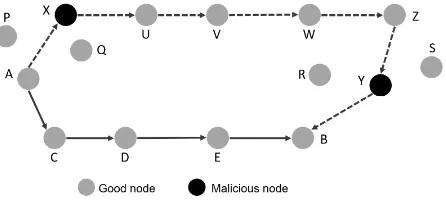
[image:2.595.322.549.67.186.2]For example, in Figure 1 where A and B finds the shortest path between them for packet transmission, where two malicious nodes X and Y is present. Node A will broadcast a RREQ but because a wormhole node is present X gets this route re-quest and encapsulates it into the packets destined for Y, and it transmit this packet through a wormhole link tunnel. When this packet is received by Y, it unmarshals the packet and re-broadcast. B being the nearest neighbour to Y will receive this packet thinking it has come from a legitimate path. Due to the encapsulation, the hop count will not increase during the traversal through U-V-W-Z. Now Node B has two routes to choose from, either A-C-D-E or A-X-Y. obeying the rules of routing protocols that uses metric of shortest path to choose a route path. B will choose the shortest route path which happens to be a wormhole link. which is about 4 hops. And apparently, the wormhole link is 3 hops away while in reality is about 7 hops away.
Fig. 1: Encapsulation Wormhole
(2) Packet Relay: This is another type of wormhole attack where malicious relays packet between source and destination nodes. Unlike encapsulation, this type of wormhole attack can be launched using only one malicious node. Considering node, A and B are two non-neighbours. With a malicious node X, it can replay packets between A and B giving the illusion that they are neighbours.
(3) Out-of-band Channel: As the name suggest is a type of worm-hole attack that uses a long range directional wireless link or a wired link. It is a very difficult attack to launch because its needs a specialized hardware. For example, in Figure 2 mali-cious node X tunnels the route request to a legitimate node Y, a neighbour of B. Node Y broadcast the packet to its neighbour, which always happens to be the destination node. Node B gets two RREQ as A-X-Y-B and A-C-D-E-F-B. obeying the rule of most routing protocol, node B will choose the fastest and shorter route which happens to be the wormhole link. (4) High Power Transmission: In this mode of attack, a single
[image:2.595.64.287.304.404.2]ma-licious node can create a wormhole without colluding node. when this single malicious node received a RREQ, it rebroad-casts the request at a very high power level capability com-pared to normal node, thereby attracting normal nodes to over-hear this RREQ and further on broadcast the packet towards destination.
Fig. 2: Out-of-Band Wormhole
3. LITERATURE REVIEW
Wireless sensor nodes are prone to different types of attacks, be-cause of its spontaneous nature in an unprotected environment where several security threats exist. Some of these attacks can in-clude wormhole attack which can cause denial of service. Up till date various techniques has been proposed for the detection and prevention of wormhole wireless sensor node attack. The applica-tion of most of the proposed soluapplica-tions is promising, but the possi-bility of malicious nodes affecting the good ones, coupled with the difficulty in distinguishing the relationship between a poor network and affected nodes behaviour must be addressed.
3.1 Reactive Protocols
A brief explanation to the most important reactive protocols (AODV and DSR), is simulated in NS-2 [10] and Qualnet simulator [1]. Both simulators conclude wormhole disrupts the three perfor-mance of routing protocol namely, throughput, end to end delay and packet delivery ratio under wormhole attack. Gaurav Garg [9] dis-cussed AODV is more vulnerable to wormhole attack in mobility state while DSR is least vulnerable in non mobility state.
3.2 Neighbour Discovery Approach
Wormhole attacks is one of the most powerful WSN attack that does not require any cryptographic breaks, as this attack does not create a separate packet. Its impact in the network and types is well described in-depth, alongside detail analysis on the detection and prevention techniques. Result obtained indicates when a packet is received, sent or dropped at the nodes due to attacks, an explanation of how the network is affected in terms of throughput variations is well analysed [25]. In the same sense, a detail review is discussed and simulated using NS-2 on the prevention of wormhole attack in mobile Ad Hoc network using neighbour node analysis. Details re-lating to the neighbouring nodes is analysed to check the authentic-ity of the nodes. In this approach, a node can request information stored by its neighbouring nodes in order to carry out a route re-quest (RREQ) and a route response (RREP) mechanism.
address and time of receiving the packet. When a node overhears a route request after wormhole prevention timer, then a wormhole attack is taking place. If a wormhole link is found, the information is stored at the source node to isolate them from taking part in the routing again. This is effective because it does not stop the flow of packets between legitimate nodes. However, it suffers from false positive. WADP is an improved WAP by Juni Biswas [4] for worm-hole attack detection. It combines node authentication to remove false positives and helps in exact location mapping of wormhole in a modified AODV routing protocol.
3.3 Digital Signature Approach
In defending against malicious nodes using digital signature, this reasearch proposed a mechanism whereby verification of neigh-bours node signature is significant. In every legitimate nodes in the network there contains the digital signature of all the remaining le-gitimate nodes of the same network. For example for a route request to take place, sender first create a secure route between source and destination. This in turn distinguish between legitimate and mali-cious nodes, because malimali-cious nodes does not possess the original digital signature [22].
In the same sense Amarijit et al. [20] developed a novel technique combining both princicles of clustering and digital signature during route discovery using the same AODV routing protocol. Informa-tion of all nodes is grouped in different clusters, and each cluster has a cluster head and a gateway nodes which forms a communica-tion link to different cluster head in the same network. To establish a route betweeen nodes, it must first send route request to its cluster head. This cluster head will further forward the request to the other clusters after it has been digitally signed using a private key con-tained in the cluster head; through the gateway link until the request reaches the cluster head of the cluster which belongs to the destina-tion node. Simuladestina-tion result for this research prooved it archieved high level of detecting and preventing wormhole attack.
Transmitting data in a network efficiently is the key most important aspect of routing. Marti et al. [21] proposed two techniques watch-dog and pathrater in detecting malicious node with minimal effect on throughput in the presence of misbehaving nodes. One of this technique is called watchdog. It is used for every nodes in the same network to detect any misbehaving node. When a packet is sent to the next hop, it tries overhear the packet forwarded by the next hop. For example a path from S to D through nodes A,B and C. node A cannot transmit to C without an intermediate node B. therefore when A transmits to B for onward forward to C, A will often tell if B transmit the same packet successfully to the correct node C oth-erwise it considers the next hop as malicious node. The pathrater uses the information about misbehaving nodes gained from the first technique (watchdog) to pick the route which is most likely legit-imate. Every node maintains a trust rating for each of the nodes in the network. When watchdog detects a malicious node, the trust rating of the node is updated negatively. Techinically the pararater calculates a path metric by averaging the nodes ratings in the path to pick a safe route to send packets. This solution however, is better suited for traditional networks based on emphasis on the reliability of point to point communication than to sensor networks.
3.4 Local Monitoring Approach
Issa Khalil et al. (2005) [18] proposed two algorithms called MO-BIWORP in the elimination of any wormhole attack when ad-hoc is in a mobility state. In this research paper a node is assigned to be the central authority which monitors the nodes neighbours locally. If any malicious nodes is found, it isolates the node globally. The
pro-posed algorithmuseslocal monitoringofall neighbouringnodes
andreliesonasecurecentralauthorityforpositiontrackingofthe
mobilenodes.Theuseofcentralauthurityiscontactedonlyinthe
eventofmotion.Centralauthoritynodewillstilloperatethrough
periodsintheeventthatitsunreachable.Thefirstproposed
algo-rithmisselfishmoveprotocol(SMP).Inthisprotocol,themobile
nodecanonlygenerate,sendandreceiveitsowntraffic.Thisdesign
arisesfromtheknowledgethatanodecanonlybeabletolaunch
anattackbyforwardingpackets.However,thisprotocolmaycause
adisconnectioninthenetworkifalargepartofthenodesmoves
atthesametime.Toaddressthisissue,theresearcherdevelopeda
secondalgorithmcalledconnectivityaidedprotocolwithconstant
velocity (CAPCV).Thisprotocoleliminates lack ofconnectivity
therebyallowingthemobilenodetoforwardpackets.
3.5 SpecialHardware-basedApproach
Generally,themostcommonmethodtodetectandprevent
worm-holeistheuseofneighbourdiscoverymechanism.Sometimesthey
are achievedthrough the useof special hardwaresuch as
direc-tionalantennal[11].Similarly,SrdjanCapkun[6]proposed
SEC-TORbasedonaspecialhardware.Othersapproachestowardsthis
attackincludestimesynchronizationfordetectionofwhether
pack-etssentfromanauthorizedneighbourarereceivedontimebythe
legitimatenode[8].Huetal.(2003)[12]Introducedpacketleashes
in defendingagainstwormholeattack.Twosolutionswere
intro-duced,temporalandgeographical.Withgeographicalleashes,
lo-cationinformationfromGPSdeviceswhichisincludedinthe
pack-ets,is usedto detectthe presenceofwormholenodes.Andwith
temporalleashes,nodesaretightlytimesynchronised,thuspacket
transmittedbetweensourceanddestinationcontainstimeatwhich
itwassent.Furthermoreprotocolscanbeadjustedtoestimatethe
distancebetweeenthesenderandthereceiver.Usingthenetwork
signal,it canbeverifiedwhether ornotthedatacomesfromthe
nodewithintherangeofcommunication.
3.6 StatisticalAnalysisApproach
Someotherapproach in this regardsappliesa centralised
mech-anism that makes use of statistical analysis for the detection of
malicious node[23].Thismechanism candetect thepresence of
a malicious node due to specific changes in the statistical
pat-tern.Analysingtheissueofencryptinganddecryptingpacketssent
acrosseachnode.PravinKhandareetal.[19]usedtheRSA
tech-niqueforencryptionanddecryptionofthenodes.Itusesthe2Ack
mechanismtocheckthatonlytheauthenticatednodereceivesthe
data.Acknowledgementistakenfromonehopandtwohopnodes.
Incases whereanattackertriesto forwardthe receivedmessage
intoanotherlocation,this mechanismwillpreventthis bytaking
theacknowledgementsfromthenexttwonodes.
3.7 RoutingProtocol
To discover multiplepaths between the source and the
destina-tion, we applied a reactive routing protocol called Ad hoc
On-DemandDistanceVector(AODV)whichwasdeveloped onJuly
2003. AODVoffersquickadaptationto dynamic linkconditions
anduseslowprocessingandmemoryoverheadbetween
participat-ingmobilenodesinanestablishednetwork.AODVroutingtable
fieldsconsistofdestinationIPaddress,sequencenumberof
des-tinationnode,hopcounttodestinationandnext hoptofollow. It
alsodefinesthreetypesof controlmessagesforupto dateroute
—RREQ: every route request carries a time to live (TTL) value that indicates the number of hops the packet should be forwarded. It is set to a predefine value at discovery stage and increased at retransmission if no reply is received by the receiving node. —RREP: Route reply message is rebroadcast back to the source of
a RREQ to confirm if the receiver is the real request address user or a valid route to the requested address.
—RERR: All node monitors the activities and link status of their neighbour in active route path. When there is a breakage in the link, a RERR message is broadcasted to notify other nodes of the lost link. For this to be activated, each node has to keep informa-tion such as IP address for each of its neighbours.
In On-demand distance vector routing protocol, each node main-tains a routing table and gets updated every time a routing message is received. For a source node to send a packet, it broadcast Route request message to the whole of the network. On acknowledging the request by the other nodes, it checks if the corresponding route exist and check to make sure is not a repeated request. If it is a re-peated one, the node simply discard the packet. If not the request will be accepted. This process is repeated till packets gets to its des-tination. The intermediate node to the destination node will send a route reply RREP to the source of the packet using a reverse route.
4. THE PROPOSED METHOD
There are two important parts contained in the detection and pre-vention of wormhole attack, neighbour and path verification. Two fake node neighbours with a wormhole tunnel will generally not share a common one hop neighbour node. while two genuine node neighbours will generally share other true neighbours between them. The proposed technique is to improve the existing algorithm in [26]. This technique will detect wormhole and isolate them from the route path. During the neighbour route discovery, the packet
will be encrypted at each level by sharinghello messagingwith
neighbouring node. The packet will be decrypted by the receiving node and message must matched with the one distributed.
4.1 Algorithm Description
This work is based on the prevention of wormhole attack in a par-ticular network. In this research, a detection and prevention mech-anism is proposed in securing the communications between source and destination node. When sensor node wants to start communica-tion, the first thing it does is a neighbour discovery from the neigh-bour list. It generates an encrypted beacon message with a secret key. As soon as the neighbouring node receives this beacon frame, it will be decrypted and the acknowledgement (RREP) is sent back to the sender.
4.1.1 Neighbour verification. The following steps will verify a neighbouring node in the network.
Building one-hop transmission neighbourhood list: Two
neigh-bour nodes such asSandPwhich has their neighbour hasN(S)and
N(P)individually. Their neighbour list information exchange will
be shared through a beacon messages. E.g. nodeSnotifies its
near-est neighbourN(S)with a periodic beacon message.
Building two-hop transmission neighbourhood list: Each node will request its neighbours to collect information about their bours list by way of transmitting beacon messages to its neigh-bours. This will enable each node to hold two hop information about their neighbours. For example, information exchanged be-tween nodes A, B and C. Node(A) sends a beacon message to its neighbour Node(B), after this message is sent, the transmission
rangeofNode(A)isincreasedto 2r. Afterthisincrease,node(A)
broadcastbeacon messagecontainingnode(B) informationto its
neighbourofnode(C). duringthis message,bothnodes Band C
willnotchangetheirtransmissionrange.Afternode(C)hearsthis
broadcast,itthenverifiestheauthenticityofnode(A)fromnode(B)
becausebothnodeAandBhadearlierexchangetheirinformation
inthefirstbroadcast.Thebeaconframewillbetransmittedat
reg-ularintervalsuntilpacketgetstoitsdestinationsuccessfully.After
eachchangein radiusoftransmittingnodes,atestnodesupdates
itsneighbournodeinthenextbeacontime.
—IfN(C)containsN(B)butnotcontainedinN(A)thenwormhole
detected
—IfN(C) containsN(B)andmeetsN(A)thennowormholeis
de-tected
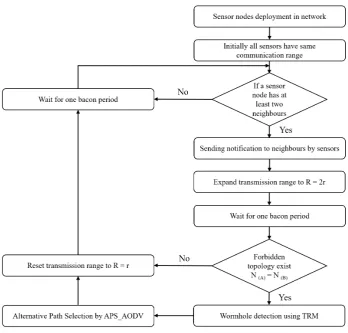
Theschematicoftheproposedalgorithmforwormholeattack
de-tectionandeliminationisgiveninFigure3.
4.1.2 TRMAODV: Wormhole Attack Detection. Input:
Worm-holepathfordatatransmission,neighboursinformation.Output:
Wormhole detection,periodically updatethe neighbourlistusing
beacon.
ThenodeAandBisusedastwotestednodestodescribethemain
wormholedetectionprocedureofTRMalgorithm.Inproposed
al-gorithm, all nodes in the network has a current information of
itsneighbours.Moreover,theneighbourlistisupdatedfrequently.
Eachnodewillrequestitsneighbourstoretrievetheirneighbour
listsbysendingabeaconmessagetoitsneighbours.Atthe
discov-erystage,allnodeswillsenditsownneighbourinformationtoits
neighboursbysendingbeaconframes.Usingthissteps,eachnode
cangetitsneighbourdetailswithintwohops.Attheend,network
topologywillbefounded.Thebeaconinformationwillbesentat
regularlyatintervals.Afterchangingtheradiustransmissionrange,
atestnodewillupdateitsneighbournodedetailsinthenextbeacon
time.Bycomparingitscurrentneighbourdetailswiththeprevious
details,atestnodecannowestablishtheexistenceoffalsetopology
ifany,thatshouldnotexistinanormalnetwork.
4.1.3 APSAODV:WormholeFreeAlternatePathSelection (Theproposedmethod). Input:Wormholeattackdetection. Output:Securedatatransmissionviaattackelimination.
Afterwormholedetection,ifwormholelinkexistsinthatcurrent
route,thenblockthatrouteandupdateitintheroutingtable.
An-otherrouteisfetchedfromtheroutingtableforsecuredata
trans-mission.Hopcountofalternatepathiscomparedwiththecurrent
path.Hopcount willbehigher in alternatepath thanwormhole
path.Insuchcase,alternatepathisconfirmedwiththe
availabil-ityofalternatepathwithouttheinvolvementofwormholenodes.
Algorithm1providesthepseudocodeoftheproposedAPSAODV
(AlternativePathSelectionbyAODV)algorithmforwormhwhole
attackdetectionandelimination.
5. EXPERIMENTALRESULTS
TheperformanceofthebasepaperTRMAODVisevaluatedfor
thesimulationsettingsasperthe followingmodeland compared
with the proposed proposal (APSAODV) and alsowith normal
scenarioinwhichthereisnowormholepresent.Inaddition,to
as-sesstherobustnessandeffectivenessoftheproposedmethod,we
comparetheresultswithapre-existingalgorithmdevelopedin[2]
calledAOMDV. Weconducted experimentsonNetwork
Simula-tor2.35(NS-2)whichisanopen-sourcediscreteeventsimulatorin
Fig. 3: The flowchart of proposed algorithm
Data: Given: Network N with node radius r, nodes n and m are nearest neighbours, wormhole number c = 0
Result: wormhole detection and elimination Starts RREQ;
Generate HELLO beacon message while all sensors maintains the same communication range;
whilecheck every node in Ndo expand radius of m to R = 2r; foreach node n in N(m)dodo
ifthere exists once d∈Nnand d∈/Nmthen
c = c + 1; else
when wormhole link exists, fetch another route (verified by hop count comparison);
end end end
Algorithm 1:The pseudocode of the proposed method
two languages, C++ for internal mechanism (backend) of the simu-lation objects and OTcl for assembling and configuring the objects by schedluing the events.
5.1 Performance Metrics
The results obtained from four techniques are compared through three parameters including throughput (Eq. 1), end-to-end delay (Eq. 2), and packet delivery ratio (Eq. 3).
(1) Throughput: The amount of data successfully reached at the destination per unit of time.
T hroughput(bits/s) =Total number o f received pckts at dst Simulation time
(1)
(2) End-to-End delay: The time taken for a packet to reach the destination from the source node.
End−to−End delay(s) =
∑
Delay f or each data packet (2) (3) Total number of delivered data packets: A ratio of the total received packets at the destination to the total packets gener-ated by source node in the presence of both wormhole attack traffic and normal traffic.Packet Delivery Rate= Packets received
Packets generated∗100 (3)
Table 1. : Simulation Parameters
Simulator NS-2
Number of nodes 1 40, 70, 100 Wormhole pairs 1 (Wormhole nodes 2) Speed variation 10 ms
Area 1000 m x 1000 m
Communication range 250 m
Interface type Phy/WirelessPhy MAC type IEEE 802.11
Queue type Droptail/Priority Queue Queue length 50 packets
Antenna type Omni antenna Propagation type TwoRayGround
Routing protocol AODV, TRM AODV and APS AODV Transport agent UDP
Application agent CBR Packet size 1024 bytes Simulation time 100 s Mobility model RWP
[image:6.595.65.281.86.269.2]5.2 Network Environment
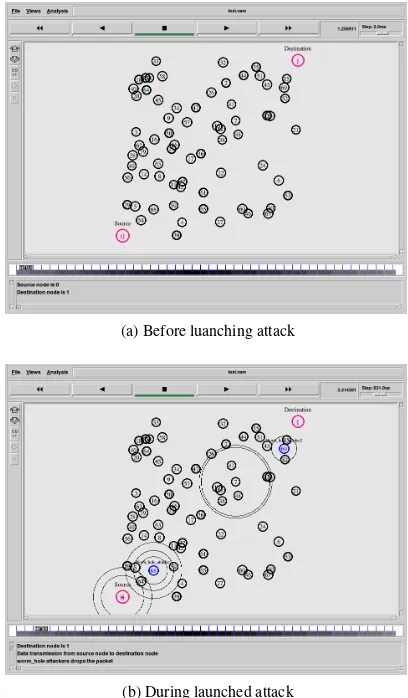
Figure 4 shows one sample of scenarios with 70 nodes ran in NS-2 environment. Figure 5a shows the throughput of the methods for three different number of nodes. The average performance of the proposed method with increasing the number of nodes is promising as compared to other methods. This confirms that the throughput of the given algorithm increases for dense networks. The average of delay is shown in Figure 5b.
According to the results, the average delay by increasing the num-ber of nodes gets high for TRM AODV, while the proposed method and the AOMDV method gets improved with less delay. However, there is still a performance gap between the wormhole detection and prevention algorithms and the attack-free channel in terms of delay. Finally, the average results for packet delivery ratio is de-picted in Figure. 5c. The proposed algorithm attempts to keep a reasonable packet delivery ratio in presence of attack even by scal-ing the network size. The results confirms that the proposed algo-rithm outperformed other methods and still needs to be improved to be able to reach to the better packet delivery ratio as compared to attack-free channels. A future work is needed for active researchers.
6. CONCLUSION
Over the years, wireless sensor networks have gained much popu-larity, because of its operating nature in day to day use in wireless channels. Wormhole attack can significantly degrade network per-formance. The most previous research works have been focused on detecting this attack without preventing. In this paper, we pro-posed an improved algorithm to detect and eliminate further attack without any specialized hardware, implemented based on the mod-ified AODV protocol in NS-2. This approach works by checking the validity of two hop neighbours that has forwarded the packet, an attack is detected when the identity of the two hop neighbours is found illegal. The authentication checks is carried out using a pre-stored nodes neighbour monitoring information. While the elimina-tion of the malicious nodes is carried out using a hop count of pre-viously route reply information. The accuracy of defence schemes are measured regarding throughput, delay, and packet delivery ra-tio. From the simulation results, it is observed that the proposed method provided promising results. In the future work, the plan
(a) Before luanching attack
(b) During launched attack
Fig. 4: Network simulation in the presence of wormhole attack
should be based on the decreasing the false positive rate, where hidden wormhole attacks are launched.
7. REFERENCES
[1] Ravinder Ahuja, Alisha Banga Ahuja, and Pawan Ahuja. Per-formance evaluation and comparison of aodv and dsr routing
protocols in manets under wormhole attack. InImage
Infor-mation Processing (ICIIP), pages 699 – 702, 2013.
[2] Parmar Amish and V.B. Vaghela. Detection and prevention of wormhole attack in wireless sensor network using aomdv
protocol.Procedia Computer Science, 79:700 – 707, 2016.
[3] Swati Bhagat and Trishna Panse. A detection and prevention of wormhole attack in homogeneous wireless sensor network. InInternational Conference on ICT in Business Industry Gov-ernment (ICTBIG), pages 1 – 6, 2016.
[4] J. Biswas, A. Gupta, and D. Singh. Wadp: A wormhole attack detection and prevention technique in manet using modified
aodv routing protocol. In9th International Conference on
In-dustrial and Information Systems (ICIIS), pages 1 – 6, 2014. [5] Avinash S. Bundela. Literature survey on wormhole attack.
(a) Throughput
(b) Delay
[image:7.595.63.288.69.682.2](c) Packet Delivery
Fig. 5: Average results for 40, 70 and 100 nodes
[6] Srdjan Capkun, Levente Buttyan, and Jean-Pierre Hubaux. Sector: Secure traking of node encouters in multi-hop
wire-less networks. InProceedings of 1st ACM Workshop on
Secu-rity of Ad hoc and Sensor Networks (ACM SANS), pages 21 – 32, 2003.
[7] S. Choi, D. y. Kim, D. h. Lee, and J. i. Jung. Wap: Worm-hole attack prevention algorithm in mobile ad hoc networks. InIEEE International Conference on Sensor Networks, Ubiq-uitous, and Trustworthy Computing (sutc 2008), pages 343 – 348, 2008.
[8] Saurabh Ganeriwal, Ram Kumar, and Mani B. Srivastava.
Timing-sync protocol for sensor networks. InProceedings of
the 1st international conference on Embedded networked sen-sor systems. ACM, pages 138 – 149, 2003.
[9] Gaurav Garg, Sakshi Kaushal, and Akashdeep Sharma. Reac-tive protocols analysis with wormhole attack in ad-hoc
net-works. InComputing, Communication and Networking
Tech-nologies (ICCCNT), pages 1 – 7, 2014.
[10] M. P. Gulwade, K. J. Dhoot, A. I. Bajaj, and M. M. Ghonge. Effectiveness of wormhole attack on dsr protocol in manet. World Research Journal of Telecommunications Systems, 1(1):13 – 15, 2012.
[11] Lingxuan Hu and David Evans. Using directional antennas to
prevent wormhole attacks. InNDSS, 2004.
[12] Y. C. Hu, A. Perrig, and D. B. Johnson. Packet leashes: a defense against wormhole attacks in wireless
net-works. In Twenty-second Annual Joint Conference of the
IEEE Computer and Communications Societies (IEEE Cat. No.03CH37428), volume 3, pages 1976 – 1986, 2003. [13] Amin Karami. A framework for uncertainty-aware visual
analytics in big data. In Proceedings of the 3rd
Interna-tional Workshop on Artificial Intelligence and Cognition (AIC 2015), volume 1510, pages 146 – 155. CEUR-WS, 2015. [14] Amin Karami and Manel Guerrero-Zapata. Mining and
vi-sualizing uncertain data objects and named data
network-ing traffics by fuzzy self-organiznetwork-ing map. InProceedings of
the 2nd International Workshop on Artificial Intelligence and Cognition (AIC 2014), volume 1315, pages 156 – 163. CEUR-WS, 2014.
[15] Amin Karami and Manel Guerrero-Zapata. An anfis-based cache replacement method for mitigating cache pollution
at-tacks in named data networking.Computer Networks, 80:51
– 65, 2015.
[16] Amin Karami and Manel Guerrero-Zapata. A fuzzy anomaly detection system based on hybrid pso-kmeans algorithm in
content-centric networks.Neurocomputing, 149(Part C):1253
– 1269, 2015.
[17] Amin Karami and Manel Guerrero-Zapata. A hybrid multi-objective rbf-pso method for mitigating dos attacks in named
data networking.Neurocomputing, 151(Part 3):1262 – 1282,
2015.
[18] I. Khalil, Saurabh Bagchi, and N. B. Shroff. Liteworp: a lightweight countermeasure for the wormhole attack in
mul-tihop wireless networks. InInternational Conference on
De-pendable Systems and Networks (DSN’05), pages 612 – 621, 2005.
[19] Pravin Khandare and N. P. Kulkarni. Public key encryption
and 2ack based approach to defend wormhole attack.India
[20] A. Malhotra, D. Bhardwaj, and A. Garg. Wormhole attack prevention using clustering and digital signatures in reactive
routing. InProceedings of 9th IEEE International Conference
on Networking, Sensing and Control, pages 122 – 126, 2012. [21] Sergio Marti, Thomas J. Giuli, Kevin Lai, and Mary Baker.
Mitigating routing misbehavior in mobile ad hoc networks. InProceedings of the 6th annual international conference on Mobile computing and networking, pages 255 – 265, 2000. [22] P. Sharma and A. Trivedi. An approach to defend against
wormhole attack in ad hoc network using digital signature. In IEEE 3rd International Conference on Communication Soft-ware and Networks, pages 307 – 311, 2011.
[23] Sejun Song, Haijie Wu, and Baek-Young Choi. Statistical
wormhole detection for mobile sensor networks. InFourth
In-ternational Conference on Ubiquitous and Future Networks (ICUFN), pages 322 – 327, 2012.
[24] Andreas Tonnesen. Reactive rotocols - AODV, 2004.http:
//www.olsr.org/docs/report_html/node16.html, ac-cessed at 2017-05-20.
[25] Saurabh Upadhyay and Brijesh Kumar Chaurasia. Impact
of wormhole attacks on manets. InInternational Journal of
Computer Science & Emerging Technologies, pages 77 – 82, 2011.
[26] Guowei Wu, Xiaojie Chen, Lin Yao, Youngjun Lee, and Kangbin Yim. An efficient wormhole attack detection method
in wireless sensor networks.Computer Science and