T.J. Sloan
1, R.J. Payne
1,2, A.R. Anderson
3, C. Bain
4, S. Chapman
5, N. Cowie
6,
P. Gilbert
7, R. Lindsay
8, D. Mauquoy
9, A.J. Newton
10and R. Andersen
71 Department of Environment and Geography, University of York, UK 2 Department of Zoology and Ecology, Penza State University, Penza, Russia
3 Forest Research, Northern Research Station, Roslin, UK 4 IUCN UK Peatland Programme, Edinburgh, UK
5 The James Hutton Institute, Aberdeen, UK
6 Centre for Conservation Science, RSPB Scotland, Edinburgh, UK
7 Environmental Research Institute, University of the Highlands and Islands, Thurso, UK 8 Sustainability Research Institute (SRI), University of East London, UK
9 School of Geosciences, University of Aberdeen, UK 10 School of Geosciences, University of Edinburgh, UK
_______________________________________________________________________________________
SUMMARY
Peatlands are a globally significant store of carbon. During the second half of the 20th century new planting techniques combined with tax incentives encouraged commercial forestry across large areas of peat bog in the UK, particularly in the Flow Country of northern Scotland. Such planting was controversial and was ultimately halted by removal of the tax incentives, and policies to prevent new planting. Here we review the literature on UK peatland afforestation in relation to carbon and climate implications, and identify key issues for future research. The effects of conifer planting on peat bog carbon storage in the UK are poorly understood. A large body of research on peatland forestry exists, particularly from naturally forested fen peatlands in Fennoscandia and Russia, but the different conditions in the UK mean that results are not directly transferable. Data on the responses of UK peat bogs to afforestation are required to address this shortfall. Studies are required that quantify the loss of carbon from the peat and evaluate it against the accumulation of carbon above and below ground in trees, considering the likely residence time of carbon in wood products.
KEY WORDS: Flow Country, forestry, GHG, greenhouse gases, peat
_______________________________________________________________________________________
INTRODUCTION
Carbon storage in peat
Peatlands are globally important stores of carbon. Covering about 3 % of the surface of the Earth (Dise 2009), they are believed to store over 600 Gt of carbon (Yu 2011, Loisel et al. 2017). This is of a similar order of magnitude to the 800+ Gt of carbon in the atmosphere (Batjes 1996, IPCC 2014).
Northern peatlands are globally the most important stores of carbon, and are distributed primarily across Russia, North America, Fennoscandia, Eastern Europe and the British Isles (Mitsch & Gosselink 2015). These northern peatlands are estimated to contain more than 90 % (547 Gt) of the total peatland carbon pool (Yu et al.
2010).
Accumulation of this peat has provided a small negative feedback to climate over the last 1000 years (Charman et al. 2013), with an estimated net sink of carbon of 44 Gt ka-1 (Yu 2011). Peatlands also influence the climate system as a significant source
of methane (CH4), carbon dioxide (CO2), aquatic carbon and to a less significant extent other greenhouse gases (N2O, VOCs), and have a direct effect on radiation balance through albedo.
Developmentoftheforestindustryin peatlands Peatlands have historically been viewed as barren and unproductive places, but in reality support many economic activities and provide often unnoticed ecosystem services. Economically, peatlands have important roles for agriculture (in particular grazing), water management, and leisure activities such as shooting and tourism (Whitfield et al. 2011). Ecosystem services include water and carbon storage (Joosten et al. 2012), and maintenance of biodiversity including specialised peatland species (Stroud et al.
1987, Lindsay et al. 1988, Littlewood et al. 2010). It is estimated that around 20 % of European peatlands are currently drained for forestry (Drosler
for example many within the Arctic and temperate zone, are naturally treeless. In these landscapes, mixed wet scrub and low wet woodland are restricted to peat bog margins and along the courses of streams (Lindsay 2010). One such area is the United Kingdom, where an estimated 2300 Mt of carbon is stored in peatlands (Billett et al. 2010), of which blanket bog is the predominant type. There are a few sites where trees naturally occur on ombrotrophic bog peat and these may have been more widespread in the past, but today almost all UK bogs are open. This changed between the 1950s and the 1980s, when approximately 9 % (190,000 ha) of the UK’s deep peats were drained for forestry (Hargreaves et al.
2003), although this figure may be an underestimate and may be as high as 17 % in Scotland (Vanguelova
et al. 2018).
Early trials in the UK
Numerous attempts at peatland afforestation have been made in the UK since the 18th century. For instance, in his history of the county of Peeblesshire, William Chambers (1864) records a drainage initiative by the Duke of Argyll in 1730, in which he made an “attempt to make a quagmire not only into a dry and arable land, but fitted by its amenity for the residence of a man of taste”. This included an early and largely ineffective attempt at drain cutting, with trees being planted on any sufficiently dry areas. After poor results and the death of the Duke in 1761, the plan was abandoned (W. Chambers 1864). Such schemes, driven generally by individuals or individual estates, are typical of the small-scale and uncoordinated efforts common at the time.
Foresters in Britain were slow to take note of developments in continental Europe. By 1836, foresters in Belgium had developed a system of turf planting in which some of the peat was removed, upturned and laid over the remaining surface to give a deeper, drier substrate on which to plant. This was combined with intensive drainage to yield the first significant successes in planting forests on peat, a system not widely adopted in Britain until around 1907 (Zehetmayer 1954).
UK peatland afforestation in the 20th century
A critical moment in the history of British peatland forestry was the establishment of the Forestry Commission, a government body with responsibility for managing forestry. The Forestry Commission was founded under the Forestry Act of 1919, with a remit to increase forest coverage and timber production. As well as aiming to develop an economic resource, this was in part a response to concerns about depleted woodland stocks following the First World War, as a
domestic supply of wooden pit props to support the mining industry was strategically important (Marren 2002). The establishment of the Forestry Commission led to a more coordinated and efficient approach to forestry.
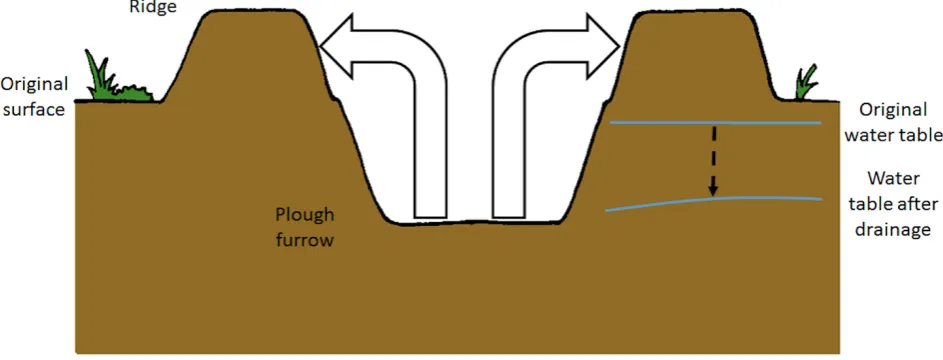
Expansion of forestry into the uplands during the inter-war years occurred mainly across organo-mineral soils. Deeper peat was considered too challenging for silviculture and unsuitable for the machinery then in use. It was not until after the Second World War that development and modification of the double mouldboard plough combined with efficient tractors with wide tracks allowed the Forestry Commission to commence more widespread trials on deeper peats (Wood 1974, Anderson 1997). The double mouldboard plough pushed cut peat into a ridge on either side of a drainage furrow, creating raised dry ridges typically two metres apart on which trees could be planted (Figure 1). This closely-spaced furrow ploughing was combined with collector drainage ditches at intervals to provide a sufficiently dry environment for tree growth (Harrison et al. 1994) and was supplemented by fertiliser application to overcome the paucity of nutrients, particularly phosphorous but also potassium, nitrogen and trace elements (Taylor 1991).
Norway spruce (Picea abies), Scots pine (Pinus sylvestris), mountain pine (Pinus mugo) and species of larch (Latrix decidua, Latrix kaempferi) had been trialled for peatland afforestation in the UK by the early 20th century, but with limited success (Zehetmayer 1954). Ultimately, forestry in UK peat bogs became feasible with the adoption into European silviculture of trees native to North America, particularly some varieties of lodgepole pine (Pinus contorta) and Sitka spruce (Picea sitchensis). ‘South Coastal’ varieties of lodgepole pine were initially seen as good candidates for afforesting large areas of peat (Pyatt 1990). This species tolerates high water tables by creating gas pockets within the pericycle of the roots that allow continued oxygenation in waterlogged conditions by diffusion from the air (King et al. 1986). Consequently, it roots deeply, drying the peat. However, problems with curvature of the base of the trunk (‘basal sweep’), low wood quality and occasional devastating outbreaks of Pine Beauty Moth (Panolis flammea) meant that lodgepole pine was ultimately abandoned as a commercial crop.
Figure 1. A double mould board plough creates a furrow in the peat and pushes excavated peat into ridges. These ridges are sufficiently raised above the drained water table that the survival chance of planted trees is substantially increased. Unlike the low tillage on Fennoscandian sites, such ploughing on UK forestry sites disturbs the peat and removes much of the bog vegetation.
species and is the most widely grown conifer in the UK, covering 682,100 ha (50.3 % of the total conifer stock) (Forestry Commission 2011). This species alone accounts for 33 % of the total woodland coverage in the Highlands of Scotland (Smith & Gilbert 2003). Sitka spruce grows poorly in waterlogged conditions, so in peat bogs in many parts of the UK it was mostly planted in mixed stands with lodgepole pine, which acted as a ‘nurse species’ (Pyatt 1993). It was hoped that the relative vigour of lodgepole pine in wet conditions, and consequent water interception due to canopy closure, would in turn increase yields of other species during the first rotation (King et al. 1986). Ultimately, while lodgepole pine was shown to have a drying effect on the peat, this did not always translate into an improvement in growth of the Sitka spruce (Ray & Schweizer 1994). For this reason the economic benefits of mixed planting were questioned and Sitka spruce monocultures became increasingly common as more stands were planted (Oosthoek 2013).
Sites across the UK were drained and planted by the Forestry Commission in the second half of the 20th century. At this time, forest planting was an industrial-scale operation involving extensive landscape change beyond simply planting trees including construction of roads, bridges and fences, and quarrying for building materials.
The technological developments which permitted peat bog afforestation coincided with a tax and grant regime favourable to forest development in unsuitable areas. Government incentives proved popular as a mechanism for reducing tax liability (Mather 1986, Mather & Murray 1988). All expenses
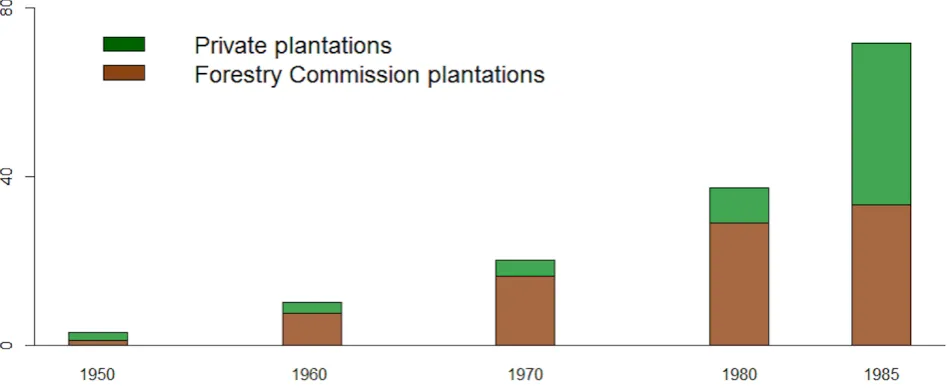
related to forestry were tax deductible, with loans available which could also be written off against tax. Companies such as Fountain Forestry managed large areas of land for wealthy individuals. Through the 1970s private planting overtook planting by the Forestry Commission (Figure 2), much of it concentrated in Scotland (Mather & Murray 1988). Tree growth was frequently poor and a large proportion of the forests planted during this period would not have been economically viable without tax relief.
Public and scientific reaction to afforestation From the late 1960s the issue of peatland afforestation grew in prominence, with concerns raised over the loss of biodiversity and the risk of eutrophication of freshwaters and damage to fisheries (Moore & Bellamy 1974, Thompson 1987). Public awareness of the large-scale planting of the uplands and the economic factors underpinning it was raised with the revelation that well-known figures such as TV presenter Terry Wogan, singer Cliff Richard and snooker player Alex ‘Hurricane’ Higgins were using forestry-based tax avoidance schemes (Rosie 1986, Anon. 1995).
Between 1987 and 1988, the Nature Conservancy Council - the UK government statutory advisor on wildlife conservation matters at the time - published ‘Birds, Bogs and Forestry’ and ‘The Flow Country - the Peatlands of Caithness and Sutherland’, a linked pair of reports on the biodiversity of the Flow Country and the scale of forestry expansion (Stroud
Figure 2. Extent and ownership of forest plantations in Caithness and Sutherland between 1950 and 1985. Adapted from Stroud et al. (2015).
400,000 ha of peat and wetland, of which around 67,000 ha (approximately 17 %) had by then been afforested. The reports highlighted the potential disruption that could be caused by forestry and, while the first report generated extensive political controversy, the detailed figures provided in the second report led the Secretary of State for Scotland to afford statutory protection to almost 200,000 ha of un-afforested peatland in the Flow Country as a composite Site of Special Scientific Interest (SSSI), the largest such site in the UK. The fallout from this controversial action is widely believed to have contributed to the subsequent decision of the government of the time to break up the Nature Conservancy Council (Warren 2000). Later, the SSSI was designated as the UK’s largest terrestrial Special Area for Conservation (SAC) and Special Protection Area (SPA) within the European Commission’s ‘Natura 2000’ nature protection network.
Controversy over tax avoidance in general, but particularly the schemes set up for forestry, led to legislative changes. With public outcry increasing, the then Chancellor of the Exchequer Nigel Lawson ended the tax breaks in his budget of 1988 (Oosthoek 2013). With the main financial incentive removed, new peat bog forestry planting has been limited since 1990 (Stroud et al. 2015) and was effectively halted by later Forestry Commission policy guidance (Patterson & Anderson 2000).
Restocking or restoration?
Following the intensive afforestation of the twentieth century around 9 % of the UK’s deep peats, amounting to a total of approximately 190,000 ha, were drained for forestry (Hargreaves et al. 2003).
This forestry is distributed across the UK but is particularly extensive in Scotland. Many plantations are approaching harvesting age and decisions must soon be taken on whether to restock the forests or restore drained bogs as far as possible to their previous state. While there is some debate as to whether restoration should aim to recreate a pre-drainage or pre-afforestation state, the process typically involves the removal of trees and blocking of drainage to raise and stabilise water tables and restore active peatland habitats.
While not the only factor (biodiversity considerations are especially important; Holden et al.
2007), the effect of afforestation on carbon stock and carbon cycling is an important issue in this decision-making given likely consequences for climate change. While peatland restoration was not originally specified by the Kyoto Protocol (beyond a general call for the protection of natural carbon stocks and sinks) or used as a mitigating factor in subsequent calculations of carbon emissions, the Protocol was ultimately amended to allow peatland rewetting to be considered in carbon accounting (Bain et al. 2012). Restoration of peatlands is recommended by several international bodies (Joosten et al. 2012) including, most recently, the International Union for the Conservation of Nature (Resolution 043; IUCN 2016).
Government’s Policy on the Control of Woodland Removal for not replanting on peatland sites that are a priority for restoration on ecological grounds, and on those peatlands that are not a priority for restoration when there would be a significant greenhouse gas benefit to restoring degraded peat (Forestry Commission Scotland 2009). Guidance (Forestry Commission Scotland 2015, 2016) provides a decision framework for this, but the underpinning evidence is limited in some important areas. Therefore, the question of what effects the drainage and planting have had on peat bogs, and the likely effects of restoration, are issues of critical importance. There are extensive gaps in current knowledge that need to be filled. This article considers the likely effects of forestry on the peatland, and the applicability of currently available research data to the unique circumstances in which UK peatlands were afforested.
WHAT EFFECTS HAS TREE PLANTING HAD ON RADIATIVE FORCING?
The climatic consequences of afforestation represent the net effect of several interacting processes on the peat bog ecosystem and wider supply-chain considerations. Changes to peatlands encompass physical changes to the peat itself, vegetation changes, changes to carbon sequestration, effluxes of carbon in gaseous and aquatic forms, and other more minor factors which may nevertheless contribute to the overall radiative forcing. This section reviews these processes.
Drainage and planting effects on carbon accumulation in peat
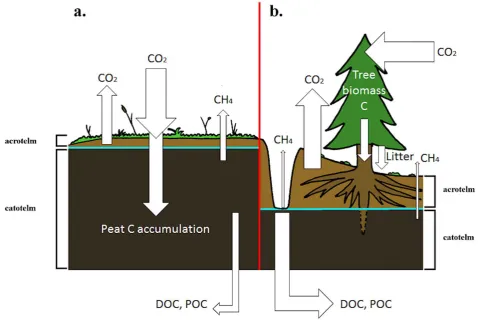
Undrained peatlands accumulate carbon through primary production, as plants (often non-vascular species such as Sphagnum) photosynthesise. Within an undrained natural bog, carbon sequestered in this way remains within the peat over long timescales (millennia) because dead material will not fully decay within the main body of peat (the catotelm). Drainage and the process of ploughing disrupts the existing vegetation, affecting the amount of carbon sequestered directly to the bog by the living layer (the acrotelm) (Figure 3). Afforestation essentially halts primary production by typical peat-forming bog species, so the ultimate capacity for radiative forcing then largely depends on the fate of carbon sequestered by trees and by the response of the peat stored in the catotelm.
Peat in a natural bog is divided between the aerated acrotelm and the deeper, constantly
waterlogged, catotelm (Ingram 1978, 1983). The boundary between these two layers is the deepest point to which the water table falls under normal conditions. Undrained peat bogs typically have a high water table, commonly within 10–20 cm of the surface of the peat, but this is substantially lowered with afforestation. Lowering the water table through drainage is arguably the most important factor for successful afforestation, providing the aeration that is essential for growth of the roots of most tree species (Braekke 1983), changing the physical and chemical properties of the peat, and affecting hydrology (Braekke 1987, Holden 2004). Planted forests lower the water table further when canopy closure leads to increased interception and evapotranspiration (Sarkkola et al. 2010).
Drainage of a peat soil gives rise to three important processes: primary consolidation, secondary compression and oxidative loss (or peat ‘wastage’, discussed below). Primary consolidation occurs rapidly following drainage and is caused by loss of water from large pore spaces within the peat. Secondary compression occurs because more tightly-bound water is slowly squeezed from the peat matrix by the weight of peat material no longer supported by the bog water. In addition, the peat may be further compacted by the weight of growing trees (Hobbs 1986). These various processes cause subsidence of the ground surface and ultimately cracking of the upper peat, which can lead to deeper aeration (Pyatt & John 1989, Pyatt et al. 1992). Furthermore, any clearing or re-grading of the drainage system will stimulate a new round of primary consolidation before the slower, steady processes of secondary compression and oxidative loss resume (Wold 1976). The horizontal ‘zone of impact’ associated with forest blocks on adjacent peatlands has yet to be determined for carbon, hydrology and bog vegetation, though effects on peatland birds are well-established (Wilson et al. 2014). There has been only limited monitoring of long-term changes in surface morphology, vegetation assemblages, hydrology and peatland microtopography, meaning that current estimates are based largely on relatively short-term studies, often of hydrology. These estimates currently range from 2–3 up to 50–60 metres, but some hydrological models suggest that drainage effects may extend for several hundred metres in some circumstances (Holden 2005).
Figure 3. A lowered water table (blue line) gives rise to different rates of carbon loss and accumulation in peatland systems (a) before drainage and (b) after drainage and afforestation, which also cause subsidence. Carbon dioxide (CO2) production will increase with aeration of the upper layer of peat, with a reduction of methane (CH4) production from waterlogged peat. Loss of aquatic dissolved and particulate carbon (DOC and POC) may be increased through drainage. Carbon is taken up by vegetation in both scenarios. In an undrained bog some of this will go on to be stored in peat over long timescales, whereas in the drained system it will form tree biomass, eventually reaching the soil as litter and roots or being removed from the site as harvested timber. Unlike Sitka spruce, lodgepole pine is tolerant of waterlogging, and its roots can extend below the water table. The peat beneath the tree crop will have increased dry bulk density compared with the non-afforested peat bog. Flux magnitudes indicated by arrow widths are indicative and open to varying and different degrees of uncertainty and to variation with site conditions.
albedo leading to a cooling effect (Lohila et al. 2010). Such effects are rarely considered but may be significant.
Greenhouse gases
The depth of the water table below the ground surface is a key driver of greenhouse gas (GHG) balance, as this determines the volume of peat exposed to aeration and consequently microbial production of both CO2 and CH4 (Drosler et al. 2008). Lowering the water table during afforestation has the potential to significantly affect the fluxes of both of these GHGs from peat to the atmosphere (Figure 3).
In the permanently waterlogged catotelm, bacterial decomposition is inhibited by low temperature, pH, and oxygen availability (Freeman et
al. 2001b). In these anoxic conditions CH4 is an end product of anaerobic decomposition through several pathways (Lai 2009). As it moves up through the acrotelm a large proportion of this CH4 is oxidised by methanotrophic bacteria. Lowering the water table in peatland afforestation increases the depth of air penetration into the normally-waterlogged catotelm peat and thereby the space in which CH4 can be oxidised, and thus typically leads to a linear decrease in CH4 efflux (Moore and Knowles 1989).
bacteria and fungi, leading to increased production of CO2 (Eggelsmann 1975, Hobbs 1986). The loss of the unique structure and function of the aerated acrotelm may lead to the bog becoming a single-layered haplotelmic bog (Ingram & Bragg 1984).
Peatland drainage is, therefore, likely to have opposing effects on these two GHGs, increasing CO2 and reducing CH4 effluxes. While more carbon is lost to the environment as CO2, CH4 has a global warming potential over 100 yr (GWP100) 34 times greater than CO2 when climate-carbon feedbacks are considered (IPCC 2013). In terms of fluxes from peat, it is likely that the CO2 increase outweighs the CH4 decrease and the net effect is to promote climate warming (Martikainen et al. 1995, Alm et al. 1999).
CO2 and CH4 are the most important GHGs arising from peatlands, but nitrous oxide (N2O) may also be significant in some situations. The GWP100 of N2O is 298 times that of CO2 when climate-carbon feedbacks are considered (IPCC 2013). Fluxes of N2O in peatlands are typically small but can become substantial in fens or when peatlands are exposed to N in fertiliser, as in some peatland afforestation. However there are few studies which directly consider the effect of afforestation on N2O flux (Maljanen et al. 2010).
Beyond the direct effect of afforestation on the carbon balance of peat there are other factors which may also result in GHG production. Emissions from vehicles and machinery, as well as road and steel fence construction, also have significant GHG implications for the initial ploughing, planting, interim management and final harvesting of any forestry site (Morison et al. 2012).
Aquatic carbon
Aquatic carbon is exported from peatlands via
watercourses, principally as dissolved organic carbon (DOC) and particulate organic carbon (POC). Both of these fluxes may be affected by afforestation. DOC concentration in streams correlates positively with the presence of organic soils and peats in a catchment (Hope et al. 1997, Aitkenhead et al. 1999). Higher outflow of water either drained from the system or lost through consolidation and compression carries with it more aquatic carbon. This process will continue slowly but indefinitely in a drained system. DOC may enter the atmosphere downstream through other degradative pathways, usually through rapid emission as CO2, and may be a significant GHG source in upland areas (Freeman et al. 2001a). The pathways of POC to the atmosphere are less certain (Rowson et al. 2010).
Disruption caused by on-site activity such as ploughing, tree planting and the continuing
maintenance of drains is also associated with increased concentrations of DOC and POC in streams draining the forest stand. Later, disruption to the peat surface caused by tree thinning or felling can lead to further aquatic carbon loss for several years after the trees are removed (Cummins & Farrell 2003). This loss of carbon through aquatic pathways may depend on variables including nutrient content of the peat (Nieminen et al. 2015), catchment properties (Holden 2005) and weather patterns (Koehler et al. 2009).
Carbon accumulation in tree biomass
Any loss of carbon from peat soils may be offset by gains of carbon stored in tree biomass, litter and new soil organic matter. The true carbon balance then depends partly on the fate of the wood produced (Minkkinen et al. 2002). The quality and longevity of the wood products that arise from forestry will determine whether or not the harvested portion of the carbon captured by the trees is sequestered over long timescales (Laine et al. 1992, Ojanen et al. 2013). In areas with high yield and high-quality wood this timber may be used for long-lifespan uses such as construction, effectively storing the carbon for many decades or even centuries. However, forestry crops on bogs in the UK are often of such poor quality that much of the wood goes for pulp, fuel and other low-grade uses, returning carbon to the atmosphere much more quickly (Thompson & Matthews 1989, Artz et al. 2013). The portion of the carbon captured by the trees that is left below ground when they are felled consists of roots, litter (root, needle, branch, etc.) and soil organic matter derived from these. In addition, the stumps, branches and top parts of the stems are normally left on the ground after harvesting. The fate of these below-ground and surface components containing tree-derived carbon also influences the true carbon balance (Vanguelova et al. 2017). The true climate consequences of peatland forestry are further complicated by the role of the wood produced in the supply chain and the potential for timber to replace alternative materials with high carbon footprints such as plastics and concrete.
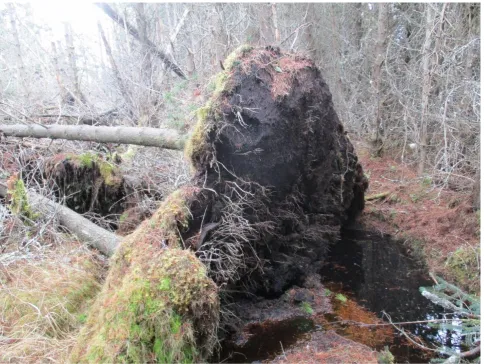
Figure 4. A wind-thrown lodgepole pine with exposed root plate at Bad a’Cheo, Rumster Forest, Caithness.
products and so reducing the residence time of carbon in the tree biomass. Lodgepole pine is especially prone to wind-throw (Nicoll et al. 2006).
Approaches to measuring carbon loss from peatlands
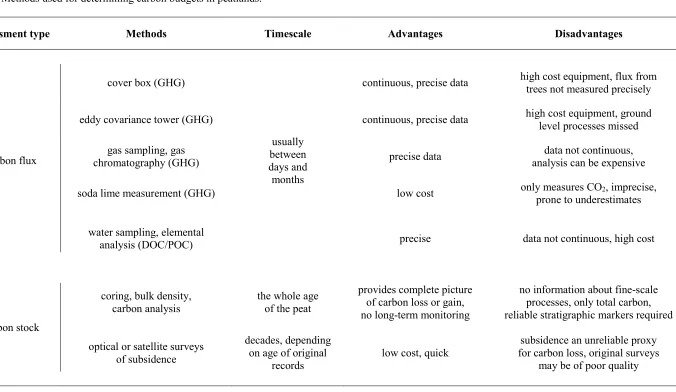
From the above discussion, it will be clear that afforestation can affect the peatland carbon budget and radiative forcing more generally through many mechanisms. Studies have taken several approaches to quantifying these effects (Table 1). Many studies attempt to assess peat carbon balance by directly measuring the key fluxes of GHGs and aquatic carbon (although aqueous carbon is considered less often in the literature).Methods such as cover boxes (‘chambers’) or eddy covariance towers use infra-red gas analysis (IRGA) to measure GHG fluxes in real time in the field, replacing older methods using gas sampling for chromatography or quadrupole mass spectrometry (QMS), or recording weight change in soda lime. Using these methods to understand the way in which carbon is imported to or exported from
peatlands can help to understand processes over short timescales. Typically, forestry on bogs requires a programme of site drainage followed by over forty years of tree growth. As a result, short-term studies of carbon fluxes in the system may not accurately describe the carbon change in the system over longer timescales. This is important as GHG emissions can be highly variable over time (Klemedtsson et al.
2008).
Table 1. Methods used for determining carbon budgets in peatlands.
Assessment type Methods Timescale Advantages Disadvantages
carbon flux
cover box (GHG)
usually between days and months
continuous, precise data high cost equipment, flux from trees not measured precisely
eddy covariance tower (GHG) continuous, precise data high cost equipment, ground level processes missed
gas sampling, gas
chromatography (GHG) precise data analysis can be expensive data not continuous,
soda lime measurement (GHG) low cost only measures CO2, imprecise,
prone to underestimates
water sampling, elemental
analysis (DOC/POC) precise data not continuous, high cost
carbon stock
coring, bulk density,
carbon analysis the whole age of the peat
provides complete picture of carbon loss or gain, no long-term monitoring
no information about fine-scale processes, only total carbon, reliable stratigraphic markers required
optical or satellite surveys of subsidence
decades, depending on age of original
records low cost, quick
subsidence an unreliable proxy for carbon loss, original surveys
may be of poor quality
specific gas and aqueous components. The use of stratigraphic markers in the peat allows the age of a sample to be identified (Pitkanen et al. 2013), meaning that direct comparisons can be made between peat of the same age. This analysis can be paired with analysis of carbon in the trees to determine net balance. Laiho and Pearson (2016) highlight a number of issues which must, nevertheless, be considered when using such an approach.
A less exact method of determining loss of carbon stock on sites that have historical ground level surveys is to use subsidence as a proxy for loss of carbon. While this method is relatively low-cost where historical records of ground levels exist, subsidence is an unreliable indicator of carbon loss as it is often based on initial surveys which can be decades old and of poor quality, with estimates produced in this way “roughly determined” at best (Hommeltenberg et al. 2014). In addition, it ignores the compaction and compression that usually occurs.
AVAILABLE RESEARCH
ApplicabilityofpreviousresearchtoUK peatlands Much of the work on the effects of peatland afforestation has been carried out in Fennoscandia and Russia. Forestry is particularly widespread on drained peat in Finland, with up to 25 % of the nation’s exploited forests growing on peat (Laiho & Laine 1997) and an area of 4.8 Mha of peatlands drained for forestry (Ojanen et al. 2014). Even so, there is little evidence from such sites of the effect of clear cutting on GHG balance, nor of the long-term balance over a full stand rotation and subsequent rotations. The majority of available data have been obtained from minerotrophic fen sites or naturally wooded bog sites, both of which tend to have greater timber production than do ombrotrophic bog sites (Minkkinen et al. 2002, Drosler et al. 2008, Maljanen
et al. 2010). These issues, combined with the differences in climate between Fennoscandia and the UK, mean that any comparison between forestry on peatlands in Nordic countries and afforestation of peat bogs in the UK and Ireland must be made with considerable care and may sometimes be inappropriate.
UK blanket bogs are naturally treeless, at least in their broad central expanses, requiring cultivation and more fertiliser than would be used elsewhere (Laine et al. 1995). The natural or pre-existing conditions on many of the Finnish peatlands are very different from the UK, and typically may include dwarf trees and scrub (Laiho & Laine 1997) or even
a significant pre-existing tree cover (Minkkinen et al.
2002). Fennoscandian bogs typically have peat with inherently very low hydraulic conductivity (Päivänen 1973), so that water table drawdown in response to drainage is probably more limited in depth and extent, with resulting aeration of the peat more limited. In addition, many peatland sites drained for forestry in Fennoscandia are minerotrophic fens and thus the required site treatments, planting methods and suitability for silviculture differ significantly from blanket bog peatlands of the UK and Ireland (Minkkinen et al. 2002, Maljanen et al. 2010). In Fennoscandia trees are often not actively planted. Drains are instead dug across peatland systems in order to encourage growth of existing trees which grow sparsely or in a variety of growth forms prior to drainage. While work on site is often required to cope with forest regeneration, forestry activities are generally restricted to deep ditching and fertiliser application, along with appropriate thinning as the forest develops (Päivänen & Hånell 2012). In consequence, such peatlands suffer less direct disruption during site preparation than in the UK, and this allows much of the original vegetation to remain and leaves the peat relatively undisturbed (Laine et al. 2009).
The use of closely-spaced plough furrows between the deeper drainage systems is, thus, almost unique to the UK and Ireland and this may explain many of the observed differences between peatland forestry responses here compared with those reported from the rest of northern Europe. These differences are worth considering in detail before Fennoscandian evidence is used to inform UK policy, as emissions from UK peatlands are likely to be much greater.
Evidence from Ireland and the UK
There has been limited work on afforested peatlands in the UK and only a few studies have considered the consequences of peat bog forestry for carbon storage (Table 2). Reviews and carbon accounting studies have often integrated Fennoscandian data to argue that planting on peat would produce a net carbon accumulation in UK peatlands over the first 100 years (Cannell 1999, Worrall et al. 2010).
Table 2. Published empirical studies on carbon in afforested peat bogs in the UK and Ireland.
Authors Year Location Type of peatland Timescale of study Measurement Method
Byrne & Farrell 2005 Cloosh Forest, County Galway, Ireland ombrotrophic blanket bog measurements, two 24-hour
repeated 13 times CO2 soda lime
Hargreaves et al. 2003
Auchencorth Moss, Midlothian, Scotland ombrotrophic blanket bog extensively drained 22 months, continuous
CO2 eddy covariance
Bealach Burn, Sutherland, Scotland ombrotrophic blanket bog month-long continuous measurements,
repeated at different aged
forest stands Channain Forest, Sutherland, Scotland peat of 1m depth
Mindork Moss, Newton Stewart, Scotland peat of 2m depth
Yamulki et al. 2013 Flanders Moss Forest, Scotland ombrotrophic raised bog two years, 2–4 week intervals CO2, CH4, N2O chamber flux
measure the CO2 flux from the peat; an approach that the authors acknowledge underestimates CO2 relative to direct instrumental measurements. And the sampling was for relatively short time periods only.
Hargreaves et al. (2003) conducted a study of carbon flux from three afforested bogs in Scotland representing different tree maturities, and one unplanted control site. This study had continuous eddy covariance assessment for over a year in the control site, but only extrapolated from shorter periods of measurements in the afforested sites. The article concluded that afforested peatlands will accumulate more carbon due to forestry than would be lost because of planting and drainage. This was believed to hold true for 90–190 years, after which restoration should take place because the amount of carbon in the tree biomass and peat would fall below that which would have been sequestered by undrained peat (Hargreaves et al. 2003). However, these conclusions are questionable. In fact, the site used to provide the baseline control had previously been drained extensively, and so provided unusually low carbon accumulation values. Also, in the ‘mature’ afforested site, canopy closure was not complete and the stand was up to 30 yr from a full rotation, meaning that the carbon loss from a large proportion of the life of the forest stand was not properly accounted for, nor were DOC and POC losses considered (Lindsay 2010).
Another important UK-based study is that of Yamulki et al. (2013), who studied gas fluxes and DOC loss from sites at West Flanders Moss in Scotland. While suggesting that drainage increases GHG emissions by 33 %, they concluded that increased CH4 emissions from rewetted bogs would outweigh the reduced CO2 emissions, meaning that restoring forest to bog is likely to increase potential warming effects on climate (Yamulki et al. 2013). This article has been criticised by Artz et al. (2013), who pointed out that there were problems with the control being unrepresentative of undrained bog, with higher than expected CH4 fluxes, and that there were calculation errors. Further investigation revealed that the control was in an area that had been dug out as a reservoir for flushing cut peat into a nearby river around 100 years previously. The flux work also ignored above-ground tree respiration, comparing below-ground CO2 flux under forest stands to total above- and below-ground flux in the control. In addition it was noted that carbon budgets of restored sites change over time, and as restored sites mature the vegetation cover becomes less ‘patchy’, producing a stronger CO2 uptake which would make restoration seem more beneficial (Artz
et al. 2013).
DISCUSSION
The evidence base for the effects of afforestation on UK peat bog carbon is weak, and research is often underpinned by data taken from other regions, particularly Fennoscandia. Such studies rely on assumptions that may not hold for conditions in the UK. There is also a bias within the research towards measurement of gas flux without considering other pathways of carbon loss from the system. At present it cannot be reliably determined whether afforestation of open UK peatlands exacerbates or ameliorates climate change.
As existing forests on peat come to harvesting age, decisions must be taken to either restock trees or, where possible, to restore bog habitats. The benefits of restoration on biodiversity are well understood. As the effects on carbon are more uncertain, work is urgently required to plug gaps in current knowledge (IUCN 2014).
Better data on the yields, quality and ultimate use of peat bog forests in the UK are needed. There must also be a proper quantification of other aspects of climate effects including fossil fuel use in ploughing, planting, fencing, fertilising, drain maintenance, road building and the effects on albedo, emissions from transport, and the fate of the wood products.
Further use of whole-column inventories should be made to provide peat carbon budgets over the life of a plantation, particularly if the ground is to undergo restocking. Such carbon stock research must be integrated with flux studies to provide a complete long-term picture of total changes in carbon storage and the processes by which these changes occur, which will determine the loss of carbon to the atmosphere relative to accumulation in tree biomass and quantify any resulting global warming potential. A wide range of organisations (government, academic, charity and non-government) are now addressing the effects of peatland forestry. A coordinated effort is required to plan and share peatland forestry research, to provide a sound body of evidence for approaching policy decisions. Work on the carbon effects of forestry needs to be understood in relation to research on the economic and ecosystem services provided by peatlands. This is a particular priority in the Flow Country, the UK’s most extensively afforested peatland region and focus of this special issue of Mires and Peat.
ACKNOWLEDGEMENTS
for our main support through grant RPG-2015-162; and the British Ecological Society and the Carnegie Trust for the Universities of Scotland. RJP thanks the Russian Science Foundation (14-14-00891) and the NERC Valuing Nature Programme for personal support.
AUTHOR CONTRIBUTIONS
The initial text was produced by T.J. Sloan. It was substantially revised and amended by all the other authors, who each provided ideas and passages of text for the final version.
REFERENCES
Aitkenhead, J.A., Hope, D. & Billett, M.F. (1999) The relationship between dissolved organic carbon in stream water and soil organic carbon pools at different spatial scales. Hydrological Processes, 13, 1289–1302.
Alm, J., Saarnio, S., Nykänen, H., Silvola, J. & Martikainen, P.J. (1999) Winter CO2, CH4 and N2O fluxes on some natural and drained boreal peatlands. Biogeochemistry, 44, 163–186.
Anderson, R. (1997) Forestry and peatlands. In: Parkyn, L., Stoneman, R.E. & Ingram H.A.P. (eds.) Conserving Peatlands, CAB International, Wallingford, 234–244.
Anon. (1995) Wogan fails to double his money on Flow Country forestry. The Herald, Tuesday 14 November. Online at: https://www.herald scotland.com/news/12064066.Wogan_fails_to_d ouble_his_money_on_Flow_Country_forestry/, accessed 16 Sep 2018.
Artz, R.R.E., Chapman, S.J., Saunders, M., Evans, C.D. & Matthews, R.B. (2013) Comment on “soil CO2, CH4 and N2O fluxes from an afforested lowland raised peat bog in Scotland: Implications for drainage and restoration” by Yamulki et al. (2013). Biogeosciences, 10, 7623–7630.
Bain, C., Joosten, H., Smith, P., Reed, M., Evans, C., Thompson, A., Coupar, A. & Coath, M. (2012)
Kyoto Protocol and National Accounting for Peatlands. IUCN UK Peatland Programme Briefing, IUCN, 4 pp. Online at: http://www.iucn- uk-peatlandprogramme.org/sites/www.iucn-uk-peatlandprogramme.org/files/Kyoto%20Protocol %20&%20National%20Accounting%20for%20P eatlands%20revised%202012.pdf, accessed 16 Sep 2018.
Batjes, N.H. (1996) Total carbon and nitrogen in the soils of the world. European Journal of Soil
Science, 47, 151–163.
Billett, M.F., Charman, D.J., Clark, J.M., Evans, C.D., Evans, M.G., Ostle, N.J., Worrall, F., Burden, A., Dinsmore, K.J., Jones, T., McNamara, N.P., Parry, L., Rowson, J.G. & Rose, R. (2010) Carbon balance of UK peatlands: Current state of knowledge and future research challenges. Climate Research, 45, 13–29.
Braekke, F.H. (1983) Water table levels at different drainage intensities on deep peat in Northern Norway. Forest Ecology and Management, 5, 169–192.
Braekke, F.H. (1987) Nutrient relationships in forest stands: Effects of drainage and fertilization on surface peat layers. Forest Ecology and Management, 21, 269–284.
Byrne, K.A. & Farrell, E.P. (2005) The effect of afforestation on soil carbon dioxide emissions in blanket peatland in Ireland. Forestry, 78, 217–227.
Cannell, M.G.R. (1999) Growing trees to sequester carbon in the UK: answers to some common questions. Forestry, 72, 237–247.
Chambers, F.M., Beilman, D.W. & Yu, Z. (2011) Methods for determining peat humification and for quantifying peat bulk density, organic matter and carbon content for palaeostudies of climate and peatland carbon dynamics. Mires and Peat, 7(07), 1–10.
Chambers, W. (1864) A History of Peebleshire. Willam and Robert Chambers, Edinburgh and London, 578 pp.
Charman, D.J., Beilman, D.W., Blaauw, M., Booth, R.K., Brewer, S., Chambers, F.M., Christen, J.A., Gallego-Sala, A., Harrison, S.P., Hughes, P.D.M., Jackson, S.T., Korhola, A., Mauquoy, D., Mitchell, F.J.G., Prentice, I.C., van der Linden, M., De Vleeschouwer, F., Yu, Z.C., Alm J., Bauer, I.E., Corish, Y.M.C., Garneau, M., Hohl, V., Huang, Y., Karofeld, E., Le Roux, G., Loisel, J., Moschen, R., Nichols, J.E., Nieminen, T.M., MacDonald, G.M., Phadtare, N.R., Rausch, N., Sillasoo, Ü., Swindles, G.T., Tuittila, E.-S., Ukonmaanaho, L., Väliranta, M., van Bellen, S., van Gee, B., Vitt, D.H. & Zhao, Y. (2013) Climate-related changes in peatland carbon accumulation during the last millennium.
Biogeosciences, 10, 929–944.
Cummins, T. & Farrell, E.P. (2003) Biogeochemical impacts of clearfelling and reforestation on blanket-peatland streams II. Major ions and dissolved organic carbon. Forest Ecology and Management, 180, 557–570.
Drosler, M., Freibauer, A., Christensen, T.R. & Friborg, T. (2008) Observations and status of peatland greenhouse gas emissions in Europe. In: Dolman, A.J. & Valentini, R. (eds.) The Continental-scale Greenhouse Gas Balance of Europe. Springer, New York, 243–261.
Eggelsmann, R. (1975) Physical effects of drainage in peat soils of the temperate zone and their forecasting. In: Hydrology of Marsh-ridden Areas: Proceedings of the Minsk Symposium, June 1972, Studies and Reports in Hydrology 19, UNESCO Press/IAHS, Paris, 69–76.
Forestry Commission (2011) Standing Timber Volume for Coniferous Trees in Britain. Forestry Commission, Edinburgh, 20 pp.
Forestry Commission Scotland (2009) The Scottish Government’s Policy on Control of Woodland Removal. Forestry Commission, Edinburgh, 20 pp.
Forestry Commission Scotland (2015) Deciding Future Management Options for Afforested Deep Peatland. Practice guide, Forestry Commission Scotland, Edinburgh, 25 pp.
Forestry Commission Scotland (2016) Forestry on Peatland Habitats. Supplementary guidance to support the FC forests and peatland habitats guideline note (2000), Forestry Commission Scotland, Edinburgh, 5 pp.
Freeman, C., Evans, C.D., Monteith D.T., Reynolds, B. & Fenner, N. (2001a) Export of organic carbon from peat soils. Nature, 412, 785.
Freeman, C., Ostle, N. & Kang, H. (2001b) An enzymic “latch” on a global carbon store. Nature, 409, 149.
Gardiner, B.A. & Quine, C.P. (2000) Management of forests to reduce the risk of abiotic damage - A review with particular reference to the effects of strong winds. Forest Ecology and Management, 135, 261–277.
Hargreaves, K.J., Milne, R. & Cannell, M.G.R. (2003) Carbon balance of afforested peatland in Scotland. Forestry, 76, 299–317.
Harrison, A.F., Howard, P.J.A., Howard, D.M. & Hornung, M. (1994) Carbon storage in forest soils. Forestry, 68, 335–348.
Hobbs, N.B. (1986) Mire morphology and the properties and behaviour of some British and foreign peats. Quarterly Journal of Engineering Geology, London, 19, 7–80.
Holden, J. (2004) Artificial drainage of peatlands: hydrological and hydrochemical process and wetland restoration. Progress in Physical Geography, 28, 95–123.
Holden, J. (2005) Peatland hydrology and carbon release: why small-scale process matters.
Philosophical Transactions of the Royal Society A: Mathematical, Physical and Engineering Sciences, 363, 2891–2913.
Holden, J., Shotbolt, L., Bonn, A., Burt, T.P., Chapman, P.J., Dougill, A.J., Fraser, E.D.G., Hubacek, K., Irvine, B., Kirkby, M.J., Reed, M.S., Prell, C., Stag, S., Stringer, L.C., Turner, A. & Worrall, F. (2007) Environmental change in moorland landscapes. Earth-Science Reviews, 82, 75–100.
Hommeltenberg, J., Schmid, H.P., Droesler, M. & Werle, P. (2014) Can a bog drained for forestry be a stronger carbon sink than a natural bog forest?
Biogeosciences, 11, 3477–3493.
Hope, D., Billett, M.F. & Cresser, M.S. (1997) Exports of organic carbon in two river systems in NE Scotland. Journal of Hydrology, 193, 61–82. Ingram, H.A.P. (1978) Soil layers in mires: function
and terminology. Journal of Soil Science, 29, 224–227.
Ingram, H.A.P. (1983) Hydrology. In: Gore, A.J.P. (ed.) Ecosystems of the World Volume 4A: Mires, Swamp, Bog, Fen and Moor. Elsevier Scientific Publishing Company, Amsterdam, 67–158. Ingram, H.A.P. & Bragg, O. (1984) The diplotelmic
mire: some hydrological consequences reviewed. In: Proceedings of the 7th International Peat Congress, Dublin, Volume 1,220–234.
IPCC (2013) Climate Change 2013: The Physical Science Basis. Contribution of Working Group I to the Fifth Assessment Report of the Intergovernmental Panel on Climate Change.
Stocker, T.F., Qin, D., Plattner, G.K., Tignor, M., Allen, S.K., Boschung, J., Nauels, A., Xia, Y., Bex, V. & Midgley, P.M. (eds.), Cambridge University Press, Cambridge and New York, 1535 pp.
IPCC (2014) Climate Change 2014: Synthesis Report. Contribution of Working Groups I, II and III to the Fifth Assessment Report of the Intergovernmental Panel on Climate Change.
Pachauri R. K. and Meyer L. A. (eds.), IPCC, Geneva, Switzerland, 151 pp.
IUCN (2014) Comparing GHG Emissions from Afforested, Restored and Near-natural Peatlands - the Status Quo. Forests and Peatland Science Workshop 3rd June 2014: key points and notes from discussions, IUCN UK Peatland Programme, 7 pp. Online at: http://www.iucn-uk- peatlandprogramme.org/sites/www.iucn-uk-peatlandprogramme.org/files/Emissions%20facto rs%20summary%20Forest%20and%20Peatland %20Science%20workshop%20final%20draft.pdf accessed 16 Sep 2018.
Peatlands. Resolution WCC-2016-Res-043-EN, IUCN UK Peatland Programme, 2 pp. Online at: https://portals.iucn.org/library/sites/library/files/r esrecfiles/WCC_2016_RES_043_EN.pdf, accessed 30 Sep 2018.
Joosten, H., Tapio-Biström, M.-L. & Tol, S. (eds.) (2012) Peatlands - Guidance for Climate Change Mitigation Through Conservation, Rehabilitation and Sustainable Use. Food and Agriculture Organization of the United Nations and Wetlands International, Rome, 114 pp.
King, J.A., Smith, K.A. & Pyatt, D.G. (1986) Water and oxygen regimes under conifer plantations and native vegetation on upland peaty gley soil and deep peat soils. Journal of Soil Science, 37, 485–497.
Klemedtsson, L., Jansson, P.E., Gustafsson, D., Karlberg, L., Weslien, P., Von Arnold, K., Ernfors, M., Langvall, O. & Lindroth, A. (2008) Bayesian calibration method used to elucidate carbon turnover in forest on drained organic soil.
Biogeochemistry, 89, 61–79.
Koehler, A.-K., Murphy, K., Kiely, G. & Sottocornola, M. (2009) Seasonal variation of DOC concentration and annual loss of DOC from an Atlantic blanket bog in South Western Ireland. Biogeochemistry, 95, 231–242.
Lai, D.Y.F. (2009) Methane dynamics in northern peatlands: A review. Pedosphere, 19, 409–421. Laiho, R. & Laine, J. (1997) Tree stand biomass and
carbon content in an age sequence of drained pine mires in southern Finland. Forest Ecology and Management, 93, 161–169.
Laiho, R. & Pearson, M. (2016) Surface peat and its dynamics following drainage - do they facilitate estimation of carbon losses with the C/ash method? Mires and Peat, 17(08), 1–19.
Laine, J., Vasander, H. & Puhalainen, A. (1992) A method to estimate the effect of forest drainage on the carbon store of a mire. Suo (Helsinki), 43, 227–230.
Laine, J., Vasander, H. & Sallantaus, T. (1995) Ecological effects of peatland drainage for forestry. Environmental Reviews, 3, 286–303. Laine, J., Minkkinen, K. & Trettin, C. (2009) Direct
human impacts on the peatland carbon sink. In: Baird, A.J., Belyea, L.R., Comas, X., Reeve, A.S. & Slater, L.D. (eds.) Carbon Cycling in Northern Peatlands, American Geophysical Union, Washington DC, 71–78.
Lindsay, R. (2010) Peatbogs and Carbon: a Critical Synthesis to Inform Policy Development in Oceanic Peat Bog Conservation and Restoration in the Context of Climate Change. RSPB Scotland, Edinburgh, 315 pp.
Lindsay, R. & Bragg, O. (2004) Wind Farms and Blanket Peat - a Report on the Derrybrien Bog Slide. University of East London, London, 149 pp. Lindsay, R., Charman, D.J., Everingham, F., O’Reilly, R.M., Palmer, M.A., Rowell, T.A. & Stroud, D.A. (1988) The Flow Country: The Peatlands of Caithness and Sutherland. Nature Conservancy Council, Peterborough, 174 pp. Littlewood, N., Anderson, P., Artz, R., Bragg, O.,
Lunt, P. & Land, M. (2010) Peatland Biodiversity. IUCN UK Peatland Programme, 42 pp.
Lohila, A., Minkkinen, K., Laine, J., Savolainen, I., Tuovinen, J.-P., Korhonen, L., Laurila, T., Tietavainen, H. & Laaksonen, A. (2010) Forestation of boreal peatlands: Impacts of changing albedo and greenhouse gas fluxes on radiative forcing. Journal of Geophysical Research: Biogeosciences, 115, G04011, 1–15. Loisel, J., van Bellen, S., Pelletier, L., Talbot, J.,
Hugelius, G., Karran, D., Yu, Z., Nichols, J. & Holmquist, J. (2017) Insights and issues with estimating northern peatland carbon stocks and fluxes since the Last Glacial Maximum. Earth-Science Reviews, 165, 59–80.
Maljanen, M., Sigurdsson, B.D., Guömundsson, J., Öskarsson, H., Huttunen, J.T. & Martikainen, P.J. (2010) Greenhouse gas balances of managed peatlands in the Nordic countries present knowledge and gaps. Biogeosciences, 7, 2711–2738.
Marren, P. (2002) Nature Conservation: A Review of the Conservation of Wildlife in Britain, 1950-2001. Harper Collins, London, 165–168.
Martikainen, P.J., Nykanen, H., Alm, J. & Silvola, J. (1995) Change in fluxes of carbon dioxide, methane and nitrous oxide due to forest drainage of mire sites of different trophy. Plant and Soil, 168, 571–577.
Mather, A.S. (1986) The greening of Scotland?
Scottish Geographical Magazine, 102, 181–186. Mather, A.S. & Murray, N.C. (1988) The dynamics
of rural land use change: The case of private sector afforestation in Scotland. Land Use Policy, 5, 103–120.
Minkkinen, K., Korhonen, R., Savolainen, I. & Laine, J. (2002) Carbon balance and radiative forcing of Finnish peatlands 1900–2100 - the impact of forestry drainage. Global Change Biology, 8, 785–799.
Mitsch, W.J. & Gosselink, J.G. (2015) Wetlands. Wiley, Hoboken, 736 pp.
Moore, P.D. & Bellamy, D.J. (1974) Peatlands. Elek Science, London, 221 pp.
emissions from peatland soils. Canadian Journal of Soil Science, 38, 33–38.
Morison, J., Matthews, R., Miller, G., Perks, M., Randle, T., Vanguelova, E., White, M. & Yamulki, S. (2012) Understanding the Carbon and Greenhouse Gas Balance of Forests in Britain. Forestry Commission, Edinburgh, 159 pp.
Nicoll, B.C., Gardiner, B.A., Rayner, B. & Peace, A.J. (2006) Anchorage of coniferous trees in relation to species, soil type, and rooting depth.
Canadian Journal of Forest Research, 36, 1871–1883.
Nieminen, M., Koskinen, M., Sarkkola, S., Laurén, A., Kaila, A., Kiikkilä, O., Nieminen, T.M. & Ukonmaanaho, L. (2015) Dissolved organic carbon export from harvested peatland forests with differing site characteristics. Water, Air, and Soil Pollution, 226, 181, https://doi.org/ 10.1007/s11270-015-2444-0.
Ojanen, P., Minkkinen, K. & Penttilä, T. (2013) The current greenhouse gas impact of forestry-drained boreal peatlands. Forest Ecology and Management, 289, 201–208.
Ojanen, P., Lehtonen, A., Heikkinen, J., Penttilä, T. & Minkkinen, K. (2014) Soil CO2 balance and its uncertainty in forestry-drained peatlands in Finland. Forest Ecology and Management, 325, 60–73.
Oosthoek, K.J. (2013) Conquering the Highlands: A History of the Afforestation of the Scottish Uplands. World Forest History Series, Australian National University (ANU) E Press, Canberra, 191 pp.
Päivänen, J. (1973) Hydraulic Conductivity and Water Retention in Peat Soils. Society of Forestry in Finland, Helsinki, 41 pp.
Päivänen, J. & Hånell, B. (2012) Peatland Ecology and Forestry - a Sound Approach. University of Helsinki Department of Forest Sciences Publications 3, Helsinki, 267 pp.
Patterson, G. & Anderson, R. (2000) Forests and Peatland Habitats: Guideline Note. Forestry Commission, Edinburgh, 16 pp.
Pitkanen, A., Turunen, J., Tahvanainen, T. & Simola, H. (2013) Carbon storage change in a partially forestry-drained boreal mire determined through peat column inventories. Boreal Environment Research, 18, 223–234.
Pyatt, D.G. (1990) Long term prospects for forest on peatland. Scottish Forestry, 44, 19–25.
Pyatt, D.G. (1993) Multi-purpose forests on peatland.
Biodiversity and Conservation, 2, 548–555. Pyatt, D.G. & John, A.L. (1989) Modelling volume
changes in peat under conifer plantations. Journal
of Soil Science, 40, 695–706.
Pyatt, D.G., John, A.L., Anderson, A.R. & White, I.M.S. (1992) The drying of blanket peatland by 20-year-old conifer plantations at Rumster Forest, Caithness. In: Bragg O.M., Hulme, P.D., Ingram, H.A.P. & Robertson, R.A. (eds.), Peatland Ecosystems and Man: An Impact Assessment.
Department of Biological Sciences, University of Dundee, 153–158.
Ray, D. & Nicoll, B.C. (1998) The effect of soil water-table depth on root-plate development and stability of Sitka spruce. Forestry, 71, 169–182. Ray, D. & Schweizer, S. (1994) A study of the
oxygen regime and rooting depth in deep peat under plantations of Sitka spruce and lodgepole pine. Soil Use and Management, 10, 129–136. Rosie, G. (1986) Cashing in on the forestry tax perk.
Glasgow Herald, Wednesday 12 November. Rowson, J.G., Gibson, H.S., Worrall, F., Ostle, N.,
Burt, T.P. & Adamson, J.K. (2010) The complete carbon budget of a drained peat catchment. Soil Use and Management, 26, 261–273.
Sarkkola, S., Hökkä, H., Koivusalo, H., Nieminen, M., Ahti, E., Päivänen, J. & Laine, J. (2010) Role of tree stand evapotranspiration in maintaining satisfactory drainage conditions in drained peatlands. Canadian Journal of Forest Research, 40, 1485–1496
Scottish Government (2017) Draft Climate Change Plan: The Draft Third Report on Policies and Proposals 2017–2032. The Scottish Government, Edinburgh, 175 pp. ISBN 978-1-78652-743-1. Online at: https://www.gov.scot/Publications /2017/01/2768, accessed 16 Sep 2018.
Scottish Natural Heritage (2015) Scotland’s National Peatland Plan: Working for Our Future. Scottish Natural Heritage, Inverness, 52 pp. ISBN: 978-1-78391-365-7.
Smith, S. & Gilbert, J. (2003) National Inventory of Woodland and Trees: Scotland - Highland Region Part I. Forestry Commission, Edinburgh, 30 pp. Online at: https://www.forestry.gov.uk/PDF/ highland.pdf/$FILE/highland.pdf,
accessed 30 Sep 2018.
Stroud, D., Reed, T., Pienkowski, M. & Lindsay, R. (1987) Birds, Bogs and Forestry. Nature Conservancy Council, Peterborough, 121 pp. Stroud, D., Pienkowski, M.W., Reed, T. & Lindsay,
R. (2015) The Flow Country - Battles fought, war won, organisation lost. In: Thompson, D., Birks, H. & Birks, J. (eds.) Nature’s Conscience - The Life and Legacy of Derek Ratcliffe. Langford Press, Peterborough, 401–439.
HMSO, London, 45 pp. Online at: https://www.forestry.gov.uk/PDF/FCBU095.pdf/ $FILE/FCBU095.pdf, accessed 16 Sep 2018. Thompson, D. (1987) Battle of the bog. New
Scientist, 113, 41–44.
Thompson, D.A. & Matthews, R.W. (1989) The Storage of Carbon in Trees and Timber. Research Information Note 160, Forestry Commission Research Division, Wrecclesham, Surrey, 6 pp. Vanguelova, E., Crow, P., Benham, S., Pitman, R.,
Forster, J., Eaton, E.L. & Morison, J.I.L. (2017) Impact of Sitka spruce afforestation on the carbon stocks of peaty gley soils - a chronosequence study in the north of England. Forestry, 174. Vanguelova, E., Chapman, S.J., Perks, M., Yamulki,
S., Randle, T., Ashwood, F. & Morison, J. (2018)
Afforestation and Restocking on Peaty Soils - New Evidence Assessment. ClimateXChange, Edinburgh, 43 pp.
Warren, C. (2000) “Birds, bogs and forestry” revisited: The significance of the Flow Country controversy. Scottish Geographical Journal, 116, 315–337.
Whitfield, S., Reed, M., Thomson, K., Christie, M., Stringer, L.C., Quinn, C.H., Anderson, R., Moxey, A. & Hubacek, K. (2011) Managing peatland ecosystem services: current UK policy and future challenges in a changing world.
Scottish Geographical Journal, 127, 1–22. Wilson, J.D., Anderson, R., Bailey, S., Chetcuti, J.,
Cowie, N.R., Quinn, C.H., Anderson, R., Moxey, A. & Thompson, D.B.A. (2014) Modelling edge effects of mature forest plantations on peatland waders informs landscape-scale conservation.
Journal of Applied Ecology, 51, 204–213.
Wold, E. (1976) Subsidence problems on Atlantic bogs of the west coast of Norway. In: Peat and Peatlands in the Natural Environment Protection,
Proceedings of the 5th International Peat Congress (International Peat Society), Poznan, Poland, 21–25 September 1976, Wydawnictwa Czasopism Technicznych NOT, Warsaw, 499–500.
Wood, R.F. (1974) Fifty Years of Forestry Research - A Review of Work Conducted and Supported by the Forestry Commission, 1920–1970. Forestry Commission Bulletin 50, HMSO, London, 134pp. Online at: https://www.forestry.gov.uk/PDF/ FCBU050.pdf/$FILE/FCBU050.pdf, accessed 16 Sep 2018.
Worrall, F., Bell, M.J. & Bhogal, A. (2010) Assessing the probability of carbon and greenhouse gas benefit from the management of peat soils. Science of the Total Environment, 408, 2657–2666.
Yamulki, S., Anderson, R., Peace, A. & Morison, J.I.L. (2013) Soil CO2, CH4, and N2O fluxes from an afforested lowland raised peatbog in Scotland: implications for drainage and restoration.
Biogeosciences, 10, 1051–1065.
Yu, Z. (2011) Holocene carbon flux histories of the world’s peatlands: Global carbon-cycle implications. The Holocene, 21, 761–774. Yu, Z., Loisel, J., Brosseau, D.P., Beilman, D.W. &
Hunt, S.J. (2010) Global peatland dynamics since the Last Glacial Maximum. Geophysical Research Letters, 37, 1–5.
Zehetmayer, J.W.L. (1954) Experiments in Tree Planting on Peat. Forestry Commission Bulletin 22, HMSO, London, 110 pp. Online at: https://www.forestry.gov.uk/PDF/FCBU022.pdf/ $FILE/FCBU022.pdf, accessed 16 Sep 2018.
Submitted 29 Nov 2017, final revision 11 Jun 2018 Editor: R.S. Clymo
_______________________________________________________________________________________
Author for correspondence: