2018 International Conference on Physics, Computing and Mathematical Modeling (PCMM 2018) ISBN: 978-1-60595-549-0
Dynamic Evolution of Multinational Relation’s Network in the South
China Sea Arbitration Based on Massive Media Data Analysis
Peng FANG
1,*, Meng-lan MA
1,2,*and Jian-bo GAO
1,2,*1Institute of Complexity Science and Big Data Technology, Guangxi University, Guangxi, China
2School of Journalism and Communication, Guangxi University, Guangxi, China
*Corresponding author
Keywords: Complex network, Information entropy, GDELT, South China sea arbitration.
Abstract. Right after the South China Sea Arbitration was concluded on 12th July 2016, it quickly attracted much attention in the world and became one of the international hot events. It is of great importance to infer the dynamic evolution of international relations before and after the hot events through quantitative analysis. International relations can be viewed as many complex social networks, whose structures are often profoundly changed with the emergence of hot events. To explore how multinational relation’s network was affected by the South China Sea Arbitration, Global Database of Events, Location, and Tone (GDELT), is used in this study. GDELT is a massive political science data created for studying world-wide political conflict and instability and contains more than 400-million geolocated events with global coverage from 1979 to the present. We have extracted nearly 30,000 events from July 5 to 25, 2016 related to the South China Sea Arbitration from GDELT, constructed the relation networks of the relevant countries, and found that the structures of the networks changed significantly during this course.
Introduction
The dispute over the South China Sea involves the sovereignty and territorial integrity of the country. Due to the multi-nation game driven by political and economic interests, the South China Sea dispute has become increasingly international and multilateral. Right after the South China Sea Arbitration was concluded on 12 July 2016, it quickly attracted much attention in the world, became one of the international hot events and exacerbated tensions in the South China Sea. How to characterize the evolution of the relations among countries in the South China Sea arbitration case, especially the attitude of other countries toward China. This issue poses a great practical value to formulate a proper foreign policy for China in order to achieve both the protection of sovereignty and territorial integrity, the easing of tensions in the South China Sea and the peaceful co-existence and development with neighboring countries.
International relations can be viewed as many complex social networks, whose structures are often profoundly changed with the emergence of hot events. Therefore, the change of network structure can be used to invert the dynamic evolution of international relations before and after major events. Based on this consideration, this paper explores the dynamic evolution of multinational relation’s network in the South China Sea Arbitration based on complex networks theory and information entropy.
GDELT, and what kind of new answers can be obtained from GDELT. Here, we ask how multinational relation’s network evolves dynamically. We use the characteristics of the network to analyze, especially, how neighboring countries respond to some of our immediate policies.
A large number of complex systems that exist in nature and in society can be partially or fully portrayed through the network. Complex network research now involves nature, engineering, economics, biology, politics, society and other areas. Complex network structure analysis originated in the 1930s, sociologists use graph theory to analyze the structural features of social networks. The random graph theory established by Erdős and Rényi [10] pioneered the systematic study of complex networks. In recent years, extensive research has been conducted on complex networks, and the small world network model [11] and scale-free network [12] is one of the representative achievements. Most studies on complex networks focus on the characteristics of the structure and behavior of the networks. So far, empirical studies on the evolution of complex networks are much fewer. Some scholars have described the evolution of the community structure of complex earthquake network[13] and evolution of an internet social network[14]. These studies encourage us to use the dynamic evolution of the network to characterize the dynamic evolution of multinational relation’s network in the South China Sea Arbitration.
Case description and Data Set
South China Sea Arbitration
South China Sea Arbitration refers to the dispute by the Republic of the Philippines that the law enforcement and island exploited by the People's Republic of China in recent years has violated the United Nations Convention on the Law of the Sea (UNCLOS), while China insists what it did is based on the "nine-dash line". Then Philippines lodge a suit against China at the International Tribunal for the Law of the Sea. On 12th July, 2016, The Hague International Arbitration Tribunal made a "final verdict" on the South China Sea arbitration case. Philippines won the case and the five arbitrators considered unanimously that China did not enjoy "historical rights" over the natural resources of the South China Sea based on the "nine-dash line" under the UNCLOS. The arbitral tribunal also decided that Chinese government must stop its activities in the South China Sea.
12th July was the date for the announcement of results of the South China Sea Arbitration. Moreover, a few key events occurred around the date for announcement, which pushed development of the events. First, on July 6, the Chinese Foreign Ministry at a routine press conference told that China will hold military exercise in the South China Sea from 5th to 11th; followed on the 16th, the Asia-Europe summit ended up in Mongolia, the participating countries agreed that the maritime disputes must be resolved in accordance with international law. On July 18, the China Maritime Safety Administration announced that the Chinese People's Liberation Army Will hold a three-day military exercise in the South China Sea starting on the 19th. Finally, the 49th ASEAN Foreign Ministers' Meeting opened on the 24th in the Laos capital Vientiane while Chinese Foreign Minister Wang Yi attended the China-ASEAN (10 + 1) Foreign Ministers' Meeting here. The meeting was held on the 25th and published a joint statement by the Ministers for Foreign Affairs of China and ASEAN countries on the "Comprehensive and Effective Implementation of the Declaration on the Conduct of Parties in the South China Sea" which encouraged them to resolve their disputes in peaceful way.
Brief description of GDELT
Goldstein scale, an actor participating in the event, and a Goldstein scale as a measure of the degree of cooperation or conflict between the two actors. The positive sign Cooperation, negative points that conflict[15].
The South China Sea Arbitration Case Data
[image:3.595.177.437.252.381.2]According to the source of news reports in GDELT, this study screened nearly 30,000 data related to the South China Sea arbitration from July 5, 2016 to July 25, 2016 (21 days in total). Figure 1 shows the time series of reported number of major participating countries in GDELT. The observation shows that China is one of the two parties to the arbitration case, and the coverage related to China during this period is far higher than that of other countries. In order to effectively explore the real response of the international community to the arbitration case in the South China Sea and reduce the huge reported disproportionate impact of China on events, this article will exclude China as one of the actor's events.
Figure 1. Number of events and the total daily Goldstein scale of the major countries in the South China Sea arbitration case.
Method
Construct Network
Each event in GDELT contains two actors and a Goldstein scale which as a measure of the degree of cooperation or conflict between the two actors. Based on the data sets, a symmetric matrix(Aij)(t)n×n, (i, j = 1,2, ⋯ , n) for each day can be built.
(𝐴𝑖𝑗)(𝑡)𝑛×𝑛 = [
𝑤11(𝑡) ⋯ 𝑤1𝑛(𝑡)
⋮ ⋱ ⋮
𝑤𝑛1(𝑡) ⋯ 𝑤𝑛𝑛(𝑡)
] (1)
Where n denotes the number of the countries and the wij(t) represents the sum of positive or negative Goldstein scales between the country i and the country jont th day,
wij(t) = ∑m(P)k=1 GSk(P)(t) ∑m(N)k=1 GSk(N)(t) (2)
Where m(P)or m(N) represents the number of positive or negative events between the country i and the country jont th day, GSk(P)or GSk(N) denotes the sum of positive or negative Goldstein scales ont th day. The graphs for the positive and the conflict networks of South China Sea Arbitration are shown in Figure 3 and Figure 4 respectively.
Information Entropy
The node and link directly determines the structure of the network. The degree of the node di, (i = 1,2, … , n), where n represents the number of nodes, the probability for each degree is
H = − ∑ni=1pilog pi (4)
Result
The Development of Event Based on Goldstein Scale
The final judgment of the South China Sea Arbitration Case was announced on July 12, 2016. In order to reveal the development of the South China Sea Arbitration case, we first use the Goldstein scale to quantitatively describe the cooperation and conflicts among the countries involved. Figure 2 shows the time series of the Goldstein scale for the cooperation and conflict events in the South China Sea arbitration from July 5 to 25, 2016. As shown in Figure 2, July 12 is a special point in time for this series. The sum of positive or negative Goldstein scales reached the maximum. In the quantitative study of the South China Sea arbitration, the Goldstein scale time series not only reflects part of the time nodes, but also depict the international community's concern about the changes in the event. However, such information is not enough to show the progress of the South China Sea arbitration and the evolution of the relations between the countries.
Figure 2. (a) shows the positive Goldstein scale time series of the major countries in the South China Sea arbitration case. (b) shows the negative Goldstein scale time series of the major countries in the South China Sea arbitration case.
Network evolution Analysis
Based on the events matrix, we construct the relation networks of the relevant countries. Figure 3 and Figure 4 shows the cooperation and the conflict network respectively. The nodes indicate the participating countries, while the link represents the connection between the countries on the same day. In these networks, the number of nodes reflects the number of countries participating in the day. The more links between nodes, the closer the interaction among the countries concerned. Figure 5 shows the node and link of South China Sea arbitration cooperation and conflict network respectively. We can observe that the July 6th, 12th, 16th, 18th and 25th are the 5 key time points in the time series. These points are basically the same with the key events mentioned earlier. It can be considered that after the occurrence of the key events, the size of the network has become larger. Thus, the progress of this case can be reflected by the changes in the number of nodes and edges.
[image:4.595.66.541.301.439.2]Figure 3. South China Sea arbitration cooperative network. Figure 4. South China Sea arbitration case conflict network.
Figure 5. (a) and (b) show the node and link of South China Sea arbitration cooperation and conflict network respectively.
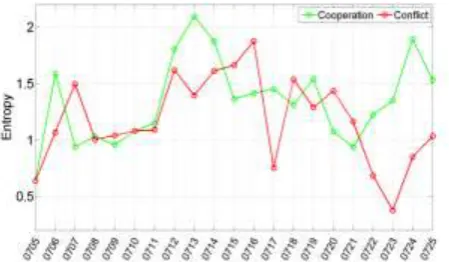
Figure 6. The information entropy of cooperation events and conflict events in South China Sea arbitration case.
Summary
Right after the South China Sea Arbitration was concluded on 12 July 2016, it quickly attracted much attention in the world and became one of the international hot events. It is of great importance to infer the dynamic evolution of international relations before and after the hot events through quantitative analysis. International relations can be viewed as many complex social networks, whose structures are often profoundly changed with the emergence of hot events. This study based on network evolution analysis to explore how multinational relation’s network was affected by the South China Sea Arbitration. We have extracted nearly 30,000 events from July 5 to 25, 2016 related to the South China Sea Arbitration from GDELT, constructed the relation networks of the relevant countries.
[image:5.595.85.528.234.372.2] [image:5.595.188.413.404.535.2]entropy of degree can effectively depict the evolution of the network and characterize the development process of the case.
Acknowledgement
This research was supported by the National Natural Science Foundation of China under Grant No.41671532 and Innovation Project of Guangxi Graduate Education under Grant No.YCSW2017022.
References
[1]A. Schein, J. Paisley, D. M. Blei, et al. Inferring polyadic events with Poisson tensor factorization. NIPS 2014 Workshop on Networks, Montreal, Quebec, Canada.
[2]S. Bi, J. B. Gao, Y. D. Wang, and Y. H. Cao, A contrast of the degree of activity among the three major powers, USA, China, and Russia: Insights from media reports. International Conference on Behavioral, Economic and Socio-Cultural Computing, 2015, 38-42.
[3]Y. Keneshloo, J. Cadena, G. Korkmaz, et al. Detecting and forecasting domestic political crises: A graph-based approach. In: Proceedings of the 2014 ACM conference on Web science, Bloomington, IN 192-196.
[4]D. Durante, D. B. Dunson, Bayesian dynamic financial networks with time-varying predictors. Statistics & Probability Letters, 2014, 93 19-26.
[5]H. Kwak, J. An, A first look at global news coverage of disasters by using the GDELT dataset. Lecture Notes in Computer Science, 2014, 8851 300-308.
[6]J. Yonamine, Predicting Future Levels of Violence in Afghanistan Districts Using GDELT. Unpublished Manuscript, 2013.
[7]J. Yonamine, A nuanced study of political conflict using the Global Datasets of Events Location and Tone (GDELT) dataset. The Pennsylvania State University. 2013.
[8]H. Kwak, An J. A first look at global news coverage of disasters by using the gdelt dataset. Social Informatics: Springer, 2014, 300-308.
[9]P. Fang, J. B. Gao, F. L. Fan, et al. Identifying Political “hot” Spots Through Massive Media Data Analysis. International Conference on Social Computing, Behavioral-Cultural Modeling and, Prediction and Behavior Representation in Modeling and Simulation. Springer International Publishing, 2016, 282-290.
[10]P. Erdös, and A. Rényi, On Random Graphs. I., Publications Mathematicae 6: 290-297.
[11]D. J. Watts, S. H. Strogatz, Collective dynamics of “small-world” networks. Nature, 1998, 393 (6684): 440-442.
[12]A. L. Barabsi, R. Albert, Emergence of scaling in random networks. Science, 1999, 286 (5439): 509-512.
[13]S. Abe, N. Suzuki, Dynamical evolution of the community structure of complex earthquake network. Europhysics Letters, 2012, 99(3):313-316.
[14]W. S. Huang, W. J. Wang, J. B. Gao, et al. Dynamical evolution of an internet social network: A case study on an event of protecting plane trees in Nanjing, China. International Conference on Behavioral, Economic and Socio-Cultural Computing. IEEE, 2015:13-17.