2017 2nd International Conference on Artificial Intelligence and Engineering Applications (AIEA 2017)
ISBN: 978-1-60595-485-1
Research Progress of Machine Vision Technology in
Artificial Intelligence
HAO ZHAO
ABSTRACT
With the development of computer science, artificial intelligence is gradually applied into all aspects of human life. A new discipline is produced in artificial intelligence image processing, that is, machine vision. Machine vision is the forefront of interdisciplinary research, and it is different from the study of human or animal vision, which is to use geometric, physical and learning techniques to build the model, using statistical methods to deal with data. Machine vision refers to the computer achieving the human visual function of perception, recognition and understanding in the objective world of three-dimensional scene. This paper introduces the research content and the development history of machine vision, and it summarizes the related application research of machine vision. Finally, we put forward the existing problems and give the direction of future research.
KEYWORDS
Machine vision, artificial intelligence, intelligent control, image processing, machine learning.
INTRODUCTION
In human sensory organs, vision is the most important. According to incomplete statistics, the number of visual cells is two or three thousand times than the auditory cells, and is 100 times more than the skin touch cells. Thus, it can be said that 80% of the information obtained from the outside world is dependent on the eye [1]. In the modern industrial production, the traditional artificial visual inspection method has been unable to meet the requirements of production automation and high appearance quality, so people began to consider combining the computer's fastness, reliability, consistency of results, and the height of human vision Intelligent and abstract ability, resulting in a new detection technology "machine vision technology" [2].
Machine vision refers to the computer achieving the human visual function of perception, recognition and understanding of the objective world of three-dimensional scene [2]. But the machine vision is very different from human vision. When we give a person an object and ask him or her to remember it visually, the person will circumvolve the object and observe it from a various of directions. We know little about how human mind learning objects, but it is extremely clear that it is the appearance that plays an important role in perceiving. Compared with the human vision, machine vision does not have the learning ability [3]. There are two main methods to achieve the machine vision : (1) bionic method refers to the structure of the human visual system, the establishment of the corresponding processing module is to complete a similar function and work; (2) Engineering approach is deliberately simulate the internal structure of the human visual system from the analysis of human visual process function, and it only consider the system input and output, and the use of any existing feasible means to achieve system functions [4].
Machine vision has become an independent discipline that can begin with the breaking work done by a professor at the Massachusetts Institute of Technology, professor Marr. In the meantime, because the machine vision has plenty of potential application prospects, numerous disciplines of knowledge is involved, the research problems are challenging, therefore, it has been a hot discipline in computer science. What's more, it has caused a lot of researchers’ attention of psychology, neuroscience, physiology, biophysics, mathematics and computer science and other disciplines, at the same time, the results of image processing, pattern recognition, intelligence, mathematics, cognitive science, machine learning, computer graphics and other aspects of research have a strong impetus to the development of machine vision technology [5-6].
Machine vision is actually one of the sub-fields of artificial intelligence, this paper aim to introduce the research contents and development history of machine vision, and review the related application of machine vision.
THE DEFINITION OF MACHINE VISION
THE MAIN RESEARCH CONTENTS OF MACHINE VISION
The main contents of machine vision research are input devices, low-level vision, middle-level vision, high-level vision, system structure and so on. The input device includes an imaging device and a digital device. Imaging equipment is to detect imaging through the optical lens into infrared, ultrasound, X-ray and other surrounding scenes and objects, and obtain the two-dimensional or three-dimensional digital images of the scene and objects [5-6]. Getting digital images is the most basic function of machine vision. Current digital imaging devices for machine vision include scanners, ultrasonic imaging probes, CT imaging devices, etc. However, these input devices are far from meeting the actual needs, there are still many researchers focus on the more advanced imaging systems, such as infrared imaging systems, laser imaging systems and so-called computing systems [7]. Low-level vision includes analysis and processing of the images themselves and intrinsic attributes, such as the light conditions, reflection, illumination direction and so forth. Also, the image repairing, elimination of the shake and the noise of the picture are contained. High-level vision focuses on the recognition and understanding of the objects, such as recognizing and tracking the specific object and its behavior in the picture, estimating the scene and predicting the next action of the object. Mid-level is between low-level and high-level, it concentrates on the character representation, such as decomposing a picture into a set of overlapping layers to describe the picture [8].
THE DEVELOPMENT HISTORY OF MACHINE VISION
As a new discipline, the development of machine vision is very rapid, and it became an important research field of computer science. Machine vision is mainly originated from the statistical pattern recognition, the initial work mainly concentrated in the binary image analysis and identification, such as character recognition, surface quality testing of work piece, micro pictures, air images analysis and interpretation. In the 60's, Roberts extracts three-dimensional structures of polyhedron, such as cubes, wedges, prisms from a digital image, and described the spatial relationship between the shape of the object and the object [9]. In 1977, machine vision technology was thrived. And in the mid-1980s, the new machine vision theory, which was different from the previous analysis method, was proposed. With the development of computer science, neural network, artificial intelligence, signal processing, neurophysiological pattern recognition and other related fields, the new concepts, new methods and new theories of machine vision have been emerging, and the research of machine vision theory has been further studied [10].
THE APPLICATION OF MACHINE VISION
invisible object perception, etc., machine vision exhibits its superiority. The following briefly introduces several typical applications of machine vision [11].
Part Recognition and Positioning
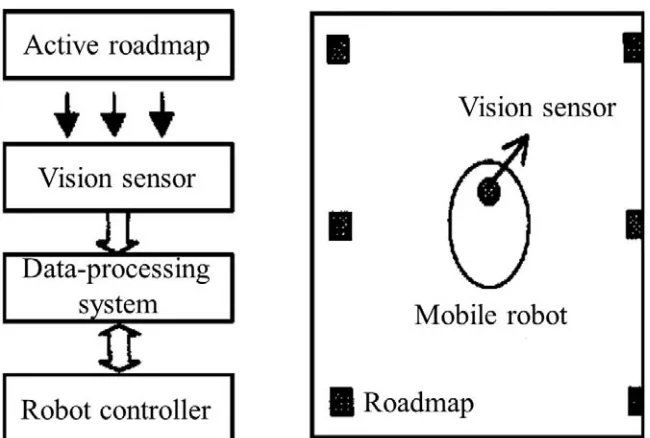
Since the structure and lighting of the industrial environment and other factors can be strictly controlled, the machine vision has been successfully applied in industrial production and assembly. The visual system is typically composed of a camera and a related visual information processing system. The camera is located above the part conveyor belt and identifies and locates the part. The purpose of the identification is to provide the robot with information on the operation or operation. The purpose of the positioning is to guide the robot to operate correctly. The overall positioning system is shown in Figure 1.
[image:4.612.136.461.420.639.2]Besides, this aspect of applications is used in our daily life widely. For example, as well known, license plate recognition is playing a growingly important part in abundant applications [12]. We can see the use of license plate recognition in almost everywhere such as crossroads, residential quarters, large hotels and even universities. What’s more, this aspect of applications is also really essential in traffic sign recognition and analysis for intelligent vehicles which is the hotspot nowadays [13], and face recognition as well [14, 15].
Product Inspection
Another successful application of machine vision in the industrial field is product inspection. It has been used for product appearance inspection, surface defect inspection and so on.
Mobile Robot Navigation
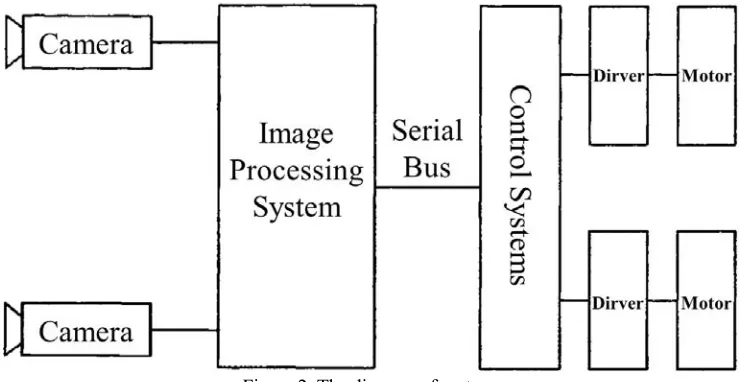
The robot can restore the scene three-dimensional information, and use the scene of the three-dimensional information to identify the target, identify the road, determine the obstacles, etc., in order to achieve road planning, autonomous navigation, and the surrounding environment independent interaction. Combining stereoscopic and motion information can form a scene depth map that satisfies the specific task resolution requirements. Figure 2 is the control system diagram of the smart car, which is responsible for the underlying control and computing tasks. This technology is very useful for autonomous navigation of unmanned vehicles, unmanned aircraft, unmanned vehicles and other autonomous systems [16].
Remote Sensing Image Analysis and Medical Image Analysis
[image:5.612.112.484.513.704.2]Security Authentication, Monitoring and Tracking
The use of the machine vision system can achieve car park surveillance, vehicle identification, license plate identification, detection and tracking "suspicious" target: to identify a specific person according to the face, eyes, fingerprints and other image features [18].
TOPICAL PROBLEMS AND SOLUTIONS.
The face recognition is a very topical problem that we have faced in which we also made much progress. It is very hard to develop a computational model of face recognition since faces are abstruse, multidimensional. A mass of researchers have developed various methods to solve it. The conventional approaches used in face recognition are used to capturing the form or shape, or gestalt-like of the objects. Fleming and Cottrell train a network via BP model to classify face images using nonlinear units [19]. Stonham’ WISRAD system [20] has achieved some success in binary face images. Stimulated by a development of Sirovich and Kirby [21], Turk and Pentland gain ground in face recognition using eigenfaces [15].
The other topical problems that we used to face are the influences of the environment such as lighting conditions and background colors which is very common in traffic sign recognition (TSR) and license plate recognition (LPR) for these influences cannot be controlled in outdoor environments. Although nowadays there are plenty of methods about TSR and LPR having already put into applications, most of them can only work in restricted conditions such as specific lighting condition or stationary backgrounds. To overcome the various lighting conditions, Wen et al. proposed a novel binary method based on Bernsen algorithm [12]. To solve the problems about background color, researchers have developed numerous studies. Some researchers studied in the RGB space [22-25], while other researchers prefer to study HIS space [26-29] for it is more immune to lighting changes. Also, Luv space has been studied as well [30].
CONCLUSION
This paper summarizes the research contents and development history of machine vision, and summarizes the related application of machine vision. For the machine vision research, we have the following aspects of the future research: (1) accurate, high-speed real-time identification of the target. (2) Effective construction and organization of a reliable identification algorithm, and being successfully achieved. Hoping have a high-speed array processing unit, as well as the new breakthrough of the algorithms (such as neural networks, wavelet transform and other algorithms). Thus, you can use very little computational effort to achieve the function of parallel. (3) Real-time is an important problem that is difficult to solve. Only to solve these problems, can machine vision technology better facilitate our lives.
REFERENCES
2. N.N. Zheng. Computer vision and pattern recognition [M]. Beijing: National Defense Industry Press, 1998: 15-23.
3. H. Murase, S.K. Nayar. Learning and Recognition of 3D Objects from Appearance [J]. IEEE 1993:
39-50.
4. S.D. Ma, Z.Y. Zhang. Computer vision-computing theory and algorithm foundation [M]. Beijing:
Science Press, 1998: 52-59.
5. S.Y. Yang. Program design of VC++ image processing [M]. Beijing: Tsinghua University Press,
2003: 284-287.
6. C. Tomasi, T. Kanade. Shape and motion from image streams under orthography: a factorization
method [J]. Kluwer Academic Publishers, 1992, 9 (2): 137-154.
7. Z.L. Dong, Y.M. Hao, F. Zhu. A positioning system based on vision mobile robot [J]. Journal of
Image and Graphics, 2000, 5 (8): 688-692.
8. Edward H. Adelson, Johb Y.A. Wang, Sourabh A. Niyogi. Mid-level vision: New directions in vision and video [J]. IEEE 1994: 21-25.
9. Y.M. Liu, Z.L. Dong, MX Sun, Y.E. Mao. A visual positioning system based on neural networks [J]. Robot, 2003, 23 (5): 461-464.
10. A. Broggi, M. Bertozzi, A. Fascioli. Self-calibration of a stereo vision system for automotive applications [C]. IEEE International Conference on Robotics & Automation, 2001, 4: 3698-3703. 11. Z.P. Sun, X.J. An, H.G. He. CITAUT-IV-The autonomic car of visual navigation [J]. Robot, 2002,
24 (2): 115-121.
12. Y. Wen, Y. Lu, J.Q. Yan, Z.Y. Zhou, Karen M. von Deneen, and Pengfei Shi. An Algorithm for
License Plate Recognition Applied to Intelligent Transportation System [J]. IEEE Transactions on Intelligent Transportation Systems, vol. 12, no. 3, September 2011: 830-845.
13. A. de la Escalera, J.M a Armingol, M. Mata. Traffic sign recognition and analysis for intelligent vehicles [J]. Image and Vision Computing 21 (2003): 247–258.
14. R. Brunelli and T. Poggio. Face Recognition: Features versus Templates [J]. IEEE Transactions on Pattern Analysis and Machine Intelligence, vol. 15, no. 10, October 1993: 1042-1052.
15. Matthew A. Turk and Alex P. Pentland. Face Recognition Using Eigenfaces [J]. 1991 IEEE:
586-591.
16. M.L. Qiu, S.D. Ma, Y. Li. A review of Camera Calibration in Computer Vision [J]. Acta Automatica Sinica, 2000, 26 (1): 43-55.
17. E. Stringa. Morphological change detection algorithms for surveillance Applications [C]. New Viewpoints, 2000, 174 (1): 402—411.
18. M. Bertozzi, A. Broggi, M Cellario, A. Fascioli, P. Lombardi, M. Porta. Artificial vision in road vehicles [C]. Proceedings of the IEEE on Intelligent Transmissi on System, 2002, 90 (7): 1258-1271. 19. M. Fleming and G. Cottrell, Categorization of faces using unsupervised feature extraction [C]. Proc.
IJCNN-90, Vol. 2.
20. T. 3. Stonham, Practical face recognition and verification with WISARD [C]. In H. Ellis, M. Jeeves, F. Newcombe, and A. Young (eds.), Aspects of Face Processing, Martinus Nijhoff Pub-lishers, Dordrecht, 1986.
21. L. Sirovich and M. Kirby, Low-dimensional procedure for the characterization of human faces [J]. J. Opt. Soc. Am. A, Vol. 4, No. 3, March 1987, 519-524.
22. S. Buluswar, B. Draper. Color recognition in outdoor images [C]. Sixth International Conference on Computer Vision, IEEE January (1998).
23. A. de la Escalera, L. Moreno, M.A. Salichs, J.Ma. Armingol. Road traffic sign detection and classification [J]. IEEE Transactions on Industrial Electronics 44 (6) (1997) 848–859.
24. S.K. Kim, D.A. Forsyth. A new approach for road sign detection and recognition algorithm [C]. 30th International Symposium on Automotive Technology and Automation, Robotics, Motion and Machine Vision in the Automotive Industries, ISATA June (1997).
25. M.M. Zadeh, T. Kasvand, C.Y. Suen. Localization and recognition of traffic signs for automated
vehicle control systems [C]. Intelligent Transportation Systems, SPIE (1998).
28. N. Kehtarnavaz, N.C. Griswold, D.S. Kang, Stop-sign recognition based on color/shape processing [J]. Machine Vision and Applications 6(4) (1993) 206–208.
29. G. Piccioli, E. de Micheli, P. Parodia, M. Campani. Robust method for road sign detection and recognition [J]. Image and Vision Computing 14(3) (1996) 209–223.