University of Huddersfield Repository
Brady, Denise Ann, Tzortzopoulos, Patricia and Rooke, John
An examination of the barriers to last planner implementation
Original Citation
Brady, Denise Ann, Tzortzopoulos, Patricia and Rooke, John (2011) An examination of the barriers to last planner implementation. In: 19th Annual Conference for Lean Construction, 1315th July 2011, Lima, Peru. (Unpublished)
This version is available at http://eprints.hud.ac.uk/id/eprint/21078/
The University Repository is a digital collection of the research output of the University, available on Open Access. Copyright and Moral Rights for the items on this site are retained by the individual author and/or other copyright owners. Users may access full items free of charge; copies of full text items generally can be reproduced, displayed or performed and given to third parties in any format or medium for personal research or study, educational or notforprofit purposes without prior permission or charge, provided:
• The authors, title and full bibliographic details is credited in any copy;
• A hyperlink and/or URL is included for the original metadata page; and
• The content is not changed in any way.
For more information, including our policy and submission procedure, please contact the Repository Team at: [email protected].
AN EXAMINATION OF THE BARRIERS TO LAST
PLANNER IMPLEMENTATION
Denise Brady1, Patricia Tzortopoulos2 & John Rooke3
Abstract
This paper presents results that contribute to an ongoing PhD work, looking at the implementation of Lean Production in manufacturing and what findings can be derived for the implementation of Lean in construction. This paper focuses on Last Planner as one approach to implementing Lean in construction. The aim of the paper is to identify implementation barriers and to determine whether or not factors contributing to the success of Lean projects in manufacturing were present in last planner implementation projects. The paper concludes with suggestions for further research aiming at reducing the barriers experienced when implementing Last Planner and highlighting important points to be considered when using any lean method on construction sites in the future. These findings will be developed further as part of the PhD work.
KEYWORDS
Lean manufacturing, lean construction, critical success factors, last planner
Introduction
The general thinking behind Lean is based on a desire to deliver a product which an individual customer needs while keeping waste in all processes to an absolute minimum. The origins of Lean can be traced back to the Toyota Motor Company, who developed a set of concepts known as the Toyota Production System, to reduce waste in all processes. The Toyota Production System incorporates tools to help managers and employees to introduce Lean into their organisation. However, experience in the implementation of Lean by using these tools has shown that much more is needed than just a tool to ensure success (Ahrens, 2006). The Lean approach needs to be adapted to work in a project-based industry (Lillrank, 1995).
It has been recognised for some time that it is necessary to improve the process of Lean implementation. This paper recommends some improvements to the Lean implementation process in construction, by looking at selected examples of Last Planner implementation. This system is used as an example since it represents a primary method of Lean implementation in Construction.
METHOD
This literature review based investigation draws on information gathered from previous research containing relevant information on the achievements, barriers and
1 PhD Student, School of the Built Environment, University of Salford; UK. [email protected] 2 Senior Lecturer, School of the Built Environment, University of Salford; UK. Phone +44 161 295
4284; [email protected]
3 Research Fellow, HaCIRIC, School of the Built Environment, University of Salford, Greater
challenges of Last Planner implementation since the early 90’s. It is important to highlight that not all papers describing last planner implementation efforts have been included here, but only those describing barriers to the implementation of Last Planner.
change models and CRITICAL SUCCESS FACTORS FOR LEAN IMPLEMENTATION
The implementation of Lean is a change process. Many change models have been described in the literature, providing guidelines on what steps to take when
implementing change. One influential change model has been that of Lewin (1947). This three-step planned change model has played an important part in understanding the change process. The essence of the three-step model is the “freeze, move,
unfreeze” concept where organisational members are disengaged from their conventional practices (unfreeze) in order to develop new values, attitudes and behaviour (move) so that these new values can be the new norm (refreeze). Other examples of planned change models are: the human resource models of change (Kolb, 1991), the political and cultural models of change (Pettigrew and Whipp, 1991) and Eclectic models of change (Kotter, 1996), which apply different elements from a range of “purist” change models together.
Kolb 1991, highlights that the relationship between managers and those affected by the change, as well as their satisfactory participation in the change, is of utmost importance. Pettigrew and Whipp, 1991 on the other hand point out five interrelated aspects of managing change i.e. Coherence, environmental assessment, leading change, human resources in assets and liabilities and linking strategic and operational change and Kotter (1996) focuses strongly on changing peoples behaviour. There are also Business Process Re-engineering approaches to organisational change which focus on the design and implementation of new or redesigned processes. Some examples of these models are Peppard and Rowland (1995), which focuses on processes, people and technology and Vakola et al. (2000), focusing on BPR and IT implementation within the construction industry.
More recently it has been suggested that managerial action is “crucial” at the level of operation and improvement and tends to be overlooked in the structure oriented BPR approach (Koskela 2010). This thinking reflects some ideas considered important by Kolb (1991) which are based on management relationships with operational level and participation in change.
Change models are also described in practical guides written for the industry (Hamlin et al., 2001). One example is Tempel (2001), who emphasises the importance of the presence of critical success factors when implementing Lean. This is an important source for the wider reseach work, as the practical projects looked at, follow the approach outlined by this author. According to Tempel (2001), the critical success factors that should be present when implementing Lean project are: Standardisation, Leadership, Speed, Measurement and Team Harmony.
Measurement refers to being able to clearly monitor progress. The introduction of Key Performance Indicators is important to track progress and prove results. Finally Team Harmony refers to the involvement of the organisational members in the change process.
A further source of knowledge on Lean success factors, drawn from empirical data, comes from a survey carried out by Ahrens (2006). The aim of the survey was to analyse the critical success factors for sustainable Lean implementation and the results of the survey in general show that cultural and leadership aspects seem to play a very important role. This is also an important part of the human resource change model from Kolb (1991), where significant importance is placed on the participation of managers and people in the change process, focusing on beliefs, attitudes and values. This is also reflected in the critical success factors as identified by Tempel (2001) above, where the origins of at least two of these factors (Leadership and Team Harmony) are concerned with good manager and worker relationships, getting people involved and gaining acceptance.
Although further research is needed in this area, so far there are common themes to be found in the literature on change models and the critical success factors for Lean implementation. The common factors that are important for the success of Lean initiatives appear to be:
ñ Training and standards (Tempel 2001, Lewin 1947)
ñ The human factor: Team work and worker involvement (Tempel 2001, Kolb 1991, Ahrens 2006)
ñ Leadership (Tempel 2001, Ahrens 2006) ñ Speed (Tempel 2001, Ahrens 2006)
ñ Measurement (Tempel 2001, Ahrens 2006)
THE LAST PLANNER SYSTEM
The implementation of the Last Planner System is analysed here as an example of Lean implementation in Construction, to determine the type of barriers experienced and to investigate whether the above critical success factors are present in any of the past implementations analysed. The Last Planner planning and control System is a method developed by Ballard and Howell to introduce better planning and reduce excess waste in construction projects. The Last Planner is the person or group accountable for production unit control, that is, the completion of individual assignments at the operational level (Ballard, 2000).
ñ Work is selected in the right sequence ñ The right amount of work is selected ñ The selected work can be done
Last Planner is a system for creating predictable and reliable workflow. This is achieved through “Pull Planning” which is at the core of LPS. This technique is based on working from a target completion date backwards which causes tasks to be defined and sequenced so that their completion releases work. This maximizes value generation and eliminates waste of over production, one of Ohnos seven areas of waste (Ballard, 2000).
Overview of barriers in last planner implementations
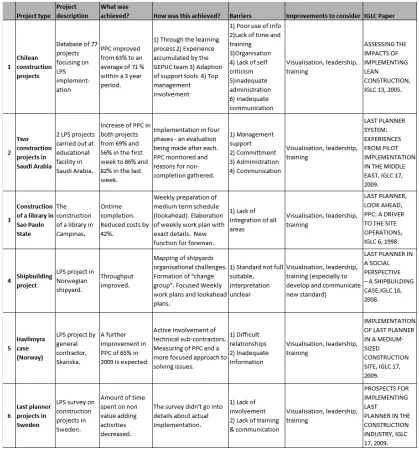
Table 1 shows of some of the implementations of Last Planner since the early 90’s, which have been documented in the IGLC conferences over the years. Only papers that contain relevant information on the barriers experienced during Last Planner implementation are shown. In the literature, it was possible to identify more than 83 construction projects where the Last Planner was implemented (A survey of 77 projects on one hand and a series of in depth studies on a further 6 projects: Aslesen et al 2008; Alarcon et al 2005; Friblick et al 2009; AlSehaimi et al 2009; Kalsaas et al 2009; Kim et al 2005; Conte 1998). The projects cover a variety of different types of construction, from low and high rise buildings, heavy industrial projects, heavy civil construction projects, light industrial construction, educational facilities to shipbuilding. Information on the types of projects where LPS was used and what the main actions were, that contributed to improvement in PPC, is displayed in Table 1. In addition, information on what barriers were experienced and suggested improvements is also presented. The barriers experienced during implementation will be discussed along with possible future improvements.
barriers experienced in past lps implementations
In the overview, it can be noted that over time, the LPS has continuously improved the PPC on projects where it has been implemented. In all projects, LPS was implemented in a somehow similar way. In the shipbuilding project (Aslesen et al 2008) it was felt that the LPS approach had to be adapted to suit the shipbuilding process. In summary, the following barriers to implementation were experienced.
Weak communication and transparency
Table 1: Overview of Last Planner implementations
Minimum involvement of construction workers
Minimum involvement of physical construction workers was perceived to have been a barrier on some projects, especially those carried out in Sweden (Friblick et al 2009) Also, the inadequate involvement of sub-contractors in the Last Planner process hindered its effectiveness.
Inadequate preparation and training of participants
good communication also on the Saudi Arabia projects (AlSehaimi et al 2009) which led to misunderstandings and non-compliance. In the Last Planner projects in Sweden (Friblick et al 2009), the lack of knowledge of what the system is and how it works on behalf of construction workers was a major obstacle. Better preparation would increase acceptance and lead with an example of good communication right from the very beginning.
Lack of role definition
Other barriers were experienced due to a lack of role definition. In some cases, important project participants did not feel obligated to work according to the terms of Last Planner. In the Seoul and Busnan Subway projects (Kim et al 2005), the foreman was not adequately involved in the planning and scheduling process!
One of the most important roles for the success of Last Planner is that of the foreman. He or she needs to be on board and this needs to be made clear right from the beginning. Other organisational issues also resulted due to a lack of role definition. For example, work was structured and scheduled not through engineers in a construction team but through those in a project control team. Problems arose since engineers in the project control team were not very aware of site constraints such as the progress of pre-requisite work. In addition, participants often found it difficult to “say no” when it was necessary – especially to superior levels. It is important for any method in use in Lean Construction that hierarchy does not come before process. This is something that needs to be made clear at the very beginning of the project when defining roles. Top management support and commitment to promises are also mentioned as critical success factors for implementation during the construction projects carried out in Saudi Arabia (AlSehaimi et al 2009).
Information not adequately used
Information was collected in meetings but it was found in the Chilean projects (Alarcón et al 2005) that this information was inadequately used and administered to create a learning cycle. In the Havlimyra case (Norway) (Kalsaas et al 2009) the information was not fully adequate as it was felt that there was a missing link between the production schedule and the phase schedule (in order to remove constraints and create a backlog of workable tasks). Clearly, we need to concentrate on ways to better use the information made available to us when implementing LP.
Lack of time for implementing improvements
This was also mentioned as a barrier during the Chilean projects (Alarcón et al 2005). There is never time for improvements unless we make time. During construction, we also need to focus on improvements that are possible. Long complicated and expensive solutions should be avoided.
Lack of integration of production chain (client, suppliers, sub-contractors)
Some of the above barriers will be subject to cultural variation. This means that they will not necessarily be encountered in the context of the research project reported here, which is based in Germany. This is particularly true of the seniority issues, which are most prominent in high power-distance cultures (Hofstede 2002). However, all are significant in considering the generic issue of implementation.
DISCUSSION: ARE THe CRITICAL FACTORS TO SUCCESS ALWAYS PRESENT WHEN IMPLEMENTING LAST PLANNER?
So far we have considered what the critical success factors are when implementing Lean and what barriers have been experienced when implementing Last Planner. This section attempts to link these two aspects by determining whether these critical success factors were present on projects using this method of Lean implementation in construction. It looks towards the future of Lean implementations in construction and attempts to determine the areas where the main focus for improvement should be.
It is not easy to say that certain success factors do or do not exist when implementing Last Planner, since each project presents unique circumstances. There is however, always an element of measurement in the Last Planner system, particularly that of PPC (PPC was positively improved on all of the projects shown in table 1). While PPC is not always a predictor of project performance (a high PPC doesn’t always mean that the project is on schedule), transparency of results helps the Lean implementation process.
Other areas however could be improved so that Lean in construction can progress in the future. Training and communication are two important areas. A lack of knowledge of the concepts of Last Planner and what the benefits were hindered progress on some projects (Chilean and Swedish). Good communication, team work and poor worker involvement were issues on others.
Satisfactory Leadership and management involvement were sometimes an issue since role definition and a sense of responsibility seemed to have been lacking on some projects.
CONCLUSION
Based on the ideas presented in this paper, the following section will suggest some points for future Lean implementations in construction .
further improvement of communications and increased involvement of construction workers
training of lean construction participants in advance
Before the implementation of any new method, those involved must be trained in its concepts and approach. As was highlighted in the shipbuilding project case (Aslesen et al 2008), there is an important “social element” to implementing Last Planner and by focusing on the training of participants and good communication from the beginning, it will make it easier to introduce any changes at a later date. Training information on Last Planner and any other method should be visualised where construction workers and all participants can see to always remind them of the reason why such methods are being used.
improved use of information available – visual management
By displaying the work to be carried out on a daily basis at the site, everyone can see what the progress is and what work was planned for when. This information can be used to measure performance of work and reasons for non-compliance should also be gathered and visualised so everyone is aware of why actions have not been carried out. Corrective actions taken should also be displayed and this would generate a learning effect.
adequate preparation
A clear definition of roles and responsibilities within the team before project start is essential. This includes making it clear that decisions will be made based on process and not on hierarchy. Once roles are defined, these can be also visualised at the area of work on an information notice board. Who is involved in the successful implementation of this tool? Who should be there at what meetings? What is the process for implementation?
Get everyone on board. To implement a new method for Lean Construction on a project is first of all a decision. Therefore time should always be made for improvements (this will save time later).
Necessary preparations should also be made in advance, in order to fully integrate the whole production chain (client, suppliers and sub-contractors). Get them involved in the process, perhaps already in the contract negotiations stage. Visual management can also be used here. Display who the sub contractors and suppliers are and what work they have to complete on site. Introduce Key Performance Indicators to measure their performance and display this information onsite. Finally, while we can see that Last Planner has proved itself as a successful method in Lean construction, there is room for improvement in the process of how it is implemented.
Future Research
The possibility of using visual management to help reduce the barriers mentioned above will be an important topic for the future research. In addition, further research into change models and success factors will be carried out.
References
Ahrens, T. (2006). “Lean Production: Successful implementation of organizational change in operations instead of short term cost reduction efforts” (24 pp). Lean Alliance
Alarcón, L.F., Diethelm, S., Rojo, O. & Calderon, R. (2005). Assessing the impacts if implementing lean construction. IGLC 13, 2005.
AlSehaimi, A., Tzortzopoulos, P., & Koskela, L. (2009). Last Planner system: experiences from pilot implementation in the middle east. IGLC 17, 2009. Aslesen, S. and Bertelsen, S. (2008). Last Planner in a social perspective – a
shipbuilding case, IGLC 16, 2008
Ballard, G. (2000). The Last Planner System of Production Control. School of Civil Engineering, Faculty of Engineering, The University of Birmingham.
Ballard, G. (2000). Phase Scheduling, LCI White Paper-7. The Lean Construction Institute.
Ballard, G. & Howell, G. (1998). Shielding Production: Essential step in Production Control. Journal of Construction Engineering and Management.
Conte, A. (1998). Last Planner, look ahead, PPC: a driver to the site operations. IGLC 6, 1998.
Convis, G. (2001). Role of Management in a lean manufacturing environment. Learning to think lean.
Fiallo C. M. Revelo P. H. (2002). Applying the Last Planner control system to a construction project: A case study in Quito, Ecuador. IGLC 10, 2002.
Formoso, C. & Moura, C. (2009). Evaluation of the impact of the Last Planner system on the performance of construction projects. IGLC 17, 2009.
Friblick, F., Olsson, V. & Reslow, J. (2009). Prospects for implementing Last Planner in the construction industry, IGLC 17, 2009.
Hamlin, Bob (2001). “Organizational change and development: a reflective guide to managers, trainers and developers”. Harlow : Financial Times/Prentice Hall. Hamzeh. F. & Ballard, G. & Tommelein, I. (2009). Is the Last Planner system
applicable to design? A case study. IGLC 17, 2009.
Hofstede, G. (2002) Culture's Consequences: Comparing Values, Behaviours,
Institutions and Organizations Across Nations, (2nd Edition) Sage, London.
Howell, G. (1999). What is Lean Construction? Proceedings of 6th IGLC Conference, California, Berkeley, 26-28 July 1999.
Junior, J., Scola, A. & Conte, A. (1998). LAST PLANNER AS A SITE OPERATIONS TOOL. IGLC 6, 1998.
Kalsaas, B., Skaar, J. & Thorstensen, R. (2009). Implementation of Last Planner in a medium-sized construction site. IGLC 15, 2009.
Kolb, David A., Rubin, Irwin M., and Osland, Joice. (1991). “Organizational behaviour: an experiential approach”. Englewood Cliffs, N.J.: Prentice Hall. London.
Koskela, L. (1992). Application of the new production philosophy to construction. CIFE Technical report # 72, Stanford University.
Koskela, L., Ballard, G. & Tanhuanpää, V.P. (1997). Towards Lean design management. IGLC 5, 1997.
Koskela, L. (2010). Is structural change the primary solution to the problems of construction? VTT Technical Research Centre of Finland, PO Box 1800, FIN-02044 VTT, Finland. P.85-96
Larson, A. (2003), Demystifying Six Sigma: A Company-Wide Approach to Continuous Improvement, AMACOM, New York.
Lewin, Kurt (1947). “Frontiers in group dynamics”. Human Relations, vol. 1, pp. 5-41.
Lillrank, P. (1995) The transfer of management innovations from Japan. Organization Studies, 16/6, 1995, p.971-989.
Ohno, T. (1988). Toyota Production System, Beyond Large-Scale Production. Productivity Press, Portland Oregan, USA.
Peppard, J, & Rowland, P. (1995). “The Essence of Business Process Re-Engineering”. Prentice Hall.
Pettigrew, Andrew M. & Whipp, Richard (1991). “Managing change for competitive success”. Massachusetts, USA: Blackwell publishers.
Tempel, F. and Holländer M. (2001). Growtth: Get rid of waste through team harmony. Verlag moderne industrie AG & Co. KG, 86895 Landsberg / Lech. Vakola, Maria, Rezgui, Yacine and Wood-Harper, Trevor (2000). “The Condor