2017 2nd International Conference on Computer Science and Technology (CST 2017) ISBN: 978-1-60595-461-5
A Traffic Adaptive Media Access Control Protocol with Hybrid
Slot Allocation for Self-Organizing Networks
Sheng-wei WANG
1, Jun LIU
2,b*,Li-jun LU
2and Hui HAO
31Power Emergency Center, Sichuan Electric Power Corporation, Chengdu, China
2National Key Lab of Science and Technology on Communications, University of
Electronic Science and Technology of China, Chengdu, China
3Information Technology Center, Tsinghua University, Peking, China
a[email protected], b[email protected], c[email protected],
*Corresponding author
Keywords: Self-organizing Networks, Time Division Multiple Access, Hybrid Slot Allocation, Time Synchronization.
Abstract. In order to promote the efficiency of media access control (MAC) in self-organizing networks (SONs), this paper proposes a time division multiple access (TDMA) style MAC protocol based on hybrid slot allocation with traffic adaptive. The frame design, the time synchronization mechanism, the hybrid slot allocation method and the protocol process are analyzed respectively. The hybrid slot allocation MAC protocol allocates slot resource on the demand of the traffic requirement of each station to improve the network throughput. As a proof of principle, system level simulations are carried out, in which the algorithm is evaluated for different traffic distribution. Analysis demonstrates the rightness of the proposed approach.
Introduction
Due to the limited bandwidth and the vulnerability to interference in wireless self-organizing networks, we cannot effectively use the wireless channel resource. An efficient resource allocation technology is important to salve the channel resource and improve the performance of wireless self-organizing networks.
Currently, the MAC protocols used in wireless self-organizing networks can be divided in two categories. One is the contention-based MAC protocols [1], in which mainly includes ALOHA, CSMA (Carrier Sense Multiple Access) [2], MACA (Multiple Access Collision Avoidance) [3], FAMA (Floor Acquisition Multiple Access) [4], etc. The other is the scheduling-based MAC protocols [5], in which mainly includes TDMA [6], FPRP (Five Phase Reservation Protocol) [7], D-TDMA (Dynamic TDMA) [8], and so on.
protocol can adaptively adjust the slot allocation in transmission, and each station can make a reservation to the later slot resource. The hybrid TDMA protocol combines the advantages of the former two categories of TDMA protocols.
System Model
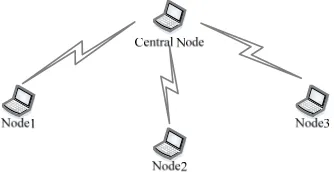
[image:2.612.223.390.248.339.2]The protocol takes the centralized control method, and the slots are assigned by the central node. Fig. 1 shows that the central node is responsible for scheduling slots resource in network, and realizes the time synchronization. The central node can directly communicate to each station in the network to collect the traffic information, and schedule the slot resource based on the traffic requirement of each station. Through direct communication with stations, the central node delivers the slot scheduling result to all stations.
Figure 1. System model.
For the consideration of enhancing resource utilization, the MAC protocol adopts hybrid slot allocation method. In a time-frame, each station is exclusively assigned a few fixed slots. Besides the fixed slots, the left slots are dynamically allocated according to the status of traffic at each station.
Protocol Design
Time-frame Format
The following rules are assumed in this paper, the count of slots in a time-frame is no less than the total number of stations in network, and the length of single slot should be longer than the packet length.
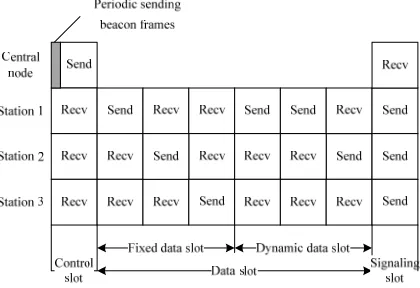
According to the functional requirements, there are three types of slots in a time-frame (i.e., the control slot, the data slot, and the signaling slot). Among them, the data slots are divided into the fixed slots and the dynamic slots. The fixed slots are exclusively used by each station. The dynamic slots are allocated in accordance with the traffic requirements. To avoid the transmitting conflict in two successive data slots, a guard period is set. The time-frame structure is shown in Fig. 2.
[image:2.612.179.435.604.699.2]The Control Slot. The central node exclusively uses the control slots to transmit the arrangement of data slots in the next time-frame. After receiving the control message, each station in the network maintains a data slot assignment table. When the next time-frame is coming, the station will take the new slot arrangement. In order to ensure the reliable transmission of control message, in control slots, the central node uses the acknowledgement mechanism to send the control message.
The Data Slot. After the control slot, each station updates its own data slot assignment table, and data transmission can be carried out in its allocated dynamic data slots and fixed data slots. In data slot, each station can only transmit data in its own assigned slots, and receive data in other data slots. In the fixed TDMA protocol, no matter the traffic is heavy or light, all stations are assigned the same number of slots, thus should cause the slot resource insufficient at heavy traffic stations, and result in waste at light traffic stations. In a time-frame, each station has at least one fixed data slot. The fixed data slots will not change in different time-frames, thus is the minimum transmission guaranty for a station. The central node allocates dynamic data slots to each station according to the traffic need. Therefore, the dynamic slots allocated to each frame may be different for a specific station.
The Signaling Slot. In order to ensure the reliable information exchange, each station is exclusively own a period of time to transmit the traffic message to the central node. The traffic message mainly includes the overflow count of transmission buffer and the traffic requirement in the current.
Hybrid Slot Assignment Algorithm
The TDMA network is a kind of synchronous network, each station in the network must have a same time base, and the slots of each station must be synchronized with the time base. Its main purpose is to obtain precise synchronization accuracy. In addition, it must minimize the complexity of the algorithm, and reduce the management overhead and computational cost. The proposed hybrid TDMA protocol uses the beacon frames to perform time synchronization. A central node regularly broadcasts the beacon frames that includes a local time to the full network. The other stations synchronize their time to that of the central node, and correct its time offset after a period. Meanwhile, the continuous cycle of time synchronization makes up the shortcoming of the cumulative. The hybrid slot assignment algorithm considers the traffic status in last time-frame and the overflow identifies of transmission buffer. The traffic is defined as the number of packets of the station need to be transmitted in a time-frame. When the transmission buffer appears overflow, the buffer overflow count is set, and the station also records the total number of packets sent by the station in this time-frame. After the central node collects the traffic information of all stations, it will allocate some slots in the next time-frame according to the traffic load. The overflow bit is of great significance in the slot allocation, if a station's transmission buffer overflow in the former time-frame due to insufficient slots, it will be allocated more slots in the next time-frame. The traffic is not only relevant to the demand of the station itself, but also is in proportion to the number of slots allocated in the former time-frame.
divide M unallocated data slots into n parts according to the traffic status of n stations. The number of slots assigned to the station Ni in the next frame Si_next is as Eq. (1)
i i i
i_next n n
i i i
i=1 i=1
O L /S
S M(α β )
O L /S
= +
. (1)
where, α [0,1]∈ , β=1-α, is the rounding function.
The count of buffer overflow and the traffic in a time-frame are normalized in the same order of magnitude. In realization, we find that the slot assignment algorithm obtains a better effect when the scale factor α of buffer overflow is small. In order to ensure that the algorithm can make maximize use of the slot resource in a time-frame, we take the rounding function to allocate integer slots to a station.
Protocol Flow
[image:4.612.196.406.367.511.2]Each site takes different action in different slot. For the central node, it sends the control information and the periodic beacon frames in control slot, and receives the traffic information in signaling slot. Fig. 3 shows the protocol flow of the system in a time-frame. For a station in control slot, it receives the control information transmitted by the central node and saves the slot selecting information for transmission in the next time-frame. In signaling slot, the traffic information collected in the former time-frame is sent to the central node. In data slot, the stations determine their sending action according to the data slot assignment table.
Figure 3. The protocol flow.
Simulation Analysis
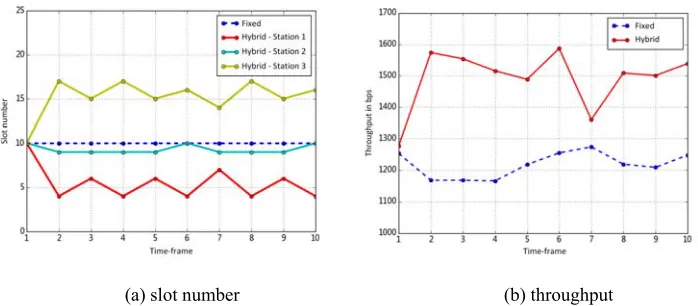
We compare the proposed slot assignment method with the fixed slot assignment method in two scenarios. One is the network traffic load is balanced in each node, and the other is that the load difference of each node in the network is relatively large. In the fixed slot assignment algorithm, the data slots allocated in one time-frame to each station is equal to 10 slots (125ms per slot). In the hybrid slot assignment algorithm, each station in a time-frame has one fixed data slot, and the remaining 27 data slots are dynamically allocated by the central node according to the traffic load.
Uniform Distribution of the Traffic
different, and the slot allocation of each station in the network can achieve the average distribution. Fig. 4(b) depicts that under the condition of uniform traffic distribution, there is no significant difference between the hybrid slot allocation and the fixed slot allocation, and their performance are roughly consistent.
[image:5.612.128.477.135.279.2](a) slot number (b) throughput
Figure 4. Comparison under the uniform traffic load.
(a) slot number (b) throughput
Figure 5. Comparison under the non-uniform traffic load.
Non-uniform Distribution of the Traffic
When the traffic of each station in the network obeys the non-uniform traffic distribution, the comparison of slot number is presented in Fig. 5(a). The slot allocation of each station is quite different from that in uniform distribution. Because the traffic is lighter, the number of slots allocated to station 1 is significantly smaller than that of the fixed allocation, and the station 3 is assigned more slots in each frame due to its heavier traffic. Fig. 5(b) depicts that in a non-uniform traffic distribution scenario, the hybrid slot assignment algorithm achieves significantly better throughput than the fixed slot assignment.
Conclusions
[image:5.612.130.479.327.480.2]according to the traffic requirement of each station. We performed a series of simulations, which show that the synchronization accuracy of the system is at microsecond level. Furthermore, we verified the performance of the proposed hybrid slot assignment algorithm under uniform and non-uniform traffic distribution.
Acknowledgement
This work was supported in part by State Grid Corporation of China 2015 Scientific Research Project under grant no. 521999150031, and the National Natural Science Foundation of China no. 61271168.
References
[1] S. Debroy, S. De, M. Chatterjee. “Contention Based Multichannel MAC Protocol for Distributed Cognitive Radio Networks,” IEEE Transactions on Mobile Computing, 2014, vol. 13, no. 12, pp. 2749-2762.
[2] IEEE Std 802.3-2008 (Revision of IEEE Std 802.3-2005), IEEE Standard for Information technology–Telecommunications and information exchange between systems–Local and metropolitan area networks–Specific requirements Part 3: Carrier Sense Multiple Access with Collision Detection (CSMA/CD) Access Method and Physical Layer Specifications, 2008, pp. 1-2977.
[3] F. Talucci, M. Gerla, L. Fratta. MACA-BI (MACA By Invitation)-a receiver oriented access protocol for wireless multi-hop networks,” The 8th IEEE International Symposium on Personal, Indoor and Mobile Radio Communications, 1997, vol. 2, pp. 435-439.
[4] N. Gajaweera, D. Dias. FAMA/TDMA Hybrid MAC for Wireless Sensor Networks, 4th International Conference on Information and Automation for Sustainability, 2008, pp. 67-72
[5] M. Anusha, S. Vemuru, T. Gunasekhar. TDMA-based MAC protocols for scheduling channel allocation in multi-channel wireless mesh networks using cognitive radio, International Conference on Circuit, Power and Computing Technologies (ICCPCT), 2015, pp. 1-5.
[6] T. L. Doumi, J. G. Gardiner. Description of a simple TDMA mobile radio simulator, IEE Colloquium on Communications Simulation and Modelling Techniques, 1993, pp. 1-5
[7] C. Zhu, M. S. Corson. A five-phase reservation protocol (FPRP) for mobile ad hoc networks,” Wireless networks, 2001, vol. 7, no. 4, pp. 371-384.