2017 2nd International Conference on Computer Science and Technology (CST 2017) ISBN: 978-1-60595-461-5
Computing the Wide Diameter of Regular Hyper-Star
Networks Using Independent Spanning Trees
Jou-ming CHANG
Institute of Information and Decision Sciences, National Taipei University of Business, Taipei, Taiwan
Keywords: Interconnection networks, Regular hyper-stars, Independent spanning trees, Wide diameter.
Abstract. In this paper, we determine the wide diameter of a regular hyper-star network HS (2k,k). We first provide a connection between the wide diameter and the maximum height of a set of particular spanning trees, called independent spanning trees (ISTs for short), of a network. According to this relation, we analyze the height of a set of constructed ISTs in HS (2k,k) to establish an upper bound of the wide diameter of
HS(2k,k). By contrast, we take the known result of fault diameter of HS (2k,k) as a lower bound. As a consequence, we obtain the following result: Dw(HS(2k,k))=2k+1 for
k≥2, where Dw(G) stands for the wide diameter of a graph G.
Introduction
Interconnection networks are usually modeled as undirected simple graphs G=(V,E), where the vertex set V(G) and the edge set E(G) represent the set of processing elements and the set of communication channels. The connectivity of a graph G, denoted by κ(G), is the minimum number of vertices whose removal leaves the remaining graph disconnected or trivial, and thus it can be used to measure the reliability of the corresponding network. The diameter of a graph G, denoted by D(G), is the greatest distance between any pair of vertices in G, and thus it represents a worst-case lower bound on the time required for performing some fundamental operations in the corresponding network, such as one-to-one routing, broadcasting, data aggregation, semigroup computation, etc.
Krishnamoorthy and Krishnamurthy [1] first considered the vulnerability of diameter in a faulty interconnection network. The fault diameter of a graph G, denoted by Df(G), is the largest diameter among subgraphs obtained from G by removing no
more than κ(G)-1 faulty vertices. For any two vertices x,y∈V(G), a path joining x and y
in G is called an (x,y)-path. Two (x,y)-paths are openly disjoint if they have no vertex and edge in common except for x and y. Recall that, by Menger's Theorem [2], there exist κ(G) openly disjoint paths between every pair of vertices in a graph G. A set of m
(x,y)-paths is called a container of size m with respect to x and y if every two paths in the set are openly disjoint. Let Cm(x,y) denote the family consisting of all such
containers in G, and lC be the length of a longest (x,y)-path in a certain container
C∈Cm(x,y). In [3], Hsu introduced a notion that integrates the connectivity and
diameter in a graph as follows. The wide diameter of a graph G, denoted by Dw(G), is
Obviously, we have D(G)≤ Df(G)≤Dw(G). So far, the fault and wide diameters of
graphs related to interconnection networks have been widely discussed.
In this paper, we determine Dw(HS(2k,k)) =2k+1, where HS(2k,k) is the regular
hyper-stars and it will be defined later in Section 2. Although the fault diameter of
HS(2k,k) has already known in [4] (see Lemma 1), the current research result with regard to the wide diameters of HS(2k,k) is not clear except that a bound appeared in [4]. Our technique is the use of analyzing the heights of a set of particular spanning trees, called independent spanning trees (introduced in Section 3), to drawing a definite conclusion of the wide diameter.
Regular Hyper-stars
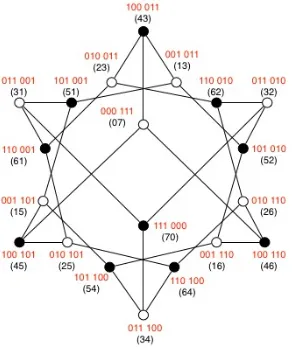
[image:2.612.241.387.413.588.2]Lee et al. [5] first introduced hyper-stars as an interconnection network model for competing with both hypercubes and star graphs. For n≥3 and 1≤k≤n-1, let L(n,k) be the set of binary strings of length n with exactly k 1's. The hyper-star HS(n,k) is a graph consisting of all vertices with labels chosen from L(n,k) such that two vertices are adjacent if and only if one can be obtained from the other by exchanging the first symbol with a different symbol (i.e., 1 with 0, or 0 with 1) in another position. From the definition, it is obvious that HS(n,k) is a bipartite graph with vertices, HS(n,k) is isomorphic to HS(n,n-k), and HS(n,k) is regular if and only if n=2k. Hence, subsequent researches particularly focused on the regular hyper-stars for intensifying their properties [4-8]. Figure 1 shows the graph HS(6,3), where each vertex is labeled by its binary representation and octal representation.
Figure 1. Regular hyper-star HS(6,3).
Lemma 1. [4]The fault diameter of HS(2k,k) is 2k+1 for k≥3.
The Heights of Independent Spanning Trees
Motivated by applications of fault-tolerant broadcasting and secure message distribution in networks, designing multiple spanning trees as broadcasting schemes and/or distribution protocols has received much attention. For a graph G, a set of spanning trees of G is called independent spanning trees (ISTs for short) if all the trees are rooted at the same vertex r such that, for any other vertex v∈V (G)\{r}, the paths from v to r in any two trees are openly disjoint. Zehavi and Itai [9] proposed the following conjecture: If G is a k-connected graph and r∈V(G) is an arbitrary vertex, then G admits k ISTs rooted at r. From then on, the conjecture has been confirmed only for k≤4 and is still open for k≥5. Also, by providing construction schemes of ISTs, the conjecture is affirmative for some restricted classes of graphs (e.g., see recent papers [10,11] and the references quoted therein). We now give the following property (here we omit the proof).
Lemma 2. Let G be a graph and Tx be a set of k=κ(G) ISTs rooted at a vertex x∈V(G).
Then,
where the term H(Tx) stands for the maximum height of a tree in Tx.
Let Zn be the set consisting of positive integers from 1 to n. For every vertex
x=x1x2… x2k in HS(2k,k), we define ri (x) to be the operation that exchanges x1 and xi
provided that 2≤i≤2k and xi = ┐x1 (i.e., xi is the complement of x1). Hence, ri (x) is a
neighbor of x in HS(2k,k). Also, for b∈{0,1}, define Hxb={i∈Z2k}: xi=b} and let Hxb(i,i
' )={j∈ Hxb: i≤ j≤ i ' } be the restricted set of Hxb. Moreover, we define
Fb: Hxb(k+1,2k) →Hx┐b(1, k)
to be a strictly increasing function, i.e., Fb maps every element of Hxb(k+1,2k) to an
element of Hx┐b(1, k) in the relative order. Since |Hx0(1,k)|=|Hx1(k+1,2k)| and |Hx1(1,
k)|=|Hx0(k+1,2k)|, both F0 and F1 are bijective. For instance, we consider
x=0101010011 in HS(10,5). Clearly, Hx0={1,3,5,7,8} and Hx1={2,4,6,9,10}. We have
the following restricted sets Hx0(1,5)={1,3,5}, Hx0(6,10)={7,8}, Hx1(1,5)={2,4} and
Hx1(6,10)={6,9,10}. Thus, F0(7)=2, F0(8)=4, F1(6)=1, F1(9)=3 and F1(10)=5.
By the symmetry, all ISTs of HS(2k,k) are considered to be with root at the vertex
r=0k1k (i.e., k consecutive 0s and follows by k consecutive 1s), and the constructed ISTs
are denoted by Tk+1,Tk+2,…,T2k. Let PARENT(T,x) denote the parent of a vertex x(≠0k1k)
in T. The algorithm was carried out by designating the parent of each vertex in every spanning tree Ti for i∈{k+1,k+2,…,2k} as follows:
PARENT(Ti,x) = rj (x), where j = NEXTx(i).
According to the parity of x1, the function NEXTx(i) is computed as follows. For x1=0,
For x1=1, it is a one-to-one mapping of {k+1,k+2,…,2k} onto Hx0 given by
The above function means that we consider Hx0(k+1,2k) as a cyclic-ordered set in
increasing order. For x1=0, if xi =1, then it maps i to itself, otherwise it maps i to F0(j)
where j is the next position with symbol '0' in the cyclic order. For x1=1, if xi =1, then it
maps i to F1(i), otherwise it maps i to the next position with symbol '0' in the cyclic
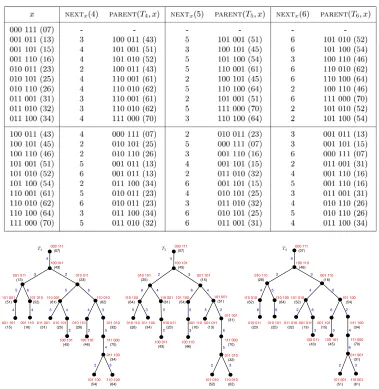
order. For example, Table 1 shows the results of NEXTx(i) and PARENT(Ti,x) for every
[image:4.612.116.495.313.702.2]vertex x∈V(HS(6,3))\{000111} and i∈{4,5,6}. Figure 2 shows the three ISTs rooted at the vertex r=000111 in HS(6,3).
[image:4.612.119.496.315.702.2]For a spanning tree T, the height of T is denoted by h(T). The unique path from a vertex x to r in T is denoted by T(x,r), and its length (i.e., the number of edges) is denoted by |T(x,r)|. From the above algorithm, we can determine the height of ISTs by the following lemma (here we omit the proof) .
Lemma 3. Let r=0k1k and x∈V(HS(2k,k))\{r} be any vertex. If |H
x0(k+1,2k)|=α, then
the length of Ti(x,r) for i∈{k+1,k+2,…,2k} is as follows:
By Lemma 3, it is obvious that the path Ti(x,r) has the maximum length provided
x1=xi=1 and |Hx0(k+1,2k)|=k-1. Thus, we have h(Ti)=|Ti(x,r))|=2(k-1)+3=2k+1.From
this result, we obtain the following upper bound of the wide diameter of HS(2k,k).
Lemma 4. For k≥3, Dw(HS(2k,k))≤2k+1.
Summary
We are now at a position to summarize the main result. We first observe the small graph
HS (4, 2), which is isomorphic to C6 and has connectivity 2. Thus, the removal of any
vertex in HS (4, 2) results in a P5 with diameter 4. Also, a container of size 2 with
respect to two adjacent vertices (resp. two nonadjacent vertices) in C6 has a longest path
of length 5 (resp. length either 3 or 4). This determines the fault and wide diameters of
HS(4,2). For k≥3, the fault and wide diameters of HS(2k,k) can be obtained by Lemmas 1 and 4. Thus, we have the following theorem.
Theorem 1. The fault and wide diameters of regular hyper-stars are as follows: (1) Df(HS(4,2))=4<5= Dw(HS(4,2)); and
(2) For k≥3, Df(HS(2k,k))=Dw(HS(2k,k))=2k+1.
Acknowledgement
This research was supported by the grant MOST104-2221-E-141-002-MY3 from the Ministry of Science and Technology, Taiwan.
References
[1] M.S. Krishnamoorthy and B. Krishnamurthy. Fault diameter of interconnection networks, Comput. Math. Appl. 13 (1993) 577-582.
[2] K. Menger, Zur allgemeinen Kurventheorie. Fund. Math. 10 (1927) 96-115. [3] D.F. Hsu. On container width and length in graphs, groups, and networks, IEICE Trans. E77-A (1994) 668-680.
[5] H.-O. Lee, J.-S. Kim, E. Oh, and H.-S. Lim. Hyper-star graph: A new interconnection network improving the network cost of the hypercube, LNCS 2510 (2002) 858-865.
[6] L. Liptak, E. Cheng, J.-S. Kim, and S.-W. Kim. One-to-many node-disjoint paths of hyper-star networks, Discrete Appl. Math. 160 (2012) 2006-2014.
[7] S.M. Mirafzal. On the automorphism groups of regular hyper-stars and folded hyper-stars, Ars Comb. 123 (2015) 75-86.
[8] F. Zhang, K. Qiu, and J.-S. Kim. Hyper-star graphs: Some topological properties and an optimal neighbourhood broadcasting algorithm, Concurrency Computation: Practice Experience 27 (2015) 4186-4193.
[9] A. Zehavi and A. Itai. Three tree-paths, J. Graph Theory 13 (1989) 175-188. [10] J.-S. Yang, J.-M. Chang, K.-J. Pai, and H.-C. Chan. Parallel construction of independent spanning trees on enhanced hypercubes, IEEE Trans. Parallel Distrib. Syst. 26 (2015) 3090-3098.