Japan’s Economic Recession
Kalim Siddiqui
Department of Strategy and Marketing
The Business School, University of Huddersfield
Queensgate, Huddersfield - HD 1 3DH, United Kingdom
Tel: + 44 (0) 1484 – 473615, Fax: + 44 (0) 1484 - 473148
E-mail: [email protected]
Abstract
Japan, the world’s second largest economy, is experiencing the worst economic crisis since the Second World War and the government is attempting to avoid a return to the “lost decade” of the 1990s when it was stuck in a deflationary spiral. To fight back recession, the Bank of Japan has kept the interest rate to 0.1 %, even lower than Bank of England’s 0.5 %. Japan’s economy has grown only at an average of 1% annually since 1992. Equally, the country’s recovery of 2003-07 did not have any long term effect on the growth.
In many respects Japan remains very unique among the developed countries. The country’s economic miracle of the 1950s and 1960s has encouraged debate among the scholars to the significance of Japan’s economic past. It is widely seen as due to different model of development in areas such as industrial organisation, the role of the state, social institutions and history. Her appeal lies in the dramatic growth rates and economic transformation. Japan was first Asian country to break the western monopoly of modern industrialisation. Less than a generation ago, Japan was viewed an exemplary success story in terms of rapid economic growth and a model to be emulated by other developed and developing countries. Here I will argue that the Japanese economy suffers from severe problems that are not cyclical but structural in nature. Such structural problems are the most serious impediments to economic dynamism and the future long-run economic success of the country.
1. Introduction
Japan has experienced a severe economic recession since the early 1990s, despite a short lived recovery in between, is one of the most significant developments in the recent history of capitalism. In this article I will examine critically the reasons behind Japanese economic recession and this seems to be connected with the process of oligopolistic accumulation. I mean the current Japanese crisis is an over production crisis and largely due to the structural propensity to build productive capacity while experiencing a decline in effective demand. The levels of effective demand depend on Keiretsu (Note 1), which determines the degree of utilization of productive capacity and levels of profits. At present exports and government spending is playing a crucial role in maintaining the levels of effective demand.
I find that neoliberal economists have largely blamed the active state and lack competitive environment for the on-going recession in Japan. However, I will argue here that falling domestic demand and a decline in income of the average working people is the main cause of the current recession. The domestic market itself is unable to provide markets for goods as long the real wages remain stagnant and lagging behind productivity growth.
Although my focus is about the current stagnation, but it does not mean to deny that the performance of Japanese economy in the last four decades, were astonishing. The country has gone from nearly total post war destruction to one of the richest country in the world. Between 1950 and 1990, the real GNP per capita rose from US$1,230 to $23,970 (both calculated at 1990 prices). Since 1950, average life expectancy has increased from 50 years to 75 years for males and from 54 to 81 years for females (Crook, 1993). By 1992, Japan’s economy had emerged as the main challenger to the United States as the world’s leading economy. The country’s export industry generated massive surpluses and the economic success was considered then nothing less than a miracle. However, the collapse of stock market boom and real estate bubble in 1991 marked the beginning of a more than a decade of stagnation (IMF, 2009b).
Table 1: Asia: Real GDP (Year on year percentage change)
Source: IMF.WEO data base.
1. Change from fourth quarter of preceding year
Note: also see Global Crisis: The Asian Context, May 2009, p. 16, IMF: Washington D.C.
On the prevailing economic crisis, The Economist notes: “Japan’s economy stagnated in the 1990s after its stock market and property bubbles burst, but the country’s more recent economic performance looks even more troubling. Industrial production plunged by 38 % in the year to February, to its lowest level since 1983. Real GDP fell at an annualised rate of 12 % in the fourth quarter of the 2008, and may have declined even faster in the first three months of this year. The OECD forecasts that Japan’s GDP will shrink by 6.6 % in 2009 as a whole, wiping out all the gains from previous five years of recovery” (The Economist, 2009:73). Japan’s economy for the last sixteen years has grown at a very slow rate i.e. less than 1 percent followed by high and growing public debts to GDP ratio e.g. 63 % in 1992, 89 % in 1996, and 95 % in 1997; large and rising budget deficits as a % of GDP i.e. 0.7% in 1990, 4.2 % in 1996, 3.2 % in 1997 (The Economist, 2009).
the past year. Overseas demands for cars and electronics, collapsed during the current global recession (The Economist, 2009).
Figure 1: Real GDP growth of major developed economies, 1991 = 100
Source: The Economist, (2009) “Japan – The Incredible Shrinking Economy”, 4th April, pp 74
In 2002-03 a large proportion of the Japan’s recovery was due to the increased overseas demand, largely from China and other East Asian countries. In fiscal year 2004, its export increased to 11.8 % of the GDP, resulting in a 13.4 trillion yen trade surplus. The share of China and other East Asian countries in 2003 reached 45.5 %, thus doubling from 23.4 % in 1984-87. During the same period, the US share declined from 37.5 % to 28.1 % (Fackler, 2008). However, the US market is still important for the Japanese exports as it remains a single-country. The rapid industrialisation in China for example, has created huge markets for Japanese technology. A major portion of Japan’s recovery in 2003 was due to foreign demands, especially from the Asian countries (Giles 2009)(Note 2) It is predicted that international trade would decline by 9 % this year and the collapse in manufacturing exports will hit economies such as Japan, Korea, Singapore and Taiwan (Giles, 2009; IMF, 2009). The fall in exports in January 2009 has widened Japan’s trade deficit to £0.8 billion, biggest since 1979. Japan is pleading with the trading partners to resist protectionism, a reversal of “Japan bashing” of 1980s, when its vast trade surpluses prompted calls to boycott products in the US.
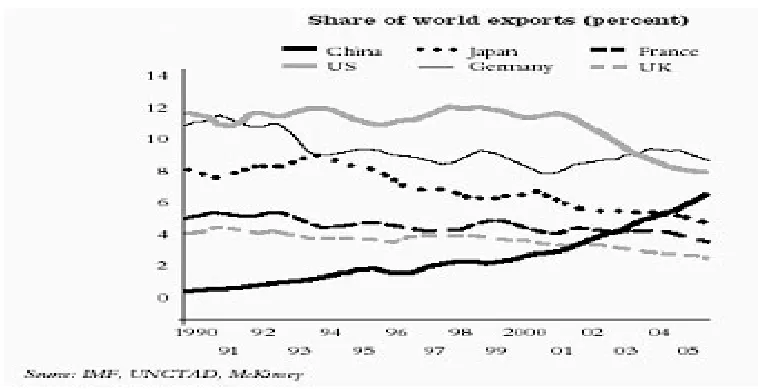
shows that the US share of world exports declined since 2000 but is still much higher than Japan.
Figure 2: Share of World Exports (percentage)
Source: also IMF.WEO data base, 2009.
The Plaza accord in 1985 was intended to make Japanese export’ more expensive in western markets and import cheaper. However, it was overlooked that Japan could also try to keep export prices down by importing raw materials at lower prices. Furthermore, the Ministry of Finance (MOF)(Note 3) along with Bank of Japan began raising the value of yen by simply increasing the money into circulation. The MOF advised banks to push vast amount of credits into an overheated economy, creating the greatest financial bubble in capitalism’s history in the late 1980s.
The rising value of yen is also blamed for Japan’s recession. It is said that an appreciated yen reduces the competitiveness of export goods in overseas markets, thereby decreases the overall exports. Jeffrey Sachs (2001) has examined the appreciation of yen since 1971, combined with Japanese trade surplus and the expectation leading towards further deflationary expectations, increases the demand for cash. He says “Japan is a structural net savings surplus economy, in which its aging population wants to save more than its companies can profitably invest in Japan. The result is structural current account surplus and a net supply of savings to the rest of the world” (Sachs, 2001:13). Sachs argues that under such circumstances the households increases their savings sensing the prolong crisis.
Only less than two decades ago Japanese economy was widely seen in the West as a success story. Its economic system was seen as unique and compatible with its state directed industrial policies, life time employment, low military spending etc. (Siddiqui, 1995a). While, on the other hand, the US and UK economic model, which was characterised as free market, labour flexible, shareholder’s driven and high military spending. Japanese products such as electronics, radios, TV, automobiles etc. became famous in overseas markets and even America’s top university has to acknowledge the high productivity achieved by Japan especially in semiconductor and auto industries (Note 4).
During the post-war boom period the manufacturing sector played a key role in the country’s economic development. The rapid increase of output and productivity in this sector provided a boost in the export markets. The Ministry of International Trade and Industry (MITI) established a successful strategy on industrial targeting in heavy industrial sectors such as petrochemicals, steel, machinery, cars etc. (Murphy, 2000). In Japan, most of the developmental policy between 1950 and 1980 was based on investment in heavy industries. These areas required large sunk costs and economies of scale, which acted effective barriers to entry. As a result a highly oligopolistic industrial structure was created known as Keiretsu like Mitsubishi, Mitsui, and Sumitomo. These large businesses exhibited a very hierarchical pattern through a subcontracting system with a small-medium sized enterprise. This amount to 80 % of the total labour force, but their contribution to overall productivity is quite low i.e. less than half of the larger firms. During the 1960-70, the wage increase was less than productivity growth. During the same period the government investment in public services like housing, welfare, nursing homes for old people etc. was minimal, while it invested heavily in infrastructure such as roads, training and R&D, which further boosted corporate profits (Tsuru, 1993).
The conditions of Japanese post war economic recovery came from not only the Japanese elite’s willingness to reignite the process of industrial accumulation, but also a very significant positive role played by US upsurge in military spending during the Cold war period. For example, the Korean War orders uplifted the whole industrial sector of the shattered Japanese economy (Forsberg, 2000). Furthermore a decade later Vietnam war helped Japan to receive further US favours both in terms of US market and US technologies with a post war strategic objective of “keeping Japan on our side”, not only Communism in Soviet Union and China bothered American but non-aligned and neutral India was too not helpful to US desire (Forsberg, 2000). Therefore, the development of oligopolistic groups Zaibatsus were overlooked by the US as Cold War was seen more important then. Michael Schaller (1985) summarised as: “The protracted effort to assure Japan access to South-east Asia and to isolate China trapped the United States in a ‘dead end alley’ to its own device in Vietnam(Note 5)”. Moreover, Japan’s relatively low military expenditure of about 1 % of the GDP did help its economy to invest more in new technology and infrastructure, compared to nearly 8-9 % of the United States (Forsberg, 2000).
initiating Japan’s dramatic growth between 1950 and early 1970s. And fourth section looks from the historical perspective and finally, fifth section examines the nature of structural crisis.
2. The Causes of Stagnation
I will examine critically various explanations given by a number of researchers regarding the causes of Japanese recession and these could be summarised as follows: the appreciation of the value of yen; a deflationary liquidity trap; interferences in the free market policies; the failure to clean up bankrupt companies and bad debts; and finally fall in international competitiveness. The first two explanations on causes of stagnating aggregate demand, while the rest points out towards the supply side factors.
Japanese post war development has been characterised by the persistent of trade surplus leading towards accumulation of foreign reserves. The accumulation of surpluses has inevitably induced a secular appreciation of yen and this meant erosion of Japan’s export competitiveness. Japan tried to counter this with the export of capital on a large scale as yen could buy more dollars. Japanese big businesses accelerated exports of capital to East Asia and China and began to rely to a lesser extent on Bank of Japan for funds. Then the banks started lending money to property and estate sectors and the stock market. During the 1987 the Bank of Japan lowered interest rates and the government followed an expansionary monetary policies. This excess liquidity had encouraged speculative activities in property. However, in 1990 the Bank of Japan raised interest rates from 3.8 % to 8.2 %, which triggered the financial bubble and stock prices collapsed by nearly 60 % from their peaks (Krugman, 1999; Koo, 2001).
Gao (2001) explains the Japanese economic recession due to the breakdown of Bretton Woods system of fixed exchange rate and regulated capital flows(Note 6). He concludes that the weak control and monitoring in Japan during the 1990s contributed to the rise of bubble economy. While others like Katz (1998) argues that financial bubbles and economic stagnation were mainly due to overregulation, inflexible, and less globally integrated economy(Note 7). In fact, between the 1980 and 1990 the “bubble economy” delayed the full onset of stagnation. The availability of easy credits escalated stock-share, land and housing prices, which in turn fuelled consumer demand and also boosted the investor’s confidence in property as a profitable area to invest. However, it all came to an end during the 1990s asset value fell sharply.
were seen new areas to invest. And also the low interest rates further increased the demand for credits by these groups, thus ultimately pushing prices of the housing, land, and stocks prices.
The liquidity crisis began with expansionary monetary policies initiated after 1985 Plaza accords, which further led to appreciation of yen in relation to dollars. The outflows of capital in the form of foreign direct investments (FDI) provided income in the form of repatriated profits and dividends, which was to be spent in domestic markets, but this did not happen. And Japan became a rentier nation. Koo (2001) blames the stagnation largely on private sector balance sheet problem. According to him, the post-bubble deflation of asset value has “left tens of millions of (firms and households) balance sheet all over the country underwater… to climb out of their negative equity position, households and companies were left with no choice but to refrain from consumption and investment” (Koo, 2001:2).
Paul Krugman (1999) blames lack of demand for the continuing stagnation in Japanese economy. He argues that “(Japan’s) huge productive capacity remains unused because consumers and businesses just don’t spend enough” (Krugman, 1999:2). Krugman points out the issues of what he terms ‘liquidity trap’. The low interest rates combined with declining birth rates and lack of immigration brings the prospects of lower expected returns on capital. All these have reduced investment demands, while crisis deepening forced households to save more for rainy days. Krugman suggests that it should supplement deficits spending with an aggressive monetary policy and the Bank of Japan should both pump money into markets to undermine deflation, which will bring some inflation (Krugman, 1999:2). Krugman has borrowed this concept what Keynes called liquidity trap, a situation in which interest rates has fallen to certain level when liquidity-preference may become crucial in the sense that households prefers cash to holding a debt which yields so low interest rates.
On 1990s stagnation some blame the focus on Japan’s massive overhang of bad bank loans. According to them, thanks credit rollovers provided by the banks helps bankrupt corporations to continue their operations and thus prevents banks from focusing and making finance available to the successful and dynamic businesses. It is argued that the banks made credit available to big businesses regardless of profitability and as a consequence huge amounts of bad debts were accumulated, estimated to be more than 1 trillion US dollars (Sanger, 1998). The banks continued to lend to insolvent companies who simply took new loans in order to pay old loans.
invest leading towards lower economic growth. These policies were officially recommended by international financial institutions as the viable option to achieve economic prosperity and could be summarised as: deregulation, privatisation, reliance on export markets (World Bank, 1993). Another commentator notes: “companies with low sales don’t cut jobs; they trim everyone’s pay …(Japan’s) labour market is incapable of rapidly shifting large numbers of workers from the disappearing jobs into new ones” (Katz, 1998:A21). According to Katz, labour inflexibility has created a supply-side problem of low productivity growth. Hence the solution put forward by the neo-liberal economists is that Japan must carry out economic reforms along free market policies. The state should not try to direct funds, protection to the domestic industries to be removed and the economy has to carry out the policies of deregulation and liberalisation (World Bank, 1993).
It seems that the government and business close cooperation did help the development of major industries, which was assisted by the Ministry of International Trade and Industry (MITI). Johnson (1982) argues that significant role played by the MITI to bring the post-war economic miracle (Note 8). This means that broad set of government policy which promoted the specific sectors. It is often said that in the post war the government policy supported industries like steel, automobiles, petrochemicals and electronics. These key industries benefited from import restraint, subsidies, anti-trust exemption etc. The Japanese state has initiated and promoted development and does not conform to the liberal Anglo-American tradition, the legitimate functions of governments are restricted to administration and policing and individual freely compete against others (Francks, 1992; Siddiqui, 1995b). However, other western government too have distorted the allocation of resources, which means the government initiated to divert resources towards some particular sectors. For instance, the US government has supported the production and export of high tech weapons – including government procurements, tax credits to NASA.
It is also being emphasised that high growth in the US in the mid-1990s was associated with greater risk taking, entrepreneurship and aggressive competition. For example, the Wall Street Journal editorial column had to say very critical words about Japan: “After having spanned a cottage industry of books of how Japan would “take over the world”, Japan now leads in few of the important industries in the late 20th century” (Wall Street Journal editorial column, 1997).
Japan’s post war growth was dependent on foreign markets, especially the United States. Largely due the increasing export demand, the export industries witnessed over all rising capital investment earlier in light industries but later on in heavy industries. Japan’s economic difficulties are also associated with the long term movement of capitalist economies and the pursuits of policies of globalisation in 1980s, which led to the shift in cycle of capital accumulation from production to financial sector and also greater reliance on market forces (Wade, 1990).
the 1980s. Moreover, they also aimed to produce at international competitive prices for overseas markets. As a result, Japanese producers have witnessed rising competition from the other East Asian countries. As Noguchi (2000) explains that the East Asian countries moving “into the fields of high technology and heavy industry….undercut the dynamism of Japan’s mass production industries, just when the information and communications revolution centred in the United States was undercutting the viability of Japan’s system from the opposite end of the technology spectrum. The result (was) a lost decade for Japan” (Noguchi (2000:1-2).
It is argued that the anti-monopoly law in Japan is quite weak and does nothing to impede the formation of cartels. Noland (1993) explains that without the government industrial policy Japan would have been net importer rather than exporter of automobiles, iron and steel, chemical products, electronics. Krugman (1987) studied Japan’s industrial policy especially towards steel industry. His study covers the periods of 1950 to 1971, when government provided subsidised credits and tax exemption to steel industries. However, their average combined rate of returns on its assets was well below the average of other industries such as manufacturing. Credits were allocated through bureaucratic criteria, rather than market driven.
During the last fifteen years the idea of a “New Economy” was put forward as to be transforming the US economy. This consists of those sectors which are closely associated with the revolution of information technologies including computers, software, fibre optics, internet etc. The “New Economy” idea was presented by Alan Greenspan, the US Federal Reserve Chairman, as to bring the structural changes: “it is the proliferation of information technology throughout the economy that makes the current period appear so different from preceding decades… One result of the more-rapid pace of IT innovation has been a visible acceleration of the process that noted economist Joseph Schumpeter many years ago termed ‘creative destructive’ – the continuous shift in which emerging technologies push out the old. … Computer modelling, for example, has dramatically reduced the time and cost required to design items ranging from motor vehicles to commercial airliners to skyscrapers” (http://www.federalreserve.gov/). The New Economy has also been associated with globalisation and non-unionised and flexible labour force. However, in the US this technological revolution finds more than three-quarters of its business demand in service sectors such as finance, health, retail sectors of the economy. And there is little evidence that the IT technology has induced long-term growth. For example, in US the annual average productivity growth increased from 1.42 % during the 1972 to 1995 to average 2.75 % between 1995 and 1999(Note 9).
lower capacity utilization and hence reduced labour productivity growth. This perspective relies on monetarism, which finds inflation, particularly wage related inflation, as the primary cause of economic crisis (Wall Street Journal, 1997; Landefeld et al, 2000; Murphy, 2000).
Some researchers have blamed Japanese recession primarily due to its businesses lagging behind with other major competitors such as US and EU. They blame the fall in international competitiveness and productivity as prime factor contributing towards recession in Japan. According to them, Japanese businesses were lagging behind in international competitiveness and productivity compare to other major rival economies such as US and EU especially since 1990s (Landefeld et al, 2000; Murphy, 2000). Competitiveness focuses on the degree of competitive advantage of a firm and the degree of competition in the industry. It is important to briefly examine here Porter’s model. Michael Porter’s corporate analysis (1990) discusses the competitive advantage of nations on the basis of four factors namely: 1) structure in the industry, 2) firm strategy, 3) factors conditions i.e. the environment in which the industry is located. And finally, 4) demand conditions i.e. the market conditions for the particular industry. However, there are a number of opinions about on the nature of competitiveness and the various structural factors affecting country’s economic performance. A Swiss based business school, namely International Institute for Management Development (IMD), examines data on international competitiveness of various countries, which presents as the basis for quantitative analysis of global competitiveness indexes.
The Institute for Management Development’s annual World Competitiveness Yearbook on competitive rankings are based on vast amount of primary data which consist of around 250 variables, which includes data on economic size, investment in new technology, financial market size etc. and opinions from corporate executives from the multinational corporations. For instance, its annual World Competitiveness Yearbook 2002 puts Japan’s competitiveness at 30th place out of 49 countries. Japan’s competitiveness has declined in compare to 26th position it had in 2001. In 2002, the country ranked 29th out of 49 countries regarding economic performance, which was listed 16th in 2001. In addition to that 1990s witnessed intensifying competition due to globalisation and the development in information technology (IT) old business models are becoming less attractive in fast changing environment (Kazuyuki, 2002).
The neoliberal economists uncritically accept capitalist relations, and this seems to be major weaknesses of such findings. However, our critical analysis suggests that all these perspective may have had some implications and contributed towards this on-going crisis, but crucial facts are that the country faces a crisis of capitalist maturity involving in widening income gap between the workers and the owners of capital and also wasteful utilisation of both natural and human resources. I will discuss these points in detail later on in this article.
3. Japanese Growth Miracle
many East Asian countries (Kosai, 1986). With the beginning of Korean War in 1950, the US purchase of goods for its soldier from Japan boosted its economy. During 1950 and 1973, the Japan’s GDP grew at 10 % per annum. The country witnessed rapid expansion of heavy industry such as chemical, iron and steel, ship building, automobiles etc. By early 1970s, Japans real GDP per capita in purchasing power parity terms stood at 59 % of the US level, compared with 17 % in 1950. In barely one generation Japan had closed much of its gap in output and incomes with the rest of the developed countries (Blomstrom et al, 2001:3). Moreover, Japan was also able to maintain very high rate of domestic savings rate i.e. 30 % of the GDP in the 1960s. High domestic savings along with favourable macroeconomic policies that kept inflation low.
After the Second World War Japan was nearly seven years under the US occupation army and its government became completely subordinate to the occupying force. During this period US drafted constitution, promoted worker unions, parliamentary democracy, dissolved Zaibatsu business conglomerate and initiated land reforms. The US saw the big landholders and zaibatsu responsible for turning the country towards military adventurism (Schaller, 1985).
Therefore, the United States supported land reform measures, which aimed besides undermining the power of big landholders, also to control land rents and land sales price to benefit tenant farmers. As a consequence, the cultivators-tenants were paying landlords only about one-sixth of the monetary value at producer prices of the corresponding shares of their crops (Flath, 2000: 73-74). Later on in 1946, government banned absentee landlordism and replaced strictly with resident cultivators residing in close proximity. The surplus lands were sold to tenant not on market prices but at much lower prices. In 1952 land law put severe restrictions on land ownership and land use. For example, under the new law, anyone household the combined ownership of agriculture land could not exceed the limit set by land reform law. Some called this measure outright confiscation of land. As a result, the share tenancy was drastically curtailed(Note 10). For example, in 1946 nearly half of the agricultural land was cultivated by tenants rather than by owners, but the situation changed dramatically and in 1955 only one-tenth of the agricultural land was cultivated by tenants (Redford, 1978).
Manufacturing industries also played an important role in the growth of Japanese economy. The manufacturing industries’ cumulative increase in output and productivity was benefited by the expanding overseas markets. The government control banks provided state officials full control over investment decisions. At the same time government put restrictions of domestic firms raising capital from foreign sources. Competition was effectively regulated through official guidance in which government encouraged the cross ownership shares between banks and Keiretsu (Johnson, 1982).
to achieve high growth, the government promoted and protected the interest of big corporations. He argues that the close cooperation between government and business of which leading architects was MITI, despite the disaster of War and occupation, the role of state survived in the post war period. As also Pempel and Muramatsu (1995) notes: “Economic development has been persistently pursued as a national goal by Japan’s business and political leaders since Meiji Restoration in 1668 and with renewed enthusiasm after the 2nd World War” (Pempel and Muramatsu,1995: 34).
The international political environment has also proved to be advantageous to Japanese corporate sector. During the Cold War, the United States prime concern was to encircle China as prop up authoritarian and semi-authoritarian regimes as strategic “bulwarks” in their struggle against the perceived threat of communism. Japan emerged as regional power to protect US interest. The United States lifted barriers to the transfer of technology to Japan.
The question arises what are the sources of Japanese miracle? The state role is crucial as to initiate the industrial transformation in “early stage” from import substitution to export-led-industrialisation. The industrial policy, as happened in Japan, was to select promising industries and sectors and then protecting, subsidising and making credits available to them. The MITI had undertaken the tasks to coordinate the industrial policies. In fact, state directed was not only adopted by Japan but also evidence from West European indicates that in early period of their industrialisation the state actively promoted and formulated policies to help the growth of domestic industries(Note 11). Chang (2002) finds that state intervention in the economy is not a peculiar that took place in Japan, but universal feature common at all successful economies at an early stage of their industrialisation including England and Unites States (Chang, 2002; Girdner and Siddiqui, 2008).
Robert Wade (1990) point out that high rate of trade performance was largely due to impact of state interventionist policies that brought radical change to favour domestic industries. However, Rodrik (1995) argues that Japan and other East Asian countries economies grew at higher rates were largely due to rapid capital accumulation and investment and that growth had little to do with industrial policy. However, such arguments fail to answer why some East Asian were able to successfully mobilise their resources including labour to launch a big push towards setting up modern industries while others were not able to able to carry out such policies.
techniques. He further says that availability of factors conditions such as human capital was important for the success of the country export industries.
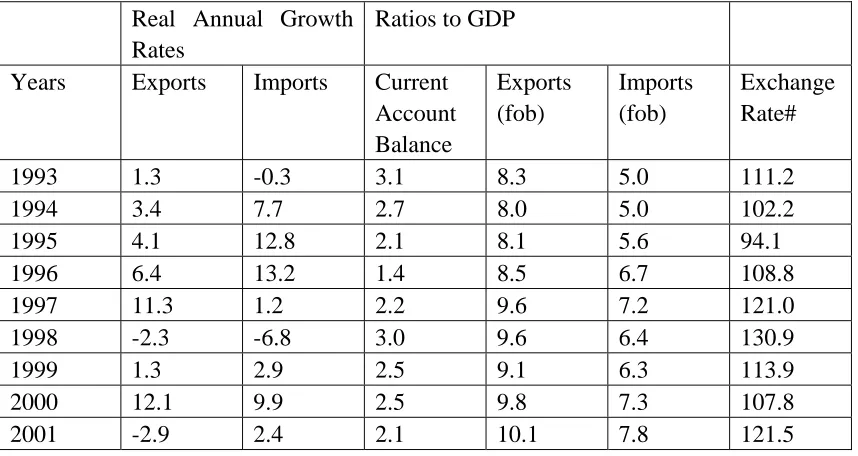
[image:14.595.67.496.343.571.2]I will critically examine the export-led-growth and find that the spectacular growth rates of Japanese economy were not achieved following laissez-faire policies. On the contrary the country maintained a policy of high levels of protection from 1950 to 1970, when the growth rates was highest. Table 2 shows export growth seems to have grown steadily except in 1998 and 2001, when it witnessed negative growths and those years also coincided with recessions. The increasing ratios of both exports and imports to GDP suggest that the economy during these periods became more reliant on trade (Burkett and Hart-Landsberg 2003:343). On the average over the last 15 years or so the increasing ratios of both exports and imports to GDP ratios clearly shows that its economy became more dependent on trade. Moreover, the GDP ratio/current account surplus seems to be influenced by exchange rate. The yen appreciation of 1992-95 corresponds to a reduction in the GDP ratio/the current account. And later on the weakening of the yen, the GDP ratio/the current account has improved as shown in Table 2.
Table 2: Japan’s Trade Indicators for various years
Real Annual Growth Rates
Ratios to GDP
Years Exports Imports Current Account Balance
Exports (fob)
Imports (fob)
Exchange Rate#
1993 1.3 -0.3 3.1 8.3 5.0 111.2
1994 3.4 7.7 2.7 8.0 5.0 102.2
1995 4.1 12.8 2.1 8.1 5.6 94.1
1996 6.4 13.2 1.4 8.5 6.7 108.8
1997 11.3 1.2 2.2 9.6 7.2 121.0
1998 -2.3 -6.8 3.0 9.6 6.4 130.9
1999 1.3 2.9 2.5 9.1 6.3 113.9
2000 12.1 9.9 2.5 9.8 7.3 107.8
2001 -2.9 2.4 2.1 10.1 7.8 121.5
Notes: # yen per US $, annual average Source: IMF staff country reports
Japan holds its export earnings in dollars, rather than in yen. Also Japanese companies have saved its export earnings in US banks, thereby making surplus available to finance the US deficits. It is also buying commercial paper and corporate bonds to help the firms raise funds. The country’s national debt has risen to 175% of GDP (Seager, 2009).
most attractive for the US customers. And most importantly, all Japanese East Asian trading countries also use the dollar as their primary external settlements and reserve currency. Japanese companies determined to expand their export markets, found dollar is critical to their global expansion and growth.
Figure 3: East Asia – Trends in Foreign Exchange Reserves
Source: also quoted in Ministry of Economy, Trade and Industry, White Paper on International Economy and Trade 2005 – overview, July 2005, p. 13
The features of Japanese growth model as compared to Anglo-Saxon was that an economic system valuing social cohesion and collective goals over individualistic pursuit of personal welfare. Francis Fukuyama (1995) in his book “Trust” argues in favour of such Japanese values by emphasising the role of “social capital” and “trust” in economic development. Furthermore, Fukuyama explains economic development in terms of culture. According to him, culture plays a crucial role i.e. “Trust”, which allows businesses to grow beyond family into large professionally managed organisations. According to him, the degree of Trust varies in different societies and nations. He divides nations in groupings like “high trust nations like US, Japan, UK, and Germany and low trust nations like Italy, Korea, Taiwan and China.
measures could be good at one period but does not necessarily so in another period. Moreover, the Chinese dramatic growth of the last nearly three decades also refutes Fukuyama’ thesis.
4. Historical Perspective
In 1853 the American warships forced Japan to open its markets for foreign countries after nearly two centuries of seclusion. It set chain of events that culminated in the 1868 Meiji Restoration, which also ended Tokugawa period. The Central Bank of Japan was opened in 1885 and government took the task to promote the development of modern industries under the slogan Kokusan shogyo (i.e. increase production and encourage industry). Some argues that Japan’s success at industrialisation before World War I essentially resulted not from any particular strategy adopted by her government or any particular characteristics of her pre-industrial economy or society, but rather from the lack of interest of the Western power in incorporating Japan, as a dependent economy (ITO, 1992). The appearance of foreign ships and the forced opening-up to trade without protection of import barriers certainly created immediate crisis then, however, the foreign interest in Japan compared to China and other Asian nations was limited. Moreover, foreign capital played little part in Japan’s economic development and foreign business managed very few incursions into the domestic economy.
Japan’s commitment to modernise its economy began with the Meiji Restoration of 1868 which represent a highly significant break with the past. The land tax was there major source of revenue and the Meiji government did not borrow a very significant proportion of revenue from foreign sources. The government set up clear goals to catch up with the West in terms of economic development. In order to achieve this, the state created institutions who were to supply increased number of educated and technical workforce towards the development of modern industry and building up infrastructure (Ito, 1992; Tsuru, 1993).
landowning classes. Meiji period witnessed various economic reforms undertaken to achieve the accomplishment of modern industrial and military capacities while maintaining country’s independence.
5. Mature Capitalism and Crisis
Japan has experienced maturity crisis, which appears to be aspects of both liquidity and over accumulation. The liquidity crisis is due to expansionary monetary policies, which was initiated to undermine the impact of Plaza accord. The over accumulation crisis was largely due to the policies of keiretsu, who dominate the demands of the economy. In the absence of domestic consumption, the above both factors together led to the long term recession in the economy.
The moving of surplus capital from productive to speculative activities are inherent features of capitalism. The mature capitalism has tendency to generate “excessive savings“, and economic stagnation during recession. The inequalities are widening between employers and employees. The number of workers paid on hourly wage rates has increased, means they will work harder due job insecurity and they could afford fewer goods. Rising inequality in the distribution of income between employers and employees has widened social, political and cultural inequalities. Thanks to this on going recession, employers have relatively more resources than workers. Rising inequality also threatens possible “recovery” that might actually begin. This is because generally employers save more and spend less of their incomes than employees do. The crisis ridden Japanese economy gets relative lower aggregate demand when income flows more to employers and less to workers. As government spends to “stimulate” the depressed economy, the corporate sector due to its policy cutting the wages to compete in global economy leave worker with less to spend, thus further reduces the aggregate demand.
Moreover, the worldwide increase in the rate of exploitation cuts the proportion of total output that workers can afford to buy as consumption goods. The economy is therefore dependent on investment if all the goods produced are to be sold, and the failure of capital to invest creates a potentially recessionary situation that may be hidden by financial and other bubbles. Such bubbles arise because profits are not invested productively and instead flow, via the financial system, from one speculative venture to another. Each venture seems for a time to offer above average profits—the stock exchange and property booms of the late 1980s, the dotcom boom of the late 1990s, the subprime mortgage boom of 2002-6. Although none of these are directly productive, they can, for a period, provide a boost to spending such as spending by those managing the speculation, the conspicuous consumption needed to attract speculative funds, and so on. That leads to a short term increase in real economic output
capitalism, higher wages undermines the share goes to profits and lower wages would mean shrinking of domestic consumers demand.
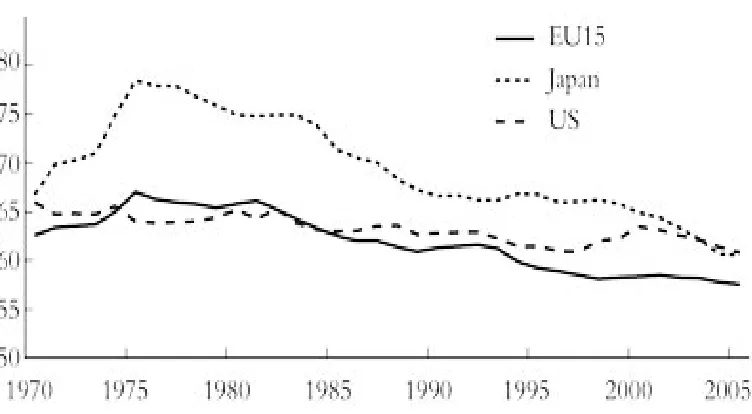
[image:18.595.74.450.346.553.2]Average wages in Japan (including bonuses and overtime pay) went down by 2.7 % between February 2008 and February 2009. Figure 4 indicates that the wage share in national income has steadily declined since 1970s in Japan. Household spending fell by 3.5 % in real terms over the same period. The departmental store overall sales plunged by 11.5 % within the same period. Although the wage share in the national income has declined in both US and EU countries since mid-1970s, however, this decline was much sharper in Japan compare to other developed countries as shown in Figure 4. I found this aspect of the Japanese development is largely neglected in the mainstream discussions. Since the imposition neo-liberal economic reforms in the developed countries the income of the working people have been cut down and benefits of the productivity growth was not equally shared between employees and employers. I find that seems to be major factor behind the lack of domestic demand and recession in Japanese economy.
Figure 4: Wage share of national income (%)
Source: Organisation for Economic Cooperation and Development (OECD), Paris; Also IMF data and statistics.
The stagnation continued despite large scale trade surpluses. The mainstream economist both Neoliberal and Keynesian with their uncritical approach to capitalist production relations seems to ignore the contradictions between production for profit and production for human needs. The deepening crisis is more clearly visible when the corporate sectors find difficulties in avenues to channel their surplus. However, since the late 1980s the growing role of financial sector in the economy with speculative activities has further worsened the problems of effective demands. The credit led boom aided by the financial sector also encouraged further investment in unproductive activities such as marketing, advertisement etc. Finally, it appears that mature capitalism has produced economic stagnation on the one hand and wasteful spending of the society productive resources on the other hand.
I have analysed the factors which had contributed towards severe economic recession in Japan and it seems to be an over accumulation crisis. It is largely due to the structural propensity to build productive capacity while experiencing decline in effective demand. In fact, the economic growth rate fell from average of 4.1 % per year in the 1980s to an average just 1 % in 1990s. Such a sharp decline in growth rates were termed as Japan’s “lost decade”. Moreover, the total amount of public debt is 151.2 % of the GDP in 2005, which is by far the highest among the major developed countries. This huge state debt is the result of neoliberal policies of tax rate reductions for the rich and also lower tax revenue due to long period of economic recession.
It has been forecasted that the Japanese population will be declining by 2010, with an increasingly large percentage of the population having retired from the employment. It means, the growth of labour will be affected as labour supply will decline, and economic growth has to be increasingly relied upon capital. However, the rising costs of capital will limit this, as currently Japanese industry faces massive over-capacity problems.
Japanese state had played an important role in creating positive environment for businesses and profitability. Following the Meiji Restoration in 1868, Japan made a fast transition onto path of modern industrialisation. During the last quarter of the 19th century Japan copied modern institutions from Western Europe and US such as in banking, judiciary, police, education etc and modified to suit local circumstances. These reforms resulted in rising growth economic between 1880 and 1940 by average 3.5 % annually. Over this period, the Japanese economy moved from being agriculture to light manufacturing industries such as textiles, light industrial goods etc. (Ito, 1992).
After the 1985 Plaza Accord with the US, the value of yen was appreciated and as consequence it raised the prices of Japanese products in overseas markets. However, Japan’s businesses found investing capital abroad more profitable due to appreciation of yen. It led to domestically the “scrapping of industries” in favour of off shore production(Note 15). The US dollar fell from 238 yen to 154 yen by June 1986. To stop further appreciation of the yen, the government followed monetary expansionary policies. Between 1985 and 87 the Bank of Japan cut down discount rate by half from 5 % to 2.5 % and also during this period the country also adopted to financial liberalisation policy under US pressure. As a consequence stock and land prices increased sharply, stimulated consumers demand and by the end of the 1980s Japan’s trade surplus with the developed countries was to a large extent minimised.
Therefore, Japanese businesses started relocating production units to East Asian countries. The rapid increase in Japanese outward investments since mid-1980s did provide new profit avenue to their corporations. The appreciated yen and an expansionary monetary policy contributed fast growth of Japanese outward FDI during 1980s and 1990s.
During my research regarding the major cause behind the recession in Japanese economy, I found the issue wage share growth in national income in quite crucial, effects the levels of aggregate demand in country. Only relying on export to boost growth as happened in post war Japan is not the long term solution. As I have discussed in previous section that the share of wages in national income declined sharply in Japan, which seems to be the major factors behind the crisis.
I found this aspect of the Japanese development is largely neglected in the neo-liberal discussions. Since the imposition neo-liberal economic reforms in the Japan the income of the working people has declined and benefits of the productivity growth was not equally shared between employees and employers. I find this to be major factor behind the lack of domestic demand and recession in Japanese economy.
The analysis provided by neo-liberal economists about the Japanese economic crisis is flawed because it does not question the capitalist mode of exploitation, where intensification of labour exploitation goes along with increased waste of resources on unproductive activities. The neoliberal economists overlook the contradictions between production for profit and production for human needs. The crisis is clearly visible when the corporate sectors experience difficulties in finding productive investment avenues to channel their surplus. However, since the late 1980s the growing role of financial sector in the economy with speculative activities has further worsened the problems of effective demands. The credit led boom aided by the financial sector also encouraged further investment in unproductive activities such as speculation, advertising etc.
Acknowledgement
I would like to thank Dr. Martin Carter, Dr. Malcolm Chapman and John Day for their useful suggestions and comments. I would also like to thank two anonymous referees for useful comments on earlier draft.
References
Blomstrom, M., Gangnes, B. and Croix, S.L. (Edi) (2001) Japan’s New Economy, New York: Oxford University Press.
Burkett, P. and Hart-Landsberg, M. (2003) “The Economic Crisis of Japan: mainstream perspectives and an alternative view”, Critical Asian Studies, Vol. 35, 3. pp.339-372
Chang, Ha-Joon (1998) “Korea: The Misunderstood Crisis”, World Development, Vol. 26, No. 8, August, pp. 1555-61
Chang, Ha-Joon (2002) Kicking Away the Ladder: Policies and Institutions fro Economic Development in Historical Perspective.
Chernow, R. (1997) “Grim Reckoning in Japan – and Beyond”, New York Times, 17th November: New York.
Dertouzos, M.L. et al (1989) Made in America, Cambridge MA: MIT Press
Fackler, Martin (2008) “In Japan, Financial Crisis is a Ripple”, The New York Times, 20th September: New York.
Flath, David (2000) The Japanese Economy, New York: Oxford University Press.
Forsberg, Aaron (2000) America and Japanese Miracle. The Cold War Context of Japan’s Post-war Economic Revival, Chapel Hill: University of North Carolina Press.
Francks, P. (1992) Japanese Economic Development, London: Routledge.
Fukuyama, Francis (1995) Trust: The Social Virtues and the Creation of Prosperity, London: Penguin.
Gao, Bai (2001) Japan’s Economic Dilemma: The Institutional Origins of Prosperity and Stagnation, Cambridge: Cambridge University Press
Giles, Chris (2009) “Hard times call for hard measures”, Financial Times, 2nd April, pp.6: London.
Gilpin, Robert (2000) The Challenges to Global Capitalism, New Jersey: Princeton University Press
Girdner, Eddie J. and Siddiqui, Kalim (2008) “Neoliberal Globalization, Poverty Creation and Environmental Degradation in Developing Countries”, International Journal of Environment and Development (IJED), January-June, Vol.5, No.1, pp. 1-27.
Gluck, C. and Graubard, S.R. (Eds.) (1992) Showa: The Japan of Hirohito, New York: W.W. Norton.
Glyn, Andrew (2005) “Imbalances of the Global Economy”, New Left Review, July-August, 34, pp.5-37.
Greenspan, Alan (2000) Federal Reserve Board website [Online] Available: http://www.federalreserve.gov/
Hobday, M. (1996) Innovation in South-East Asia: Lessons for Europe?”, Management Decision, 34/9, pp.71-81
International Monetary Fund (2009a) Data and Statistics: Washington D.C
International Monetary Fund (2009b) Global Crisis: The Asian Context, May 2009, IMF: Washington D.C.
Ito, T. (1992) The Japanese Economy, Cambridge, Mass: MIT Press.
Ito, T. (1996) “Japan and the Asian Economies: a miracle in transition”, Brookings Papers on Economic Activity, No.2:220.
Ito, Hiro and Yoshida, Yushi, (2004) “How does China compete with Japan in the US market?”, August, on European Trade Study Group website, [Online] Available: http://www.etsg.org/
Johnson, Chalmers (1982) MITI and the Japanese Miracle: The Growth of Industrial Policy 1925-1975, Stanford: Stanford University Press.
Johnson, Chalmers (1992) “The People who invented the Mechanical Nightingale”, p.74, in C. Gluck and S.R. Graubard (Eds) (1992) Showa: The Japan of Hirohito, New York: W.W. Norton.
Kaneda, H. (1978) “Structural Change and Policy Response in Japanese Agriculture after Land Reform” in Lawrence H. Redford (Edi) (1978) The Occupation of Japan- Economic Policy and Reform.
Katz, R. (1998) “A Crisis? Don’t tell the Japanese”, New York Times, 8th July: New York.
Kazuyuki, M. (2002) “Spotlight on Japan’s Competitiveness”, Journal of Japanese Trade and Industry, September/October, pp.34-37.
Koo, R.C. (2001) “The Japanese Economy in Balance Sheet Recession”, Business Economics, 36, No.2:1
Kosai, Yutaka (1986) The Era of High Speed Growth: Notes of Post War Japanese Economy, p.21.
Krugman, Paul (1987) “Targeted Industrial Policies: Theory and Evidence”, in Salvatore, D. (Edi) The New Protectionist Threat to World Welfare, Amsterdam: North-Holland.
Krugman, Paul (1994)”The Myth of Asian Miracle”, Foreign Affairs, Vol. 73, No.6, 62-78.
Krugman, Paul (1996) Pop Internationalism, MIT Press: Cambridge MA
Krugman, Paul (1999)”Japan Heads for Edge”, Financial Times, 20th June: 2, London.
Landefeld, J. S. and Fraumeni, B. M. (2000) Measuring the New Economy, Bureau of Economic Analysis Advisory Committee meeting, 5th January.
McCurry, Justin (2009) The Guardian, 26th February, pp.29: London.
Murphy, R.T. (2000) “Japan’s Economic Crisis”, New Left Review, January-February, pp. 25-52: London.
Nakamoto, M. (2009) “Japan tears up growth forecasts as it seeks backing for stimulus”, in Financial Times, 28th April, pp.1: London
Noguchi, Y. (2000) “An Information Technology Revolution to Revive in Japan,” Japan Echo, Vol. 27, No.1: 1-2.
Pempel, T.J. and Muramatsu, M. (1995)”The Japanese Bureaucracy and Economic Development: structuring a proactive civil service” in Hyung-Ki, Kim, Muramatsu, M., Pempel, T.J., and Yamamura, K. (Eds) The Japanese Civil Service and Economic Development: Catalyst of Change, New York: Oxford University Press.
Porter, Michael (1990) The Competitive Advantage of Nations, New York: Free Press.
Porter, Michael and Stern, S. (1999) “The New Challenges to America’s Prosperity”; Findings from the Innovative Index, Council on Competitiveness”, Washington D.C.
Redford, L.H. (Edi) (1978) The Occupation of Japan: Economic Policy and Reform.
Rodrik, D. (1995) “Getting Intervention Right: How South Korea and Taiwan Grew Rich”, Economic Policy, Vol. 10, No.20, pp.53-107
Sachs, Jeffrey (2001) “The Benefits of a Weaker Yen”, Financial Times, 18th April, p. 13: London.
Samuels, Richard (1994) Technological Transformation of Japan, Cornell University Press.
Sanger, D.E. (1998) “Japans’ bad debt is now estimated near $1 trillion”, New York Times, 30th July, A1.
Schaller, Michael (1985) The American Occupation of Japan, New York: Oxford University Press.
Seager, A. (2009) “Financial: Japan: $100billion stimulus to avoid return to Japan’s ‘lost decade”, The Guardian, 7th April, pp.21: London.
Siddiqui, Kalim (1995a) “Political Economy of Japan”, The Nation, 20th January.
Siddiqui, Kalim (1995b) “Role of the State in South-East Asia”, The Nation, 27th May.
Siddiqui, Kalim (1998) “The Export of Agricultural Commodities, Poverty and Ecological Crisis: A Case Study of Central American Countries”, Economic and Political Weekly, Sept. 26, 1998, No. 39, vol. xxxiii, pp. A128-A137, Mumbai.
Siddiqui, Kalim (2009a) “Globalisation and Developing Countries: Opportunities or Marginalisation?”, in Verma, S. B. et al (Eds.) Globalisation at the Cross Roads, New Delhi: Sarup & Sons Publishers, India, 2008, pp.46-71.
Siddiqui, Kalim (2009b) “The Political Economy of Growth in China and India”, Journal of Asian Public Policy (JAPP), March, Vol.1, No.2, pp.17-35.
Siddiqui, Kalim (2009c) “The Current Financial Crisis and its Impact on the Emerging Economies – China and India”, Research in Applied Economic, Vol.1, No.1, 2009.
Stiglitz, Joseph (2000) “What I have learned at the World Economic Crisis”, The New Republic, 17th April, pp. 56-60
Tsuru, Shigeto (1993) Japan’s Capitalism: Creative Defeat and Beyond, New York: Cambridge University Press.
The Economist (2009) “Japan – The incredible shrinking economy”, pp. 73-74: London
United Nations Conference on Trade and Development (1993) Trade and Development Report, New York: United Nations, UNCTAD
Wade, R. (1990) Governing the Market: Economic Theory and the Role of the Government in East Asian Industrialisation, Princeton: Princeton University Press.
Wall Street Journal (1997) Editorial Column, 22nd October.
World Bank (1993) The East Asian Miracle: Economic Growth and Public Policy, New York: Oxford University Press.
Yukio, N. (1996) “Macroeconomic policies and asset price inflation: a political economic analysis of the bubble economy”, in (Edi.) Yukio, N. and Yamamura, K. (1996) US-Japan Macroeconomic Relations and Interdependence in the 1980s, Seattle: University of Washington Press.
Notes
1. The term, “Keiretsu” is defined as groups of synergistic businesses that complement one another naturally and dutifully. In corporate culture, keiretsu refers to a uniquely Japanese form of corporate organization. A keiretsu is a grouping or family of affiliated companies that form a tight-knit alliance to work toward each other's mutual success. The keiretsu system is also based on an intimate partnership between government and businesses. It can best be understood as the intricate web of relationships that links banks, manufacturers, suppliers, and distributors with the Japanese government. [Online] Available: http://dictionary.bnet.com/definition/keiretsu.
2. Some view that the export-led growth was instrumental in technological transfer and assimilation by subcontracting, FDI, joint ventures and licensing etc. Hobday (1996) draws attention about the success of export-led strategies in promoting the development of modern industries.
3. The Japanese Ministry of Finance is too powerful over the country’s financial institutions, primarily due to licensing system that accords licenses.
4. See M.L. Dertouzos et al (1989) Made in America, Cambridge MA: MIT Press.
5. On this issue for detail see M. Schaller (1985) The American Occupation of Japan, New York: Oxford University Press.
bubble economy”, in (Edi.) N. Yukio and K. Yamamura (1996) US-Japan Macroeconomic Relations and Interdependence in the 1980s, Seattle: University of Washington Press.
7. The proponents of this view are based in United States, who idealise ‘neoliberal economic theory’, and on Japanese economic stagnation of the 1990s they blame overregulation, inflexible policies and government constraints on the market (for more detail see Katz, 1998).
8. It is said that in Japan the government supported specific sectors/industries by “facilitating changes of industrial structure to keep as many high-value-added jobs in Japan as possible”, see C. Johnson (1992:74) “The People who invented the Mechanical Nightingale”, in C. Gluck and S.R. Graubard (Eds.) (1992) Showa: The Japan of Hirohito, New York: W.W. Norton.
9. See analysis and estimation of the contribution of New Economy to economic growth made by J.S. Landefeld and B.M. Fraumeni (2000) Measuring the New Economy, Bureau of Economic Analysis Advisory Committee meeting, 5th January.
10. This point is discussed in detail by Yutaka Kosai (1986) The Era of High Speed Growth: Notes of Post War Japanese Economy, p.21. And also see H. Kaneda (1978) “Structural Change and Policy Response in Japanese Agriculture after Land Reform” in L. H. Redford (Edi.) (1978) The Occupation of Japan; Economic Policy and Reform.
11. For detail analysis on early British industrialisation policy, see Girdner and Siddiqui, 2008.
12. The emphasis on exports in general is interesting (for another example on export-led-growth in Central America, see Siddiqui, (1998), because in some other cases it voices scepticism that selective industrial policy was effective.
13. The World Bank study (1993) argues that by making easy access to credits, industrial licensing, and foreign exchanges and its impact on country’s export performance. The Japanese government was able to create an environment that helped to achieve exceptionally high growth rates during 1950-1990.
14. See the findings of R. Samuels (1994) who argues that national security concerns underlay Japan’s industrial policy formulations, not only in Meiji era, but also in the 20th century.