The London School of Economics and Political Science
Computational Consumption: Social Media and the
construction of Digital Consumers
Cristina Alaimo
Declaration
I certify that the thesis I have presented for examination for the PhD degree of the London School of Economics and Political Science is solely my own work other than where I have clearly indicated that it is the work of others (in which case the extent of any work carried out jointly by me and any other person is clearly identified in it).
The copyright of this thesis rests with the author. Quotation from it is permitted, provided that full acknowledgement is made. This thesis may not be reproduced without my prior written consent.
I warrant that this authorisation does not, to the best of my belief, infringe the rights of any third party.
I declare that my thesis consists of 85,609 words
(including footnotes but excluding bibliography and appendices).
Statement of use of third party for editorial help
Abstract
The abundance of social data and the constant development of new models of personalized suggestions are rewriting the way in which consumption is experienced. Not only are consumers now immersed in an information mediated context - decoupled from physical and socio-cultural constrains - but they also experience other consumers and themselves differently, embracing the prescriptions of a technological medium made by algorithmic suggestions and software instructions.
A single case study of a social shopping platform in its start up phase has served as the empirical object of this thesis. The company investigated represents a typical case in the field of data driven consumption. The case has been conducted following the company’s
infrastructure design and implementation for over a year. The analysis of the case has revealed the distinctive computational logic embedded in the platform system. The system uses the data produced by user selection as representation of consumer choice. On this account it structures social and individual consumption patterns and computes personalized suggestion.
Acknowledgements
Big thank you to all my friends for helping me maintain a quasi-normal life during this journey. Manuela deserves an individual thank you. Particular thanks go to Jamie, Flaminia, Licia, Clarissa and Davide. Your random acts of friendship have powered my writing engine. My parents, Cinzia e Giuseppe have all my love and gratitude for their constant encouragement and sustain. To my brother Mauro go special thanks for helping me take some distance from myself. Elisa thank to you too.
Luciano, I have been able to accomplish this work because of your loving presence, patience, and constant support. Thank you.
I am grateful to have been part of the ISI group at the Department of Management at LSE. I am thankful for their gracious support with the LSE Research Studenship and for the intellectual support I received during these years. Thank you to Antonio Cordella, Carsten Sørensen, Shirin Madon and to my second supervisor Chrisanthi Avgerou. I would like to thank also my colleagues and friends Maha Shaikh and Hono Honarvar and my wonderful comrades of the TIGAIR team José-Carlos Mariátegui, Aleksi Aaltonen, Niccolò Tempini, and Attila Márton for the sharing of ideas and beers. A special thank you goes to Heather Barry Kappes for providing me a space to further my intellectual adventure.
I am thankful to all the interviewees that have dedicated time to this project during its pilot phase. To the founders of the company I have investigated for over a year goes all my gratitude. Their affable openness made this study’s fieldwork not only possible but also interesting and engaging.
Table of Contents
Computational Consumption: Social Media and the construction of Digital
Consumers
... 1
Abstract
... 3
Acknowledgements
... 4
List of Abbreviations
... 7
List of Tables
... 8
List of Figures
... 8
1 Introduction
... 9
1.1 Research approach ...10
1.2 Research objectives ...12
1.3 Thesis outline...13
2 Social Media
... 18
Introduction ...18
2.1 A ‘user-centric’ perspective ...20
2.2 A critical perspective ...25
2.3 Social Media as technologies of the social ...28
2.4 Conclusion...31
3 Consumption
... 33
Introduction ...33
3.1 Consumption as a ‘modality of the social’ ...34
3.1.1 A brief history of individuality in fashion consumption ... 40
3.2 Managing meanings, measuring emotions ...45
3.2.1 Marketing: from classification to self-governing ... 46
3.2.2 Social Media marketing... 51
3.3 Conclusion...52
4 Theory
... 55
Introduction ...55
4.1 A semiotic approach ...56
4.2 Framing Social Media as media ...62
4.2.1 Databases of every day ... 63
4.2.2 A computed sociality ... 67
4.3 Conclusion...70
5 Analytical Framework
... 71
Introduction ...71
5.1 Social Media consumption: an analytical framework ...72
5.1.1 Search and Discovery ... 74
5.1.2 Selection ... 78
5.1.3 Experience... 81
5.2 Conclusion...84
6 Methodology
... 85
Introduction ...85
6.1 Epistemology: constructivism and semiosis ...86
6.1.1 Research questions ... 89
6.2 Research Design ...90
6.4 Social Shopping Platform: a single case study ...94
6.4.1 Studying a tech start-up ... 95
6.4.2 Data collection and internal validity ... 97
6.5 Corpus Construction ...99
6.5.1 Rules and Criteria... 101
6.5.2 Thematic coding ... 105
6.6 Conclusion... 107
7 Case Study Narrative
...109
Introduction ... 109
7.1 Social Shopping Platforms: an introduction. ... 109
7.2 Background of the founders ... 114
7.3 Innovative Visions: ‘The future of retailing’ ... 117
7.4 Social Shopping Technology: database, tokens and measures ... 119
7.4.1 Product object ... 123
7.4.2 Profiling People ... 125
7.4.3 Lists ... 128
7.4.4 Actions: Tagging, Searching, Clicking and Buying... 129
7.5 Commercial value ... 134
7.6 From recommendation to personalization ... 137
7.6.1 The Social Algorithm ... 139
7.7 Conclusion... 141
8 Analysis
...143
Introduction ... 143
8.1 The information infrastructure of social shopping as a system of signification ... 144
8.1.1 Premises: the social web ... 148
8.2 Grammatization of consumption ... 154
8.2.1 Tagging as a sign-function ... 158
8.2.2 The logic of relations: aggregation and database functionalities ... 160
8.2.3 Computation of personalized routes of shopping ... 166
8.3 Conclusion... 169
9 Discussion
...170
Introduction ... 170
9.1 The personalized architecture of computational consumption ... 171
9.1.1 Assisted Discovery ... 176
9.1.2 Selection ... 181
9.1.3 Experience... 186
9.2 Conclusion... 191
10 Conclusion
...192
Introduction ... 192
10.1 Infrastructures of the social ... 192
10.2 Computational Consumption ... 197
11 Appendix
...201
11.1 Pilot Study: Major themes emerged ... 201
11.1.1 Information abundance ... 201
11.1.2 Information processing: discovery / selection ... 201
11.1.3 Disruption of identities narratives / reconfiguration of experience ... 202
11.1.4 Pilot study: list of interviewees ... 203
11.2 Corpus Construction Masterlist ... 204
List of Abbreviations
I have tried to avoid using acronyms except where the argument would have otherwise become cumbersome. In that cases the acronym has become the primary denomination of the concept.
ACPF – Average Click Per Follow API – Application Programming Interface CEO – Chief Executive Officer
ICT – Information and Communication Technology IS – Information Systems
LSE – London School of Economics NDA – Non Disclosure Agreement ROI – Return On Investment SM – Social Media
SMEs – Small and Medium Enterprises SQL – Structured Query Language SSP – Social Shopping Platforms
List of Tables
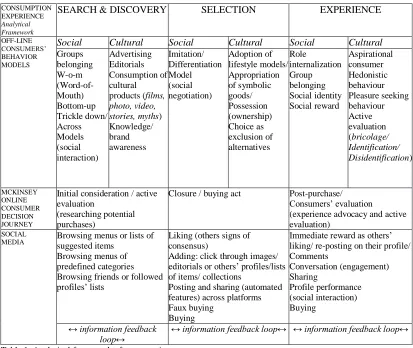
Table 1: Analytical framework of consumption. ... 73
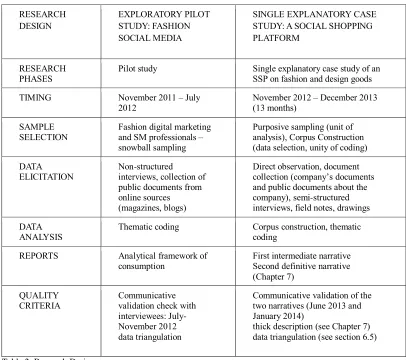
Table 2:Research Design ... 91
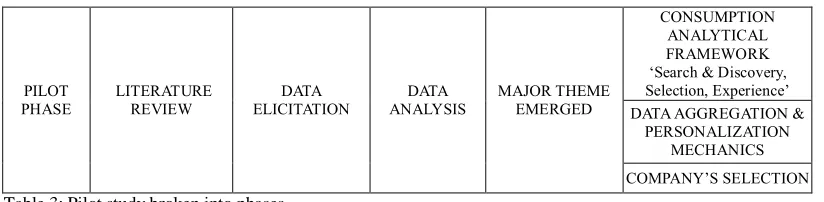
Table 3: Pilot study broken into phases. ... 94
Table 4: Case Study’s different sources of evidence. ... 97
Table 5: Case Study’s database headline. ... 98
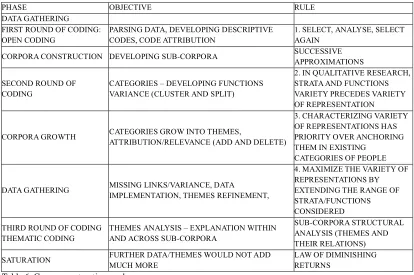
Table 6: Corpus construction roadmap. ... 102
Table 7: Extract of the cross-tabulation obtained from the first round of coding and sub-corpora attribution. ... 106
Table 8: The analyitical framework of consumption revisited. ... 174
List of Figures
Figure 1: Screenshot of a row of the products feeds on the platform homepage. ... 111Figure 2: Screenshot of the profiles’ headline and first row of products. ... 112
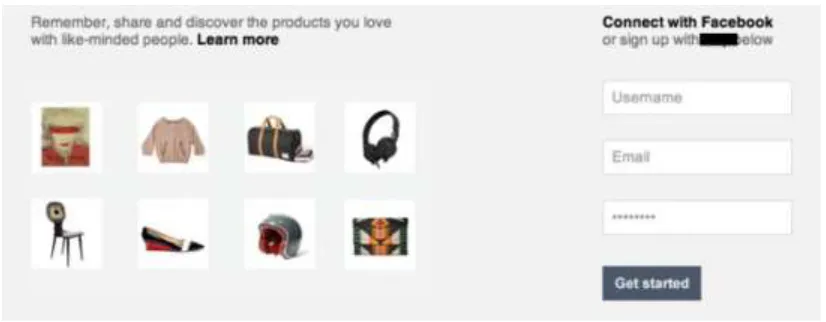
Figure 3: Screenshot of the log-in phase via Facebook. ... 112
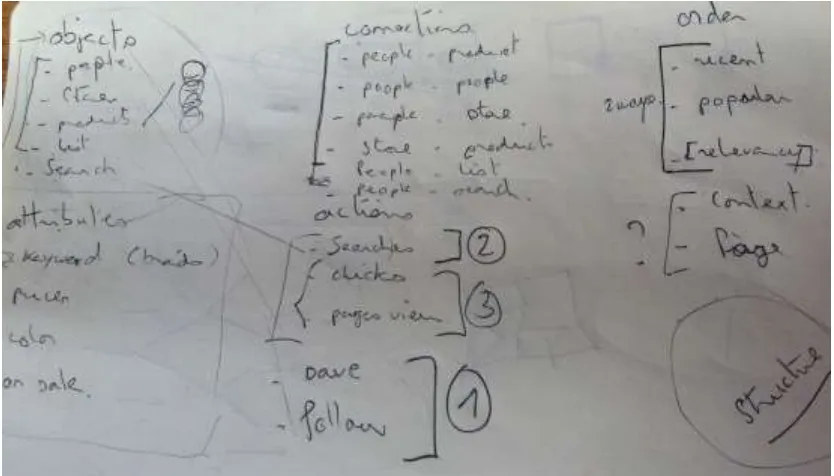
Figure 4: Sketch of the database’s structure made by one of the co-founders. ... 122
Figure 5: The database’s conceptual structure. ... 122
Figure 6: Sketch of the product table made by one of the co-founders. ... 123
Figure 7: Screenshot of the Company’s Facebook wall. ... 127
Figure 8: The actions programmed by the platform. ... 130
Figure 9: Chart illustrating the proportion between volume of data procured by explicit actions and the strengh of intent. ... 133
Figure 10: Screenshot of a store’s dashboard in the platform. It illusrtates the tracking of consumer’s activities broken down into actions. ... 134
Figure 11: SSP’s system as a signification system. ... 147
Figure 12: The actions programmed by the platform. ... 155
Figure 13: The database’s conceptual structure. ... 163
1 Introduction
The impact of information technology on our lives is hard to overlook. Almost every daily activity is now entwined in a complex web of applications, platforms, and devices. We use social media platforms and personalized suggestions to consume music, movies and television programs, to choose restaurants, to buy fashion goods, and to review hotels and reality shows (often in real time). In short, we understand and make sense of the world – at least of its consumption possibilities – through the use of technological devices. On social media (SM), software functionalities, data operations, and techniques of information ordering construct a new technological regime (Kallinikos, 2006) that mediates consumption goods, social activities and cultural processes in new and non-trivial ways. Increasingly, these methods and techniques propose a personalized version of the world, a world ‘tailored for you’ that is both descriptive and prescriptive (Ayres, 2008; Elmer, 2004; Pariser, 2011). Personalization of online content, as empowered by SM functionalities and operations, is set to solve a problem: it reduces the abundance of information available, providing criteria of relevance for individuals and groups and thus, possibilities for reasonable action. SM’s production of personalized information does not simply filter our access to social reality. Its technologically mediated social context also blurs the boundaries between social facts and algorithmic suggestions by encasing consumption process into a constant information feedback loop. Is social media and the personal world it creates just a fashion, a fad, or is it changing our references to the social reality of consumption? In my view, both options are worthy of investigation.
Bourdieu considered that the ‘trivia’ of life are the very stuff of sociological investigation. The mundane character of some phenomena often hides interesting possibilities to advance knowledge on social changes in selected domains. This is thus the ambition of this PhD thesis. By drawing on different scholarly traditions this study constructs a theoretical scaffolding to frame and understand SM’s technological impact on the ‘trivia’ of daily life that is then explored and refined through the empirical investigation of a SM start-up. The dissertation seeks to understand to what extent the logic of technological mediation embodied by SM intervenes and restructures the process by which individuals make sense of consumption possibilities and thus of their consumer selves.
through which individuals, inhabiting the social role of consumers, assemble their selves by using the symbolic marketplace resources at their disposal. With the gradual collapse of social superstructures, consumption has acquired a more prominent role as the mundane practice of asserting one’s own persona with respect to group belonging and social values at large. Who we are, becomes defined by how we appear to others, which in return grants us proof of our existence in the world as individuals. Fashion is the superficial (or apparent) exercise of this controlled freedom, its timing dictated by market and socio-cultural values. Fashion consumption is the domain of appearance par excellence. Common prejudices about fashion still tend to connote it as a superficial, if not a superfluous activity, despite the fact that some of the most influential sociologists have studied fashion as a battlefield where fundamental human issues come to be negotiated. Social change, the pursuit of individuality, and the conflict between individuals and collective norms and rules are just some of the most important. The choice to study consumption, and consumption of fashion in particular, is justified essentially because fashion emphasizes some of the fundamental quests of individuals pertaining to identity building in social settings.
Consumption's symbolic exchange, the articulation of one’s own identity with respect to others and to socio-cultural values, has now migrated online. SM mediates this symbolic space with personalized suggestions, data architecture and algorithm mechanics. The cultural battlefield of consumption is now disassembled into bits and pieces and represented under the logic of technological systems.
I believe that the implications of this shift towards a computational logic of representation are wide-ranging. Since an increasing part of consumption experience is lived through SM’s computational operations and personalized suggestions, I believe it is worth investigating how the computational logic of SM represents consumption and presupposes consumer versions.
1.1 Research approach
acting, and how and why those possibilities are different from previously established methods of consuming. SM and personalization not only suggest what should matter to consumers but they also presuppose models of cognitive and behavioral action. This research does not study online consumer behavior. It rather observes, analyzes and interprets how technology expects consumers to behave building these expectations into coherent technological systems. It is because SM expects individuals to perform as consumers in determined ways and not in others, I argue, that it embodies and consequently shapes the ‘appropriateness’ of being a consumer in the online world. This in turn might condition actual behaviors, and marketing and communication practices.
This research views technology as one of the main actors of sense-making activities for consumer. As with any other media (from written texts to television) SM represents reality in particular ways. SM mediates the ‘social’. All in all it does exactly what its label suggests. Its specificities rely in the fact that SM builds capacities and functionalities characteristic of technology to the representation of sociality and the standardization of its communicative forms. Because of the interest in how manifestations of the social might be technologically represented, one of the scholarly traditions this work relies upon is semiotics. By framing SM’s technological functionalities in semiotic terms this study investigates them as the new mediating infrastructures of the social. It integrates SM’s infrastructural properties with its representation capabilities. Information technology exhibits a peculiar logic of representation that is based upon data structuration and computation capabilities. If technology mediates the social it does so on the grounds of its own functioning logic, and this I believe is where important shifts can be observed. By selecting, storing, and framing data, SM intervenes in representing social life under a different logic. By studying the structural semiotic properties of the system this research exposes the logic underlying the technological mediation of social media consumption and how it might challenge the traditional socio-cultural process of consumption.
The approach taken is not common. Often SM and online consumption alike are studied by focusing on the interaction occurring at the interface level. Because of this, very little has been published with respect to the possible structuring effects of SM’s technology on social life and on ways of organizing it.
definition of this dissertation, it led to the design of the analytical framework of consumption (presented in chapter 5) and to the refinement of the research questions (chapter 6, section 6.2). On a more practical level it also led to the selection of the company chosen as a single explanatory case study. The second phase of the research strategy is a single case study conducted on a fashion-tech startup for over a year. The company is a data driven organization interested in innovating the retailing of fashion and design goods through social data computation. It implements a social shopping platform, which is essentially based on SM functionalities and on social data extracted from general social media (Facebook and Twitter) and from its own platform’s interaction. The possibility of studying a social shopping infrastructure, and its conceptualization and implementation, perfectly matched this research interests and expectations. The case study granted the possibility of analyzing the system’s logic and theorizing its role as a signification system, mediating – and thus changing - the socio-cultural dimension of consumption process.
Theorizing plays a fundamental and manifold role in this study. First, theory is extensively used to construct a robust theoretical reference to frame and analyze the gathered empirical evidence. Second, it informs the qualitative methodological design and the choice of corpus construction as a data selection and analysis tool (Bauer & Aarts, 2000). Deriving from linguistic and semiotic traditions, corpus construction has been chosen because it confers an overall coherence to the study, providing the connection between theoretical constructs, empirical data, and interpretations of findings. Third, the findings are interpreted and developed into theoretical contributions as they provide the hypothetical mechanisms able to conceptually explain how the system’s structure actualizes events as personal information.
The hypothetical mechanisms I am referring to are the system’s principles of ordering data and producing information (value): the SM’s logic of consumption representation.
1.2 Research objectives
implications of SM’s information production and dissemination. The study offers some important insights into the consequences of an increasing socialized web. Thereof it contributes to the nascent fields of social media studies. SM makes the web social and the social technical (van Dijck, 2013), the empirical findings of this study provide an explanation of how the logic of SM makes the socio-cultural mechanics of consumption technical.
In a recent newspaper article on Google and its rapid rise to power Shoshana Zuboff quotes Norbert Elias' extended essay “The Loneliness of the Dying”. Elias defines dying as a largely unformed situation – a blank space – that occurs when “earlier meanings and practices no longer apply, but new ones have yet to be created”1. I see the contribution this research offers to the sociology of consumption and social identity literature as a conceptual passage cutting through the still unformed space where old cultural roles are dead but new roles are still not consolidated. The mediating space that comes to be regulated by structural properties of data architecture and computational rules is a transformative space. The logic exhibited by the system's functioning impinges upon traditional representations of consumption, changing its logic, its method of accessing knowledge, and its social role. SM’s technology embeds presuppositions on consumers - ways of being consumers, and knowledge on consumers. On these yet to be consolidated technological presuppositions in turn, it is very likely that a new social role of consumers will emerge, conditioning actual consumer behaviors, marketing practices and communication strategies.
1.3 Thesis outline
This thesis is structured as follows. The present chapter introduces the reader to the motivation and scope of the research. It also provides a short outline of the theoretical approach of the dissertation and of its main contributions.
Chapter 2 reviews the literature on social media. The review is organized around the main themes of self-presentation and social participation. By comparing a ‘user-centric’ and a ‘network-centric’ approach the chapter singles out limitations in the current understanding of the SM phenomenon. The majority of the contributions reviewed under the ‘user-centric’ model do not go beyond the level of interaction SM technologies sustain. By contrast the ‘network-level’ approach frames SM as a site of power, it however does not adequately consider how SM gets also involved into the social and psychic life of its users. A third
1 Zuboff, S. Dark Google, Feuilleton, Frankfurter Allgemeine, 30/04/2014 see:
http://www.faz.net/aktuell/feuilleton/debatten/the-digital-debate/shoshanna-zuboff-dark-google-12916679.html
strand of literature, focused on ‘SM as technology of the social’, represents a middle-range approach. It proposes an integration of specific SM technological functionalities with facets of social life. The contributions in this section are reviewed critically to assess how SM functionalities impact on modalities of the social, opening a fruitful path for our investigation.
Chapter 3 reviews the literature on consumption. The chapter defines consumption as a socio-cultural process and singles out social and symbolic mechanics of consumption exchange. The literature traces the contours of the knowledge space of consumption, a cultural battlefield where agencies of meaning and cultural codes regulate consumer quests of identity. The review serves to open consumption’s knowledge space to the analysis. If SM conditions major changes in consumption, it is very likely that it does so by changing the language and logic of exchange (how value is produced) and, consequently, the role of the agencies of meaning involved. A second section is dedicated to the concept of individuality constructed by the fashion system. It shows how consumption logic gradually migrated into the symbolic dimension of consumer self-articulation. A final section provides examples of how this self-regulation has been managed by marketing. The section critically examines how marketers have fostered a culture of personal involvement of consumers in consumption processes and discusses recent marketing approaches against the common understanding of SM. The brief discussion endorses the need for an alternative approach to SM. If one wants to understand the novelty of SM mediation of consumption, one should ask how the very logic of consumption might be conditioned by technological representation.
and framing data. The chapter considers some of the most interesting characteristic of SM’s databases. A final section questions the process of formalization that SM’s databases require in order to function. SM’s databases do not store facts but representations of facts. In the technological operations SM carries out, social data – the byproduct of SM's social interaction – stands for the social participation SM programs. SM produces personalized information on the basis of a computed sociality. Following Kallinikos’s computational rendition of reality (Kallinikos, 2009) I argue that the current development of SM’s participatory activities calls for a theoretical reconsideration of the relationship between social interaction, computational mediation, and the resulting new forms of social consumption.
Building on the theoretical scaffolding of the previous chapter and on the results of the pilot study undertaken, Chapter 5 proposes an analytical framework, which is used to analyze the consumption experience SM presupposes. The need for a conceptual framework arises from the gap identified in reviewing the literature on SM. Little has been published on the manner in which SM functionalities might condition the experience of consumption. Therefore the framework decomposes consumption in three moments: ‘search and discovery, selection, and experience’, and compares established socio-cultural mechanisms with novel online functionalities. The three moments of consumption seem to undergo a technological mediation that suggests reconsidering how consumption might be represented and acted online. Online socio-cultural contexts and norms become undergirded by the presence of a computed sociality and the constant feedback loop which personal information initiates.
Chapter 6 illustrates the research's epistemological foundations, research object, and the methodology used. The empirical investigation is theory driven: it not only relies on a strong theoretical scaffolding but it also aims at contributing theoretically to the understanding the SM mediation of social life. The chapter discusses what to expect from a research project interested in the reality of signs. The first section delves into the epistemological foundation of the dissertation. The epistemology lays down the foundations of the research strategy that is designed to allow relevant themes and their interaction to emerge from the empirical case. It is by observing the structuring properties of empirical evidence that the analysis infers the ‘hypothetical mechanisms’ able to explain the phenomenon under study. By which I mean
fashion and design goods by using social data and SM’s functionalities. The company
founded a social shopping platform (SSP) that has provided the context for the study undertaken. The chapter describes the tools used for data gathering, selection, and analysis. It delves into the description of the corpus construction technique, a methodological tool that allows a continuous feedback between theory, empirical data, and emerging themes. As Barthes says, it makes ‘structure’ immanent by way of grouping unknown elements under a
known category (Barthes, 1967). It means that corpus construction functions as a structure, thus by grouping scattered elements under known categories, it makes data interrelation visible. In so doing, the structural interplay of data similarities and differences favours the emergence of themes relevance. Ultimately it allows one to theorize those ‘hypothetical mechanisms’ able to explain the phenomenon studied.
Chapter 7 is the case study narrative. It describes the company’s aims, history, and visions. The chapter is a detailed account of a data driven organization. By relying on thick description it constructs a flowing narrative of the company’s main business operations and the platform’s system functionalities. In particular the section dedicated to the system’s infrastructure describes the object of the present dissertation that subsequent chapters will analyze and discuss as a system of signification.
Chapter 8 proposes an analytical interpretation of the system's infrastructure as a signification system. Its main aim is to lay bare the logic by which the system produces personal information as meaningful events. Structural semiotics is used to read how the logic of sorting, storing and selecting data decomposes the socio-cultural process of consumption under digital rules. The main argument outlined in this and the following chapter is that the infrastructure of social shopping as system of signification creates the technological conditions whereby relations between the social and the personal are refigured. SSP operations differ from traditional commercial spaces in radically reframing the social process of consumption. By reordering product data, social data, and personal data under its own rules, the system disassembles social consumption into data language and reproduces consumers as data assembled from socialized product data. The technological criteria of information ordering are the basis of my argument. By unraveling the logic of data language, its structure and relations I explain how personal information is produced.
of the three moments of consumption is now structured by the computational logic of the system. The logic of computation mediates the access to the knowledge space inhabited by symbols and meanings, changing the conditions by which consumption might be experienced and consumer roles might be inhabited. Whereas chapter 8 exposes the system's logic, anchoring the analysis to structural semiotic principles, this chapter discusses consumption experience and consumer roles by referring to the pragmatics of signification, what is defined as “the entire presuppositions entitled by the message” (Eco, 1979). ‘Assisted discovery, selection and experience’ are presupposed under the technological regimes of indexing, aggregation and computation. I discuss how the shift in the logic of consumption representation might condition marketing practices and consumer self-articulation. Computational consumption, by attenuating the links between meaning agencies (the social and the personal), is already producing specialized mythologies, new practices, and a new (albeit still not consolidated) role for consumers.
2 Social Media
Introduction
This chapter reviews the Social Media (SM) literature. Given the complexity of the relatively new phenomenon and its still fragmented scholarly production, the review is organized around the core themes of self-presentation and social participation. Such organization responds primarily to the interests of the present dissertation. In fact, the experiences of social- and self-representation, as we will see in subsequent chapters, are fundamental for the understanding of possible changes in the experience of consumption. Furthermore, the thematic arrangement adopted allows the review to expose critical points in different scientific contributions and to expose the gaps in the SM literature.
In 2014, Facebook, the major social media platform, turned ten years-old. The corporation has reached 1.23 billion web users and 1 billion mobile users a month2. Recent Facebook’s acquisitions include Instagram, one of the leading photo-sharing platforms (200 million active users3), for $1 billion, and WhatsApp – a mobile messaging service – for $19 billion (465 million active users). In March 2014, while this review was still in progress, Facebook bought Oculus Rift virtual-technology. Mark Zuckerberg – Facebook founder and CEO - considers virtual reality technology, like the Oculus Rift headset, as devices which let users experience the impossible. He writes on his Facebook page that immersive gaming “will be
just the start”, and any other experience - educational, social, or cultural - will be
transformed so as to give users the “real presence”. Zuckerberg states: “By feeling truly present, you can share unbounded spaces and experiences with the people in your life.
Imagine sharing not just moments with your friends online, but entire experiences and adventures”4 (Emphasis added).
The mediation of social life is what these platforms aim at achieving. Social Media involves the social and psychic life of its users (Lovink & Rasch, 2013), encompassing macro social communication changes and the business of advertising and marketing. Although a considerable amount of literature has been recently dedicated to SM, the published research still makes the contours of a coherent picture problematic to attain. Many studies in the field of SM, for example, only focus on the behavioral consequences of SM use. So far, however,
2 See: http://www.ubergizmo.com/2014/03/facebook-announces-1-billion-monthly-active-mobile-users/ (Last
Accessed 14/4/14)
3See: http://www.cnet.com/uk/news/instagram-passes-200m-active-users/ (Last Accessed 14/4/14)
there has been little discussion about the role of SM technology in influencing such behaviors. Yet, SM technological infrastructure and functioning appear to be central in today's socio-communicative discourses. SM can condition processes and practices of organizing and experiencing communication in different areas of socio-cultural life. Users, media institutions, and infrastructures have been indissolubly related to each other and to macro social changes (Couldry, 2012; Kittler, 2013; van Dijck, 2013). In this respect however SM seems to mark a change. By operating in a constant anticipation of possible future scenarios, the rapid growth of SM leaves outside large part of society, and it seems to impose its own pace to entire economic and social sectors such as consumption, marketing, advertising, communication and broadcasting industries.
It comes as no surprise therefore, that scholarly accounts of SM struggle to keep the pace with the developments with which social media is associated. This research project is concerned with SM’s influence on the way in which consumption is organized as an experience. One of the hypotheses that underlies this project is that SM remediates social experience by proposing yet a new model of ‘ideal user’. Therefore this research investigation also concerns how SM might partake in delineating and ultimately shaping a new type of consumer-user. Although extensive research has been carried out on SM’s experience, no single study exists which investigates the relationship between SM and its mediation of consumption experience. In what follow I thus synthetize and frame related SM research so as to serve the gradual development of this project's main ideas.
This chapter is divided into two main sections. The first section subsumes a range of different approaches from different disciplines and theoretical backgrounds under a ‘user-centric’ perspective. Central to the entire paradigm is the concept of user identity and social
interaction from the user’s point of view. Under this proposition SM is generally considered as a neutral platform aiding human interaction, self-performance and new communicative practices. The second section summarizes the contributions that adopt a critical perspective of SM. Drawing from political economy approaches, media and software studies, these works aim at unpacking SM as a site of power struggle. Under this paradigm social participation and user self-performances are induced to harvest user data production and to foster commercial purposes of SMs. SM platforms are viewed principally as for-profit businesses, centered on user data collection. As Scholz argues:
By contrasting the two views, this chapter seeks to delineate a conceptually rich portrait of SM. The two sections contrast micro approaches to interaction against macro structural properties that SM exhibits. It is however clear that “[d]ismissing social media as neutral
platforms with no power is as implausible as considering social media the bad boys of capitalism” (Lovink & Rasch, 2013, p. 11). The majority of contributions fail to resolve the contradiction between users' ‘empowerment’ and ‘exploitation’. Section 2.3 reports studies
that analyze how SM produces new forms of social communication starting from SM technological and infrastructural properties. The section thus aims at highlighting a possible ‘middle-ground’ approach to SM, represented by the growing number of publications that
critically engage with the technological production of social life. A final section summarizes the main themes which have emerged and paves the way for the subsequent investigation.
2.1 A ‘user-centric’ perspective
Under the ‘user-centric’ approach, the majority of scholarly production on SM centers
around the notion of self-performance, social connection and user-generated-content as empowering user voice and social participation. The phenomenon of SM is commonly framed as the possibility to connect with others and to enact an online version of the ‘self’.
This branch of literature on SM views it mostly as sites where users are empowered with a new ‘networking’ practice, and are consequently engaged with different possibilities of
self-performance. Under this paradigm, which often refers to SM as Social Networking Sites (SNS), the attention is focused on the new ‘virtual’ social and personal space designed by the possibilities of interaction SM sustains. In a seminal contribution, danah boyd and Nicole Ellison defined Social Media as “web-based services that allow individuals to (1)
construct a public or semi-public profile within a bounded system, (2) articulate a list of
other users with whom they share a connection, and (3) view and traverse their list of connections and those made by others within the system” (boyd & Ellison, 2008, p. 2, Emphasis added). This definition – widely adopted in subsequent studies – has the effectiveness to stress two of the major changes brought about by SM: the construction of a profile as self-presentation, and the ‘active engagement’ of users in articulating their social networks.
Drawing from previous contributions and from early analysis of Internet-induced behavior, the ‘user-centric’ literature on SM predominantly explores its networking capability and
(Schlenker, 1980), self-presentation (Goffman, 1956), and friendship performance (Stone, 1991; Waskul & Douglass, 1997). Marwick (2005, quoted in boyd & Ellison, 2008) finds that users have complex strategies for negotiating the rigidity of a prescribed profile, and are negotiating an authentic self. Meanwhile boyd argues that: “profiles could never be real” (boyd and Ellison 2008, p. 218). SM profiles become the online identity through which users access and experience the Internet and perform themselves. Online users can claim to be whoever they wish (Pearson, 2009). Online identities as profiles are unique pages where one can “type oneself into being” (Sundén, 2003, p. 3). “Now, the general public plays virtual dress-up every day, privately but zealously developing a virtual personality” (Heaton & McLellan, 2008, p. 6). Various studies attempt to correlate the possibility of modulating a selective presentation (and consequent representation) of oneself to a self-esteem increase (Ellison, Steinfield, & Lampe, 2007; Gonzales & Hancock, 2011; Mehdizadeh, 2010). They suggest that the absence of real life contexts facilitates the ‘filtering-in’ of positive notions about one-self and consequent ‘filtering-out’ of negatives. Drawing from different methodologies, several contributions seek to explore the relationship between the online perceived freedom and strategies of self-presentation. Although the conclusions emerging from this stream of studies are hardly unequivocal, they provide a rich terrain for questions and future analysis. Some authors argue that SM facilitates the articulation of a ‘possible self’, others insist on the occurrence of a ‘true self’ (Bargh, McKenna, & Fitzsimons, 2002), others delineate a ‘hoped-for possible self’ (Zwier, Araujo, Boukes, & Willemsen, 2011),
and finally others speculate on the possibility that Facebook activates the ‘ideal self’ (Gonzales & Hancock, 2011).
In contrast to a positive view of SM as ‘liberating’ self-expression, Langlois suggests that SM might favor the construction of a ‘false self’, which arises when external pressures need to be met (Langlois, 2013b). Indeed SM somehow breaks with ‘real life’ context-based
modalities of self-presentation. All the various notions of possible, ideal, hoped-for, false, or true self mark a difference with offline modes. In general, the literature reveals the difference between offline and online ‘mode of sociality’, but without explaining SM
mediating properties that might condition differences to arise (Bargh et al., 2002; McKenna, Green, & Gleason, 2002). In contrast with a general understanding of ‘online freedom’ Davis finds that online identity articulation is constrained by different ‘spheres of obligation’
“[m]ultiplicity is not viable if it means shifting among personalities that cannot communicate” (Turkle, 1995, p. 258). She remarked how the perceived freedom might have
negative consequences in articulating an increasingly fragmented self. How does SM technology afford this articulation of multiple selves? Self-presentation, social connection and sharing are all intertwined to a deep search of meaning and recognition (Turkle, 2011). Langlois affirms that “the constant linking that happens through social media gives very
little space to pauses, constructive breakdowns, and the creation of new ways of seeking reassurance from the world” (Langlois, 2013b, p. 57).
A real time virtual sociality often overlaps with a physical world that becomes just one of the possibilities for experiencing social connections and presenting one self. Gergen describes us as struggling with the “challenge of absent presence” (Gergen, 2002, p. 227),
arguing that we prefer to engage with online contacts despite the ‘real life’ proximities of partners. Baym argues that the disconnection between physical presence and communication, if offering us more control, also subjects us to new forms of control (Baym, 2010). Part of the ‘user-centric’ literature, drawing from the ‘dramaturgical’ framework postulated by Goffman (1956), has sought to individuate major changes in self and social presentation strategies. However as Jurgenson and Ray rightfully remark, Goffman effectively stressed the power of ‘social prescription’ and how it conditions self-presentation. Meanwhile SM literature seems rather focused on remarking on the creation capabilities users are endowed with, overlooking the fact that users are more often than not just selecting between few options (Jurgenson & Rey, 2013). Rather, on SM different conditioning factors close the choices users are confronted with into a set of social and technological determined frames. Although the majority of ‘social interaction’ literature
sketches a fertile view of socio-individual behavioral effects, it does not seem to provide detailed accounts on how SM technological infrastructural principles, as well as its technological specificities, might trigger these effects.
“Facebook helps you connect and share with the people in your life”5
, this simple slogan exemplifies the foundational principles of SM self-articulation: the connection with people in your life is maintained and constantly reinforced by sharing. Different kinds of media (video, images, texts, and sounds) are used to articulate profiles within the socially-mediated space. The change thus pertains not only to the private-public former division of communication. It also concerns the convergence of different modes of communication and the merging of former mass, interpersonal and peers' communication channels. As boyd and Baym observe, the change in communication more generally involves what ‘public’ means and how it differs from ‘audience’6. In this sense users should be seen as performers and
audiences at the same time. SM is a disembodied mediated and controlled space where display of performances occurs (boyd, 2010): “online both audience and performer are disembodied and electronically re-embodied through signs they chose to represent themselves” (Pearson, 2009, p. 5). According to Ellison et al. online acts of storytelling are
always ambiguous and also dependent on technical affordances, which constrain self-presentational choices (Ellison, Hancock, & Toma, 2012; Marwick & Ellison, 2012). However the analysis of ‘signs of representation’ and technical affordances are often
overlooked. The attention is rather focused on self-presentation practices that, in the above quoted study for example, are framed as ‘promises’ made to an ‘imagined audience’ (Ellison
et al., 2012, p. 56). Notably, the work concludes that the sense of identity online becomes flexible albeit not ‘fundamentally different’ from real life situations. Whereas the very
notion of an imagined audience (Baym & boyd, 2012; Marwick & boyd, 2011) seems to undergo a considerable change online. The imagined audience is understood as: “the mental conceptualization of the people with whom we are communicating, our audience” (Litt, 2012, p. 331). With SM the mental conceptualization of audiences are not anymore bounded to social clues. Social contexts collapse, and consequentially “navigating collapsed contexts
requires a wide variety of strategies. While some people seek to engage in strategic facework and minimize visibility, others seek to publicize themselves in ways that may complicate their relationship to different members of their audience” (Baym & boyd, 2012, p. 324).
As various contributions have demonstrated, the majority of users do not seem to engage in active participation. On the contrary they are predominantly ‘lurkers’, or passive spectators (Baym, 2010; Bechmann & Lomborg, 2012). How does the diffused notion of active self-presentation explain the majority of user behavior? Still, the majority of studies focus on the active involvement of users. The ‘new visibility’ of social and personal connections, the new
5It is the slogan displayed on Facebook homepage. See http://www.facebook.com (Last Accessed 14/4/14) 6They start their reflection from an interesting article appeared on the Huffington Post, titled ‘The people
‘semi-public’ domains of social life, and the influence on self and social identity construction are considered as the main areas changed by SM. Understanding users’
interaction and the effects it has on self- and social-perception is surely relevant but, if it does not connect to SM's structural social and technical properties, it fails to acknowledge the main challenge that SM posits to the ‘social’ and the ‘personal’ sphere. As Jurgenson
and Rey allege, the common story is that SM's new public visibility comes at the expenses of privacy, however: “privacy and publicity are deeply intertwined, mutually reinforcing, and perhaps both increasing as digital information grows more ubiquitous” (Jurgenson & Rey, 2013, p. 62). Social interaction, self-presentation and visibility are conditioned by SM functioning. What we see and how we are seen on Facebook is empowered by data work, data architecture and algorithm functioning. In turn, the more we perform, the more Facebook tunes its own functioning on the data we make available with our usage. How can we measure SM's influence on self-perception without considering how SM constructs the possibilities of interaction with one's self-presentation and others’ presentation in the first place?
Facebook is known for flattening different typologies of social connections in an all-encompassing notion of ‘friendship’. On SM the interplay between different factors such as
social norms and categories, and personal motivation emphasize user interaction with audiences that, lacking social contexts and clues, are mostly imagined. Interestingly, what emerges from the studies reviewed, is that one of the most widely adopted strategies to ‘confirm’ the effectiveness of one's own network articulation is the ‘number of friends’
gathered (Kim & Lee, 2011; Lee, Moore, Park, & Park, 2012; Wilcox & Stephen, 2013). It is Facebook’s friend number, which confers the ‘social status’ of a well-connected
individual conditioning self-performance. As van Djick suggests, in the offline world, the effectiveness of communication was ensured by the quality of connections, thus by the quality of responsiveness of one's own network (van Dijck, 2013). Today’s SM world instead pushes categories such as ‘friends’ or ‘followers’ to be assessed only by their size
(Vallor, 2012).
“From the technological inscription of online sociality we derive that connectivity is a quantifiable value, also known as the popularity principle: the more contacts you have and make, the more valuable you become, because more people think you are popular and hence want to connect with you” (van Dijck, 2013, p. 13).
Friendship online becomes quantifiable, declared, formalized and made public. It becomes a performative act, which responds to specific indications: “if one declares someone to be one’s friend, one in a certain sense makes him or her a friend, and forces her or him to be
Consistent with the observed ambiguity of ‘friending’, Langlois infers that such conceptual
destabilization demonstrates the importance of software-based processes in the unfolding of everyday practices (Langlois, 2013a). The issues van Dijck, Stiegler, and Langlois raise expose what can be arguably considered as the missing link between technology and social categories, which a ‘user-centric’ analysis often fails to acknowledge. I believe that this
space is exactly where a possible fruitful explanation of SM influence on social life can be performed and consumption understood at a deeper level. However to connect SM properties to possible social changes, another passageway is needed. Next I review a different stream of literature that problematizes the notion of sociality conveyed by SM's rhetoric of participation.
2.2 A critical perspective
As Kennedy remarks, SM platforms are also cultural intermediaries. SM is a site of power that participates actively in the construction of subjects through – for instance – the rhetoric of participation, sharing and socialization. “Good subjects post, update, like, tweet, retweet, and most importantly, share” (Kennedy, 2013, p. 130).
Effectively, the formation of online communities is actively facilitated by exploiting discourses on participation and the representation of groups’ characteristics such as commonalities of interests, values or opinions. SM platforms are a: “group of Internet based applications built on the ideological and technological foundation of web 2.0, that allow the creation and exchange of user generated content” (Kaplan & Haenlein, 2010, p. 60). User-generated content and social participation are the central tenets of much of the literature on SM's new forms of sociality. Certainly Kaplan and Haenlein have a point, and they remark that the tightly coupled ideological and technological foundation of web 2.0 has been paramount for communicating SM's new forms of sociality and social participation. As Berners-Lee suggests sharing information has been the dream of the early Internet (Berners-Lee & Fischetti, 2008). Likewise, Kennedy remarks, sharing is both part of the discourse and of the infrastructure of SM.
“Principles of Web 2.0 rhetoric are centered around participatory practices such as information distribution, interoperability between interfaces and systems, and user-centered design which optimizes design choices around the end user’s perceived needs and desires. Essential to this rhetoric are attributes of openness, freedom for users to participate, and collective intelligence” (Kennedy, 2013, p. 132).
Surowiecki, 2005). In particular, the role of user as producer (Bruns, 2008; Jenkins, 2006) sustains and maintains a large part of the participatory rhetoric produced around SM. Users are pushed to produce more information about themselves not only by platform functionalities and language, but also by producers and marketers. “These sites are pointless without audience participation” (Mandiberg, 2012, p. 1). Participation intended as production, sharing and constant updating of information, constitutes SM experience. Mandiberg continues that “in order to experience the site you have to become a media producer” (Mandiberg, 2012, p. 4). User participation grants SM the possibility to act as medium.
“The growth of social media platforms was (and still is) often innocuously conflated with the rise of Web 2.0, and the participatory potential of social media (…) Words like ‘interactivity’ and ‘participatory’ described Web 2.0’s potential to ‘talk back’ and send messages instantly, whereas previous media had wielded power over their one-way publishing or broadcasting channels” (van Dijck, 2013, p. 9).
Jenkins optimistically states that “our media future could depend on the kind of uneasy truce that gets brokered between commercial media and collective intelligence” (Jenkins, 2004, p. 35). However, the increasing control of a few players, such as Facebook and Twitter, in the SM-scape raises some doubts about the negotiating power of collective intelligence. Mirroring these concerns, Langlois for example questions the role of corporations and their software platforms in the closing off of participatory media (Langlois, 2013a).
Social media platforms explicitly and strategically make sharing and connecting with friends the central principles of a new participatory culture able to promote social innovation. SM positions itself as enabling sharing for the purpose of community development and self-creativity. Proponents of a critical perspective frame SM discourse of sharing as instrumental to “obscure a proprietary control of data and labor” where “sharing is the engine of data” (Kennedy, 2013, p. 131). Sharing thus is purposely sustained to
engage users as producers of content (John, 2013). By sharing, users produce content as data on their selves. Sharing constitutes one of the central pillars of the conceptual framework of SM functionalities elaborated by Kietzman et al. Such a framework is designed as a honeycomb of several building blocks7 around the issue of ‘identity’ where SM functions because it is suggested that users reveal information about themselves, their preferences, tastes, and feelings in a conscious or unconscious constant ‘self-disclosure’ (Kietzmann et al., 2011). Different contributions attest that the socio-psychological power of sharing our lives with friends and acquaintances is decisive in overcoming barriers of skepticism and prudence in revealing private facts and opinions (Beldad, de Jong, & Steehouder, 2011;
7Others are: presence, sharing, conversation, groups, reputation, and relationships (see Kietzmann, Hermkens,
Krasnova, Spiekermann, Koroleva, & Hildebrand, 2010; Stutzman, Capra, & Thompson, 2011). The power of sharing is further bolstered by the fact that a growing number of SM applications now automatically share our habits by default8. As Manuel Castells writes: “In our society, the protocols of communication are not based on the sharing of culture, but on the culture of sharing” (Castells, 2009, p. 126). Self-expression, connections with the people you love and sharing are all part of the core messages behind social media's ‘social agenda’.
Participatory discourses create user expectations and behaviors and at the same time hide a tension between the motivation of users and the effective functionalities of SM. Sharing, participation, and connectivity promoted by SM have evolved into a ‘valuable resource’. As
van Djick suggests, it is the capacity of coding those particular forms of sociality that has brought about the profitability of user-generated content (UGC) to serve SM markets (van Dijck, 2013, p. 4). ‘User-generated content’ is still considered as the main empowering capability of SM. The ‘user-centric approach’ reads it as one of potentialities of new media
in personal and social development. By contrast, the critical ‘network-centric’ approach presented here sees UGC as part of the SM power discourse. Meanwhile the user-centric perspective analyzes participation and self-performance as the main empowerments of SM systems, the industry-centric perspective underscores that this is exactly the ‘usage pattern’ that SM requires in order to function and to sustain its own business. “What - from the ordinary user’s perspective - is value creation in terms of social belonging is - on the flip
side - economic benefit and thus value to Facebook” (Bechmann & Lomborg, 2012, p. 11). A large volume of published studies increasingly frame SM’s users as exploited. As McKenzie Wark provocatively remarks: “We get all the culture; they get all the revenue”
(Scholz, 2013). In a renewed attention to the engines of value production a stream of political economy critique on SM has focused on the exploitation of users’ labour both as
data producers and data-information consumers. Consider for example:
“When you are logged in Facebook collects a timestamped list of the URLs you visit and pair it with your name, list of friends, Facebook preferences, email address, IP address, screen resolution, operating system, and browser. When you’re logged out, it captures everything except your name, list of friends, and Facebook preferences. Instead, it uses a unique alphanumeric identifier to track you”9.
Tiziana Terranova was one of the first to investigate the contraddictory status of users as free, and exploited at the same time (Terranova, 2004, 2006). Michael Zimmer explains that as users, the promise of online participatory media is that we can be free to express ourselves both from a cultural, political, and economic perspective, but this freedom comes
8Brooker, C. I'm all for sharing, but why the online obsession with revealing every detail of your life?, The
Guardian, January 29, 2012 (Last accessed 25/03/12)
9Dylan Love, Here’s the Information Facebook Gathers on You as You Browse the Web, Business Insider, 18
at a cost in terms of further placing ourselves within networks of surveillance, marketing, and advertising (Zimmer, 2008).
In a recent contribution, Gillespie reinforces the critique of SM by tracing the evolution of the term ‘platform’. Commonly coupled with SM, the concept of ‘platform’ has come to signify the leveraging property that SM has for users: “a device that props a speaker up and makes her or him audible and visible to others” (Langlois, 2013b, p. 58). Introduced by Tim O’Reilly “in a classic O’Reilly style”, as Gillespie provocatively remarks, the term has been mutated by computational lexicon and adapted to carry a “cyber-political sense of liberty
and an info-business taste of opportunity” (Gillespie, 2010, p. 352). What the term conceals is instead the specificity of SM functions; in contrast to the neutrality of the possible activities that SM platforms sustain, their functions are never neutral. Thus the term 'platform' suggests an egalitarian arrangement despite the fact that its mediating functionalities, such as the power of visibility and the modulation of control, are still platform-owned. Gillespie concludes sustaining that “despite the promises made, ‘platforms’ are more like traditional media than they care to admit” (Gillespie, 2010, p. 359). Even if true in some sense, Gillespie's conclusion doesn’t portray the complete picture of what these
platforms are doing. In order to add another layer to different visions of SM, the next section offers a third perspective to frame SM's remediation of social life.
2.3 Social Media as technologies of the social
A growing body of literature has adopted a more technology-centric approach to investigate the mediating capabilities of SM. In particular some have investigated the relationship between SM-specific functionalities and social communication (Beer, 2009; Bucher, 2012; Gerlitz, 2012; Gerlitz & Helmond, 2011, 2013; Langlois, 2011; Langlois & Elmer, 2009; Langlois, Elmer, McKelvey, & Devereaux, 2009).
Drawing from contributions in the field of software studies (Berry, 2011; Dodge & Kitchin, 2009; Fuller, 2003; Fuller & Goffey, 2012a, 2012b; Manovich, 2002) and Internet infrastructure (Lessig, 2006), these studies collectively outline a critical role for the infrastructural configurations of SM. In contrast to the ‘user-centric’ perspective, communication happening at the interface level is here viewed only as the tip of the iceberg
(Langlois, 2013b)
.
The difference between this approach and the ‘network-centric’ approachAs Langlois explains, software becomes an actor with a capacity to produce certain forms of cultural understanding and the ability to influence user cultural experience (Langlois, 2013a)
.
Consistent with this view, David Beer alleges that web 2.0 is fundamentally aquestion of “various sorting and filtering algorithms determining what the user encounters online” (Beer, 2009, p. 998).
Under this approach, attention is placed on software and technological functionalities. The key concern circles around the question of how technological configurations influence and condition experiences and practices in the first place. Filters and personalization mechanisms embedded in SM, Pariser argues, shape our perceptions of “what is out there” (Pariser, 2011). Currently, he reports, 36% of Americans under 30 read news prevalently on SM (Pariser, 2011, p. 14). Pariser believes that this number testifies to the increasing control that Facebook and SM exercise on representations of the world. SM personalization executed by filters and algorithms organizes what it is relevant to know. Pariser traces the evolution of Facebook-specific functionalities and their criteria of relevance. As he reports, the first step toward personalization came with the introduction of the NewsFeed10 in May 2005. Since then, the success of the platform has increased significantly. NewsFeed empowered the personalized display of all one's friends’ activities aggregated under a simple yet powerful (now SM) form: a list. However, when the platform reached a large number of users and the consequent over-production of information occurred, another technological layer was needed. Thus came about the presentation of the EdgeRank algorithm. The algorithm was introduced to systematize the display of friends’ updates on the NewsFeed section, Facebook’s homepage. As Tania Bucher eloquently demonstrates, the algorithm dynamically constitutes a form of social practice (Bucher, 2012). Bucher explains the concept of SM ‘visibility’ by unpacking EdgeRank functioning. On Facebook, every post displayed in the NewsFeed section is considered an ‘object’ (for instance pictures, check-ins, and status updates). In turn every interaction with an object constitutes an ‘Edge’. EdgeRank orders the relevance of edges shaping what users see, and how they are seen.
“There are at least two interesting assumptions apparent in this. First, there exists a notion about what should be visible. Second, there is a notion that Facebook acts ideologically in that the platform is hiding something from people’s view. But what is it that you should be able to see? Clearly, there is a discrepancy between what users think they should be seeing and what Facebook thinks users should be seeing” (Bucher, 2012, pp. 1168-1169).
She continues by saying that Facebook social algorithm exposes a certain circular logic where, in order to become visible, users need to participate, but participation is fostered by visibility. Thus, new ‘participatory subjects’ are produced by the logic embedded in the
algorithm mechanics. It is the functioning of the algorithm that produces a ‘normal user’, one that participates, likes or comments; “by creating the impression that everybody
participates, Facebook simultaneously suggests that participation is the norm” (Bucher, 2012, p. 1175). By measuring users' activity under its own criteria, the algorithm indicates what kind of user it needs in order to perform its function. That is, the algorithm's principles, by attributing ‘relevancy’ to user participation, indicate the type of participation Facebook
requires.
Various contributions emphasize the increasing importance of algorithm power in shaping our daily activities (Gillespie, 2013; Mackenzie, 2007). Mackenzie argues that algorithms are a way of framing environments (2007). Kitchin and Dodge (2009) attribute to algorithms the power to influence how sociality is represented and organized. As Berry remarks, the situation of instability between technical systems and user behavior does not reside in the fact that users are ‘exploited’. It rather fosters an increasing discrepancy between users’ awareness of SM possibilities (and consequently what kind of behavior they adopt) and the effective functioning of platforms. As we saw, UGC, social participation and the rhetoric fueled by the term ‘platform’ very often fill a space where users are given the impression that they are ‘in control’. Berry comments that this intrinsic contradiction can be observed as the disconnection between “interface and the actual intentions or functioning of these devices” (Berry, 2013, p. 41). This is an ambiguous margin, as I previously stated, which is
often conveyed as a space of possibility.
To conclude this section, I would like to stress the increasing influence that SM functioning begets on the entire web. Mark Zuckeberg, as Pariser reports, has variously asserted that the main idea behind Facebook’s development is to make the entire web social (Pariser, 2011).
A recent study by Gerlitz and Helmond demonstrates the importance of the introduction of Facebook's social buttons in 2010. Through its social buttons, and in particular through the ‘Like’ button, Facebook is effectively increasing its data collection capabilities to large
sections of the web. In what they called the ‘like economy’ Gerlitz and Helmond show that Facebook's social buttons create a cycle of data production and value multiplication that is set to substitute the ‘hit and link’ economy powered by Google (Rogers, 2002). They sustain that what is in the making is not just a ‘social web’, but a “recentralised, data-intensive infrastructure” of the web (Gerlitz & Helmond, 2013, p. 8). The contribution draws on
engines of appreciation, an ambiguous technological construct that fosters social participation in a new SM-empowered form.
2.4 Conclusion
The division of the literature into user-centric and network-centric approaches, albeit artificial, has served a purpose. The critical comparison between the two approaches has brought to the fore the emergence of key themes and gaps in the SM literature. Let me now summarize the main points.
The user-centric paradigm focuses more on the question of social and individual behavior. It focuses its attention on the possibilities of expression that SM enables. By contrast, the critical paradigm is concerned with SM's hidden commercial purposes of data production and information transmission. Although the two approaches differ in a number of respects, they also run a similar risk. By treating SM technology merely as a communicative tool, the ‘user-centric’ literature runs the risk of concluding that ‘there is nothing fundamentally new’. The focus on self and social performance in fact overemphasizes the negotiating power of users, despite the noticeable constraints that SM presents. The ‘network-centric’
literature, oriented toward a political economy critique, runs a similar conceptual risk. Assessing SM platforms as ‘bad boys of capitalism’ it risks overlooking one of the main
innovations of SM. Users are not just data producers. Increasingly,



![Figure 1: Screenshot of a row of the products feeds on the platform homepage. Each product image is complemented with the description: ‘Tagged by [users name] at [store name]’](https://thumb-us.123doks.com/thumbv2/123dok_us/387283.1039217/111.595.115.517.495.702/figure-screenshot-products-platform-homepage-product-complemented-description.webp)