University of Huddersfield Repository
Lever, JohnMainstreaming Regeneration
Original Citation
Lever, John (2005) Mainstreaming Regeneration. Working Paper. Office of the Deputy Prime Minister (ODPM).
This version is available at http://eprints.hud.ac.uk/id/eprint/18868/
The University Repository is a digital collection of the research output of the University, available on Open Access. Copyright and Moral Rights for the items on this site are retained by the individual author and/or other copyright owners. Users may access full items free of charge; copies of full text items generally can be reproduced, displayed or performed and given to third parties in any format or medium for personal research or study, educational or notforprofit purposes without prior permission or charge, provided:
• The authors, title and full bibliographic details is credited in any copy; • A hyperlink and/or URL is included for the original metadata page; and • The content is not changed in any way.
For more information, including our policy and submission procedure, please contact the Repository Team at: [email protected].
Mainstreaming Regeneration
By
John Lever
ESRC/ODPM Postgraduate Research Programme
Working Paper 20
2005
Preface
John Lever is a PhD student supported by the ESRC/ODPM Postgraduate Research programme at the University of the West of England, Faculty of the Built Environment. John commenced his research in November 2003 and an earlier version of this paper was produced towards the end of his first year of study, and subsequently revised during his second year. John’s research is examining the impact of Local Strategic Partnerships on the integration of mainstream government programmes and funding streams at a local level. This paper discusses the notion of ‘mainstreaming’ in general terms and explains how mainstreaming in the field of community safety will be studied locally in Bristol during the course of the PhD research.
Ade Kearns
Contents
I: Introduction ... 1
II: Context... 2
III: Exclusion, regeneration and mainstreaming ... 6
IV: Mainstreaming neighbourhood renewal ... 10
V: Definitional problems? ... 12
VI: Mainstream failure ... 15
VII: The national evaluation of LSPs ... 17
VIII: Mainstreaming community safety ... 20
IX: Recent developments... 22
X: Research Agenda... 23
XI: Methodology ... 24
XII: References ... 25
I: Introduction
Regeneration policy has been a central feature of public policy in the UK since it was first recognised, during the 1960s, that the welfare state had not fully eliminated poverty. Essentially there are two broad institutional approaches to regeneration. The first involves the regeneration attempted through main government programmes and universal funding streams, the second that attempted through targeted, area-based solutions to particular social problems1. To
the same extent, there are two broad institutional approaches to mainstreaming. Simplified, the first involves the bending (or redirecting) of main government programmes and funding streams towards the most needy and deprived areas of society. The second involves the transferring of learning and good practice from localised area based initiatives into the mainstream. ‘Mainstreaming’, so understood, is not a new idea (CDP 1977; DoE 1977). But it is popular, critics argue, because it is low cost and because it allows government to blame others when things go wrong (Deakin and Edwards 1993). New Labour, however, has gone much further than previous appeals to reform by attempting to institutionalise mainstream change across the board, and it is these developments this review is ultimately concerned with. It does not, however, aim to foster a clear cut working definition of ‘mainstreaming’. It aims more to clarify the ways in which ‘mainstreaming’ has been defined through policy and to clarify the antecedents to the new emphasis on main government programmes and funding streams since 1997. Finally it draws out the implications of research as to why mainstreaming remains so difficult and puts forward a research agenda to examine the issues raised in more detail.2
1 For a discussion of the history, pros and cons, and different modes of ABIs see SEU (2000b)
2 This review has included a scan of relevant academic and professional journals, a wide-ranging
Internet and library search, and a comprehensive review of all policy related literature. All sources consulted - documents, books, journal articles, working papers, government advice and briefing papers - however briefly, are listed in the bibliography. The review has aimed to be as comprehensive as possible. However, it should be noted that relatively little has been written on mainstreaming in a regeneration context.
II: Context
‘Mainstreaming’ has been a stated desire of Public Policy (at both the central and local level) since the Urban White Paper: Policies for the inner cities (DoE 1977) stressed the need to bend main government programmes and funding streams towards the most deprived areas of Britain’s inner cities, and also to integrate public service provision at the local level. The analysis put forward in the White Paper was novel and seen by many as a step in the right direction, as was the recognition of the interrelatedness of economic, physical and social decline. Prior to this, small project based initiatives were in principle backed by the Urban Programme, while attempts to integrate local provision were also attempted through Area Management Trials and Education Priority Areas3. However, despite
the stated intention to develop a more co-ordinated approach to these seemingly interrelated problems, mainstreaming has been a much talked about but little utilised way of addressing deprivation, and regeneration has largely remained the responsibility of individual government departments. Although successive evaluations of regeneration policy have consistently highlighted the need to pay more attention to the ways in which mainstream programmes operate (Russell et al 1996; Hall et al 1996; Robson et al, 1994), most regeneration has since taken place through area-based working and single issues agencies focussed on physical regeneration.
Since the late 1980s, however, a more integrated approach to regeneration has tried to solve the problems highlighted in 1977 through multi agency partnership working. The Single Regeneration Budget (SRB), for example, introduced in 1994, was a significant step forward in this direction in that it was designed to advance partnership working and develop cross cutting interventions. Nonetheless, separate government initiatives continued to emerge and although mainstreaming remained a core objective of many such initiatives (Wilks-Heeg 2001), lessons were rarely incorporated into the mainstream to any significant extent, and it remains a disappointing aspect of policy development that decades of regeneration have consistently failed to have an impact on the life chances of those living in deprived areas.
In 1998 the newly established Social Exclusion Unit (SEU) suggested that: The failure to get to grips with the problems of the poorest neighbourhoods represents a costly policy failure. Public money has been wasted on programmes that were never going to work and generations of people living in poor neighbourhoods have grown up with the odds stacked against them. We are all paying for this failure,
3 Although not identifiable with any single set of philosophical ideas, the notion of
area-management based approaches to local authority policy making generally emerged from a concern about ‘responsiveness’ (see Webster 1982).
whether through the direct cost of benefits or crime, or the indirect costs of social division and low achievement (SEU 1998, 5).
In light of this critique, the SEU put forward a series of far reaching reforms to join up the Government’s response. The goal was to “develop integrated and sustainable approaches to the problems of the worst housing estates, including crime, drugs, unemployment, community breakdown and bad schools”, the overall intention being to of bring about “a virtuous circle of regeneration, with improvements in jobs, crime, education, health and housing all reinforcing each other” (SEU 1998, 9).
In the ensuing period the use of ABIs took on an increased intensity in line with the stated intentions to modernise local government (DETR 1998) and ensure policymaking was ‘more joined up and strategic’ (Cabinet Office 1999, paragraph 20). A range of new area and zone-based initiatives were announced in rapid succession (Employment Zones, Education and Health Action Zones; New Start; Sure Start; New Deal for Communities; Crime Reduction Programmes, for example) with the intention of improving public service provision in deprived areas, all such initiatives having cross cutting policy objectives relating to education, employment, health, housing, crime and community safety. Mainstreaming was a central feature of these developments on a number of levels. Health Action Zones, for instance, while premised on the need to reduce health inequalities across localities, were also required to consider wider issues and change the ways in which mainstream agencies delivered health and social care. The Crime and Disorder Act 1998 also placed a statutory duty on local authorities to make community safety a mainstream concern, and many of the plans and strategies now emerging at the local level now have community safety and mainstreaming as primary objectives.
On top of the government failures identified, a number of social and political developments frame the necessity to develop joined-up forms of government. The most important are the new public management (NPM) reforms of the 1980s, the emergence of multi-level governance arrangements, and the appearance of ‘wicked issues’ cutting across the organisational landscape of the state (Rittel and Weber 1973). All these developments, it is argued, have made joining up “at once more difficult and more necessary’ to achieve” (Sullivan and Stewart 2002, 38).
The initial NPM reforms of the 1980s emerged alongside traditional critiques of institutional arrangements. Influenced by ‘public choice theory’, the Conservative approach to public management suggested private sector institutions were likely to be more efficient than public sector agencies (Lane 1987; Niskanen 1994), and further that market-like mechanisms would liberate public sector managers from the shackles of bureaucratic government which, it was argued, was unable to deliver its policy objectives. While rapidly changing social conditions
undoubtedly played a part in these developments, others blamed the functional prerequisite of organisational design and suggested power plays between separate government departments had hindered policy development and implementation (Richards and Jervis 1997). Whatever the truth of these assertions, the tensions involved were exposed most clearly during the budgetary processes and throughout the Thatcher-Major era there was a subsequent emphasis on economic rationality and market forces in the management of public services. However, critics of the new approach argued that the pursuit of efficiency therein hindered the quest for better coordination by reducing resources and increasing central control (Richards et al 1999), much of the subsequent literature highlighting the difficulties of joint working.
Although the antecedents of the emergent governance paradigm can be traced back to the social and economic changes of the late 1960s, the use of governance strategies took hold more strongly during the 1980s when attempts to overcome the perceived failure of state centred government began to increase. As global pressures grew and European competitiveness intensified, the growth of multi level governance solutions increased alongside demands for a more coordinated policy response (Rhodes 1994; Jessop 1995). The realisation that ‘wicked issues’ (social exclusion, environmental sustainability and community safety, for example) were impinging on the ability of the state to deliver its policy objectives challenged conventional approaches to policy making in a similar manner, such issues being difficult to define and even more difficult to resolve.
In light of these developments more generally, it has been widely argued that ‘government’ must find ways of bringing together diverse stakeholders in order to develop the capacity necessary to govern an increasingly complex world (see Osborne and Gaebler 1992). And on being returned to power in 1997 New Labour attempted to modernise the governance agenda in light of these demands (Newman 2001). However, despite the perceived benefits of increased stakeholder involvement facilitated by the increased use of ABIs in the initial post 1997 period, the proliferation of such initiatives and accusations of ‘initiativitas’ soon began to raise “questions about overload in local government, about the interactions between such initiatives, and about the continuing failure of government to ‘join-up’” (DETR 2002, 7).
Local Strategic Partnerships (LSPs) (DETR 2001) were introduced early in the new millennium with an agenda set partly by concerns over these problems. One of the primary functions of LSPs is to rationalise existing partnership working within a given locality and create dynamic local forums within which integrated partnership working can emerge to improve mainstream service provision. Although LSPs have a wide remit, and can, in theory, focus on any issue of concern in their locality, they are non-executive bodies with no formal statutory powers. However, whilst they must be close enough to the local decision making process to allow community engagement, they must also operate at a level which gives them
strategic influence. They must, therefore, “operate within the context of wider regional frameworks” – as clear “and effective working relationships between LSPs and sub-regional partnerships” are seen to be vital to the long-term success of the New Labour’s wider governance project (DETR 2001, 15). Indeed, although regional responsibilities for the social and economic aspects of regeneration were devolved to the Government Offices of the Regions (GORs) and Regional Development Agencies (RDAs) respectively, it was also envisaged that LSPs would play a role coordinating the action of these agencies.
In line with the intention to improve mainstream services, a number of core government activities and policies are now also closely related to the work of LSPs. These include:
Community Strategies: statutory arrangements, introduced in line with the Local Government Act 2000, to enable local authorities to form partnerships to improve economic, social and environmental ‘well being’ and facilitate sustainable development
The National Strategy for Neighbourhood Renewal (NSNR): New Labour’s flagship policy development set up to narrow the gap between the 88 most deprived areas and the rest by improving the delivery of public services
Local Public Service Agreements: these are flexible, negotiated contracts between central and local government designed to join up the delivery of public services and tackle priorities in individual policy areas
Local Area Agreements (LAAs) and Mini LAAs (The Safer and Stronger Communities Fund): this is a relatively new framework through which central government departments can allocate funding to local authorities and their partners through LSPs, the aim being to deliver national outcomes in ways that better reflect local priorities
In line with these developments more generally, regeneration policy has not surprisingly taken on a much broader focus across key policy and geographical areas, and here one could argue that the full strategic impact of the 1977 white paper is only just starting to emerge4.
4 Atkinson, R (1999) provides an interesting discussion and comparison of the two phases of
policy development to emerge post 1977 and post 1997. See also Burton, P. (1997).
III: Exclusion, regeneration and mainstreaming
Regeneration policy has been a central feature of urban policy for nearly 40 years – as has a desire to make poverty and deprivation – in current usage, social exclusion5, a thing of the past. Although community involvement has featured in
some experimental partnerships during this period, most regeneration partnerships have been top-down initiatives driven by bureaucrats and, since the 1980s, business people. Since coming to power in 1997, however, New Labour has appeared intent on facilitating the conditions under which community involvement can once again flourish, and in the intervening years regeneration policy has thus encompassed four main changes. Primarily, although localities still compete for funds at some levels, targeted spending in key areas has, in principal, replaced the competitive bidding process, as is the case, for example, in Neighbourhood Renewal. Partnerships with communities have also been replaced, again in principle, by partnerships led by communities, as in New Deal for Communities (NDC)6. Regeneration policy has also been aligned more broadly to
facilitate joining up by including a wider array of players, initially through the NDC, and then through the National Strategy’s desire to facilitate joining-up across smaller localities. Finally, the duration of initiatives has increased significantly. NDC, for example, now has a time scale of up to 10 years7.
As discussed, LSPs were set up to overcome the problems of institutional proliferation that emerged from these developments. Essentially they are an attempt to bring together partners from across the public, private community and voluntary sectors and provide a framework through which local partners can find solutions to pressing local problems. The Bristol LSP, for example, has four members from the business sector, ten from public sector agencies, thirteen members independent of the business and public sectors, and has a focus on a range of issues that are seen to matter locally.
The thinking behind the LSP idea emerged through a number of channels, primarily through the Local Government Associations (LGA) New Commitment to Regeneration (NCR) (see Russell 2001) and other strategic initiatives on the ground
5 Social exclusion is now seen to be more than just poverty and deprivation, a combination of
relational and systematic factors forcing marginal groups and individuals into exclusion (see SEU 2000b).
6 NDC is the government’s flagship policy programme to the regenerate neighbourhoods
suffering most. Part of the NSNR, there are 39 neighbourhood-based projects in the scheme, each one being able to draw on funding of about £50 million over a 10-year period.
7 Sullivan et al (2002) suggests this final development is particularly important for the
mainstreaming agenda, as one of the initial justifications for ABIs was that they would allow particular issues to be addressed and that learning would be transferred into the mainstream. Longer-term initiatives, it is argued, allow for a greater chance of ABIs becoming institutionalised in this sense.
(City Pride, for example) and latterly through New Labours flagship policy development the NSNR (SEU 2001). New Commitment to Regeneration was highly influential in these developments in that it facilitated a more inclusive approach to regeneration that offered “the possibility of a more integrated approach to balancing social, economic and environmental goals in widely differing areas” (Russell 2001, 2). Set up as a pilot scheme in a number of localities, the intention was to involve a wider array of partners than previous regeneration initiatives and to include the mainstream programmes and budgets of all local public sector agencies. It also implicated national government as a partner as well as exploring the development and implementation of national policies and, as no extra funding was available, the realignment (or bending) of mainstream resources was the only funding option available. Russell (2001, 3) suggests NCR was thus “considerably ahead of the game” in its understanding of deprivation, the use of pathfinder LSPs providing far reaching insights, some of which were which subsequently absorbed into the wider policy framework through the New Deal for Regeneration, itself announced as part of the 1998 Comprehensive Spending Review (HM Treasury 1998). However, as we have seen, the development of policy in this period was dynamic and fast moving and more complex than this initial insight suggests, and it is therefore explored below through the workings of The Government Interventions in Deprived Areas Cross-Cutting Review (The GIDA Review) (HM Treasury 2000a), itself undertaken as a precursor to the 2000 Comprehensive Spending Review (HM Treasury 2000).
The underlying aim of the GIDA Review (HM Treasury 2000a) was to move forward the vision for Neighbourhood Renewal in terms of resource allocation and service delivery. It started off by pointing out that public services have often been worst in areas where they are ‘needed most’ and that this has often contributed to deprivation and social exclusion. While it was acknowledged that there was no single reason why this was so, a “failure to join-up, under funding (in some cases), poor management or performance management, and a lack of explicit floor/ convergence targets for services” were all implicated (p 5). Moreover, while it was acknowledged that deprived areas receive ‘marginally more money’ than other areas, it was also pointed out that much of this money is ‘ameliorative’ and does not really attack the root causes of deprivation. ‘Programme inflexibility’ and the ‘centralised prescription of process’ were also seen to have restricted the ability of service providers to address services in a localised way (p 5). Even where strategic partnerships had emerged, problems of overlap were still seen to created ‘confusion’ and a ‘lack of co-ordination’ (p 5). While poor public services were not seen to be the only cause of the problem, it was argued that mainstream service providers must work together more closely to improve outcomes in deprived neighbourhoods.
Although the GIDA acknowledged the impact and success of many ABIs, it also highlighted research identifying several consistent criticisms (SEU 2000a; PIU 2000). Key findings were that ABIs have:
Often shored-up rather than added ‘additionality’ to main programmes
Not fitted in with strategic plans or with local or regional strategies for national targets/ aims
Been regularly co-located, thus engaging the same actors, but with conflicting objectives
Related poorly to main programmes in terms of process.
Often had different monitoring and accounting procedures and requirements
Regularly been to tightly defined, thus lacking flexibility for local innovation and priorities
Often been time-limited and therefore unable to finish what they started
The use of ABIs after 1997 continued on the suggestion made in the 1998 Comprehensive Spending Review (HM Treasury 1998) that there remained social and economic reasons for pursuing additional interventions into areas suffering multiple problems. And, as the GIDA pointed out, the NDC programme and the Single Regeneration Budget initially serviced these needs by providing holistic frameworks through with community groups could play a more inclusive part in regeneration. However, as we have seen, problems of overlap and a proliferating institutional context forced a new round of policy development, the GIDA subsequently endorsing the view that main government programmes “should be the Government’s principle weapon for tackling deprivation’. “Core public services”, it was argued, “must be proportion to need,” so that “in deprived areas they must be as good as, or even better…than they are elsewhere,” deprived areas thus getting “the main programme priority they need” (HM Treasury 2000a, 7).
Several ways of addressing these concerns and bringing improvement in the delivery of main programmes were laid out. These included:
‘Setting targets’
‘Performance management’ ‘Better resource allocation’
‘Better partnership working’
(HM Treasury 2000a, 8)
Targets were identified as the simplest (though not the only) way of getting improvements and it was therefore recommended that departments should set Public Service Agreements (PSA) nationally to reflect absolute outcomes and enable the most deprived areas to be judged against the rest. Here it was argued that, while departments “need to ensure their local service providers are given the goals, resources and performance management structures to deliver on national
targets”, they will also need to strike “a balance between central prescription and local flexibility” (p 8).
Although LSPs had initially been proposed as a way of focussing attention onto deprived areas, a rapidly moving policy context meant the remit of the review was expanded rapidly to encompass a wider policy focus. Significant change, for example, was engendered through the Local Government Act 2000 which placed a duty on local authorities to develop a community strategy and improve economic, social and environmental ‘well being’ through partnership working. Evidence gathered developing the national strategy and elsewhere had also shown that community involvement in partnership working helps mainstream public services to tackle deprivation. So, while the improvement of public services was seen to be a necessary step towards improving outcomes, it was not in itself seen to be sufficient. Better co-ordination and strategic partnership working were also seen to be necessary. While it was acknowledged that some ABIs had made a real difference in many instances – and that they still had a role to play – it was argued that they should now be used as part of a wider framework, rather than a main tool. Thus, where they had different delivery mechanisms to main programmes, they could be aligned and co-ordinated by LSPs. The new emphasis on main government programmes was formally aligned with area-based regeneration through the National Strategy Action Plan (SEU 2001).
IV: Mainstreaming neighbourhood renewal
The National Strategy Action Plan (SEU 2001) drew heavily on the GIDA Review (HM Treasury 2000a) and the work of the Social Exclusion Unit’s 18 Policy Action Teams (SEU 1998; 2000). Aiming to tackle deprivation in England’s poorest wards, it set out the root causes of decline and presented a vision that within the not to distant future no-one should be disadvantaged by where they live. The long-term goal was to narrow the gap between the most deprived neighbourhoods and the rest in terms of worklessness, crime, health, skills, housing provision and the physical environment thereby arresting years of decline. As well as recognising the importance of joining-up national resources in tackling these goals, the plan also stressed the importance of coordinating local services in line with the needs of individual neighbourhoods and communities.
A number of new arrangements, special funding streams and initiatives were instigated to overcome the barriers to integration identified and encourage the changes in behaviour necessary to facilitate change. The Neighbourhood Renewal Fund (NRF), for example, was established to enable the 88 most deprived local authority areas to improve core public services. Although receipt was initially predicated on the set up of an LSP and a Local Neighbourhood Renewal Strategy (LNRS) the fund can, in principle, be spent in any way the recipients see fit. The fund is administered by the Neighbourhood Renewal Unit (NRU) which is itself part of a series of new administrative arrangements initiated to oversee these developments at the local, regional and national levels. A range of neighbourhood renewal floor targets and local public service agreements (LPSAs) are also being used to lever up the performance of public services in deprived areas and help narrow the gap with better off areas. Here central government offers financial incentives in return for delivery on national targets in priority policy areas.
In essence the National Strategy Action Plan (SEU 2001) encapsulates the practicalities behind New Labour’s original vision and thinking (SEU 1998). It represents a significant change of direction in that local service providers now have to consider each other when planning service delivery and reallocate resources accordingly. Neighbourhood renewal thus encourages a move away from special, one off funding streams and interventions towards regeneration and renewal based on mainstream government programmes. It promotes the idea of neighbourhood management and encourages residents to have a voice in the development of joined-up services. While mainstream services are already in these areas, the aim is to improve them through the use of incentive based targeting.
Mainstreaming, then, from a neighbourhood renewal perspective, is about making mainstream services work better in deprived areas. It is about improving health, education, employment prospects, housing provision and the local environment, and reducing crime and disorder. It is about influencing mainstream
service providers to work in a more effective manner by reshaping services to reflect local needs. While a range of new initiatives are overseeing the process of implementation and delivery at the neighbourhood level (by encouraging local groups to engage the mainstream in the search for solutions) LSPs are the mechanism through which local public service providers are being engaged to facilitate change.
Research carried out by the Audit Commission (2002) looked at neighbourhood renewal and argued that local public sector agencies need to change their policies, methods of resource allocation, and the ways in which services are provided and accessed if mainstreaming is to emerge as intended. The talk here was of ‘bending the mainstream’ and ‘mainstreaming neighbourhood renewal’ (p 5). As public bodies had previously been asked to mainstream ‘equalities’ and ‘environmental sustainability’ it was argued that they had past experience to guide them. However, research examining the development of Local Neighbourhood Renewal Strategy’s (ODPM 2004d) found little evidence of progress, and it was suggested that bending mainstream activity and funding in areas where priority wards make up a high percentage of the population is (although commitment may be much stronger) much more difficult than it is elsewhere.
V: Definitional problems?
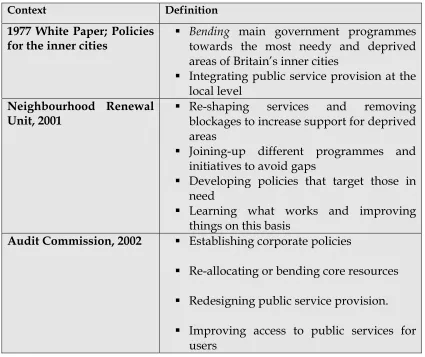
[image:16.595.86.511.378.735.2]Although ‘mainstreaming’ is now seen to be crucial to the modernisation agenda and to the long-term sustainability of neighbourhood renewal (Stewart 2003a) there is still much confusion about what ‘mainstreaming’ actually means in practice. Feedback from a number of evaluations has repeatedly highlighted the fragility of mainstreaming (Audit Commission 2002; ODPM 2003; ODPM 2004). The most consistent problems relate to uncertainty about what mainstreaming means, the demands of centrally imposed targets, threats to middle managers, and concerns over budgets and spending priorities. In the Bristol NDC there has even been evidence of reverse bending – attempts to extract or withdraw resources from the initiative in order to help subsidise mainstream service provision (Neighbourhood Renewal Unit 2003). Although many people do not use the term in any definitive sense, mainstreaming is often talked about because it represents the goal of achieving better outcomes by making better use of resources. Not surprisingly perhaps, a number of attempts at clarification have been made over recent years. Some of these are outlined below in Table 1.
Table 1: Mainstreaming definitions, 1977 – 2004
Context Definition
1977 White Paper; Policies
for the inner cities Bending main government programmes towards the most needy and deprived
areas of Britain’s inner cities
Integrating public service provision at the local level
Neighbourhood Renewal
Unit, 2001 Re-shaping services and removing blockages to increase support for deprived
areas
Joining-up different programmes and initiatives to avoid gaps
Developing policies that target those in need
Learning what works and improving things on this basis
Audit Commission, 2002 Establishing corporate policies
Re-allocating or bending core resources
Redesigning public service provision.
Improving access to public services for users
National Evaluation of
LSPs, 2004 Strategic Mainstreaming refers to refocusing the mainstream (both
programmes and funding) onto targets agreed with local partners, thus reflecting the needs of local communities (this top-down approach is often referred to as mainstream bending)
Bottom-up or Initiative Mainstreaming refers to approaches which aim is to spread learning from localised, one-off pilots to mainstream programmes, the aim being to achieve sustainable funding for pilots. This bottom-up approach is seen to be one way of achieving strategic mainstreaming
Despite the many attempts at clarification, worries over long term (‘continuity’) funding for ABIs still dominates the mainstreaming debate. Indeed, people have long had concerns about what happens when special initiatives end. Under the traditional Urban Programme in the 1970s, for example, concern often focused on ‘tapering’ and the ability of local authorities to accommodate initiatives when funding ran out (SEU 2000b). During the 1980s the focus moved from ‘exit strategies’ to the more positive use of ‘forward strategies’ and ‘successor bodies’ in the recognition that the long-term sustainability of regeneration needed to be considered more thoroughly (SEU 2000b, 51). More recently, in line with Walsh’s (1998) assertion that ABIs and local partnership working are not a way of transferring responsibility for national problems to local actors, attention has again started to focus on ‘mainstreaming’. Stewart (SEU 2000b) suggests this in turn corresponds to the European foundation suggestion that ‘mainstreaming’ is the next big challenge and to Alcock et al’s (1998, 25) suggestion that including “new into basic service provision is now called ‘mainstreaming’”.
However, research (DETR 2002) examining the links across the rash of ABIs initiated in the immediate post 1997 period found that the need to secure longevity for a project meant that ABI managers often look towards the mainstream for the wrong reasons, as a way of securing the future of a project, rather than as a way of integrating provision. There were exceptions to this rule, however, which tended to be those initiatives involving heath (Health Action Zones and Sure Start) and those driven by national policy goals. These tended to be those initiatives in areas rather those initiatives for areas (New Start and Employment Zones, for example) where a strong departmental lead or policy theme gave initiatives a particular policy focus. For instance one “Sure Start had developed a new way of training and disseminating good practice in the treatment off post natal depression and this was now being rolled out” more broadly (DETR 2002, 38). New Start had also made progress on transferring practice and from April 2001 had been subsumed
under the Connexions careers and advice service: it was suggested that this was “perhaps the best example of mainstream learning from an ABI” (p 40). However, although Community Legal Services and Crime Reduction Partnerships also had good connections with the mainstream in the sense outlined, these successes were countered by the recognition that those initiatives that joined up vertically often did least joining-up horizontally, especially at the Whitehall level8.
Overall the research found little evidence of mainstreaming in the sense of mainstream agencies replicating examples of successful practice from initiatives. Mainstreaming was generally seen to be piecemeal and opportunistic, with most ABIs representing a distraction from the mainstream rather than a contribution to it. While many ABIs may well have been set up with mainstreaming in mind, many had also been set up as solutions to particular local problems, rather than as experiments to find out what might work nationally. Mainstreaming, as such, had not been the dominant force it could have been and the long disjuncture between ABI working and mainstream policy development had continued.
8 Rhodes, J. (2003) identified similar trends in relation to the operation of local initiatives
funded through the Single Regeneration Budget (SRB). What the research found was that, although it was clearly necessary to get some locally disadvantaged groups ‘job ready’ through SRB funded initiatives, the statutory requirement for local authorities and other agencies (Training and Enterprise Councils (TECs), for example) to contribute to wider processes of labour market training and restructuring limited the amount of mainstream funding they could divert to local SRB schemes.
VI: Mainstream failure
Stewart (2002) suggests the failure to join-up has been maintained by highly entrenched circuits of Whitehall power since the Haldane reforms (Haldane 1918) established public administration on a vertically integrated, highly functional basis nearly a century ago. In the 1970s, for example, the joint approach to public policy (CPRS 1975) came up against many of the same problems encountered by the Social Exclusion Unit in 1998, with ministerial ambition, inflexible public expenditures, and rigid, seemingly intractable organisational boundaries holding back integration across government (Blackstone and Plowden 1988). Stewart (2002, 153) suggests Rittel and Weber (1973) recognised this “vertical intractability … when they invented the wicked issue a quarter of a century ago”.
Recent research, examining the impact and interaction of five cross-cutting issues across national, regional and local levels of government, would appear to confirm this view, Stewart et al (1999) finding that in no area of government was there a clear and unambiguous definition of the problem at hand, or of desired outcomes. Whitehall departmentalism, it was argued, remained strong, with robust local departments driving cross cutting issues to the margins of policy development. If local capacity for joint working was weak, explicit central guidance provided assistance. If it was strong, excessive and inflexible management inhibited joint working. Although flatter organisational structures and new management practices had started to cut across some departmental structures, the research found that departmental pressures meant cross-cutting issues were still not given the priority they demanded. Long-established bureaucratic practice dominated and policy delivery was heavily influenced by traditional organisational cultures, especially at middle management level. While new collaborative skills and flexible working practices were needed, disincentives and system compliance tended to dominate (Stewart 2002)9.
Stewart (2002) confirms that these problems have often been worst in relation to ABIs. As we have seen, research examining collaboration and co-ordination across a range of ABIs came up with similar findings to the research examining cross cutting issues, with vertical structures dominating horizontal structures to a large extent. Stewart (2002) suggests this situation has not been helped by stakeholder relations within partnerships, where power is often distributed unevenly and where many ‘flagship’ policies and initiatives demand “tangible political returns” for individual government departments (Stewart 2002, 155). Again, as we have seen throughout this review, many such departmental projects often fail to join up horizontally, especially at the Whitehall level. This is not to say, however, that such problems only exist at the national level: many local
9 Research examining the participation of public bodies in LSPs looked at similar issues. What it
found was that many public bodies are often more willing to work on minor cross cutting issues were the threat from silo-based responsibilities is less apparent (OPDM 2002).
authorities suffer the very same problems with central and local stakeholders combining to create barriers and keep out unwanted influences, silos often stretching from “centre to region, to locality and even to neighbourhood, immuring actors from all levels within their walls” (Stewart 2002, 156).
There are also tensions and cultural differences within departments. Here Stewart (2002) suggests those who manage main programmes often regard ABIs as marginal activity. “To this group, initiatives are at best a distraction, at worst an irrelevance, to the business of managing main programme budgets” (Stewart 2002, 156/7). The other side of the coin, however, as Stewart (2003a) suggests elsewhere, is that ABI managers often ignore the mainstream because the mainstream has for so long ignored them. Indeed, as suggested above, lacking mainstream support for their work, many ABI managers view mainstreaming solely as a way keeping a project going, rather than as a way of integrating provision and improving mainstream services.
The latest attempt at reform is taking place through LSPs and a range of initiatives designed to improve and refocus mainstream services. In the widest sense, LSPs aim to build commitment and purpose amongst partners, share information and good practice, support local initiative and innovation, consult with local people, and increase the coordination of public services (through rationalisation) and opportunities for co-governance (through partnership working). A major intention of LSP work thus revolves around the improved use of resources: shared budgets, joint working, and pooled budgets all feature strongly with LSPs expected to manage and coordinate a number of separate funding streams. Complimenting the work of the Health Development Agency (HAD 2004) the national evaluation of LSPs (ODPM 2004b) thus focussed on ‘mainstreaming and aligning resources’ – the aim being to learn “about existing practice, to understand and clarify the barriers and opportunities pooling resources, and to develop good practice in relation to mainstreaming” (p 6).
VII: The national evaluation of LSPs
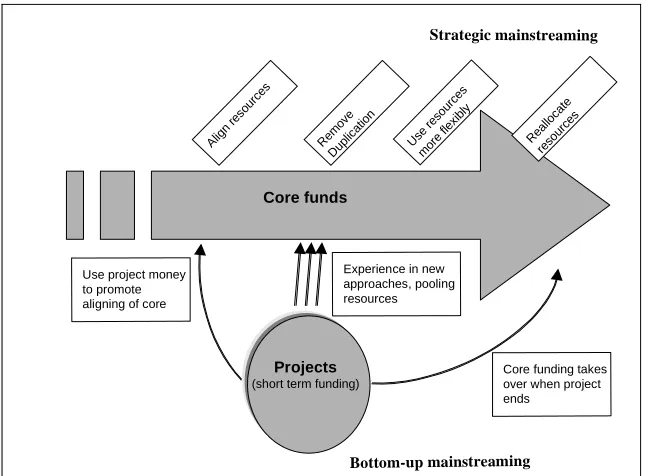
[image:21.595.137.461.349.587.2]The national evaluation of LSPs identified two types of mainstreaming. On the one hand, Strategic mainstreaming was seen to reflect the Neighbourhood Renewal Units (Bright 2001) definition which stressed the need to refocus the mainstream onto shared targets (reflecting the needs of deprived communities), learn about what works, and improve ways of doing things on this basis. This was recognised to be similar to the Audit Commissions (2002) definition, which is also strategic. On the other hand, Bottom up (or initiative mainstreaming), was typically seen to involve multi-agency partnership arrangements funded through a mixture of central and local resources. Here there is often seen to be a focus on changing policy or practice on the basis of results from short-term pilots or experiments, the aim being to achieve sustainable funding for such initiatives. The evaluation suggested this was one way of developing strategic mainstreaming. An illustration of these ideas is laid out in Figure 1 below.
Figure 1: Mainstreaming: the theory?
Projects
(short term funding)
Alig n re
sour ces Rem ove Dup licat ion Strategic mainstreaming Bottom-up mainstreaming Use project money
to promote aligning of core
Core funding takes over when project ends
Experience in new approaches, pooling resources Use reso urce s mor e fle
xibl y Core funds Rea lloca te reso urce s
ODPM (2004b, 10) What Figure 1 illustrates are the ways in which core-funding streams can be aligned, coordinated and used in more efficient and effective ways to fill the gaps between individual organisational budgets, thus creating synergy. It illustrates how the overall process can remove duplication, reallocate funds, fill gaps and prioritise the needs of individual neighbourhoods and groups by responding more flexibly to their needs. It also draws attention to the ways in which initiatives and short-term projects can promote the realignment of main budgets, support change
and innovation and thus help to support sustainability and incorporate learning into the mainstream.
Although the evaluation noted that the importance of mainstreaming was widely recognised across LSPs, it also found that partners still tend to give their own agencies priority and that organisational barriers still inhibit integration and the development of working on cross cutting issues. The evaluation also found that there is often a lack of guidance from parent departments and a lack of clarity about departmental priorities. Here the attitudes of board members and middle managers were seen to be significant, and it was pointed out that tension about leadership, legitimacy and identity, and concerns over new budget controls, priority specification and targets can also cause problems within and across partner organisations. Indeed, it was argued that the “processes within and between organisations, where government policies are translated into programmes, has to a large extent been ignored by policies to promote mainstreaming” (ODPM 2004b, 21).
Some technical/ legislative barriers (data protection issues and audit requirements, for example) to mainstreaming were also identified. However, while such barriers were seen to present real problems in some instances, it was also suggested that such threats can sometimes be more perceived than real and may be a mechanism to deflect institutional and cultural resistance. Similarly, while ‘pooled budgets’ were identified as a particular form of ‘joint resourcing’ where new flexibilities were needed, it was suggested that there were not as many barriers to other forms of joint resourcing (sharing time, information and people, for example) as many LSP partners believed. Imagination, rather than permission, was the key issue here. Political maturity was also seen to be important in this sense.
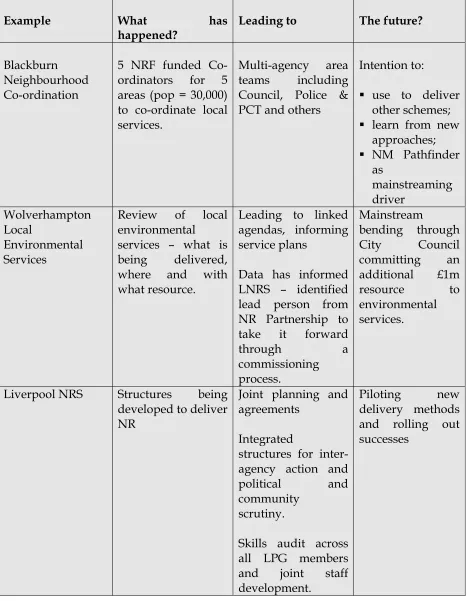
Overall, however, despite interesting developments and a number of emergent examples of new mainstreaming practice (see Appendix), the evaluation stressed the significance of LSP partners still prioritising their own agendas and failing to provide guidance and clarity of intention to their representatives within LSPs. Complimenting previous research findings, it was also suggested that attempts to mainstream in a bottom up manner are often most successful in initiatives where strong central pressure or national priorities provide a definitive focus for partnership working. Bending mainstream resources in a strategic manner, on the other hand, was again seen to be more likely on marginal cross cutting issues where internal pressure from individual departments and agencies were less acute. Here, it is important to remember that that the brand of managerialism to evolve from NPM under New Labour can also be seen as ‘a threat to joint working’, in that accountability, regulation, and inspection, for example, now “demand focussed and targeted behaviour from a range of public bodies” (Sullivan and Stewart 2002, 38).
A mainstreaming workshop (ODPM 2004e) ran in conjunction with the LSP evaluation examined the issues raised in more detail and asked some interesting questions, questions it found difficult to answer. Primarily, as Crime and Disorder Reduction Partnerships (CDRPs) had again featured strongly in several of the positive examples of successful mainstreaming identified in the evaluation (see Appendix), the question was raised as to the significance of the characteristics shared by the initiatives attracting mainstream resources? The following characteristics were highlighted:
They are amongst the longer established partnerships; They have a statutory role;
They are outcome driven;
They are lead organisations that can see ‘what’s in it for them’; They are frequently pursuing additional funding, and;
They have common performance issues.
The first thing to say here is that since the emergence of LSPs, CDRPs have become a delivery arm or sub partnership group of LSPs in much the same way as neighbourhood renewal partnerships. In theory, the concerns of all existing local partnerships should be aligned and joined up through the inclusive, rationalizing power of LSPs to improve the coordination and operation of mainstream services within a given locality. As we have seen, however, things are often much more complicated in practice than this brief summary suggests, a situation clearly illustrated through workings of the community safety agenda.
VIII: Mainstreaming community safety
Community safety is now widely recognised as a cross cutting issue for government, which means that by its very nature it is at once both difficult to define and even more difficult to resolve (Sullivan et al 2002). As we have seen, when New Labour came to power in 1997 they set out to develop a virtuous circle of regeneration within which developments in crime, health, housing, employment and education all reinforcing each other (SEU 1998). And it was in this discursive context, where regeneration and crime reduction shared the same social and political objectives, that community safety became a central feature of New Labour policy, a situation in which both criminal justice and social policies were “ostensibly geared to providing genuinely ‘joined up’ policies to tackle the (perceived) social causes of crime within specific ‘problem’ localities” (Cook 1998, 208). Community safety, it was argued, must be tackled in a way that brings together and addresses the mutually reinforcing elements of social exclusion in a holistic way.
A statutory duty to develop crime and disorder reduction partnerships (and triennial strategies) and improve community safety was subsequently placed on local authorities and the Police through the Crime and Disorder Act 1998. However, an important and often overlooked part of the Act is Section 17, which states that “it shall be the duty of each [local] authority … to exercise its various functions with due regard to the likely effect of the exercise of those functions on, and the need to do all it reasonably can to prevent, crime and disorder in its area”. This means that all local authority plans, policies, strategies and budgets must be considered in light of the duty to reduce crime and disorder – that all corporate plans and departmental activities must attempt to make community safety a ‘mainstream’ concern. As we saw earlier, significant change was also engendered through the Local Government Act 2000 where a duty was placed on local authorities to develop a community strategy and enter into partnerships to improve economic, social and environmental ‘well being’. Again, as illustrated, many of the plans, policies and practices now emerging at the local level thus have community safety and mainstreaming as primary concerns. In Bristol, for example, a major element of the community strategy focuses on a range of issues aiming to “create and develop neighbourhoods that are safe from high crime rates and where the fear of crime is low” (Bristol Community Strategy 2003, 45). However, as we have also seen, getting mainstream government departments (at both the national and local level) to change the way they do things in pursuit of such aims is no easy task.
A question posed by the mainstreaming workshop (ODPM 2004a) illustrates the complexity that now envelops the policy-making environment. Querying whether or not mainstreaming is easier in some policy sectors than others, the authors of the report asked whether or not the concerns of local partnerships link
more easily with the social aspects of regeneration (overseen by Government Offices in the regions) than they do with the economic agenda (as perused by Regional Developments Agencies (RDAs). As the report suggested, there is no easy answer to this question, for although RDAs have been consistently implicated in strategic planning over recent years, it is still not entirely clear whether they have relevance to local organisations (Bennett (2004), their intentions often running counter to those of the Government Offices to exert contradictory pressures on local organisations and partnership members (Johnstone 2004). As we have seen, a similar set of tensions is also manifest within the workings of the social regeneration agenda, where the projects attracting mainstream resources often have a narrow policy focus constrained by mainstream agency requirements. These findings are confirmed by the community safety literature, where it quickly emerges that ODPM’s imaginative strategy for neighbourhood renewal and inclusion is being counterbalanced by criminal justice measures emerging from the Home Office (Edwards 2002) and by private sector demands (Coleman et al 2002). As Gilling (2005) confirms, local authorities face a tricky dilemma when attempting to marry these competing demands in order to address local problems.
Taken together these issues highlight the complex nature of the processes at work within the workings of New Labour’s wider governance project, there now being a wide range of policies, partnerships and funding streams in operation at the national, regional and local levels – each being concerned with a particular aspect of policy being pursued by New Labour, each increasing the pressure on partnership members through increasingly complex working arrangements and ongoing demands for social, political and economic outcomes. Combined with the local government modernisation agenda, and the duty to develop a community strategy, these developments place considerable pressure on local partnerships and initiatives seeking to address the cross cutting nature of community safety.
IX: Recent developments
Local Area Agreements (LAAs) were introduced (ODPM 2005) to simplify the workings of local government and provide a mechanism for joining up the multiple funding streams in operation, the overall intention being to draw up plans for local service delivery based on targets spanning central and local government. This means that local authorities will have to work more closely with LSPs to produce LAAs in order to address the concerns identified in community strategies. Initially, local authorities will also have mini LAAs for the Safer and Stronger Communities Fund (SSCF), a development that brings together ODPM and Home Office funding streams for crime, anti-social behaviour, drugs and community empowerment. Despite the possible benefits of these developments, it should be noted, however, that although the simplification of bureaucratic processes involved will make the identification of local priorities more straightforward, local authorities still have to use funding streams in ways that help central government to address their priorities.
X: Research Agenda
What previous research has demonstrated is that while the governing process is currently being pursued through partnership working, and that while individuals and community groups are increasingly being asked to do more for themselves in line with these developments, the process of governing is currently being dominated by the priorities of central government. This suggests that (1) partnerships facilitate the priorities of central government and hinder the development of inclusive governing structures at the local level. As research has indicated, local initiatives and projects often attract mainstream resources through partnerships linked to statutory, central government priorities. What this means, in effect, is that the mainstreaming agenda aligns itself substantially with national priorities, that (2) the mainstreaming discourse illustrates the ways in which national priorities are addressed through partnership working. Moreover, as ‘the community’ is consistently implicated in partnership working, this in turn suggests that community involvement is more important than the success of communities, that (3) the discourse of community is being been mobilised to facilitate central government priorities. The key empirical concern of the project, therefore, is to asses whether the continued use and deployment of partnership technologies is more a means of facilitating the priorities of central government than it is about realigning resources (strategic mainstreaming) and facilitating inclusive mainstream change (bottom-up mainstreaming).
I will test these propositions in relation to community safety as a cross cutting theme in the city of Bristol. Primarily this requires an examination of the ways in which partnerships operate and what mainstreaming means to those involved. Similarly, it requires an exploration of the ways in which partnerships mainstream change in the field of community safety? By necessity, this in turn requires an exploration of the ways in which the disparate elements of New Labour’s wider governance agenda exert their influence on the actors and agencies involved in community safety work, and the extent to which the cross cutting nature of community safety is being addressed.
XI: Methodology
A case study methodology will be utilised to develop “detailed, intensive knowledge” about the workings of community safety in Bristol (Robson 2002, 89). Information will be collected through a range of data collection methods and techniques, including semi structured interviews, observation and documentary analysis. In-depth semi-structured interviews will be carried out with between 30 and 40 managers at the neighbourhood, city and regional levels of government. Semi-structured interviews are appropriate in this instance because they allow respondents to discuss the workings of partnerships in their own terms whilst providing some degree of structure for the purposes of comparability (May 1997). Participant observational methods will also be utilised (at partnership meetings) in the exploratory phase of the project, and also to provide supportive evidence of information gained during interviews (Robson 2002). Documentary analysis will be used to keep on top a quickly evolving policy making environment. Theoretically the project will utilise insights emerging from Figurational Sociology (Elias 1978; 1994), as this allows for a comprehensive analysis of contextual relations between groups within specific case study localities (Dopson 2003).
XII: References
Alcock, P. et al (1998) Inclusive Regeneration, Department of the Environment, Transport and the Regions, Sheffield Hallam University and University of Lincolnshire and Humberside.
Atkinson, R. (1999) Narratives of the Inner City: The Construction of Urban Problems and Urban Policy in the Official Discourse of British Government 1968-1998', in Critical Social Policy, Vol.20.
Audit Commission (2000) Neighbourhood Renewal Policy Focus, London: the Audit Commission.
Bennett R. J., et al (2004) “Local government and local economic development in Britain: an evaluation of developments under labour” Progress in Planning 62
(4) 209-274.
Blackstone, T. and Plowden, W. (1988) Inside the Think Tank: London, Heinemann.
Bramley, G. (1998) Where does public spending go? Pilot study to analyse the flows of public expenditure into local areas, London: DETR.
Bright, J. (2001) Neighbourhood Renewal Unit Neighbourhood Management presentation to Kendray Neighbourhood Management Seminar.
Burton, P. (1997) 'Urban policy and the myth of progress', Policy & Politics, 1997, vol 25, no 4.
Bristol Community Strategy: The Bristol Partnership (2003), Bristol City Council.
Cabinet Office (1999) Modernising Government, (Cmnd 4130 (The Stationary Office, London).
CDP (1977)(Community Development Project) Gilding the ghetto the state and the poverty experiments, CDP.
Chatterton and Bradley (2000) Bringing Britain Together: The limitations of area based regeneration policies in addressing deprivation, in Local Economy, vol 15, No. 2, 98-111.
Coleman R., Sim J., and Whyte, D. (2002) Power, Politics and Partnerships: the state of crime prevention on Merseyside, in Crime Control and Community: The new politics of public safety, Willan Publishing.
Cook, D. (1998) Putting crime in its place: the causes of crime and New Labours local solutions, in Social Policy Review 11.
Cowell, R. and Martin, S. (2003) The joy of joining up: modes of integrating the local government modernisation agenda, in Environment and Planning C: Government and Policy, vol 21, 159-179.
CPRS (1975) Central Policy Review Staff, A Joint Approach to Public Policy, London HMSO.
Deakin, N. and Edwards, J. (1993) The Enterprise Culture and the Inner City, Routledge.
DETR (1998), Modern Local Government: In Touch with the People, London: DETR.
DETR (2001), Local Strategic Partnerships: Government Guidance, London: DETR.
DETR (2002) Department of Transport, Local Government and the Regions, Collaboration and Co-ordination in Area-Based Initiatives NRU/ RCU, Research Summary No. 1, 2002.
DoE (1977) Department of the Environment, Policy for the inner cities, Cmnd 6845, London: HMSO.
Dopson, S. (2003) The potential of the case study method for organisational analysis, Policy and Politics Vol. 31 (2), p 217-26.
Edwards, A. (2002) Learning from diversity: the strategic dilemmas of community-based crime control, in Crime Control and Community: The new politics of public safety, Willan Publishing.
Elias, N. (1978) What is Sociology? London: Hutchinson.
Elias, N. (1994) The Civilizing Process, Oxford: Basil Blackwell.
Gilling, D. (2005) Partnership and crime prevention, in Handbook of Crime Prevention and Community Safety, (Ed) Nick Tilley, Willan Publishing.
Health Development Agency (HAD 2004), Pooling Resources Across Sectors: a report for local strategic partnerships, by Lucy Hamer.
Haldane, J. (1918) Report of the machinery of government Committee (The Haldane Report) cmnd 9230, London: HMSO
Hall, S. et al (1996) The Single Regeneration Budget: A Review of Challenge Fund Round 2 (Birmingham: Centre for Urban AND Regional Studies).
Harvey, B. (1998) Working for Change: A Guide to Influencing Policy in Ireland. Dublin, Combat Poverty Agency.
HM Treasury (1998), Comprehensive Spending Review 1998, HM Treasury.
HM Treasury (2000), Comprehensive Spending Review 2000, HM Treasury.
HM Treasury (2000a) Government Interventions in Deprived Areas Cross-Cutting Review (GIDA), HMSO: London.
Home Office (1998) Crime and Disorder Act 1998, London: HMSO.
Jessop, B. (1995) ‘The Regulation Approach; governance and post Fordism: alternative perspectives, Economy and Society 24 (3).
Johnstone, G. (2004) Crime Disorder and the Urban Renaissance: in New Horizons in British Urban Policy: Perspectives on New Labours Urban Renaissance, (eds) Johnstone, C. and Whitehead M., Ashgate.
Johnson and Osborne (2003) Local Strategic Partnerships, neighbourhood renewal and the limits of co-governance, Public Money and Management.
King, A. (1997) ‘Overload: Problems of Governing in the 1970s’, Political Studies, vol. 23, no 2-3.
Lambert, C. (2004) Local Strategic Partnerships, Community Strategies and Developmental Planning: Negotiating Horizontal and Vertical Integration in emergent Local Governance, paper presented to AESOP Annual Conference, Grenoble July 2004.
Lane, J.E. (ed.) (1987) Bureaucracy and Public Choice, Sage, London.
Lawless, P. et al (2000) The Evidence Base for Regeneration and Policy and Practice, DETR Regeneration Research 39, London DETR.
LGA (2004) Local Public Service Boards: an innovation Forum ‘prospectus’. Improvement and Development Agency.
Lowndes, V. and Skelcher, C. (1998) ‘The Dynamics of Multi-organisational Partnerships: An Analysis of Changing Modes of Governance, Public Administration, vol. 76, no.2 p313-34.
Maddock, S. (1999) Managing the Development of Partnerships and Modernisation, NW Change Centre/ MBS.
Mackeon, A. and Creedon, M. (1998) ‘Local Partnerships: Key challenges, future directions. Paper to the European Foundation national policy seminar, Dublin.
May, T. (2001) Social Research: Issues, methods, and process, Open University Press.
Newman, J. (2000) Beyond the New Public Management: Modernising Public Services, in New Managerialism: New Welfare? (eds.), Clarke, J. et al, Sage Publications.
Niskanen, N. A. (1994) Bureaucracy and Public Economics, Edward Elgar: Aldershot.
Neighbourhood Renewal Unit (2003) New Deal for Communities, The National Evaluation, Annual Report 2002/03: Research Report 7.
ODPM (2002) Public Sector Body Involvement in Local Strategic Partnerships, Interim (Phase One) Report, Draft, November 2002.
ODPM (2003) Office of the Deputy Prime Minister, National Evaluation of New Deal for Communities, London ODPM.
ODPM (2003a) Office of the Deputy Prime Minister, Factsheet 18, Mainstreaming and Neighbourhood Renewal, Neighbourhood Renewal Unit.
ODPM (2004) Office of the Deputy Prime Minister, National Evaluation of LSPs, Case Studies Interim Report, January 2004.
ODPM (2004a) Office of the Deputy Prime Minister, National Evaluation of LSPs, Interim Report, April 2004.
ODPM (2004b) Office of the Deputy Prime Minister, Evaluation of local strategic partnerships: Mainstreaming and aligning resources, a briefing paper for LSPs by LSPs. ODPM (2004c) Office of the Deputy Prime Minister, Evaluation of local strategic partnerships: Governance, a briefing paper for LSPs by LSPs.
ODPM (2004d) Office of the Deputy Prime Minister, Evaluation of local strategic partnerships and Action Research Programme, Local Neighbourhood Renewal Strategies: Document Analysis and Review, Summary Report, May 2004.
ODPM (2004e) Office of the Deputy Prime Minister, National Evaluation of Local Strategic Partnerships Mainstreaming Workshop Paper, 12 March 2004.
ODPM (2003) Developing Mainstreaming in Neighbourhood Renewal, Government Office for the West Midlands, Wednesday Set, Workshop Two, June 2003.
ODPM (2005) Local Area Agreement Guidance, ODPM Publications.
Osborne, D. and Gaebler, G. (1992) Reinventing Government. Reading, MA, Addison-Wesley.
Pierre, J. and Peters, B.G. (2000) Governance, Politics and the State, London: McMillan.
PIU (2000) Performance and Innovation Unit, Reaching Out: The Role of Central Government at Regional and Local Level (London: Cabinet Office).
PIU (1999) Performance and Innovation Unit, Wiring It Up: Whitehall’s Management of Cross Cutting Policies and Service, PIU report (Cabinet Office, January 1999).
Rhodes, R.A.W. (1988) Beyond Westminster and Whitehall, London, Unwin.
Rhodes, J. et al (2003) New Developments in Area-based Initiatives in England: The experience of the Single Regeneration Budget, in Urban Studies, Vol. 40, No. 8, 1399-1426.
Richards, S. and Jarvis, P. (1997) Public Management: Raising the Game’, Public Money and Management, vol. 17, no.1, 1-8.
Richards, S., Barnes, M., Coulston, A., Gaster, L., Leach, B. and Sullivan, H. (1999) Cross Cutting Issues in Public Policy and Public Services, London, DTLR. Rittel, H. and Webber, M. (1973), Dilemmas in a General Theory of Planning, Policy Sciences, vol. 4, 155-169.
Robson, C. (2002) Real World Research: A resource for Social Scientists and Practitioner –Researchers, Blackwell Publishing.
Robson, S. et al (1994) Assessing the Impact of Urban Policy (London: HMSO).
Russell, H. et al (1996) City Challenge: Interim National Evaluation (London: HMSO)
Russell, H. (2001) Local Strategic Partnerships: Lessons from New Commitment to Regeneration, The Policy Press and the Joseph Rowntree Foundation.
SDC (2003) Mainstreaming Sustainable Regeneration: a call to action, A report by the Sustainable Development Commission, December 2003.
SEU (1998) Bring Britain Together: A National Strategy for Neighbourhood Renewal, CM 4045, TSO: 1998.
SEU (2000) National Strategy for Neighbourhood Renewal: Policy Action Team report summaries: a compendium.
SEU (2000a) Social Exclusion Unit, Joining It Up Locally: Report of Policy Action Team 17, Volume 1. London: DETR.
SEU (2000b: Stewart M. et al) Social Exclusion Unit, Joining It Up Locally - The Evidence Base Report of Policy Action Team 17, Volume 2. London: DETR.
SEU (2000c) National Strategy for Neighbourhood Renewal: A Framework for Consultation. Report by the Social Exclusion Unit, Cabinet Office.
SEU (2001) A New Commitment to Neighbourhood Renewal: National Strategy Action Plan. Report by the Social Exclusion Unit, Cabinet Office.
Smith, K. (2001) Audit Commission, Mainstreaming Neighbourhood Renewal, Paper to 2nd Regeneration Management Research Workshop, Durham.
Steward, J. (1998) Paper to the European Foundation national policy seminar ‘Local Partnerships: Key challenges, future directions, Dublin.
Stewart, M. (1994) Between Whitehall and Town Hall: the realignment of regeneration policy in England, in Policy and Politics, Vol. 22, No. 2, 133-145.
Stewart, M., Goss et al (1999) Cross Cutting Issues Affecting Local Government, London DETR.
Stewart, M. (2002) Compliance and Collaboration in Urban Governance, in Cars et al (2002) Urban Governance, Institutional Capacity and Social Milieux, Ashgate.
Stewart, M. (2002a) Systems Governance: Towards Effective Partnership Working, Paper to the Health Development Agency Seminar Series on Tackling Health Inequalities, Cities Research Centre, The University of the West of England, Bristol.
Stewart, M. (2003) Towards Collaborative Capacity, in Urban Transformation and Urban Governance; Shaping the competitive city of the future, (Ed) Martin Boddy, Policy Press.
Stewart, M. (2003a) Neighbourhood Renewal and the Mainstreaming Agenda (working paper), Cities Research Centre, The University of the West of England, Bristol.
Sullivan, H. and Stewart, M. (2002) Review of Public Administration in Northern Ireland, Briefing Paper: ‘Joining-Up’ Governance – The Coordination And Integration Of Arrangements In Northern Ireland. Cities Research Centre: The University of the West of England, Bristol.
Sullivan, H. and Skelcher, C. (2002) Working Across Boundaries: Collaboration in Public Services, Palgrave.
Sullivan, H. (2003) ‘New forms of local accountability – coming to terms with ‘many hands’?’ Policy and Politics, Vol. 31, no. 3, pp353-69.
Sullivan, H. (2004) Community governance and local government: a shoe that fits the emperor’s new clothes? Forthcoming chapter in Wilson, D and Stoker, G: Local Governance in the 21st Century, Palgrave.
Turok, I. (1999) Localisation or Mainstream Bending in Urban Regeneration, European Experience, in Local Economy, May 1999.
Walsh J. (1998) ‘Mainstreaming the Policy Impact of Local Partnerships’, Paper to the European Foundation national policy seminar ‘Local Partnerships: Key challenges, future directions, Dublin.
Webster, B (1982) Area Management and Responsive Policy Making, in Approaches in Public Policy (Eds) Leach, S. and Stewart, J., Institute of Local Government Studies, Allen and Unwin.
Wilks-Heeg, S. (2001) Mainstreaming Regeneration: a review of policy over the last thirty years (London: LGA).
Williams, G. (1998) City Vision and Strategic Regeneration – the Role of City Pride, in N. Oatley (Ed) Cities, economic competition and urban policy, London: Paul Chapman.