Munich Personal RePEc Archive
Justification and cooperation
Xiao, Erte
Carnegie Mellon University
2 March 2012
Justification and Cooperation
Erte Xiao
Department of Social and Decision Sciences
Carnegie Mellon University
March, 2012
Abstract
The need for justification is a widely observed social phenomenon. This paper develops a theoretical framework and reports laboratory evidence to show how pure justification pressure affects cooperative behavior in economic exchange environments. In a one-shot anonymous interaction, compared with the case when the behavior is simply observed by the audience, individuals are more likely to act on what they believe the audience thinks they should do when they also have to explain the decisions to the audience. When it is salient that the audience thinks one should cooperate, justification pressure significantly promotes cooperation even absent negative consequences for non-cooperative behavior. We discuss the implications of our findings for shaping institutional design to promote cooperation.
Keywords: justification, accountability, cooperation, social norms, experimental economics
JEL classification: C91; C72; D63; D03; D83; D84
I. Introduction
When people take actions or make judgments, they are often expected to or feel obliged to
provide a justification. This is as true for trivial decisions in daily life as it is for critical national
policy making. Justification may even be mandatory when an action has negative consequences
for others. For example, a manager is often expected to provide explanations when deciding to
fire an employee. Recently, the Department of Health and Human Services (HSS) announced
that health insurance providers will need to justify rate increases of 10% or more starting
September 1, 20111. In the past several decades, research in psychology has argued that an
important universal feature of decision-making environments is that people are accountable for
their decisions, and provided evidences that the social necessity of this accountability has a
significant impact on shaping peoples’ thoughts (see Lerner and Tetlock (1999) for a
comprehensive review). While the pressure of justification has been discussed in psychology
literature on accountability, how it affects behavior in exchange environments has received little
attention and has been unjustifiably quiet in economic literature, despite its importance in
predicting economic outcomes.2 For instance, in addition to promoting transparency, we may
expect the pure pressure of justification imposed by HSS’s new policy to have an impact on
health insurance providers’ pricing decisions. If the need to provide justification influences a
manager’s hiring and firing decisions, these conditions can have a significant impact on labor
market outcomes.
In this paper, we provide both a theoretical framework and laboratory evidence to explain
how the requirement of justification affects cooperative behavior in economic exchange
environments. The theoretical framework is built on previous psychology research on
accountability and on norm obedience. Tetlock (1985) proposed a social contingency model of
judgment and choice to understand how accountability influences behavior, mostly in the domain
of judgment. In this model he assumes that people tend to be "cognitive misers," in that they rely
on simple heuristics to make judgments quickly. When people believe they will have to justify
their views, if they are unconstrained by past commitments they will try to anticipate the possible
objections from the audience and adopt the salient, socially acceptable position. The proposed
underlying mechanism of the accountability effect is that, if people do not behave in ways for
1
See http://www.hhs.gov/news/press/2011pres/05/20110519a.html (accessed on January 7, 2012) 2
which they can provide acceptable accounts, they will be evaluated negatively by others and
suffer negative reputational consequences. Thus, accountability manipulation in previous
empirical research often involves not only pure justification (that is, providing explanations for
one’s behavior or views) but also other factors such as the presence of others (subjects expect
someone will observe their behavior); identifiability (subjects’ decision or opinion will be linked
to them personally); or evaluation (subjects expect someone will evaluate their performance) (see
Lerner and Tetlock, 1999). Thus, the impact of pure justification remains unclear. In addition,
most studies on accountability have focused on judgment accuracy or social perception, but no
systematic studies have been conducted to investigate how the pure justification necessity
influences economic behavior when there is temptation to pursue self-interest at a cost to others.
Applying previous psychology findings on accountability effects, we argue in this paper
that the pure pressure of providing explanations can reduce selfish behavior in an economic
exchange environment even absent negative consequences for selfishness such as bad reputation.
The reason is that the pressure of justification can remind one to think about what the audience
thinks, as suggested in the Tetlock (1985) model. Furthermore, previous research on social
norms shows that, subjects’ behavior is more likely to be consistent with their beliefs regarding
what others think they should do when social norms are more salient (see, e.g., Collins and
Loftus, 1975; Harvey and Enzle, 1981; Cialdini et al., 1990; Bicchieri, 2006; and Bicchieri and
Xiao, 2009). If the expectation of justification promotes the salience of social norms in guiding
behavior, it can reduce profit-maximizing behavior in economic exchange environments when it
violates social norms even if the decision maker does not bear any monetary cost of bad behavior.
Furthermore, we hypothesize that the pressure of justification is more effective in promoting
cooperation when it is clearer to the subjects that the audience disapproves of profit-maximizing
behavior.
To test these hypotheses, we design an experiment based on a dictator game and a trust
game that have been widely used to study prosocial behavior. We revise these two games so that
to maximize one’s own profit at the cost of others, the subject has to violate multiple norms such
as truth telling, efficiency, fairness, and reciprocity. Selfish behavior is thus presumably less
acceptable compared with standard dictator games or trust games. We also design the payoff
structure of the games such that selfish behavior violates different norms in different conditions.
leads to more severe norm violations. We compare subjects’ behaviors between two treatments:
Justification and No Justification. The only difference between the two treatments is that the first
requires the subject to provide explanations for her behavior to a third party.
We find that when subjects are not required to justify their behavior, most will maximize
their own profit at the cost of their counterpart in all the conditions. In contrast, in the
Justification treatment, subjects are significantly less likely to choose the profit-maximizing
action when such a choice is clearly not acceptable. To further test the hypotheses, we conduct
an incentivized survey to elicit subjects’ beliefs regarding what the audience thinks they should
do. The data are consistent with the hypothesis that when justification is required, subjects’
behavior is more likely to be consistent with their expectations of what the audience thinks they
should do. The effect of justification on cooperation is thus stronger when it is clearer that the
audience thinks the subjects should cooperate.
This study contributes to the understanding of how the pressure to justify behavior can
influence cooperation in an economic exchange environment - even within the context of
anonymous one-shot interactions. Further, our findings provide important insights into how to
design institutions to promote pro-social behavior. Incentive mechanisms, such as penalties or
rewards, have been widely used to enhance cooperation. In relation to incentive mechanisms,
building institutions to require justification for decisions, such as HSS’s new justification policy,
can be a less costly way to increase social welfare. In addition, justification mechanisms may
avoid the potentially negative effects of incentives. Previous research shows that external
incentives can crowd out intrinsic motivations and lead to less cooperation (e.g., Gneezy and
Rustichini, 2000; Houser, et al., 2008; and Li, et al., 2009). In contrast, this paper suggests that
justification pressure may enhance intrinsic motives for norm conformity by prompting one to
consider others’ perceptions of the right thing to do in a particular decision context.
The remainder of this paper is organized as follows. Section II reviews related literature.
Section III introduces experiment design. Section IV presents theoretical analysis. Section V
reports results. Section VI concludes.
II. Literature Review
The effect of justification on judgment and decision making has been widely discussed in
psychology literature on accountability. Accountability refers to the implicit or explicit
expectations that one may have to provide reasons for his or her beliefs, feelings, or actions to
others (Scott and Lyman, 1968; Tetlock, 1992). This expectation can place constraints on
virtually everything people do as the failure to provide an acceptable account for one’s behavior
can lead to punishment and disapproval (Tetlock, 1992).
In his seminal work, Tetlock (1985) proposed and tested a social contingency model of
how accountability affects judgment and choices. The model assumes that people tend to rely on
simple, low-effort heuristics to make decisions. When people know the views of the audience to
whom they are accountable and are unconstrained by past commitments, they tend to adopt
views or actions that will be accepted by the audience. When people do not know the views of
the audience and are unconstrained by past commitments, they may be motivated to engage in a
preemptive self-criticism process to try to anticipate the objections of potential critics. Finally, if
people have already committed to a position, they will try hard to generate arguments supporting
the position. Because this paper explores how the pure justification necessity can change
behavior, we focus on situations where people anticipate having to justify their behavior before
they take an action. Tetlock’s model may suggest that the effect of justification would be
different if people have made a choice in a similar environment in the past.
Psychologists have conducted numerous experimental studies to examine the effect of
accountability on judgment and decisions. Many of those studies have focused on the effect of
biases in decision-making. For example, when the audience’s view is unknown, accountability
can reduce the anchoring effect (Kruglanski and Freund, 1983), overconfidence (Siegel-Jacobs
and Yates, 1996), sunk cost fallacy, oversensitivity to the order that the information is presented
(Webster et al., 1996), and conjunction error (Simonson and Nye, 1992). Accountability also
amplifies some biases. For example, Simonson and Nowlis (1998) found that accountability
increases preferences for compromise options and loss aversion. Taylor (1995) found
accountability increases ambiguity aversion. Accountability has also been found to have no
effect on some biases, such as insensitivity to the base rate and preference reversal (Simonson
and Nye, 1992; also see Lerner and Tetlock, 1999, for a comprehensive review).
Recent studies have also investigated the effect of accountability on cooperative behavior
manipulation of accountability in these studies often involves the presence of others;
identifiability; or evaluation. For example, De Kwaadsteniet, et al. (2007) show justification
pressures facilitate coordination in common resource dilemmas when there is no uncertainty
about the resource size. As indicated in their paper, the justification manipulation is quite strong
because subjects not only have to justify the behavior to the group members but their decisions
would also become identifiable. De Cremer and Van Dijk (2009) show that subjects who have
great endowments also contribute more in a public goods game when they were told that after
making the decisions they would meet up with other group members and explain their
contribution decisions. Thus their paper cannot inform pure justification effects on cooperation
either.
The need to justify can be made not only explicitly to others, as studied in the
accountability literature, but also implicitly to oneself, which can also affect one’s behavior. For
example, Shalvi, et al. (2011) show that people are more likely to lie if self-justifications for
lying are available. This paper focuses on the effect of exogenous justification pressure when it
has to be made explicitly to others. Nevertheless, in the theory model discussed below, we
include the case when the target group is the subject himself, which reflects the possibility that
the individual has internal pressure to make a decision that can be justified to himself or herself.
II.B. Justification and accountability in economic literature
Economists have only recently drawn attention to the importance of accountability. Recent
economic research on accountability effects has focused on risk choices. The accountability
manipulation in these studies, however, often involves not only pure justification pressure but
also identifiability. For example, Vieider (2010) showed when the subjects know they have to
explain their choice to an experimenter face-to-face, they increase the effort in solving the
decision task and are more likely to choose the normatively superior event. Pahlke, Strasser, and
Vieider (2011) studied how individuals make decisions when they take risks that affect
themselves and a passive recipient and found less loss aversion when the subjects have to explain
their decisions to the recipient face-to-face. Brandts and Garofalo (2010) adopted physiological
measurements to study gender difference in accountability effects when individuals are asked to
choose between simple and compound prospects. In their accountability manipulation treatments,
emerging literature in two ways: first, we examine the effect of pure justification pressure on
decision making without introducing identifiability; second, we extend the study of justification
effects to the domain of prosocial behavior in economic exchange environments.
Some experimental research on communication is related to our study, although these are
not designed to study justification directly. For example, Andreoni and Rao (2011) show that
allowing a dictator to send a message to a receiver in a dictator game leads to more selfish
behavior, but the dictators are more generous when the receivers can send a message to them.
Unlike the dictator game, where the right thing to do is unclear (see Bicchieri and Xiao, 2009), in
this paper, we investigate the affect of justification in a setting where a selfish act can clearly be
viewed as bad because it violates multiple norms including truth-telling, efficiency, reciprocity,
and equality. As discussed in more detail below, for justification to promote cooperation decision
makers must clearly understand that the audience believes the decision makers should not pursue
their own self-interest.
II.C. Social norms
Economic research connecting norms and decisions is only beginning to emerge (see, e.g., Fehr
and Fischbacher, 2004; Krupka and Weber, 2009; Gächter, et al., forthcoming). People do not
always behave how society thinks they should. In the absence of monetary incentives, even a
strong personal commitment to a social norm does not predict norm-obedient behavior unless
that norm is a focus of attention (Bicchieri, 2006). This concept has received substantial attention
in the law and economics literature (see, e.g. Kahan, 1998; Cooter, 1998; and Sunstein, 1996)
and has been heavily researched by psychologists.
For example, drawing from the Collins and Loftus (1975) theory of semantic memory,
Harvey and Enzle (1981) proposed a cognitive model of social norms and norm-directed
behavior. In their model, cooperation is more likely after observing a transgression, because
doing so draws attention to a cooperation norm. Experimental studies have also provided
supporting evidence that people are more likely choose what they expect others think they ought
to when this normative message is salient (e.g., Cialdini et al., 1990; and Bicchieri and Xiao,
2009).
Building on previous studies on accountability and social norms, we develop a theoretical
cooperative behavior. The theory can help explain why, in some situations, justification pressure
may or may not influence behavior and thus shed light on how to incorporate justification
requirements in institution design to promote cooperation. We argue that the justification
pressure can prompt one to think about what the audience thinks he or she should do (i.e., what is
the norm) and it can promote cooperation in environments where selfish behavior is clearly not
acceptable.
III. Experiment Design
The experiment consists of two treatments: No Justification and Justification. In each treatment,
subjects play two games with a different randomly paired partner. The two games are designed
so that the same decision may be more acceptable in one and less so in the other. In both games
to make a selfish decision requires a subject to violate multiple norms.
III.A. No Justification treatment
In this treatment, subjects are randomly assigned to the role of either Person A or Person B and
play two games. Each Person A is randomly matched with a different Person B in each of the
two games. This is common knowledge. We randomize the order of the two games to control the
potential order effect. At the end of the experiment, one of the games is randomly selected and
subjects will be paid by the amount they earned in this game.
In Game D, subjects are told that the computer will first pick one of three possible
earnings outcomes: ($10, $2), ($7, $7), and ($5, $9). The first numbers in the parentheses are
Person A’s payoff and the second numbers are Person B’s payoff. Person A will see what
earnings outcome the computer selected for his pair, but Person B will never receive this
information. Person A will then decide what to report to Person B regarding the real
computer-selected earnings outcome, and Person A’s report will decide each one’s final earnings. For
example, if the computer selected (7,7) but Person A told Person B that the computer selected
(10,2), then Person A receives $10 and Person B receives $2 in this game. Person A is told that
he can either tell the truth or tell a lie. All this is common knowledge.
In this game, the profit-maximizing outcome for Person A is (10,2). When the computer
selects (7,7) or (5,9) for the group, Person A has to tell a lie and scarify efficiency to seek his
assume that Person A will believe to report (10,2) when the computer selects (5,9) is relatively
more acceptable than when the computer selects (7,7). The reason is that when the true
computer-selected outcome is (5,9), Person A has to accept disadvantageous inequality if he tells
the truth. In contrast, in the case when the true computer-selected outcome is (7,7), Person A not
only has to lie and scarify efficiency but also has to violate equality to report (10,2) to Person B.
In Game T, Person B first chooses whether to opt “out” or “in.” If Person B opts out,
Person A’s and Person B’s final earnings in this game are $4. If Person B opts in, then each
one’s earnings will be decided by the same procedure as described in Game D. That is, the
computer first picks one of the three possible outcomes and then Person A decides what to report
to Person B regarding the computer-selected earnings outcome, which will decide each one’s
final payoff.
Previous studies show that people are more likely to cooperate when others have signaled
positive intentions (e.g., McCabe, Rigdon, and Smith, 2003). In view of those findings, we
assume that the when computer selects (7,7) or (5,9), to report (10,2) to Person B is less
acceptable in Game T than in Game D. The reason is that in Game T, by opting in, Person B has
trusted Person A to be honest, and Person B would have received $4 by opting out if he had
chosen not to trust Person A, in which case Person A would only receive $4.
Because we are mostly interested in the cases when the computer-selected outcome is
either (7,7) or (5,9), to obtain enough data in each case, we design the experiment so that most
pairs receive one of these two outcomes. Because we are also interested in whether subjects
behave differently in Game D than in Game T, subjects receive the same outcome in both games.
Subjects are not told about the probability of receiving each of the three possible outcomes and
do not know that the computer will assign the same outcome to their group in both games. They
are simply told that the computer will select one of the outcomes for their group and their
decision in one game will not affect their payoff in the other game. To avoid a learning effect,
subjects are told they will not see the outcomes of each game until the end of the experiment.
(See instructions in Appendix A for details.)
To keep this treatment as symmetric as the Justification treatment described below,
participants also are told that at the end of the experiment, two Person Bs who didn’t play either
Game D or Game T with Person A will be randomly selected and each of the two Person Bs will
III.B. Justification treatment
The only difference between the two treatments is that, in the Justification treatment, subjects are
asked to provide explanations for their decisions to the Person B who will observe the report and
the truth. To study a pure justification effect without any reputation effect or other extrinsic
incentive effect such as punishment or reward, we introduce the weakest justification
manipulation in this treatment. Person A is required to write at least two different explanations
for his decision when deciding what to report. Note that the subject was not explicitly asked to
“justify” his decision but just “to provide at least two different explanations,” so as not to suggest
to the subjects that they should do what the audience thinks they should do.
In addition, the explanations will not affect his payoff but will be seen by another Person
B who did not play either of the two games with the Person A. In particular, the Person B who
sees the explanations will also see Person A’s report and the true computer-selected earnings
outcome. However, the matched Person B involved in each game is not allowed to see Person
A’s explanation. This assures Person A that his matched Person B in each game will not know if
he told the truth or not, just as in the No Justification treatment. This feature also mitigates the
potential concern that the process of justification may change the social distance between Person
A and his matched Person B. All of this is common knowledge.
III.C. Belief elicitation
We argue that the pure justification requirement makes subjects more likely to behave
consistently with what they believe others think they should do because the social norm is more
salient in decision making when subjects are required to justify their behavior (see Section IV for
more details). Thus, it is important to know about a subject’s belief in this regard.
In the experiment, after the subjects finished all the decisions in both games in each
treatment, we conducted an incentivized survey (see Appendix B for details). Subjects could earn
points for answering some questions. At the end of the experiment, two of the survey questions
that Person A can earn points for were randomly selected, and Person A was rewarded $2 for
each point he earned. The most relevant question for our purpose was the second question:
“Before seeing what you actually reported to your matched Person B, he/she was asked to
You will earn one point if your answer is the same as what this Person B answered in his/her
survey.”3 This question is intended to elicit Person A’s normative expectations about what the
audience thinks he should do (see Bicchieri and Xiao, 2010).4 As illustrated in section IV, the
comparison between Person A’s behavior and his normative expectation can help explain how
the justification requirement influences behavior.
III.D. Procedures
The experiment was conducted at P.E.E.L. lab using z-tree (Fischbacher, 2007). Subjects were
randomly and anonymously assigned a role and the role was fixed for the whole experiment. At
the end of the experiment, one game was randomly chosen and each subject was paid according
to the outcome in that game. Subjects were paid privately. Each subject participated in exactly
one treatment.
IV. The Role of Justification
Based on the previous literature on accountability and social norms, we argue that the need to
justify can decrease selfish behavior that harms others because it leads people to be more likely
to think about what behavior is approved by the audience when deciding what to do, and thus
social norms are more salient in the decision-making process. When the norm clearly
disapproves of selfish behavior, people are more likely to be cooperative when they are required
to justify their behavior. To illustrate how the justification condition influences individual
choices, we construct a utility function along the lines of the Bicchieri (2006) norm-based utility
function and incorporate justification conditions.
In Bicchieri’s (2006) social norm model, an individual’s utility function consists of two
parts: his own payoff from the strategy he takes and the disutility from norm violations. A norm
here is defined as the individual’s belief of what others think ought to be done (i.e., normative
expectations). The disutility from norm violations depends on (1) the difference between the
profit from one’s action and the profit if one takes an action based on the norm, and (2) the
individual’s sensitivity to the relevant norm.
3
Data for all survey questions are available on request. 4
In this paper, our hypothesis is that the need to justify promotes the salience of the social
norm because it leads the individual to think about what behavior is approved by the audience to
whom he justifies. We construct an individual i’s utility function as follows:
Ui (si) =πi (si) - ki (J) |πi (si) - πi (sti)|
where si is the action individual i takes and sti is the strategy that the individual i believes the
target group thinks he should do (i.e., normative expectations). The target group is any group to
whom the individual i believes he must justify his behavior. It can be a third party as designed in
this experiment, or the partner, or even the individual himself. In the equation, πi (si) is individual
i’s profit when he takes action si ; πi (sti) is individual i’s profit when he takes action sti ; and ki
represents the individual’s sensitivity to the normative expectations of the target group. The latter,
ki , is a function of the probability J in [0,1] that the individual believes he needs to justify his
behavior to the target group. We assume: 1) ki>0, that is, individual i experiences disutility from
norm violations; and 2) ∂ki /∂J>0, that is, the more likely one has to justify his behavior, the
more sensitive he is to the normative expectations held by the target group. Note that ki (J) |πi (si)
- πi (sti)| also captures the ease with which an individual can justify his behavior. When the
action taken by the individual is closer to what he believes the target group believes he should do,
it is natural to assume that it is also easier for him to provide acceptable reasons for his behavior
to the target group. Thus, ki (J) |πi (si) - πi (sti)| can also be interpreted as the psychological cost
of justifying his behavior to the target group.
This model suggests that the need to justify does not always lead to behavioral
differences; particular conditions need be satisfied in order for justification to have behavioral
consequences. To see this, consider a simple setting similar to the experiment designed here. In
this setting, a subject has two choices: to lie (L) or to be honest (H), si∈(L, H).Consider the case
when πi (L)>πi (H), as studied in the experiment. Further consider two justification conditions:
justification is surely not needed (J=0) and justification is required with probability one (J=1).
Without loss of generality, assume that ki (0)=0. It is straightforward to see that when
justification is not required the subject will choose to lie. When justification is required:
Ui (si=L | J=1)= πi (L) - ki (1) |πi (L) - πi (sti)|
Ui (si=H | J=1)= πi (H) - ki (1) |πi (H) - πi (sti)|.
In this case, differences in decisions between Justification and No Justification treatments occur
Case 1.sti=H (i.e., the subject expects the audience to believe she should be honest) .
In this case when πi (L) - ki (1) |πi (L) - πi (H)|< πi (H) - ki (1) |πi (H) - πi (H)|, Ui (si=L |
J=1)< Ui (si=H | J=1) is satisfied. It is straightforward that the justification requirement would
lead to more honest behavior when ki (1)>1. That is, more honest behavior occurs under the
justification condition when subjects believe the audience believes they should be honest, and
when subjects are sufficiently sensitive to this normative expectation.
Case 2.sti=L (i.e., the subject expects the audience to believe she should tell a lie).
In this case, again, when πi (L) - ki (1) |πi (L) - πi (L)|< πi (H) - ki (1) |πi (H) - πi (L)|, Ui
(si=L | J=1)< Ui (si=H | J=1) is satisfied. It is straightforward that this condition cannot be
satisfied regardless of the value of ki (1) because πi (L)>πi (H). In other words, the expectation
justification requirement does not promote honesty when subjects believe the audience believes
they should lie, regardless whether subjects are sensitive to the normative expectation.
Thus, the model suggests that the pure justification effect can significantly reduce lying
behavior when there exists a sufficiently large number of subjects who 1) believe the audience
disapproves of lying behavior and 2) are sufficiently sensitive to norm violations. We next apply
this model to derive several hypotheses relevant to our investigation.
First, as mentioned above, subjects are presumably more likely to expect the audience to
think they should be honest when the truth is (7, 7) than when the truth is (5,9) (i.e., Prob
(sti=H|truth=(7,7))> Prob (sti=H|truth=(5,9)). The reason is that, in addition to violating
efficiency and truth telling that apply to both (7,7) and (5,9) cases, to report (10,2) when the truth
is (7,7) also violates equality. Moreover, when the truth is (5,9), subjects may believe the
audience believes it is acceptable to lie by reporting (7,7) as in this case lying creates equality.
Thus, for each particular game (Game D or Game T), it should be more likely that justification
pressure promotes honest behavior when the truth is (7,7) than when the truth is (5,9). Second,
in view of previous studies on reciprocity (e.g., McCabe, Rigdon, and Smith, 2003), we expect
the probability that subjects believe the audience thinks they should be honest is higher in Game
T than in Game D (i.e., ProbGameT (sti=H) > ProbGameD (sti=H)). The reason is that in addition to
also fails to reciprocate when reporting (10,2) because Person B has chosen to trust him. Thus,
ceteris paribus, pure justification pressure is more likely to promote honest behavior in Game T
than in Game D. Therefore, our first hypothesis is:
H1: Pure justification pressure is more likely to reduce profit-maximizing behavior when (1) the
truth is (7,7) than when the truth is (5,9), and (2) in Game T than in Game D.
In the experiment, we elicit beliefs regarding what the target group thinks one should do
(normative expectations). We test our model by examining the difference between normative
expectations and behavior in the two treatments. As discussed above, the model predicts that
Person A is more likely to choose what is acceptable to the audience (sti ) when Person A is
required to explain his decision (J=1). Thus, our second hypothesis is:
H2: Compared with the No Justification treatment, people are more likely to choose what they
believe the audience thinks they should do in the Justification treatment.
V. Results
We ran 16 sessions in total (8 sessions for each treatment) and obtained observations on 334
subjects: 170 subjects in the Justification treatment, 164 subjects in the No Justification
treatment.5 Since we are interested in the cases when the true computer-selected earnings
outcome is (7,7) and (5,9), we designed the experiment so that in each session most pairs receive
either (7,7) or (5,9).
As discussed above, it is more likely that subjects expect the audience to think they
should not report (10,2) for the (7,7) condition than for the (5,9) condition. Thus, the (7,7)
condition has a greater chance to reveal the effects of justification requirements. In view of this,
we also design the experiment so that more pairs receive (7,7) than (5,9). In total, we obtain 87
observations for the (7,7) condition (43 in the No Justification treatment and 44 in the
5
Justification treatment); 61 observations for the (5,9) condition (28 in the No Justification
treatment and 33 in the Justification treatment) and 16 observations for the (10,2) condition (8 in
each treatment). This is summarized in Table 1.
When the computer-assigned earnings outcome is (10,2), 7 out of 8 Person As reported
the truth in Game D in both the Justification and the No Justification treatments; 6 out of 8
Person As reported the truth in Game T, also in both treatments. Below we focus on the cases
when the computer-assigned earnings outcome is (7,7) or (5,9). We first report Person A’s
decisions to test H1 then, to test H2, we examine how many Person As chose exactly what they
believed the audience thought they should do in each condition. All messages are listed in
Appendix C.
V.A. Justification and lying
When Person A sees the computer’s selected earnings outcome is (5,9), he can either report the
truth or lie. There are two types of lies in this condition: to report (7,7) or (10,2). In both case,
Person A’s earnings are higher than the computer-assigned. Compared with the
profit-maximizing decision of reporting (10,2), to report (7,7) can reach equality and maintain
efficiency. When the computer-selected earnings outcome is (7,7), there is only one type of lie:
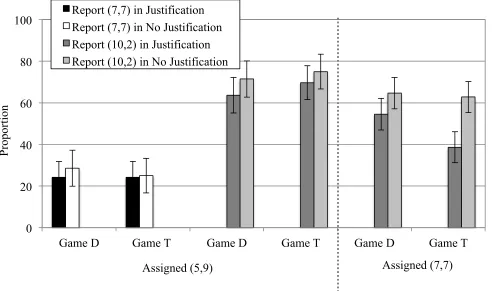
to report the profit-maximizing outcome (10,2). Figure 1 plots the proportion of lies in each
treatment and each condition.
As shown in Figure 1, consistent with our hypothesis, the rate of lying is always higher in
the No Justification treatment than in the Justification treatment. The comparison of lying rates is
significant in Game T when the true computer-selected outcome is (7,7) (39% vs. 63%, Z-test,
p=0.02). We also find that the comparisons in the other five cases are not significant (Z-tests,
p>0.50). Thus, the finding that the justification requirement significantly reduces the probability
of reporting (10,2) when the computer assigns (7,7) in Game T but the effect is not significant
when the computer assigns (5,9) or when play in the Game D setting supports our first
hypothesis.
Each Person A plays both Game D and Game T and receives the same computer-selected
earnings outcome in each game. Again, to avoid an order effect, we randomize the order of the
two games. We did not observe a significant order effect in this experiment. It is interesting that,
T in the No Justification treatment regardless whether the truth is (7,7) or (5,9) while previous
research shows that people are more likely to share with the partner if the partner has signaled
trust (see Cox, 2004; McCabe, et al. 2003). However, in the Justification treatment, when the
truth is (7,7), Person As are significantly less likely to report (10,2) in Game T than in Game D
(39% vs. 55%, Wilcoxon sign rank test, p=0.03). The reporting behavior does not differ
significantly between Game D and Game T when the truth is (5,9) (Wilcoxon sign rank test,
p>0.10).6
One explanation is that, unlike the standard trust game, in this experiment, Person A’s
partner Person B never knows whether a good (or bad) outcome is generated by a computer or by
Person A’s positive (or negative) intention. If the reason the trustee reciprocates to the trustor is
that the trustee does not want the trustor to feel betrayed (e.g., Bohnet and Zeckhauser, 2004;
Aimone and Houser, 2011), this concern does not exist or is present to a lesser degree in the
experiment. However, in the Justification treatment, the requirement of justification draws
subjects’ attention to what the audience thinks. Thus any differences in the normative
expectations among these conditions can lead to behavioral differences.
It is worthwhile to note that the belief data elicited by our survey are consistent with this
explanation. In the Justification condition, Person As are significantly more likely to believe that
the audience thought they should tell the truth when assigned (7,7) in Game T than in Game D
(89% vs. 77%; Wilcoxon sign rank test, p=0.03). When the truth is (5,9), in both Game T and
Game D, only a small proportion of Person As believed the audience thought they should tell the
truth (27% in Game T vs. 24% in Game D, Wilcoxon sign rank test, p=0.57). Thus, even though
Person A’s matched Person B does not know the truth in the Justification treatment, they are
more likely to tell the truth in Game T than Game D when the truth is (7,7) but not when the
truth is (5,9). We next examine the belief data obtained from the survey to provide further
information on how the justification manipulation affects behavior.
V.B. Justification and beliefs
Recall that our second hypothesis is that Person A is more likely to choose what he believes the
audience thinks he should do (normative expectation) when justification is required than when it
6
The percentage of Person B’s who chose “in” is not significantly different between treatments (67% in the No
is not required. To examine this hypothesis, we calculate the percentage of subjects whose
reporting behavior is exactly the same as their normative expectation. We plot the data in Figure
2. As shown in Figure 2, compared with No Justification treatment, more subjects in the
Justification treatment report exactly the same as their normative expectations.
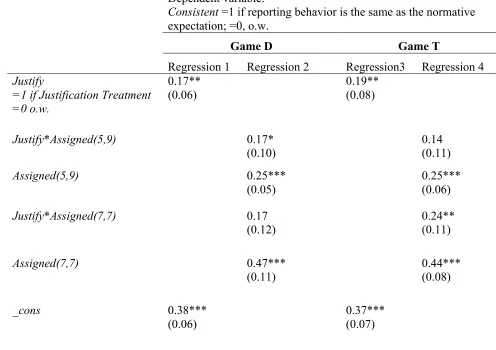
We ran an OLS regression to test whether this percentage is higher in Justification than
No Justification (pooling across both (5,9) and (7,7) conditions)7. Each Person A plays both
Game T and Game D. We conduct a regression analysis for Game T and Game D separately. The
regression results are reported in Table 2. The dependent variable “consistent” is equal to one if
Person A’s choice is the same as his normative expectation, and zero otherwise. For independent
variables, we first include only the treatment variable “Justify” (Regression 1 and Regression 3
in Table 2). We then separate the (5,9) and (7,7) conditions (Regression 2 and Regression 4). As
shown in Table 2, the treatment variable “Justify” is positive and significant in Regression 1 and
Regression 3. In Regression 2 and Regression 4, the coefficients for “Justify*Assigned(5,9)” and
“Justify*Assigned(7,7)” are jointly positive (F-test, one tail, p=0.02 for Regression 2 and p=0.04
for Regression 4).
It is also interesting to note that we find the proportion of Person A’s who believe the
audience thinks they should be honest is significantly higher in the Justification treatment than in
the No Justification treatment when assigned (7,7) in Game T (88% vs. 65%, Z-test, p<0.01).
We did not observe significant differences between the two treatments for the other three cases
(assigned (7,7) in Game D and assigned (5,9) in Game D and Game T). We discuss possible
explanations in the next section.
VI. Discussion
The need for justification is ubiquitous within society. The way justification pressure impacts
decisions is highlighted in the accountability literature, where the focus is on judgment and
perception (Lerner and Tetlock,1999). Recently, economists have investigated how
accountability affects risky decisions (e.g., Vieider, 2010; Pahlke, Strasser, and Vieider, 2011;
and Brandts and Garofalo, 2010). Despite these advances, there remains a lack of systematic
evidence informing whether and how justification pressure influences prosocial behavior in
7
economic exchange environments, especially in the important case where selfishness results in
negative externalities.
This paper developed a theoretical framework to assess the effect of justification
requirements on decisions. We argued that justification requirements – even absent payoff
consequences - lead people to consider and consequently act on what they believe others believe
they should do. We hypothesize that requiring one to justify their actions can reduce selfish
behavior when it is clear that selfishness is not acceptable to the audience. Our data support this
hypothesis. In one-shot anonymous interactions, subjects are more likely to avoid
profit-maximizing choices, and instead to pursue cooperative outcomes, when they are required to
justify their behavior in a context where selfish decisions are clearly unacceptable.
Our data also offers evidence that the need to justify may change people’s expectations
regarding what observers believe they should do (represented by sti in our model). An
explanation is that the need to justify may reshape people’s perceptions as they try to anticipate
objections of potential critics (as discussed above in the Literature Review).8 This mechanism
can potentially enhance the effect of justification on promoting cooperation. The reason is that
the need to justify both leads people to choose what they expect the audience thinks they should
do and also brings their expectation more closely in line with what the audience actually thinks
they should do.
Previous studies suggest that when subjects can send a message to their partner they act
selfishly and then try to excuse their selfish behavior (e.g., Andreoni and Rao, 2011). In addition
to framing differences regarding the function of messages, our study differs from others in that
we design our games so that selfish actions clearly violate multiple norms. Thus, the difference
between our findings and previous findings might suggest the importance of ensuring the
transparency of the standard held by the target group.Another important way our study departs
from earlier investigations is that a decision makers behaviors do not have material impact on the
audience.
Our study extends previous research on accountability by showing that justification
pressure can have significant behavioral consequences in economic exchange environments.
Although we exclude the effect of identifiability in order to focus study pure justification effects,
8
our findings provide an explanation for why cooperation is more likely in environments that
include high transparency and publicity. In addition to reputation concerns, it is reasonable to
argue that people expect it is more likely that they will have to justify their behaviors to others
when their decisions are made public (e.g. Linardi and McConnell, 2011).
This paper also contributes to the theoretical literature on accountability and norm
obedience, as well as to institution design. The literature has demonstrated the importance of
social norms to decision making. Nevertheless, our understanding of how social norms influence
behavior, especially in the absence of monetary incentives such as penalties, is still limited. The
present study suggests that the need to justify decisions - a universal feature of human interaction
- may play an important role in facilitating norm obedience. In particular, when people expect
they will need to provide explanations for their behavior they are more likely to conform to
norms even when there is no extrinsic incentive tied to such obedience.
Finally, our findings have practical implications for institution design. In particular, our
results highlight the importance of formal requirements for justification in promoting socially
desirable behavior. Indeed, many institutions explicitly request leaders and policy makers to
explain decisions (e.g., the HSS’s new policy requiring justification for increases in health
insurance premiums). Our study suggests that this policy may indeed leave it more likey that
health insurance companies set reasonable premiums. Another example is corporate boards,
which are often required to explain their actions to shareholders (see Model Business Corporate
Act, section 8.30, 2008). In addition to helping people understand and support board policies, an
advantage to this is that narrowly self-interested decisions can be effectively deterred by
References
Aimone, J. and Houser, D. 2011. “Beneficial Betrayal Aversion,” PLoS ONE, 6(3): e17725. doi:10.1371/journal.pone.0017725
Andreoni, J. and Rao, J. 2011. “The power of asking: How communication affects selfishness, empathy, and altruism”, Journal of Public Economics, 95(7), 513-520
Bicchieri,C. The Grammar of Society: The Nature and Dynamics of Social Norms, Cambridge University Press, 2006
Bicchieri, C. and Xiao, E. 2009 "Do the right thing: But only if others do so", Journal of Behavioral Decision Making.22(2), 191-208.
Bohnet, I. and Richard Z. “Trust, Risk and Betrayal.” Journal of Economic Behavior and Organization, 2004, 55 (4), 467-484.
Brandts, J. and Garofalo, O. 2010. “Gender pairings and accountability effects”. Working paper.
Cialdini, R. B.; Kallgren, C. A. and Raymond R.1990,"A Focus Theory of Normative Conduct: A Theoretical Refinement and Reevaluation of the Role of Norms in Human Behavior.”
Advances in Experimental Social Psychology, 24, 201-234.
Cooter, R. D. “Expressive Law and Economics, Journal of Legal Studies 27(2), 585-608
Collins, A. M. & Loftus, E. F. “A Spreading-Activation Theory of Semantic Processing.” Psychological Review, 1975, 82, 407-428.
Cox, J. (2004). How to identify trust and reciprocity. Games and Economic Behavior, 46, 260– 281.
Fehr, E. and Fischbacher,U. “Social norms and human cooperation.” TRENDS in Cognitive Sciences, 2004, 8 (4), 185-190.
Fischbacher, Urs (2007): z-Tree: Zurich Toolbox for Ready-made Economic Experiments, Experimental Economics 10(2), 171-178.
Gächter, S. Nosenzo, D. and Sefton, M. (forthcoming) "Peer Effects in Pro-Social Behavior: Social Norms or Social Preferences?" Journal of the European Economic Association
Gneezy, U., Rustichini, A. 2000a. A Fine Is A Price. Journal of Legal Studies. 29(1), 1-17.
Houser, D. Xiao, E., McCabe, M. and Smith, M. 2008. “When punishment fails: Research on sanctions, intentions and non-cooperation”, Games and Economic Behavior, 62 (2), 509-532.
Kahan, D. M. (1998) “Social Meaning and the Economic Analysis of Crime. Journal of Legal Studies 27(2), 661-672.
Kruglanski, A. W., & Freund, T. (1983). The freezing and unfreezing of lay-inferences: Effects on impressional primacy, ethnic stereotyping and numerical anchoring. Journal of Experimental Social Psychology, 19, 448-468
Krupka, E. L. and Weber, R. (2009); “The Focusing and Informational Effects of Norms on Pro Social Behavior” The Journal of Economic Psychology, 30(3):307-320.
De Kwaadsteniet, E.W., Van Dijk, E., Wit, A., De Cremer, D., De Rooij, M. (2007). “Justifying Decisions in Social Dilemmas: Justification Pressures and Tacit Coordination Under
Environmental Uncertainty”. Personality and Social Psychology Bulletin. 33(12), 1648-60
De Cremer and Van Dijk (2009) “Paying for sanctions in social dilemmas: The effects of endowment asymmetry and accountability”. Organizational Behavior and Human Decision Processes. 109, 45-55
Lerner, J. S., & Tetlock, P. E. (1999). Accounting for the effects of accountability. Psychological Bulletin, 125(2), 255-275
Li, J., Xiao, E., Houser, D. and Montague, R. 2009, “Neural responses to sanction threats in two-party economic exchange”, PNAS. September 29, vol. 106 no. 39, 16835-16840
Linardi, S. McConnell, M. A. (2011) “No Excuses for Good Behavior: Volunteering and the Social Environment” Journal of Public Economics, 95, 5-6, 445-454
McCabe, K., Rigdon, M., Smith, V. 2003. Positive reciprocity and intention in trust games. Journal of Economic Behavior and Organizations. 52(2), 267-275.
Model Business Corporate Act (2008) section 8.30, 2008
Pahlke, J., Strasser, S. and Vieider, F. M. (2011). “Risk-Taking for Others under Accountability”, working paper
Scott, M. B., & Lyman, S. (1968). Accounts. American Sociological Review, 33(1), 46-62.
Siegel-Jacobs, K., & Yates, J. F. (1996). Effects of procedural and outcome accountability on judgment quality. Organizational Behavior and Human Decision Processes, 66, 1-17.
Simonson, I., & Nye, P. (1992). The effect of accountability on susceptibility to decision errors. Organizational Behavior and Human Decision Processes, 51, 416-446.
Sunstein, C. R. “On the Expressive Function of Law”. University of Pennsylvania Law Review, 1996,144. 2021-2031
Shalvi. S., Dana, J., Handgraaf, M. J.J. De Dreu, C. K.W. 2011. “Justified ethicality: Observing desired counterfactuals modifies ethical perceptions and behavior” Organizational Behavior and Human Decision Processes. 115,181–190
Tetlock, P. E. (1985). Accountability: A social check on the fundamental attribution error. Social Psychology Quarterly, 48(3), 227-236.
Tetlock, P. E. (1992). The impact of accountability on judgment and choice: Toward a social contingency model. Advances in Experimental Social Psychology, 25, 331-376.
Vieider, F.M., 2010. “Separating Real Incentives and Accountability”. Working paper.
Figure 1. Lying behavior by treatments
0 20 40 60 80 100
Game D Game T Game D Game T Game D Game T Report (7,7) in Justification
Report (7,7) in No Justification Report (10,2) in Justification Report (10,2) in No Justification
Assigned (7,7) Assigned (5,9)
P
roport
Figure 2. Percentage of Person As whose reporting behavior is the same as the normative expectation by treatments.
0 20 40 60 80 100
(7,7) Game T (7,7) Game D (5,9) Game T (5,9) Game D
P
e
rc
e
n
tage
Table 1. Experiment conditions and the number of observations
Treatment Computer assigned
earnings condition Justification No Justification
(10,2) 8 8
(5,9) 33 28
(7,7) 44 43
Note: The first number in the parentheses is Person A’s earnings and the second one is Person B’s earnings.
Table 2. OLS regression analysis of Person A’s reporting behavior
Dependent variable:
Consistent =1 if reporting behavior is the same as the normative expectation; =0, o.w.
Game D Game T
Regression 1 Regression 2 Regression3 Regression 4
Justify
=1 if Justification Treatment =0 o.w.
0.17** (0.06)
0.19** (0.08)
Justify*Assigned(5,9) 0.17*
(0.10)
0.14 (0.11)
Assigned(5,9) 0.25***
(0.05)
0.25*** (0.06)
Justify*Assigned(7,7) 0.17
(0.12)
0.24** (0.11)
Assigned(7,7) 0.47***
(0.11)
0.44*** (0.08)
_cons 0.38***
(0.06)
0.37*** (0.07)
Note: numbers in the parenthesis are the robust standard error.
[image:26.612.64.560.304.654.2]Appendix A. Instructions
• Game D in Justification Treatment
In this task, you are randomly matched with another participant. One plays as Person A and the other plays as Person B. Person A’s and Person B’s final earnings are decided by the following steps:
Step 1: For each group, the computer will select one of the following three possible earnings outcomes. Each of the three possible earnings outcomes specifies Person A’s and Person B’s earnings.
• Person A receives $5 and Person B receives $9 • Person A receives $7 and Person B receives $7 • Person A receives $10 and Person B receives $2 •
Step 2: Person A will see the computer-selected earnings outcome for his/her group. Person B will not see the computer-selected earnings outcome. Neither will B see the real computer-selected earnings outcome throughout today’s experiment.
Step 3: Person A decides what to report to Person B regarding the computer-selected earnings outcome. Person A can choose either to tell the truth or tell a lie. A and B will receive earnings based on the earnings outcome A reports to B.
For example, suppose the computer-selected earnings outcome for your group was “A receives $7 and B receives $7.” After seeing this outcome,
o If A told the truth and reported to B that “The true computer-selected earnings outcome is A receives $7 and B receives $7”, then A’s final earnings are $7 and B’s final earnings are $7.
o If A told a lie and reported to B that “The true computer-selected earnings outcome is A receives $5 and B receives $9,” then A’s final earnings are $5 and B’s final earnings are $9. o If A told a lie and reported to B that “The true computer-selected earnings outcome is A
receives $10 and B receives $2,” then A’s final earnings are $10 and B’s final earnings are $2.
Person B will see Person A’s report and therefore each one’s earnings in this task at the end of the experiment. Person B will never know what the real computer-selected earnings outcome is throughout the experiment.
When A decides what to report to B, A must also provide at least two different explanations for his/her decision.
At the end of the experiment, one Person B who has never been matched with Person A in the decision tasks will be randomly selected and this Person B will review Person A’s message of explanations. In particular, this Person B will see the following information of your group:
1) the real computer-selected earnings outcome in decision task 1
2) Person A’s report and explanations of his/her decisions in decision task 1.
“I decide to tell the truth and report to B that “The true computer-selected earnings outcome is A receives $__ and B receives $___” because first...; second…; ……”
Or
“I decide to lie and report to B that “The true computer-selected earnings outcome is A receives $__ and B receives $___” because first...; second…; ……”
Please note: Person A should not identify him/herself by name, ID number, gender, or appearance. Person A should write a message to explain his/her decision using the format described above. Any violation of these requirements will result in Person A forfeiting all earnings and receiving only the $5 show-up bonus.
• Game T in Justification Treatment
In this task, you are randomly matched with another participant. One plays as Person A and the other plays as Person B. Person A’s and Person B’s final earnings are decided by the following steps:
Step 1: Person B decides to either choose “In” or “Out.”
• If Person B chooses “Out,” the final earnings for both Person A and Person B is $4 each.
• If Person B chooses “In,” then the final earnings for Person A and Person B will be decided by the three steps described below.
Step 2: In the case where Person B chooses “In,” the computer will select one of the following three possible earnings outcomes. Each of the following three earnings outcomes specifies Person A’s and Person B’s earnings.
• Person A receives $5 and Person B receives $9 • Person A receives $7 and Person B receives $7 • Person A receives $10 and Person B receives $2
Step 3: Person A will see the computer-selected earnings outcome for his/her group. Person B will not see the computer-selected earnings outcome. Neither will B see the real computer-selected earnings outcome throughout today’s experiment.
Step 4: Person A decides what to report to Person B regarding the computer-selected earnings outcome. Person A can choose either to tell the truth or tell a lie.
If “In” is B’s actual choice in Step 1, A’s report will be carried out and A and B will receive earnings based on the earnings outcome A reports to B.
Note that Person A will not know whether Person B has chosen “In” or “Out” when deciding what earnings outcome to report to B. However, since A’s report will only make a difference when B has chosen “In,” we ask A to presume that B has chosen “In” for the purpose of making this decision.
For example, suppose B chose “In” and the computer-selected earnings outcome for your group was: “A receives $7 and B receives $7.” After seeing this outcome:
o If A told the truth and reported to B that “The true computer-selected earnings outcome is A receives $7 and B receives $7,” then A’s final earnings are $7 and B’s final earnings are $7.
o If A told a lie and reported to B that “The true computer-selected earnings outcome is A receives $10 and B receives $2,” then A’s final earnings are $10 and B’s final earnings are $2.
In the case where B’s actual choice in Step 1 is “In,” B will see A’s report and therefore each one’s earnings in this decision task at the end of the experiment. B will never know what the real computer-selected earnings outcome is throughout the experiment. In the case where B’s actual choice in Step 1 is “Out,” B will not see either A’s report or the real computer-selected earnings outcome. In this case, A and B’s final earnings will be $4 each.
When A decides what to report to B, A must also provide at least two different explanations for his/her decision.
At the end of the experiment, one Person B who has never been matched with Person A in the decision tasks will be randomly selected and this Person B will review Person A’s message of explanations. This Person B will also be different than the Person B who was randomly selected to review Person A’s message in decision task 1. In particular, this Person B will see the following information of your group: 1) the real computer-selected earnings outcome in decision task 2
2) Person A’s report and explanations of his/her decisions in decision task 2.
Person A should write his/her explanations message in the following format.
“I decide to tell the truth and report to B that “The true computer-selected earnings outcome is A receives $__ and B receives $___” because first...; second…; ……”
Or
“I decide to lie and report to B that “The true computer-selected earnings outcome is A receives $__ and B receives $___” because first...; second…; ……”
Please note: Person A should not identify him/herself by name, ID number, gender, or appearance. Person A should write a message to explain his/her decision using the format described above. Any violation of these requirements will result in Person A forfeiting all earnings and receiving only the $5 show-up bonus.
• Game D in No Justification Treatment
In this task, you are randomly matched with another participant. One plays as Person A and the other plays as Person B. Person A’s and Person B’s final earnings are decided by the following steps:
Step 1: For each group, the computer will select one of the following three possible earnings outcomes. Each of the three possible three earnings outcomes specifies Person A’s and Person B’s earnings.
• Person A receives $5 and Person B receives $9 • Person A receives $7 and Person B receives $7 • Person A receives $10 and Person B receives $2
Step 2: Person A will see the computer-selected earnings outcome for his/her group. Person B will not see the computer-selected earnings outcome. Neither will B see the real computer-selected earnings outcome throughout today’s experiment.
For example, suppose the computer-selected earnings outcome for your group was “A receives $7 and B receives $7.” After seeing this outcome,
o If A told the truth and reported to B that “The true computer-selected earnings outcome is A receives $7 and B receives $7,” then A’s final earnings are $7 and B’s final earnings are $7.
o If A told a lie and reported to B that “The true computer-selected earnings outcome is A receives $5 and B receives $9,” then A’s final earnings are $5 and B’s final earnings are $9. o If A told a lie and reported to B that “The true computer-selected earnings outcome is A
receives $10 and B receives $2,” then A’s final earnings are $10 and B’s final earnings are $2.
Person B will see Person A’s report and therefore each one’s earnings in this task at the end of the experiment. Person B will never know what the real computer-selected earnings outcome is throughout the experiment.
At the end of the experiment, one Person B who has never been matched with Person A in the decision tasks will be randomly selected and this Person B will see the following information of your group:
1) the real computer-selected earnings outcome in decision task 1
2) Person A’s report.
• Game T in No Justification Treatment
In this task, you are randomly matched with another participant. One plays as Person A and the other plays as Person B. Person A’s and Person B’s final earnings are decided by the following steps:
Step 1: Person B decides to either choose “In” or “Out.”
• If Person B chooses “Out,” the final earnings for both Person A and Person B is $4 each.
• If Person B chooses “In,” then the final earnings for Person A and Person B will be decided by the three steps described below.
Step 2: In the case where Person B chooses “In,” the computer will select one of the following three possible earnings outcomes. Each of the following three earnings outcomes specifies Person A’s and Person B’s earnings.
• Person A receives $5 and Person B receives $9 • Person A receives $7 and Person B receives $7 • Person A receives $10 and Person B receives $2
Step 3: Person A will see the computer-selected earnings outcome for his/her group. Person B will not see the computer-selected earnings outcome. Neither will B see the real computer-selected earnings outcome throughout today’s experiment.
Step 4: Person A decides what to report to Person B regarding the computer-selected earnings outcome. Person A can choose either to tell the truth or tell a lie.
Note that Person A will not know whether Person B has chosen “In” or “Out” when deciding what earnings outcome to report to B. However, since A’s report will only make a difference when B has chosen “In,” we ask A to presume that B has chosen “In” for the purpose of making this decision.
For example, suppose B chose “In” and the computer-selected earnings outcome for your group was: “A receives $7 and B receives $7.” After seeing this outcome:
o If A told the truth and reported to B that “The true computer-selected earnings outcome is A receives $7 and B receives $7,” then A’s final earnings are $7 and B’s final earnings are $7.
o If A told a lie and reported to B that “The true computer-selected earnings outcome is A receives $5 and B receives $9,” then A’s final earnings are $5 and B’s final earnings are $9. o If A told a lie and reported to B that “The true computer-selected earnings outcome is A
receives $10 and B receives $2,” then A’s final earnings are $10 and B’s final earnings are $2.
In the case where B’s actual choice in Step 1 is “In,” B will see A’s report and therefore each one’s earnings in this decision task at the end of the experiment. B will never know what the real computer-selected earnings outcome is throughout the experiment. In the case where B’s actual choice in Step 1 is “Out,” B will not see either A’s report or the real computer-selected earnings outcome. In this case, A and B’s final earnings will be $4 each.
At the end of the experiment, one Person B who has never been matched with Person A in the decision tasks will be randomly selected and this Person B will review Person A’s report. This Person B will also be different than the Person B who was randomly selected to review Person A’s report in decision task 1. In particular, this Person B will see the following information of your group:
3) the real computer-selected earnings outcome in decision task 2 4) Person A’s report.