Evaluating A Business Intelligence
Solution. Feasibility Analysis Based On
Monte Carlo Method
Muntean, Mihaela and Muntean, Cornelia
West University of Timisoara
18 November 2012
Online at
https://mpra.ub.uni-muenchen.de/48478/
EVALUATING A BUSINESS INTELLIGENCE SOLUTION.
FEASIBILITY ANALYSIS BASED ON MONTE CARLO METHOD
Abstract: Business Intelligence (BI) initiatives are challenging tasks, implying significant costs in their implementation. Therefore, organizations have adopted prudent policies requiring a financial justification. A business-driven methodology is recommended in any BI project initiative, project scoping and planning being vital for the project success. A business-driven approach of a BI project implementation starts with a feasibility study. The decision-making process for large projects is very complicated, and will not be subject of this paper. Having in mind a middle-sized BI project, a feasibility study based on the Monte Carlo simulation method will be conducted. A SaaS BI initiative versus a traditional one will be taken into consideration.
Keywords: Business Intelligence (BI), Software as a Service (SaaS), Monte Carlo method, BI project feasibility, Total Cost of Ownership (TCO), Return on Investment (ROI), Internal Rate of Return (IRR)
JEL classification: C02, C88, G17, L21, L86, M15
1 Business Intelligence
1.1 Adding Value to Businesses
Business Intelligence (BI) is unanimous considered the art of gaining business advantage from data (Ghilic-Micu, 2008); therefore, BI systems and infrastructures must integrate disparate data sources into a single coherent framework for real-time reporting and detailed analysis within the extended enterprise. Gaining into the business/organisation by understanding the company′s information assets, like
customer’s information, supply chain information, personnel data, manufacturing
data, sales and marketing activity data as well as any other source of critical information, BI tools have the power to make informed decisions more effectively (Negash, 2003). Including aggregation, analysis, and reporting capabilities, BI solutions transform data into a high-value insight that allows managers to make more timely and informed decisions. Without any doubts, business decisions are only as good as the information on which they are based (Manjunath, 2011).
________________________________________________________________ competitor in the changing market, constantly taking advantage of the raising opportunities, risking and being flexible at new multiple demands (Kaplan, 1996). Having as a main goal productivity and profitability, BI initiatives help decidents in solving business problems for maximizing the business value (Negash, 2003). Subordonated to performance management at operational and strategic level, the actual Business Intelligence approaches consolidate the corporate management strategies.
Also the solution to a business problem is a process that includes Business Intelligence. BI, by itself, is rarely the complete solution to the problem (Jamaludin, 2011). Therefore, BI tools must understand the process and how to be part of it.
Based on the company’s information assets, the Business Intelligence value chain represents a „From DATA To PROFIT“ approach and is recommended to
ground any performance management program (Muntean, 2011). BI applications take data that is generated by the operations of an enterprise and translate that data into relevant and useful information for consumption by people throughout the enterprise. Further, the obtained valuable knowledge supports any decision-making processes in order to achieve profit. According to (Porter, 1980), a value chain is a systematic approach to examine the development of competitive advantage, consisting of a series of activities that create and build value. Business Intelligence can be described as a value proposition that helps organisations in their decision-making processes.
Succesful implementation of performance management relies on technology platforms that sustain the whole BI value chain. Some literature references ((Brohman, 2000), (McKnigts, 2004), (Mukles, 2009)) analyse the value delivered by BI solutions. Aberdeen Group defines the BIPM AXIS (Business Intelligence – Performance Management AXIS) and provides an objective vendor assesment
looking at the provider’s history of Value Delivered (Y-axis) and their Market Readliness (X-axis) (Hatch, 2009). In all situation „Value delivered“ implies the knowledge created with respect to the introduced BI value chain.
1.2 Analyzing a BI project feasibility
Many organizations are in front of most competitive economic environments, where, in order to survive, they must reduce costs all the time and adopt the most intelligent business strategies, for increasing revenues and improving asset utilization.
The investment into a corporate IT project, like the implementation of a Business Intelligence approach or any other Enterprise Information Systems’ view, can be profitable for the investor, if certain aspects are taken into consideration.
„Building the ROI is a key component of ensuring that the project is focused on the
right areas and the company’s investment is justified“. (Oco, Inc., 2007). A robust framework for ROI analysis is recommended, a framework that is capable to help companies, justify and measure the benefits of the IT project.
__________________________________________________________________ opportunities to increase revenue, lower costs and improve asset utilization. BI system implementation success measures rely on process performance (budget, time schedule) and infrastructure performance (system quality, information quality, system use).
Delphi experts consider that BI system implementation is a „continual information improvement program to leverage decision support“ (Yeoh, 2008). A business-driven methodology is recommended in any BI project management approaches, project scoping and planning being vital for the project success. According to a Delphi expert „the success of 90percent of the BI projects is
determined prior to the first day“. A well-communicated scope, realistic expectations and time-lines and an appropriate budget will be conclusive (Yeoh, 2008).
A business-driven approach of a BI project implementation starts with a feasibility study. The decision-making process for large projects is very complicated, and will not be subject of this paper. Having in mind a middle-sized BI project, a feasibility study based on the Monte Carlo simulation method will be conducted. According to (Gonzalez, 2009), project management best practices recommend the most suitable probabilistic, statistical and simulation tools for the project analysis.
2 Monte Carlo Method
2.1. Theory fundaments
Today, the concept “Monte Carlo Method” has become something very unspecific, because you can find Monte Carlo methods in almost every domain, from medicine to economy and from chemistry to regulating the flow of traffic. It’s obvious that the way these methods are applied varies substantially from field to field and there are dozens of subsets of Monte Carlo in each of these fields. Finally, to call something a “Monte Carlo” experiment all you need to do is use random numbers to examine some problem (Woller, 1996). Upon the whole, Monte Carlo methods allows us to examine more complex systems than we otherwise can (Mode, 2011).
The Monte Carlo method relies on using random occurrences for approximation calculi. The beginnings of Monte Carlo methods can be related to the year 1873, when Hall published a paper about the determination of number Pi
by means of Buffon’s needle. PERCENTBuffon's needle problem asks to find the probability that a needle of length a will land on a line, given a floor with equally spaced parallellines a distance d apart (Weisstein, 2002). Actually, the innermost crux of the method consists in revealing the association which could be established between some thorough deterministic phenomena and some random experiments.
________________________________________________________________ neutrons from a fissile material. The possibility of applying Monte Carlo methods to deterministic problems was first announced by E. Fermi, J. Von Neumann, S. Ulam and put forth by them hard upon the second world war.
At bottom, the Monte Carlo method is a method of computational disposal of mathematical problems, based on the modelling of random variables.
We presume z to be a random variable. We perform n independent experiments so that each should end with a value of z (we can imagine that in every experiment, simply and solely, the value of z is measured). This process of constructing for z a number of n values x1, x2, …, xn represents the modelling of the random variables, and the values xi are called the achievments of z.
If it is about studying real phenomena, then the modelling of random variables connected with them is called simulation.
The main procedure of elaborating a Monte Carlo method for solving a problem consists in reducing this problem to the determination of mean values. Rather, for calculating the approximate value of a scalar a (which could be the area of a surface, the root of an equation, the value of a definite integral etc.) we must find a random variable z, so that we can have z med = a. Then, by modelling z, that is
building n achievments for it x1, x2, …, xn, we will consider:
. 1
1 n
i i x n a
[image:5.595.215.381.443.580.2]We want to make obvious the method by considering that we would like to estimate the area SA of a plane bounded surface A (Postaru, A., 2004). To figure this out we will fix on a rectangle D with the area SD which should enclose A (Figure 1).
Figure 1. Area SA estimation (A -a plane bounded surface included in D) In D we choose randomly n points. We name with n(A) the number of points that got in A. Certainly if n is great-sized, then:
, D A S S n
A n
D
__________________________________________________________________ Hence, we can determine the estimation:
D A S n A n S
In other words we can calculate the deterministic value SA by using a known value
D
S which we multiply through the incidence
n
A
n
, a random variable which
represents the number of favorable events n A related to the total number of events n , produced by the experiment of generating random points in the area D. In this example the random variable z is by default present and has two possible values: SD if the point gets in A and 0 if the point gets in D\A. We can easily verify that:
zmed = SA,
and thus: D n i i S n A n x n 1 1
Based on this reasoning the Monte Carlo method has four parts: 1. The definition of a domain of possible entries;
2. The construction of the probabilistic model of the real analysed process (system);
3. The generation of random entries with a given distribution law and the execution of deterministic computations with the random generated entries; 4. The use of the statistical estimation theory for aggregating the results.
Especially due to the third item in the above list, the Monte Carlo methods lend oneself best to be approached with computer programs and tend to be used especially when it is impossible to calculate an exact result with a deterministic algorithm (Wang, 2010). In economy, the Monte Carlo methods are especially useful for modelling phenomena with uncertain entries, such as risk evaluation in business, feasibility studies, financial forecasting, portfolio analysis and much more (Evans, 2009).
2.1 Evaluating BI projects. Establishing a general theoretical approach
Nowadays, organizations have adopted more prudent policies requiring a financial justification for nearly every IT initiative, including Business Intelligence system implementation. Therefore, a feasibility analysis is determinant in the decision of going further with a BI initiative. The precision and reliability of the feasibility analysis relies on the information used in the analysis. Based on the input data, the financial condition and performance of the investment will be evaluated and forecastings will be made. Expected return and expected risks will ground the final financial decision (Björnsdóttir, 2010).
________________________________________________________________ financially viable if an economic return to the investors „at least equal to that available from other similarly risky investments“ is predictable, and additionally an
„attractive interest rate of return“ has (Bennett, 2003). Therefore, for justifying a Business Intelligence initiative the following indicators have been taken into consideration:
- the Return on Investment (ROI) is a profitability ratio that evaluates the benefits of a project; it indicates how much will be obtained at the end of the project for each invested monetary unit; and
- the Internal Rate of Return (IRR) calculates the inherent discount rate or investment yield rate produced by the project.
[image:7.595.122.471.353.505.2]With respect to the introduced Monte Carlo simulation method, a general approach for evaluating BI projects will be established (Figure 2). Inputs, that will ground the indicators calculation, are vital. These are in fact uncertain values up to a point and will be modelled using random variables. According to the estimates provided by experts, probability distributions will be associated with the uncertain inputs grounding the predictions for the considered time period.
Figure 2. Establishing ROI & IRR for Business Intelligence initiatives
Financial feasibility calculations need to be done with care and the complexity of the calculations depends on the number of different aspects that need to be considered. The type of the BI initiative (Software as a Service - SaaS approach or a traditional BI implementation) is determinant for the project, having a direct influence on the Total Cost of Ownership (TCO). Obviously, a BI SaaS alternative implies a lower TCO than a traditional BI implementation (Oco, Inc., 2007). According to the previous indicated reference, the TCO is build by BI/PM Application License, Data Integration License, System Integration Costs, Database License, Infrastructure/Hardware Costs, Internal IT Personnel Costs, Training cost and Support/Subscription Fees. „For small- and mid-sized companies, a SaaS BI
__________________________________________________________________ initiatives, in fact SaaS approaches, are gaining advantage over the traditional ones, lower costs being the main reason for this phenomena (Reyes, 2010).
2.3 Business Intelligence as a shared service
SaaS is a model of software delivery that allows companies to deliver solutions to its customers in a hosted environment over the Internet (Joha, 2012).
„SaaS is generally associated with business software and is typically thought of as a low-cost way for businesses to obtain the same benefits of commercially licensed, internally operated software without the associated complexity and high
initial cost“ (Hurbean, C., 2010). Aspects like: 1 – low cost of entry; 2 – the responsability is on the vendor; 3 – less risky investment; 4 – vendors must provide a secure data environment; 4 – the worls is flat; 5 – Saas is safer; 6 – SaaS products are automatically backed up; 7 – SaaS vendors innovate faster; 7 - SaaS is more stable, especially for SMEs; 8 – packaging and pricing, have been recognized by the IT specialists’ community ((Jakovljevic, 2006), (Peterson, 2012)) as general characteristics of the SaaS family. All major analysts, including IDC, Garnter, and Forrester, predict for the SaaS BI market a major growth through 2013 (Neubarth, 2011).
Comming back to the TCO for a BI initiative, „all the upfront and ongoing fees associated with the BI project implementation should be taken into
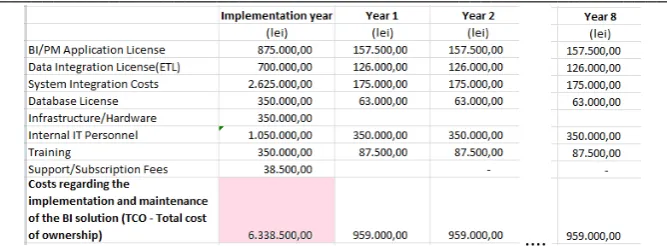
[image:8.595.127.475.475.596.2]consideration“ (Oco, Inc., 2007). Based on the proposed general approach (Figure 2), TCO will be calculated as part of a concret feasibility analysis regarding a BI project proposal for a midsized Limited Liability Company (LLC), that will ground the practical study case in paragraph 3. Figure 3a shows a TCO calculation for a SaaS BI initiative vs. a traditional BI implementation in Figure 3b.
________________________________________________________________
[image:9.595.131.465.112.235.2]....
Figure 3b. TCO calculation for a traditional implementation
As expected, the implementation year has a huge cost and the next eight years have also much greater costs then the SaaS variant. This because ETL (Data Integration License), System Integration Costs, Database License and Infrastructure/ Hardware Costs are not zero and because the internal IT Personnel costs are much higher for a traditional BI solution implementation comparing with the SaaS alternative.
3 Practical Case Study
The most powerful argument when implementing a BI solution is the substantial growth of visibility over business performance (Mircea, 2012). The greatest restriction that limits the adoption of a BI solution is the existence of a limited organizational culture (Nicolau, 2009).
In Romania, the local business culture related to BI is not so developed, only few managers have invested in BI initiatives. Recording to the last year statistics, less than 10 percent from the eligible firms acquired a BI solution (Edelhauser, 2011). In the nowadays Romanian business environment, small and medium sized enterprises proved to be a major source of innovation, flexibility and growth (Raşca, 2007), (Voicu, 2009), (Păunescu, 2012). It is also encouraging that entrepreneurs begin to identify the advantages brought by the BI systems in supporting decision-making processes (Mircea, 2008). Based on a request formulated by a Romanian midsized LLC, a complete feasibility analysis of a desired BI initiative has been conducted. The demarche was deployed according to the defined theoretical approach (Figure 2) and a convenient, popular Monte Carlo simulation based tool, like @RISK6, was used.
3.1 Establishing predictions for the inputs
__________________________________________________________________
Figure 4. No BI initiative. Prediction of the operational profit
Based on historical data and/or expert judgment, a distribution function for the annual sales growth rate is introduced.
Predictions for Year 1, for example, have in mind a Pert distribution (Figure
5) with a certain base percentage and a provisioned Min…Max range for possible extreme situations. Based on these assumptions, the probable evolution scenario together with the pessimistic and the optimistic one will be deployed. In a similar way, adequate distribution functions for the next years have been chosen.
Figure 5. Pert distribution function for Sales growth rate in Year 1
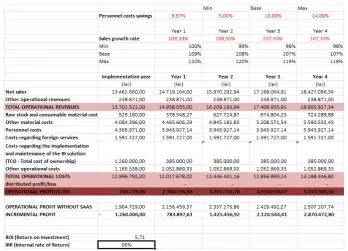
[image:10.595.184.412.405.556.2]________________________________________________________________ The predicted sales growth rate has suffered some adjustments regarding the considered Base, Min and Max assumption; the Pert distribution remains in actuality. The adoption of a SaaS BI initiative is supposed to increase the sales considerable and to diminish the personnel costs due to the increased operational efficiency. Personnel costs savings are presumed to be enclosed in a range from a minimum of 5% to a maximum of 14 percent and a base value of 10 percent (Figure 6), a triangular distribution function being associated (Figure 7).
Figure 6. SaaS BI initiative. Prediction of the operational profit/ ROI / IRR
[image:11.595.177.421.501.669.2]__________________________________________________________________ All previously established outputs (Figure 2) are calculated. A mean ROI value of 5,71 and a mean IRR of 95 percent has been obtained after 10.000 iterations executed during the Monte Carlo simulation process.
The simulation was also performed for a traditional BI initiative (Figure 8). As expected, the results are not encouraging.
[image:12.595.131.467.212.463.2]…
Figure 8. Traditional BI initiative. Prediction of the operational profit/ ROI / IRR after eight years of implementation
3.2 Analysing and interpreting the results
The two main outputs ROI (Figure 9) and IRR (Figure 10) will be analyzed based on a histogram, respectively a graph with cumulative descending distribution. Interactions are possible moving the sliders over the diagrams in order to identify the probability to obtain a certain output value (ROI or IRR).
In our case, according to Figure 9, the probability to obtain a ROI smaller than 1.5 is 1.6 percent, fairly sufficient for the company to go ahead with the project investment.
________________________________________________________________ and fourth year.
[image:13.595.138.457.170.343.2]Nevertheless, if the minimum sales growth rate can be increased to 100 percent, the risk of the project vanishes for good at all.
Figure 9. SaaS BI initiative. Results histogram for ROI
Figure 10. Saas BI initiative. Result graph for IRR
The mean values for ROI and IRR being profitable, the recommendation of a SaaS BI initiative as an advisable solution will be reinforced.
[image:13.595.133.462.383.556.2]__________________________________________________________________ Figure 11, and the graph with cumulative descending distribution for the IRR is shown in Figure 12.
Figure 11. Traditional BI initiative. Results histogram for ROI
Figure 12. Traditional BI initiative. Result graph for IRR
________________________________________________________________ 4. Conclusions and future work
Business Intelligence is the process for increasing the competitive advantage of a company by intelligent use of available data in decision-making. Only a revolutionary solution, like a Business Intelligence initiative, can solve the complex issues faced when evaluating decision support applications and ensure the availability of any business-critical information.
Small and medium sized firms have demands for BI solutions, needing systems that take into account users involved in operational actions, not only top managers, using scorecards, key performance indicators, analytical grid, dashboard analysis. But a rigorously feasibility analysis should be performed before starting any BI initiative. To avoid losses, a carefully monetary analysis is necessary. Therefore, a general theoretical approach will be proposed; outputs like ROI and IRR will be determined based on the specified input values and their predictions over the considered time period. Using Monte Carlo simulation techniques, pessimistic, probable and optimistic scenarios are deployed.
The theoretical considerations have been applied to a concrete study case on a Romanian LLC. Predictions of the inputs have been established, simulations have been fulfilled and results have been analysed. As expected, the SaaS BI initiative can be implemented with almost no risks at all.
Future researches have in mind an extended theoretical unitary approach of
further financial indicators in order to improve the proposal’s capabilities. Thereby,
the necessary support for evaluating BI initiatives will be guaranteed. This is an essential first step in helping firms, in particularly Romanian small and medium sized organizations, to become competitive by accumulating the right business intelligence.
REFERENCES
[1] Bennett, F.L. (2003), The Management of Construction: A Project Life Cycle Approach. 1st ed. Burlington: Butterworth-Heinemann;
[2] Björnsdóttir A.R. (2010), Financial Feasibility Assessments. Building and Using Assessment Models for Financial Feasibility Analysis of Investment Projects; Thesis submitted in partial fulfillment of a Magister Scientarium degree in Industrial Engineering, University of Iceland, Reykjavik;
[3] Brohman, D.K. (2000), The Business Intelligence Value Chain: Data Driven Decision Support in A Warehouse Environment. An Exploratory Study; Proceedings of the 33rd Hawai International Conference on Systems Science;
__________________________________________________________________ [5] Evans G. E., and Jones, B. (2009), The Application of Monte Carlo
Simulation in Finance, Economics and Operations Management; Computer Science and Information Engineering, 2009 WRI World Congress, Volume 4, 370-383
[6] Ghilic-Micu, B., Stoica M. and Mircea, M. (2008), How to Succeed in Business Intelligence Initiative: A Case Study for Acquisitions in Romania Public Institutions ; WSEAS Transactions on Business and Economics, issue 5, Volume 6, ISSN 1109-9526;
[7] Gonzalez, J.G. (2009), How to Apply a Monte Carlo Simulation to a Feasibility Study; October 2009, paper presented at the International Conference on Economics and Administration, Bucuresti;
[8] Hatch D., and Lock M. (2009), Business Intelligence (BI): Performance Axis, QI, <<a href='http://www.aberdeen.com/index.htm'>http://
www.aberdeen.com/index.htm>, Accessed on April. 3, 2012;
[9] Helfert, E.A. (2001), Financial Analysis Tools and Techniques: A Guide for Managers; 1st ed. New York: McGraw-Hill, 2001;
[10] Hurbean, C. and Dănăiaţă, D. (2010), SaaS – Better Solution for Small and Medium-Sized Enterprises. WSEAS Applied Economics and
Business Administration, ISSN 1790-5109;
[11] Jakovljevic, P.J. (2006), Software as a Service Is Gaining Groun'. March 14, 2006, <<a href='http://www.technologyevaluation.com/Research/ ResearchHighlights/CRM/2006/03/research_notes/TU_CR_PJ_03_14_06_ 1.asp >, Accessed on March 30, 2012;
[12] Jamaludin, I. A. and Mansor, Z. (2011), The Review of Business Intelligence (BI) Success Determinants in Project Implementation; International Journal of Computer Applications (0975 – 8887), 33( 8 ); [13] Joha, A. and Janssen, M. (2012), Design Choices Underlying the
Software as a Service (SaaS) Business Model from the User Perspective: Exploring the Fourth Wave of Outsourcing; Journal of Universal Computer Science, 18(11);
[14] Kaplan, R. and Norton, D. (1996), Translating Strategy into Action. The Balanced Scorecard. Harvard Business School Press Boston;
[15] Lee, A.C., Lee, J.C., Lee, C.F. (2009), Financial Analysis, Planning and Forecasting: Theory and Application. 2nd ed. Singapore: World Scientific Publishing Company;
[16] Manjunath, T. H. (2011), Design and Analysis of DWH and BI in Education Domain; International Journal of Computer Science Issues, 8(2), ISSN 1694-0814;
[17] Matson, J. (2000), Cooperative Feasibility Study Guide. (online) USA: United States Department of Agriculture. Rural Business – Cooperative Service. Report 58, <<a href=' http://www.rurdev.usda.gov/rbs/pub /sr58.pdf >, Accessed on April. 13, 2012;
________________________________________________________________ [19] Melfert, F., Winter, R. and Klesse, M. (2004), Aligning Process
Automation and Business Intelligence to Support Corporate
Performance Management; Proceedings of the 10th America Conference on Information Systems;
[20] Mircea M. (2008), Strategy for Selecting a Business Intelligence Solution; Revista de Informatica economica, 1(45), 2008;
[21] Mircea M. (2012), (Editor), Business Intelligence – Solutions for Business Development; InTech Publishing, ISBN 978-953-51-0019-5; [22] Mode C.J.(2011), Applications of Monte Carlo Methods in Biology,
Medicine and Other Fields of Science; InTech Publisher, ISBN 978-953-307-427-6;
[23] Mukles, Z. (2009), Business Intelligence: Its Ins and Outs; Technology Evaluation Centers, April 29th, 2009, <<a href='http://www;
technologyevaluation.com/research /articles/businessintelligence-its-ins-and-outs19503/>, Accessed on April. 23, 2012;
[24] Muntean M. and Cabău, L. (2011), Business Intelligence Approach in a Business Performance Context; Austrian Computer Society, Band 280; [25] Negash, S. and Gray, P. (2003); Business Intelligence; Proceedings of
the Americas Conference on Information Systems, 2003;
[26] Neubarth M. (2011), BI for SMBs is the Next SaaS Frontier,<<a href='http://www.business2community.com/tech-gadgets/bi-for-smbs-is-the-next-saas-frontier-072744 >, Accessed on May. 3, 2012;
[27] Nicolau C. M. (2009), The Development of Business Intelligence in Romanian Enterprises: A Possible Cultural Approach. Paper presented at the International Conference on Economics and Administration, Bucuresti, 2009;
[28] Oco, Inc. (2007), www.oco-inc.com: Calculating ROI for BI Solutions in Small and Mid-Sized Businesses, White Paper, 2007, <<a
href='http://whitepapers.technologyevaluation. com/pdf/8499/calculating-
roi-for-business-intelligence-solutions-in-small-and-midsized-businesses.pdf>, Accessed on May. 23, 2012;
[29] Park, C.S. (2002), Contemporary Engineering Economics. 3rd ed. New Jersey: Prentice Hall, Inc.;
[30] Păunescu (Răilean) L. (2012), Reflections on the Competitiveness of Small and Medium Enterprises in Romania, <<a href=
'http://www.management.ase.ro/reveconomia/20121/5.pdf>, Accessed on May. 30, 2012;
[31] Peterson D. and Fox A. (2012), Engineering Long-Lasting Software. An Agile Approach Using SaaS & Cloud Computin'; Alpha Edition,
Strawberry Carryon LLC, 2012;
[32] Popescu D. D. (2009), Enterprise Analysis; ASE Publishing; Bucuresti, 2009;
[33] Porter, M. E. (1980), Competitive Strategy; Free Press, New York, 1980; [34] Poştaru, A. and Benderschi, O. (2004), Teoria probabilitatilor şi
href='http://try-__________________________________________________________________ solve.com/downloads/Literatura/Metoda%20Monte Carlo.doc >, Accessed on May. 23, 2012
[35] Raşca, L. and Deaconu A. (2007), Romanian Small and Medium Sized Enterprises – Challenges Upon Accession into the European Union; Analele Universitatii din Oradea, 2007;
[36] Reyes E.P. (2010), A System Thinking Approach to Business Intelligence Solutions Based on Cloud Computing, submitted to the System Design and Management Program in partial fulfillment of the requirements for the degree of Master of Science in Engineering and Management,
Massachusetts Institute of Technology, 2010;
[37] Voicu V., Zirra D. and Ciocirlan D. (2009), Business Intelligence Effective Solutions for Management; the 10th WSEAS Conference on Mathematics and Computers in Business and Economics, Prague, 2009; [38] Wang Y., Li L. and Lim E.P. (2010), Trust-Oriented Composite Service
Selection with QoS Constraints; Journal of Universal Computer Science, 16(13), 1720-1744;
[39] Weisstein, E.W. (2002), Buffon's Needle Problem. From MathWorld--A Wolfram Web Resource., <<a href='http://mathworld.wolfram.com/ BuffonsNeedleProblem.html>, Accessed on May. 23, 2012; [40] Woller J. (1996), The Basics of Monte Carlo Simulations; University of
Nebraska-Lincoln, Physical Chemistry Lab (Chem 484), Spring 1996, <<a href='http: //www.chem.unl.edu/zeng/joy/mclab/mcintro.html>, Accessed on May. 23, 2012;
[41] Yeoh W., Koronios A. and Gao J. (2008), Managing the