ISSN Online: 2327-4379 ISSN Print: 2327-4352
Effect of Hole Size on Flow Structure and
Mixing Characteristic in a Multi-Hole
Baffled Micro Combustor
Won Hyun Kim, Young Su Park, Seon Myeong Park, Tae Seon Park
*School of Mechanical Engineering, Kyungpook National University, Daegu, Republic of Korea
Abstract
Flow structure and mixing properties by the baffle shape are numerically stu-died for a baffled micro combustor. The baffle shape is changed by various fuel and hole sizes. The numerical simulations based on different geometric conditions are performed by using the Reynolds Stress Model. The fuel-air mixing is greatly affected by flow recirculations. The centrally located flow circulation has an important role for the entire mixing performance. The re-sults show that this feature depends on the baffle configurations, and the baf-fle with small air holes represents efficient characters.
Keywords
Micro Combustor, Baffle, Diameter Ratio, Flow Recirculation, Mixing, Secondary Flows
1. Introduction
In most combustion based micro power generation devices, the micro combus-tor is an important key faccombus-tor to implement the energy converting from fuel contained chemical energy [1] [2]. Therefore, the entire system performance is determined by the combustion efficiency of combustor depending on the fuel-air mixing. However, for a micro combustor, the mixing of incoming fluids in a combustor is inherently weakened due to the flow laminarization and thus the combustion efficiency becomes worse. Especially, this feature is more obvious for a non-premixed combustor and results in a severe degradation for the whole system. Accordingly, a revised combustor for much higher fuel conversion effi-ciency is needed to solve such mixing problem.
To achieve this aim, many efforts have been devoted in recent [3]-[11]. Among them, one of effective way to get high mixing performance is to form a
How to cite this paper: Kim, W.H., Park, Y.S., Park, S.M. and Park, T.S. (2017) Effect of Hole Size on Flow Structure and Mixing Characteristic in a Multi-Hole Baffled Mi-cro Combustor. Journal of Applied Mathe- matics and Physics, 5, 7-16.
http://dx.doi.org/10.4236/jamp.2017.51002
circulating flows and mixing efficiency is not explored.
In the present study, the baffle shape effect on the flow structure and mixing performance is numerically examined. Based on this, the optimum condition is proposed to get more homogeneously mixed fuel-air mixture. For that purpose, the hole size is selected as a key parameter to vary baffle configurations. Because various momentum difference can be drawn via reducing or enlarging each hole size under a constant inflow condition. From the result, the relation of flow re-circulation and mixing performance are discussed by various baffle shapes.
2. Numerical Methods
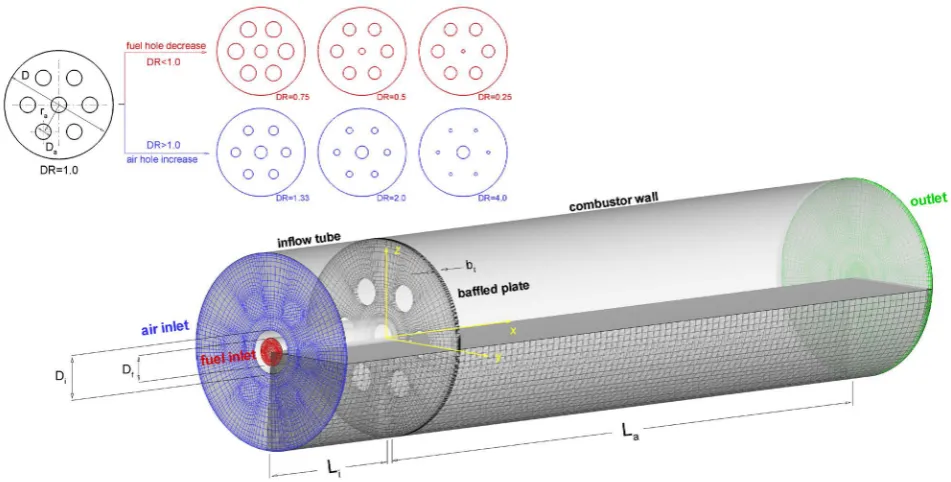
The entire computational domain is composed of the inflow tube, baffle plate, and combustor as depicted in Figure 1. Details of geometric conditions are summarized in Table 1. The inlet of central jet and annular tube is imposed by the fully developed velocity and turbulent profile based on the preliminary computation results of inflow tube. Incoming fluids of center jet and annular tube are selected as the methane and air, respectively. For comparison, the inlet mass flow rate is maintained as the air-fuel ratio of 17.11 for selected all cases. The pressure outlet and adiabatic wall (300 K) boundary condition are adopted. To see the baffle shape effect, the hole size is changed for seven cases depending on the diameter ratio (DR=Df /Do).
For steady and incompressible turbulent flows, the continuity and momentum equation are as follows [12]:
( )
0 i
i U x ρ
∂ =
∂ (1)
Table 1. Details of geometric conditions.
Combustor diameter, D 2.80 mm
Radial air hole position, ra 0.80 mm
Baffle thickness, bt 0.04 mm
Inner diameter of inflow tube, Di 0.62 mm
Combustor length, La 40.0 mm
Inflow tube length, Li 5.60 mm
Fuel (=air) hole diameter, Df (=Da) 0.1 - 0.4 mm
Figure 1. Computational domain and baffle configurations.
' '
( i j) i
i j
i j i
U U P U
u u
x x x x
ρ
µ ρ
∂ = −∂ + ∂ ∂ −
∂ ∂ ∂ ∂ (2)
where Ui, P,
µ
,ρ
, and ' ' i ju u are the velocity components, pressure, vis-cosity, density, and Reynolds stress, respectively. In Equation (2), is needed to an additional modeling to solve it. Among various turbulent closures, the Reynolds Stress Model is used and expressed as follows [12]:
( k i ) ij
k
j ij ij ij
U u D
x
ρ
u P +φ
ε
∂ = + +
∂ (3)
where Dij, Pij, φij, and εij represent the turbulent diffusion and production,
pressure-strain, and dissipation term, respectively. For simplicity, details of modeling and related constants for each term are omitted. And the species transport equation is additionally solved to evaluate a passive scale mixing and it is written as follows [12]:
(
j i)
i ij
U Y J R
t ρ x
∂ = − ∂ +
∂ ∂ (4)
where Yi, Ji, and Ri denote the mass fraction, diffusion flux, and net mass
rate of species i, respectively. Numerical simulations are employed by the An-sys FLUENT 13.0 [12]. The SIMPLEC algorithm is used for the pressure-velocity coupling and the second-order upwind scheme is applied to solve all equations under the convergence criteria of 6
10− . For saving the computational costs, the
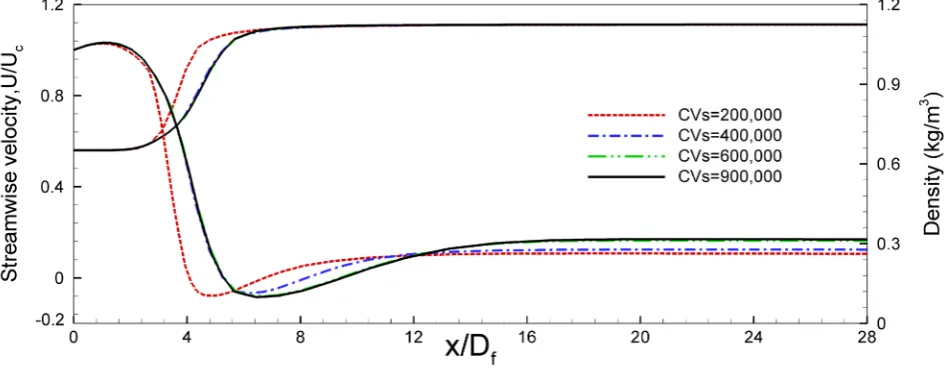
Figure 2. Grid dependency for different control volumes.
in the figure, the streamwise velocity and density profile appear almost identical more than 600,000 CVs. Based on this result, the final grid resolution is main-tained an approximate of 600,000 CVs.
In order to validate the numerical method, the present
RSM
is comparedwith the numerical result for κ ε− −fµ model and
LES
of Choi and Park [9]due to the lack of an available experiment data as the same current geometric condition. Figure 3 plots the vector map of x−z plane to see the evolution of flow recirculations by different turbulence models. Because of the turbulence closures difference, the size and position of reproduced recirculating flows are somewhat dissimilar to each model, but the overall trend of flow development is well predicted. Therefore, the numerical simulation implemented by a current method can be seen as reasonable.
3. Results and Discussions
3.1. Flow Structure and Mixing for DR = 1.0
According to the previous studies [6]-[11], the current baffle geometry induces the momentum difference between the incoming fuel jet and air flow passing by six air holes and between the air stream and ambient flow in a combustor. As a result of this, separated two parts of flow recirculation zones are generated. These features are dominant flow structure in determining the entire flow mix-ing. Therefore, the mixing mechanism properties coupled to the evolution of flow structure are needed to investigate previously before further discussion of the baffle shape effect.
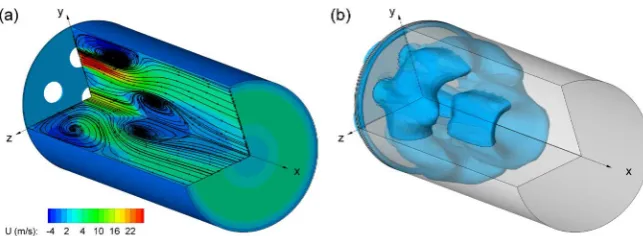
Firstly, in order to see the evolution of flow structure in a baffled micro com-bustor, Figure 4(a) shows the streamlines of
x
−
y
and x−z plane with the streamwise velocity contour forDR
=
1.0
. Looking at the figure, large two partsFigure 3. Comparison of vector plot for different turbulence models.
Figure 4. (a) streamlines of x-y and x-z plane with streamwise velocity contour; (b) iso- surface of Q = −0.05.
features contain strongly circulated radial flows, so large scale vortical structures are taken place as plots in Figure 4(b). To identify such vortical motions, the second invariant of the velocity gradient tensor, i.e. Q-criterion is used and the iso-surface of Q = −0.05 is presented. Here, the Q-criterion is defined as Q =
2 2
0.5(Ω Ω −ij ij S Sij ij)×Df /Uc where Sij and Ωij mean the strain rate and
vor-ticity tensor, respectively [13]. From its definition, the positive value of Q-crite- rion represents the vortical motion by the rotation tensor and it is well described in a current baffled combustor. As addressed by the previous studies [6]-[11], flow recirculations with large scale vortical structures provoke the development of complicated three dimensional flows. Under this process, the mixing of fuel and air becomes more homogenous. This can be confirmed through the follow-ing figure.
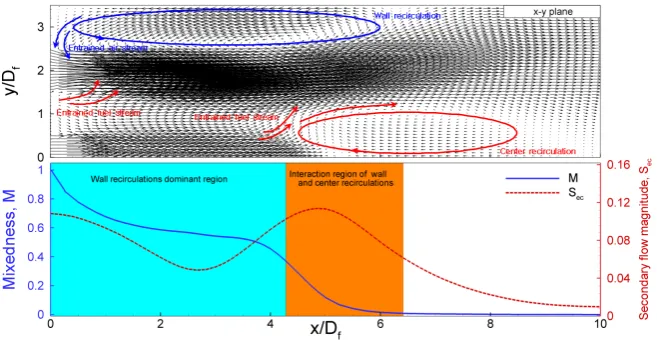
To examine the mixing process by flow recirculations, Figure 5 shows the vector plot of
x
−
y
plane, mixedness (M), and secondary flows magnitude (Sec). Herein, a passive scale mixing is quantitatively evaluated by following[14]:
(
)
(
)
(
)
( )
4 4
4 4
, , , ,
0, , 0
CH CH
CH CH
Y x y z Y x y z dydz M
Y y z Y dydz
− =
−
∫
∫
(5) [image:5.595.210.532.272.390.2]Figure 5. Vector plot of x-y plane and distribution of mixedness and secondary flows magnitude to the streamwise direction.
According to its definition, more homogenous mixing state is to be achieved when M becomes closer to 0. And Sec is computed from Sec= V2+W2/Uc. In the figure, M is initially decreased to x D/ f =4.0 where
WRF
appearsonly. This means that
WRF
is a dominant flow structure resulting in the flowmixing for that region. After that, M is steeply reduced for x D/ f =4.3 ~ 6.4
where the interaction of
WRF
andCRF
is actively occurred. These featuresare closely related to the entrained flow by recirculations. Namely,
CRF
andWRF
make the entrained flow toward the center axis and combustor wall asdisplayed by the added arrow in the vector plot. Due to this, the radial secondary flows motion is more provoked and its maximum value is about 12% versus the momentum of fuel jet at the baffle exit. Accordingly, M is fastly decayed un-der a comparatively high value of Sec for x D/ f =0.0 ~ 1.0 and
/ f 4.0 ~ 6.0
x D = . Especially, it is to note that the complete mixing is to be achieved before the center of
CRF
. From this result, we can conclude thatCRF
is an important factor to develop more efficient and compact combustor.Because, if
CRF
would be removed, M and Sec values are monotonically decreased. This means that much longer combustor length is needed to obtain perfectly mixed state of incoming fuel and air into a combustor.3.2. Diameter Ratio Effect
As discussed in previous section, the mixing properties in a micro combustor are seriously dependent on the evolution of flow recirculations. Thus, the modified flow structure by the variance of momentum difference has a significant effect on the entire mixing performance. To confirm this, the fuel and air hole size are changed for various diameter ratios. Because, in a current baffle geometry, vari-ous momentum differences can be drawn by the resizing of fuel or air hole. Based on the same fuel and air hole for
DR
=
1.0
, DR=0.75, 0.5, 0.25 for fuelhole decreased cases and DR=1.33, 2.0, 4.0 for the air hole reduced cases are
additionally selected.
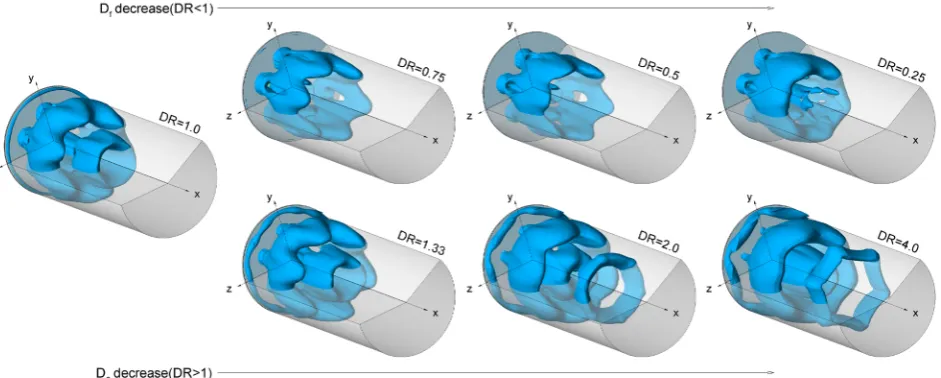
recircula-tions, the iso-surface of Q = −0.05 for different diameter ratios are presented in Figure 6. As can be seen in the figure, the influence of baffle shape on the re-produced flow structure is very clear. For
DR
<
1.0
,CRF
is not formeddis-similar to
DR
=
1.0
, so there is no centrally locatedVF
. It is mainly attributedto the strongly penetrated fuel stream with the decrease of fuel hole. Instead, near wall
VF
is expanded to downstream by more passed and circulated flowin a streamwise direction. On the other hand, the wallward motion of
VF
isalmost unchanged for
DR
>
1.0
, but theVF
in the vicinity of center axis ismore enlarged and pulled upstream. From this feature, the interaction is more enhanced as can be explained in Figure 5 and thus the flow mixing becomes better than
DR
=
1.0
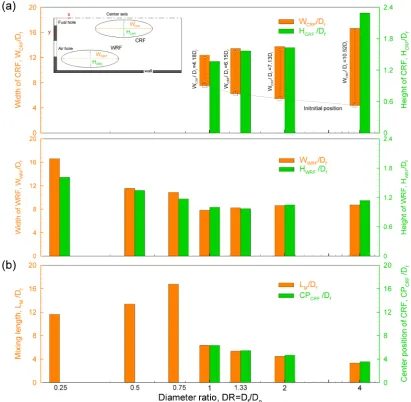
.For detailed comparisons, the variance of flow recirculations depending on DR is needed to quantify. Toward this end, the variations of width and height for CRF and WRF by DR are compared in Figure 7(a). As added in the figure, the width and height of each flow recirculation are defined as the streamwise and vertical length across the center, respectively. And Figure 7(b) shows the mixing length (LM). Herein, LM is defined as the normal distance
to M =0.01 which is achieved 99% mixing.
In Figure 7(a), CRF appears for DR > 1.0 and it is expanded to a stream-wise and radial direction as the air hole is scaled down. Also, the initially devel-oped location moves upstream and thus the interaction with WRF becomes more intensified. This spatial enlargement of CRF and subsequently rein-forced interaction between recirculations can induce more entrained flows and secondary motions. Due to this feature, the mixing ability is more enhanced for
1.0
DR> based on DR=1.0. Among them, DR=4.0 shows the best mixing
[image:7.595.67.538.522.711.2]performance with the shortest mixing length. It is mainly due to the largest de-veloped CRF with its intensified interaction with WRF. Moreover, the width and height of WRF is also increased, but its change is negligible compared to the variance of CRF.
Figure 7. Comparison of (a) flow recirculation variance, (b) mixing length by diameter ratio.
For DR < 1.0,
WRF
is seriously varied depending on DR. The highly ejectedfuel stream inversely proportional to the fuel hole size hinders to generate
CRF
,but it contributes to make more spatially enlarged
WRF
. For those cases, theflow mixing is becomes fast for smaller fuel hole size. However, compared to
1.0
DR
=
, further longer combustor length is required to obtain completelymixed flows. On the other hand, 99% mixing is to be achieved near the middle of
CRF
and this location is further anchored upstream as the air hole decreases.Especially, almost a half of combustor size is required for
DR
=
4.0
. So, tode-velop a more efficient micro combustor, it is desirable to make for higher mo-mentum of air flow than that of the fuel jet. In this point, the selection of smaller air hole in a baffled combustor is an one of effective alternative.
4. Conclusions
baffle were changed by various diameter ratios. For the baffle with constant sized holes, the overall flow mixing was governed by the evolution of flow recircula-tions with large scale vortical structure. The mixing was provoked by the en-trained secondary flows due to the wall recirculations near the baffle plate. As the flow develops downstream, the interaction between the wall and center re-circulations is reinforced within a narrow zone. Then, the complete mixing was to be achieved before the middle of center recirculation. From this result, it was ascertained that the center recirculation is a decisive factor for the mixing per-formance.
So, the relation between the variation of center recirculation and the flow mixing characteristics was investigated by changing fuel and air hole size. For
1.0
DR< , the center recirculation was not formed, whereas the wall recircula-tions were spatially enlarged as the fuel hole decreased. For those cases, relatively longer combustor length was required to obtain completely mixed mixture compared to DR=1.0. On the contrary, it was possible to make more
mini-mized combustor with highly mixed state of incoming fluids as the air hole re-duced. This was mainly due to the strongly developed center recirculation for
1.0
DR> and DR=4.0 had the largest center recirculation with the fastest
flow mixing. As a result, it was confirmed that the better mixing performance in a baffled combustor is obtained by the air stream of higher momentum than that of the fuel stream.
References
[1] Chia, L.C. and Feng, B. (2007) The Development of a Micropower (Micro-Thermo- photovoltaic) Device. Journal of Power Sources, 165, 455-480.
https://doi.org/10.1016/j.jpowsour.2006.12.006
[2] Ju, Y. and Maruta, K. (2011) Microscale Combustion: Technology Development and Fundamental Research. Prog. Energy Combust. Sci, 37, 669-715.
https://doi.org/10.1016/j.pecs.2011.03.001
[3] Bagheri, G., Hosseini, S.E. and Wahid, M.A. (2014) Effects of Bluff Body Shape on the Flame Stability in Premixed Micro-Combustion of Hydrogen-Air Mixture. Ap-plied Thermal Engineering, 67, 266-272.
https://doi.org/10.1016/j.applthermaleng.2014.03.040
[4] Wan, J., Fan, A., Maruta, K., Yao, H. and Liu, W. (2012) Experimental and Numer-ical Investigation on Combustion Characteristics of Premixed Hydrogen/Air Flame in a Micro-Combustor with a Bluff Body. International Journal of Hydrogen and Energy, 37, 19190-19197. https://doi.org/10.1016/j.ijhydene.2012.09.154
[5] Fan, A., Wan, J., Liu, Y., Pi, B., Yao, H. and Liu, W. (2014) Effect of Bluff Body Shape on the Blow-Off Limit of Hydrogen/Air Flame in a Planar Micro-Combustor. Applied Thermal Engineering, 62, 13-19.
https://doi.org/10.1016/j.applthermaleng.2013.09.010
[6] Yahagi, Y., Sekiguti, M. and Suzuki, K. (2007) Flow Structure and Flame Stability in a Micro Can Combustor with a Baffle Plate. Applied Thermal Engineering, 27, 788- 794. https://doi.org/10.1016/j.applthermaleng.2006.10.019
Characteristics in a Micro Can Combustor with a Seven-Hole Baffle. Applied Ther- mal Engineering, 100, 378-391.
https://doi.org/10.1016/j.applthermaleng.2016.02.004
[12] Fluent 6.3 User’s Guide, Fluent Inc., Lebanon, New Hampshire, 2006.
[13] Haller. G. (2005) An Objective Definition of a Vortex. Journal of Fluid Mechanics, 525, 1-26. https://doi.org/10.1017/S0022112004002526
[14] Park, T.S. and Chung, Y.M. (2011) Turbulent Flow and Scalar Mixing of a Coaxial Injector Having Two Fluid Jets. Numerical Heat Transfer, Part A, 60, 197-211.
https://doi.org/10.1080/10407782.2011.582410
Submit or recommend next manuscript to SCIRP and we will provide best service for you:
Accepting pre-submission inquiries through Email, Facebook, LinkedIn, Twitter, etc. A wide selection of journals (inclusive of 9 subjects, more than 200 journals)
Providing 24-hour high-quality service User-friendly online submission system Fair and swift peer-review system
Efficient typesetting and proofreading procedure
Display of the result of downloads and visits, as well as the number of cited articles Maximum dissemination of your research work
Submit your manuscript at: http://papersubmission.scirp.org/