Munich Personal RePEc Archive
Does the Food Stamp Program Really
Increase Obesity? The Importance of
Accounting for Misclassification Errors
Vassilopoulos, Achilleas and Drichoutis, Andreas and Nayga,
Rodolfo and Lazaridis, Panagiotis
Agricultural University of Athens, University of Ioannina, University
of Arkansas
January 2011
Online at
https://mpra.ub.uni-muenchen.de/41811/
Does the Food Stamp Program Really Increase Obesity?
The Importance of Accounting for Misclassification Errors
Achilleas Vassilopoulos1,Andreas C. Drichoutis2, Rodolfo M. Nayga, Jr.3and
Panagiotis Lazaridis4
1
Dept. of Agricultural Economics and Rural Development, Agricultural University of
Athens, Greece, email: avas(at)aua.gr
2 Dept. of Economics, University of Ioannina, Greece, email: adrihout(at)cc.uoi.gr
3
Dept. of Agricultural Economics and Agribusiness, University of Arkansas, USA;
Norwegian Agricultural Economics Research Institute. email: rnayga(at)uark.edu
4 Department of Agricultural Economics and Rural Development, Agricultural
University of Athens, Greece, email: t.lazaridis(at)aua.gr
Abstract
Over the last few decades, the prevalence of obesity among US citizens has grown
rapidly, especially among low-income individuals. This has led to questions about the
effectiveness of nutritional assistance programs such as the Supplemental Nutrition
Assistance Program (SNAP), formerly known as the Food Stamps Program (FSP).
Results from previous studies generally suggest that FSP participation increases
obesity. This finding is however based on the assumption that participants do not
misclassify their program participation despite significant misclassification errors
reported in the literature. Using propensity score matching and a new method to
conduct extensive sensitivity analysis, we conclude that this finding is sensitive to
misclassification errors above 10% and to the conditional independence assumption.
JEL codes:C63, D12, I1
2
1. Introduction
Obesity is increasing worldwide in dramatic rates. The World Health Organization
indicated that there were 1.4 billion overweight adults and at least 500 million obese
adults in the world in 2008 (WHO (2012) Obesity and Overweight. Fact Sheet No 311.
World Health Organization). By 2015, these figures are expected to rise to 2.3 billion
overweight and 700 million obese adults. Obesity effects on health are well supported
by the medical literature and include a long non-exhaustive list that includes
osteoarthritis, sleep apnea, asthma, high blood pressure, gallbladder disease,
cholesterol, type II diabetes, cardiovascular disease, stroke, renal and genitourinary
diseases (Bray, 2004, Esposito et al., 2004, Grundy, 2004, Whitmer et al., 2005,
Ejerblad et al., 2006, Van der Steeg et al., 2007). Obesity may also inflict severe
emotional harm, such as social stigmatization, depression, and poor body image.
Researchers have rightly responded to this unprecedented rise of obesity as
evidenced by the exploding number of papers published in the nutrition/medical as
well as the economics literature. The economic causes of obesity for adults and
children are nicely analyzed in Rosin (2008) and Papoutsi et al (2012), respectively.
Among the many factors linked to the high obesity prevalence are the increased
opportunity cost of time for food preparation, along with the availability of “cheap”
calories provided by fast-food restaurants, as well as the adoption of sedentary
lifestyles (Cutler et al., 2003, Philipson and Posner, 2003, Lakdawalla et al., 2005).
One interesting aspect of the obesity epidemic is that prevalence rates have been
found to be higher and to increase more rapidly among lower income people, a group
usually associated with fewer resources and poor diets.
To this respect, a number of nutrition assistance programs funded by the U.S.
3
andnutrition concerns. The Supplemental Nutrition Assistance Program (SNAP),
formerly known as the Food Stamps Program (FSP)1 is by far the largest nutrition
assistance program in the US. The FSP as implemented in 1964 was designed to
alleviate hunger by distributing coupons that could only be used to purchase food at
grocery stores. FSP benefits are given to a single person or family who meets the
program’s requirements pertaining to income, assets, work and immigration status.
Most benefit periods last for 6 months but some can be as short as 1 month or as long
as 3 years. Currently, electronic benefit transfers that operate essentially as debit cards
have replaced food stamp coupons. According to USDA data, about 40 million
individuals and 18 million households nation-wide participate in this program, with
total amount of benefits reaching 65 billion USD in 2010. Eligibility and benefits are
based on household size, household assets, and income. Other food assistance
programs in the US include the School Breakfast Program (SBP), the National School
Lunch Program(NSLP) andthe Women, Infant and Children Program (WIC).
Due to increasing obesity rates in the US, particularly among low-income
individuals, this paper is focused on assessing the effect of FSP on obesity. There are
two main theories on how food stamp benefits could contribute to weight gain: (1)
food stamps encourage beneficiaries to spend more money on food than they
otherwise would (and presumably, to eat more); and (2) food stamp participation is
linked to a cycle of deprivation followed by abundance and binge eating, which
results in weight gain over time (Ver Ploeg et al., 2007).
Several studies have examined the effect of FSP participation on various
outcomes. These studies differ in terms of the targeted groups (e.g., children, adult
1 For the rest of the paper we use the term FSP rather than SNAP since this program is still more popularly known
4
women/men and the elderly), the outcomes of interest (e.g., Body Mass Index, food
security index, probability of being overweight/obese), the nature (e.g.,
cross-sectional, longitudinal) and the sources of the data2 as well as the methodology they
employ3. Results from a number of past studies suggest a positive effect of FSP
participation on adult obesity. For example, Baum (2007) found that FSP participation
increases the probability of being obese in females aged 20-28 while the amount of
food stamps benefit was positively related to BMI in males of the same age group.
Gibson(2003) concluded that FSP participation is responsible for a 2 percentage point
increase in the BMI of adult women. This effect was even greater in the case of
long-term participation. Chen et al. (2005) also found that women FSP beneficiaries have
an obesity rate that is 6.7 percent higher than that of women non- beneficiaries. On
the other hand, Kaushal (2007) found no significant effect of FSP participation on
obesity of both men and women.
These past studies, however, did not take into account the misclassification
errors associated with self-reported FSP participation status. This issue is important
since results could be sensitive to these misclassification errors, which have been
reported in the literature to be non-trivial. For instance, Bollinger and David (1997)
and Bitler et al. (2003) suggest that about 10%-15% of recipients do not report FSP
participation when asked by the interviewer while Meyer et al. (2010) report an even
higher (35%-50%) misclassification error. If this is the case, then previous findings
2
The Panel Study of Income Dynamics (PSID) along with the Child Development Supplement (CDS), the
National Health and Nutrition Examination Survey (NHANES), the National Longitudinal Survey of Youth
(NLSY79), the Health and Retirement Study (HRS) and the Asset and Health Dynamics Among the Old (AHEAD)
are some of them.
3 Descriptive statistics, OLS and Logistic Regressions, IV estimators (with and without fixed effects), Bivariate
5
associating FSP participation with obesity could be biased and misleading. Our
objective is to assess how misclassification errors could affect the estimated effects of
FSP participation on obesity. We also take into account the complex endogeneity
issues inherent in these types of analysis and extensively assess the robustness of our
results to deviations from the usual assumptions.
Since FSP participation is not randomly but rather endogenously assigned to
subjects according to some observable (e.g., eligibility criteria) and unobservable (e.g.,
information acquisition, attitudes etc.) factors, it is very likely that some of these
factors are highly correlated with the outcome of interest, making it hard to uncover
any causal effect without a proper identification strategy. In this study, we employ the
propensity score matching method and perform an extensive sensitivity analysis to
assess the robustness of its restrictive assumptions. Quoting Angrist and Pischke
(2010), scrutinizing our results through a sensitivity analysis process is what takes the
con out of the econometrics.
We build on the work of Ichino et al.(2008) who proposed an excellent way of
assessing the robustness of matching estimators while avoiding parametric
assumptions. We then extend this method to account for the misclassification errors in
FSP participation. To our knowledge, this is the first time such a sensitivity analysis is
performed in the literature. To illustrate how misclassification errors could affect the
estimated effects of FSP participation on obesity, we utilize the 2005–2006 National
Health and Nutrition Examination Survey (NHANES). NHANES is designed to
assess the health and nutritional status of adults and children in the US and is unique
in that it combines interviews and physical examinations.
2. Methods
6
The research question of interest is whether participating in the FSP increases
the probability of being obese. Formally, assume that there is a binary indicator Y
that takes the value of 1 if the respondent has both a BMI4 greater than 30 kg/m2 and
a waste circumference (WC) greater than 100 cm, and 0 otherwise5. Define a second
binary variable T, indicating the treatment and being equal to 1 for participants and 0
for non-participants. Of course, a mere comparison of the obesity rate among
participants and non-participants does not reveal a causal relationship between the
FSP participationand obesity. It is likely that the two groups differ in many other
characteristics that could lead to differences in the outcome even if food stamps were
not received by either group. We postulate the existence of two potential binary
outcomes denoted by Y
1 and Y
0 which take a value of 1 if the subject is obeseand 0 otherwise and denote the outcome that would be realized in the case of
participation and non-participation respectively. It is obvious that we either observe
1Y or Y
0 , but never both. The effect of the treatment on each individual can bedefined as:
(1) (0)
tY Y (1)
This effect, averaged over participants is the average treatment effect on the treated
(ATT) estimand, namely:
1 | 1
0 | 1
ATT E Y T E Y T (2)
4
The BMI (Body Mass Index) is used to define nutritional status and is derived from the division of Weight in kilograms by the square of height in meters. The acceptable range is the same for men and women and lies between 20 and 25. Obesity is taken to start at a BMI of 30 and gross obesity at 40. A BMI of 18-20 is defined as mild starvation and severe starvation begins when BMI falls below 16.
5
7
Since E Y( (0) |T 1) is not observed, one needs to make some additional
assumptions in order to estimate the ATT. The first is that Y(0), conditional on a set
of observable covariates X , does not influence participation in the program:
0 |Y T X (3)
This assumption is widely known as the Conditional Independence Assumption (CIA),
the restrictive nature of which seems unappealing to many researchers and decreases
the popularity of matching estimators. A second assumption is the common support or
overlap condition, which ensures that for every FSP participant, there are
non-participants with the same observable covariates, that is:
Pr T 1 |X 1 (4)
In the estimations to follow, we ensure that observations falling out of the
common support region are excluded. If assumptions (3) and (4) hold, then after
conditioning on X , ATT becomes estimable through (2) by substituting the
unobservableE Y[ (0) |T 1,X], with its observable counterpart, E Y[ (0) |T 0,X]. To
solve the dimensionality problem arising when Xis a lengthy vector, Rosenbaum and
Rubin (1983) suggested the use of the propensity scoree X( ) Pr(T 1 |X), instead
of Xas the conditioning variable. Thus, the ATT parameter is given by:
{ 1} 1 | 1, ( ) 0 | 0, ( )
PSM T
ATT E E Y T e X E Y T e X (5)
Inasmuch as the FSP is designed to help low-income groups, it seems
reasonable that the control group should be the eligible non-recipients, classified as
such using the most important eligibility criterion of FSP participation, the Poverty
Income Ratio (PIR). The PIR is also the only available eligibility criterion in our
8
could render CIA implausible) are less likely to differ among individuals of these two
groups.
ATT can be estimated using several matching algorithms such as the nearest
neighbor, kernel, stratification, radius and spline smoothing. We use the nearest
neighbor propensity score matching, using the four nearest neighbors6 and report
analytical standard errors since the bootstrap variance estimator is invalid for nearest
neighbor matching (Abadie and Imbens, 2006). The variables used in the probit
regression in order to estimate the propensity score (e X( )) are shown in Table 1. The
first two variables are the outcome and the control variable respectively. In selecting
the variables to be included in the propensity score estimation we rely on the advice
of Rubin and Thomas (1996) and the evidence provided by Brookhart et al. (2006)
that one should include in the estimation of propensity scores all variables that are
thought to be related to the outcome, regardless of whether they are related to the
exposure. Household’s FSP participation (FS_hh) was used instead of the individual’s
participation status since FSP benefits are most certainly shared among the members
of the household. For the same reason, WIC participation (WIC_hh) was included in
the set of covariates. Other factors such as Alcohol and Smoker were included to
account for the non-food expenses of the groups which could reduce available
resources for food and decrease or increase the probability of being obese. Chronic
and DocDiab are used to account for the possible links between these different
6
When selecting the number of matches one has to consider the bias-variance trade-off, since utilizing multiple
matches for each treated individual will generally increase bias (2nd, 3rd, and 4th closest matches are, by
definition, farther away from the treated individual than is the 1st closest match) while on the other hand, it can
decrease variance due to the larger matched sample size (Stuart, 2010). We use four matches in order not to rely on
too little information but to also avoid incorporating observations that are not sufficiently similar. Like all
9
conditions and obesity. Square, cubic and interaction terms for all continuous
variables and their transformations were also included in the model. Millimet and
Tchernis (2009) showed that over-specifying the model used to estimate the
propensity score is always the best strategy, considering the penalty associated with
the under-specification. Finally, we include demographic variables such as age, ethnic
characteristics, educational level, income, marital status, and household size to
capture the biological differences affecting BMI, the awareness about nutrition issues
as well as the within-household consumption dynamics in the allocation of resources.
The estimates of ATT derived from the above procedure will be referred to as the
Unconfounded Baseline Estimates (UBEs). These are then compared with those
described below.
2.2. Misclassification errors
Due to the self-reported nature of the FSP participation data at hand, (5) is not
estimable, since what we observe is not Tbut Tobs. The difference between the two
indicators depends on whether the individuals that stated non-participation in FSP
were actually non-recipients or not7. Given that there is no way to identify those who
made a false-statement, the misclassification of subjects in the treated and the control
groups would have caused a severe bias through e X( ), thereby making the results
completely uninformative. Since some individuals are erroneously misclassified as
樂丹怒寧怜琉猪 ٻ ڈ ژ ک ہ ھ
underestimated depending on the extent of misclassification (see Battistin and Sianesi
2011). In addition, the ATT estimated from raw data could refer to a population
7
Although we ignore the proportion of individuals acting the other way around (i.e., reporting being FSP
participants while they are not) due to the fact that it is usually a negligible group, the proposed methodology can
10
different from the population the true ATT refers to, as some of the individuals with
1
T might be discarded from the analysis due to violation of the common support or
overlap condition. Finally, in the estimation with a confounder (analyzed in the next
section) there would be no possible way to define the parameters Prijthat characterize
its distribution, since actual i’s are not known.
We circumvent this problem by simulating different scenarios where a
respondent that reported not to have received food stamps belies her true state of
participation by some probabilityPr
T 1 |Tobs 0
8. To avoid further functionalform assumptions about the probability distribution, we assume different
misclassification values in an attempt to discover a cut-off point, beyond which our
results fall flat. Specifically, we assess the robustness of our results to
misclassification errors of 5%, 10%, 15%, 20%, and 25% to cover the possible
misclassification errors suggested by Bollinger and David (1997), Bitler et al. (2003),
and Meyer et al. (2010). To accomplish this, we created m new databases9 for each
level of misclassification errors (i.e., 5m in total), with each of these datasets
containing all the variables that are exactly as in the original database and a new
participation indicator (FS_hh_new). The values of this dummy are same as those of
FS_hh, with the only difference being that a random10 percentage of zeroes (5%-25%
depending on the level of misclassification error examined) in the latter (FS_hh), are
8
Note that these values can be further decomposed into Pr
T1|Tobs0,Y1
and Pr
T1|Tobs0,Y0
, if the researcherhas strong evidence or a meaningful explanation on why the probability of misclassification can be related to the
outcome of interest.
9
In particular we've usedm=1000 but we keep this notation for demonstration simplicity.
11
transformed into ones in the former (FS_hh_new). Hence, we consider 5%-25% of the
non-participation reports to be false-statements.
It should be mentioned that during the simulation, from the whole pool of
possible datasets we utilize only those that satisfied the following criteria: a) the
averages of the covariates in the treated group and the weighted averages of the same
covariates in the control group were not to be significantly different11 based on a
Hotelling’s test, b) the probit model to be used for the estimation of the propensity
score passed a link test (Pedigon, 1980) and the Hosmer–Lemeshow (2000) goodness
of fit test with 10 groups, and finally c) after matching, all covariates in the probit
model were jointly insignificant as indicated by a Likelihood Ratio test as in Sianesi
(2004). Datasets not satisfying one of the above criteria were discarded and the
process continued until m datasets were constructed. This way, the danger of
introducing severe bias into the model or violating the balancing property (i.e. having
the treated and control units have the same distribution of observable covariates) is
mitigated. We then proceeded by obtaining a point estimate of ATT for each of the
new databases (i.eATTk PSM,mis for k=1,...m). Although it is relatively easy to calculate
mis
PSM
ATT by averaging overall point estimates, the calculation of the standard errors is
less straightforward. Using Rubin's (1987) combination of repeated complete-data
variances, we calculate the standard errors as:
1
1
mis
PSM m
ATT
se V B
m
(6)
11
We use weighted averages for the control group since we employ a 4 to 1 nearest neighbor matching. The
weights are the common normalized weights that were then used in the estimation of the 4 to 1 nearest neighbor
12
where 1 1
m
is the correction factor (correcting for the fact that m is finite),Vis the
average of the estimated variances associated with each of the m ,mis k PSM
ATT :
1
1 m
k k
V V
m
(7)andBm is the variance among the m ATTk PSM,mis :
2
1
1
( , )
1
m mis
mis
k P M PSM k
m ATT S ATT
B
m
(8)For a large number of replications the statistic ( ) / mis PSM mis
PSM ATT seATT
ATT is
approximately normal.
2.3 Confounders
Another possible pitfall of the methodology is the possible bias of ATTPSM in
the case of a failure of the CIA, namely:
0 | 1, ( )
0 | 0,
BIAS E Y T e X E Y T e X (9)
The bias is minimized when e(X)0.5 (Black and Smith, 2004, Heckman
and Navarro-Lozano, 2004). Hence, Black and Smith (2004) suggested to estimate the
PSM
ATT , within the ‘thick support’ region of the propensity score (i.e.,
0.33e X 0.66 ). However, if treatment effect varies with X , the estimated
parameter would deviate from the corresponding population parameter and thus might
not be very informative. We follow a different strategy instead: we assume that CIA
13
U .12 In the case of CIA failure, such confounders once added would impose CIA to
the model and consequently would transform (5) into:
{ 1} 1 | 1, ( , ) 1 | 0, ,
conf PSM T
ATT E E Y T e X U E Y T e X U (10)
We are particularly interested in assessing how the baseline estimates of (5)
would change with the addition of possible confounders U, in order to perform a
robustness check of our results. If the findings suggest that conditional on the
existence of such confounders a positive effect is still in place, then one can be more
confident of the interpretation of the results. According to Ichino et al. (2008), it is
preferable to avoid parametric assumptions about the simulated confounder. Different
hypotheses about the distribution of the confounding factorcould be simulated by
imposing the values of the parameters characterizing the distribution of U
Prij Pr U 1|T i Y, j X, i j,
0,1 ; then predict a value for each subjectaccording to these parameters, and finally estimate ATTk PSM,conf n times for the same
distribution parameters13 (i.e., for k=1,...,n). For each simulated confounder, the
conf
PSM
ATT is the average of all ATTk PSM,conf and these results will henceforth be called the
Confounded Baseline Estimates (CBEs) which are to be compared with the UBEs.
The formulas for the calculation of the standard errors of the ATTconfPSM are those
shown in (6)-(8), replacing the subscripts m with n and ATTmisPSM with conf PSM
ATT .
In each of the n iterations, two logit models (two odds ratios) are fitted
(calculated). The first (Pr
Y 1|T 0, ,U X
)is estimated to show the effect that such
12
If inferences based on the UBEs are robust in the presence of binary confounders, then this holds even if the true
ones are continuous (see Ichino et al. (2006), for a proof via Monte Carlo simulations).
13
14
a confounder would have on the odds of being obese in the case of no treatment
(outcome effect), while the second (Pr
T 1| ,U X
) is employed to highlight therelative importance of the hypothesized confounder on the participation probability
(selection effect). The odd ratios obtained from the above models are referred to as α
and ε respectively.
As a first simulation practice, we simulate a neutral confounder (i.e., a
confounder which has exactly a 50% chance to be 1 in all possible treatment/outcome
combinations) and the confounders that mimic the distribution of some of the
demographic variables (i.e., Male, Chronic, Educ1, Educ2, Educ3,MarStat1, MarStat2).
The results are shown in Tables 5, 6, and 7. Since these results are highly dependent
upon the selection of the covariates, we then search for the possible existence of
confounders that could determine a positiveATTPSM even in the absence of a true
causal relationship between T and Y. As shown in Ichino et al. (2006), such
‘dangerous’ confounders can be simulated by fixing the probability Pr(U = 1) and the
difference pr11 − pr10 at some predetermined values14 and then assigning positive
values15 to d= pr01 – pr00 and s= pr1. – pr0., wherepri. Pr
U 1|T i X,
.Then,through α and ε,we are able to assess how strong the confounders generated in this
particular configuration of parameters should be in order to alter inferences based on
PSM
ATT . If only very strong confounders are capable of doing so, the findings are
considered to be robust to CIA failures.
14
We have set the value of Pr(U = 1) to 0.3 and that of p11 − p10to 0. Since these quantities are not expected to
represent a real threat to the baseline estimate, the results remain qualitatively intact when considering different
values.
15
To do so, we used the Matlab codeavailable on the website http://www.tommasonannicini.eu , which returns all
15
2.4 Misclassification errors and Confounders
Up to this point, we have managed to assess the robustness of inferences based
on UBEs by assuming misclassification errors and confounding variables separately.
However, we have ignored the possibility of these two deviations coexisting in our
settings. Hence, we need a combination of the two procedures described above to
further assess the validity of our results. The combining rule is a nested imputation
approach as described in Shen (2000) and employed in Rubin (2003) and Harel
(2007). According to this procedure, in each of the m databases created for each level
of misclassification errors (as previously demonstrated under the Misclassification
errors section), we construct n confounders for each set of parameters prij as described
above in the estimation of ATTconfPSM. As a result we end up with m×n (i.e. 1 million)
ATT estimates for each level of misclassification errors and each confounder
examined, the average of which provides the Misclassified Confounded Estimates
(MCEs) ATTmis confPSM, . The calculation of the standard errors of , mis conf PSM
ATT is now more
tedious since the variability comes from multiple sources and is calculated as:
mis conf, 1 1 (1 1)
PSM n m
ATT
se V B B
n m
(11)
where(1 1)
n
and (1 1)
m
are the correction factors (correcting for the fact that m and
n are finite), Vis the average of the estimated variances associated with each of the
,
, mis conf i PSM
ATT for i=1,..,.m n :
1 1
1 m n
k j kj
V m
V
n
16 m
B is the between database variance:
, , 1 2 1 , 1 1 ( ) 1
m mis conf mis conf
m kj PSM PS
n
M k j
B ATT ATT
m n
(13)and Bn the average between imputation variance:
, ,
1 1
2
1
, ,
1 1 1
( )
1
n mis conf mis conf
n k
m n
k j j
j PSM kj PSM
B ATT ATT
m n n
(14)For a large number of replications the statistic ,
,
)
( / mis conf PSM mis conf
PSM ATT seATT
ATT
approximates a normal distribution.
To sum up, the methodology of the paper consists of foursteps. First, we estimate
PSM
ATT using nearest neighbor propensity score matching, using the four nearest
neighbors while assuming that CIA holds and that Pr
T 1 |Tobs 0
0. The resultsof this procedure are the Unconfounded Baseline Estimates (UBEs). Second, we
simulate different misclassification scenarios and obtain the Misclassified Baseline
Estimates (MBEs) that are compared with the UBEs. Next, we derive the CBEs and
MCEs by augmenting the model used for UBEs and MBEs separately with a neutral
confounder (i.e., a confounder which has exactly 50% chance to be 1 in all possible
treatment/outcome combinations) and with confounders that mimic the distribution of
known demographic variables (Male, Chronic, Educ1, Educ2,
Educ3,MarStat1,MarStat2). In the final step, we generate confounders that could
incorrectly reveal a causal relationship between Y and T and assess the robustness of
our results to such 'dangerous' confounders using the CBEs and MCEs. In addition,
through α and ε, we are able to determine how strong the tolerance or sensitivity of
17
3. Data and Results
Researchers face additional problems when dealing with data on FSP participation
and weight outcomes. The first is that many US national surveys collect self-reported
data for weight and height which can render biased BMI values (Roberts, 1995, Hill
and Roberts, 1998). We circumvent this problem by using the 2005-06 National
Health and Nutrition Examination Survey (NHANES) which measures the weight and
height of individuals, thus reducing intentional and unintentional deviations from the
true values (i.e., measurement errors).
The 2005-2006 National Health and Nutrition Examination Survey (NHANES) is
designed to assess the health and nutritional status of adults and children in the United
States. The survey is unique in that it combines interviews and physical examinations
and includes demographic, socioeconomic, dietary, and health-related questions. The
examination component consists of medical, dental, and physiological measurements,
as well as laboratory tests administered by highly trained medical personnel. The
dataset includes 10,348 respondents in its fullest module.
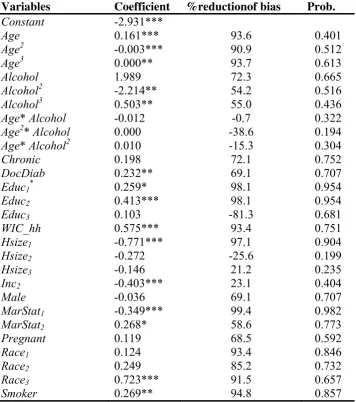
Results from the probit model used to estimate the propensity scores are given in
table 2, which also contains the percentage reduction of bias16 due to the matching
procedure as well as the probability of a type I error if we reject the null hypothesis of
noremaining bias after the matching. We offer a few remarks on these results. First,
we need to mention that we have not excluded the statistically insignificant covariates
in the construction of the propensity scores since our aim is to get the most
accurateestimation of that score and not of the model. Also, since no figure in the last
column is smaller than 0.10, we can accept the hypothesis of no remaining bias for all
18
variables used in the estimation of the propensity score at the 10% confidence level;
although for some covariates (e.gAge*Alcohol and Hsize2) the matching procedure
increased the bias between the treated and the control group. Finally, it is worth
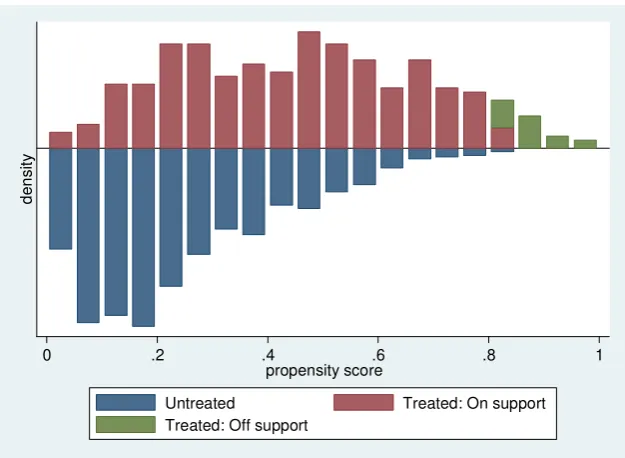
noticing that the balancing property is satisfied within the five strata17 of the common
support region which is 0.004 to 0.833 while, as shown in Figure 1, there seems to be
large heterogeneity of the treated and control groups with respect to the propensity
[image:19.595.150.463.271.500.2]score.
Figure 1. Propensity score (density of probability intervals by participation status)
At a first glance in Table 3, one can notice that the UBEs show that FSP
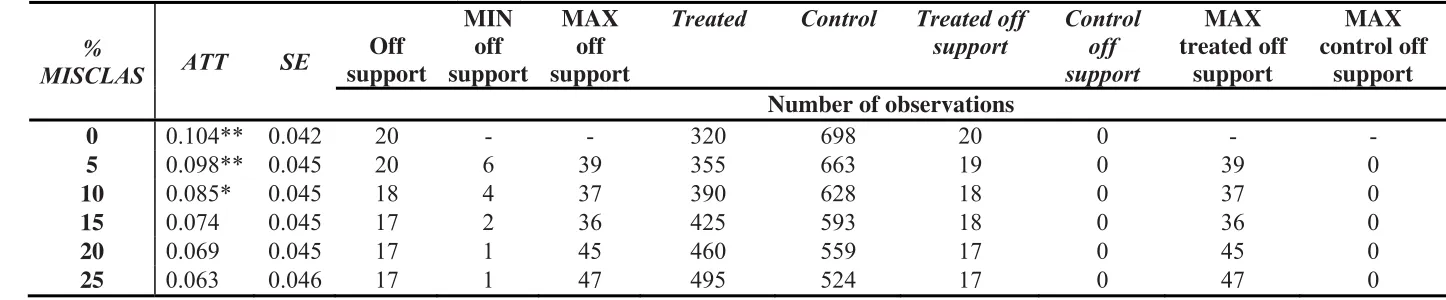
participation increases the likelihood of being obese by 10.4%. As we move on to
Table 4 where the MBEs are presented for the five levels of misclassification errors18,
we can see that when 5% and 10% misclassification errors are examined, the effect of
the FSP on the likelihood of being obese still remains statistically significant at the
17
The optimal number of blocks was selected by the pscore procedure in Stata. 18
In the first line we also include the UBEs to facilitate comparisons. As a matter of fact, UBEs can be considered
a special case of MBE where the level of misclassification errors is 0%.
de
ns
it
y
0 .2 .4 .6 .8 1 propensity score
19
10% confidence level. However, if 15% or more of the participants have made a
false-statement about their participation status, theATTmisPSMsuggests that the causal effect
becomes questionable. Hence, the positive ATT is only robust to misclassification
errors of 10% or less.
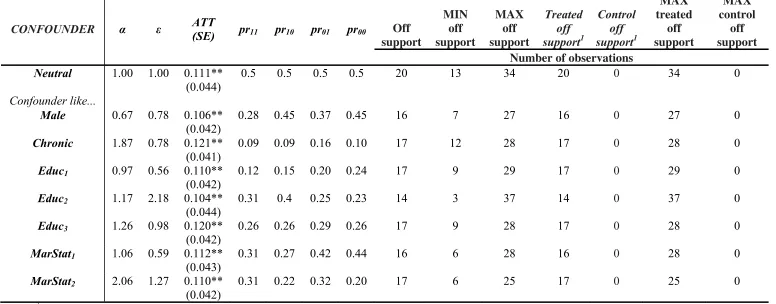
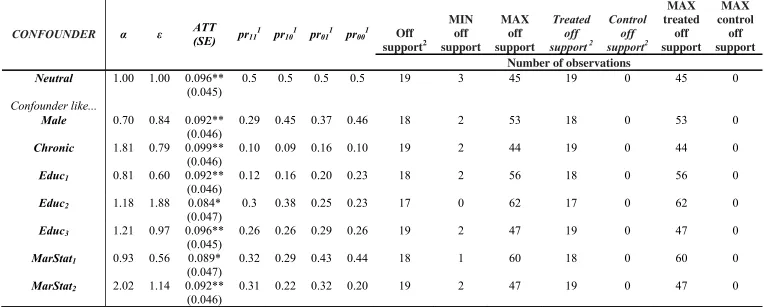
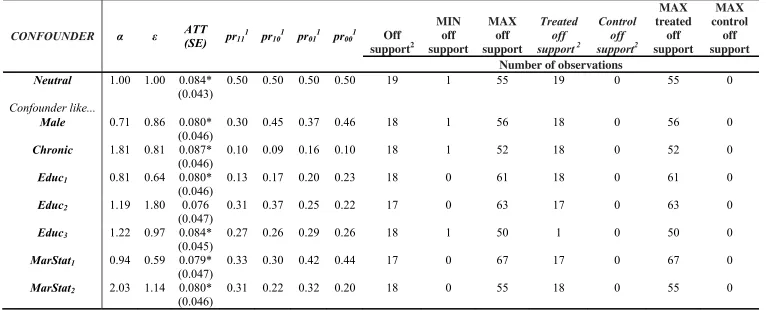
The CBEs and MCEs for potential confounders that mimic the distribution of
known covariates for 5% and 10% misclassification errors are exhibited in Tables 5, 6,
and 7. We only present the results on these two levels of misclassification errors since
in the previous step we found that for higher misclassification levels the ATT is not
robust even when the CIA holds. The CBEs show that when there are no
misclassification errors, the results are robust to the existence of confounders that
mimic the distribution of all selected covariates. From the values of α and ε, we also
conclude that the outcome and selection effects of such confounders are not very
strong. This is also true for the MCEs under the 5% misclassification errors. However,
when 10% misclassification errors are assumed, the ATT in the presence of some
confounders (those that mimic the distribution of Educ2, MarStat1) is not statistically
significant at the 10% confidence level.
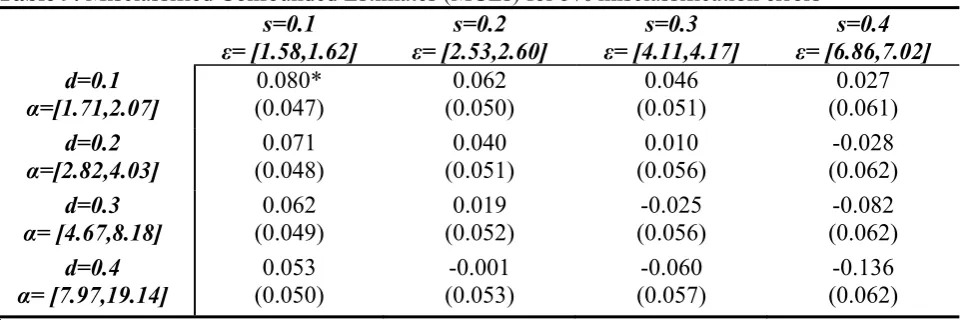
In Tables 8, 9 and 10, the CBEs and MCEs are also presented but this time with
confounders that are designed to carry all the properties of a ‘dangerous’ confounder.
As we move down each row in these tables, the selection effect (ε) is held constant
and the outcome effect (α) of the hypothesized unmeasured variable increases, whilst
the exact opposite is true when moving along each line. Moving down the first
column of Table 8, we find that for no misclassification errors, the result of a positive
effect of the FSP on the likelihood of being obese of the participants is very robust to
unobservable confounders with strong outcome effects; it is also relatively robust to
20
presence of an unobservable confounder, the selection effect is 1.58 to 1.6319; but for
the ATT to become not statistically significant, it should also have an outcome effect
of more than 7.3320. However, for unobservable confounders with higher selection
effects, the causal effect of the FSP could prove to be an artifact of the CIA, even for
weaker outcome effects. The same pattern is also observed for the 5%
misclassification errors (Table 9) but in this case the estimator appears to be also more
sensitive to the outcome effect of the possible confounder (although confounders with
such a high outcome effects are still rather strong). Finally, for 10% misclassification
errors (Table 10), the MCEs indicate that the treatment effect is very sensitive to
additional confounders since the ATT parameter is not statistically significant even
for small outcome/selection effects. Overall, the positive effect of FSP participation
on obesity for participants is very (quite) robust to the existence of confounders when
there is 0% (5%) misclassification errors. Hence, in these cases, we can claim that the
treatment effect is not an artifact of our assumptions. However, we cannot conclude
the same thing in the presence of 10% misclassification errors and some unobservable
confounder.
4. Concluding Remarks
The Food Stamp Program is one of the few nutritional assistance programs in the
history of the US that has drawn so much attention. Due to the high prevalence of
obesity among low-income individuals, a number of papers have examined the effect
of FSP participation on obesity. Most of these studies have suggested a positive effect.
19
Which in turn means that individuals for whom this confounder is equal to 1 are 58%-63% more likely to
participate in the FSP that the others.
20
Meaning that non participants for whom this confounder is equal to 1 are 633% more likely to be obese than
21
However, none of these studies has evaluated the potential effect of misclassification
errors (i.e., misreporting of actual participation status) in the analysis. We feel that
this is a very important issue since results could be sensitive to these misclassification
errors up to a point where findings can be considered no longer valid. In this study,
we examined the complex interrelationship of FSP participation and the likelihood of
being obese of participants using propensity score matching. We then assessed the
robustness of our results under different misclassification errors in the treatment
variable as well as the extent of the presence of additional confounders that would be
needed for the Conditional Independence Assumption to hold.
Our results suggest that participation in FSP is linked to a 10.4% higher
likelihood of being obese for adult participants. This result is robust to CIA but only
when misclassification errors are 10% or less. Hence, if the predictions of Bollinger
and David (1997) and Bitler et al. (2003) are accurate that about 10% to 15% of the
participants are misreporting their FSP participation status, then one should be more
cautious about the accuracy or validity of the causal effect of FSP participation on
obesity. Specifically, our results indicate that if the level of misclassification error is
above 10%, the ATT becomes extremely sensitive to plausible confounders. This
issue is important since it can even be possible that misclassification errors are
significantly greater than 15% according to Meyer et al. (2010). With
misclassification errors of 15% or more, our results reveal no statistically significant
effect even under CIA.
Our findings have significant implications for future analyses of FSP
participation effects since we provide credible evidencethat questions the positive
correlation between FSP and obesity suggested inprevious studies that failed to
22
our findings, failure to account for these potential sources of biases can render results
inaccurate and unreliable for policy making. Similar to the majority of previous
papers, a weakness of our study is the lack of information in our data about the
duration of participation in the program. Nevertheless, a critical implication of our
findings is that misreporting of self-reported participation information should also be
taken into account when analyzing the effect of duration of FSP participation on
health related outcomes. This would not be an issue with revealed or measured
23
Table 1. Names and descriptions of the variables
* These variables were dropped from estimations to avoid perfect multicollinearity Variables Description
Obese Dummy, respondent’s BMI≥30 kg/m2 & WC≥100 cm
FS_hh Dummy, household received food stamps last year
Age Age of respondent
Alcohol Average glasses (250 ml) of alcohol consumed by respondent the last 2 days
Chronic Dummy, Respondent suffers from coronary heart disease, heart attack, stroke or liver condition
DocDiab Dummy, Respondent has been diagnosed for diabetes/prodiabetes or at risk of diabetes
Educ1 Dummy, up to 9th grade
Educ2 Dummy, 9th-11th grade/High school grad/GED or
equivalent
Educ3 Dummy, Some College or Associate of Arts degree
Educ4* Dummy, College graduate or above
WIC_hh Dummy, household received Women, Infants and Children benefits last year
Hsize1 Dummy, Household size<2
Hsize2 Dummy, 2Household size<5
Hsize3 Dummy, 5Household size<7
Hsize4* Dummy, Household size7
Inc1 Dummy, Annual household income<$24,999
Inc2* Dummy, $25,000<Annual household Income<$54,999
Male Dummy, Respondent male
MarStat1 Dummy, Respondent married
MarStat2 Dummy, Respondent divorced/separated/widowed
MarStat3* Dummy, Respondent unmarried
Pregnant Dummy, Respondent was pregnant at examination
Race1 Dummy, Hispanic race
Race2 Dummy, Ethnicity is non-Hispanic White Race
Race3 Dummy, Ethnicity is non-Hispanic Black Race
Race4* Dummy, Other ethnicity
24
Table 2. Results of the propensity score (Probit) estimation
*,**,*** statistically significant at the 10%,5% and 1% level respectively
Variables Coefficient %reductionof bias Prob.
Constant -2.931***
Age 0.161*** 93.6 0.401
Age2 -0.003*** 90.9 0.512
Age3 0.000** 93.7 0.613
Alcohol 1.989 72.3 0.665
Alcohol2 -2.214** 54.2 0.516
Alcohol3 0.503** 55.0 0.436
Age* Alcohol -0.012 -0.7 0.322
Age2* Alcohol 0.000 -38.6 0.194
Age* Alcohol2 0.010 -15.3 0.304
Chronic 0.198 72.1 0.752
DocDiab 0.232** 69.1 0.707
Educ1* 0.259* 98.1 0.954
Educ2 0.413*** 98.1 0.954
Educ3 0.103 -81.3 0.681
WIC_hh 0.575*** 93.4 0.751
Hsize1 -0.771*** 97.1 0.904
Hsize2 -0.272 -25.6 0.199
Hsize3 -0.146 21.2 0.235
Inc2 -0.403*** 23.1 0.404
Male -0.036 69.1 0.707
MarStat1 -0.349*** 99.4 0.982
MarStat2 0.268* 58.6 0.773
Pregnant 0.119 68.5 0.592
Race1 0.124 93.4 0.846
Race2 0.249 85.2 0.732
Race3 0.723*** 91.5 0.657
25 Table 3. Unconfounded Baseline Estimates (UBEs)
ATT SE
p-value
OFF SUPPORT
TREATED CONTROL TREATED
OFF SUPPORT
CONTROL OFF SUPPORT Number of observations
0.104 0.042 0.01 20 320 698 20 0
Table 4. Misclassified Baseline Estimates (MBEs)
%
MISCLAS ATT SE
Off support
MIN off support
MAX off support
Treated Control Treated off
support
Control off support
MAX treated off
support
MAX control off
support Number of observations
0 0.104** 0.042 20 - - 320 698 20 0 - -
5 0.098** 0.045 20 6 39 355 663 19 0 39 0
10 0.085* 0.045 18 4 37 390 628 18 0 37 0
15 0.074 0.045 17 2 36 425 593 18 0 36 0
20 0.069 0.045 17 1 45 460 559 17 0 45 0
25 0.063 0.046 17 1 47 495 524 17 0 47 0
[image:26.842.52.775.233.383.2]26 Table 5. Confounded Baseline Estimates (CBEs)
CONFOUNDER α ε ATT
(SE) pr11 pr10 pr01 pr00 Off
support
MIN off support
MAX off support
Treated off support1
Control off support1
MAX treated
off support
MAX control
off support Number of observations
Neutral 1.00 1.00 0.111** (0.044)
0.5 0.5 0.5 0.5 20 13 34 20 0 34 0
Confounder like...
Male 0.67 0.78 0.106** (0.042)
0.28 0.45 0.37 0.45 16 7 27 16 0 27 0
Chronic 1.87 0.78 0.121** (0.041)
0.09 0.09 0.16 0.10 17 12 28 17 0 28 0
Educ1 0.97 0.56 0.110** (0.042)
0.12 0.15 0.20 0.24 17 9 29 17 0 29 0
Educ2 1.17 2.18 0.104**
(0.044)
0.31 0.4 0.25 0.23 14 3 37 14 0 37 0
Educ3 1.26 0.98 0.120** (0.042)
0.26 0.26 0.29 0.26 17 9 28 17 0 28 0
MarStat1 1.06 0.59 0.112**
(0.043)
0.31 0.27 0.42 0.44 16 6 28 16 0 28 0
MarStat2 2.06 1.27 0.110** (0.042)
0.31 0.22 0.32 0.20 17 6 25 17 0 25 0
1
27
Table 6.Misclassified Confounded Estimates (MCEs) for 5% misclassification errors
CONFOUNDER α ε ATT
(SE) pr11 1
pr101 pr011 pr001 Off
support2 MIN off support MAX off support Treated off support 2
Control off support2 MAX treated off support MAX control off support Number of observations
Neutral 1.00 1.00 0.096** (0.045)
0.5 0.5 0.5 0.5 19 3 45 19 0 45 0
Confounder like...
Male 0.70 0.84 0.092** (0.046)
0.29 0.45 0.37 0.46 18 2 53 18 0 53 0
Chronic 1.81 0.79 0.099** (0.046)
0.10 0.09 0.16 0.10 19 2 44 19 0 44 0
Educ1 0.81 0.60 0.092** (0.046)
0.12 0.16 0.20 0.23 18 2 56 18 0 56 0
Educ2 1.18 1.88 0.084* (0.047)
0.3 0.38 0.25 0.23 17 0 62 17 0 62 0
Educ3 1.21 0.97 0.096** (0.045)
0.26 0.26 0.29 0.26 19 2 47 19 0 47 0
MarStat1 0.93 0.56 0.089*
(0.047)
0.32 0.29 0.43 0.44 18 1 60 18 0 60 0
MarStat2 2.02 1.14 0.092** (0.046)
0.31 0.22 0.32 0.20 19 2 47 19 0 47 0
1
These are average percentages over all simulations since the value of the distribution parameters of the demographic variables on the treatment/outcome condition were different in each of the 1,000 simulated databases.
2
28
Table 7. Misclassified Confounded Estimates (MCEs) for 10% misclassification errors
CONFOUNDER α ε ATT
(SE) pr11 1
pr101 pr011 pr001 Off
support2 MIN off support MAX off support Treated off support 2
Control off support2 MAX treated off support MAX control off support Number of observations
Neutral 1.00 1.00 0.084* (0.043)
0.50 0.50 0.50 0.50 19 1 55 19 0 55 0
Confounder like...
Male 0.71 0.86 0.080* (0.046)
0.30 0.45 0.37 0.46 18 1 56 18 0 56 0
Chronic 1.81 0.81 0.087* (0.046)
0.10 0.09 0.16 0.10 18 1 52 18 0 52 0
Educ1 0.81 0.64 0.080* (0.046)
0.13 0.17 0.20 0.23 18 0 61 18 0 61 0
Educ2 1.19 1.80 0.076 (0.047)
0.31 0.37 0.25 0.22 17 0 63 17 0 63 0
Educ3 1.22 0.97 0.084* (0.045)
0.27 0.26 0.29 0.26 18 1 50 1 0 50 0
MarStat1 0.94 0.59 0.079*
(0.047)
0.33 0.30 0.42 0.44 17 0 67 17 0 67 0
MarStat2 2.03 1.14 0.080* (0.046)
0.31 0.22 0.32 0.20 18 0 55 18 0 55 0
1
These are average percentages over all simulations since the value of the distribution parameters of the demographic variables on the treatment/outcome condition were different in each of the 1,000 simulated databases.
2
29 Table 8. Confounded Baseline Estimates (CBEs)1
s=0.1 ε= [1.58,2.60]
s=0.2 ε= [2.57,2.60]
s=0.3 ε= [4.11,4.19]
s=0.4 ε= [6.82,6.94] d=0.1 α=[1.70,2.03] 0.091* (0.048) 0.070 (0 .051) 0.057 (0 .055) 0.037 (0.062) d=0.2
α=[1.71,3.86] (0 .048) 0.090*
0.046 (0 .052) 0.020 (0.057) -0.017 (0.063) d=0.3 α= [4.70,7.66]
0.071 (0 .050) 0.025 (0.053) -0.018 (0.057) -0.069 (0.063) d=0.4 α= [7.95,11.68]
0.063 (0.051) 0.004 (0.054) -0.052 (0.059) -0.124 (0.064) 1
[image:30.595.60.543.267.427.2]For each of these 16 models, similar results such as those in Tables 5-7 are available upon request * Statistically significant at the 10% level
Table 9. Misclassified Confounded Estimates (MCEs) for 5% misclassification errors1
s=0.1
ε= [1.58,1.62] ε= [2.53,2.60] s=0.2 ε= [4.11,4.17] s=0.3 ε= [6.86,7.02] s=0.4 d=0.1 α=[1.71,2.07] 0.080* (0.047) 0.062 (0.050) 0.046 (0.051) 0.027 (0.061) d=0.2
α=[2.82,4.03] (0.048) 0.071
0.040 (0.051) 0.010 (0.056) -0.028 (0.062) d=0.3
α= [4.67,8.18] (0.049) 0.062
0.019 (0.052) -0.025 (0.056) -0.082 (0.062) d=0.4 α= [7.97,19.14]
0.053 (0.050) -0.001 (0.053) -0.060 (0.057) -0.136 (0.062) 1
For each of these 16 models, similar results such as those in Tables 5-7 are available upon request. * Statistically significant at the 10% level
Table10.Misclassified Confounded Estimates (MCEs) for 10% misclassification errors1
s=0.1 ε= [1.62,1.63]
s=0.2 ε= [2.64,2.65]
s=0.3 ε= [4.37,4.39]
s=0.4 ε= [7.59,7.61] d=0.1 α=[1.73,2.24] 0.069 (0.047) 0.052 (0 .050) 0.035 (0 .054) 0.012 (0.061) d=0.2
α=[2.87,4.76] (0 .048) 0.059
0.030 (0 .051) -0.004 (0.055) -0.051 (0.061) d=0.3 α= [4.82,11.07]
0.050 (0 .048) 0.007 (0.052) -0.043 (0.056) -0.11 (0.062) d=0.4 α= [8.38,37.15]
0.040 (0.049) -0.015 (0.052) -0.082 (0.056) -0.176 (0.060) 1
30
References
Abadie A, Drukker D, Herr JL, Imbens GW. 2004. Implementing Matching
Estimators for Average Treatment Effects in Stata. Stata Journal 4: 290-311.
Abadie A, Imbens GW. 2006. Large Sample Properties of Matching Estimators for
Average Treatment Effects. Econometrica 74(1): 235-267.
Angrist J, Pischke J-S. (2010). The Credibility Revolution in Empirical Economics:
How Better Research Design Is Taking the Con out of Econometrics, National
Bureau of Economic Research.
Baum C. (2007). The Effects of Food Stamps on Obesity,The United States
Department of Agriculture (USDA), Economic Research Service (ERS).
Bitler MP, Currie J, Scholz JK. 2003. Wic Eligibility and Participation. Journal of
Human Resources 38: 1139-1179.
Black DA, Smith JA. 2004. How Robust Is the Evidence on the Effects of College
Quality? Evidence from Matching. Journal of Econometrics 121(1-2): 99-124.
Bollinger CR, David MH. 1997. Modeling Discrete Choice with Response Error:
Food Stamp Participation. Journal of the American Statistical Association 92
(439): 827-835.
Bray GA. 2004. Medical Consequences of Obesity. Journal of Clinical
Endocrinology & Metabolism 89(6): 2583-2589. 10.1210/jc.2004-0535
Brookhart MA, Schneeweiss S, Rothman KJ, Glynn RJ, Avorn J, Stürmer T. 2006.
Variable Selection for Propensity Score Models. American journal of
epidemiology 163(12): 1149-1156.
Chen Z, Yen ST, Eastwood DB. 2005. Effects of Food Stamp Participation on Body
Weight and Obesity. American Journal of Agricultural Economics 87(5):
31
Cutler DM, Glaeser EL, Shapiro JM. 2003. Why Have Americans Become More
Obese? Journal of Economic Perspectives 17(3): 93-118.
Ejerblad E, Fored CM, Lindblad P, Fryzek J, McLaughlin JK, Nyren O. 2006. Obesity
and Risk for Chronic Renal Failure. Journal of the American Society of
Nephrology 17(6): 1695-1702. 10.1681/asn.2005060638
Esposito K, Giugliano F, Di Palo C, Giugliano G, Marfella R, D'Andrea F,
D'Armiento M, Giugliano D. 2004. Effect of Lifestyle Changes on Erectile
Dysfunction in Obese Men: A Randomized Controlled Trial. Journal of the
American Medical Association 291(24): 2978-2984.
Gibson D. 2003. Food Stamp Program Participation Is Positively Related to Obesity
in Low Income Women. Journal of Nutrition 133(7): 2225-2231.
Grundy SM. 2004. Obesity, Metabolic Syndrome, and Cardiovascular Disease.
Journal of Clinical Endocrinology & Metabolism 89(6): 2595-2600.
10.1210/jc.2004-0372
Harel O. 2007. Inferences on Missing Information under Multiple Imputation and
Two-Stage Multiple Imputation. Statistical Methodology 4(1): 75-89.
Heckman J, Navarro-Lozano S. 2004. Using Matching, Instrumental Variables, and
Control Functions to Estimate Economic Choice Models. Review of
Economics and Statistics 86(1): 30-57.
Hill A, Roberts J. 1998. Body Mass Index: A Comparison between Self-Reported and
Measured Height and Weight. Journal of Public Health 20(2): 206-210.
Ichino A, Mealli F, Nannicini T. 2006. From Temporary Help Jobs to Permanent
Employment: What Can We Learn from Matching Estimators and Their
32
Ichino A, Mealli F, Nannicini T. 2008. From Temporary Help Jobs to Permanent
Employment: What Can We Learn from Matching Estimators and Their
Sensitivity? Journal of Applied Econometrics 23(3): 305-327.
Kaushal N. 2007. Do Food Stamps Cause Obesity? Evidence from Immigrant
Experience. Journal of Health Economics 26(5): 968-991.
Lakdawalla D, Philipson T, Bhattacharya J. 2005. Welfare-Enhancing Technological
Change and the Growth of Obesity. American Economic Review 95(2):
253-257.
Meyer BD, Goerge R, Hall C. (2010). The Analysis of Food Stamp Program
Participation with Matched Administrative and Survey Data,University of
Chicago Working Paper.
Millimet DL, Tchernis R. 2009. On the Specification of Propensity Scores: With
Applications to the Analysis of Trade Policies. Journal of Business &
Economic Statistics 27: 397-415.
Philipson TJ, Posner RA. 2003. The Long-Run Growth in Obesity as a Function of
Technological Change. Perspectives in Biology and Medicine 46.
Papoutsi GS, Drichoutis AC, Nayga JRM. 2012. The Causes of Childhood Obesity: A
Survey. Journal of Economic Surveys: 10.1111/j.1467-6419.2011.00717.x
Roberts RJ. 1995. Can Self-Reported Data Accurately Describe the Prevalence of
Overweight? Public Health 109(4): 275-284.
Rosenbaum PR, Rubin DB. 1983. The Central Role of the Propensity Score in
Observational Studies for Causal Effects. Biometrika 70(1): 41-55.
Rosenbaum PR, Rubin DB. 1985. Constructing a Control Group Using Multivariate
Matched Sampling Methods That Incorporate the Propensity Score. American
33
Rosin O. 2008. The Economic Causes of Obesity: A Survey. Journal of Economic
Surveys 22(4): 617-647.
Rubin DB. 1987. Multiple Imputation for Nonresponse in Surveys. New York, NY:
John Wiley and Sons.
Rubin DB. 2003. Nested Multiple Imputation of Nmes Via Partially Incompatible
Mcmc. Statistica Neerlandica 57(1): 3-18.
Rubin DB, Thomas N. 1996. Matching Using Estimated Propensity Scores: Relating
Theory to Practice. Biometrics 52(1): 249-264.
Shen Z. (2000). Nested Multiple Imputation,Cambridge, MA: Harvard University.
Stuart EA. 2010. Matching Methods for Causal Inference: A Review and a Look
Forward. Forthcoming in Statistical Science.
Van der Steeg JW, Steures P, Eijkemans MJC, Habbema JDF, Hompes PGA,
Burggraaff JM, Oosterhuis GJE, Bossuyt PMM, van der Veen F, Mol BWJ.
2007. Obesity Affects Spontaneous Pregnancy Chances in Subfertile,
Ovulatory Women. Human Reproduction 23(2): 324-328.
Ver Ploeg M, Mancino L, Lin B-H, Michele Ver Ploeg LM, Lin. (2007). Food and
Nutrition Assistance Programs and Obesity: 1976-2002,USDA.
Whitmer RA, Gunderson EP, Barrett-Connor E, Quesenberry CP, Yaffe K. 2005.
Obesity in Middle Age and Future Risk of Dementia: A 27 Year Longitudinal