Munich Personal RePEc Archive
Commodity ETFs in the Japanese Stock
Exchanges
Yamori, Nobuyoshi
Nagoya University
20 May 2011
Online at
https://mpra.ub.uni-muenchen.de/31003/
1
Commodity ETFs in the Japanese Stock
Exchanges
Nobuyoshi Yamori, Professor, Nagoya University
Abstract
The “Financial Big Bang” reforms during the latter half of the 1990s
substantially transformed the Japanese financial system, but despite this, the level of
risky assets that Japanese households have in their portfolio has not increased. One
reason for this is the lack of knowledge necessary to invest in risky assets, such as
stocks. Therefore, the Japanese government and financial industry have developed
collective investment schemes such as investment trusts, which are an effective way to
hold risky assets for retail investors who lack sophisticated investment knowledge. This
paper analyzes commodity investment trusts and commodity ETFs as a method for
investing in commodities.
1. Introduction
The “Financial Big Bang” reforms during the latter half of the 1990s
substantially transformed the Japanese financial system and created an environment
that made it easier for individual investors to put their money into risky assets.
However, bank deposits continue to form the core of Japanese households’ financial
asset holdings. Several surveys have found that one reason people remain reluctant to
invest is a lack of relevant knowledge.
As such, there is demand for a simpler, easy-to-understand investment vehicle;
2
development of the environment for investment trusts, net asset value of investment
trust has increased from 50 trillion to 80 trillion yen during the seven years from the
end of 1999 to the end of 2007.
However, despite the fact that use of commodity investments in financial asset
management has expanded on a global level, their use in Japan remains extremely
subdued. Growth in commodity funds, which used to be expected high growth as a
collective investment scheme for commodities, has been sluggish, with assets under
management failing to reach only 15 billion yen.
Many experts now have high expectations for investment trusts and ETFs as a
new way to invest in commodities, and the purpose of this paper is to analyze the
current state of commodity ETFs and investment trusts linked to commodities
(“Commodity investment trusts” for simplicity's sake).
2. Investment Trusts and Commodity Investment Trust as Means for Investment by
Individuals
(1) Commodity Investment Trusts
Due to restrictions in Japanese law, investment trusts are not allowed to
purchase commodities or commodity futures directly. Commodity investment trust is a
kind of investment trust, so they are subject to the restriction. However, there is a
loophole. Namely, commodity investment trust can conduct indirect commodity
investment through purchasing securities linked to commodities.
Using this loophole, the Daiwa Commodity Index Fund (aka the Jim Rogers
World Adventure) launched on December 10, 2004. Although it is out of reach for most
individual investors since the minimum investment is 5 million yen, its net asset value
grew to 12.1 billion yen by July 2006. However, the base value declined with the
plummet in the commodities market in 2008 and has been sluggish ever since; moreover,
with five-year returns deeply in the red as of October 2010, the fund has failed to deliver
the expected investment results.
3
Japan (24 in total) were 68 billion yen. The largest, the Daiwa Rogers International
Commodity Fund launched on April 23, 2009, has 22.6 billion yen under management
and is the only investment trust with assets over 10 billion yen. Out of the 2154
investment trusts in the Morningstar database of funds that are at least one year old,
the scale of assets under management of this fund is ranked 278th.
(2) Commodity Funds
In Japan, commodity transactions are mainly regulated by the Ministry of
Economy, Trade and Industry and the Ministry of Agriculture, Forestry and Fisheries.
Therefore, collective investment schemes linked to commodity transaction come under
the jurisdiction of these Ministries. To differentiate investment trusts which the
Financial Supervisory Agency is to regulate, collective investment schemes linked to
commodity transaction is called “Commodity Funds.” Unfortunately, commodity funds
have been stagnant.
In 2000, the total number of commodity funds was 99 with 236.4 billion yen
under management, amounting to about 2.4 billion yen per fund1. However, unlike
commodity investment trusts, commodity funds’ assets under management have fallen
constantly, with the number of funds as of the end of March 2010 dropping to 20 and
assets under management declining to 15 billion yen. Over the past several years,
almost no new commodity funds have been started, and total assets under management
have fallen as funds sold in the past have been redeemed.
3. Commodity Investment through Commodity ETFs
(1) Pre-Global Financial Crisis Period
Up until 2007, FSA’s regulations limited ETFs listed on domestic exchanges to
those that moved in tandem with pre-determined indices such as the Nikkei average,
1 The year-end peak was 318.4 billion yen at the end of March, 1998. At this point there
4
and ETFs linked to commodities such as gold or crude oil were not permitted.
The Osaka Securities Exchange succeeded in listing an ETF linked to gold
prices in August 2007. This ETF was an investment trust that incorporated bonds
(so-called linked bonds) that fluctuated with movements in prices in the London gold
market. Although it was legally a security ETF, it was effectively the first domestic
commodity ETF in Japan.
Nearly one year later in June 2008, the Tokyo Stock Exchange listed an ETF
backed by physical gold assets, which was a dual listing of a gold ETF previously listed
on the New York Stock Exchange managed by U.S. asset management heavyweight
State Street Global Advisors.
(2) Changes to Environment Surrounding ETFs after Global Financial Crisis
With the implementation of an extremely expansionary monetary policy
employed by central banks in many nations to address increasing uncertainty about the
economy, concerns about inflation also arose and investor demand for safe assets such
as gold and other commodities rose, which resulted in a growth in ETFs.
Second, many index-based ETFs used linked bonds. However, the global financial
crisis highlighted the fact that in the case of bond-based ETFs, the credit risk of the
bond issuer and liquidity risk of the bonds cannot be ignored2. As a result, ETFs directly
linked to the physical assets became more preferable.
Third, simple products became attractive. A news article of Nihon Keizai
Shimbun on June 23, 2009, pointed out that “the main commodity indices incorporate
around 20 to 30 listed products. Investors are questioning whether that many
commodities are necessary as a strategy against inflation,” and further commented that
“one reason that the Deutsche Bank Liquid Commodities Index has been resilient is its
conciseness, with components limited to six representative commodities such as crude
oil, gold, and wheat.
2 For example, calculation of the base price of the DJ/AIG commodities index (currently
5 (3) Listing of New Types of Commodity ETFs
In August 2009, ETF Securities, one of the world’s largest ETF issuers, listed a
total of five ETFs on the TSE: gold, silver, platinum, palladium, and an ETF linked to a
price comprised of these four elements. Prices move in tandem with those on the London
spot market, but holders of ETFs do not have the right to exchange their shares for gold
bullion.
Also in the same month, Japan’s first crude oil ETF was listed on the Osaka
Securities Exchange, which uses West Texas Intermediate (WTI) crude oil prices as an
indicator.
In February 2010, two ETFs linked to the Tokyo Commodity Exchange’s gold
and platinum indices, the Mizuho Gold ETF and the NEXT FUNDS Nikkei-TOCOM
Platinum Index Linked ETF, were listed on the Osaka Securities Exchange.
In March 2010, ETF Securities listed a batch of 14 commodity-linked issues
including grains, copper, and natural gas at once.
In July 2010, Mitsubishi UFJ Trust and Banking Corporation listed several
precious metal ETFs (gold, silver, platinum, and palladium) backed by physical assets
on the Tokyo Stock Exchange. The physical asset-backed precious metal ETFs that were
previously listed could not be effectively exchanged for said asset as it was located
overseas. However, a significant characteristic of this ETF was that it was the first
precious metal ETF backed by physical assets kept within the country, and as such,
could actually be exchanged for the asset.
4. Assessment of Current Commodity ETFs
(1) Summary of Commodity ETFs as of Fall 2010
As of present (September 7th, 2010), there are 106 ETFs listed on the Tokyo
Stock Exchange or Osaka Securities Exchange, 30 of which are commodity ETFs3.
Among those commodity ETFs, those linked to gold are most numerous, with five being
6
listed. SPDR Gold Shares, which is listed on five exchanges around the world including
the New York Stock Exchange, is a large-scale product that makes up 80% of the world’s
gold ETFs.
Management fees for commodity ETFs range from 0.39% to 0.85%, which is
significantly less expensive than the average of 1.46% charged for the commodity
investment trusts.
The most actively traded commodity ETFs are those based on gold. Ranked by
2009 trading value, the gold-linked ETF (listed on the OSE) ranks 7 amongst all
domestic ETFs. However, compared to the average trading value of 218.6 billion yen for
stocks listed on the first section of the TSE, this ETF’s yearly trading value of 84.8
billion yen is significantly smaller. Considering commodity ETFs in foreign markets,
there is still considerable room for growth for commodity ETFs in Japan.
(2) ETFs Transaction
This section looks in detail at trading in the 30 commodity ETFs in existence as
of the end of July 2010.
Price and trading volume data were obtained through Yahoo Finance on all
ETFs for every trading day since listing. A certain length of data is necessary to perform
an effective analysis, but only three commodity ETFs were listed before the end of 2008.
First, this paper examines the first commodity ETF linked to gold prices
(securities code 1328). Trading in commodity ETFs is generally thin, but as stated
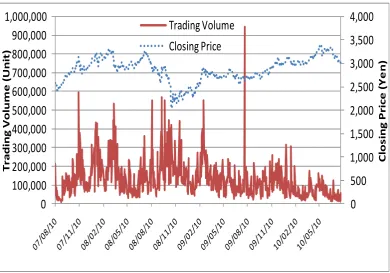
before, gold-linked listed funds are traded relatively heavily. In fact, shown in Figure 1,
this fund was traded on all 726 trading days from August 10, 2007 to July 30, 2010, with
a cumulative trading volume of 94.24 million shares (units) and daily trading volume of
around 130,000 shares (currently one share is around 3,000 yen).
The subsequent long-running SPDR Gold Shares was traded on all 510 trading
days since June 30, 2008, with cumulative trading volume of 13.85 million shares and
daily trading volume of around 27,000 shares (currently one share is around 10,000
yen).
7
was also traded for all 432 trading days, with cumulative trading volume of 820,000
shares and daily trading volume of around 1,900 shares (currently one share is around
3,500 yen).
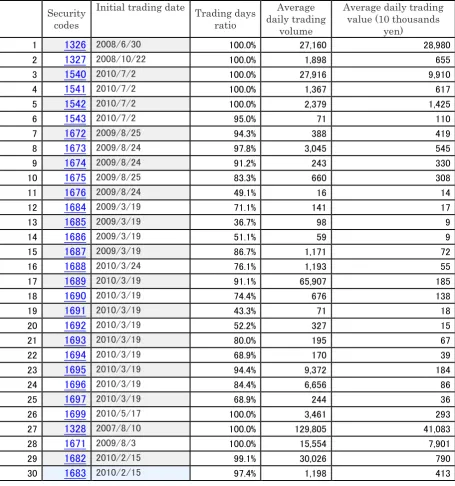
These three long-runners have seen a decent amount of trading, but volumes
for newly listed ETFs remain light, as shown in Table 1. In fact several ETFs have seen
almost no trading at all, with daily trading value below 100,000 yen. Many issues have
only recently been listed, so there is still potential for trading volumes to pick up as
people are recognizing them in the future, but currently there is not a very high
[image:8.595.91.482.367.640.2]probability of this happening soon.
Figure 1
Trading volumes and closing prices for the gold-linked ETF
0
500
1,000
1,500
2,000
2,500
3,000
3,500
4,000
0
100,000
200,000
300,000
400,000
500,000
600,000
700,000
800,000
900,000
1,000,000
C lo s in g P r ic e ( Y e n ) T r a d in g V o lu m e ( U n it )Trading Volume
Closing Price
(Note) This graph shows The Listed Investment Trust Linked to Gold Prices (security
8 Table 1
Basic statistics of all commodity ETFs in Japan
Security codes
Initial trading date
Trading days ratio
Average daily trading
volume
Average daily trading value (10 thousands
yen)
1 1326 2008/6/30 100.0% 27,160 28,980
2 1327 2008/10/22 100.0% 1,898 655
3 1540 2010/7/2 100.0% 27,916 9,910
4 1541 2010/7/2 100.0% 1,367 617
5 1542 2010/7/2 100.0% 2,379 1,425
6 1543 2010/7/2 95.0% 71 110
7 1672 2009/8/25 94.3% 388 419
8 1673 2009/8/24 97.8% 3,045 545
9 1674 2009/8/24 91.2% 243 330
10 1675 2009/8/25 83.3% 660 308
11 1676 2009/8/24 49.1% 16 14
12 1684 2009/3/19 71.1% 141 17
13 1685 2009/3/19 36.7% 98 9
14 1686 2009/3/19 51.1% 59 9
15 1687 2009/3/19 86.7% 1,171 72
16 1688 2010/3/24 76.1% 1,193 55
17 1689 2010/3/19 91.1% 65,907 185
18 1690 2010/3/19 74.4% 676 138
19 1691 2010/3/19 43.3% 71 18
20 1692 2010/3/19 52.2% 327 15
21 1693 2010/3/19 80.0% 195 67
22 1694 2010/3/19 68.9% 170 39
23 1695 2010/3/19 94.4% 9,372 184
24 1696 2010/3/19 84.4% 6,656 86
25 1697 2010/3/19 68.9% 244 36
26 1699 2010/5/17 100.0% 3,461 293
27 1328 2007/8/10 100.0% 129,805 41,083
28 1671 2009/8/3 100.0% 15,554 7,901
29 1682 2010/2/15 99.1% 30,026 790
30 1683 2010/2/15 97.4% 1,198 413
(Notes)
1) Trading days ratio = numbers of days that transaction actually are made / numbers of business days since the initial transaction date
9
(4) Relationship between Gold ETFs and Gold Trading on the Tokyo Commodity
Exchange
The issue of whether trading in gold ETFs diverts trading away from gold
futures on commodities futures markets or if such trading performs a supplemental
function is critical. The correlation coefficients between gold-linked ETF trading volume
and trading volume in gold futures (and mini-gold futures) on the Tokyo Commodity
Exchange are calculated in this section. The gold-linked ETF examined was listed on
August 10, 2007, so the time frame used was September 2007 to July 2010, for which
statistics on both were available. The analysis used monthly trading volume data.
Our empirical test shows that there was a significantly high positive
correlation between the two, with the ETF having a positive correlation coefficient of
0.453 with gold futures and 0.405 with mini gold futures. Deducing the cause and effect
is difficult with this level of sample data, but at the very least, there is no evidence of a
trend in which both products compete with each other, with trading in gold futures on
the Tokyo Commodity Exchange falling as trading in gold ETFs rises4.
5. Conclusion
The author believes that rather than direct trading on commodities futures
markets, using a group-based investment scheme, such as ETFs, is more preferable as a
method for individuals to build their wealth. Despite this, commodity funds, which held
a lot of potential as a group-based scheme for investment in commodities, have not been
utilized to a great extent. Commodity-based investment trusts grew steadily until the
global financial crisis, after which asset values plummeted. However, outstanding
amounts eventually stabilized after the drop, and commodity-based funds are now well
established.
Many have high expectations for commodity ETFs, which have experienced
4 As the correlation between gold futures and mini gold futures on the Tokyo
10
rapid diversification in recent years. The types of ETFs available have grown
considerably more diverse as regulations have been eased, but investor participation
remains limited, with trading in many newly listed ETFs in particular continuing to be
extremely subdued. To make more investors recognize these products is an important
challenge in making these valuable diverse investment opportunities to be widely
utilized. Many have pointed out that commodity ETFs are difficult for salespersons of
securities companies to proactively sell due to a lack of a lack of commodities knowledge
and relatively smaller sales fees. To learn from the failures of commodity funds, an
enhanced approach on the sell side is necessary.
Finally, there are several research issues that we have to analyze in the future.
First, data analysis is still inadequate as commodity ETFs have only recently arrived on
the scene. Future analysis is necessary with more data accumulation; for example, it
would be fascinating to study the relationship between commodity ETF and commodity
futures trading on a daily or more frequent basis. Second, the assets that ETFs are
linked to have become more diversified, but the differences in price formation stemming
from the way that the ETFs are linked to these assets are also interesting. For example,
there are differences in the nature of the various gold-linked ETFs; there are those that
cannot be exchanged with the physical asset, those that can only be exchanged with the
physical asset overseas, and those that can be exchanged with the physical asset
domestically. Discovering how these differences impact price formation is extremely
critical in considering the formation of commodity ETFs in the future.
References
Yamori, Nobuyoshi, "Characteristics of Japan's Commodities Index and its Correlation with Stock
Index," Journal of Applied Research in Finance I(2) , 187-192, Winter 2009.
Yamori, Nobuyoshi, "Co-movement between Commodity Market and Equity Market: Does