Case Study on H Corp. Software Project Risk
Management with ISM
*
Jiangping Wan1,2, Yahui Cao1, Jiajun Hou1 1
School of Business Administration, South China University of Technology, Guangzhou, China 2
Institute of Emerging Industrialization Development, South China University of Technology, Guangzhou, China Email: [email protected], [email protected], [email protected]
Received June 5, 2013; revised July 5, 2013; accepted July 12, 2013
Copyright © 2013 Jiangping Wan etal. This is an open access article distributed under the Creative Commons Attribution License, which permits unrestricted use, distribution, and reproduction in any medium, provided the original work is properly cited.
ABSTRACT
The comprehensive risk management system based on the software project features of H Corp. is established, the causal relationships among risk factors are discovered, and corresponding risk structure model is built with ISM. Five origi- nal risk factors are found, including requirements analysis risk, project communication risk, schedule risk, risk of sys- tem design, and risk of project cooperation. Finally, some specific counter measures are put forward to help H Corp. improve the ability of software project risk management.
Keywords: Software Project Management; Comprehensive Risk Management System; Interpretive Structural Model
1. Introduction
Today, financial innovation has become the core com- petitiveness of small and medium-sized financial institu- tions, financial tools built with the information technol- ogy have made more complex financial products transac- tions become reality. However, the financial industry highly depends on information technology, which makes the safety, reliability and efficiency of information tech- nology system directly affect the entire banking industry security and the stability of the financial system. Since 2010, supervision departments have paid high attention to risk management of IT (information technology). A series of guidelines and regulatory documents have been launched. And in 2011 Senior Banking Information Tech- nology Risk Management Steering Committee has been founded, guided by Total Risk Management, to promote the continuous, healthy development of information tech- nology of the financial industry.
Auto Finance Ltd. is not a banking finance organiza- tion, but provides professional financial services for car dealers and terminal customers, so its loan portfolios are increasing. In order to support this trend, a mount of in- formation systems are establishing, and more effective cooperation are needed among systems and projects, which make a severe stress to the instruction and operation of
IT system. And in this process if the capacity of man- agement and control can’t keep up, it will lower the qual- ity of software products and cause system operating risks. In this paper, we will construct a risk structure model for H Corp. and then find out some original risks to propose several solutions. The contents are as follows: Section 2 is literature review, Section 3 is H Corp. software project risk management analysis, Section 4 is to construct a software project risks structure model with ISM, Section 5 is the analysis and counter measures for the key risk of H Corp. software project, and session six is conclusions.
2. Literature Review
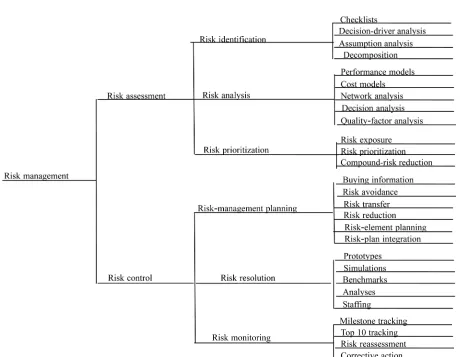
The software risk management involves two primary steps each with three subsidiary steps is illustrated in Figure 1 [1].
The first primary step, risk assessment, involves risk identification, risk analysis, and risk prioritization: 1) Risk identification produces lists of the project-specific risk items likely to compromise a project’s success. Typical risk identification techniques include checklists, exami- nation of decision drivers, comparison with experience (assumption analysis), and decomposition; 2) Risk ana- lysis assesses the loss probability and loss magnitude for each identified risk item, and it assesses compound risks in risk item interactions. Typical techniques include per- formance models, cost models, network analysis, statis- tical decision analysis, and quality-factor (like reliability,
*
Figure 1. Software risk management steps.
availability, and security) analysis; 3) Risk prioritization produces a ranked ordering of the risk items identified and analyzed. Typical techniques include risk-exposure analysis, risk-reduction leverage analysis (particularly in- volving cost-benefit analysis), and Delphi or group-con- sensus techniques.
The second primary step, risk control, involves risk- management planning, risk resolution, and risk monitor- ing: 1) Risk-management planning helps prepare you to address each risk item (for example, via information buy- ing, risk avoidance, risk transfer, or risk reduction), in- cluding the coordination of the individual risk-item plans with each other and with the overall project plan. Typical techniques include checklists of risk-resolution techni- ques, cost benefit analysis, and standard risk management plan outlines, forms, and elements; 2) Risk resolution pro- duces a situation in which the risk items are eliminated or otherwise resolved (for example, risk avoidance via relaxa- tion of requirements). Typical techniques include proto- types, simulations, benchmarks, mission analyses, key- personnel agreements, design-to-cost approaches, and in- cremental development; 3) Risk monitoring involves tra- cking the project’s progress toward resolving its risk
items and taking corrective action where appropriate. Ty- pical techniques include milestone tracking and a top-10 risk-item list that is highlighted at each weekly, monthly, or milestone project review and followed up appropriate- ly with reassessment of the risk item or corrective action.
and questionnaire survey are used to establish and verify the relational model between the root risk factors of im- plementation of the ITSM project and the six complexity propositions based grounded theory [4]. J. P. Wan and J. J. Hou studied the possible risk factors during SAP Busi- ness One implementation with depth interview. The re- sults were then adjusted by experts. 20 categories of risk factors that are totally 49 factors were found. Based on the risk factors during the SAP Business One implemen- tation, questionnaire was used to study the key risk fac- tors of SAP Business One implementation. The study illustrated that the structure is olive-like, in which the risk of data import is on the top, and the risk of senior managers is on the bottom [5].
3. H Corp. Software Project Risk
Management Analysis
3.1. The Overview of H Corp. and Its Software Project
H Corp. is the first Auto Finance Ltd. in Guangdong pro- vince, providing auto financing services for car dealers and terminal customers of its parent company’s related brands. Its core business platforms consist of automotive retail credit business system (NETSOL), approval system for inventory business, capital management system, gen- eral ledger system, and the data warehouse platform. All the other systems are referred to as peripheral systems. In the process of the project, core business systems are in
the center, peripheral systems can communicate with the cores directly, or via the agency. Strict message rules, de- finite handshakes and rigorous enciphered message should be established for smooth communication.
There are several features of H Corp. software projects. 1) Both core business systems and peripheral systems are closely related to the business and its process; 2) The specifications are very strict in many aspects, including project, document, process, design, development, code, test, end of the project, etc. We should comply with the specifications strictly; 3) All the projects are affiliated to the IT department, but the requirements are put forward by the related business departments; 4) It’s only coopera- tion with each other that we can success; 5) The fruits of the project are not only the project itself, but also some- thing abiding the specifications, including SC (source code), design document, prototypes, operation manual, and in- spection report, etc.
3.2. Analysis of Comprehensive Risk Management System
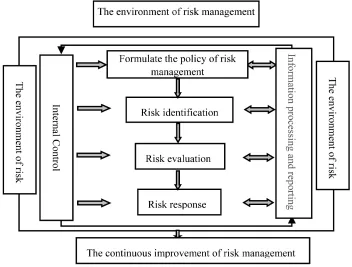
[image:3.595.121.473.451.718.2]A comprehensive risk management system is established for the success of H Corp. Software project (Figure 2). The contents are as follow. 1) The environment of risk management can be divided into the internal and the ex- ternal. Including the culture of risk management, the pro- ject management policy, matrix organization structure, etc.; 2) The policy of risk management is to define the process and content of the risk management, formulate
the report template for the regular work; 3) We will make a detailed instruction about the process of risk identifica- tion in the part 4; 4) Risk evaluation contains qualitative analysis and quantitative analysis, is to make sure the effect and loss extent of the risk accidents; 5) After the identification and evaluation of the risk, we can make specific counter measures to response the risk; 6) A in- ternal control system should be established by internal control department and continuous control department to discover the problem, propose the improvement plan and put it into effect; 7) Recognize, judge, analyze and evalu- ate the risk source, then dispose and make a report. This process will provide basis for the next risk coming; 8) The constant improvement of risk management can be based on Kaizen Process-PDCA.
3.3. The Construction of Comprehensive Risk Management System
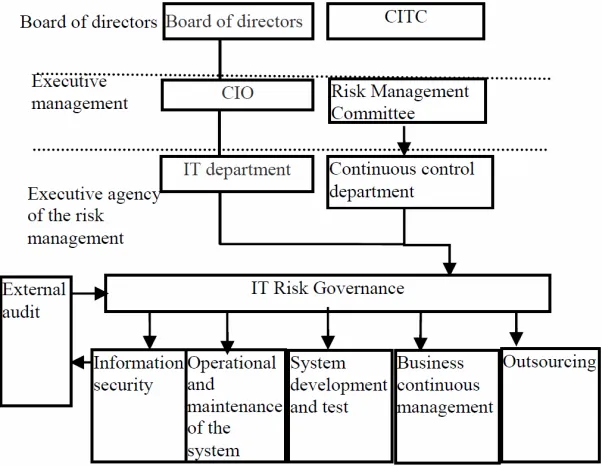
We can construct the comprehensive risk management system of H Corp. software project in three aspects. Firstly, on the aspect of organizational structure, we should make sure that board of directors, executive and Communica- tion and Information Technology Commission (CITC) will be responsible for IT risk strategy, and resource al- location. The orientation of IT risk management institu- tions should be defined. The IT risk management respon- sibility of every department should be clear. Three lines of defence has been established as follow (Figure 3), and IT management department, risk management department, each business line in the front, each support department in the background, institutions at all levels should be fully participated. Second, on the policy aspect, IT risk should
belong to company risk management policy. Last, on the process aspect, IT management department should report to department head and Chief Risk Officer discretely, analyze the IT cases regularly, complete the policy, and promote the improvement of management process and solution of the problem.
3.4. Software Project Risk Control Strategy
In view of comprehensive risk management system, the risk management of the software project has the follow- ing steps: 1) Build enterprise risk management culture, make more training and communication to improve the internal risk management environment; 2) Set clear risk management objectives and policies; 3) Establish a per- fect risk identification and monitoring system; 4) improve the skill of risk evaluation continuously; 5) Perfect risk counter measures step by step, and establish risk database in order to prevent the risk advance; 6) Establish a per-fect internal control system led by the continuous control department; 7) Set up a risk disclosure and reporting sys- tem; 8) Establish the continuous improvement system of risk management.
4. Construct a Software Project Risks
Structure Model with ISM
4.1. Identify the Risks of the Software Project
[image:4.595.148.449.487.720.2]The major event sequence of ISM is in the following [6]: 1) Theme is selected; 2) Developer is identified; 3) Ele- ments and contextual relation are identified; 4) Leader is identified; 5) ISM program is entered in computer; 6) Adequate computer time is allocated; 7) Facilities are
ready; 8) Session plan is complete; 9) Computer contains elements and contextual relation; 10) Session can begin; 11) Element set is edited; 12) Reachable matrix is com- plete; 13) Total structure is available; 14) Amendments are complete; 15) Final structure is satisfactory.
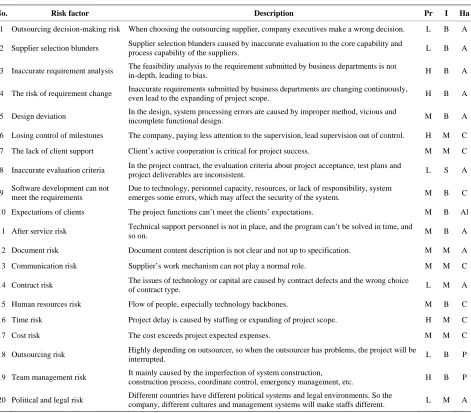
According to the ten risk categories of financial ser- vices proposed by the Basel Committee on Banking Su- pervision, we deeply analysis the risk we met in the process of the project from aspects, such as the risk types, risk description, risk probability, risk incidence, process- ing mode, etc. Then 20 major risk factors of IT projects of H Corp. were found out. These risks can be illustrated in Table 1.
We consult with experts, who come from company in- ternal risk management team or project team with Delphi, including Project managers, Developers, Testers, Busi- ness personnel, Software development and the internal
control manager, QA, etc. By the way of calculating va- riable coefficient, we analysis the opinions of the experts, then conclude the descriptive statistics risks of software project, which can be illustrated in Table 2.
4.2. Construct Adjacency Matrix and Reachable Matrix
Construct an adjacency matrix according to risk factors and its weight. It is illustrated in Figure 4.
Calculate by ISM Win 1.1, we can get a reachable ma- trix. It is illustrated in Figure 5.
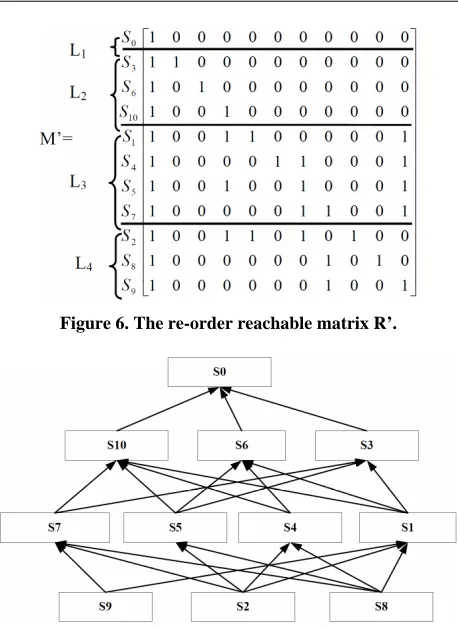
4.3. Construct the Re-Order Reachable Matrix M’
[image:5.595.65.536.313.726.2]According to the result of class division, we can get the re-order reachable matrix as follows (Figure 6).
Table 1. Major risks of software project of H corp.
No. Risk factor Description Pr I Ha
1 Outsourcing decision-making risk When choosing the outsourcing supplier, company executives make a wrong decision. L B A
2 Supplier selection blunders Supplier selection blunders caused by inaccurate evaluation to the core capability and
process capability of the suppliers. L B A
3 Inaccurate requirement analysis The feasibility analysis to the requirement submitted by business departments is not
in-depth, leading to bias. H B A
4 The risk of requirement change Inaccurate requirements submitted by business departments are changing continuously,
even lead to the expanding of project scope. H B A
5 Design deviation In the design, system processing errors are caused by improper method, vicious and
incomplete functional design. M B A
6 Losing control of milestones The company, paying less attention to the supervision, lead supervision out of control. H M C
7 The lack of client support Client’s active cooperation is critical for project success. M M C
8 Inaccurate evaluation criteria In the project contract, the evaluation criteria about project acceptance, test plans and
project deliverables are inconsistent. L S A
9 Software development can not meet the requirements
Due to technology, personnel capacity, resources, or lack of responsibility, system
emerges some errors, which may affect the security of the system. M B C
10 Expectations of clients The project functions can’t meet the clients’ expectations. M B Al
11 After service risk Technical support personnel is not in place, and the program can’t be solved in time, and
so on. M B A
12 Document risk Document content description is not clear and not up to specification. M M A
13 Communication risk Supplier’s work mechanism can not play a normal role. M M C
14 Contract risk The issues of technology or capital are caused by contract defects and the wrong choice
of contract type. L M A
15 Human resources risk Flow of people, especially technology backbones. M B C
16 Time risk Project delay is caused by staffing or expanding of project scope. H M C
17 Cost risk The cost exceeds project expected expenses. M M C
18 Outsourcing risk Highly depending on outsourcer, so when the outsourcer has problems, the project will be
interrupted. L B P
19 Team management risk It mainly caused by the imperfection of system construction,
construction process, coordinate control, emergency management, etc. H B P
20 Political and legal risk Different countries have different political systems and legal environments. So the
company, different cultures and management systems will make staffs different. L M A
Table 2. The descriptive statistics risks of software project.
Risk factors Number Weight Description
Inaccurate requirement
analysis S1 4.31
The content of requirements is not clear, so it’s easy to change. Technicist’s misunderstanding of requirements, Requirements analysis errors, etc.
Supplier selection blunders S2 4.25 Supplier selection blunders caused by inaccurate evaluation to the core capability and process capability of the suppliers.
The risk of requirement
change S3 4.25
Inaccurate requirements submitted by business departments is changing continuously, even lead to the expanding of project scope, rising costs and schedule delays.
Outsourcing decision-making
risk S4 4.19 When choosing the outsourcing supplier, company executives make a wrong decision.
The lack of client support S5 4 Client’s active cooperation is critical for project success.
Losing control of milestones S6 3.88 The company, paying less attention to the supervision, lead supervision out of control.
Design deviation S7 3.81 Caused by design errors, vicious and incomplete functional design, using new technology.
Communication risk S8 3.75 Supplier’s work mechanism can not play a normal role.
Human resources risk S9 3.69 Flow of people, especially technology backbones.
Time risk S10 3.63 Project delay is caused by staffing or expanding of project scope.
Figure 4. Adjacency matrix.
Figure 5. Reachable matrix.
4.4. Construct the Interpretive Structural Model
[image:6.595.309.538.282.596.2]According to the re-order reachable matrix, we can con- struct the risk structural model of H Corp. They can be illustrated by Figure 7.
Figure 6. The re-order reachable matrix R’.
Figure 7. Risk management structural model for H Corp.
4.5. Analyze the Interpretive Structural Model
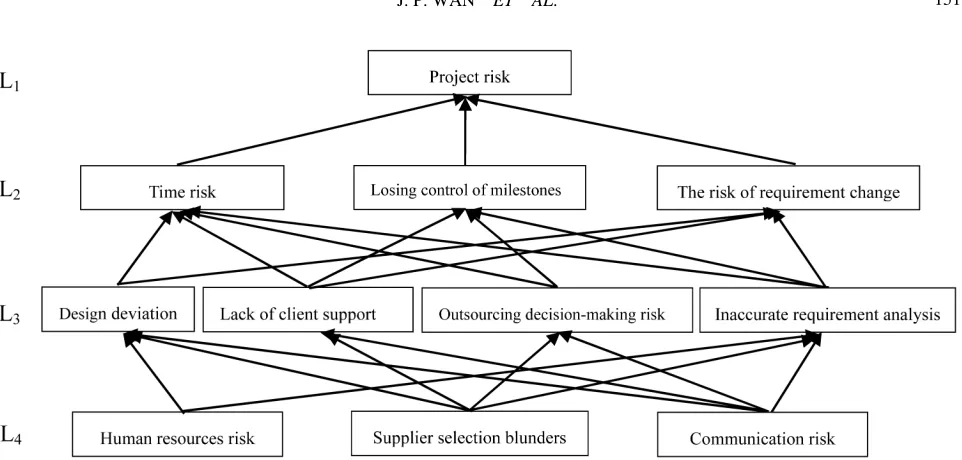
Figure 8. Interpretive structure model of H Corp. software project risk management.
1) The lowest level constitute of human resource risk, supplier selection blunders, and communication risk. They are the key factors affecting the success of software pro- jects; especially, the risk of supplier selection blunders occur in the early stages of operation of software projects, having significant impact on the process of cooperation and success of H Corp.’s project. So it deserves much more attention.
2) The factors of the second layer is the direct risk factors resulting H Corp. to crisis, including time risk, losing control of milestones, and the risk of requirement change. Three risks are indirectly affected by a variety of risk factors.
3) Uncertain demand analysis, design deviation, the lack of client support and outsourcing decision-making failure is the direct reason, which leads to the project schedule risk, losing control of milestones, demand change. The direct reasons should be monitored in the process of software project.
4) Time risk mainly due to design deviation, the lack of client support, outsourcing decision-making risk, in- accurate requirement. The deeper reasons are lacking of effective communication, the mistakes in selection of suppliers is caused by lacking comprehensive assessment of suppliers’ technical human resource and management level results, the team human resource changing, and tech- nological level & professional skill falling behind.
5. The Counter Measures for the Risk
Management of H Corp. Software Project
According to the ISM model above, we discover five critical risks of H Corp. software project, which consti- tute of requirements analysis risk, project communication risk, schedule risk, risk of system design, and risk of
project cooperation. Now we will analysis the critical risks and try to put forward some specific counter meas- ures.
5.1. Requirements Analysis Risk
There are three typical requirements analysis risks in the process of software project, critical users can’t partici- pate in the process of requirements analysis, so the team can’t accurately grasp the user’s real requirements; with the micro-increasing of the project functions and features, the requirements of the project is extending; and the bu- siness requirements jump when the project functions and features are changing obviously. Facing these risks, we can apply the measures as follows. 1) control the require- ments change by specifying the process, defining the cri- teria, confirming the priority rating, or guiding the change by communicating; 2) control the requirement quality by specifically investigating the critical users; 3) control the requirements understanding deviation caused by the dif- ferences between business personnel and technical per- sonnel in the professional background and job field by communicating sufficiently or confirming repeatedly.
5.2. Project Communication Risk
of the project. 5) because of the special personality of the financial system project, there is no general development mode in the industry, so the support should be timely provided by the business analysts.
5.3. Project Schedule Risk
Project delay not only makes members under high pres- sure, but also leads to the dissatisfaction of the stakehol- ders. The counter measures are in the following. 1) estab- lish a communication system and the technical personnel should be trained heavily to improve the ability for han- dling problems; 2) define the project process to make sure the project-related personnel can finish their own job on time; 3) make sure all the team members know all the project requirements; 4) formulate the project emer- gency plan; 5) show the project fruit in time in the proc- ess to motivate the team members.
5.4. Risk of System Design
The risk of system design mainly includes integrity risk, risk of data storage, data acquisition risk and risk of ar- chitecture, etc. The counter measures are in the following. 1) establish review committee and change management system; 2) define the criteria of connector to the different Apps; 3) according to the method of system engineering and certain criteria, combining with the principle of man- agement information system, under the condition of the stable system structure frame, develop business systems step by step. An integrated planning of the system and cer- tain technical criteria should be defined by IT department. By doing these, we could make sure the success of the present project, the stability of data changing among the systems, and reduce the risk of project failure. So the con- struction of the IT system is under the control.
5.5. Risk of Project Cooperation
The risks of project cooperation not only refer to the risk inside the project team and between different departments, but also contain all the risks between company and out- sourcers in the process. In order to avoid these risks, we can follow the counter measures. 1) Project managers should pay more attention to the leadership and manage- ment; 2) when it comes to the part outsourcing of the project, we should fully consider the feasibility and cost, and rigorously evaluate the outsourcers, including tech- nology, management level, corporate organizational struc- ture, industry experience, and after-sale service, etc.; 3) Team members should keep good touch with each other and learn to communicate with the supplier forwardly; 4) A training to technical personnel of outsourcers should be conduct by IT department in accordance with the con- inuous control institution of the company; 5) When the
project environment changing, IT department should eva- luate its effect to the service of the outsourcers, and put forward the related plan to make sure the success of the project; 6) In the process of system development, we could apply related counter measures to ensure informa- tion security management fit the institution of the com- pany; 7) After system launched and operated normally, IT department should found a effective communication system with the outsourcers, so as to acquire technical support in time.
t
6. Conclusion
The comprehensive risk management system based on the software project features of H Corp. is established, the causal relationships among risk factors are found, and corresponding risk structure model is built with ISM. Five original risk factors are found, including require- ments analysis risk, project communication risk, sched- ule risk, risk of system design, and risk of project coop- eration. Finally, some specific counter measures are put forward to help H Corp. improve the ability of software project risk management.
7. Acknowledgements
Thanks for helpful discussion with Mr. Jinghe Wang, et al.
REFERENCES
[1] B. W. Boehm, “Software Risk Management: Principles and Practices,” IEEE Software, Vol. 8, No. 1, 1991, pp. 32- 41. doi:10.1109/52.62930
[2] J. P. Wan, D. Wan and H. Zhang, “Case Study on Busi- ness Risk Management for Software Outsourcing Ser- vice,” Technology and Investment, Vol. 1, No. 4, 2010, pp. 173-194. doi:10.4236/ti.2010.14033
[3] J. P. Wan and D. Wan, “Analysis on the Mindbugs in In- formation Technology Service Management Project Im- plementation,” TechnologyandInvestment, Vol. 2, No. 3, 2011, pp. 184-192. doi:10.4236/ti.2011.23019
[4] J. P. Wan and L. Y. Liang, “Risk Management of IT Ser- vice Management Project Implementation with Killer As- sumptions,” Technology and Investment, Vol. 3, No. 1, 2012, pp. 48-55. doi:10.4236/ti.2012.31007
[5] J. P. Wan and J. J. Hou, “Research on SAP Business One Implementation Risk Factors with Interpretive Structural Model,” Journal ofSoftware Engineering and Applica- tions, Vol. 5, No. 3, 2012, pp. 147-155.
doi:10.4236/jsea.2012.53022