http://www.scirp.org/journal/alamt ISSN Online: 2165-3348 ISSN Print: 2165-333X
On Characterization of Poised Nodes for a Space of
Bivariate Functions
Hayk Avdalyan, Hakop Hakopian
Department of Informatics and Applied Mathematics, Yerevan State University, Yerevan, Armenia
Abstract
There are several examples of spaces of univariate functions for which we have a characterization of all sets of knots which are poised for the interpolation problem. For the standard spaces of univariate polynomials, or spline functions the mentioned results are well-known. In contrast with this, there are no such results in the bivariate case. As an exception, one may consider only the Pascal classic theorem, in the in-terpolation theory interpretation. In this paper, we consider a space of bivariate piece-wise linear functions, for which we can readily find out whether the given node set is poised or not. The main tool we use for this purpose is the reduction by a basic sub-problem, introduced in this paper.
Keywords
Bivariate Interpolation Problem, Poisedness, Fundamental Function, Bivariate Piecewise Linear Function, Reductions by Basic Subproblems
1. Introduction
Consider the interpolation problem with a finite dimensional space of univariate func-
tions S and a set of knots t1,,tm∈, that is for a given data c:=
{
c1,,cm}
find afunction s∈S satisfying the conditions
( )
i i, 1, , .s t =c i= m (1)
We say that the set of knots is poised for S if for any data c there is a unique
function s∈S satisfying the conditions (1). A necessary condition of the poisedness is
dim .
m= S
There are several cases of spaces S of univariate functions for which we have a characterization of all poised sets.
How to cite this paper: Avdalyan, H. and Hakopian, H. (2016) On Characterization of Poised Nodes for a Space of Bivariate Func-tions. Advances in Linear Algebra & Matrix Theory, 6, 89-103.
http://dx.doi.org/10.4236/alamt.2016.64010
Received: October 6, 2016 Accepted: November 25, 2016 Published: November 28, 2016
Copyright © 2016 by authors and Scientific Research Publishing Inc. This work is licensed under the Creative Commons Attribution International License (CC BY 4.0).
Suppose that S≡πn is the space of polynomials of degree at most n. We have that
dimπ = +n n 1. Then, according to the Lagrange theorem, all sets of knots
{
t1,,tn+1}
are poised.
Now suppose that S≡Sn m, :=Sn x;1,,xm is the space of spline functions of order n
and a:=x1<<xm =:b are the knots of the space (see, e.g., [1]). Here s∈Sn m, means that s is piecewise polynomial function of degree at most n−1, s vanishes outside of
the segment
[ ]
a b, and s belongs to the differentiability class (n−2). We have that,
dimSn m= −m n and the set of interpolation knots
{
t1,,tm n−}
is poised if and only ifthe following conditions are satisfied:
, 1, , .
i i i n
x < <t x+ i= m n−
This result is due to Schoenberg and Whitney [2][3]. In the univariate case there are also several characterization results concerning the trigonometric interpolation.
In contrast with this there are no such results in the bivariate case. As an exception one may consider only the Pascal classic theorem, in the interpolation theory inter- pretation (see, e.g., [4]). To present it let S≡ Π2 be the space of bivariate polynomials of total degree at most 2. We have that dimΠ =2 6. Let also Π1 be the space of bivariate linear functions, dimΠ =1 3. Then consider any set of 6 nodes
{
A1,,A6}
in the plane. Construct 3 new nodes as follows:
1 12 45, 2 23 56 3 34 61,
B = ∩ B = ∩ B = ∩
where ij is the line passing through the nodes Ai and Aj. Then according to the
Pascal theorem the 6 nodes
{
A1,,A6}
are lying in a conic if and only if the 3 nodes{
B B B1, 2, 3}
are collinear. To arrange the case connected with the parallel pairs of linesone may replace the plane with the projective one. The interpolation version of this result is:
Theorem 1.1 (Pascal) Any 6 nodes
{
A1,,A6}
in the plane are poised for Π2 if and only if the set of respective 3 nodes{
B B B1, 2, 3}
is poised for Π1.Note that the latter poisedness condition with Π1 merely means that B B B1, 2, 3 are not collinear.
Next we are going to introduce the space of bivariate functions we will consider in this paper. For this we need some preliminaries.
Let us define a strip of triangles. Fix a sequence of points in the plane
{
1 2}
:= V,,Vn+
for the vertices of triangles. Then consider the n triangles
[
1 2]
: , , , 1, , .
i V Vi i+ Vi+ i n
∆ = = (2)
Note that by a triangle we mean the closed set bounded by the sides of the triangle. The sequence of the triangles
{
1}
: , , n
∆ = ∆ ∆
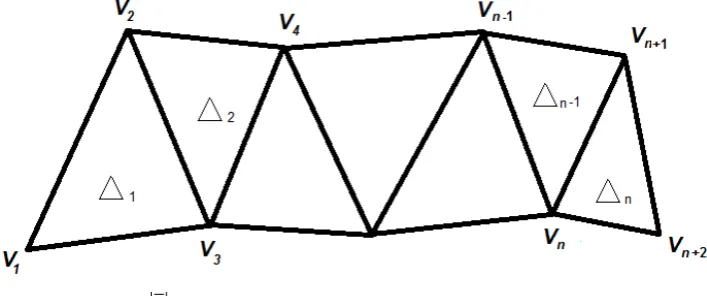
makes a triangulation of the following strip (see Figure 1)
1
: ni= i.
Figure 1. The strip ∆.
Sometimes it is convenient to call itself ∆ a strip, too.
Here we require that the intersection of any neighboring triangles ∆i and
1, 1, , 1,
i+ i n
∆ = − is the common side
[
Vi+1,Vi+2]
, any pair of triangles ∆i and2, 1, , 2,
i+ i n
∆ = − have a single common point which is the vertex Vi+2, and all the other pairs of the triangles are disjoint.
It is easily seen that the sides
[
V Vi, i+2]
,i=1,, ,n together with the sides[
V V1, 2]
and
[
Vn+1,Vn+2]
, form the boundary of the strip ∆ (see Figure 1). We call thesesides boundary sides. The remaining sides of the triangles are called interior sides of the strip. Let us call also the sides
[
V V1, 2]
and[
Vn+1,Vn+2]
, the left and right (boundary)sides of the strip ∆, respectively, and denote
( )
:[
1, 2]
,( )
:[
n 1, n 2]
.l ∆ = V V r ∆ = V+ V+
For a triangle ∆i given in (2) we call the sides
[
V Vi, i+1]
and[
Vi+1,Vi+2]
, the leftand right sides of it, respectively.
Denote by S
( )
∆ the linear space of continuous piecewise linear functions on ∆.More precisely, s∈S
( )
∆ means thati) 1, 1, , .
i
s∆ ∈ Π i= n
ii) s∈C
( )
∆ .Here sD means the restriction of s on D.
Definition 1.2 A set of nodes :=
{
A1,,Am}
is called poised for the space S( )
∆if for any data
{
c ii, =1,,m}
the interpolation problem( )
i i, 1, , ,s A =c i= m (3)
has exactly one solution s∈S
( )
∆ .Let us denote the interpolation problem (3) by
{ }
∆, .The aim of this paper is the characterization of all poised sets for the space S
( )
∆ .The following is a necessary condition of the poisedness:
( )
#=m=dimS ∆ . (4)
To prove this consider the fundamental functions of the interpolation
( )
, 1, , ,i
( )
j, , 1, , ,i j i
s A =δ i j= m
where δ is the symbol of Kronecker.
Obviously the fundamental functions are linearly independent and for the solution of the interpolation problem (3) we have the following formula of Lagrange:
1
.
m i i i
s c s
=
=
∑
Thus, the fundamental functions form a basis for S
( )
∆ and we get (4).Now, let us show that the set of vertices is a poised set for S
( )
∆ . Indeed,having the values of a linear function at the vertices of a triangle ∆i, 1,i= , ,n we
recover it in a unique way on the triangle. On the other hand it is easily seen that the recovered piecewise linear function is continuous on ∆. Thus, the dimension of
( )
S ∆ equals to the number of the vertices in the strip ∆:
( )
dimS ∆ = +n 2. (5)
In view of (4) we obtain that any poised set for the space S
( )
∆ consists of2
n+ nodes:
#= +n 2. (6)
Let us call interpolation problem
{ }
∆, satisfying this condition exact. In the cases#< +n 2 and #> +n 2 we call the problem
{ }
∆, underdetermined and over- determined, respectively.Denote by
, 1, , 2,
i i n
σ = +
the fundamental polynomials with respect to the poised set . They form a basis for the space S
( )
∆ . Thus we have the following representation for any piecewise linearfunction s∈S
( )
∆ :( )
2 1 . n i i is s V σ
+ =
=
∑
In view of this representation the interpolation problem (3) reduces to m linear equations with n+2 unknowns, which are the values a piecewise linear function at
the vertices . Hence an exact interpolation problem
{ }
∆, is poised if and only ifthe following Vandermonde determinant does not vanish:
{ }, 0,
V∆ ≠ (7)
where
{ }
( )
(
)
( )
(
)
( )
(
)
1 1 1 2
2 1 2 2
,
2 1 2 2
.
n n
n n n
A A A A V A A σ σ σ σ σ σ + + ∆ + + + =
Characterize all exact sets for which the Vandermonde determinant does not vanish, i.e., (7) holds.
The following two propositions are basic Linear Algebra facts.
Proposition 1.3 Given an exact problem
{ }
∆, . Then each of the following con- ditions is equivalent to the poisedness of{ }
∆, :i) All fundamental functions si∈ ∆ =,i 1,,n+2, exist.
ii) s∈S
( )
∆ ,s = ⇒ =0 s 0.Proposition 1.4 Given a problem
{ }
∆, Then the following hold:i) If the problem is underdetermined then there is a function s∈S
( )
∆ such that0, and 0.
s = s≠
ii) If the problem is overderdetermined then there is a node in for which no fundamental function exists.
2. Subproblems
For a given strip ∆ denote by ∆ ≤ ≤ ≤mk, k m n, the following part of it
{
1}
: , , , .
m
k k k+ m
∆ = ∆ ∆ ∆
For a problem
{ }
,∆ , denote by{ }
, m,k
∆
the subproblem with the function space S
( )
∆mk , and the set of nodes km =∩ ∆mk, i.e.,{ }
, m:{
m, m}
.k k k
∆ = ∆
Problems with Boundary Conditions
Denote by S
( )
:∆ the linear space of continuous piecewise linear functions on ∆vanishing at the left (boundary) side of the strip ∆ , i.e.,
( )
:{
( )
, l( ) 0 .}
S ∆ = s∈S ∆ s ∆ =
In the similar way one can define the space of functions vanishing at the right side of the strip ∆, i.e.,
( )
( ){
}
( :) , 0 .
r
S ∆ = s∈S ∆ s ∆ =
One may define also the space of functions vanishing at the both left and right sides of the strip ∆, i.e.,
( )
: :{
( )
, l( ) r( ) 0 .}
S ∆ = s∈S ∆ s ∆ =s ∆ =
By counting the number of vertices of the strip where a function from the space may differ from 0, we get, in the same way as in the proof of (5), that
( )
( )
( )
dimS :∆ =dimS ∆ =: n and dimS :∆ = −: n 2.
Denote the interpolation problems with the spaces S
( ) ( )
:∆ ,S ∆: , S( )
:∆: , and anode set by
{
∆:,}
,{
: ,∆}
,{
:∆:,}
, respectively.adding two nodes in the left or/and right sides of the strip.
For this purpose it is convenient to use the following notation for the strip ∆
{
1 2}
2+:=∪ V V, ,
where V1 and V2 are the two vertices of l
( )
∆ .{
1 2}
2 : Vn+,Vn+ ,
+ = ∪
where Vn+1 and Vn+2 are the two vertices of r
( )
∆ . Denote also{
1 2 1 2}
2+ + = ∪ 2 : V V V, , n+,Vn+ .
Let us call two interpolation problems equivalent if both they are poised or both they are not poised. By using Proposition 1.3, ii), we readily get
Proposition 2.1 The folllwing pairs of interpolation problems are equivalent:
{
∆:,}
and{
∆,+2 ,}
{
: ,∆}
and{
∆ +, 2 }
,{
:∆:,}
and{
∆ + +, 2 2 .}
Note that in the subproblem
{
, 2}
mk
∆ + we have that
{
1 2}
2 : Vm+,Vm+ ,
+ = ∪
where Vm+1 and Vm+2 are the two vertices of
( )
.m k
r ∆ The situation is similar with
the sets 2+ and 2+ + 2.
3. Reductions of Interpolation Problems
Below we bring a main theorem regarding the reduction of an interpolation problem having an exact or overdetermined subproblem.
Theorem 3.1 Suppose that
{ }
∆, is an exact problem where the strip ∆ consistsof n triangles and
{ }
, mk
∆ is a subproblem, where 1≤ ≤k m≤n.
Then the following hold. i) If the subproblem
{ }
, mk
∆ is exact and not poised, or overdetermined, then the problem
{ }
∆, is not poised.ii) If the subproblem
{ }
, mk
∆ is poised then the problem
{ }
∆, is poised if andonly if the both following two reduced problems
{
}
1{
}
1 1
, 2 k , , 2 n ,
m
−
+
∆ + ∆ + (8)
are exact and poised.
Note that in the cases k=1 and m=n we have just one reduced problem instead
of two.
Proof. Suppose first that the subproblem
{ }
, mk
∆ is exact and not poised, or overdetermined. Then, in view of Propositions 1.3, i), and 1.4, ii), there is a node
m k
A∈ which does not have a fundamental function. Then, evidently the same node
A does not have a fundamental function for the whole node set , too. Hence, in
view of Proposition 1.3, i), we get that the problem
{ }
∆, is not poised.Now consider the case when the subproblem
{ }
, mk
∆ is poised.
that the problem
{ }
∆, is poised, too. Notice first that the problem{ }
∆, is exact.Thus, by following Proposition 1.3, ii), assume that s∈S
( )
∆ ,s=0. Now, since thesubproblem
{ }
, mk
∆ is poised, we conclude that s vanishes on the triangles
, , 1, , .
i i k k m
∆ = + Therefore s vanishes at the right side of the triangle ∆k−1 and at
the left side of the triangle ∆m+1. Thus we have that
{
1}
1k 2 0s −+ =
and s
{
2+mn+1}
=0. Finally, since the problems in (8) are poised, we obtain that s vanishes on the triangles, 1, , 1
i i k
∆ = − and ∆i,i= +m 1,m+2,, .n Hence s vanishes on all triangles of ∆.
Next let us assume that the problem
{ }
∆, is poised and prove that the bothreduced problems in (8) are poised, too. Let us show first that these reduced problems are exact. There are k−1 and n m− triangles in the reduced problems (8), respectively.
Thus for exactness we need k+1 and n− +m 2 nodes, respectively, altogether 3
n+ − +k m nodes. It is easily seen that indeed, in two mentioned problems together
we have that many nodes. Indeed, this is the number of the nodes in minus the number of the nodes in m
k
and plus 4, i.e., n+ −2
(
m− + + = + − +k 3)
4 n k m 3.Latter 4
(
= +2 2)
nodes come from the added nodes in the boundary in the node sets 2+
and 2+.
Now, assume by way of contradiction that a subproblem in (8) is not exact. Therefore one of the subproblems, say the first problem in (8), is underdetermined, and another is overdetermined. Then, in view of Proposition 1.4, i), there is a function
( )
11
k
s∈S ∆ − such that
{
1k1 2}
0, and 0.s − + = s≠ (9)
Thus s here vanishes on 1 1
k−
and, since of “+2”, also on the right side of the triangle ∆k−1. Now let us extend this function s from
1 1
k−
∆ till the whole strip ∆
by defining it to be 0 on the triangles ∆i, ,i=k k+1,, .n Denote by s the extended
function. Then it is easily seen that s∈S
( )
∆ ,s =0 and s≠0. This, in view ofProposition 1.3, ii), means that the problem
{ }
∆, is not poised, which contradictsour assumption.
Finally, let us show that the both reduced problems in (8) are poised. Assume by way of contradiction that one of them, say the first, is not poised. Since it is exact, we can use Proposition 1.3, ii), to get that there is a function
( )
11
k
s∈S ∆ − such that the
relation (9) is satisfied. From here we continue in the same way as in the above step, after the relation (9).
4. The Basic Interpolation Problems
Let us denote by “3” the problem with a strip consisting of a triangle and at least three nodes inside. The respective basic problem, denoted briefly by “3 B”, is a “3” problem
with exactly three nodes, which are non-collinear.
Then, let us denote by “2 2+ ” the problem with a strip consisting of two triangles
and exactly two nodes in each of them. Note that in this case no node can lie in the interior side of the strip. We call a problem “2 2+ ” basic and denote it by “2 2+ B” if
other triangle. Note that in the case of “2 2+ B” problem no node can coincide with a
vertex of the strip.
Next consider an interpolation problem denoted by “2 1+ + + + 1 2, ,m ” where m is
the number of 1’s. This is the interpolation problem with a strip consisting of m+2
triangles such that each of the first and the last triangles contains exactly two nodes and each of the other m triangles contains exactly a node. Note that in this case no node can be located in an interior side of the strip. We call a problem “2 1+ + + + 1 2,m” basic
and denote it by “2 1+ + + + 1 2,m B” if the line passing through the two nodes in
each of the first and the last triangles does not intersect the neighboring triangle. Note that the “2 2+ ” problem can be considered as a special case of the
“2 1+ + + + 1 2,m” problem, where m=0.
The Poisedness of the Basic Problems
Let us start this section with a simple lemma. Suppose that two nodes A B, of a node
set belong to a triangle of ∆. Denote by A B′ ′, the points of intersection of the
line passing through A and B with the sides of the triangle. Let us call
{
A B′ ′,}
theintersection pair of
{
A B,}
. Denote by ′ the set of the nodes received from byreplacing the pair
{
A B,}
with{
A B′ ′,}
there. We call the set ′ the line trans-formation of the set with respect to the pair
{
A B,}
.Two node sets and are called line-equivalent if one of them can be obtained from the other by means of several line transformations.
Lemma 4.1 The exact interpolation problems
{ }
∆, and{ }
∆, are equivalent, if the node sets and are line-equivalent.Proof. In view of Proposition 1.3, ii), it suffices to verify that
( )
, 0( )
, 0,s∈S ∆ s = ⇔ ∈s S ∆ s′= (10)
where the node set ′ is the line transformation of the set with respect to an appropriate pair of nodes
{
A B,}
⊂. Now notice that (10) readily follows from theevident fact that
( ) ( )
0( ) ( )
0,s A =s B = ⇔s A′ =s B′ =
where
{
A B′ ′,}
is the intersection pair of{
A B,}
. Indeed, each side of this equiva-lence means merely that
s
vanishes on the line passing through A and B.The proof of the following proposition contains an easy algorithm for verifying the poisedness of basic problems.
Proposition 4.2 The problems “3 B” and “2 1 2+ + B” are always poised.
The problem “2 1+ + + + 1 2,m B,” where m≠1, may be poised or not, depen-
ding on the configuration of nodes. Moreover, if the problem is not poised then it becomes poised after changing the location of one of the two nodes in the first or the last triangle, such that the slope of the line passing through the two nodes is changed.
Note that the case m=0 here concerns the problem “2+2 B.” Proof. The case of “3 B” is obvious.
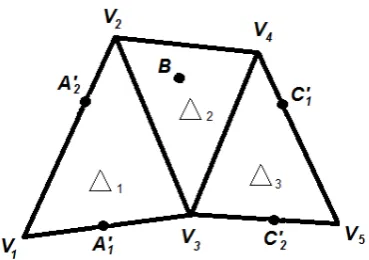
Figure 2. The problem “2 1 2+ + B”.
and =
{
A A B C C1, 2, , 1, 2}
, where A A1, 2∈ ∆1,B∈ ∆2, C C1, 2∈ ∆3. In view of Lem- ma 4.1 we may replace the node set with the set ′={
A A B C C1′ ′, 2, , 1′ ′, 2}
, where{
A A1′ ′, 2}
and{
C C1′, 2′}
are the intersection pairs of the respective pairs from .Since the problem
{ }
∆, is basic we have that the nodes A A C C1′ ′ ′ ′, 2, 1, 2 belong to thefour sides of the triangles ∆1 and ∆3, which are boundary sides of the strip ∆, one node in each side (see Figure 2). Now suppose by way of contradiction that the problem
{
∆,′}
is not poised. This in view of Proposition 1.3, ii), means that there isa function s∈S
( )
∆ such that s′ =0 while s≠0. Then it is easily seen that1 0
s∆ ≠ and therefore s V
( )
1 ≠0. Assume without loss of generality that s V( )
1 >0.Then, since s is linear and s A
( ) ( )
1′ =s A2′ =0 we get readily that s V( )
2 <0 and( )
3 0.s V < Now, in view of the latter condition and s C
( ) ( )
1′ =s C2′ =0, we get readilythat s V
( )
5 >0 and s V( )
4 <0. Thus s assumes negative values at all the vertices of thetriangle ∆2 and it vanishes at B∈ ∆2, which is a contradiction.
Finally, consider the problem “2 1+ + + + 1 2,m B,” where m≠1. Suppose that
{
1, , m+2}
∆ = ∆ ∆ and =
{
A A B1, 2, 1,,B C Cm, 1, 2}
, where1, 2 1, i i1, 1, 2 m 2.
A A ∈ ∆ B ∈ ∆+ C C ∈ ∆ +
Assume that the problem
{ }
∆, is not poised. This in view of Proposition 1.3, ii),means that there is a function s such that
( )
, 0 and 0.s∈S ∆ s = s≠ (11)
It is easily seen that s∆1 ≠0. Indeed,
1 0
s∆ = implies that s vanishes at the left side
of ∆2. Then, in view of the condition s B
( )
1 =0, where B1∈ ∆2 we conclude that 2 0.s∆ = Notice that B1 does not belong to the left (or right) side of the triangle, since
the problem is basic. Continuing this way we obtain 0, 2, , 2
i
s∆ = i= m+ and thus
0,
s= contradicting our assumption. In the same way we get that
2 0.
m
s
+
∆ ≠ (12)
By replacing s, if necessary, with a nonzero constant multiple of it, assume that
( )
1 1.s V = Now, in view of the condition s A
( ) ( )
1 =s A2 =0, where Ai∈ ∆1, the func-tion s∈S
( )
∆ is determined on ∆1. Indeed, the nodes V A A1, 1, 2 are not collinear since the problem is basic. Hence s is determined at the left side of the second triangle2.
right) side of the triangle. Thus we get that s is determined on ∆2. Continuing this way we get that s is determined on ∆m+1. Now s is determined at the left side of the last triangle ∆m+2. By using the condition s C
( )
1 =0, where C1∈ ∆m+2, we con- clude, in view of (12), that the zero set of s in ∆m+2 is a line passing through C1. Thus if the last node C2 lies in this line then we have that s vanishes at C2 too. Hence the condition (11) holds, which, in view of Proposition 1.3, ii), means that the problem is not poised. While the condition C2∉ implies that s vanishes on ∆m+2 which contradicts (12) and whence (11). Thus the problem is poised in this case. This consideration makes clear also the “moreover” part of Proposition.It is worth mentioning that if the restriction of s on the left side of triangle ∆m+2 has a zero (as it will happen in the case of “2 1 2+ + B”) denoted by C then the basic
problem is poised, wherever the two last nodes C1 and C2 are situated. Indeed, otherwise we would have that the zero-line of s in the last triangle passes through
1, 2,
C C and C, which contradicts the fact that the problem is basic.
5. Reductions by Basic Subproblems
5.1. Reduction by “3/
B
”
In the case of basic subproblem “3 B” we have a poised subproblem with one triangle.
Thus we get from Theorem 3.1, ii), the following
Corollary 5.1 Assume that
{ }
∆, is an exact problem, where the strip consists of ntriangles. Assume also that a triangle ∆k, 1≤ ≤k n, contains exactly 3 non-collinear nodes. Then the interpolation problem
{ }
∆, , is poised if and only if the bothfollowing two reduced problems
{
}
1{
}
1 1
, 2 k , , 2 n ,
k
−
+
∆+ ∆ + (13)
are exact and poised.
Note that in the cases k=1 and k=n we have just one reduced problem instead
of two.
5.2. Reduction by “2 + 1 + ··· + 1 + 2/
B
”
For this case we get from Theorem 3.1 the following
Corollary 5.2 Assume that
{ }
∆, is an exact problem, where the strip consists of ntriangles. Assume also that the subproblem
{ }
2, k m , 1 2,
k k n m
+ +
∆ ≤ ≤ − − is basic of
type “2 1+ + + + 1 2,m B,” where m≥0,m≠1. Then the problem is not poised if
the subproblem is not poised. In the case when the subproblem is poised the problem
{ }
∆, is poised if and only if the both following two reduced problems{
}
1{
}
1 3
, 2 k , , 2 n ,
k m
−
+ +
∆ + ∆ + (14)
are exact and poised.
Note that in the cases k=1 and k= − −n m 2 we have just one reduced problem
instead of two.
we get from Theorem 3.1, ii), the following
Corollary 5.3 Assume that
{ }
∆, is an exact problem, where the strip consists of n triangles. Assume also that the subproblem{ }
2, k , 1 2,
k k n
+
∆ ≤ ≤ − is basic of type
“2 1 2+ + B”. Then the problem
{ }
∆, is poised if and only if the both following two reduced problems{
}
1{
}
1 3
, 2 k , , 2 n ,
k
−
+
∆ + ∆ +
are exact and poised.
Note that in the cases k=1 and k= −n 2 we have just one reduced problem
instead of two.
6. Existence of a Reduction
In this section we prove that every exact problem has a subproblem of type “3”, “2+2”,
or “2 1+ + + + 1 2,m”. Next, we show that by applying line-transformations to this
subproblem, we can reduce it to a basic subproblem or determine that the given exact problem is not poised. After this, by following the algorithm pointed out in the proof of Proposition 4.2, we may verify whether the basic subproblem is poised or not. If not then, in view of Theorem 3.1, i), we conclude that the given exact problem is not poised either. If the basic subproblem is poised then we may apply the respective reduction, given by Corollaries 5.1, 5.2, or 5.3. Thus we have a complete solution of the poisedness problem.
Theorem 6.1 Assume that
{ }
∆, is an exact problem. Then it has a subproblem oftype “3”, “2+2”, or “2 1+ + + + 1 2,m”. Moreover, by using line-transformations, we
either determine that the problem is not poised, or we reduce the node set to such that the line-equivalent problem
{ }
∆, has a basic subproblem of type “3 B”,“2 2+ B”, or “2 1+ + + + 1 2,m B”.
Proof. Suppose that a triangle contains more than 3 nodes, or exactly 3 collinear nodes. Then the problem obviously is not poised and also we have a type “3” sub- problem. If a triangle contains exactly 3 non-collinear nodes then we have a type “3 B”
basic subproblem.
Now, let us assume that no triangle of ∆ contains more than 2 nodes.
Step 1. Let us verify that the problem
{ }
∆, contains a subproblem of type “2+2”,or “2 1+ + + + 1 2,m”.
Let us throw away those triangles of ∆ which do not contain nodes from . Let
us throw away also those triangles of ∆ which contain just one node from located in an interior side of ∆. By saying a node is thrown we mean that it does not belong to
the remained triangles.
Notice that only a node located in an interior side of the strip can be thrown. Moreover, this can happen only if the both neighboring triangles were thrown, i.e., if it is the only node in the interior side and also the only node in the both neighboring triangles.
are
1 2
1, 2, , ,
l l
k k k k k k
′
′ ′
∆ ∆ ∆ (15)
where 1≤k1≤k1′<k2≤k2′<<kl ≤kl′≤n.
Now, let us verify that for a block here the number of nodes (from ) is greater or equal to the number of triangles plus two.
Assume by way of contradiction that for all blocks in (15) the number of nodes does not exceed the number of triangles plus one. Then we get that the number of nodes in all above connected blocks is less than or equal to the number of triangles in all connected pieces plus l, where l is the number of blocks in (15).
Next, consider the breaks, i.e., the dropped blocks. For each break we have that the number of nodes, i.e., number of the thrown nodes in the above mentioned operation, is less than or equal to the number of triangles there minus 1. Indeed, a such node (in an interior side of ∆) is thrown if both triangles containing it where thrown. Thus we can assign two thrown triangles to each thrown node. Also note that all the triangles assigned are different. Hence the number of nodes in all above mentioned breaks is less than or equal to the number of the triangles there minus l−1, since there are at least
1
l− breaks.
Thus we may conclude that the number of nodes in ∆ does not exceed the number of triangles there plus 1
(
= − −l(
l 1 .)
)
This contradicts the assumption that the pro-blem
{ }
∆, is exact.Now assume, without loss of generality, that in the first block 1 1
k k
′
∆ the number of nodes from is greater or equal to the number of triangles there plus two. Note that if a triangle in this block contains only one node then it is not located in its left or right side, otherwise the triangle would be thrown away before.
Since no triangle contains three nodes, we get that there is a triangle in this block containing two nodes. Consider the first such triangle ∆k, i.e., a such triangle with the
minimal subscript k≥i1. If both the two nodes here are lying in the right side of the triangle then the next triangle ∆k+1 contains only these two nodes. Now notice that in the triangles from ∆i1 till ∆k+1, the number of nodes equals to k− +i1 2, i.e., the number of triangles here. This means that there is another triangle in the first block, following ∆k+1, containing two nodes, such that at least one node is not lying in the right side of the triangle.
Then consider the first such triangle ∆k′. If one of the two nodes here is in the right
side of the triangle then the next triangle ∆k′+1 also contains two nodes, because otherwise it would be thrown away before. Now notice that in the triangles from ∆i1
till ∆k′+1, the number of nodes does not exceeds k′ − +i1 3, i.e., the number of triangles here plus 1. This means that there is another triangle in this series, denoted by
,
l
∆ following ∆k′+1, containing two nodes, which do not lie in its right side. This will
be the first triangle of the desired subproblem.
Now notice that in the triangles from ∆k′+1, till ∆l, the number of nodes equals to
1 2,
l− +i i.e., the number of triangles here plus 1. This means that there is another
first such triangle. This will be the last triangle of the desired subproblem. First notice that each triangle between ∆l and ∆l′, if there is a such, contains just one node,
which, as was mentioned earlier, cannot be located in its left or right side. Therefore no node in ∆l′ belongs to the left side of the triangle, since otherwise ∆l′−1 would con- tain a node in its right side. Note also that in this case ∆l′−1 does not coincide with
,
l
∆ since the latter has no node in its right side. Thus the subproblem
{ }
, ll
′
∆ is of type “2+2”, or “2 1+ + + + 1 2,m” with
1.
m≥
Step 2. Next, by using line-transformations, we either reduce this subproblem to a basic subproblem or determine that the problem
{ }
∆, is not poised.First suppose that the subproblem
{ }
, ll
′
∆ is of type “2+2”. If it is not basic then
the line through the two nodes in a triangle intersects its interior side. Then by replacing these two nodes with their intersection pair we will have in the other triangle one more node, i.e., three nodes. This case was considered in the beginning of the proof.
Finally, suppose that the subproblem
{ }
, ll
′
∆ is of type “2 1+ + + + 1 2,m”, with
1.
m≥ Now, if this subproblem is not basic then in the same way as in the previous
case we may reduce it by line transformation to a problem of the same type, where the number of 1’s equals to m−1. Thus we may complete readily the proof by using in-
duction on m, where the first step of induction corresponds to the case m=0
considered already.
7. Final Remarks
7.1. Some Necessary Conditions of Poisedness
Consider a problem
{ }
∆, , where the strip consists of n triangles. Denote thenumber of nodes from in the triangles ∆ ∆k, k+1,,∆m, 1≤ ≤ ≤k m n, by : m k
ν
:= # .
m m
k k
ν
The following proposition gives some necessary conditions of poisedness.
Proposition 7.1 Given a poised problem
{ }
∆, , where the strip consists of ntriangles. Then for each k and m, 1≤ ≤ ≤k m n, we have that
1 km 3.
m k− − ≤
ν
≤ − +m k (16)Moreover, in the cases k=1 and m=n we have stricter inequalities:
1 2, 1 3.
m n
k
m≤
ν
≤ +m n k− + ≤ν
≤ − +n k (17)Proof. Let us prove first the right inequality in (16):
3.
m
k m k
ν
≤ − + (18)Indeed, suppose conversely that
ν
km ≥ − +m k 4. Then the subproblem{ }
, ,m k
∆ is overdetermined. Therefore the problem
{ }
∆, , in view of Theorem 3.1, is not poised,which is a contradiction.
1
1 2, 1 1.
n k
m n m k
ν
ν
−+ ≤ − + ≤ + (19)
Now, in view of the relations 1 2 1
m n
m n
ν = + −ν + and 2 1 1
n k
k n
ν
= + −ν
− we get theinequalities in the left sides in (17).
Finally, let us verify the left inequality in (16). In view of (19) we have
(
) (
)
1 1 1
2 2 1 2 1.
m k n
k n m n k n m m k
ν ν − ν
+
= + − − ≥ + − + − − + = − −
From the particular case m= +k 2 of (16) we have that
2
1 k 5, 1, , .
k k n
ν
+≤ ≤ =
Therefore, if in an exact problem
{ }
∆, some three successive triangles do notcontain nodes then the problem is not poised.
Also, in view of (17), we have that an exact problem is not poised if there are no nodes in the first or the last triangles of the strip.
In the last subsection we consider the case when there are no nodes in two successive triangles which do not include the first or the last triangles of the strip.
7.2. Reduction “0 + 0”
Theorem 7.2 Given an exact problem
{ }
∆, , where the strip consists of n triangles.Suppose that some two successive triangles ∆k and ∆k+1, where 2≤ ≤ −k n 2, do not contain nodes. Then the problem
{ }
∆, is poised if and only if the both fol-lowing two reduced problems
{ }
1{ }
1 2
, k , , n ,
k
−
+
∆ ∆ (20) are exact and poised.
Proof. Let us assume that the both reduced problems in (20) are poised. Notice that then the problem
{ }
∆, is exact. Now let us prove, by following Proposition 1.3, ii),that the problem
{ }
∆, is poised, too. Thus, assume that s∈S( )
∆ ,s =0. Fromhere we get that 1 1k 0
s − = and
2 0.
n k
s
+ =
Since the two subproblems in (20) are poised, we conclude that s vanishes on the triangles ∆i,i=1,,k−1 and
, 2, 3, , .
i i k k n
∆ = + + Therefore s vanishes also at the left side of the triangle ∆k
and at the right side of the triangle ∆k+1. In particular s vanishes at all the vertices of triangles ∆k and ∆k+1. Thus it vanishes on these two triangles too. Hence s=0.
Next let us assume that the problem
{ }
∆, is poised and prove that the bothreduced problems in (20) are poised.
Let us show first that the both reduced problems in (13) are exact. There are k−1
and n− −k 1 triangles in the reduced problems (20), respectively. Therefore for exact-
ness we need k+1 and n− +k 1 nodes, respectively, altogether n+2 nodes. Now,
assume by way of contradiction that a subproblem in (20) is not exact. Then a sub- problem is overdetermined and the other is underdetermined. Therefore, by Theorem 3.1, i), the problem is not poised, which is a contradiction.
References
[1] Bojanov, B.D., Hakopian, H. and Sahakian, A. (1993) Spline Functions and Multivariate In-terpolations, Mathematics and Its Applications. Vol. 248, Kluwer Acad. Publishers Group, Dordrecht.
[2] Schoenberg, I.J. and Whitney, A. (1949) Sur la positivié des déterminants de translations des fonctions de fréquence de Pólya avec une application a une problèeme d’interpolation. C. R. Acad. Sci. Paris Ser. A, 228, 1996-1998.
[3] Schoenberg, I.J. and Whitney, A. (1953) On Pólya Frequency Functions. III. The Positivity of Translation Determinants with an Application to the Interpolation Problem by Spline curves. Transactions of the American Mathematical Society, 74, 246-259.
[4] Hakopian, H., Jetter, K. and Zimmermann, G. (2009) Vandermonde Matrices for Intersec-tion Points of Curves. Jaen Journal on ApproximaIntersec-tion, 1, 67-81.
Submit or recommend next manuscript to SCIRP and we will provide best service for you:
Accepting pre-submission inquiries through Email, Facebook, LinkedIn, Twitter, etc. A wide selection of journals (inclusive of 9 subjects, more than 200 journals)
Providing 24-hour high-quality service User-friendly online submission system Fair and swift peer-review system
Efficient typesetting and proofreading procedure
Display of the result of downloads and visits, as well as the number of cited articles Maximum dissemination of your research work
Submit your manuscript at: http://papersubmission.scirp.org/