N A N O E X P R E S S
Open Access
A Method for Decomposition of the Basic
Reaction of Biological Macromolecules into
Exponential Components
Yu. M. Barabash
*and A. K. Lyamets
Abstract
The structural and dynamical properties of biological macromolecules under non-equilibrium conditions determine the kinetics of their basic reaction to external stimuli. This kinetics is multiexponential in nature. This is due to the operation of various subsystems in the structure of macromolecules, as well as the effect of the basic reaction on the structure of macromolecules. The situation can be interpreted as a manifestation of the stationary states of macromolecules, which are represented by monoexponential components of the basic reaction (Monod-Wyman-Changeux model) Monod et al. (J Mol Cell Biol 12:88–118, 1965). The representation of
multiexponential kinetics of the basic reaction in the form of a sum of exponential functions A tð Þ ¼Xin¼1aie−kitÞ
is a multidimensional optimization problem. To solve this problem, a gradient method of optimization with software determination of the amount of exponents and reasonable calculation time is developed. This method is used to analyze the kinetics of photoinduced electron transport in the reaction centers (RC) of purple bacteria and the fluorescence induction in the granum thylakoid membranes which share a common function of converting light energy.
Keywords:Multidimensional optimization, Decomposition of the curve, Exponential function, Electron-conformational states of biological macromolecules, Multi-component structure, Reaction center, Purple bacteria, Electron transport, Fluorescence of chlorophyll, Configuration variability
Background
It is known that the kinetics of electron transport in the RCs of purple bacteria [1–3] and the shape of the curve of chlorophyll fluorescence in the complex of photosystem II in thylakoid grana are multiexponential in nature [4]. As a rule, this is explained by a multilevel organizational structure of macromolecules and a manifestation of self-regulation effect on the structural and dynamic properties of biological macromolecules in non-equilibrium operat-ing conditions. This effect is determined by certain hidden parameters among which structural variables that characterize the state of macromolecules can act. While these parameters are difficult to measure directly in experiment, they impact the kinetics of basic reaction in macromolecules along with control parameters (substrate concentration, light intensity, etc.). Due to changes in the
structure of macromolecules, a feedback in the basic reac-tion occurs. This feedback links the recurring elementary acts of the basic reaction. The elementary acts lead to sig-nificant changes in the structure of macromolecules. They modify the very elementary reaction and provide adaptive functioning of the macromolecules. The effect of self-regulation can occur with different amounts of structural variables. These factors make it difficult to analyze the basic reaction, and the kinetics of this reaction assumes a multiexponential character. Therefore, there is a problem, using the experimentally measured kinetics of basic reac-tion, to identify the stationary states and self-consistent re-organizations of macromolecules, which are reflected by monoexponential components of the basic reaction.
Methods
Multidimensional Optimization Method
The representation of multiexponential kinetics curve for the basic reaction in the form of a sum of exponential * Correspondence:[email protected]
Institute of Physics, National Academy of Science of Ukraine, 46, Nauky Ave, Kyiv 03039, Ukraine
terms A tð Þ ¼Xin¼1aie−kitÞ
with restriction (ki>0,
ai> 0), is a multidimensional optimization problem with
identification difficulties. There are various optimization algorithms (gradient, evolutionary, stochastic methods, etc.) which have different sorting strategies. The choice of algorithm is related to the ambiguity of the behavior of objective function, the existence of local extrema of ob-jective function, and thecurse of dimensionality(obtaining quality results within a reasonable time) [5, 6].
To analyze the kinetics of photoinduced charge trans-port in the RCs of purple bacteria and induce the fluor-escence in the granum thylakoid membranes, a gradient optimization algorithm using the methods of linear alge-bra was developed. This algorithm allows to determine the number of exponents and their parameters which correspond to the global minimum of the objective func-tion expansion (root-mean-square error). It also allows excluding the impact of initial values of parameters and step size of their changes on the results of calculation. The algorithm does not require searching the values of exponential weights (ai) during optimization that
pro-vides a reasonable time of calculations.
The algorithm includes two reciprocal steps. At the first step, the problem of determining the numerical represen-tation (ai) of a given decomposition basis with the best
ap-proximation to the analyzed curve is solved. At the second step, an optimization of the parameters of decom-position basis (n,ki,(ai)) is carried out. Let us briefly
con-sider the first step. One can assume that the analyzed signalx(t) with a finite energy belongs to a metric space with the scalar product (x,y) =∫x(t)y(t)dt. The signal x(t) is uniquely (best) represented as a linear combination [7]
x tð Þ ¼Xin¼1αiφið Þt ; ð1Þ
whereφi(t) is a system ofnlinearly independent functions, and αi form the desired numerical representation x(t). This basis does not need to be orthogonal. Let us multiply
x(t) byφj(t). Then the relation between the signalxand its numerical representationain a matrix form is
φ1;φ1
ð Þðφ2;φ1Þ…ðφn;φ1Þ
φ1;φ2
ð Þðφ2;φ2Þ…ðφn;φ2Þ :
: :
φ1;φn
ð Þðφ2;φnÞ…ðφn;φnÞ 2 6 6 6 6 6 6 4 3 7 7 7 7 7 7 5 a1 a2 : : : an 2 6 6 6 6 6 6 4 3 7 7 7 7 7 7 5 ¼ x;φ1
ð Þ
x;φ2
ð Þ
: : : x;n
ð Þ
; Ga¼β;; ð2Þ
Let us introduce reciprocal basis functions θi(i= 1, 2, 3,…,n) which are represented by linear combina-tions φi θj ¼X
k¼1 n
Γjkφkð Þt ;. The scalar products of the
bases equal φi;θj¼δij; i:eXk¼1nΓjkðφi;φkÞ ¼δij;
ΓG¼I→Γ ¼G−1in matrix form. Using a common
basis, it is possible to rewrite (2) in the following form:
αi¼ðx;θiÞ; i¼1;2;…;n ð3Þ
whereαiare the required values of exponential weights.
Therefore, at the first step the number (n) and discrete values of decrements (ki) of the basic exponential
func-tionsφk are specified, and a matrix of their scalar prod-ucts G is formed. Then we calculate the inverse to G matrix Г and determine their reciprocal basis θj. Using the expression (3), we find the values of the weights of exponential functionsαi, which best fit the analyzed sig-nal. According to the array of possible decrements, the decrements of exponential functions (ki) are discrete in
nature. This leads to errors in the optimization, which correspond to the difference between the left and right side of the expression (1), i.e. between the analyzed sig-nal and its approximation.
Now the first step is finished. At the second step we find the optimal parameters of the decomposition basis. We select one exponent with an initial value of decre-ment and, using the operations of the first step, go over the decrement values k1 and determine the optimal
values of the parameters (α1opt, k1ont,a1> 0) of the first
exponent, which provides the minimum error (disper-sion) of approximation. Then we add the second expo-nent and use the first step of optimization. At fixed value of the first exponent, k1opt, we examine k2 and
determine the optimal values for two exponents (a1opt, k1ont, a2opt, k2ont). After that we go back to the
first exponent and at fixed value of the second exponent, k2optgo overk1and determine new optimal values of both
exponents. Then we return to the second exponent and at new value ofk1optexamine k2and determine new values
of both exponents. The procedure is repeated until the dispersion of approximation stops to change. Then we add the third exponent and determine k3opt for it with
fixed decrements of previous two exponents, k1opt and k2opt. After that we repeat the above process of
optimization for two exponents with fixed value of the third exponent k3opt. Then we adjustk3optfor new values
ofk1optand k2opt. Next, we adjustk1optand k2optat fixed
value ofk3opt. The procedure is repeated until the
disper-sion of approximation stops to change. Then we add the fourth exponent, and so on. The optimization process ends when the next set of the components of decompos-ition at the next step will have greater dispersion than the previous set, and the latter will be used.
number (<8) of decomposition exponents and click
Start/continue. As a result, the directory with files
appears.
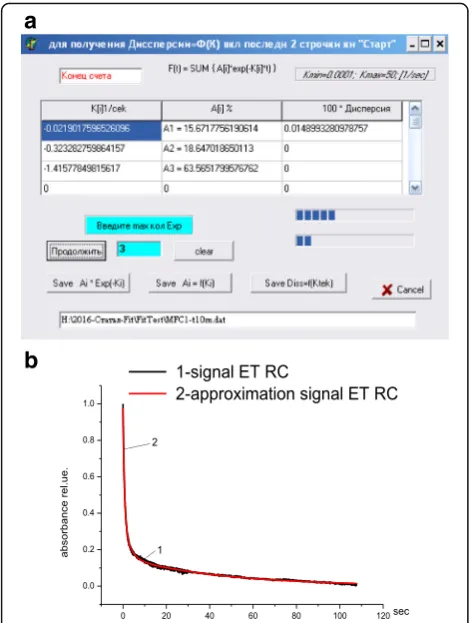
If the original file has correct format, the decomposition of the initial signal into exponential components starts. After that the parameters of exponents will appear in a table. The decomposition results can be saved in two text files: (i) as an approximation signal for visual control, by means ofSave Ai*Exp(-Ki) button, or (ii) as a table of ex-ponential parameters, by clickingSave Ai = f(Ki). Figure 1b shows the normalized plot of the kinetics of absorption re-covery of RC solution after switching off the excitation light (reference signal) and the approximation curve for the experimental signal. A good correlation between the experimental signal and its decomposition into three com-ponents (dispersion = 0.00015) is observed. The accuracy of decomposition is ±2.5%.
Figure 2 shows a characteristic behavior of the object-ive function of approximation of electron transport kinetics in RC for different modes of photoexcitation. This character of the objective function allows the optimization without the risk of falling into a local mini-mum, and significantly reduces the computation time (to 5 min).
Results and Discussion
Problem Solving and Discussion
The developed software has been tested for an analysis of the kinetics of electron transport in various modes of RC photoexcitation and induction of chlorophyll fluores-cence in four leaves of winter wheat.
The RCs were studied on wild-type isolated bacteria
Rhodobacter sphaeroides. The chromatophores of
bacteria were solubilized by detergent LDAO (lauryldi-methylamine N-oxide), and RCs were separated from other membrane components by means of hydroxyapa-tite column chromatography. The isolated RCs were slurry suspended in a 0.01-M Na-P buffer, pH 7.2, with 0.05% LDAO [8]. The RC absorption kinetics was studied by means of exposure of RCs to light pulses of different durations and intensities. The results were sat-isfactorily approximated by 2 ÷ 4 exponential functions.
Although the absorption kinetics corresponded to the kinetics of electron transport, the achievement of dark ab-sorption values during RC relaxation after turning off the light did not guarantee the end of the structural changes in RCs. In this regard, the RC absorption kinetics was studied under photoexcitation by two successive light pulses with duration of 100 s and intensity of 7 mW/cm2; the interval between the pulses was varied from 0 to 2500 s (Fig. 3).
The present studies showed that at intervals between RC photoexcitation pulses smaller than 40 s the weighta1of fast
component of RC recovery increased, the weighta2of
inter-mediate component decreased, and the weight a3 of slow
component slightly increased; the decrementsk1,>k2,>k3
rap-idly dropped, that indicated on the impact of previous RC history. At intervalstimp=40 ÷ 100 s a slow change of
pa-rameters was observed. At timp> 100 s the parameters of
exponents reached their initial values. At intervals greater than 700 s, the parameters (ai, ki ) of RC recovery after
turning off the second pulse did not change, and the pulses of photoexcitation were independent of each other.
The efficiency of the developed algorithm was also tested in the study of fluorescence induction in the PSII
Fig. 2Dependence of objective function (dispersion) of decomposition on the decrementk3at the final stage of optimization (afterk1andk2
were decrement)
[image:3.595.56.293.87.399.2] [image:3.595.304.539.87.216.2]chlorophyll complexes of four types of winter wheat of dif-ferent ages. The shape of chlorophyll fluorescence induc-tion curve in the leaves of plants depends on several processes that determine the energy distribution. A signifi-cant role is played by the energy exchange processes in the light-harvesting antenna complex, photochemical transformation, and electron outflow from the reaction centers. Blocking the electron transport from the reaction centers leads to a simplification of the shape of fluores-cence curve. In this case the shape depends mainly on the energy transfer in antenna. Several subsystems (units) can be distinguished in the PSII structural organization [9, 10]: a unit of photoelectric converters that perform the photo-chemical reaction, an antenna unit, and block of small protein subunits. The antenna unit includes pigment-proteins of internal antennas, external minor antennas, and external LHCII antennas with trimers (S, M, L). The PSII complex has three dimers (C2–dimers of
core-complexes) which include the reaction centers with in-ternal antennas, as well as trimers (S, M) of the extenal LHCII antenna. The induction of fluorescence was measured in a classical mode in cut leaves adapted to darkness. The electron transport was blocked by DCMU (3-(3,4-dichlorophenyl)-1,1-dimethylurea) which was fed into the tissues together with the buffer mixture through the section in the bottom of the leaves.
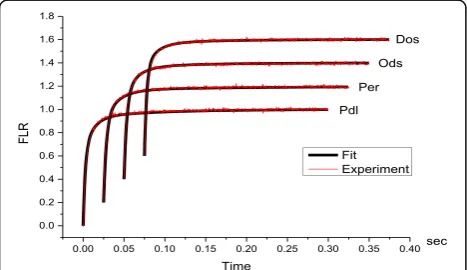
It was shown that there are only three components in the exponential decomposition of the kinetic curve of fluorescence induction for the leaves of plants of differ-ent genotypes grown in normal conditions, and the sum of these components well correlates with the experimen-tal curve (Fig. 4).
Table 1 shows the results of decomposition of induc-tion curves of chlorophyll fluorescence for four types of winter wheat.
The values of exponential components for four leaf genotypes are close to each other. The ratio of the weights of exponential components with decrements (k1> k2> k3)
is approximately a1:a2:a3= 10/5/1. Electron microscopic
studies of thale cress (Arabidópsis thaliána) and spinach
[image:4.595.59.539.88.284.2]Fig. 4Experimental curves of fluorescence induction for the leaves of four types of winter wheat (Pdl, Per, Ods, Dos) (red); the results of approximation by three exponential components (black)
Table 1The results of decomposition of induction curves of chlorophyll fluorescence for four types of winter wheat
Type of winter wheat
Weighted contributions of exponential components a1,a2,a3 %
Rate constants k1,k2,k3 c−1
Chl a/b
Ratio a1/a2/a3
Pdl 59, 29, 7 400, 87, 11 3.59 8/4/1
Per 67, 23, 3 300, 57, 5 3.52 22/8/1
Ods 67, 22, 4 300, 66, 12 3.91 17/6/1
Dos 77, 22, 4 370, 71, 13 3.60 19/6/1
[image:4.595.57.291.558.693.2] [image:4.595.304.537.626.731.2](Spinácia olerácea)[11] showed that the ratio of the de-tected three configurations of PSII pigment-protein com-plexes was 8:2:1, that is close to the above ratio a1:a2:a3
(see Table 1).
Conclusions
A computer program for the decomposition of the basic reaction kinetics of biological macromolecules into ex-ponential components has been developed. The program was tested for analysis of the kinetics of photoinduced charge transfer in the reaction centers (RCs) of purple bacteria and the induction of fluorescence in granum thylakoid membranes. An identification of the kinetics of structural changes in RC in the process of photoexci-tation was carried out with this program. It was found that after photoexcitation of RC, its structure had the most non-equilibrium character within the first 40 s after switching off the light. The dark state was achieved by RC in the process of relaxation after turning off the light, and dark values of absorption were achieved after additional exposure of RC without light for 700 s.
Examination of fluorescence induction of PSII com-plexes in four genotypes of winter wheat of different ages showed that only three exponential components were present in the kinetics of induction, with the ratio of weightsa1:a2:a3= 10/5/1. This value is close to the ratio of
8:2:1 for three configurations of PSII pigment-protein complexes, obtained by electron microscopic studies of thale cress (Arabidópsis thaliána) and spinach (Spinácia
olerácea). This indicates on possible correlation between
the exponential components of fluorescence induction of PSII complexes and the composition of pigment-protein complexes of granum thylakoid membranes. It provides an opportunity to replace expensive electron microscopic investigations by much easier studies of the kinetics of fluorescence induction in granum thylakoid membranes.
Funding None.
Authors’Contributions
YuMB took part in the formulation of problems and ways to solve it. AKL participated in the task and designed the manuscript according to the requirements of article publication. Both authors read and approved the final manuscript.
Competing Interests
The authors declare that they have no competing interests.
Received: 24 September 2016 Accepted: 25 November 2016
References
1. Monod J, Wyman J, Changeux JP (1965) J Mol Cell Biol 12:88–118 2. Kleinfeld D, Okamura MY, Feher G (1984) Electron-transfer kinetics in
photosynthetic reaction centers cooled to cryogenic temperatures in the charge-separated state: evidence for light-induced structural changes. Biochemistry 23:5780–5786
3. Shaytan KV, Uporov V, Lukashev Ye P, Kononenko AA, Rubin AB (1991) Mol Biol 25:695–705, in Russian
4. Kochubey SM, Yu M, Barabash ID, Panas (2015) Multi-component structure of induction curve of chlorophyll fluorescence in wheat leaves//XXII Galyna Puchkovska International School-Seminar“Spectroscopy of Molecules and Crystals”September 27–October 4, 2015. Chynadiyovo, Zacarpattia, Ukraine, p 34
5. Glushkov VM (1974) Introduction to Automated Control Systems. Tekhnika, Kiev, p 320, in Russian
6. Gen M, Cheng R (1997) Genetic algorithms and engineering design. New Jersey: John Wiley & Sons; 1997. p 352
7. Franks LE (1974) Signal theory-Moscow: Soviet Radio. Russian, p 344 8. Zakharova NI, Churbanova IY (2000) Biochemistry 65:181
9. Golbeck J, van der Est A, Eds (2014) The biophysics of photosynthesis. New York: Springer. p465
10. Kochubey SM (2001) Organization of photosynthetic apparatus of higher plants. Kiev,“Alterpress”, Russian, p 204
11. Boekema EJ, van Breemen JFL, van Roon H, Dekker JP (2000) Arrangement of photosystem II supercomplexes in crystalline macrodomains within the thylakoid membrane of green plant chloroplasts. J Mol Biol V 301:1123–1133
Submit your manuscript to a
journal and benefi t from:
7 Convenient online submission 7 Rigorous peer review
7 Immediate publication on acceptance 7 Open access: articles freely available online 7 High visibility within the fi eld
7 Retaining the copyright to your article