N A N O E X P R E S S
Open Access
Enhanced Diffuse Reflectance and
Microstructure Properties of Hybrid
Titanium Dioxide Nanocomposite Coating
Hai Lu
1,3*, Meng Huang
1, Ke-Sheng Shen
1, Jun Zhang
1, Shi-Qiang Xia
1, Chao Dong
1, Zong-Gang Xiong
1,
Ting Zhu
1, Da-Peng Wu
2, Bo Zhang
3and Xian-Zhou Zhang
1Abstract
In this research, we studied enhanced diffuse reflectance that can be achieved by excitations of multiple-scattering in a hybrid micro-structured titanium dioxide coating. Conventional approaches to obtain diffuse reflection structure rely heavily on exciting the scattering of randomly textured surface, whereas here, we reveal numerically and experimentally that, besides interface scattering, bulk scattering of ordered-disordered hybrid structure can be also employed to obtain highly efficient diffuse reflector. The diffuse reflectance over the measured wavelength region increases significantly with thickness, while angle and polarization-dependent specular reflections are suppressed. These results show the potential to be used as a highly efficient diffuse reflector or for applications in various advanced fields of photonics related to light extractions and diffusers.
Keywords:Optical properties, Microstructure, TiO2nanocrystals, Coating
Background
Rough-surfaces-induced light scattering responses, espe-cially diffuse reflection, serve as the cornerstone of many branches of optics and materials science [1–3] and play a central role in lots of exotic optical and photonic phenomena [4–7]. Besides the relatively intuitional sur-face scattering of randomly textured dielectric intersur-faces [8,9], it was recently discovered that bulk scattering ex-ists within inhomogeneous structure, which stems from cross-correlation parameters between roughnesses or in-homogeneities [10, 11]. Consequently, a new branch of diffuse reflector emerges, which relies on a full exploit-ation of excitexploit-ations and interferences of both surface and bulk scattering [12, 13] and enables much more flexible control of both magnitudes and polarizations of the electromagnetic fields [14, 15]. Moreover, such a field rapidly hybridizes with other branches of plasmo-nics, optical nanoantennas, and metamaterials, which renders enormous extra freedom for manipulations of
various kinds of light-matter interactions and makes possible lots of novel photonic functionalities and de-vices [16–18].
A recent rather remarkable achievement based on the microstructure diffuse reflector is light management real-ized in various optical components [19–21]. When the light is reflected back from the diffuse reflector at the rear side, escaped light can be effectively eliminated at the front surface due to the transverse wave vector of the scat-tering light beyond the light cone of air. This is of great importance for various applications including solar cell, il-lumination, and many other applications related to light-matter interaction enhancement in devices [22–24]. Nevertheless, similar to many novel functionalities ob-tained in surface-relief structures and nanoparticle-based structures [16–24], the existing approaches to obtain dif-fuse reflector heavily rely on the excitations of the scatter-ing of randomly textured surface [14,15]. Then it is vital to ask: Can the diffuse reflectors be supported by interface and bulk scattering simultaneously to realize better functionalities?
Here in this paper, we report new observations of en-hanced diffuse reflection in one platform by patterned ellipsoidal TiO2 nanoparticle assemblies. Firstly, we
* Correspondence:[email protected]
1Engineering Laboratory for Optoelectronic Technology and Advanced
Manufacturing, Henan Normal University, Xinxiang 453007, China
3Xinxiang Baihe O.E. Co., Ltd, Xinxiang 453731, China
Full list of author information is available at the end of the article
fabricated different hybrid structures and analyzed their diffuse reflection spectrum. It is revealed that hybrid microstructure coating composed of TiO2particles-based
three-dimensional spheres can totally substitute for non-absorbing powder, such as ultrahigh-purity fumed sil-ica [23], to obtain highly efficient diffuse reflectors. And then, we performed finite difference time domain (FDTD) simulations to investigate this hybrid microstructure coat-ing for diffuse reflection, as well as for bulk scattercoat-ing. In addition, we also show that specular reflection of this hy-brid microstructure coating can be greatly suppressed to achieve isotropic scattering.
Methods
Preparation of TiO2Products
Tetrabutyl titanate (12.5 mL) was slowly added into a mixture solution of 50 mL hydrogen peroxide (H2O2,
30 wt%) and 5 mL ammonia (NH4OH, 26–28 wt%)
dropwise in a 500 mL beaker with continuous shaking. Afterwards, cold distilled water was poured into the bea-ker to yield a saffron yellow precursor solution with a final volume of 200 mL. The precursor solution was fil-tered to remove the undissolved yellow bulks occasion-ally floating on the solution. Then, 10 mL of this yellow precursor was extracted and transferred into a 50 mL Teflon container with additions of 10 mL distilled water and 20 mL absolute ethanol. The mixture was tightly sealed with a stainless jacket and heated at 180 °C for 10 h. The final residue was centrifuged and washed with water and ethanol, respectively. Finally, the as-prepared sample was dried at 60 °C for 2 h. In addition, the pre-cursor dosage was adjusted to 5 mL to prepare the ana-tase TiO2nanocrystals.
Fabrication of Hybrid TiO2Nanocomposite Coating The hybrid TiO2 nanocomposite coatings are grown
through utilizing self-made anatase TiO2nanocrystal
de-posited on a fluorine-doped tin oxide glass substrate. The fabrication method consists of three steps. First, self-made anatase TiO2 nanocrystals and its assemblies
were selectively prepared via a solvothermal method by altering the peroxotitanium complex precursor dosage. And then, these nanocrystals or assemblies were spread onto the substrate by doctor-blade method with adhesive tape to control the coating thickness. At last, after dried in air, the coating was heated up to 450 °C at a rate of 5 °C/min and maintained for 30 min.
Characterization
The structures of the fabricated coatings were character-ized by field-emission scanning electron microscopy (HITACHI S4800). And the structural details of these assemblies can be obtained by transmission electron mi-croscopy (Tecnai F30). The XRD pattern of the coatings
were tested by Rigaku D/max-2500 diffractometer with Cu Kαradiation,λ= 0.1542 nm, 40 kV, 100 mA. The dif-fuse reflectance and the polarization-dependent specular reflectance of the coatings were measured, respectively, using a spectrophotometer (Angilent Carry 5000) equipped with 110 mm integrating sphere and variable angle specular reflectance accessory.
Results and Discussion
The Diffuse Reflectance Properties of Four Types of Microstructured TiO2Coatings
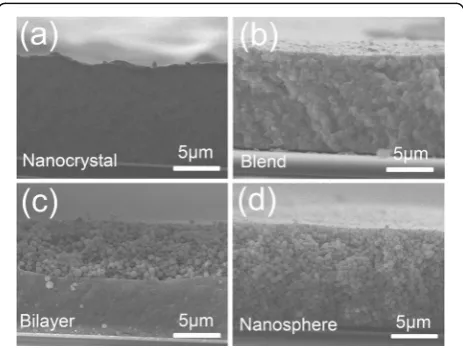
Here, we have fabricated four types of microstructured coating as shown in Fig. 1. They are pure nanocrystal coating, blend and bilayer coating with ellipsoidal nano-crystal and spheroidal assembly, and pure spheroidal as-sembly coating, respectively, and labeled as nanocrystal, blend, bilayer, and nanosphere. It should be noted that the process differences which lead to these coating structures mainly come from the different coating mate-rials and the order of preparation. The pure nanocrystal and spheroidal assembly coatings are made by TiO2
nanocrystals and spheroidal assemblies, respectively. But for the blend coating, the ellipsoidal nanocrystals and spheroidal assemblies are equally mixed in weight. The bilayer coating was constructed by the doctor-blade method through two-step calcination as stated in“Fabri cation of Hybrid TiO2Nanocomposite Coating”section.
Firstly, nanocrystal slurry was spread onto substrate. And then, after calcination, another layer of spheroidal assembly slurry was deposited on the semi-transparent layer and annealed with the same heating profile. The structures of the four fabricated coatings are character-ized by field-emission scanning electron microscopy as shown in Fig. 1a–d. The thicknesses of coatings are all limited to 14μm, and the bilayer coating is composed of
[image:2.595.306.538.520.694.2]ellipsoidal nanocrystal layer and spheroidal assembly layer equal in thickness (~ 7 μm). As the TiO2 nanocrystals
grow with different sizes, they ultimately assemble to pro-duce different diameters of the sphere. In Fig. 1, the ob-tained sizes in ellipsoidal TiO2nanocrystal and spheroidal
assembly are about 20 and 100 nm, respectively.
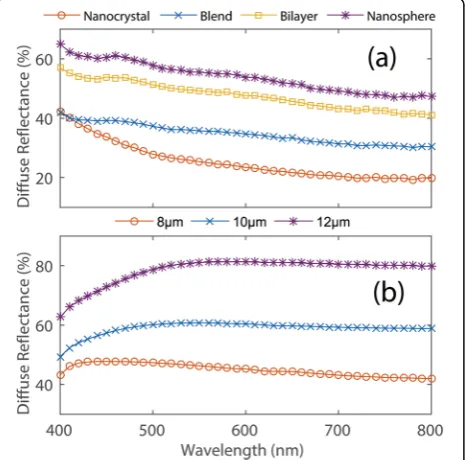
The diffuse reflectance of the four samples was mea-sured using a spectrophotometer. The measurement wavelength range was 400–800 nm which covers the vis-ible region relevant for the working of display and solar cells. The results obtained are presented in Fig.2a. From Fig.2a, it can be seen that blend coating constructed from the mixture of ellipsoidal nanocrystals and spheroidal as-semblies exhibits a higher reflectance compared with pure nanocrystal coating. But, even though the ratio of nano-crystals to polymer spheres is approximately the same in these coatings, the diffuse reflectance of the bilayer coat-ing is still higher than that of the blend coatcoat-ing. It suggests that the scattering properties of coatings made by spher-oidal assemblies may be better than nanocrystals. Indeed, compared with the other three coatings, nanosphere coat-ing possesses a best scattercoat-ing effect because the coatcoat-ing is solely constructed by spheroidal assemblies.
Now, it is clear that these simple spheroidal assemblies, which are composed of ellipsoidal TiO2nanocrystals, can
be considered as superior scattering particles to enhance the diffuse reflectance. But as shown in Fig.2a, the average reflectance for nanosphere coating is about 55%, but for certain wavelength ranges (e.g., > 700 nm), the reflectance becomes less than 50%. Moreover, it is worthy to note
here that the reflectance value plummets in the visible re-gion, indicating the weak scattering effect of low-energy photons induced by small size of unit cells.
In order to further optimize the diffuse reflectance of the pure spheroidal assembly coating, the sizes of nano-crystals and spheroidal assemblies were increased through adjusting the dosage of precursor. The mea-sured diffuse reflectance spectra corresponding to the optimized nanosphere coatings with enlarged unit cell size and for the different thicknesses (8, 10, and 12μm) are shown in Fig.2b. For 8 μm thickness of nanosphere coating, the average reflectance increases above 40% and remains high throughout the whole wavelength range. But as observed in Fig.2b, the reflectance of nanosphere coating strongly depends on the thickness or, in other words, on the packing fraction of the unit cell. When the thickness of the coating is thin, the packing fraction of ellipsoidal nanocrystals in a spheroidal assembly de-creases. Even if the size of the spherical component has been optimized, the hybrid spheroidal structures of thin coatings could not shield the scattering lights properly. And a major portion of the incident light is directly transmitted by the coating. On the other hand, there tend to be more lobes in the scattering diagram near the directions toward which the particle presents a large width than near the directions for which the projected width is smaller [25]. Note that ellipsoidal TiO2
nano-crystals oriented with their symmetry axes oblique to the incident beam scatter asymmetrically about the forward direction in Fig. 2b. It means that incident light will be scattered randomly by spheroidal assemblies composed of multi-oriented ellipsoidal TiO2 nanocrystals. Thus, it
is possible to get a higher diffuse reflectance from the thicker nanosphere coating, because in which the for-ward scattering may be suppressed by the multi-oriented ellipsoidal TiO2nanocrystals.
The Structural Details of Hybrid TiO2Nanosphere Coatings The information about structural properties of nano-sphere coating used in Fig. 2b can be seen clearly in Fig.3. As depicted in Fig. 3a, the diameter of the spher-oidal assembly ranges from 100 to 600 nm, with an aver-age size of 330 nm. In general, for sufficiently large nanospheres (radius of equal volume sphere greater than about 300 nm in visible band), the larger the sphere, the more heavily forward scattering directions are weighted compared with backscattering directions [25]. But as can be seen in Fig.3b, the enlarged SEM image shows that the nanospheres are assembled from multi-oriented sized ellipsoidal nanocrystals about several nano-meters in diameter and several tens of nanonano-meters in length. Compared with the well-defined spheres with uniform diameter, the spheroidal assemblies could in-crease the backward scattering of the incident light rays Fig. 2a,bDiffuse reflectance spectra of the four samples with
[image:3.595.58.292.463.693.2]and lead to a better diffuse reflection when used as dif-fuse reflector. In addition, as shown in Fig.3c, the struc-tural details of these spheroidal assemblies can be obtained by transmission electron microscopy (Tecnai F30). The corresponding TEM image shows that these spheroidal assemblies possess mesoporous structures (Fig. 3c). Moreover, the ellipsoidal nanocrystals at the surface of the sphere exhibit sharp tips and spindle-like configuration (Fig. 3d). As known, the geometry irregu-larities at surfaces can bring considerable light scattering responses [8, 9, 21]. In fact, using similar TiO2
nanos-pindles as the scattering overlayer in solar cells, efficient light scattering has been observed experimentally [26]. On the other hand, the investigation on variations in layer thickness can be applied to point out some essen-tial differences between surface and bulk processes. It is apparent that bulk scattering increases with layer thick-ness of nanosphere coating as shown in Fig.2b, since it depends on the integral in the volume of the stationary zero-order electromagnetic field [10]. Thus, it is possible that both bulk and surface scattering benefit from this nanosphere coating. Furthermore, in the high-resolution TEM image of the tip area of an individual nanospindle (Fig. 3e), the well-defined lattice fringes with inter-plane spacing of 0.35 nm indicate that the primary nanospin-dles are highly crystallized. Similarly, the XRD pattern of
the nanosphere coating suggests the products exhibit well-crystallized structure (Rigaku D/max-2500 diffract-ometer with Cu Kα radiation, λ= 0.1542 nm, 40 kV, 100 mA), in which all the diffraction peaks can be indexed to anatase TiO2(JCPDS no. 21-1271). It is obvious that
the diffraction peaks belonging to (103), (004), and (112) are integrated together, indicating the broadening of the diffraction peaks due to the different particle size.
The Underlying Scattering Mechanism of Hybrid TiO2
Nanosphere Coatings
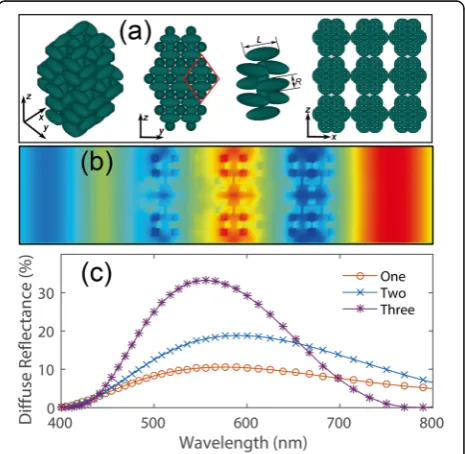
To explore the nature of these structures, FDTD simula-tions were conducted using models with geometric size identical to those of the measured samples in experi-ments by commercial software (East FDTD, Dongjun technology, Shanghai, China). The corresponding model of the nanosphere coating utilized in FDTD simulations is shown in Fig.4a. The length L and radius R of the el-lipsoidal nanocrystal are selected as 60 nm and 30 nm, respectively. And the assemblies (as shown in Fig.3) are grown through closely packed structure of nanocrystals. In order to simplify the consideration, the different thicknesses of the coating are replaced by changing the layer number of nanospheres. The electric field profile for wavelength 600 nm is shown in Fig. 4b, where light through the coating is scattered uniformly by the coating and resonates inside the assemblies. Thus, we can con-clude that, when light is incident from the top side of the nanosphere coating, it gets trapped by the assembly Fig. 3Thea,bSEM,c,dTEM, andehigh-resolution TEM images of
the nanosphere coating. Thed,ethe zoom-in TEM images which gives the details of the area corresponding to the red boxes in (c,d), respectively. The XRD pattern of the nanosphere coating (f)
Fig. 4aThe schematic of the nanosphere assemblies: from left to right, the perspective, front view, the unit cell of the assemblies, and the three layer nanosphere coating utilized in FDTD simulation, respectively.bElectric field profile in three layer nanosphere coating.
[image:4.595.57.290.85.358.2] [image:4.595.306.539.446.673.2]and gradually diverges backward due to the multi-oriented nanocrystals and the scattering effect. In fact, the back-ward scattering behavior of light in nanosphere coating depends on the amount of spherical assemblies. As can be seen in Fig. 4c, the reflectance of the three-layer nano-sphere coating has been significantly improved in the vis-ible wavelength band corresponding to that of the single/ two layer(s) coating.
The Polarization-Dependent Specular Reflectance Properties of Hybrid TiO2Nanosphere Coatings with
Different Thicknesses
As well known, reflection spectra of almost all crystal types of titanium dioxide are in the ultraviolet region below 400 nm [27, 28]. Therefore, titanium dioxide fre-quently appears in many sunscreen cosmetics aiming to reduce the damage of ultraviolet rays to human skin. However, in the visible light region, its efficiency de-creases as the transmittance inde-creases. There is great sig-nificance on how to improve the reflection efficiency of titanium dioxide in the visible light region.
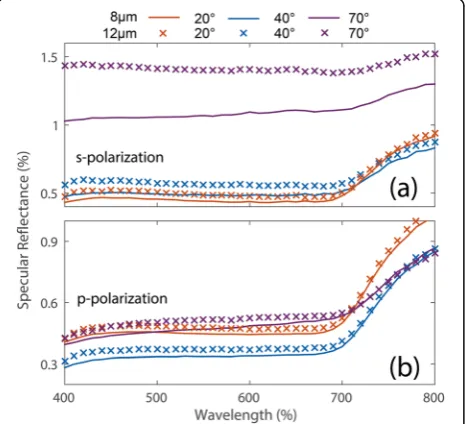
We further analyzed the polarization-dependent specular reflectance of the nanosphere coatings using spectrophotometer (Agilent Carry 5000). The obtained results for the optimized nanosphere coatings at two dif-ferent thicknesses (8 and 12 μm) are shown in Fig. 5. The specular reflectivity of the two samples in the spec-tral region of 400–700 nm is maintained at a low level (less than 2%), which proves the previous discussion. The results show that the nanosphere coating has a strong ability in suppressing specular electromagnetic wave reflection in the spectral region of 400–700 nm for
both normal and wide-angle incidences. However, the specular reflectance of the two samples in the 700–800 nm range has a significant upward trend for different angles and polarizations. This anomalous phenomenon probably comes from the effect of the nanotopography of titanium dioxide. Previously, it has been demonstrated that reflect-ive coatings composed of titanium dioxide with different structural topographies have a great influence on the re-flection band. For instance, the light-scattering of titanium dioxide around 400 nm and 700 nm can be improved by adopting different structures, nanorod, nanowire, and nanosphere [29]. Here, our results also prove this point.
In addition, the bandwidth and amplitude of specular reflection reduction are insensitive to the polarization of the incident light and the thickness of the coating. As stated above, these special properties can be attributed to the fact that the sphere assembly is a collection of many randomly oriented particles, which may them-selves be anisotropic. However, the results also show that the proper polarization may have an effect on the reflection efficiency of the coating, which provides more possibilities for future designs.
Conclusions
In conclusion, we report a new technique to enhance diffuse reflectance in a hybrid TiO2 microstructured
coating. Depending on the shape of the TiO2
nanoparti-cles in the coating, the incident light is reflected uni-formly due to the multi-oriented nanocrystals and the scattering effect. These hybrid microstructured coatings are grown through a low-cost solvothermal method by altering the peroxotitanium complex precursor dosage. By increasing the size of the ellipsoidal TiO2
nanocrys-tals, we optimized our structure to achieve a maximum reflectance of approximately 80% over the wavelength range of 550 nm to 800 nm. With the help of fine structure and morphology characterization, we have analyzed the behavior of the measured reflectivity spectrum with the change in thickness and verified the result with FDTD simulation. Finally, a wide-angle, polarization-insensitive specular reflection reduction can be found in these nanosphere coatings. And the max-imum specular reflectance at any wavelength is less than 1.5% for the whole broadband (400–800 nm) range of wavelengths. Our proposed hybrid microstructured coat-ings with its unique light scattering and tunable ability will be useful for highly efficient diffuse reflector or for applications in various advanced fields of photonics re-lated to light extractions and diffusers. There is a further scope of investigations on the effect of the diameter, orientation, and distributions of the ellipsoidal TiO2
nanocrystal in the spherical assemblies on the light ma-nipulation mechanism.
[image:5.595.58.291.491.703.2]Abbreviation
FDTD:Finite difference time domain
Acknowledgments
We appreciate the experimental assistance from Masters students Jingya Liu, Xinkai Li, and Taiyu Yang.
Funding
The National Natural Science Foundation of China (NSFC) (Nos. 11404102, 11704104, 11704102, and 11647127), Key Project of Science and Technology of Henan Province (No. 142102210055), and the Natural Science Foundation of Henan Province of China (19B140003).
Availability of Data and Materials
The datasets used and/or analyzed during the current study are available from the corresponding author on reasonable request.
Authors’Contributions
HL, MH, and KSS carried out the experiments and drafted the manuscript. JZ and SQX participated in the measurements and performed the analysis. XZZ supervised the overall study and polished the manuscript. DC, ZGX, TZ, DPW, and BZ participated in the measurements. All the authors read and approved the final manuscript.
Competing Interests
The authors declare that they have no competing interests.
Publisher’s Note
Springer Nature remains neutral with regard to jurisdictional claims in published maps and institutional affiliations.
Author details 1
Engineering Laboratory for Optoelectronic Technology and Advanced Manufacturing, Henan Normal University, Xinxiang 453007, China.2School of
Chemistry and Chemical Engineering, Henan Normal University, Xinxiang 453007, Henan, China.3Xinxiang Baihe O.E. Co., Ltd, Xinxiang 453731, China. Received: 30 July 2018 Accepted: 17 October 2018
References
1. Wiersma DS (2013) Disordered photonics. Nat Photonics 7(3):188–196 2. Graydon O (2015) Lighting that talks. Nat Photonics 9(12):785–786 3. Jahn HA, Lonsdale K (1941) Diffuse reflections from diamond. Nature
147(3716):88–89
4. Wang N-W, Chen X-D, Yang Y-H, Dong J-W, Wang C-X, Yang G-W (2013) Diffuse reflection inside a hexagonal nanocavity. Sci Rep 3:1298 5. Pors A, Ding F, Chen Y-T, Radko IP, Bozhevolnyi SI (2016) Random-phase
metasurfaces at optical wavelengths. Sci Rep 6:28448
6. Velten A, Willwacher T, Gupta O, Veeraraghavan A, Bawendi MG, Raskar R (2012) Recovering three-dimensional shape around a corner using ultrafast time-of-flight imaging. Nat Commun 3(2):745
7. Gratzel M (2001) Ultrafast colour displays. Nature 409(6820):575–576 8. Sanchez-Gil JA, Nieto-Vesperinas M (1991) Light scattering from random
rough dielectric surfaces. J Opt Soc Am A 8(8):1270–1286
9. González-Alcalde AK, Méndez ER, Terán E, Cuppo FLS, Olivares JA, García-Valenzuela A (2016) Reflection of diffuse light from dielectric one-dimensional rough surfaces. J Opt Soc Am A 33(3):373–382
10. Amra C, Besset CG, Bruel L (1993) Comparison of surface and bulk scattering in optical multilayers. Appl Opt 32(28):5492–5503
11. Amra C (1993) From light scattering to the microstructure of thin-film multilayers. Appl Opt 32(28):5481–5491
12. Jang J-E, Lee G-H, Song B-G, Cha S-N, Jung J-E (2013) Enhancement of diffuse reflectance using air tunnel structure. Opt Lett 38(3):290–292 13. Jang J-E, Cha S-N, Lee J-M, Kim J-J, Amaratunga GAJ, Jung J-E (2012)
Multiple color reflection in a single unit cell using double-layer electrochromic reaction. Opt Lett 37(2):235–237
14. Gur D, Palmer BA, Weiner S, Addadi L (2017) Light manipulation by guanine crystals in organisms: biogenic scatterers, mirrors, multilayer reflectors and photonic crystals. Adv Fun Mat 27:1603514
15. Mohri Y, Kobashi J, Yoshida H, Ozaki M (2017) Morpho-butterfly-inspired patterning of helical photonic structures for circular-polarization-sensitive wide-angle diffuse reflection. Adv Opt Mat 5:1601071
16. Zeng L, Yi Y, Hong C, Liu J, Feng N, Duan X, Kimerling LC, Alamariu BA (2006) Efficiency enhancement in Si solar cells by textured photonic crystal back reflector. Appl Phys Lett 89(11):111111
17. Pyo B, Joo C-W, Kim H-S, Kwon B-H, Lee J-I, Leeb J, Suh MC (2016) Nanoporous polymer film as a diffuser as well as a light extraction component for top emitting organic light emitting diodes with a strong microcavity structure. Nanoscale 8(16):8575–8582
18. Ahmed R, Yetisen AK, Khourya AE, Butt H (2017) Printable ink lenses, diffusers and 2D gratings. Nanoscale 9(1):266–276
19. Kim J-Y, Kwon M-K, Park I-K, Cho C-Y, Park S-J, Jeon D-M, Kim J-W, Kim Y-C (2008) Enhanced light extraction efficiency in flip-chip GaN light-emitting diodes with diffuse ag reflector on nanotextured indium-tin oxide. Appl Phys Lett 93(2):021121
20. Powell AW, Wincott MB, Watt AAR, Assender HE, Smith JM (2013) Controlling the optical scattering of plasmonic nanoparticles using a thin dielectric layer. J Appl Phys 113(18):184311
21. Barugkin C, Beck FJ, Catchpole KR (2017) Diffuse reflectors for improving light management in solar cells: a review and outlook. J Opt 19(1):014001 22. Slovick BA, Baker JM, Flom Z, Krishnamurthy S (2015) Tailoring diffuse
reflectance of inhomogeneous films containing microplatelets. Appl Phys Lett 107(14):141903
23. Mason JD, Cone MT, Donelon M, Wigle JC, Noojin GD, Fry ES (2015) Robust commercial diffuse reflector for UV-VIS-NIR applications. Appl Opt 5425: 7542–7545
24. Lan C-W, Bi K, Li B-W, Zhao Y-J, Qu Z-W (2017) Flexible all-dielectric metamaterials in terahertz range based on ceramic microsphere/PDMS composite. Opt Exp 25(23):29155
25. Bohren CF, Huffman DR (1983) Absorption and scattering of light by small particles. New York: Wiley
26. Jiang J, Gu F, Ren X, Wang Y-H, Shao W, Li C-Z, Huang G-J (2011) Efficient light scattering from one-pot solvothermally derived TiO2nanospindles. Ind
Eng Chem Res 50(15):9003–9008
27. Companion AL, Wyatt RE (1963) The diffuse reflectance spectra of some titanium oxides. J Phys Chem Solids 24:1025–1028
28. Sekiya T, Igarashi M, Kurita S, Takekawa S, Fujisawa M (1998) Structure dependence of reflection spectra of TiO2 single crystals. J Elect Spectrosc Relat Phenom 92:247–250
29. Jalava JP (2010) The use of an exact light-scattering theory for spheroidal TiO2