Journal of Criminal Law and Criminology
Volume 7 | Issue 3
Article 11
1916
Notes and Abstracts
Follow this and additional works at:
https://scholarlycommons.law.northwestern.edu/jclc
Part of the
Criminal Law Commons
,
Criminology Commons
, and the
Criminology and Criminal
Justice Commons
This Note is brought to you for free and open access by Northwestern University School of Law Scholarly Commons. It has been accepted for inclusion in Journal of Criminal Law and Criminology by an authorized editor of Northwestern University School of Law Scholarly Commons.
Recommended Citation
NOTES AND ABSTRACTS
ANTHROPOLOGY-PSYCHOLOGY-LEGAL-MEDICINE
Prof. De Sanctis on the Method of Criminal and Judicial Psychology.-The article, technically called the "original article" in the February, 1916, number of La Scuola Positiva, is written by Professor De Sanctis on "The Method of Criminal and Judicial Psychology" It is the opening lecture of the course Professor De Sanctis gives at the School of Applied Criminal Sciences at Rome.
A School of Applied Science, he says, is not for propaganda; it is essen-tially for the teaching of method and of technic. Criminal psychology has suf-fered for want of proper method. There are two ways of approach in the psy-chology of individuals, of passions, of inventions, of events. One is the way of the historians, the literary men, the physicians, the journalists, and the sociolo-gists. The other is that of the specialists in psychological technic. In spite of the fact that the former method is more interesting and appealing, and some-times even very illuminating, it must be the mission of the psychologists in this school to teach psychology in the fashion of the technical psychologist. This kind of psychology is more pedestrian, less exciting, but more certain to bring forth fruitful results.
Scientific method is the ensemble of the processes of mind which must be followed to come to immediate, or evident and universal certainty. The perfect model of certainty is to be found in the physical-mathematical sciences. It is well known that there are two methods-the analytic and the synthetic. The former precedes the latter. This is true because the scientist passes from in-stances to generalizations. Science, indeed, reveals these steps: observation, experimentation, generalization, and prevision. Evident certainty cannot be reached through logic alone.
There are those who fear that the rigor of method kills invention. This is probably true, atl least in part. But the inventive spirit is rare, and the devotees of science are many. Others fear that method limits the subject matter of science. But the strength of science lies in that very limitation. Science is a system of relations. What of it if the assertion of the relativity of scientific knowledge postulates 'an unknowable? Criticism has not pene-trated all of truth. Science ignores the non-relative, the absolute, the thing in itself, and concerning it maintains an attitude of agnosticism. Our positiv-ism is notl a philosophical, but a methodological positivpositiv-ism. If we abandon method, or ask too much of it, we launch out into metaphysical adventures. Science does not presume to destroy metaphysics. Even Kant, the great de-stroyer, did not believe the spirit of man would ever renounce metaphysics. No one has the right to deny that beyond the bournes of rational experimenta-tion and of scientific method there is the realm of pure reason, of aesthetical intuition, and of religious enthusiasm. The .important. thing is to keep these apart.
I
CRIMINAL AND JUDICIAL PSYCHOLOGYScience has teleology with respect to the laws which itself has discovered or verified. But our adversaries are not in accord. While some of them deny certainty to science, others are offended by the laws and the hypotheses of it, as is Poincare. But hypotheses are important; they appease the researcher and they protect him against a gelid skepticism and an ardent enthusiasm, rational or mystic. Science and philosophy should not be in conflict; they should be separated.
Contemporary psychology tends to science rather than to philosophy. The classical method of introspection should be continually verified by the scientific methods of comparative external observation, and of experimentation. There are, of course, difficulties in scientific psychology. But these difficulties have been partly, if not entirely, overcome by median values, by variational fields, by studies of masses. Physical, physiologic, and psychical factors determine a certain state of consciousness. To determine this state of consciousness we have a potent, though difficult, instrument-psychological experimentation. An-other objection is that experimental psychology is barren, that it deflowers the psychical fact, and that this fact cannot be analyzed, but must be pene-trated, must be lived. But we cannot call barren a study which is not indeed satisfied with empirical notions, but only with the formulation of laws between two or more orders of phenomena.
If experimental psychology is positive, a fortiori are the applications of
it positive. Psychology is being applied to almost all activities of life. In America they wish to make psychology a profession. Professional psychologists competent to use technical instruments, might be of great service, especially in respect to the social activities of the race, and in regard to the determination of native and acquired abilities, and .dispositions. In psychopathology the psychiatrists were the forerunners of the psychologists; the penalists and the anthropologists were the precursors of the psychologists in criminal psychology. The anthropologists and the penalists anticipated the great discovery of modern psychology-individual differentiation. The change of the point of attack from the crime to the individual to elicit lessons in social prevention indicated a change from the old to the new psychology.
It is said that the experimental method is not sufficient: the "liberal" method of questioning is preferable. But this objection would change the character of science, as knowledge of that which is evidently and universally certain. We do not deny a "theory of the individual." But this is not the question. What in the individual escapes capture by the experimentalist is not necessary for the practical ends which every application of psychology proposes to it-self. Another rock some people split on is the new intuitionism, which invades even individual psychology. It is probable that the gravest peril to scientific individual psychology is the abuse of intuition, the abusers of intuition believing that it alone can put us into communication with the intimate life of events and of indii'duals.
A few words on the first step in scientific procedure-the gathering of the facts. Facts may be gathered, but they may be worth nothing. Take the case of a criminal. Will the facts gathered about him in prison be of value,
com-pared with those gathered about him in the very environment of his criminal activities? Questioning of a criminal may be entirely futile if it be carried on in the wrong set of circumstances. The proper places for the study of criminals
FAMILY OF SAM SIXTY
are the Courts, the chambers of the Magistrate, the prison. The closer we come to the individual's natural, as distinguished from his artificial, environ-ment, the more we penetrate to his innermost being. But there are other dangers in the research for facts. The psychology of the indicted person is different from that of the one found guilty. And the innocently accused per-son may show us abnormal reflexes.
In criminal and judicial psychology, it can be argued, the pure and simple application of the ordinary clinical method to get at the facts may turn out to be insufficient and ambiguous. The art of questioning is a difficult art, and varies with different doctors, and with different judges. The clinical method of allowing a person to tell his own story is adequate in the medical clinic, but not in the criminal clinic. The experimental method should be adopted here-the method that draws out truth from conditions set by ourselves. Measurements are not sufficient. We must know how to use them. An example will explain the meaning: research shows that mental weakness is a trait of the criminal. Ferri, studying the born murderer, came to the conclusion that the great characteristic of the born murderer is lack of foresight. Is this lack of foresight due to the general mental weakness, and thus, is it a characteristic of the man, or is it due to the peculiar conditions surrounding the homicidal act, and thus rather characteristic of the act? If lack of foresight reveals it-self in the life of the murderer previous to the murder, and after it, then we may say it is a constant factor, and belongs to the man. On the other hand, if that quality is not to be found before or after the act, but only during the act, then it is a characteristic of the act of murder, and not of the individual. The distinction is important, because our object is to reach results which will be useful to us in preventing crime. The question, then, raised by the facts gathered: Is lack of foresight due to the conditions of the crime of murder, or is it due to no special conditions of a specific crime, but only to the gen-eral state of mental weakness-must be answered after the gathering of the facts by the use of a proper logical and psychological technic.
R. F. The Family of Sam Sixty.-(The following is from a recent bulletin from the Ohio Bureau of Juvenile Research):
Introductory Note: In November, 1914, Mr. Starr Cadwallader, then a member of the Ohio Board of Administration, informed the Bureau of Juvenile Research that two brothers, Sam and Jim Sixty, had been committed to the Ohio Penitentiary for incest upon daughters of the former; and that one of these daughters, Violet, had been committed to the Girls' Industrial Home. Jim had been discharged, but Sam was still serving his term. Such criminality seemed to point to inferiority of stock, and the father and daughter were given mental examinations.
442 FAMILY OF SAM SIXTY
The father, Sam, proved to be a medium grade moron. His chronological age was 47'V years. By the Point Scale he made a score of fifty-seven points. This is the expected performance of a child of 8 4/5 years, and is exactly sixty per cent of the average adult perfdrmance in these tests. By the Year Scale he made a score of 8 4/5 years. He was a large, brawny man, well qualified physically to support himself and a family. His family of eight, and the crime of which he stands convicted, leave no question as to the physiological maturity of the man. At the same time, his crimes, the intelligence tests, and his gen-eral behavior and reactions, all indicate that in self-control and all that con-stitutes morality, he is a child of less than nine years. On account of this mental immaturity he should never have been allowed to become a father. It would have been a great economy for the community to have prevented his feeble-minded and criminalistic brood, by taking him into custody as a boy and keeping him segregated and at farm work all his life long.
We have called the family Sixty from the mental endowment of this principal representative, since he has a sixty per cent mental equipment, as measured by the Point Scale. Some of our ancestors were named Smith, Butcher, Cook, Schneider, and Kaufman, on account of what they did; and others were called Brown, White, and Schwartz, on account of the colors of hair, eyes and skin. This family we called Sixty on account of the color of their minds, and the amount of performance this representative can exhibit when his mind is tested.
The data, geneological, biological and sociological, presented herewith, have been gathered and put together by Mrs. Mary Storer Kostir. She has been most diligent and conscientious in looking up geneological connections, personal traits and characteristics, and court and institution records. She has been very con-servative in her estimation of mental ability. She is familiar with the Binet-Simon Scale, having used it in hundreds of cases. When, therefore, she asserts that an individual is feeble-minded, the possibility that he is not so is very re-mote indeed.
Her charfs alone, show both the prolificness of these feeble-minded stocks and the certainty of transmission of mental defect with criminal tendencies. They present the false economy and great expense of our present temporizing with the problems involved in feeble-mindedness. Her description and sum-mary reenforce these points.
SALIENT POINTS OF THE STUDY: 1. In this incomplete study of the offspring of the ancestors of Sam Sixty and Pearl Lanimirc, we have striking evidence of the inheritance of low mentality. Feeble-minded parents have feeble-minded children.
2. In the descendants of Levi Lanimirc, grandfather of Pearl, we find a great amount of lawlessness which seems to proceed from instability, irritability and irascibility of temper. These strains seem to yield less of what is properly designated defect of intelligence. But they have marked character defects and these appear consistently and persistently in successive generations.
3. These traits combine in the family of Sam Sixty in a most unhappy
de-FAMILY OF SAM. SIXTY 443
pendents, as we see in the children of this pair, by keeping thze feeble-minded
in custody while they are of child bearing and child begetting ages.
4. In addition to the dependency due to the mental deficiency, the Sixty family exhibits a high incidence of criminality. The crimes are not those re-quiring ingenuity. They are no embezzlers, forgers, or pickpockets among them. Theirs are the crimes of lust and passion. They proceed from lack of self-control. And the feeble-minded, of the sixty per cent variety, cannot be ex-pected to have the ordinary amount of self-control. They are children of nine years mentality, with all the passion that goes with physical maturity. Hence the crimes of the feeble-minded, which greatly enhance their cost to society.
5. In view of this dependence of their delinquencies upon their mental
de-ficiencies, our present method of handling delinquents appears most short sighted and costly. Sam and Violet Sixty are in correctional institutions, and both are subject to parole. Violet cannot be legally held where she is, after she becomes of age. The mental endowment of neither can be increased. They are feeble-minded because they have brains incapable of growing up like those of ordinary people. With this handicap, it is impossible to instill into them self-control.
They can never attain the usual respect for the laws of morality, because they lack the intelligence which is necessary for this appreciation. What is true of these two, father and daughter, holds equally of many others of their family. If the community deals intelligently with such people, it will cease to temporize by making efforts at reform, it will recognize the fundamental de-ficiency in intelligence and will provide permanent custody for such persons. In custody they will produce more and be much happier, and at the same time, will not be producing broods of feeble-minded dependents.
That the life-long custody of Sam and Pearl Sixty would have been cheaper to the states concerned than the crimes and delinquencies of themselves and their children cannot require further demonstration. Such physically vigorous but mentally feeble persons are a social menace today.
6. Their children threaten to overwhelm the civilization of the future.
Our philanthropy, which makes life so easy for them, must also consider our children, and not burden the future with an incubus of mental deficiency.
7. For this purpose it is necessary that courts, social workers, and county
and state institutions, all take their actions, and make their dispositions of cases of dependency and delinquency, with full knowledge of the mental condition of
each subject who comes before them. Such subjects must be examined by medical psychologists. Preventive medicine must come to the aid of courts and schools in this work of saving the social waste which is incurred by the present method of treating the feeble-minded as if-they were capable of ordinary self-control, or could be educated to such self-control.
8. Inasmuch as our incomplete study of this group has placed on record
forty-seven illicit sexual relationships, and forty-one children known to be ille-gitimate, the folly of framing restrictive marriage laws to remedy conditions here presented, is at once apparent. Many of these people are as irresponsible sexually as are rabbits or guinea pigs. To pass laws to prevent the marriage of such individuals would serve only to increase illegitimacy. It would not lessen the number of offspring from the least desirable parents.
SCHOOL FOR THE BLIND
which accompany them, are arguments which convince the fair-minded that, some control by society of the increase of the human family is imperative. They show that society has the right to' take measures to prevent some individuals from becoming parents, because society pays taxes. It is the public which must support the children of these persons, and must bear the expense of the crimes of the feeble-minded.
THOMIAS H. HAINES, M.,D.,
Bureau of Juvenile Research, Columbus, 0.
Mental Survey of the Ohio State School for the Blind.-We have re-ceived publication No. 9, January, 1916, from the Ohio Board of Administra-tion under the above title, by Dr. Thos. H. Haines, Clinical Director of the Bureau of Juvenile Research at Columbus. Following is a summary of the findings:
The practical outcome of this survey may be summarized as follows:
(1) The intelligence development of each pupil in the school has been
assessed.
(2) The capacity of each person to deal intelligently with his environ-ment, being compared with that of averages for those of his age, and with bet-ter established norms for seeing persons, fairly reliable bases are found for set-ting off the subnormal and the mentally deficient.
(3) Twenty-one persons are so definitely feeble-minded that the main-tenance of these persons in the school constitutes of it, to this extent, an asylum, which is clearly contrary to the statutory provisions for the institution.
(4) The blind children of this school, as compared to the average school population, are back in their school work about two years.
(5) The blind child, as such, is not noticeably behind the ordinary seeing child, in the development of that sort of mental endowment which makes for adaptation to environmental conditions.
(6) The child who is blind from birth or early childhood lacks visual imagery, which is the large synthetic element for organizing the experience of most seeing persons. Consequently he must find other means of organizing his experience. This nakes his mental organization proceed more slowly, in some respects, and makes him less agile in handling practical situations.
(7) A Provisional Point Scale for Measuring the Mental Ability of the Blind, with tentative age norms, has been developed. This affords ready means for the easy elimination of the feeble-minded from any school for the blind, and for testing candidates for admission before they are allowed to enter.. Any physician who will take the time to inform himself as to the methods of test-ing and assesstest-ing results, can, in a half hour's time, spent with a blind child, get the information regarding the child's mentality, which will make of his certificate a document of real -value to the superintendent of a school for the blind.
(8)' Other tests have been standardized so that material is in hand for
constructing a Year Scale, after the form of the Binet-Simon Tests, for those who may prefer this form of mental measurement.
COMMISSION ON LAW REFORM
COURTS-LAWS.
Tcntative Report of the North Carolina Commission on Law Reform and
Procedure.-To the Governor:
The General Assembly on 9 March, 1915, enacted Resolution No. 43:
A RESOLUTION RELATIVE TO THE APPOINTMENT OF A COMMISSION FOR THE PURPOSE
OF REVISING THE SYSTEM OF COURT PROCEDURE AND TO FORMULATE
A UNIFORM SYSTEM OF INFERIOR COURTS
WHEREAS, the system of procedure which now obtains in the courts of North Carolina is, in many respects, cumbersome and antiquated; and;
WHEREAS, it is manifest that certain changes in said system would greatly facilitate the trial of causes and safeguard the interest of parties; and
WHEREAS, many useless technicalities now exist which do not subserve any good purpose; and
WHEREAS, many inferior courts have been established in this State, with varying jurisdiction; and
WHEREAS, the jurisdiction of said inferior courts should be uniform; there-fore, be it
Resolved by the House of Representatives, the Senate concurring:
SEcTION 1. That the Governor of the State be, and he is hereby, authorized and empowered to appoint a commission of five members, one of whom shall be a member of the Supreme Court, one of whom shall be Superior Court judge, and the other two shall be active practitioners .of the law, and one a layman, whose duty it shall be to revise and simplify the present system of procedure. Said commission is hereby authorized to make such other changes in the rules of procedure as to them may seem wise and proper, and to make such general recommendations as they may deem practicable.
SEc. 2. That said commission shall devise and formulate a uniform sys-tem of inferior courts for the State, and prescribe the jurisdiction thereof.
SEC. 3. That said revision and changes and said system of inferior'courts made by said commission shall only be recommendatory, and not binding un-less the same shall be enacted into law.
SEC. 4. It shall be the duty of the said commission to submit their report to the Governor of the State on or before 1 January, 1917, and the Governor shall cause a copy of the same to be transmitted to each branch of the General Assembly at its regular session in 1917.
SEC. 5. That each member of said commission shall receive for his ser-vices his actual expenses, together with the hire of a clerk during the time actually engaged in the work herein contemplated: Provided, that not more than $500 shall be expended for this purpose.
The following named men were appointed as Commissioners under the above Resolution:
WALTER CLARK, -W. I. ADAMS,
W. A. GRAHAM, W. P. BY-iuM,
L. V. BASSET=.
The recommendations of the commission may be thus summed up:
446 COMMISSION ON LAW REFORM
reduction of the Recorders' Courts between the Superior Court and the justice of the peace to 15 in number.
2. That the jurisdiction of the Recorders' Courts shall be uniform and restricted to criminal cases only, and to offenses not above the grade of mis-demeanors, and the officers prohibited from practice in criminal cases.
3. An amendment to the Constitution empowering the Legislature, when-ever the public opinion shall so require, to abolish the rotating system and re-quire each judge to ride his own district, and that in the meantime the districts shall be so divided by legislation into circuits that each judge will ride his own district once in four years.
4. A return to the original code system by which process is returnable at any time before the clerk and pleadings are made up in his office. And that demurrers shall be passed upon by the judge at chambers so that issues of fact can be tried before the jury at the first term.
5. That expert witnesses shall be selected by the judge and not by the parties, and shall be restricted in number.
6. That on appeal from a justice of the peace in civil cases, whether the justice had jurisdiction or not, the Superior Court shall not dismiss the case, but shall retain jurisdiction as is now the case on similar appeals in criminal cases and on appeals from the clerk.
7. That the petitioners as well as the railroad companies, shall have the right of appeal from any decision by the Corporation Commission. ,
-8. That in capital cases the State and the prisoner shall each have 6
peremptory challenges and in all other criminal cases the State and the defendant shall each have two peremptory challenges.
9. That the net earnings of any convict who has a dependent wife or children shall be paid over to them.
10. That the judge shall be reinvested, as before the "Spears act," with the discretion as to the length and number of speeches by counsel, except that in capital cases the number of speeches allowable shall be not less than two on each side, and that each side shall be allowed three hours for argument.
11. The adoption of the U. S. Revised Statute, 1024, by which several charges against any person for two or more acts connected together, or belong-ing to the same class of crimes, may be joined in one indictment.
12. The repeal of the provision forbidding any inference in criminal cases to be drawn by the jury from the refusal of the defendant to testify in his own behalf.
13. The adoption of the U. S. Criminal Code, sec. 330, that whenever a prisoner is found guilty of a capital offense the jury may add to their verdict, should they see fit, "without capital punishment," and in such case the prisoner shall be sentenced to imprisonment for life.
14. That, as in Virginia and in some other States, the jury should be authorized in any case, whenever they see fit, to fix the punishment, within the limits of punishment provided therefor by the statute.
15. That the judge may, whenever he thinks proper, direct a special jury to be drawn in the manner above specified.
NEW LAWS 447
time is not occupied fully may be from time to time assigned to hold courts in districts where the docket is at the time fully taken up.
17. That the number of justices of the peace be reduced to justify their
attention to judicial duties.
18. That sheriffs and other officers may serve summonses by telephone. 19. The adoption of a small debtor's court, wherever found desirable, with jurisdiction not to exceed $20, applicable to cases where the parties are not able to pay attorneys' fees and c~urt costs, whose officers, like our magistrates form-erly, shall serve without compensation and in which there shall be no court costs.
WiLIAm H. GLASSON; Durham, N. C.
New Laws Relating to Admission of Standards of Comparison in Prov-ing HandwritProv-ing.-
Handwriting.-United States of America.
An Act enacted by the Senate and the House of Representatives of the United States, session of 1913; Approved by the President, February 26th, 1913. "Be it enacted by the Senate and House of Representatives of the United States of America in Congress assembled, That in any proceeding before a court or judicial officer of the United States where the genuineness of the handwriting of any person may be involved, any admitted or proved hand-writing of such person shall be competent evidence as a basis for comparison by witnesses, or by the jury, court, or officer conducting such proceeding, to prove or disprove such genuineness!'
The State of North Carolina.
1913-Cir'AER 52-An Act extending the handwritings to be used as standards for comparisons in trials.
The General Assembly of North Carolina do enact:
Section 1. That in all trials in this State, when it may otherwise be competent and relevant to compare handwritings, a comparison of a disputed writing with any writing proved to the satisfaction of the judge to be genuine, shall be permitted to be made by witnesses, and such writings and the evidence of witnesses respecting the same may be submitted to the court and jury as evidence of the genuineness or otherwise of the writing in dispute: Provided, this shall not apply to pending actions.
In the General Assembly read three times and ratified this the 5th day of
March, 1913.
The State of Pennsylvania.
REVISED STATUTE. ENACTED AND APPRovD, 1913.
Section 1. Be it enacted by the Senate and House of Representatives of the Commonwealth of Pennsylvania in General Assembly met and it is hereby enacted by the authority of the same That where there is a question- as to any writing the opinions of the following persons shall be deemed to be relevant. (a) The opinion of any persons acquainted with the handwriting of the
supposed writer.
NEW, LAWS
Sec. 2. It shall be competent for experts in giving their testimony, under the provisions of this Act, to make comparison of documents and comparison of disputed handwriting with any documents or writing admitted to be genuine, or proven to the satisfaction, of -the judge to be genuine, and the evidence of such experts respecting the same shall be submitted to the jury as evidence of the genuineness or otherwise of the writing in dispute.
Sec. 3. It shall be competent for experts, in .formulating their opinions to the court and jury, to place the genuine and disputed signatures or writings in juxtaposition and to draw the attention of the jury thereto; and it shall, furthermore, be competent for counsel to require of an expert a statement of the principles on which he has based his Work, the details of his work, and his opinion that the results are important to the point at issue, or the reason-ing, analysis, and investigation by which he has arrived at his opinion.
Sec. 4. The opinions of the witnesses to handwriting being submitted as competent testimony to the jury, the final determination as to whether any particular handwriting is genuine or simulated shall remain, as heretofore, a
question for the jury on all the evidence submitted.
Sec. 5. Al provisions of this act shall apply to all courts of judicature, criminal and civil, and to all persons having, by law or consent of parties, au-thority to hear, receive, and examine evidence.
The State of Indiana.
CHi'rmA 312-An Act relating to proof of signatures and handwriting (S. 545. Approved March 15, 1913).
COURTS-SGNATURES-HADWRITING COMPETENT EVIDENCE.
Section 1. Be it enacted by the General Assembly of the State of Indiana, That in any proceedings before a court or judicial officer of the State of Indi-ana where the genuineness of the handwriting of any person may be involved, any admitted or proved handwriting of such person shall be competent evidence as a basis for comparison by witnesses, or by the jury, court or officer con-ducting such proceeding, to prove or disapprove such genuineness.
Repeal.
See. 2. All laws and parts of laws in conflict with this act are hereby repealed.
The State of Alabama.
No. 90) Regular Session 1915. (S. 42. To further regulate the admission of evidence concerning disputed writings.
Be it enacted by the Legislature of Alabama:
Section 1. That comparison of a disputed writing with any writing admitted to be genuine or proven to the reasonable satisfaction of the court to be gen-uine shall in civil and criminal cases be perrhitted to be made by witnesses who are qualified as experts or being familiar With the handwriting of the person
whose handwriting is in question and such writings and the evidence of witnesses respecting the same may be submitted to the court or jury trying the case as evidence of the genuineness or otherwise of the writings in dispute. Sec. 2. This act shall take effect sixty days after the approval thereof. Approved March 6, 1915.
DELINQUENT CHILDREN
The State of Michigan.
THE JUDICATURE AcT oF 1915. APPROVED MAY 18, 1915.
Proof of Signatures or handwriting: CHAPTER XVII.
Sec. 51. Whenever in any suit or proceeding in any of the courts of this State, it shall be necessary or proper to prove the signature or the handwriting of any person, it shall be competent to introduce in evidence for the purpose of comparison, any specimen or specimens of the handwriting or signature of such person, admitted or proved to the satisfaction of the court to be genuine, whether or not the paper on which such handwriting or signature appears is one admissible in evidence or connected with the case or not; provided, That if such paper is not one almissible in evidence for some other purpose, or connected with the case, it shall not be admissible in evidence for the purpose of comparison unless it was made before the controversy arose con-cerning which such suit or proceeding was brought
The State of New York.
PERmIssiON TO PHOTOGRAPH DOcumENTS.
Par. 803. (Am'd 1909, 1913) Chases Code Civil Procedure. Court may direct discovery of books, etc.
A court of record, other than a justices' court in a city, has power to compel a party to an action pending therein, to produce and discover, or to give to the other party, an inspection and copy, or permission to take a copy or photograph, of a book, document1 or other paper, or to make discovery of any article of property, in his possession or under his control, relating to the merits of the action, or of the defense therein.
I (The 1913 Revision by the Legislature consists of the addition of words
"or photograph.")
The State of Illinois.
An Act concerning proof of handwriting and to permit proof of handwriting to be made by comparison.
Section 1. Be it enacted by the People of Illinois represented in The General Assembly: That in all courts of the State it shall be lawful to prove handwriting by comparison made by the witness or jury with writings properly in the files or records of the case, admitted in evidence or treated as genuine or admitted to be genuine, by the party against whom the evidence is offered, or proved to be genuine to the satisfaction of the court.
Sec. 2. Before a standard of writing shall be admitted in evidence by the court for comparison such notice thereof as under all the circumstances of the case is reasonable shall first be given to the opposite party or his at-torney.
Sec. 3. A reasonable opportunity to examine such proposed standards shall on motion duly made be accorded the opposite party, his attorney and witnesses, prior to 'the introduction in evidence of such standards and the court may, in its discretion, impound the same with the clerk of the court for that purpose.
Approved July 23d, 191t.
450 DELINQUENT CHILDREN
An Act Relative to Delinquent Children.. (General Acts Chap. 243), Mas-sachusetts.
SECTION 1. Section five of chapter four hundred and thirteen of the acts of the year nineteen hundred and six is hereby amended by inserting after the word "cases", in the eighth line, the words:--except that the trial of the said appeals in the superior court shall not be in conjunction with the other business of that court, but shall be held in a session set apart and devoted
for' the time being exclusively to the trial of juvenile cases. This shall be
known as the juvenile session of the superior court, and shall have a separate trial list and docket All juvenile appeal cases in the superior court shall be transferred to this list, and shall be tried, unless otherwise disposed of by direct order of the court. In any appeal case the superior court before pass-ing sentence or before orderpass-ing other disposition shall be supplied with a re-port of any investigation thereon made by the probation officer of the court from which the appeal was taken,-so as to read as follows:-Section 5. Hearings upon cases arising under this act may be adjourned from time to time. A child that has been adjudged by the court a wayward or delinquent child may appeal to the superior court, and such child shall, at the time of such adjudication, be notified of its right to appeal. The appeal, if taken, shall be entered, tried and determined in like manner as appeals from trial justices in criminal cases, except that the trial of the said appeals in the superior court shall not be in conjunction with the other business of that court, but shall be held in a session set apart and devoted for the time being exclusively to the trial of juvenile cases. This shall be knbwn as the juvenile session of the superior court, and shall have a sepafate trial list and docket. All juvenile appeal cases in the superior court shall be transferred to this list, and shall be tried, unless otherwise disposed of by direct order of the court. In any appeal case the superior court before passing sentence or before order-ing other disposition shall be supplied with a report of any investigation there-on made by the probatithere-on officer of the court from which the appeal was taken. The provisions of section thirty-four of. chapter two hundred and seventeen, and of section twenty-two of chapter two hundred and nineteen of the Revised Laws, relative to recognizances in cases continued or appealed, shall be applicable in cases arising under this act.
A child under fourteen years of age, who has been held for examination or trial, or to prosecute an appeal to the superior court, if unable to furnish bail, shall be committed to the care of the state board of charity or of a probation officer. The person to whose care it is so committed shall provide for its safe keeping and for its appearance at its examination or trial, or at the prosecution of its appeal.
A child fourteen or more years of age, so'held, if unable to furnish bail shall be so committed to a probation officer, unless the court, upon im-mediate inquiry, shall be of opinion that, if so committed, such child will not appear at such xamination or trial, in which case said child may be com-mitted to jail.
DELINQUENT CHILDREN 451
S--'oir 2. Section six of said chapter four hundred and thirteen is hereby amended by striking out all after the word "kept," in the fifth line, down to and including the word "trials", in the seventh line, and inserting in place thereof the following:-Said session shall be separate from that for the trial of criminal cases, shall not be held in conjunction with other, business of the court, and shall be .held in rooms not used for criminal trials; and in places where no separate juvenile court room is provided the hearings, so far as possible, shall be held in chambers,-and by adding at the end of the section, the words :-and the court shall have power to exclude the general public from the room, admitting only such persons as may have a direct interest in the case,-so as to read as follows:-Sec-tion 6. Courts shall designate suitable times for the hearing of cases of juvenile offenders, and wayward or delinquent children, which shall be called the session for children, for which a separate docket and record shall be kept. Said session shall be separate from that for the trial of criminal cases, shall not be held in conjunction with other business of the court, and shall be held in rooms not used for criminal trials; and in places where no separate juvenile court room is "provided, the hearings, so far as pos-sible, shall be held in chambers. No minor shall be allowed to be present at any such hearing unless his presence is necessary, either as a party or as a witness, or, in the opinion of the court, in the interests of justice; and the court shall have power to exclude the general public from the room, admitting only such persons as may have a direct interest in the case.
SEcTioN 3. Section eight of said chapter four hundred and thirteen is
hereby amended by inserting after the word "girls", in line twenty-four, the following :-until discharged by the trustees of the school, but not for a longer period than,--and also by inserting after the word "years", in the twenty-fifth line, the words:-; but nothing in this act shall affect or abridge the powers of said trustees to parole,--so as to read as follows.-Section 8. At the hearing of a complaint against a child the court shall
examine such child, and any witnesses that appear, and take such testi-mony relative to the case as shall be produced. If the allegations against a child are proved, it may be adjudged a wayward or delinquent child, as the case may be.
If a child is adjudged a wayward child, the court may place it in the care of a probation officer for such time and upon such conditions as may seem proper, or may deal with it in the manner provided by law for the disposal of the case of a neglected child.
CHIEF JUSTICE RUSSELL
but nothing in this act shall affect or abridge the powers of said trustees to parole. Said board may provide for the maintenance, in whole or in part, of any child so indentured or placed in charge of any person.
The court shall also have power to commit such delinquent child to any institution to which it might be committed upon a conviction for such viola-tion of law, excepting a jail or house of correcviola-tion, and all laws applicable to a boy or girl committed upon such a conviction shall apply to a delinquent child committed under this section.
SECTION 4. Said chapter four hundred and thirteen is hereby further. amended by striking out section thirteen and inserting in place thereof the following:-Section 13. Any parent or guardian or person having the custody or control of a wayward or delinquent child, as defined by this act, who shall be found to have knowingly or wilfully encouraged, aided, caused or abetted, or connived at, or has knowingly or wilfully done any act or acts to produce, promote or contribute to the delinquency or waywardness of such child shall be guilty of a misdemeanor, and may be punished by a fine. of not more than fifty dollars or by imprisonment for not more than six months. The court, how-ever, may release on probation under the provisions of section eighty-four of chapter two hundred and seventeen of the Revised Laws, as amended by chapter eight of the acts of the year nineteen hundred and eleven, subject to such orders as it may make as to future conduct or tending to produce or contribute to such delinquency or waywardness, or it may suspend sentence under the provisions of section one of chapter two hundred and twenty of the Revised Laws, as amended by chapter six hundred and fifty-three of the acts of the year nineteen hundred and thirteen, or before trial, with the defendant's con-sent, it may allow the defendant to enter into recognizance, in such penal sum as the court may fix, conditioned to comply with such terms as the court may order for the promotion of the future welfare of the child, and the said case may then be placed on file. The provisions for appeal and recognizance stated in section five of this act shall be applicable to cases arising under this section. The Boston juvenile court shall have jurisidic-tion, concurrent with the municipal court of the city of Boston, of com-plaints under this section.
SECTION 5. This act shall take effect upon its passage. [Approved May 22.
1916. Chap. 243, page 3.
The Administration of Chief Justice Russell of the Court .of Special Sessions, New York.-The termination of the six-year term of office of Isaac Franklin Russell as Chief Justice of the Court of Special Sessions of the City of New York on July 1, 1916, renders it appropriate to summarize the many important improvements in the administration of the criminal law in this important criminal court of inferior lurisdicttion which were introduced during the last six years.
CHIEF JUSTICE RUSSELL 453
to provide bail for their appearance at the next General Quarter Sessions of
the Peace.
By the terms of a statute enacted in 1910 the two divisions of the Court of Special Sessions were consolidated, civilian court attendants were substituted for police court attendants and civilian probation officers were substituted for police probation officers. Both the civilian court attendants and the civilian probation officers were selected by Chief Justice Russell from civil service eligible lists, and these civillian employes have attained a degree of efficiency which had never been attained by their police predecessors.
The most important advances in the administration of criminal justice introduced during the incumbency of Chief Justice Russell are the organization and development of the probation system, the establishment of separate children's courts, the introduction of a system for the examination of mentally defective and feeble-minded prisoners and effective co-operation with private agencies interested in the rehabilitation of criminals.
The efficiency of the probation system established by Justice Russell is clearly indicated by the statistics of 1914 which show that of 1637 adult tioners, only 119 were committed to institutions and that of 3701 children proba-tioners only 346 were committed to institutions. Probationary treatment was accordingly effective in about 90% of the juvenile cases and in about 94% of the adult cases. This is an excellent record.
The separate children's courts in New York are models of-efficiency. In the manner in which the defendants are handled, tried and treated after con-viction, in the interest and ability of the judges, in the capacity and sympathy of the probation officers and in the results accomplished, they show a greater progress in the administration of the criminal law than any other activity in
New York and than any activity in juvenile rehabilitation in the world. Justice Russell has also made considerable progress in the establishment of psychological and psychiatric clinics for the examination, diagnosis and record-ing of mental defects and deficiencies. These clinics have saved from incarcera-tion in prisons, many adults and children who because of mental defects did not know the nature of the criminal act which they committed.
During the incumbency of Justice Russell the co-operation between the Courts of Special Sessions and the Societies for the Prevention of Cruelty to Children in the various boroughs of the City was perfected and brought to a high grade of efficiency. A Clearing House for Mental Defectives has been established.
The Big Brother Movement and the Big Sister Movement were established to assist boys and girls placed on probation to lead an honest, life by supply-ing their material needs, givsupply-ing them advice and assistsupply-ing them in every pos-sible way. Similar functions have been performed by the Jewish Big Brother Association, the Queens County Big Brothers and the Society of St. Vincent de Paul. Another organization established during the administration of Justice Russell is the Upanin Club, whose object is to assist by providing a temporary home and by securing employment for those young men who upon their
dis-charge from prison find themselves down and out.
454 RULES OF PRACTICE
term on the'bench of the -Court of Special Sessions the most important period in the history of that Court which is almost 200 years old, has succeeded in introducing improvements of vital importance in the administration of criminal justice and has laid the foundations for the future development of adult and juvenile probation, court administration, and psychological examination in one of the busiest criminal courts in this country
LEONHARD FEX FuLD, Municipal Civil Service Bureau, N. Y. City.
Massachusetts Rules of Practice in Interstate Rendition.-Every ap-plication to the Governor for a requisition upon the executive authority of any other State or Territory, for the delivery up and return of any offender who has fled from the justice of this Commonwealth, must be made by the district or prosecuting attorney for the -county or district in which the offence was com-mitted, and must be in duplicate 'original papers, or certified copies thereof.
The following must appear by the certificate of the district or prosecuting
attorney:-(a) The full name of the person for whom extradition is asked, together with the name of the agent proposed, to be properly spelled.
(b) That, in his opinion, the ends of public justice require that the alleged criminal be brought to this Commonwealth for trial, at the public ex-pense.
(c) That -he believes he has sufficient evidence to secue the conviction of the fugitive.
(d) That the person named as agent is a proper person, and that he has no private interest in the arrest of the fugitive.
(e) If there has been any former application for a requisition for the same person growing out of the same transaction, it must be so stated, with an explanation of the reasons for a second request, together with the date of such application, as near as may be.
(f) If the fugitive is known to be under either civil or criminal arrest in the State or Territory to which he is alleged to have fled, the fact of such arrest and the nature of the proceedings on which it is based must be stated.
I (g) That the application is not made for the purpose of enforcing the collection of a debt, or for any private purposes whatever; and that, if the requisition applied for be granted, the criminal proceedings shall not be used for any of said objects.
(h) The nature of the crime charged, with a reference, when practicable, to the particular statute defining and punishing the same.
(i) If the offence charged is not of recent occurrence, a satisfactory reason must be given for the delay in making the application:
1. In all cases of fraud; false pretences, embezzlement or forgery, when
made a crime by the common law, or any penal code or statute, the affidavit of the principal complaining witness or informant that the application is made in good faith, for the sole purpose of punishing the accused, and that he does not desire or expect to use the prosecution for the purpose of collecting a debt or for any private purpose, and will not directly or indirectly use the same for any of said purposes, shall be required, or a sufficient reason given for the absence of such affidavit.
rUDICIAL SYSTEM IN JAPAN 455
that the alleged criminal has fled from the justice of the State, and is in the State on whose Executive the demand is requested to be made, must be given. The fact that the alleged criminal was in the State where the alleged crime was committed at the time of the commission thereof, and is found in the State upon which the requisition was made, shall be sufficient evidence, in the absence of other proof, that he is a fugitive from justice.
3. If an indictment has been found, certified copies, in duplicate, must accompany the application.
4. If an indictment has not been found by a grand jury, the facts and circumstances showing the commission of the crime charged, and that the ac-cused perpetrated the same, must be shown by affidavits taken before a magis-trate. (A notary public is not a magistrate within the meaning of the statutes.) It must also be shown that a complaint has been made, copies of which must accompany the requisition, such complaint to be accompanied by affidavits to the facts constituting the offence charged by persons having actual knowledge there-of, and that a warrant has been issued, and duplicate certified copies of the same, together with the returns thereto, if any, must be furnished upon an application.
5. The official character of the officer taking the affidavits or depositions,
and of the officer who issued the warrant, must be duly certified.
6. Upon the renewal of an application,-for example, on the ground that
the fugitive has fled to another State, not having been found in the State on which the first was granted,--new or certified copies of papers, in conformity with the above rules, must be furnished.
7. In the case of any person who has been convicted of any crime, and
escapes after conviction, or while serving his sentence, the application may be made by the jailer, sheriff, or other officer having him in custody, and shall be accompanied by certified copies of the indictment or information, record of conviction and sentence upon which the person is held, with the affidavit of such person having him in custody, showing such escape, with the circumstances attending the same.
8. No requisition will be made for the extradition of any fugitive
ex-cept in compliance with these rules.
JOSEPH MATTHEW SULLIVAN,
Boston, Massachusetts.
JUDICIAL SYSTEM IN JAPAN
This law by the express terms of its provision continues in operation until December 31st, '16. The organization of law courts in Formosa is determined not by the Japanese Law of the Organization of Law Courts but by the Order in Council of the Governor-General of Formosa promulgated with the Imperial sanction on July 19th, '98. Article I of that Order in Council provides that
the Law Courts of Formosa are immediately subordinate to the
Governor-Gen-eral and administer justice in civil and criminal matters. "Directly subordinate" means that there is no intervening official or authority between the
Governor-General and the Law Courts but that the Law Courts are subordinate to the
authority of the Governor-General. It will thus be seen that there is an im-mense difference between the law courts of Japan proper and of the law courts of Formosa. In Formosa there is one supreme court, three district courts, all of which form no part of the system of Japan proper.
When the lease of Kwantung in which Port Arthur and Darien are situated, was acquired by Japan as a result of the Russo-Japanese war, the Japanese judiciary consisting of a supreme court and a district or local court was established in that territory subordinate to the Governor-General. Similar-ly when the Kingdom of Korea was merged with the Empire of Japan, the judicial system of Korea was reorganized as a branch of the Governor-Gen-eral's office. The judiciary in Korea consists of one supreme court, three appellate courts and eight district courts with sixty branch offices of the dis-trict courts.
In the case of Karafuto there is no d~legation of legislative authority such as we find with- regard to Formosa, Korea and Kwantung. In a law promul-gated on March 29th, '07 with the consent of the Imperial Diet, it is provided that the laws of Japan which are in part or 'in their entirety applicable to Karafuto shall be designated by Imperial Ordinance. In pursuance with that law an Imperial Ordinance was issued on March 31st of the same year de-claring among other things that the Law of the Organization of the Law Courts was applicable to Karafuto. Thus Saghalien forms an integral part of the judicial system of Japan, whereas Formosa, Korea and Kwantung form inde-pendent judicial units.
Law Courts of Japan
Proper:-The present Law of the Organization of the Law Courts was originally enacted on February 10th, '90 and has been amended in various directions by subsequent legislation and particularly by law No. 6 of '13. Article I of that law provides that the following are the ordinary law courts :-1. Ku Saibansho or Local Court; 2. Chiho Saibansho or District Court; 3. Koso In or Court of Ap-peal; 4. Dai Shin In or Court of Cassation.
In Japan Proper, that is to say, in those territories that formed the Em-pire of Japan before the Sino-Japanese war of '94-5 with the subsequent addi-tion of Saghalien, there is one Dai-Shin-In or Court of Cassaaddi-tion, seven Appellate Courts, fifty District Courts, sixty-two branches of district courts and one hundred and eighty-four Local Courts. In this coun-try ordinary law courts are not established according to the dif-ferent classes of subjects they deal with, such as Probate, Admiralty or Divorce Courts. With the exception of such matters as fall with-in the jurisdiction of special courts, ordwith-inary law courts exercise jurisdiction
JUDICIAL SYSTEM IN JAPAN 457
one judge, sitting alone with the clerk of the court, is competent to discharge judicial functions. In courts above the grade of a District Court a judge sitting alone is not competent to discharge his functions. All cases must be heard and tried before a division or a department of the court consisting of three judges in a district or Appellate Court, and of five judges in the Court of Cassation. Attached to every court there is a Public Procurator's office. In criminal matters it is the duty of the Public Procurator to conduct the prosecu-tion in behalf of the Crown, and to ask the law court to apply the laws against the defendant, and to see that the sentence of the court is properly executed. In civil matters, if the Public Procurator deems it necessary to do so, he may ask the court to give him notice of trials that are coming up and he shall be permitted to express opinions at the hearing, and generally in all matters relating to the administration of justice, it is the duty of a Public Procurator to see, as the guardian of public interests, that judicial administration is carried out according to law.
A Public Procurator is independent of the law court although he is an officer of the court in the same sense as the barristers are. He is amenable to the orders of his superior officer. There is a Procurator-General attached to the 'Court of Cassation, a Chief Procurator attached to each Ap-pelate Court, and a Chief Procurator to each District Court. The Procurator highest in rank among those attached to Local Courts is called the Senior Procurator. The Procurator-General is the senior officer of all the Procurators of Japan Proper. The Chief Procurator of an Appellate Court is the official superior not only to the Procurators attached to that particular court but of all the Procurators attached to every court within the jurisdiction of that Appellate Court, and of all the Public Procurators attached to the local courts established within the jurisdiction of the District Courts concerned. A Public Procurator is subordinate to his official superiors, and the difference between a Public Procurator and an ordinary administrative officer in point of tenure of office is that, whereas an ordinary administrative officer holds office during the pleasure of the Crown subject to a certain measure of protection offered
by an Imperial Ordinance governing the status of civil functionaries, a Public
Procurator cannot be divested of office against his will except by way of criminal sentence or disciplinary punishment. Attached to every law court there is a secretariat or clerk's office of the court. Thus we find as a general proposition that in every court there are first, Judges, secondly, Public Procurators, and thirdly, the clerks of the court.
Special Courts-As mentioned in Arts. 60-61 of the Constitution of Japan, there are also special courts consisting in time of peace of the Court of Ad-ministrative Litigation. the Maritime Disciplinary Courts and the Tribunal of the Patent Office.
Conclusion.-There is an old Chinese adage that "people shall be made to conform themselves to law. Laws shall not be made known to them". In adopting Chinese civilization with its merits and drawbacks we have also im-ported this principle of oriental despotism.- During the regime of the Tokuwaga Shogunate, the body of laws was, as far as the people were concerned, a sealed book not only in the territories directly governed by the authority of the Shogun, but in the respective dominions of the feudal Daimyos who were in a sense
458 CENTRAL HOWARD ASSOCIATION
When the Emperor Meyi ascended the throne in 1868, he took an oath con-sisting of five declarations, which together with others, have laid the founda-tion of the liberal and progressive policies which have marked his era. In 1870 a general penal code entitled "Shinritsu Koryo" or "Principles of New Statutes" was promulgated. That law was mainly based on principles of Chinese criminal law of the Ming Dynasty. In 1873 it was replaced by a body of laws called "Amended Laws" in ,ihich European ideas were more or less adopted. In 1880 a penal code based on the principles of French penal code and drafted by a French jurist, Boisgonade, was promulgated after a careful revision by the Senate which was a deliberative assembly created by the Emperor Meyi in 1875. That Penal Code took effect in 1882 and marked the beginning of Japan's adoption of laws based on the principles of European jurisprudence. Simul-taneously with the creation of a deliberative assembly called the Geuroin or Senate, the Court of Cassation was created in 1875 for the unification of judicial interpretation. When the Government decided in 1881 to establish a .National Assembly ten years hence, the late Prince (then Count) Ito and other statesmen of the period foresaw the danger of dividing with the Diet the responsibility of enacting organic and other laws that would be needed in assuring to the people the benefits of a constitutional form of government. Thus the greater part of the Civil Code of Japan, the Commercial Code, the Law of the Organization of Law Courts, the Law of Administrative Litigation and the Law of Disci-plinary Punishment for judges were all enacted in the year 1880 before the meeting of the Imperial Diet.
From Japanese Year Book, 1915.
JOSEPH MATtHEW SULLIVAN,
Boston, Massachusetts.
PENOLOGY.
Report of the Work of the Central Howard Association for April and May, 1916.-Within the last two months the Superintendent has worked in six of the eight states in which we operate, and has visited eight prisons and reformatories. Meantime the campaign to secure adequate employ-ment for the inmates of prisons has been continued, and several articles have been written and published with reference to the bills now before Congress which would still further limit prison industries and create idleness.
In other words, the problem of unemployment has been shifted from the men coming out of prison to those going in. As a result, our Association has had a smaller number of applicants during this time than for any correspond-ing period for several years. Our new applicants numbered forty-two in April and forty-five in May, or a total of eighty-seven. We were able to place these men promptly, though the work involved a total of four hundred tventy-eight interviews. Owing to steady work for men previously placed, the demands upon us for relief have not been great.
JAPANESE PRISONS AND PRISONERS 459
During the above period we have steadily sent out special appeals to selected lists of Chicago citizens for an increase of our budget. Thus far, however, we have had but few responses from these letters. It is important, therefore, that we have the hearty support of all friends of this movement, to maintain our reputation for successful work.
The Central Howard Association has been asked by Mr. Whitman to participate in the distribution of the special fund of the House of Correction for the payment of prisoner's families during the incarceration of the wage earner. Mr. Whitman is entitled to great credit for putting that institution on a profit-sharing basis and we are glad to have a share in the working out of this prob-lem for the payment of prisoners, which has long been advocated by this Asso-ciation.
Since this Association did not have an annual meeting similar to those held by nearly every other such organization, I believe we should have a special public meeting at the opening of the autumn season, to call attention to our work and present a constructive program for the year.
Trusting plans may be matured for such. a meeting, in order that the widest usefulness of the Association may be realized, this report is respectfully submitted.
F. EMORY LYON, Superintendent.
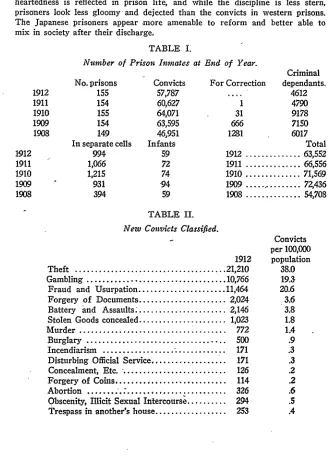
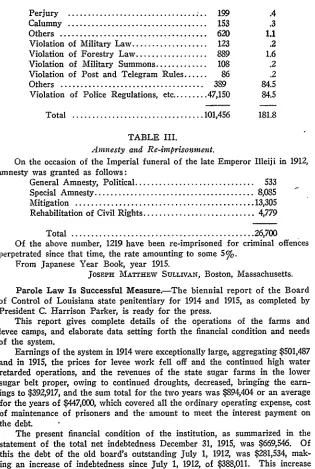
Japanese Prisons and Prisoners.-Enforcement of the New Crintinal Code. Daily manner of living constitutes an important factor in judging cases of criminal offences according to the new code, and professional gamblers, pick-pockets, and other scum of society have been visited with graver sentences than could be imposed according to the old code. Chiefs of gamblers, pick-pockets and others in Tokio and elsewhere who used to levy percentage on their followers, and were leading very luxurious lives with impunity have been sen-tenced to as long as 15 years. Sentences inflicted- on these classes being generally much longer, the number of prison inmates has suddenly increased with the enforcement of the new code. Numbers of new convictions before and after the enforcement of the new code are 126,104 and 118,099 respectively, and do not show any great difference.