Number 6166
Konkoly Observatory Budapest
24 April 2016
HU ISSN 0374 – 0676
USING APASS STANDARDS TO TRANSFORM CCD OBSERVATIONS: APPLICATION TO NEW AND OLD OBSERVATIONS OF MT Cam
TERRELL, DIRK1,2
; GROSS, JOHN2
; COONEY, WALTER R., JR.3 1
Department of Space Studies, Southwest Research Institute, 1050 Walnut St., Suite 300, Boulder, CO, USA, 80302
2
Sonoita Research Observatory, 705 W. Millbrook Lane, Tucson, AZ USA, 85704 3
Sonoita Research Observatory, 19523 Salado Creek Ct., Cypress, TX USA, 77433 e-mail: [email protected]; [email protected]; [email protected]
The variability of MT Camelopardalis was reported by Nakajima et al. (2004), and identified as a W UMa binary with a period of 0.3662 days. The light curve appeared to have complete eclipses and was placed in the observing queue at Sonoita Research Observatory (SRO) in late 2004. A reasonably complete light curve was observed in the Johnson V passband. In early 2016, MT Cam was again observed at SRO, this time in the Johnson B and V passbands, and the Cousins I passband. Complete light curves in all passbands were obtained.
While it has been customary to make observations of eclipsing binary stars as differ-ential magnitudes of the target star against a comparison star, the observations reported herein have been transformed to the standard (Vega) system using on-chip standards from data release 9 of the AAVSO Photometric All-Sky Survey (hereafter, APASS; Henden et al., 2012). The CCD images were first reduced in the usual manner by subtracting bias and dark frames and flatfielding in IRAF. Point-spread function (PSF) photometry on the reduced images was then performed with the SExtractor and PSFEx software (Bertin & Arnouts, 1996) to get instrumental magnitudes for all detected stars in each frame.
Transformation of the instrumental magnitudes to the standard system for the 2016 observations was straightforward. Normally one will observe a target field and several standard star fields (Landolt, 1992; 2009) during the night to get a set of transformation coefficients for the night. With the availability of the APASS catalog, there is a high probability that several standards in the 10th
to 16th
magnitude range will be in the target field itself, making it unnecessary to move the telescope away from the target field. Not only does this allow for more observations of the target star, it also allows for more observations of standard stars. It also allows the transformation coefficients to be determined for each frame. Observations in at least two passbands enable a least squares fit between the standard magnitudes of suitable APASS stars in each frame and their instrumental magnitudes and colors of the form:
whereM is the standard magnitude,mis the instrumental magnitude,cis the instrumen-tal color, and µ,ǫ,ξ are the transformation coefficients. Figure 1 shows the instrumental versus APASS magnitudes and the residuals from the fit for a typical frame. Once the transformation coefficients have been determined, instrumental photometry of objects in the frame can be transformed onto the standard system. Because the MT Cam field is reasonably crowded, many APASS stars are available for use. We used APASS stars with photometric errors of 0.05 mag or less, and usually had 20 or more standards on each frame for each fit. To avoid potential problems with long-period variable stars, we rejected stars that showed large residuals (greater than 0.05 mag) in the fit. Comparison of the transformed magnitudes and colors for those APASS stars not used in the fit with their APASS catalog values, as well as Tycho photometry for the brighter stars, showed good agreement.
In
st
ru
m
e
n
ta
l
V
M
a
g
n
it
u
d
e
11.0 12.0 13.0 14.0 15.0 16.0
R
e
si
d
u
a
l
0 0.03
−0.03
APASS V Magnitude
[image:2.595.156.438.269.545.2]10 11 12 13 14 15
Figure 1. Instrumental V versus APASS V magnitudes and the residuals from the fit to data for a typical frame. The solid line represents only the linear portion of the fit. The residuals are for the full
fit, including the color term, and clearly show that the color term is important.
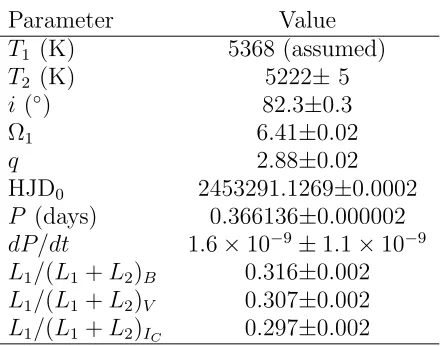
Table 1. Parameters for MT Cam.
Parameter Value
T1 (K) 5368 (assumed)
T2 (K) 5222± 5
i (◦) 82.3±0.3
Ω1 6.41±0.02
q 2.88±0.02
HJD0 2453291.1269±0.0002
P (days) 0.366136±0.000002
dP/dt 1.6×10⁻⁹±1.1×10⁻⁹
L1/(L1+L2)B 0.316±0.002
L1/(L1+L2)V 0.307±0.002
L1/(L1+L2)IC 0.297±0.002
on all frames and formed the mean of those measurements to get V=11.35±0.01. (The APASS catalog gives V=11.36±0.04.) We then formed differential magnitudes between MT Cam and GSC 3736-00851 on each frame, and then added the mean V magnitude for GSC 3736-00851 to get the final V magnitudes for MT Cam.
The photometry was then analyzed with the 2013 version of the Wilson-Devinney program (hereafter, WD; Wilson & Devinney, 1971; Wilson, 1979). The light curves show an overcontact morphology, and therefore we used WD in mode 3 (Leung & Wilson, 1977). The 2013 version of WD can compute several quantities automatically, such as curve-dependent weights and local limb darkening coefficients, and we employed these features. The mean effective temperature of the primary was set to 5368 K based on the APASS B −V value of 0.79±0.03. The adjusted parameters were orbital inclination (i), mean effective temperature of the secondary (T2), surface potential of the primary (Ω1), mass ratio (q), reference epoch (HJD0), orbital period (P), first time derivative of the orbital period (dP/dt), and the bandpass luminosities of the primary (L1B, L1V, L1IC).
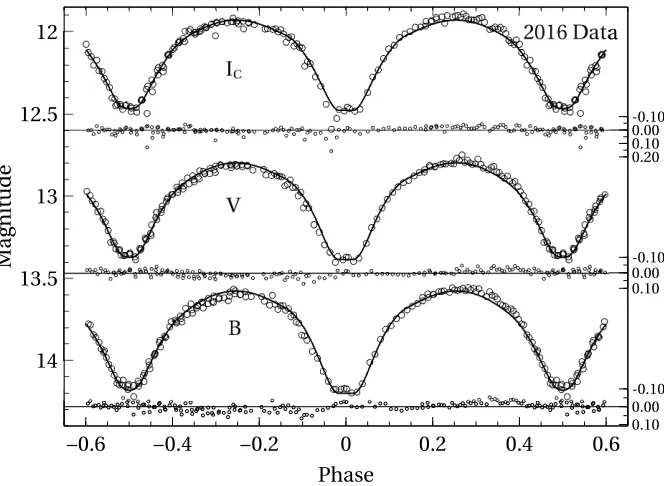
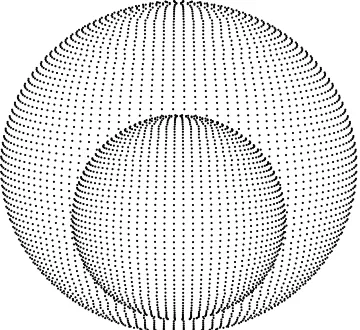
Table 1 shows the final parameters from the solution. Figure 2 shows the fit to the 2004 observations and Figure 3 shows the fits to the 2016 observations. Figure 4 shows the system at secondary eclipse. The observations are available from the IBVS web site as file 6166-t2.txt.
The analysis shows that indeed the eclipses are complete, with the slightly deeper eclipse (0.02 mag in B) showing totality, so we find the cooler star to be the more massive one. The light curves do show variability between the 2004 and the 2016 observations, presumably due to spots on one or both stars, so the relative depths of the eclipses may change over time, even changing which eclipse is deeper. So, while our solution technically makes this a W-type system, light curve changes could easily make the system look like an A-type system (which is what the Nakajima et al. (2004) observations appear to show). We did not attempt to perform any solutions with spots on the stars. Our purpose in publishing these observations and a preliminary analysis now is to show that with complete eclipses, this is a system that is a very rewarding target for radial velocity observations.
Our solution does show a marginal detection of a period change, dP/dt = 1.6×10⁻⁹
±
R
e
si
d
u
a
ls −0.06
−0.02 0.02 0.06
Phase
−0.6 −0.4 −0.2 0 0.2 0.4 0.6
2004 Data
V
M
a
g
n
it
u
d
e
12.8
13
13.2
[image:4.595.140.467.102.355.2]13.4
Figure 2. The 2004V light curve of MT Cam and the fit from the WD solution (solid line). The residuals of the fit are shown at the bottom.
2016 Data
M
a
g
n
it
u
d
e
12
12.5
13
13.5
14
Phase
−0.6 −0.4 −0.2 0 0.2 0.4 0.6
-0.10 0.00 0.10 -0.10 0.00 0.10 0.20
-0.10 0.00 0.10
[image:4.595.133.465.460.703.2]Figure 4. The appearance of MT Cam at the time of secondary eclipse.
Because the eclipses are complete, the mass ratio should be relatively well-determined (Terrell & Wilson, 2005), and if spectroscopic observations could only reveal one com-ponent’s spectral lines, a full solution for the system’s absolute parameters could still be achieved. Note also that since our observations are on the standard system, such a solution could also include a direct estimate of the distance to the system (Wilson, 2008) as part of the analysis. Versions of WD since 2013 can include the distance to the system as a model parameter, thus eliminating the need to make any simplifying assumptions (such as spherical stars), dependence on stellar evolution models (e.g., Klagyivik & Csiz-madia, 2004), or statistically derived period-color-luminosity relations (Rucinski, 1996). Given the lack of radial velocities for the system, we can only characterize our solution as preliminary, but the complete eclipses and standardized photometry make future radial velocity observations even more valuable.
In conclusion, we have shown how the availability of APASS standards not only makes new observations easier to transform onto the standard system, they also enable the re-analysis of existing observations to transform them as well, even in the case where the existing observations were made in only one filter. Just as all-sky astrometric catalogs have made it possible to easily perform plate solutions for CCD observations, APASS now makes it easy to place photometric observations onto the standard system.
References:
Bertin, E. & Arnouts, S., 1996,A&AS,117, 393
Henden, A. A., Levine, S. E., Terrell, D., Smith, T. C. & Welch, D., 2012, JAAVSO, 40, 430
Klagyivik, P. & Csizmadia, S., 2004, ASP Conf. Ser., 318, 195 Landolt, A., 1992, AJ, 104, 340
Landolt, A., 2009, AJ, 137, 4186
Leung, K.-C., & Wilson, R.E., 1977,ApJ, 211, 853
Nakajima, K., Yoshida, S., Ohkura, N., & Kadota, K., 2004, IBVS, 5600 Nelson, R. H., Terrell, D. & Milone, E. F., 2014, New Astr. Rev., 59, 1 Rucinski, S., 1996, ASP Conf. Ser., 90, 270
Terrell, D. & Wilson, R. E., 2005, ApSpSc,296, 221 Wilson, R. E., 1979, ApJ, 234, 1054
Wilson, R. E., 2008, ApJ, 672, 575