An IEEE LOM Application Profile to Describe Serious
Games «SG-LOM»
Yassine EL BORJI
Laboratory of Computer Science Operational Research
and Applied Statistics, Abdelmalek Essaadi University,
Faculty of Science, Tetouan, Morocco B.P. 209 Martil, Morocco
Mohamed KHALDI
Laboratory of Computer Science Operational Research
and Applied Statistics, Abdelmalek Essaadi University,
Higher Normal School, Tetouan, Morocco B.P. 209 Martil, Morocco
ABSTRACT
Serious games have become an indispensable part of the training compared to traditional online training that is often seen as restrictive and boring sometimes by learners. However, despite the contribution and potential of serious games in the education, their integration in the learning process is limited, this is due to the lack of tools and features of tracking and assessment of the learner/Player. For this and after a study of existing standards for describing learning resources we find that they are incomplete when it comes to describe the serious games.
This article explains how we can effectively deliver serious game for our students through LMS with a metadata schema to describe serious game as learning resources. This new metadata schema it is an application profile of IEEE LOM entitled "SG-LOM" which takes into account different evaluation studies and classifications of serious games. This metadata allows one hand to the serious games take advantage of features of tracking and assessments offered by these systems. On the other hand the LMS to complete their educational offer and reach a certain maturity.
General Terms
Education, Technology, Application, E-Learning
Keywords
Serious Games, LMS, LOM, Application profile
1.
INTRODUCTION
Compared to the traditional approach of e-learning, the approach through serious games has now become a reality, this current is now called the "Serious Game" which Includes games whose primary purpose is other than simple entertainment allows the video game to reach new areas such as vocational training, medical, advertising ... and even in politics, today they make a grand entrance and massive in the world of education.
We are particularly interested in serious games used in education, because young people today are familiar with new technologies and virtual worlds they have already taken over outside schools as part of their recreation, a habit that allow these young people to be immediately in the heart of the matter, because they have most often a video game culture as well as the keys to the gameplay culture and can therefore focus on the main message.
However, despite the contribution and potential of serious games in education, integrating them into the learning process is limited because it is difficult to track and assess the knowledge acquired by the learner, this is due to lack of
tracking tools of the player in serious games except perhaps an overall score far enough to reflect sufficiently the learning of the player, thus preventing us from assessing the impact of learner choice.
This paper proposes a way to improve the integration of serious games in education through an approach to the production of serious games in the form of reusable learning objects (LO), this requires the definition of a metadata schema explicit with new fields specific to serious games, this standardization of metadata schemas means that LMS are able to work together and use the learning objects outcome of serious games interchangeably.
2.
LIMITATIONS OF SERIOUS GAMES
IN EDUCATION
2.1
Aspects related to serious games and
e-learning
In this section we present general overviews of both e-learning and serious games and discuss some issues that must be addressed in order to guarantee effective integration of serious games in the education.
Serious games are a particular form of e-learning [2], all forms of serious and digital games are subtypes of e-learning they are not intended to replace the contents of the e-Learning platform instead They are here to complete their pedagogical offer by offering playful modules adapted to acquire skills and knowledge by experience, they are less likely to acquire an abstract and theoretical understanding some people may need. E-Learning is used to transmit knowledge distance and provide exercises to validate the acquisition of knowledge also allows the personal tracking of the learner and his advancement in e-learning courses .The learner therefore saves and restores acquired learning during testing.
Serious games is different from e-learning because they allow a practical concrete, they promote experiential learning and action, familiarize learners with the scientific approach, seeking the long-term memory, involve intuition, develop the ability to manage complex tasks, also allow to confront unexpected situations because the actors or the number of variables included in the simulators.
Learners are therefore not "consumers of knowledge" but become "producers of their learning".
2.2
Problem of tracking the learner in
serious games
homogeneous class, it allows the systematic collection and analysis of information as well as the progression of learner and assessment of these skills [1]. Tracking also gives us an overall summary of the activities of the learner and an overview of the modules or tools most frequently consulted or just used as a point of entry / exit of the course.
The challenges of tracking in serious games:
Player : motivation and thus promote learning by providing him advice to advance in the game
The Tutor : give visibility of knowledge acquired through the use of game
Designer: improve the game in its subsequent versions by detecting common errors players
The game: adapt the proposed content for the player based on his performanceThe problem here is that there is a lack of tools for tracking and assessment of learners in serious game at the in order to place the learner in terms of outcome. The tutor that uses these tools only see the final result or overall score, far enough to reflect the learning of the player and no method with which the learner has achieved its goal or not.
So our problem is in particular to find ways with which serious games can be integrated with LMS (Learning Management Systems) in order to benefit their features that we talked about
.
3.
METADATA STANDARDS
Here we present in brief the most used educational standards that focus on the effective use of learning resources within communities of practice (teachers, trainers and librarians), both in terms of sharing, reuse than to indexing strategies.
3.1
IEEE learning object metadata (IEEE
LOM)
LOM (Learning Object Metadata) is a set of metadata to describe the teaching and learning resources, this standard was designed in 2002 by the IEEE LTSC LOM-committee [3].
The idea of IEEE LOM was that metadata about learning resources was needed much like a library catalogue record. The catalogue had to provide structured descriptions for learning objects and thus enable repositories to make the described learning objects searchable by selected attributes like title, author or subject. By defining a set of metadata, the description can be stored separately from the learning objects or packaged with the resource.
The IEEE LOM was the first of the learning standards to become an officially endorsed standard. It also was widely accepted from the very beginning and thus it was integrated into almost all further e-learning standards, which in turn also helped to further establish IEEE LOM as the backbone of the e-learning standardization.
The contribution of LOM is the definition of sixty fields organized into nine categories and to describe accurately and consistently any educational resource (1.General, 2.Life Cycle, 3.Meta-Metadata, 4.Technical, 5.Educational, 6.Rights, 7.Relation, 8.Annotation, 9.Classification).
3.2
IMS content packaging (IMS CP)
IMS Content Packaging is an interoperability specification to allow content creation tools, learning management systems and run-time environments to share content in a standardized set of structures [4].
The IMS Content Packaging Specification focuses on the packaging and transport of resources but doesn’t determine the nature of those resources. This is because the specification allows adopters to gather, structure, and aggregate content in an unlimited variety of formats. So the IMS Content Packaging aims to provide a mechanism which once implemented by producers and vendors, will allow content to be exported between systems with the minimum of effort. The IMS Content Packaging (IMS CP) standard consists of two components: the Information Model (IMS, 2004a) and its corresponding binding (IMS, 2004c). The CP Information model describes the data structure of IMS CP, which ensures the interoperability between LMS and authoring tools. The IMS CP XML Binding Specification describes the representation of the data structure using XML (W3C, 2005). While the information model describes the data used to make IMS Content Packages interoperable, the XML Binding offers a technical solution to extract the data from each package. This is realized by adding one metadata file to each IMS Content Package which includes the metadata. This file is called manifest and added to the top level of the package which also includes all content files of the package.
The IMS content Package can be same like an SCORM unit but the main difference is that IMS is mainly for "static" content whereas a SCORM content package is considered to be an activity mostly dynamic since SCORM units contain control questions and interactions between the LMS and the SCORM unit. So an IMS CP has only static content and there is no activity directly in the content.
3.3
Shareable Content Object Reference
Model (SCORM)
Content Object Reference Model (SCORM) is a collection of standards and specifications for web-based e-learning. It enables communications between client side content and a host system called the run-time environment, which is commonly supported by a learning management system. SCORM also defines how content may be packaged into a transferable ZIP file called "Package Interchange Format"[5]. SCORM uses specifications defined by other organisms, especially IMS, and organises them so that their integration offers a system where learning can be created, delivered and reused in an effective way.
Based on XML, SCORM uses IMS Content Packaging to store and deliver content. Support for metadata is provided through the use of the IEEE LOM (Learning Object Metadata) specification, it can be determined for each level in SCORM including: Assets, SCO, Lesson, Course and Organization or as a separated file. It can be also embedded by using a space named XML.
Each component found within the SCORM Content Model is represented in the manifest, and the manifest provides you with the means to associate metadata to these components. The manifest file is structured in four categories: Metadata, Organisation, Resources and Sub-Manifest.
4.
CLASSIFICATION AND
EVALUATION OF SERIOUS GAMES
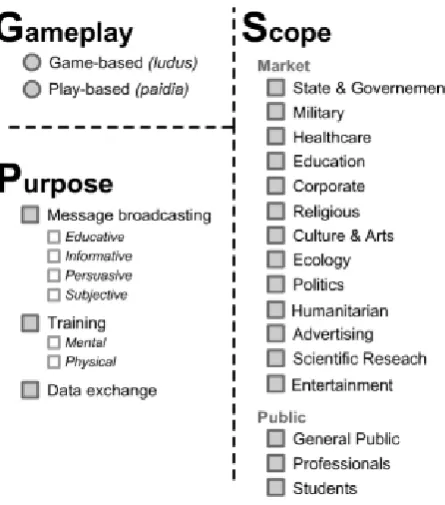
Several research studies have Been Made to Evaluate and classify serious games such as the study by DJAOUTI that aims to introduce an overall classification system for Serious Games based on (G/P/S) model that relies on three aspects [6] :
Gameplay, which refers to the type of gameplay used. This aspect is intended to provide information about the game structure of the Serious Game: how it is played.
Purpose, which refers to the designed purpose. This aspect accounts for the eventual purpose(s) apart from entertainment intended by the designer of the Serious Game.
Scope, which refers to the targeted application(s) of the title. This aspect suggests the actual use(s) related to the Serious Game: the kind of market, the audience… who uses it.
Fig1: Representation of the G/P/S model
The (G / P / S) model provide an overview of how each game is played and for what purpose it is intended. The use of these informations allows us to quickly browse a wide range of serious games to choose those that are relevant to our needs. Mark Prensky [7] has attempted to classify serious games based on the possible playing styles (eg, detective games, strategy games, Role play games,) learning activities (feedback, making choices (practice), coaching) and the type of content (eg, Creativity, skills).
This classification shows us how serious games can be classified according to the different types of content.
Another classification of serious games proposed by Pivec and Motetti based on learning objectives [8]. This
classification uses the features required, typology, and number of players and a set of learning objectives to classify games. This classifications show us that the description of the learning objectives can be an important aspect to describe serious games as they often have multiple learning objectives, unlike most other educational material. The classification classifies games along the following groups.
Memory/Repetition/Retention (factual knowledge); Dexterity/Spread/Precision (sensorial knowledge);
Applying Concepts/Rules (translating knowledge into new context);
Decision-making (strategy & problem-solving);
Social Interaction/values/cultures (understanding the social environment of others);
The ability to learn/self-assessment (evaluation).
The evaluation and assessment of serious games can be done with several frameworks as the four dimensional frameworks (4DF), which emerged from user studies and influenced the development process for several Serious Games [9].
[image:3.595.63.286.339.592.2]The original framework highlights the importance of four main aspects of a serious game and its effective use, which we summarize here:
Table 1: The Four Dimensional Framework
Four Dimensional Framework
Learner Specifics Profile
Role Competences
Pedagogy Associative
Cognitive Social/Situative
Representation Fidelity Interactivity
Immersion
Context Environment Access to learning Supporting resources
Topic being studied
Learner Specifics: involves profiling and modeling the learner to ensure a close match between learning activities and the required outcomes.
Pedagogy: analyses the pedagogic perspective of the learning activities which are supported by associative (instructivist and often task-centered), cognitive (constructivist) and situative (learning in communities of practice) perspectives, these three perspectives come into play rapidly at different points as the learning progresses.
Representation: serious games require specific levels of engagement in order to be effective. This includes how levels of immersion, fidelity and interactivity are integrated into the game application. In some cases basic puzzle games can be effective, however many expectations necessitate a higher level of engagement and immersion with more realistic graphical interfaces preferred.
environment where the game will be played conducive for learning with a game?
De Freitas and Jarvis introduced a development process for serious games that aims to encompass learner specifics and targeted learning outcomes in order to ensure that the serious game is successful. A framework for describing game-based learning scenarios is introduced, and an approach to the analysis that effectively profiles the learner within the learner group with respect to game-based learning is outlined.
5.
SERIOUS
GAMES
METADATA
5.1
Review of proposed metadata for
serious games
Metadata is generally defined as "data about data" or "information about data", Standardized Metadata allow efficient access to the data using a common set of issues of terminology and metadata that allows a fast data discovery and retrieval of metadata exchange centers. But these standardized metadata suffers from a number of limitations when it comes to describing the serious games, so we need a new standard metadata schema to describe the serious games based on existing technology enhanced learning and standards, also taking into account existing frameworks for evaluating serious games.
We reviewed several studies which have been made to introduce a new scheme of standard metadata to describe serious games such as the study by Maurice Hendrix [10] that aims to establish a metadata schema for describing serious games as educational resources, based on existing metadata standards and a comprehensive four dimensional framework for evaluating serious games. The proposed metadata schema, which adds a number of fields to IEEE LOM, had two different levels. The first level that focuses on human readability and the second level that focuses on machine processability.
The result of this study suggests the addition of new technical and descriptive fields to IEEE LOM also presents a set of elements contained in a review entry for serious games. But this result is limited because it focuses on the technical side of serious games and ignores other side’s (pedagogy, context ...).
Another important study by Marfisi-Schottman [11] that seeks to define a metadata schema to describe the SG and SG components so they can be easily found the basis of common or shared data.This metadata schema contains all the elements of LOMFR,” French application profile of LOM standardized by AFNOR in December 2006 for describing educational resources produced by the entire French educational community” and introduce a new application profile of LOM called LOMFR-SG which add descriptive elements for the playing characteristics, the type of game component and characteristics of the elements in the integration training. To cover the funding requirements and sharing of serious games this study has focused on three types of components: educational components that provide interactivity to promote learning, functional components that provide services to publishers and SG components that allow authors set of interactivity by changing the contents or rules.
To allow educators and parents easily to find the most relevant serious games and share their experiences from using these games, a tool for sharing Experiences about Serious Games was developed by the EduGameLab project
and introduced in the study of Maurice Hendrix [12]. The development of this tool requires a metadata schema for formally describing serious games and experiences with these games .this metadata schema has been presented in the same study as an extended of metadata schema that was previously introduced in [10] to describe the serious games.
This study allow us to find a particular game in a set of games described using this metadata schema also to search the purpose of a game; the circumstances it was intended for or is used in; the pedagogy it was intended for or used with.
5.2
Background of metadata schema
proposed
As explained earlier in the review of metadata used to describe serious games, the current standards for describing learning content cannot be directly used to describe serious games as educational resources. This is why we seek a way to customize standardized Metadata to adapt the context of use and to meet specific needs such as the description of serious games.
The IEEE LOM standard has been chosen as the basis for the metadata schema to be used to describe serious games since it is widely used to describe learning objects. It is therefore necessary to adapt this standard to meet the specific and concrete needs of serious games. In fact, it means to interpret, refine, extend or simplify the syntax and semantics of metadata schema. This work of adaptation leads us to the "application profile".
According to Erik Duval [13 ]“an application profile is an assemblage of metadata elements selected from one or more metadata schemas and combined in a compound schema... The purpose of an application profile is to adapt or combine existing schemas into a package that is tailored to the functional requirements of a particular application, while retaining interoperability with the original base schemas”. The analysis of previous studies that aims to assess or classify serious games has allowed us to analyze their needs in terms of indexing. To address these indexing constraints of serious games we have adopted a pragmatic point of view and methodological approach which focuses on the study of user needs and led us to a new metadata schema which includes new descriptive fields of serious games taking into account the various criteria to follow as well as different types of the components of serious games.
In order to guarantee an appropriate indexing with an effective description of serious games our proposed metadata scheme focuses on four main aspects:
One of the central concepts of the serious game is the concept of gameplay. The gameplay is the source of immersion, and the heart of the motivation that drives the players. Without it, no real input in the game or "in the illusion."
The Portugal (2006) defines the “gameplay” as the combination of five components: Rules, Input methods, Space-related setup, Time-related setup, Drama-related setup . The “Rules” element is very interesting for classification tasks because its “logical” nature makes it eligible for formal deconstruction.
The analysis of gameplay “rules” provides several ways to classify serious games, with different degree of accuracy. An initial distinction can be made between “Game-based” and “Play-based” serious games, according to their use/lack of rules stating the goals.
So a serious game can feature one of the two gameplay types already mentioned, either "Game-based", which means this title is designed with stated goals to reach. These goals are used as reference to evaluate the performance of the player, in order to judge if he has "won" or "lost", or to give him an objective mark called "score".
The second gameplay type is the "Play-based", which means this title is designed with no stated goals to reach. Hence, this title does not explicitly evaluate the performance of the player. However, the player is free to state his own goals if he decides to.
A more detailed analysis of these rules can be made with the “GamePlay” bricks, to provide information about the basic rules used that shape the gameplay. Currently, a set of 10 combinable bricks have been identified by DJAOUTI [6]:
- Stated Goals: Avoid, Match, Destroy.
- Means & Constraints: Create, Manage, Move, Select, Shoot, Write, Random
Fig3: Djaouti Gameplay bricks
Storytelling (Theory : Pedagogical specifications) : The Storytelling refers to the pedagogical scenario that is needed to formalize and harmonize learning practices using the theories related to the science of learning (cognitive, education, psychology, behavior ....).
The storytelling has been used as motivational tool in serious games by using stories as a reward for learning tasks. The use of stories in pedagogical scenarios can motivate learner toward a learning goal. They are ideal for attitudinal training because when an audience is motivated they no longer need to be persuaded, learners begin to see themselves in the story and begin to identify with it, they start to care, therefore we
Storytelling in any serious game will benefit from a story construction, organizing information into a format with a beginning (setting the stage), middle (the challenge) and ending (new reality) can work for many topics.
So pedagogical scenarios and storytelling, two very different forms of narration but ultimately complementary, they can help us to classify and describe serious games based on educational approaches and theories related to the science of learning used for the implementation of the learning scenario of the game.
Game Design : (Technical specifications) :The game design refers to the technical and technological aspects related to serious games.
Game design is the game development process of designing the content and rules of a serious game in the pre-production stage The designer of a serious game is very much like the director of a film; the designer is the visionary of the game and controls the artistic and technical elements of the serious game in fulfilment of their vision. Game design requires artistic and technical competence as well as writing skills. Just as there are many types of serious games, there are many types of game design, too:
World design is the creation of the overall backstory, setting, and theme of the serious game.
System design is the creation of rules and underlying mathematical patterns in a serious game.
Content design is the creation of characters, items, puzzles, and missions.
Game writing is the writing of dialogue, text, and story within the serious game world.
Level design is the crafting of levels in a game, including the layout of maps and placement of objects and challenges within those maps.
User interface (UI) design consists of two things: how the player interacts with the game, and how the player receives information and feedback from the game.
So when we think about game design we're talking about technical Features of serious game that allows us to technically classify and describe serious games.
Context (Audience & Application area) : The gaming market has grown considerably since the advent of serious games, which refers us to their context of use which represents an essential argument for the effectiveness of how the game is used.
Contextual factors may focus firstly on target audience of a serious game in terms of age range, type (General Public, Professionals, Students), the player experience, qualifications, sex, taste…and secondly where a game will be used: for example will the game be used in a classroom setting, in an outside location, will technical support be provided? Is the environment where the game will be played conducive for learning with a game? These factors had importance for the development of a game, and will affect which game is chosen and which game type (e.g., role play, simulation etc.) would be most appropriate.
5.3
The SG-LOM Application Profile
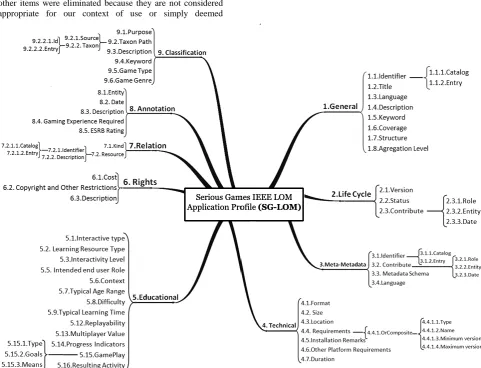
specializing several of them in order to best match the needs of the serious games, as new elements have been added and other items were eliminated because they are not considered appropriate for our context of use or simply deemed
unnecessary or too subjective, an overview of the SG- LOM is presented in Figure1 [14].
.
Fig 4: An overview of the proposed SG-LOM application profile.
5.3.1
Elements added to LOM
To meet specific needs of serious games, it was necessary to add new elements specific game features. This addition does not present a problem from the viewpoint of compatibility with the LOM. Indeed, the LOM is a metadata set open, that
[image:6.595.56.538.95.463.2]is to say in which it has been foreseen the possibility of extension. We propose to add specific fields to the characteristics of the game to the elements 9. Classification, 8.Annotation, 5.Educational and 4.Technical of LOM [14]:
Table 2: New fields that have been added in category 9.Classification
Nr Name Explanation Size Value Space Data Type Obligation
9.5 Game Genre
Means a set of video games characterized by a similar gameplay
Smallest permitted maximum: 10 items
Action Simulation Adventure Puzzle RolePlaying Strategy
Vocabulary
(Enumerated) Recommended
9.6 Game Type
The game type allows us to classify the games by their narrative content.
Smallest permitted maximum: 10 items
Drama Crime Fantasy Horror Mystery Science Fiction War&Espionage Western/ Eastern / frontier
Vocabulary
Table 3: New fields that have been added in category 8.Annotation
Nr Name Explanation Size Value Space Data Type Obligation
8.4
Gaming experience required
It gives an idea on the level of experience required to play this game
1
Novice Beginner Intermediate Experienced Advanced Senior Expert
Vocabulary
(Enumerated) Optional
8.5 ESRB Rating
A system to ensure clear labeling of contents games for the age group to which they are best suited.
1
EC E E10+ T M AO RP
Vocabulary
[image:7.595.50.575.295.764.2](Enumerated) Optional
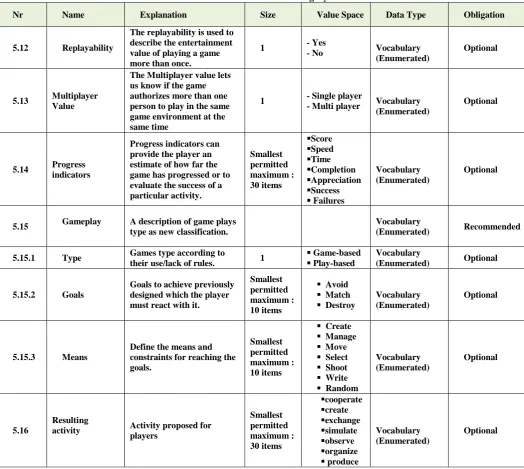
Table 4: New fields that have been added in category 5.Educational
Nr Name Explanation Size Value Space Data Type Obligation
5.12 Replayability
The replayability is used to describe the entertainment value of playing a game more than once.
1 - Yes
- No Vocabulary
(Enumerated)
Optional
5.13 Multiplayer Value
The Multiplayer value lets us know if the game authorizes more than one person to play in the same game environment at the same time
1 - Single player
- Multi player Vocabulary (Enumerated)
Optional
5.14 Progress indicators
Progress indicators can provide the player an estimate of how far the game has progressed or to evaluate the success of a particular activity.
Smallest permitted maximum : 30 items
Score Speed Time Completion Appreciation Success Failures
Vocabulary (Enumerated)
Optional
5.15 Gameplay A description of game plays type as new classification.
Vocabulary
(Enumerated) Recommended
5.15.1 Type Games type according to
their use/lack of rules. 1
Game-based Play-based
Vocabulary
(Enumerated) Optional
5.15.2 Goals
Goals to achieve previously designed which the player must react with it.
Smallest permitted maximum : 10 items
Avoid Match
Destroy Vocabulary (Enumerated)
Optional
5.15.3 Means
Define the means and constraints for reaching the goals.
Smallest permitted maximum : 10 items
Create Manage Move Select Shoot Write Random
Vocabulary (Enumerated)
Optional
5.16
Resulting
activity Activity proposed for players
Smallest permitted maximum : 30 items
cooperate create exchange simulate observe organize produce
Vocabulary (Enumerated)
5.3.2
Extend the use of LOM data elements for
SGs
It is possible to extend the use of existing data elements from their traditional application to meet the specific needs of serious games by adding the possible values that can characterized some specific sides of serious games (technical, educational, entertaining, ...)[3].
Here are some recommendations for the best use of LOM data elements to describe the characteristics of the SG.
2.3.2. Entity: We are talking about people or organizations who have contributed to the production of this learning object, in our case we are talking about Game developer, Game publisher, and Game designer…
2.3.1. Role: this item allows us to specify the type or nature of the contribution according to the entity of who contribute: Implement the learning scenario, Graphics design, Test the game…
4.4. Requirement: Technical requirements whatever hardware or software needed to use this learning object: Required technical platform (PC, Mac, iPhone, Android, Playstation 3, Wii ...), Operating System Required, Browser required (if an online gambling), Version of java and flash required… 4.1. Format : Physical or numerical representation of the learning object and his technical data type: application, audio, example, image, message model multipart, text, video … 5.6. Context: The principal environment within which the game and use of this learning objects is intended to take place. For our case we can specify the market where the game is intended to be used like : State & Government, Military & Defense, Healthcare, Education, Corporate, Religious, Culture & Art, Ecology, Politics, Humanitarian, Advertising, Scientific Research.
6.
CONCLUSION
AND
FUTURE
WORK
As we have seen in this paper, games are increasingly recognized for their educational potential. Indeed, many research issues arise. In particular, how can we assess and track the knowledge acquired by the player/learner in the game.
The development of an appropriate metadata scheme can greatly facilitate search and indexing of serious games as well as the description of learning objects outcome of these games, which gives us the possibility of integrating these games with learning management systems and therefore they can take advantage of features of tracking and assessment proposed by these systems.
In this paper we propose a new application profile (SG-LOM) specified for serious games based on the LOM standard in which we adopted a methodological approach that focuses on the study of the main components of serious games taking into account the classification studies and evaluation have been done before.
Since LOM is designed specifically for e-learning, its use in the SCORM standard is widely accepted. LOM can be determined for each level in SCORM including: Assets, SCO, Lesson, Course and Organization or as a separated file. It can be also embedded by using a space named XML. Our future work aims to validate and extend the use of the proposed application profile (SG-LOM) also we intend to use SG-LOM in every level of the Content Aggregation Model of SCORM to describe learning objects outcome of serious games.
7.
REFERENCES
[1] Maureen T. Hallinan 1994. “Tracking: From theory to practice”. Sociology of Education, 67 (2): 79-84. [2] Breuer, J. & Feletti, G. Why so serious? On the Relation
of Serious Games and Learning. Eludamos. Journal for Computer Game Culture. 2010; 4 (1), pp. 7-24
[3] LOM, Standard for Learning Object Metadata., IEEE 1484.12.1, 2002.
[4] Wilson, S and Currier, S., (2002), “What is IMS Content Packaging”, CETIS Briefing Paper, CETIS, November 2002.
[5] Advanced Distributed Learning. (2004). SCORM 2004 (4th edition version 1.1 Documentation).
[6] D. Djaout, J. Alvarez, J.P. Jessel, "Classifying Serious Games : the G / P / S model," Medicine, 2008.
[7] M. Prensky, “Digital Game-Based Learning,” McGraw-Hill, 2001.
[8] M. Pivec and M. Moretti, Game-based learning_: discover the pleasure of learning. Lengerich: Pabst-Science- Publishers, 2008.
[9] S. De Freitas and M. Oliver, “A four dimensional framework for the evaluation and assessment of educational games,” Computer Assisted Learning, 2005. [10]M. Hendrix, A. Protopsaltis, C. Rolland, I. Dunwell, S.
de Freitas, S. Arnab, P. Petridis, and J. LLanas, ‘Defining a Metadata Schema for Serious Games as Learning Objects’, in eLmL 2012, The Fourth International Conference on Mobile, Hybrid, and On-line Learning, 2012, pp. 14–19.
[11]I. Marfisi-Schottman, S George, F Tarpin-Bernard, Un profil d’application de LOM pour les Serious Games, Environnements Informatiques pour l'Apprentissage Humain, Conférence EIAH'2011 (2011) 81-94
[12]M. Hendrix, P. Backlund, M. Lebram, H. Lundqvist, Sharing Experiences with Serious Games,2013.
[13]Duval E., Hodgins W., Sutton S., Weibel S.L., “Metadata Principles and Practicalities”, D-Lib Magazine, 8, 2002. [14]Guidelines and support for building application profiles