http://dx.doi.org/10.4236/ojapps.2014.47037
Experimental Evidence of Capillary
Interruption of a Liquid Jet
Taha Massalha
1, Rafael M. Digilov
21Academic Arab College for Education, Haifa, Israel
2Department of Education in Technology & Science, Technion-Israel Institute of Technology, Haifa, Israel
Email: [email protected], [email protected]
Received 23 April 2014; revised 26 May 2014; accepted 3 June 2014
Copyright © 2014 by authors and Scientific Research Publishing Inc.
This work is licensed under the Creative Commons Attribution International License (CC BY).
http://creativecommons.org/licenses/by/4.0/
Abstract
We observe the gravity discharge of liquid through the short cylindrical tube of diameter of 2 mm and aspect ratio 2.5 and 10 attached to the underside of Mariotte bottle. When the hydrostatic head is reduced and approaches to a certain value, a laminar jet escaped from the nozzle is inter-rupted and the discharge is drop wise. The plot of the discharge rate as a function of hydrostatic head does not pass through the origin as predicted by Torricelli law for an ideal liquid. We attribute this feature to the energy losses related with creating a new free surface area of the jet. The measurements for water and aqueous ethanol solution are compared with theoretical predic-tions based on the modified Bernoulli equation with the interfacial energy density correction and good agreement is observed.
Keywords
Mariotte Bottle, Modified Bernoulli Equation, Interfacial Energy Density Correction
1. Introduction
The simplest example of the use of Bernoulli’s equation in introductory physics course [1] is Torricelli’s law, which relates the velocity of efflux of a liquid issuing from the small orifice in a tank
υ
to the hydrostatic headh of the liquid:
2gh
υ= (1)
be applied in the case of real flow due to the various dissipation effects [4] [5], which Equation (1) does not in-clude. Nevertheless, taking into account the energy losses, Bernoulli’s equation was used [3] to modified Equa-tion (1) as follows:
(
)
2 1
g
h Z
k
υ = − ∆
+ (2)
where k and ∆Z are empirical constants related, respectively, with the losses due to the losses proportional to the fluid velocity squared and the losses independent of the fluid velocity. While the presence of the constant
k in Equation (2) is somehow justified, there is no physical explanation for the constant ∆Z. The interpreta-tion proposed in [6] associates ∆Z with capillary pressure, which hold up the liquid from coming out of the hole.
To give further understanding to this problem, we use the Bernoulli equation modified by the surface energy density and viscosity effect [5] to explain the physical meaning of the correction term ∆Z . The validity of this approach is demonstrated by measuring the discharge velocity of Newtonian liquids with different surface ten-sion and viscosity using discharge tubes of different aspect ratio.
2. Theoretical Background
Consider a Newtonian liquid of density ρ, viscosity η and surface tension γ discharged under gravity through the short tube of radius r and length L attached at the side of a large tank. A volume flux from the tube generates the axisymmetrical cylindrical jet of radius r. We apply the modified Bernoulli equation [5]
with the interfacial energy density along the streamline as is schematically shown inFigure 1:
2
los 1
constant 2
A
p gz w
V
ρυ ρ γ∂
+ + + + =
∂
(3)
where p is the mechanical pressure,
υ
is the velocity at any point, z is the height of the liquid above a ref-erence level, all measured at the same point inside the liquid. The term γ(
∂ ∂A V)
represents the interfacial energy density required to create a unit of free surface area of the jet, and wlos is the pressure head loss along the streamline due to various dissipative effects.Let us apply Equation (3) for two points 1 and 2 ofFigure 1, i.e. at the free liquid surface in the vessel and inside the jet. Since p1= p2=patm, υ ≈1 0, υ2=υ and z1−z2 =h, we get
2
los 1
2
A
gh w
V
ρ = ρυ +γ∂ + ∂
(4)
The derivative
(
∂ ∂A V)
in Equation (4) consists of two components, one being tangential and the other normal to the jet surface:2r
υ h
atm
p
2 1
Central Streamline V
δ
L
[image:2.595.198.425.540.697.2]Jet
Tangential Normal
A A l A r
V l V r V
∂ ∂ ∂ ∂ ∂
= + ∂ ∂ ∂ ∂ ∂
(5)
For an ideal cylindrical jet of length l , volume 2
V =πr l and surface area A=2πrl , we have:
(
∂ ∂ ∂ ∂A l)(
l V)
=A V =2 r and(
∂ ∂A r)(
∂ ∂r V)
=1 r, where 2 r is due to formation of a fluid-air inter-face and 1r due to its curvature. The physical meaning of these two effects can be clarified by considering the corresponding values of free energies. Whereas Vγ(
∂ ∂A l)(
∂ ∂l V)
=2π γr l is the interfacial surface energy, the value Vγ(
∂ ∂A r)(
∂ ∂r V)
gives V P∆ ∆ =(
P γ r)
, the excess free energy due to the pressure jump across the interface. These two effects have to be considered together, therefore we have γ(
∂ ∂A V)
=3γ r. However, since the shape of the jet is not a perfect cylinder, we introduce in this expression the shape factor β≤1 to get3 A
V r
γ γ ∂ = β
∂ (6)
Dissipation term wlos can be expressed [7]-[10] as the sum of the head loss at orifice entry of the tube and losses due to the skin friction within the tube orifice:
2 2
loss
2 2 2
L
w k f
r
ρυ ρυ
= + (7)
Here, k is the coefficient of entry pressure loss, and f is the skin friction coefficient, which depends on
Reynolds number Re 2rρυ η
= as
Ren C
f = (8)
where C and n are constants.
Combining Equation (4) with Equations (6) - (8), we obtain the sought equation for the average discharge ve-locity as a function of the pressure head:
2 2
1 3
2 4 2
n n
k CL
h
g rg r gr
η
βγ
υ
υ
ρ
−ρ
+ + = −
(9)
where constants n and C are typically, n=1 and C=64 for laminar flow, n=0.25 and C=0.3164 for turbulent flow [10]. For laminar flow, Equation (9) reduces to the quadratic equation for
υ
with the solu-tion:( )
(
)
(
)
2
2 2
8 2 3 8
1
1 1
L g L
h h
k gr
r k r k
η βγ η
υ ρ ρ ρ = + + + − − +
(10)
which involves the effects of viscous resistance and surface tension showing that at h→3βγ ρgr the dis-charge velocity approaches to zero. We refer to this phenomenon as capillaryinterruption of a liquid jet. When the viscosity term 8L
η
r2ρ
(
k+1)
becomes negligible, Equation (10) reduces to Equation (2):( )
2 31 g h h k gr βγ υ ρ = −
+ (11)
with ∆ =Z 3βγ ρgr. Equations (10) and (11) for the discharge velocity
υ
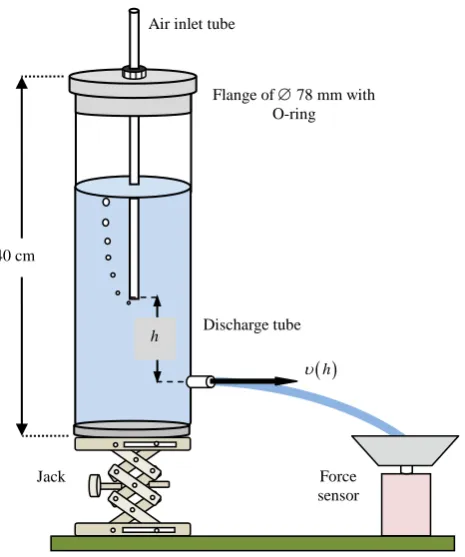
versus the pressure head h of real liquids are the main result of present paper.3. Experiment
h
( )h
υ Air inlet tube
Force sensor Jack
Flange of ∅78 mm with
O-ring
40 cm
[image:4.595.202.435.82.361.2]Discharge tube
Figure 2. Experimental set up for the measuring the discharge rate as a function of the pressure head υ(h).
plastic cylinder of diameter 78 mm and height 40 cm with the opening in the lower part of the wall. Plexiglas’s flange with O-ring at the top of the cylinder provides a seal.
An air intake tube of diameter 8 mm and length 50 cm was inserted through the flange using a compression fitting that seals with an o-ring. Glass capillary tubes with i.d.=2 mm and different lengths were separated inserted in the opening of the cylinder. As a liquid flows out of the bottle it is replaced by air, which enters through the air intake tube and bubbles up through the liquid level to provide a constant flow. The head, equal to the vertical distance from the bottom of the air-inlet tube to the outlet tube, was varied by raising or lowering the inserted tube. The discharge speed of liquid versus the pressure head was determined as follows. The force sen-sor, connected through a data logger to a computer, continuously recorded the fluid weight m t g
( )
escaped from the bottle as a function of time. The average discharge velocity was calculated from the slope(
dm dt)
as2 1 d
d m
t r
υ π ρ
= (12)
Then, using the nonlinear curve fitting procedure available in MATHEMATICA (see Ref. 24 in [5]), Equa-tion (10) was fitted to measured discharge rate versus the pressure head υ
( )
h taking k and β to be fitting parameters.4. Results
To clarify the influence of surface tension and viscosity on the discharge rate of real liquids we used ordinary tap water with a density of ρ≈997.7 kg m⋅ −3, viscosity η≈0.8914 mPa s⋅ and surface γ 0.072 mN⋅m−1, and also 30% aqueous ethanol of density ρ≈957.7 kg m⋅ −3, viscosity η≈2.014 mPa s⋅ and surface tension
1 0.037 mN m
γ ⋅ − . Two tubes of diameter 2 mm and aspect ratio
(
L 2r=)
Figure 3.Discharge rate υ versus the pressure head h of tap water. Symbols denote experimental results. Solid lines are predicted by the present theory.
Figure 4.Discharge rate υ versus pressure head h of aqueous ethanol. Sym- bols denote experimental results. Solid lines are predicted by the present theory.
glass tubes with aspect ration L 2r=2.5 and 10 at temperature 25 C . It is seen that the discharge rate strongly depends on the fluid properties and the geometry of the outlet orifice. The range of the average dis-charge velocity, υ
( )
h , Reynolds number, Re and fitting parameters k and β are presented in Table 1.As expected, in the case of the discharge through the tube with L 2r=10, the viscous resistance plays a prominent role and the rate of discharge as function of the pressure head is better described by Equation (10), whereas Equation (11) provides the best fitting of experimental data υ
( )
h of the same liquids discharged0 50 100 150 200
0 5 10 15 20 25
Di
sc
har
ge
ra
te
, v
(c
m
/s
)
Pressure head, h (cm)
Experiment for L/2r=10 Fit to Eq. (10)
Experiment for L/2r=2.5 Fit to Eq. (11)
0 25 50 75 100 125 150 175
0 5 10 15 20 25
Di
sc
har
ge
ra
te
, v
(c
m
/s
)
Pressure head, h (cm)
Experiment for L/2r=10 Fit to Eq. (10)
[image:5.595.179.449.349.598.2]Table 1. The range of experimental data represented in Figure 3 andFigure4.
Test liquid L/2r Range of υ (m/s) Range of Re k β
Water
2.5 0.4 to 1.54 900 to 3450 0.338 ± 0.007 0.693 ± 0.030
10 0.55 to 1.8 1230 to 4000 0.602 ± 0.005 0.727 ± 0.017
Aqueous Ethanol
2.5 0.32 to 1.63 304 to 1550 0.727 ± 0.016 1.005 ± 0.108
10 0.25 to 1.36 240 to 1300 0.955 ± 0.013 0.998 ± 0.058
through the orifice with L 2r=2.5, despite the fact that initially, in the case of water, the Reynolds number was slightly higher than its limit value 3000 for the laminar flow.
It can be seen also from Figure 3 andFigure4, that over the range of the pressure head under operation, the rate of discharge of both liquids through the orifice with the aspect ratio L 2r=10 is considerably less than the rate discharge through the orifice with L 2r=2.5, as attributed to the viscosity resistance. If the point
3 jet
h = βγ ρgr, at which the rate of the discharge
υ
decays to zero, is added to Figure 3 andFigure4, it can be seen that the fit is quite reasonable. That the plot of υ( )
h in Figure 3 andFigure4, intersects the horizon-tal axis at the same point hjet =3βγ ρgr for each liquid independently of the tube aspect ratio, L 2r, is in-deed related to the fact that fluid flow losses energy in creating the free surface area of the jet as predicted by the theoretical model.5. Summary
Subject of the discharge of Newtonian liquids from the container through the orifice of small diameter is an in-teresting topic in science education. One of the most important aspects that students can learn from these studies is the concepts of capillary pressure, interfacial energy and viscous. The use of the modified Bernoulli equation for the liquid jet, involving the interfacial energy density, is very useful for teaching the fundamentals of fluid flow. Students have the opportunity to study the effect of surface tension and viscosity on the fluid flow.
Acknowledgements
This work was partially supported by the Israel Ministry of Absorption and Immigration through the KAMEA Science Foundation.
References
[1] Halliday, D., Resnick, R. and Walker, J. (1977) Fundamentals of Physics Extended. 5th Edition, Wiley, New York.
[2] de Oliveira, P.M.C., Delfino, A., Costa, E.V. and Leite, C.A.F. (2000) Pin-Hole Water Flow from Cylindrical Bottles. Physics Education, 35, 110-119. http://dx.doi.org/10.1088/0031-9120/35/2/306
[3] Saleta, M.E., Tobia, D. and Salvador, G. (2005) Experimental Study of Bernoulli’s Equation with Losses. American Journal of Physics, 73, 598-602. http://dx.doi.org/10.1119/1.1858486
[4] Synolakis, C.E. and Badeer, H.S. (1989) On Combining the Bernoulli and Poiseuille Equation—A Plea to Authors of College Physics Texts. American Journal of Physics, 57, 1013-1019. http://dx.doi.org/10.1119/1.15812
[5] Massalha, T. and Digilov, R.M. (2013) The Shape Function of a Free-Falling Laminar Jet: Making Use of Bernoulli’s Equation. American Journal of Physics, 81, 733-737. http://dx.doi.org/10.1119/1.4819196
[6] Escamilla, P.L.L. (2009) Surface Tension Influence in Vessel Discharge: Comment on Experimental Study of Bernoul- li’s Equation with Losses by Saleta M. E., D. Tobia and G. Salvador Gil [Am J Phys 73 (7), 598-602 (2005)]. Ameri- can Journal of Physics, 77, 477-478. http://dx.doi.org/10.1119/1.3000362
[7] Fox, R.W. and McDonald, A.T. (1973) Introduction to Fluid Dynamics. Wiley New, York.
[8] White, F.M. (1979) Fluid Mechanics. McGraw-Hill, New-York.
[9] Streeter, V.L. and Wylie, E.B. (1986) Fluid Mechanics. McGraw-Hill, New-York.
[10] Ramamurthi, K. and Nandakumar, K. (1999) Characteristics of Flow through Small Sharp-Edge Cylindrical Orifices. Flow Measurement and Instrumentation, 10, 133-143. http://dx.doi.org/10.1016/S0955-5986(99)00005-9
http://dx.doi.org/10.1021/ac60045a043
[12] Maroto, J.A. and de Dios, J. (2002) Use of a Mariotte Bottle for the Experimental Study of the Transition from Lami- nar to Turbulent Flow. American Journal of Physics, 70, 698-701. http://dx.doi.org/10.1119/1.1469038
[13] Kires, M. (2006) Mariotte Bottle with Side Openings. The Physics Teacher, 44, 388-389.