http://dx.doi.org/10.4236/ojn.2015.512116
How to cite this paper: Fridlund, B., et al. (2015) Essentials of Teamcare in Randomized Controlled Trials of Multidisciplinary or Interdisciplinary Interventions in Somatic Care: A Systematic Review. Open Journal of Nursing, 5, 1089-1101.
http://dx.doi.org/10.4236/ojn.2015.512116
Essentials of Teamcare in Randomized
Controlled Trials of Multidisciplinary
or Interdisciplinary Interventions in
Somatic Care: A Systematic Review
Bengt Fridlund1,2*, Ewa K. Andersson1,3, Sidona-Valentina Bala1, Gull-Britt Dahlman1, Anna K. Ekwall1, Stinne Glasdam1, Ami Hommel1, Catharina Lindberg1,3, Eva I. Persson1, Andreas Rantala1, Annica Sjöström-Strand1, Jonas Wihlborg1, Karin Samuelson1
1Department of Health Sciences, Lund University, Lund, Sweden 2School of Health & Welfare, Jönköping University, Jönköping, Sweden 3Department of Health, Blekinge Institute of Technology, Karlskrona, Sweden
Received 10 November 2015; accepted 18 December 2015; published 21 December 2015
Copyright © 2015 by authors and Scientific Research Publishing Inc.
This work is licensed under the Creative Commons Attribution International License (CC BY). http://creativecommons.org/licenses/by/4.0/
Abstract
Background: Teamcare should, like all patient care, also contribute to evidence-based practice (EBP). Randomized controlled trials (RCTs) focusing on teamcare have been performed but no study has addressed its essentials. How far this EBP has progressed in different health aspects is generally established in systematic reviews of RCTs. Aim: The aim is to determine the essentials of teamcare including the nurse profession in RCTs of multi- or interdisciplinary interventions in somatic care focusing on the stated context, goals, strategies, content as well as effectiveness of quality of care. Methods: A systematic review was performed according to Cochrane review as-sumptions to identify, appraise and synthesize all empirical evidence meeting pre-specified eligi-bility criteria. The PRISMA statement guided the data selection process of 27 articles from PubMed and CINAHL. Results: Eighty-five percent of RCTs in somatic care showed a positive effectiveness of teamcare interventions, of which interdisciplinary ones showed a greater effectiveness compared with the multidisciplinary approach (100% vs 76%). Also theory-based RCTs presented higher positive effectiveness (85%) compared with non-theory-based RCTs (79%). The RCTs with posi-tive effecposi-tiveness showed greater levels for professional-centered ambition in terms of goals and for team-directed initiatives in terms of strategy, and a significantly higher level for patient-team interaction plans in terms of content was shown. Conclusions: Teamcare RCTs are still grounded in the multidisciplinary approach having a professional-centered ambition while interdisciplinary
approaches especially those that are theory-based appear to be essential with regard to positive effectiveness and preferable when person-centered careis applied.
Keywords
Teamcare, Randomized Controlled Trial, Somatic Care, Systematic Review
1. Introduction
Healthcare professionals, and nurses in particular, are continuously being challenged to find evidence-based ways for improving patient care including the increase of job satisfaction and reduction of costs [1]. They also encounter increasingly well-educated patients at the same time as evidence-based recommendations include in-volving patients in their own care [2]. Team-practice has been generally proposed to meet these challenges, and interdisciplinary teams have in particular been more emphasized than multidisciplinary ones [3]. It can thus be important to have a common understanding of the differences between these, and the following operational dif-ference, as proposed by Jessup, has thus been used [4]: Multidisciplinary team approaches utilize the skills and experience of individuals from different healthcare professions, with each team member approaching the patient from their own perspective. It is common for the multidisciplinary teams to meet the patient at separate individ-ual consultations as well as regular team meetings in the absence of the patient. Multidisciplinary teams thus provide more knowledge and experience than healthcare professionals operating in isolation. Interdisciplinary team approaches integrate separate healthcare professionals into a single consultation: the patient-history taking, assessment, diagnosis, intervention and goals are conducted by the team on one occasion, together with the pa-tient. The patient is intimately involved in his/her condition as well as the plan about the care. A common un-derstanding and holistic view of all perspectives of the patient’s care ensues in the best of cases, and is empo-wered to form part of the decision-making process for working towards the best patient outcome [4]. This is quite in line with increasing evidence that person-centered care interventions including the nurse profession [5] [6], which is the utmost form of patient-centered care comprising the patient’s preferences [7] [8], are the most effective actions in restoring patients’ health [9] [10]. Many patients are still, however, not directly involved in their own care and thus the patient’s preferences are not interactively assessed for determining the optimal care recommendation on an individual basis [11].
Today’s healthcare services as well as policy-making organizations emphasize the importance of evidence- based knowledge, which is essential for dealing with a clinical condition, through the resources available to healthcare professionals and their skills in using them [12]. Randomized controlled trials (RCTs) have been recommended for evaluating the effectiveness of the different teamcare interventions [13]. However, a clear discrepancy exists between everyday clinical practice and available empirical evidence about care interventions [14].
interven-tions in somatic care focusing on the stated context, goals, strategies, content as well as effectiveness of quality of care.
2. Methods
2.1. Eligibility Criteria
RCTs evaluating the effectiveness of teamcare interventions, comprising the nurse profession in the context of somatic care, were included. A team was defined as consisting of at least two individuals from different health-care disciplines and only RCTs with at least one nurse in the team was included; defining nurse as a RN. In or-der to narrow our target area, studies in the field of women’s (gynecology/obstetrics), children’s (pediatrics) and mental (psychiatric) health were excluded. Patients as participants were in focus and thus studies comprising relatives were excluded. Outcome measures of main interest were patient-reported outcome measurements (PROM) [22] thus excluding studies focusing on e.g. cost analyses and healthcare professionals.
2.2. Literature Search
A review team of 13 researchers, experienced in somatic nursing care, performed a literature search in the data-bases PubMed and CINAHL between 2007 and 2011 with the following criteria: the English language as the most established international and scientific language and Randomized Control Trials. The following controlled vocabulary was used in the identification: “Medical Subject Headings (MeSH)”; “Patient Teamcare” or “Inter professional Relations” or “Multidisciplinary Teamcare” or “Interdisciplinary Communication”. The literature search also excluded, with the Boolean operator NOT, the following free text words from the search: gynecolo-gy, pediatrics, pregnancy, psychiatric, psychiatry, mental, depression. A total of 323 references, found in PubMed and CINAHL after the extraction of duplications (n = 15), were thus available for screening.
2.3. Systematic Data Selection Process
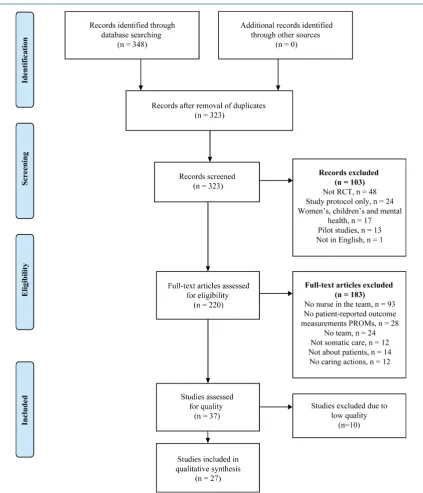
A study protocol inspired by the Preferred Reporting Items for Systematic reviews and Meta-Analyses (PRISMA) statement [23] was used to guide the review team through the data extraction process. All retrieved titles and ab-stracts were screened to determine eligibility. Studies were excluded based on: non-RCTs, only study protocols, only pilot studies or not in English. Full-text copies of 220 publications were assessed by the review team and 183 of these were excluded based on; no nurse in the team, or non-PROM, non-teamcare, non-somatic care, non-patient-directed, non-caring actions (Figure 1).
2.4. Quality Assessment
The review team, under the direction of the first and last authors, abstracted information about and reviewed the publications in accordance with the well-established audit template of The Swedish Council on Health Tech-nology Assessment [24]. The following keywords in the audit template were considered: study population, se-lection criteria, sample size, power calculation, randomization strategy, comparability between groups, blinding, compliance/adherence, primary outcomes, description of intervention and control care and treatment, drop-outs, primary/secondary outcome measures, efficacy/effectiveness, side effects, results, precision, bonds and disquali-fication. The publications were thus graded for methodological quality from low through medium to high, the latter indicating a stronger likelihood of the RCT design to generate unbiased results. Ten of the 37 publications assessed for quality were excluded due to low quality.
2.5. Data Analysis
Figure 1. Flow diagram of the systematic review process.
was reached.
3. Results
3.1. Demographical and Contextual Data
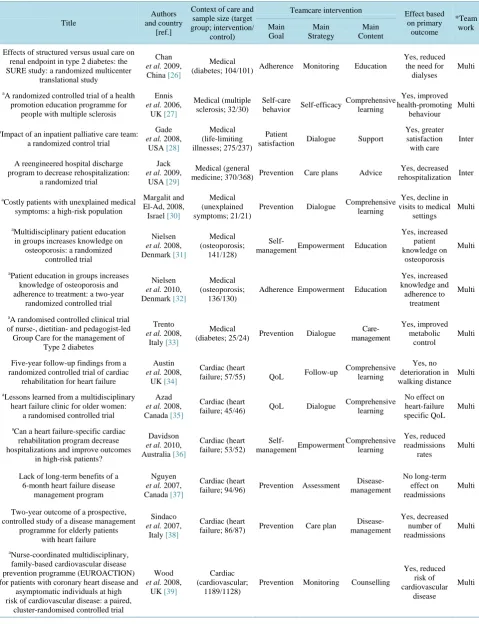
Table 1. Descriptive overview of the studies included (n = 27): context, teamcare interventions, effects and type of teamwork.
Title
Authors and country
[ref.]
Context of care and sample size (target group; intervention/
control)
Teamcare intervention Effect based
on primary outcome *Team work Main Goal Main Strategy Main Content
Effects of structured versus usual care on renal endpoint in type 2 diabetes: the SURE study: a randomized multicenter
translational study
Chan
et al. 2009, China [26]
Medical
(diabetes; 104/101) Adherence Monitoring Education
Yes, reduced the need for
dialyses
Multi
aA randomized controlled trial of a health promotion education programme for
people with multiple sclerosis
Ennis
et al. 2006, UK [27]
Medical (multiple sclerosis; 32/30)
Self-care
behavior Self-efficacy
Comprehensive learning Yes, improved health-promoting behaviour Multi
aImpact of an inpatient palliative care team: a randomized control trial
Gade
et al. 2008, USA [28]
Medical (life-limiting illnesses; 275/237)
Patient
satisfaction Dialogue Support
Yes, greater satisfaction
with care
Inter
A reengineered hospital discharge program to decrease rehospitalization:
a randomized trial
Jack
et al. 2009, USA [29]
Medical (general
medicine; 370/368) Prevention Care plans Advice
Yes, decreased rehospitalization Inter
aCostly patients with unexplained medical symptoms: a high-risk population
Margalit and El-Ad, 2008,
Israel [30]
Medical (unexplained symptoms; 21/21)
Prevention Dialogue Comprehensive learning
Yes, decline in visits to medical
settings
Multi
aMultidisciplinary patient education in groups increases knowledge on
osteoporosis: a randomized controlled trial
Nielsen
et al. 2008, Denmark [31]
Medical (osteoporosis;
141/128)
Self-
management Empowerment Education
Yes, increased patient knowledge on
osteoporosis Multi
aPatient education in groups increases knowledge of osteoporosis and adherence to treatment: a two-year
randomized controlled trial
Nielsen
et al. 2010, Denmark [32]
Medical (osteoporosis;
136/130)
Adherence Empowerment Education
Yes, increased knowledge and adherence to
treatment
Multi
aA randomised controlled clinical trial of nurse-, dietitian- and pedagogist-led
Group Care for the management of Type 2 diabetes
Trento
et al. 2008, Italy [33]
Medical
(diabetes; 25/24) Prevention Dialogue
Care- management Yes, improved metabolic control Multi
Five-year follow-up findings from a randomized controlled trial of cardiac
rehabilitation for heart failure
Austin
et al. 2008, UK [34]
Cardiac (heart
failure; 57/55) QoL Follow-up
Comprehensive learning Yes, no deterioration in walking distance Multi
aLessons learned from a multidisciplinary heart failure clinic for older women:
a randomised controlled trial
Azad
et al. 2008, Canada [35]
Cardiac (heart
failure; 45/46) QoL Dialogue
Comprehensive learning
No effect on heart-failure specific QoL
Multi
a
Can a heart failure-specific cardiac rehabilitation program decrease hospitalizations and improve outcomes
in high-risk patients?
Davidson
et al. 2010, Australia [36]
Cardiac (heart failure; 53/52)
Self-
management Empowerment
Comprehensive learning Yes, reduced readmissions rates Multi
Lack of long-term benefits of a 6-month heart failure disease
management program
Nguyen
et al. 2007, Canada [37]
Cardiac (heart
failure; 94/96) Prevention Assessment
Disease- management No long-term effect on readmissions Multi
Two-year outcome of a prospective, controlled study of a disease management
programme for elderly patients with heart failure
Sindaco
et al. 2007, Italy [38]
Cardiac (heart
failure; 86/87) Prevention Care plan
Disease- management Yes, decreased number of readmissions Multi
aNurse-coordinated multidisciplinary, family-based cardiovascular disease prevention programme (EUROACTION) for patients with coronary heart disease and
asymptomatic individuals at high risk of cardiovascular disease: a paired,
cluster-randomised controlled trial
Wood
et al. 2008, UK [39]
Cardiac (cardiovascular;
1189/1128)
Prevention Monitoring Counselling
Yes, reduced risk of cardiovascular
disease
Continued
The effects of guided care on the perceived quality of health care for multi-morbid older persons: 18-month outcomes from
a cluster-randomized controlled trial
Boyd
et al. 2010, USA [40]
Primary care (elderly multi-morbid;
485/419)
Patient
satisfaction Care plans
Comprehensive learning
Yes, improved self-reported quality of Care
Inter
aGeriatric care management for low-income seniors: a randomized
controlled trial
Counsell
et al. 2007, USA [41]
Primary care (low-income seniors; 474/477)
QoL Care plans Care-
management
Yes, improved quality of life
Multi and inter
Randomized controlled trial of anticipatory and preventive multidisciplinary team care: for complex
patients in a community-based primary care setting
Hogg
et al. 2009, Canada [42]
Primary care (elderly at risk of
adverse events; 120/121)
Prevention Care plans Care- management
Yes, improved Quality of Care Multi
The impact of a multidisciplinary information technology-supported program on blood pressure control
in primary care
Rinfret
et al. 2009, Canada [43]
Primary care (hypertension;
111/112)
Adherence Monitoring Education
Yes, improved blood pressure
levels
Multi
Changes in walking activity and endurance following rehabilitation
for people with Parkinson disease
White
et al. 2009, USA [44]
Primary care (Parkinson; 35+37/35) Self-manage ment Practical
training Education
Yes, improved walking activity
and endurance Inter
Evaluation of a fall-prevention program in older people after femoral neck
fracture: a one-year follow-up
Berggren
et al. 2008, Sweden [45]
Orthopedic (femoral neck fracture; 84/76)
Prevention Assessment Comprehensive learning
No effect on number of fall after one year
Multi
aLack of effectiveness of a multidisciplinary fall-prevention program in elderly people at risk:
a randomized, controlled trial
Hendriks et al. 2008, the Netherlands
[46]
Orthopedic (elderly after fall;
124/134)
Prevention Assessment Disease- management
No effect on falls and daily
functioning Multi
A multidisciplinary, multifactorial intervention program reduces postoperative falls and injuries
after femoral neck fracture
Stenvall
et al. 2007a, Sweden [47]
Orthopedic (femoral neck fracture; 102/97)
Prevention Assessment Comprehensive learning
Yes, reduced postoperative
falls
Multi
Improved performance in activities of daily living and mobility after a multidisciplinary postoperative rehabilitation in older people with femoral neck fracture: a randomized controlled trial with 1-year follow-up
Stenvall
et al. 2007b, Sweden [48]
Orthopedic (femoral neck fracture; 102/97)
Prevention Assessment Comprehensive learning Yes, enhanced activities of daily living performance and mobility Multi
Will improvement in quality of life impact fatigue in patients receiving radiation therapy for
advanced cancer?
Brown
et al. 2006, USA [49]
Oncological
(cancer; 49/54) QoL Dialogue Advice
No effect of fatigue Multi
Therapeutic exercise during outpatient radiation therapy for advanced cancer: Feasibility and impact on physical
well-being
Cheville
et al. 2010, USA [50]
Oncological (advanced cancer;
49/54)
QoL Dialogue Advice
Yes, physical wellbeing improved at
4 week
Multi
aQuality of life after self-management cancer rehabilitation: a randomized controlled trial comparing physical and
cognitive-behavioral training versus physical training
Korstjens et al.
2008, the Netherlands [51] Oncological (cancer survivors; 71+76/62) Self-manage ment Practical
training Support
Yes, physical training improved QoL
Multi
aFast-track in open intestinal surgery: prospective
randomized study
Serclová et al.
2009, Czech Republic [52]
Surgical (intestinal resection; 51/52)
Patient
safety Monitoring
Disease- management
Yes, reduced postoperative complications and hospital stay
Inter
3.2. Goals, Strategies and Content
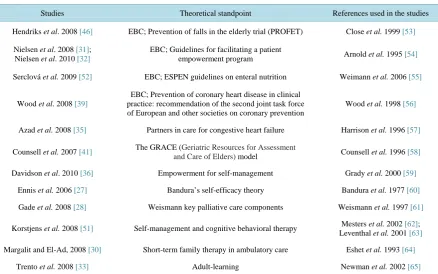
Forty-eight percent (n = 13) of the RCTs in somatic care presented a theoretical standpoint related to teamcare intervention (Table 2), with evidence-based guidelines (n = 5) as the most common. Goals were abstracted into two main categories; a professional-centered ambition and a patient-centered ambition, with a predominance for the former of these (Table 3). The most prominent and outstanding goal with the professional-centered ambition was prevention (n = 11) while quality of life (n = 5) and self-management (n = 4) were the most common goals related to the patient-centered ambition. Strategies were abstracted into three main categories: team-directed in-itiatives, patient-team-directed initiatives and patient-directed initiatives (Table 3). Team-directed initiatives comprised more categories, i.e. strategies, than patient team-directed and patient-directed initiatives. The most prominent strategy for team-directed initiatives were assessment and care plans (both n = 4) while the corres-ponding figures for patient team-directed and patient-directed initiatives were dialogue (n = 6) and monitoring (n = 4), respectively. Contents were abstracted into two main categories (Table 3); a patient-team interaction plan and a team-management plan, the former comprising almost three times the number of categories, i.e. contents. The most common content for patient-team interaction plan was comprehensive learning (n = 9) while disease management (n = 4) and case management (n = 3) were the corresponding contents for the team-management plan.
3.3. Teamcare and Its Effectiveness
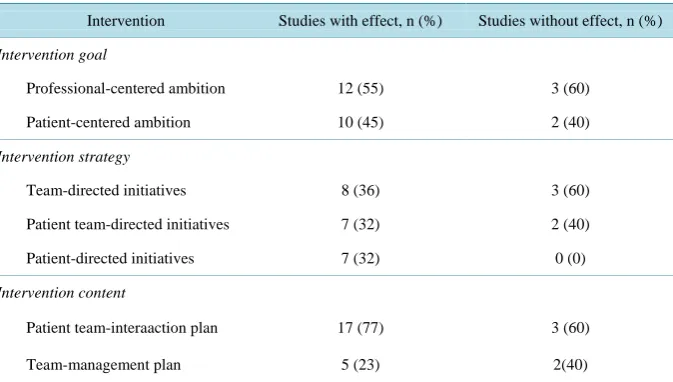
[image:7.595.95.534.433.707.2]A total of 85% of the RCTs in somatic care (n = 22) showed positive effectiveness of a teamcare intervention, of which the interdisciplinary team had 100% positive effectiveness (6 of 6) compared to that of the multidiscipli-nary team of 76% (16 of 21). There was a somewhat higher proportion (11 of 13; 85%) for the theory-based RCTs in terms of positive effectiveness compared to that for the non-theory-based RCTs (11 of 14; 79%). Fur-thermore, when comparing the RCT studies with positive effectivenesswith those without effectiveness, the former showed a somewhat greater level for professional-centered ambition in terms of goals and for team-di- rected initiatives in terms of strategy, and a significantly higher level for patient-team interaction plan in terms of content (Table 4).
Table 2. Theoretical standpoints used in the theory-based studies (n = 27).
Studies Theoretical standpoint References used in the studies
Hendriks et al. 2008 [46] EBC; Prevention of falls in the elderly trial (PROFET) Close et al. 1999 [53]
Nielsen et al. 2008 [31]; Nielsen et al. 2010 [32]
EBC; Guidelines for facilitating a patient
empowerment program Arnold et al. 1995 [54]
Serclová et al. 2009 [52] EBC; ESPEN guidelines on enteral nutrition Weimann et al. 2006 [55]
Wood et al. 2008 [39]
EBC; Prevention of coronary heart disease in clinical practice: recommendation of the second joint task force of European and other societies on coronary prevention
Wood et al. 1998 [56]
Azad et al. 2008 [35] Partners in care for congestive heart failure Harrison et al. 1996 [57]
Counsell et al. 2007 [41] The GRACE (Geriatric Resources for Assessment
and Care of Elders) model Counsell et al. 1996 [58]
Davidson et al. 2010 [36] Empowerment for self-management Grady et al. 2000 [59]
Ennis et al. 2006 [27] Bandura’s self-efficacy theory Bandura et al. 1977 [60]
Gade et al. 2008 [28] Weismann key palliative care components Weismann et al. 1997 [61]
Korstjens et al. 2008 [51] Self-management and cognitive behavioral therapy Mesters et al. 2002 [62]; Leventhal et al. 2001 [63]
Margalit and El-Ad, 2008 [30] Short-term family therapy in ambulatory care Eshet et al. 1993 [64]
Trento et al. 2008 [33] Adult-learning Newman et al. 2002 [65]
Table 3. Categorization matrix of the interventional goal, strategy and content in the studies analysed (n = 27).
Goal Strategy Content
Category Main category Category Main category Category Main category
Prevention (11) Adherence (3) Patient safety (1)
Professional-centered ambition (15)
Assessment (5) Care plans (5) Follow-up (1)
Team-directed initiatives (11)
Comprehensive learning (9) Education (5)
Advice (3) Support (2) Counselling (1)
Patient-team interaction plan (20)
Quality of life (5) Self-management (4) Patient satisfaction (2) Self-care behaviour (1)
Patient-centered ambition (12)
Dialogue (6) Empowerment (3)
Patient-team-directed initiatives (9)
Disease-management (4) Care-management (3)
Team-management plan (7) Monitoring (4)
Practical training (2) Self-efficacy (1)
Patient-directed initiatives (7)
Table 4. RCTs in somatic care with effect (n = 22) and without effect (n = 5) in relation to intervention goal, strategy and content.
Intervention Studies with effect, n (%) Studies without effect, n (%)
Intervention goal
Professional-centered ambition 12 (55) 3 (60)
Patient-centered ambition 10 (45) 2 (40)
Intervention strategy
Team-directed initiatives 8 (36) 3 (60)
Patient team-directed initiatives 7 (32) 2 (40)
Patient-directed initiatives 7 (32) 0 (0)
Intervention content
Patient team-interaaction plan 17 (77) 3 (60)
Team-management plan 5 (23) 2(40)
4. Discussion
4.1. Methodological Considerations
[image:8.595.145.482.299.490.2]4.2. Teamcare Intervention Considerations
Considering the fact that almost all teamcare intervention studies had been carried out in Europe and North America, it is questionable how well the results can be generalized outside these continents. On the other hand the need for more teamcare interventions has been emphasized [3] [4] and this appears to be particularly true for all countries, except perhaps for the USA. It is noteworthy that one care context in somatic care stands out; medical care in general and cardiac care in particular. Cardiac care is, however, a common area engaging both clinical and academic healthcare professionals, and not least the nurse profession [67]. This is in line with the conclusions of a literature review on nurse-led RCTs in somatic care where professional interests and public re-sources were a major feature in this field. [18]. It is also satisfactory that as many as 85% of the teamcare RCTs reported positive effectiveness, thus confirming previous findings [14]. However it is important to conclude that teamcare interventions appear to be more efficient compared to nurse-led interventions (85% vs. 71%) [18]. One relevant reason for the success of teamcare interventions is, apart from the holistic view of the patient, clearly the enhanced patient participation in the decision-making process, in terms of all the involved healthcare profes-sionals, making the patient more motivated to make a change [4] [11]. RCTs with a person-centered care ap-proach demonstrated relatively high positive effectiveness [10], but this literature review does not completely confirm these findings of a person-centered care approach in terms of interventional goal and strategies, which is surprising when considering the high level of positive effectiveness of 85%. This could, however, be explained by the fact that most of the teamcare interventions were based on the multidisciplinary and not the interdiscipli-nary approach, which when performed correctly has “a real” holistic view thus empowering the decision-making process towards the best health outcome [3] [11]. This reasoning is supported in this literature review by the fact that the interdisciplinary approach demonstrated greater effectiveness compared to the multidisciplinary ap-proach (100% vs 76%). A person-centered care is again preferable in order to empower the patient in maintain-ing health or preventmaintain-ing disease [68] [69]. Apart from the holistic perspective involvmaintain-ing a participatmaintain-ing patient, person-centered care also advocates the need for and use of EBP [2] [6]. Such reasoning thus highlights the im-portance of using theoretical standpoints when operationalizing the study design by using appropriate measure-ments in order to establish both relevant and effective outcomes [70]. This literature review confirms results from previous studies regarding theory-based designs (85%) being more effective than the non-theory-based ones (79%), but such theory-based strategies still seem premature [6] [18]. A theory-based teamcare RCT inter-vention thus indicates the need for a platform for planning and developing the context, goals, strategies, content as well as the essentials of an interdisciplinary approach related to desirable effectiveness.
5. Conclusions and Implications
Teamcare RCTs are still founded on the multidisciplinary approach having a professional-centered ambition with the team-directed initiative whilst utilizing a patient team-interaction plan. Interdisciplinary approaches es-pecially those that are theory-based appear to be essential with regard to positive effectiveness, preferably when person-centered care is applied based on evidence-based practice. More literature reviews are needed in order to compare teamcare RCTs in somatic care with those focusing on children’s and women’s health as well as mental health.
References
[1] Fineout-Overholt, E., Melnyk, B.M. and Schultz, A. (2005) Transforming Health Care from the Inside Out: Advancing Evidence-Based Practice in the 21st Century. Journal of Professional Nursing, 21, 335-344.
http://dx.doi.org/10.1016/j.profnurs.2005.10.005
[2] Angel, S. and Frederiksen, K.N. (2015) Challenges in Achieving Patient Participation: A Review of How Patient Par-ticipation Is Addressed in Empirical Studies. International Journal of Nursing Studies, 52, 1525-1538.
http://dx.doi.org/10.1016/j.ijnurstu.2015.04.008
[3] Nancarrow, S.A.,Booth, A., Ariss, S., Smith, T., Enderby, P. and Roots, A.(2013) Ten Principles of Good Inter- disciplinary Team Work. Human Resources for Health, 11, 19. http://dx.doi.org/10.1186/1478-4491-11-19
[4] Jessup, R.L. (2007) Interdisciplinary versus Multidisciplinary Care Teams: Do We Understand the Difference?
Aus-tralian Health Review, 31, 330-331. http://dx.doi.org/10.1071/AH070330
[6] Ekman, I., Swedberg, K., Taft, C., Lindseth, A., Norberg, A., Brink, E., Carlsson, J., Dahlin-Ivanoff, S., Johansson, I.L, Kjellgren, K., Lidén, E., Öhlén, J., Olsson, L.E., Rosén, H., Rydmark, M. and Sunnerhagen, K.S. (2011) Person-Cen- tered Care—Ready for Prime Time. European Journal of Cardiovascular Nursing, 10, 248-251.
http://dx.doi.org/10.1016/j.ejcnurse.2011.06.008
[7] Starfield, B. (2011) Is Patient-Centered Care the Same as Person-Focused Care? Permanente Journal, 15, 63-69. http://dx.doi.org/10.7812/TPP/10-148
[8] Say, R.E. and Thomsen, R. (2003) The Importance of Patient Preferences in Treatment Decisions-Challenges for Doc-tors. British Medical Journal, 327, 542-545. http://dx.doi.org/10.1136/bmj.327.7414.542
[9] Boivin, A., Currie, K., Fervers, B., Gracia, J., James, M., Marshall, C., Sakala, C., Sanger, S., Strid, J., Thomas, V., van der Weijden, T., Grol, R. and Burgers, J.; G-I-N PUBLIC (2010) Patients and Public Involvement in Clinical Guide-lines; International Experiences and Future Perspectives. Quality and Safety in Health Care, 19, e22.
http://dx.doi.org/10.1136/qshc.2009.034835
[10] Olsson, L.-E., Jakobsson Ung, E., Swedberg, K. and Ekman, I. (2012) Efficacy of Person-Centered Care as an Inter-vention in Controlled Trials—A Systematic Review. Journal of Clinical Nursing, 22, 456-465.
http://dx.doi.org/10.1111/jocn.12039
[11] Coulter, A., Entwistle, V.A., Eccles, A., Ryan, S., Shepperd, S. and Perera, R. (2013) Personalised Care Planning for Adults with Chronic or Long-Term Health Conditions (Protocol). The Cochrane Collaboration, 5, No. CD010523.
[12] Ellen, M.E., Léon, G., Bouchard, G., Lavis, J.N., Ouimet, M. and Grimshaw, J.M. (2013) What Supports Do Health System Organizations Have in Place to Facilitate Evidence-Informed Decision-Making? A Qualitative Study.
Imple-mentation Science, 8, 84. http://dx.doi.org/10.1186/1748-5908-8-84
[13] Lewin, S., Glenton, C. and Oxman, A.D. (2009) Use of Qualitative Methods Alongside Randomised Controlled Trials of Complex Healthcare Interventions: Methodological Study. British Medical Journal, 339, b3496.
http://dx.doi.org/10.1136/bmj.b3496
[14] Kilgore, R.V. and Langford, R.W. (2010) Defragmenting Care: Testing an Intervention to Increase the Effectiveness of Interdisciplinary Health Care Teams. Critical Care Nursing Clinics of North America, 22, 271-278.
http://dx.doi.org/10.1016/j.ccell.2010.03.006
[15] Rios, L.P., Ye, C. and Thabane, L. (2010) Association between Framing of the Research Question Using the PICOT Format and Reporting Quality of Randomized Controlled Trials. BMC Medical Research Methodology, 10, 11. http://dx.doi.org/10.1186/1471-2288-10-11
[16] Fineout-Overholt, E., Melnyk, B.M., Stillwell, S.B. and Williamson, K.M. (2010) Evidence-Based Practice Step by Step: Critical Appraisal of the Evidence—Part I. American Journal of Nursing, 110, 47-52.
http://dx.doi.org/10.1097/01.NAJ.0000383935.22721.9c
[17] Tuckett, A.G. (2005) The Care Encounter: Pondering Caring, Honest Communication and Control. International
Journal of Nursing Practice, 11, 77-84. http://dx.doi.org/10.1111/j.1440-172X.2005.00505.x
[18] Fridlund, B., Jönsson, A.C., Andersson, E.K., Bala, S.-V., Dahlman, G.-B., Forsberg, A., Glasdam, S., Hommel, A., Kristensson, A., Lindberg, C., Sivberg, B., Sjöström-Strand, A., Wihlborg, J. and Samuelson, K. (2014) Essential of Nursing Care in Randomized Controlled Trials of Nurse-Led Interventions in Somatic Care: A Systematic Review.
Open Journal of Nursing, 4, 181-197. http://dx.doi.org/10.4236/ojn.2014.43023
[19] Martin, J.S., Ummenhofer, W., Manser, T. and Spiriga, R. (2010) Interprofessional Collaboration among Nurses and Physicians: Making a Difference in Patient Outcome. Swiss Medical Weekly, 140, w13062.
http://dx.doi.org/10.4414/smw.2010.13062
[20] Forbes, A. (2009) Clinical Intervention Research in Nursing. International Journal of Nursing Studies, 46, 557-568. http://dx.doi.org/10.1016/j.ijnurstu.2008.08.012
[21] Zwarenstein, M., Goldman, J. and Reeves, S. (2009) Interprofessional Collaboration: Effects of Practice-Based Inter-ventions on Professional Practice and Healthcare Outcomes. Cochrane Database of Systematic Reviews, 3, CD000072.
[22] Valderas, J.M., Kotzeva, A., Espallargues, M., Guyatt, G., Ferrans, C.E., Halyard, M.Y., et al. (2008) The Impact of Measuring Patient-Reported Outcomes in Clinical Practice: A Systematic Review of the Literature. Quality of Life
Re-search, 17, 179-193. http://dx.doi.org/10.1007/s11136-007-9295-0
[23] Liberati, A., Altman, D.G., Tetzlatt, J., Mulrow, C., Gotzsche, P.C. and Joannidis, J.P. (2009) The PRISMA Statement for Reporting Systematic Reviews and Metaanalyses of Studies That Evaluate Healthcare Interventions: Explanation and Elaborations. British Medical Journal, 339, b2700. http://dx.doi.org/10.1136/bmj.b2700
[24] Swedish Council on Health Technology Assessment (2009) Evaluation and Synthesis of Studies Using Quantitative-Methods of Analysis. SBU, Stockholm.
[26] Chan, J.C., So, W.Y., Yeung, C.Y., Ko, G.T., Lau, I.T., Tsang, M.W., Lau, K.P., Siu, S.C., Li, J.K., Yeung, V.T., Leung, W.Y. and Tong, P.C., SURE Study Group (2009) Effects of Structured versus Usual Care on Renal Endpoint in Type 2 Diabetes: The SURE Study: A Randomized Multicenter Translational Study. Diabetes Care, 32, 977-982. http://dx.doi.org/10.1136/bmj.b2700
[27] Ennis, M., Thain, J., Boggild, M., Baker, G.A. and Young, C.A. (2006) A Randomized Controlled Trial of a Health Promotion Education Programme for People with Multiple Sclerosis. Clinical Rehabilitation, 20, 783-792.
http://dx.doi.org/10.1177/0269215506070805
[28] Gade, G., Venohr, I., Conner, D., McGrady, K., Beane, J., Richardson, R.H., Williams, M.P., Liberson, M., Blum, M. and Della Penna, R. (2008) Impact of an Inpatient Palliative Care Team: A Randomized Control Trial. Journal of
Pal-liative Medicine, 11, 180-190. http://dx.doi.org/10.1089/jpm.2007.0055
[29] Jack, B.W., Chetty, V.K., Anthony, D., Greenwald, J.L., Sanchez, G.M., Johnson, A.E., Forsythe, S.R., O’Donnell, J.K., Paasche-Orlow, M.K., Manasseh, C., Martin, S. and Culpepper, L. (2009) A Reengineered Hospital Discharge Program to Decrease Rehospitalization: A Randomized Trial. Annals of Internal Medicine, 150, 178-187.
http://dx.doi.org/10.7326/0003-4819-150-3-200902030-00007
[30] Margalit, A.P. and El-Ad, A. (2008) Costly Patients with Unexplained Medical Symptoms: A High-Risk Population.
Patient Education and Counseling, 70, 173-178. http://dx.doi.org/10.1016/j.pec.2007.09.020
[31] Nielsen, D., Ryg, J., Nissen, N., Nielsen, W., Knold, B. and Brixen, K. (2008) Multidisciplinary Patient Education in Groups Increases Knowledge on Osteoporosis: A Randomized Controlled Trial. Scandinavian Journal of Public
Health, 36, 346-352. http://dx.doi.org/10.1177/1403494808089558
[32] Nielsen, D., Ryg, J., Nielsen, W., Knold, B., Nissen, N. and Brixen, K. (2010) Patient Education in Groups Increases Knowledge of Osteoporosis and Adherence to Treatment: A Two-Year Randomized Controlled Trial. Patient
Educa-tion and Counseling, 81, 155-160. http://dx.doi.org/10.1016/j.pec.2010.03.010
[33] Trento, M., Basile, M., Borgo, E., Grassi, G., Scuntero, P., Trinetta, A., Cavallo, F. and Porta, M. (2008) A Rando-mised Controlled Clinical Trial of Nurse-, Dietitian- and Pedagogistled Group Care for the Management of Type 2 Di-abetes. Journal of Endocrinological Investigation, 31, 1038-1042. http://dx.doi.org/10.1007/BF03345645
[34] Austin, J., Williams, W.R., Ross, L. and Hutchison, S. (2008) Five-Year Follow-Up Findings from a Randomized Controlled Trial of Cardiac Rehabilitation for Heart Failure. European Journal of Cardiovascular Prevention and
Re-habilitation, 15, 162-167. http://dx.doi.org/10.1097/HJR.0b013e3282f10e87
[35] Azad, N., Molnar, F. and Byszewski, A. (2008) Lessons Learned from a Multidisciplinary Heart Failure Clinic for Older Women: A Randomised Controlled Trial. Age and Ageing, 37, 282-287. http://dx.doi.org/10.1093/ageing/afn013
[36] Davidson, P.M., Cockburn, J., Newton, P.J., Webster, J.K., Betihavas, V., Howes, L. and Owensby, D.O. (2010) Can a Heart Failure-Specific Cardiac Rehabilitation Program Decrease Hospitalizations and Improve Outcomes in High-Risk Patients? European Journal of Cardiovascular Prevention and Rehabilitation, 17, 393-402.
http://dx.doi.org/10.1097/HJR.0b013e328334ea56
[37] Nguyen, V., Ducharme, A., White, M., Racine, N., O’Meara, E., Zhang, B., Rouleau, J.L. and Brophy, J. (2007) Lack of Long-Term Benefits of a 6-Month Heart Failure Disease Management Program. Journal of Cardiac Failure, 13, 287-293. http://dx.doi.org/10.1016/j.cardfail.2007.01.002
[38] Del Sindaco, D., Pulignano, G., Minardi, G., Apostoli, A., Guerrieri, L., Rotoloni, M., Petri, G., Fabrizi, L., Caroselli, A., Venusti, R., Chiantera, A., Giulivi, A., Giovannini, E. and Leggio, F. (2007) Two-Year Outcome of a Prospective, Controlled Study of a Disease Management Programme for Elderly Patients with Heart Failure. Journal of
Cardiovas-cular Medicine (Hagerstown), 8, 324-329. http://dx.doi.org/10.2459/JCM.0b013e32801164cb
[39] Wood, D.A., Kotseva, K., Connolly, S., Jennings, C., Mead, A., Jones, J., Holden, A., De Bacquer, D., Collier, T., De Backer, G. and Faergeman, O., EUROACTION Study Group (2008) Nurse-Coordinated Multidisciplinary, Fami-ly-Based Cardiovascular Disease Prevention Programme (EUROACTION) for Patients with Coronary Heart Disease and Asymptomatic Individuals at High Risk of Cardiovascular Disease: A Paired, Cluster-Randomised Controlled Trial.
The Lancet, 371, 1999-2012. http://dx.doi.org/10.1016/S0140-6736(08)60868-5
[40] Boyd, C.M., Reider, L., Frey, K., Scharfstein, D., Leff, B., Wolff, J., Groves, C., Karm, L.,Wegener, S., Marsteller, J. and Boult, C. (2010) The Effects of Guided Care on the Perceived Quality of Health Care for Multi-Morbid Older Per-sons: 18-Month Outcomes from a Cluster-Randomized Controlled Trial. Journal of General Internal Medicine, 25, 235-242. http://dx.doi.org/10.1007/s11606-009-1192-5
[41] Counsell, S.R., Callahan, C.M., Clark, D.O., Tu, W., Buttar, A.B., Stump, T.E. and Ricketts, G.D. (2007) Geriatric Care Management for Low-Income Seniors: A Randomized Controlled Trial. Journal of the American Medical
Associ-ation, 298, 2623-2633. http://dx.doi.org/10.1001/jama.298.22.2623
[43] Rinfret, S., Lussier, M.T., Peirce, A., Duhamel, F., Cossette, S., Lalonde, L., Tremblay, C., Guertin, M.C., LeLorier, J., Turgeon, J., Hamet, P. and LOYAL Study Investigators (2009) The Impact of a Multidisciplinary Information Tech-nology-Supported Program on Blood Pressure Control in Primary Care. Circulation: Cardiovascular Quality and
Out-comes, 2, 170-177. http://dx.doi.org/10.1161/CIRCOUTCOMES.108.823765
[44] White, D.K., Wagenaar, R.C., Ellis, T.D. and Tickle-Degnen, L. (2009) Changes in Walking Activity and Endurance Following Rehabilitation for People with Parkinson Disease. Archives of Physical Medicine and Rehabilitation, 90, 43-50. http://dx.doi.org/10.1016/j.apmr.2008.06.034
[45] Berggren, M., Stenvall, M., Olofsson, B. and Gustafson, Y. (2008) Evaluation of a Fall-Prevention Program in Older People after Femoral Neck Fracture: A One-Year Follow-Up. Osteoporos International, 19, 801-809.
http://dx.doi.org/10.1007/s00198-007-0507-9
[46] Hendriks, M.R., Bleijlevens, M.H., van Haastregt, J.C., Crebolder, H.F., Diederiks, J.P., Evers, S.M., Mulder, W.J., Kempen, G.I., van Rossum, E., Ruijgrok, J.M., Stalenhoef, P.A. and van Eijk, J.T. (2008) Lack of Effectiveness of a Multidisciplinary Fall-Prevention Program in Elderly People at Risk: A Randomized, Controlled Trial. Journal of the
American Geriatrics Society, 56, 1390-1397. http://dx.doi.org/10.1111/j.1532-5415.2008.01803.x
[47] Stenvall, M., Olofsson, B., Lundström, M., Englund, U., Borssén, B., Svensson, O., Nyberg, L. and Gustafson, Y. (2007) A Multidisciplinary, Multifactorial Intervention Program Reduces Postoperative Falls and Injuries after Femor-al Neck Fracture. Osteoporos International, 18, 167-175. http://dx.doi.org/10.1007/s00198-006-0226-7
[48] Stenvall, M., Olofsson, B., Nyberg, L., Lundström, M. and Gustafson, Y. (2007) Improved Performance in Activities of Daily Living and Mobility after a Multidisciplinary Postoperative Rehabilitation in Older People with Femoral Neck Fracture: A Randomized Controlled Trial with 1-Year Follow-Up. Journal of Rehabilitation Medicine, 39, 232-238. http://dx.doi.org/10.2340/16501977-0045
[49] Brown, P., Clark, M.M., Atherton, P., Huschka, M., Sloan, J.A., Gamble, G., Girardi, J., Frost, M.H., Piderman, K. and Rummans, T.A. (2006) Will Improvement in Quality of Life (QOL) Impact Fatigue in Patients Receiving Radiation Therapy for Advanced Cancer? American Journal of Clinical Oncology, 29, 52-58.
http://dx.doi.org/10.1097/01.coc.0000190459.14841.55
[50] Cheville, A.L., Girardi, J., Clark, M.M., Rummans, T.A., Pittelkow, T., Brown, P., Hanson, J., Atherton, P., Johnson, M.E., Sloan, J.A. and Gamble, G. (2010) Therapeutic Exercise during Outpatient Radiation Therapy for Advanced Cancer: Feasibility and Impact on Physical Well-Being. American Journal of Physical Medicine & Rehabilitation, 89, 611-619. http://dx.doi.org/10.1097/PHM.0b013e3181d3e782
[51] Korstjens, I., May, A.M., van Weert, E., Mesters, I., Tan, F., Ros, W.J., Hoekstra-Weebers, J.E., van der Schans, C.P. and van den Borne, B. (2008) Quality of Life after Self-Management Cancer Rehabilitation: A Randomized Controlled Trial Comparing Physical and Cognitive-Behavioral Training versus Physical Training. Psychosomatic Medicine, 70, 422-429. http://dx.doi.org/10.1097/PSY.0b013e31816e038f
[52] Serclová, Z., Dytrych, P., Marvan, J., Nová, K., Hankeová, Z., Ryska, O., Slégrová, Z., Buresová, L., Trávníková, L. and Antos, F. (2009) Fast-Track in Open Intestinal Surgery: Prospective Randomized Study (Clinical Trials Gov Iden-tifier No. NCT00123456). Clinical Nutrition, 28, 618-624. http://dx.doi.org/10.1016/j.clnu.2009.05.009
[53] Close, J., Ellis, M., Hooper, R., Glucksman, E., Jackson, S. and Swift, C. (1999) Prevention of Falls in the Elderly Tri-al (PROFET): A Randomized Controlled TriTri-al. The Lancet, 353, 93-97.
http://dx.doi.org/10.1016/S0140-6736(98)06119-4
[54] Arnold, M.S., Butler, P.M., Anderson, R.M., Funnell, M.M. and Feste, C. (1995) Guidelines for Facilitating a Patient Empowerment Program. The Diabetes Educator, 21, 308-312. http://dx.doi.org/10.1177/014572179502100408
[55] Weimann, A., Braga, M., Harsanyi, L., Laviano, A., Ljungqvist, O., Soeters, P., DGEM (German Society for Nutri-tional Medicine) Jauch, K.W., Kemen, M., Hiesmayr, J.M., Horbach, T., Kuse, E.R., Vestweber, K.H. and ESPEN (European Society for Parenteral and Enteral Nutrition) (2006) ESPEN Guidelines on Enteral Nutrition: Surgery in-cluding Organ Transplantation. Clinical Nutrition, 25, 224-244. http://dx.doi.org/10.1016/j.clnu.2006.01.015
[56] Wood, D., De Backer, G., Faergeman, O., Graham, I., Mancia, G. and Pyörälä, K. (1998) Prevention of Coronary Heart Disease in Clinical Practice: Recommendations of the Second Joint Task Force of European and Other Societies on Coronary Prevention. European Heart Journal, 19, 1434-1503. http://dx.doi.org/10.1053/euhj.1998.1243
[57] Harrison, M.B., Toman, C. and Logan, J. (1996) Partners in Care for Congestive Heart Failure. 2nd Edition, Continuity of Care Study, University of Ottawa Loeb Research Institute, Ottawa.
[58] Counsell, S.R., Callahan, C.M., Buttar, A.B., Clark, D.O. and Frank, K.I. (2006) Geriatric Resources for Assessment and Care of Elders (GRACE): A New Model of Primary Care for Low-Income Seniors. Journal of the American
Ge-riatrics Society, 54, 1136-1141. http://dx.doi.org/10.1111/j.1532-5415.2006.00791.x
http://dx.doi.org/10.1161/01.CIR.102.19.2443
[60] Bandura, A. (1977) Self-Efficacy: Toward a Unifying Theory of Behavioural Change. Psychological Review, 84, 191-215. http://dx.doi.org/10.1037/0033-295X.84.2.191
[61] Weismann, D. (1997) Consultation in Palliative Medicine. Archives of Internal Medicine, 157, 733-737. http://dx.doi.org/10.1001/archinte.1997.00440280035003
[62] Mesters, I., Creer, T.L. and Gerards, F. (2002) Self-Management and Respiratory Disorders: Guiding from Health Counseling and Self-Management Perspectives. In: Kaptein, A. and Creer, T.L., Eds., Respiratory Disorders and
Be-havioral Research, Dunitz, London, 139-174. http://dx.doi.org/10.4324/9780203221570_chapter_6
[63] Leventhal, H. and Carr, S. (2001) Speculations on the Relationship of Behavioral Therapy to Psychosocial Research on Cancer. In: Baum, A. and Andersen, B.L., Eds., Psychosocial Interventions for Cancer, American Psychological Asso-ciation, Washington DC, 375-400. http://dx.doi.org/10.1037/10402-020
[64] Eshet, I., Margalit, A. and Almagor, G. (1993) Short Family Therapy in Ambulatory Medicine (SFAT-AM): Treatment Approach in 10 - 15 Minute Encounters. Family Practice, 10, 178-187. http://dx.doi.org/10.1093/fampra/10.2.178
[65] Newman, P. and Peile, E. (2002) Valuing Learners’ Experience and Supporting Further Growth: Educational Models to Help Experienced Edult Learners in Medicine. British Medical Journal, 325, 200-202.
http://dx.doi.org/10.1136/bmj.325.7357.200
[66] Hildon, Z., Allwood, D. and Black, N. (2012) Making Data More Meaningful: Patients’ Views of the Format and Con-tent of Quality Indicators Comparing Health Care Providers. Patient Education and Counseling, 88, 298-304. http://dx.doi.org/10.1016/j.pec.2012.02.006
[67] Allen, J.K. and Dennison, C.R. (2010) Randomized Trials of Nursing Interventions for Secondary Prevention in Pa-tients with Coronary Artery Disease and Heart Failure: Systematic Review. Journal of Cardiovascular Nursing, 25, 207-220. http://dx.doi.org/10.1097/JCN.0b013e3181cc79be
[68] Prilleltensky, I. (2005) Promoting Well-Being: Time for a Paradigm Shift in Health and Human Services. Scandinavian
Journal of Public Health, 33, 53-60. http://dx.doi.org/10.1080/14034950510033381
[69] Specht, J.K., Taylor, R. and Bossen, A.L. (2009) Partnering for Care: The Evidence and the Expert. Journal of
Geron-tological Nursing, 35, 16-22. http://dx.doi.org/10.3928/00989134-20090301-09
[70] Shepperd, S., Lewin, S., Straus, S., Clarke, M., Eccles, M.P., Fitzpatrick, R., et al. (2009) Can We Systematically Review Studies That Evaluate Complex Interventions? PLoS Medicine, 6, e1000086.