S T U D Y P R O T O C O L
Open Access
Medicine in spine exercise (MiSpEx) for
nonspecific low back pain patients: study
protocol for a multicentre, single-blind
randomized controlled trial
Daniel Niederer
1*†, Lutz Vogt
1†, Pia-Maria Wippert
4, Anne-Katrin Puschmann
4, Ann-Christin Pfeifer
3,
Marcus Schiltenwolf
3, Winfried Banzer
1†and Frank Mayer
2†Abstract
Background:Arising from the relevance of sensorimotor training in the therapy of nonspecific low back pain patients and from the value of individualized therapy, the present trial aims to test the feasibility and efficacy of individualized sensorimotor training interventions in patients suffering from nonspecific low back pain.
Methods and study design:A multicentre, single-blind two-armed randomized controlled trial to evaluate the effects of a 12-week (3 weeks supervised centre-based and 9 weeks home-based) individualized sensorimotor exercise program is performed. The control group stays inactive during this period. Outcomes are pain, and pain-associated function as well as motor function in adults with nonspecific low back pain. Each participant is scheduled to five measurement dates: baseline (M1), following centre-based training (M2), following home-based training (M3) and at two follow-up time points 6 months (M4) and 12 months (M5) after M1. All investigations and the assessment of the primary and secondary outcomes are performed in a standardized order: questionnaires–clinical examination– biomechanics (motor function). Subsequent statistical procedures are executed after the examination of underlying assumptions for parametric or rather non-parametric testing.
Discussion:The results and practical relevance of the study will be of clinical and practical relevance not only for researchers and policy makers but also for the general population suffering from nonspecific low back pain. Trial registration:Identification number DRKS00010129. German Clinical Trial registered on 3 March 2016. Keywords:Sensorimotor training, Motor control, Low back pain, Exercise, Functional capacity, Individualized intervention
Background
Nonspecific low back pain is the most common kind of musculoskeletal pain with a lifetime prevalence of up to 90 % [1, 2] and of particular relevance in industrialized countries. Point prevalence varies between 30 and 50 %, depending on age and sex [1]. When focusing on com-petitive elite athletes only, actual research findings esti-mate the lifetime prevalence at 60 % and the point
prevalence at 18 % [3, 4]. Just as in the general public, prevalences vary in different subsamples of athletes, depending on the specific sport, age or sex [5, 6].
Neuromuscular and/or structural deficits [7, 8], mostly accompanied by psychological or social factors (‘yellow flags’) [9], are known risk factors for both the onset and chronification of nonspecific low back pain. With valuable impact on these factors and the back pain itself, target-oriented movement training is of increasing relevance in (secondary) prevention and therapy [10, 11]. Evidence-based therapeutic approaches have changed and are no longer solely passive-reactive but multidisciplinary-active with a major physical activity part. However, the evidence
* Correspondence:[email protected];[email protected] †Equal contributors
1Department of Sports Medicine, Goethe University Frankfurt, Ginnheimer Landstraße 39, 40487 Frankfurt am Main, Germany
Full list of author information is available at the end of the article
for the effectiveness of physical activity in the therapy of nonspecific low back pain is mixed. A recent meta-analysis indicates that physical activity has positive effects in the therapy of nonspecific low back pain [10]. In addition, the authors show that, using pooled subgroup effects, coordinative and stabilizing training also has an effect by addressing sensory deficiencies. The latest Cochrane review, however, only provides low to moderate quality evidence that isolated motor control exercises are able to improve pain in the short, intermediate or long term [11]. The authors conclude that a final proof for the efficacy of motor control exercise on relevant functional factors like kinematics, strength, postural control and pain is still missing.
A further potential explanation for the lack of consistent evidence for the beneficial impact of physical activity on nonspecific back pain may be that the impact of physical activity on pain is moderated by contextual and individual psychological and social factors (so-called yellow flags [12]). A better understanding of the role of these modera-ting factors is crucial to evaluate the role of physical acti-vity for the treatment of chronic back pain and eventually enable the personalization of such physical activity inter-ventions. Individualizing the sensorimotor therapy with respect to individual skill level, demands, preferences, and potential moderating factors such as pain, physical activity, pain experience, stress, life context and the medical care context may lead to greater therapy success [12]. Likewise, determining the optimal dose for treating patients as individuals is still a matter of debate [13, 14].
Against the background of the need for further evidence for the efficacy or non-efficacy of motor control exercise targeting neuromuscular factors like kinematics, strength, postural control and pain [11], the purpose of this study is to test (1) the feasibility and (2) the efficacy of individualized motor control interventions in nonspecific low back pain patients. We hypothesize that individualized motor control exercises lead to an improvement in motor function, assessed as maximal back extension torque, in low back pain patients and in comparison to a control group. Secondary research questions are: (1) does individualized motor control exercises lead to an improvement in motor function, pain and/or pain-related variables in low back pain patients and compared with a control group at short and/or long term and (2, exploratory) to what extent do moderating factors play a role in non-responder detection dose-response con-siderations and therapy individualization?
Methods/Design
Study design and flow
The study consists of a multicentre (Appendix A), single-blind two-armed randomized controlled trial to evaluate the effects of a 12-week individualized sensorimotor exer-cise program on pain, pain-related outcomes and function
in nonspecific low back pain adults compared with a wait-ing control group. The study has been approved by the in-dependent Ethics Committee of the University of Potsdam (committee’s reference number 3/2016; amendment for number 47/2013). Date of preliminary approval was the 25 January 2016; date of the final approval was the 9 May 2016. The study was planned and is performed in agree-ment with the Declaration of Helsinki (Version Fortaleza 2013). Trial registration number is DRKS00010129 (DRKS, German Clinical Trials Register, drks.de; 3 March 2016). All adverse events will be reported.
Primary outcome is trunk extension strength [Nm]. The assessment and analyses of all records are performed by blinded evaluators. Five assessment visits (M1-M5) will take place over a period of 12 months.
Participants
Sample size determination
A pilot feasibility study was conducted (unpublished material). The therein found outcome with the largest effect size was selected as the primary outcome for the present study. Thus, primary outcome is maximal back extension torque. Sample size calculation was based on the effect size of d = 0.24 (based on the changes in primary outcome from baseline to post-intervention (12 weeks)). For the main study, effect size was conservatively com-pleted to d = 0.2.
Participants are allocated to intervention or control group at the ratio of 2:1. Normal distribution and variance equality are assumed. Following a determined α-error probability of 2.5 % and aβ-error probability of 0.1, a min-imal sample size of 1186 patients are consequently to be included into analysis (n= 791 in the intervention andn= 395 in the control group). As a dropout rate of 30 % is assumed, a total ofN= 1542 participants are included in the study. Although motor control and stabilizing exercise are likely to show equal effects for the general population and for top athletes [15], medical access and the potential to implement medical exercise regimes into everyday life differ between these populations (e.g. training schedule, competitions). According to study aim 1, and beside the studies’ main target group, we make additional effort to also recruit a sample of athletes to gain further (beyond the main analyses) insight and test the feasibility in this much less investigated population. For dichotomization purpose, only top competitive athletes (A to D pool, participating in top level international, federal or state competitions) are further treated as athletes.
Recruitment, screening and informed consent
participating study sites, mostly at the mandatory annual sports medical examination. Only general information is provided during recruitment. Interested persons are sched-uled for a visit in one of the six study sites and then screened for eligibility. Males and females aged 18–65 years with chronic low back pain are considered eligible if they fulfil the following inclusion criteria: at least one episode (≥ 4 days) of nonspecific back pain in the last 12 months, abil-ity to understand the extent and meaning of the study and to answer a questionnaire without help.
Exclusion criteria consist of acute infection, pregnancy, inability to execute a one-legged stance, diseases with contraindication for exercise (including spine complaints based on space-occupying, inflammatory, traumatic or systemic processes [12]) and change or progression in the severity, localization or type of back pain during the last 7 days. Following application of inclusion and exclu-sion criteria, patients are approved by the physician in charge. Each participant signs informed consent prior to study enrolment.
Randomization procedure and blinding
After inclusion and completing the first visit, volunteers are block-randomised (nblock= 18; 2:1 basis) into either
the intervention or control group by the study coordin-ator. Randomization order follows the study inclusion order. Each study site receives its own randomization lists once a week from the primary study centre; the randomization sequence is generated using a computer-based algorithm (www.randomization.com). All assessors and study personnel other than the study coordinator (and the therapist) are blinded. Participants are told not to communicate their group allocation to other partici-pants or study staff.
Experimental procedure
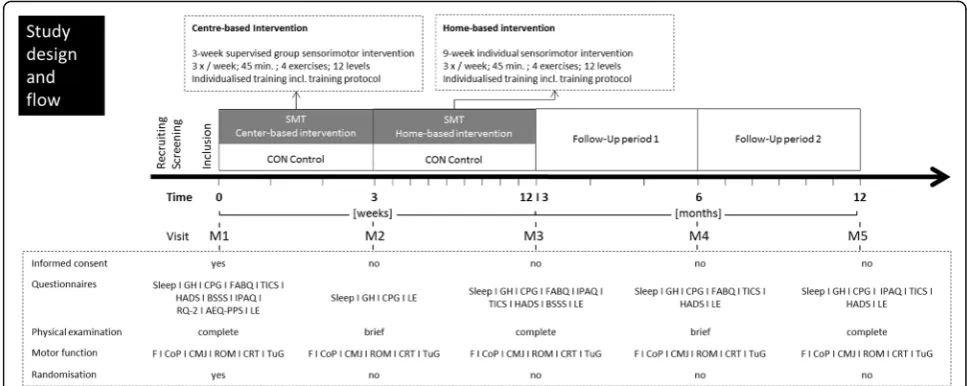
In this multicentre intervention trial, a 12-week sensori-motor intervention is performed (3 weeks supervised centre-based followed by 9 weeks home-based) after the randomization (intervention group only). The control group does not receive any (additional) therapeutic or placebo treatment during this period. Each participant is scheduled for five measurement visits (M1-M5) prior to (M1) and following centre-based (M2), following home-based training (M3) and at two follow-up points in time (M4: 6 months after M1 and M5: 12 months after M1). All investigations and thus the assessment of the primary and secondary outcomes are performed in a standardised order: questionnaires – clinical examination – biomechanics. Whilst all biomechanical assessments (including the pri-mary outcome) are assessed at each visit, the clinical exam-ination and questionnaires are assessed in a sequenced order. The experimental procedure is shown in detail in Fig. 1 and Additional file 1. Although the measurement
periodization is defined, an individual tolerance time of 7 days (M2, M3), 14 days (M4) and 30 days (M5) is set.
Questionnaires–assessment of back pain and moderating factors
At each measurement day (M1-M5) a psychometric assessment is performed to detect the moderating fac-tors (‘yellow flags’) for the chronification of back pain. The test battery will be rotated (Fig. 1) and is partially based on subscales in order to reduce the burden for participants. Pain is assessed by the Chronic Pain Grade questionnaire (CPG) [16], which allows a differentiation in the subscales pain intensity (PI: 0 =“no pain”to 100 =“the worst pain imaginable”), and disability (DS: 0 =“no disabi-lity” to 100 =“I was incapable of doing anything”) in the past 3 months. Furthermore, participants can get classified into one of the four hierarchical pain and disability grades ranging from low pain/disability (grade I) to high pain/dis-ability scores (grade IV) [17].
The five moderating factors were assessed using the following psychometric instruments: (1) physical activity: International Physical Activity Questionnaire (IPAQ) [18] and type of physical activity. (2) Pain experience: pain-related cognitions by the Fear-Avoidance Beliefs question-naire (FABQ-D, [19]), avoidance‐endurance‐behaviour by the Avoidance-Endurance Questionnaire (AEQ; [20] and anxiety and depression by the Hospital Anxiety and Depression Score (HADS-D; [21]) ). (3) Stress: chronic stress by the Trier Inventory of Chronic Stress (TICS; [22]) and critical life events in the last 3 months. (4) Personal life context: social support by the Berlin Social Support Scales (BSSS; [23], individual attachment style by the Relationship Questionnaire 2 (RQ‐2; [24, 25]) as well as the socioeconomic status (CASMIN; [26] and lifestyle (alcohol, smoking, general health and sleeping status). (5) Medical care context: health services options (see also DSF, [27]) .
Physical examination
The medical/physical examination has two aims: first, secondary outcome variables are assessed; second, con-traindications for the following motor function assess-ment are screened.
Motor function
Following the physical examination and in case of no contraindications, functional outcomes are assessed in a standardized order at each visit. Following consensus dis-cussions and in order to prevent muscle fatigue prior to torque assessment, the order is as follows: (1) posturogra-phy, (2) jumping assessment, (3) kinematics, (4) clinical testing, (5) strength. If a functional assessment is done for both the left and right side, side order will be randomized. Randomization sequence is generated using a computer-based algorithm (www.randomization.com). For standardiz-ing purpose (settstandardiz-ing and device familiarization) and to avoid bias, one demonstration (by the investigator) and one test run are completed before each new biomechanical outcome assessment start. A numerical rating scale (NRS, 0–10 points Likert scale) is used to assess actual pain prior to and following the motor function assessment.
Posturography
Postural control in single and bipedal stance is assessed using balance boards (Wii Balance Board, Nintendo, Kyoto, Japan; modified by CSMi Computer Sports Medicine Inc., Stoughton, MA, USA). Postural sway is estimated by the trace length [mm] of the excursion of the centre of pres-sure (COP). For the meapres-surement, participants were asked to maintain in upright stance as still as possible for 30 sec-onds without wearing shoes, with their hands on their hips and their eyes open, standing on two balance boards. After-wards, the single leg stands (left and right) followed in the
randomized order (each 30 s, eyes open, one single balance board) with the contralateral knee bend (90°).
In comparison to a laboratory-grade force platform and with an intraclass correlation (ICC) of 0.81 (single limb stance, 95 % CI 0.39–0.92) and 0.77 (double limb stance, 95 % CI 0.69–0.95), respectively, the Wii balance board shows a sufficient validity [29]. Accordingly and with an ICC of 0.89 (95 % CI: 0.76–0.95) for single limb balance assessments and an ICC of 0.86 (95 % CI: 0.54–0.9) for bipedal stance, a high reproducibility was shown [29].
Jumping assessment
Jumping ability is afterwards determined using the same balance boards. Countermovement jumps (CMJ) and combined CMJs followed by reactive jumps are executed. Whilst each participant performs double leg jumps, single leg jumps are, for security purpose, per-formed by athletes only.
After warm-up (30 s tapping on a stepper with a 14– 21 cm high) and familiarization, participants perform two bipedal CMJs, followed by two combined bipedal CMJs/ reactive jump. For the reactive jumps, all participants are told to immediately add another jump after landing from the CMJ. All athletes afterwards jump twice with the left and twice with the right leg (randomised order), each time starting with a CMJ followed by a CMJ with a reactive jump. Main outcomes will be jumping height in cm for the CMJ and contact time [ms] for the reactive jumps.
The balance board is able to precisely (r= 0.99 in com-parison to gold standard laboratory-grade force platform)
[image:4.595.55.539.88.281.2]measure vertical ground reaction force and thus jumping performance [30]. Data from both the posturography and the jumping tests are stored for the later analysis using the HUMAC Balance program (CSMi Computer Sports Medicine Inc., Stoughton, MA, USA).
Kinematics
A non-invasive external three-dimensional wireless move-ment analysis system (IMU sensors, Ergotest Innovations, Porsgrunn, Norway) with a 200 Hz sample rate is used to collect kinematic data. Sufficient test–retest reliability of this measurement system for lumbar spine kinematics (r2> 0.97; RMSE = 4.1°;p< 0.001) has recently been dem-onstrated [31]. Six sensors are attached, two on the lower back (each 5 cm left/right from L3), two on the pelvis (left and right iliac spines), and two on the thigh, each 10 cm above the medial tibia plateau. Participants perform over the maximal range of motion in a self-determined and comfortable velocity with eyes open. After familiarization trial and device zeroing, all subjects perform two times maximal spine flexion-extension movements, followed by maximal lateral flexion movements (two times), followed by two maximal rotation movements (side order rando-mised). Maximal ranges of motion (ROMs) [°] will be selected for further analysis.
Data were stored on a data processor for the following offline analysis. Maximal ROM was computed from raw data using MuscleLab Professional (Ergotest Innova-tions, Porsgrunn, Norway).
Clinical testing
The Timed Up and Go test (TuG) for mobility testing and the Chair Rise Test (CRT) for lower extremity strength/force are performed during clinical function testing [32]. For the TuG, subjects will sit on a chair with arm support, stand up, walk straight 3 m to a mark on the floor, turn around, walk back to the chair and sit down again. Participants then (CRT) are set on a chair (46 cm sitting height, arms crossed in front of the breast) and are asked to stand-to-sit five times as fast as possible without losing control.
Time [s] is the outcome further analysed for CRT and TuG; common stopwatches are used to assess it. Both tests are performed twice; the best result will be selected for further analysis.
Torque/strength
Maximum trunk extension strength assessment with isokinetic or, depending on the participating centres’ isokinetic device availability, isometric maximum trunk extension torque testing [Nm] is considered to be the primary outcome. To obtain maximal torque (isokinetic,
n= 4 study sites) or maximum isometric voluntary force (isometric, maximal isometric voluntary force (MIVF),
n= 2 study sites) of the trunk extensors (primary out-come) and flexors, validated devices from various but nevertheless renowned producers are used.
After a specific warm-up with 30 isokinetic repetitions at 60°/s (isometric: two submaximal practice trials), five (three) tests at 60°/s (3 s) were performed, separated by 2-min rest intervals. Ranges of motions (isokinetic) are device-specific set to 40–45° in flexion and 10–15° in extension. Subjects were verbally encouraged in a stan-dardized way to elicit maximal effort. Collected data were immediately analysed and the highest torque (force) was considered to be representative for further statistical analysis.
Intervention
Therapy flow and phases
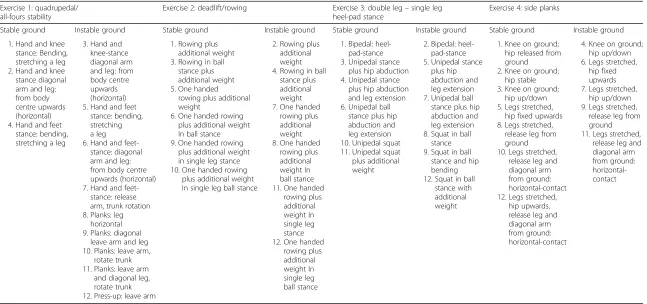
All interventions are guided (centre-based) or instructed (home-based) by trained and experienced medical training or sports therapists. Following the randomization at the end of M1, intervention group participants are scheduled to a 3-week centre-based guided intervention, followed by a 9-week home-based individual training. In each phase and in accordance with the guidelines [33], intervention participants are told to train three times a week with a mean duration of 30 minutes. The program consists of four different sensorimotor exercises. For individualization purposes, all exercises comprise 12 different levels and offer the possibility to add self-initiated additional motor tasks like ball tapping (single-handed, on the floor or against the wall and/or additional weight). Two of the ex-ercises are dedicated to directly train the core stabilizing and/or core surrounding muscles whilst the two other ex-ercises are considered to impact indirectly on the upper and/or lower extremities. The exercises are commonly de-scribed as: (1) quadrupedal/all-fours stability; (2) deadlift/ rowing; (3) double leg–single leg heel-pad stance; (4) side planks. Exercises will be performed with three series of ten repetitions each. In between series, a 2-minute break (self-controlled) is held. Details on the intervention and belonging levels are provided in Table 1.
Individualization
Table 1Interventional exercises details. For each exercise, level (1–12), surface (stable/instable) and description are provided
Exercise 1: quadrupedal/ all-fours stability
Exercise 2: deadlift/rowing Exercise 3: double leg–single leg
heel-pad stance
Exercise 4: side planks
Stable ground Instable ground Stable ground Instable ground Stable ground Instable ground Stable ground Instable ground
1. Hand and knee stance: Bending, stretching a leg 2. Hand and knee stance diagonal arm and leg: from body centre upwards (horizontal) 4. Hand and feet
stance: bending, stretching a leg
3. Hand and knee-stance diagonal arm and leg: from body centre upwards (horizontal) 5. Hand and feet
stance: bending, stretching a leg 6. Hand and
feet-stance: diagonal arm and leg: from body centre upwards (horizontal) 7. Hand and
feet-stance: release arm, trunk rotation 8. Planks: leg
horizontal 9. Planks: diagonal
leave arm and leg 10. Planks: leave arm,
rotate trunk 11. Planks: leave arm
and diagonal leg, rotate trunk 12. Press-up: leave arm
1. Rowing plus additional weight 3. Rowing in ball
stance plus additional weight 5. One handed
rowing plus additional weight
6. One handed rowing plus additional weight In ball stance 9. One handed rowing
plus additional weight in single leg stance 10. One handed rowing
plus additional weight In single leg ball stance
2. Rowing plus additional weight 4. Rowing in ball
stance plus additional weight 7. One handed
rowing plus additional weight 8. One handed
rowing plus additional weight In ball stance 11. One handed
rowing plus additional weight In single leg stance 12. One handed
rowing plus additional weight In single leg ball stance
1. Bipedal: heel-pad-stance 3. Unipedal stance
plus hip abduction 4. Unipedal stance
plus hip abduction and leg extension 6. Unipedal ball
stance plus hip abduction and leg extension 10. Unipedal squat 11. Unipedal squat plus additional weight
2. Bipedal: heel-pad-stance 5. Unipedal stance
plus hip abduction and leg extension 7. Unipedal ball stance plus hip abduction and leg extension 8. Squat in ball
stance 9. Squat in ball
stance and hip bending 12. Squat in ball
stance with additional weight
1. Knee on ground; hip released from ground 2. Knee on ground;
hip stable 3. Knee on ground;
hip up/down 5. Legs stretched,
hip fixed upwards 8. Legs stretched,
release leg from ground 10. Legs stretched,
release leg and diagonal arm from ground: horizontal-contact 12. Legs stretched,
hip upwards, release leg and diagonal arm from ground: horizontal-contact
4. Knee on ground; hip up/down 6. Legs stretched,
hip fixed upwards 7. Legs stretched,
hip up/down 9. Legs stretched,
release leg from ground 11. Legs stretched,
this accuracy can be reached. This level (including the number and type of self-initiated additional motor tasks and additional weight) is further adaptive and may be corrected in both directions (increase or even decrease in level) continuously by the therapist during the centre-based phase. The goal for the intervention is to increment by one level once a week until the maximum level 12 is reached.
The intervention group patients receive individualized exercise counselling for home-based training as follows: at the end of the centre-based trainings, the starting level for the home-based phase is determined (therapist in collab-oration with the participant). In addition, the goal level for the home-based phase is determined. Each subjects’goal level and the periodization to reach this level is subse-quently recorded on the training log. Intervention group subjects were additionally encouraged to contact the counselling exercise therapist by phone, e-mail or in per-son at any time during the home-based intervention. Final therapy individualization may be accomplished by using a standardized procedure to detect potential non-responder and/or non-complier. This detection is based on cutoff values which will be determined from the studies’ ques-tionnaires. If a potential responder and/or non-complier is detected, each study site is recommended to implement an additional behavioural module to the inter-vention. This module and its empirical funding is described in detail elsewhere [34].
Control group participants do not receive any ad-ditional intervention in/from one of the study centres but may proceed with their regular care (e.g. physiothe-rapy or manual thephysiothe-rapy) or additional interventions (the same applies to the intervention group) if they are engaged in one at the time of study inclusion. The inter-vention within medicine in spine exercise (MiSpEx) thus can be seen as additive.
Therapy monitoring
During the stationary centre-based phase, a standardized training log is completed by the therapist, documenting the exercise level and the (if applied) additional weight. To monitor home training compliance, intervention group patients are asked to fill in an exercise log during the home-based training (between M2 and M3).
Statistical analysis
Data is collected and analysed centrally after assessment completion. Following visual and physiological range plausibility control, a gain score analysis (change score analysis) using the mean difference between M1 and M3 for between-group differences of the primary outcome is performed.
Hypotheses testing for all other measurement times and secondary outcomes are performed using particular
fitting regressional and variance analytical testing. Poten-tial mediators and confounders like the amount of physical activity, psychosocial scores, age, gender, initial pain level and body weight will be analysed using multiple regression mediating analyses [35] or included into variance analyses as covariates. For mediation analyses, total as well as direct and indirect effects are calculated. Sobel testing and 95 % confidence interval (CI) bias corrected bootstrapping (nsub-samples= 10,000)
are conducted for indirect effect quantification [36–38]. All statistical procedures are executed after the examin-ation of underlying assumptions for parametric or rather non-parametric hypotheses testing. Due to the explorative analyses of the secondary outcomes, no alpha-error adjustment is performed. To increase statistical power, missing values are multiple imputed using standardized procedures [39] and only following (in case of psychomet-ric scores) specific test manuals. The one-sided a priori level of significance is set at α= 0.025 for all statistical analyses.
Discussion
Primary aim of the study is to test the feasibility and effi-cacy of individualized sensorimotor training interven-tions for the treatment of nonspecific low back pain. To do so, a standardized and practically relevant diagnostic assessment and a randomized controlled single-blind intervention design is used.
The intervention consists of sensorimotor exercises for core/trunk stability with additive perturbation elements [40] in highly individualized yet guided group therapy sessions. Although there is compelling evidence for the relevance of exercise elements in the therapy of chronic nonspecific low back pain [11, 14], only limited data pro-vides solid information on dose-response and sensorimotor training individualization. Moreover, the biopsychosocial effects of such interventions are yet to be unravelled.
To reduce the risk of bias as much as possible, all investiga-tors are blinded to intervention allocation.
A suggested underlying mechanism for the hypothe-sised effect is mostly seen in the analgesic effect of exer-cise. Exercise releases beta-endorphin both spinal and supraspinal by activating μ-opioid receptors [41]. Fol-lowing that, an acute sensible decrease in pain is felt. On the long term, exercise and, in particular, sensorimotor or motor control training increases the functional cap-acity of all involved tissues [42].
Our study provides further evidence for the efficacy or non-efficacy of motor control exercise targeting neuro-muscular factors like kinematics, strength, postural con-trol and pain [11]. Beyond that, the results and practical relevance of our study will be of importance not only for researchers and policy makers but also for patients suffering from nonspecific low back pain. On the one hand, the target group diagnostics we implement are of relevance for the planning and longitudinal screening of our individualized motor control exercise. On the other hand and if of clinical relevance, our motor control exer-cise provides a as far as possible individualized interven-tion, characterized by low effort and cost.
Trial status
Participant recruiting started January 2016. At the time of manuscript submission, we had included 142 participants into the study with no participant having completed the intervention. Screening completion is anticipated to be April 2017, measurement completion April 2018 and study completion is expected to be December 2018.
Appendix A. Study sites, local principal investigators and scientific responsibilities
The MiSpEx-Network multicenter study’s sites are: Department of Orthopaedics and Trauma Surgery, Heidelberg University Hospital, Heidelberg, Germany; Prof. Dr. Marcus Schiltenwolf.
Department of Sports Medicine and Sports Nutrition, Ruhr-University Bochum; Prof. Dr. Petra Platen.
Institute of Sports Orthopaedics, Schön Klinik München Harlaching; Dr. Christian Schneider.
Department of Sports Medicine, Goethe University Frankfurt, Frankfurt am Main, Germany; Prof. Dr. Dr. Winfried Banzer; Prof. Dr. Lutz Vogt.
University Hospital Carl Gustav Carus at Technical University Dresden, Dresden, Germany; Dr. Heidrun Beck.
University Outpatient Clinic, Center of Sports Medicine, University of Potsdam, Potsdam, Germany; Prof. Dr. Frank Mayer; Principal Investigator.
Additional file
Additional file 1: Figure S1.Schedule of enrolment, interventions, and assessments. (DOC 41.0 kb)
Abbreviations
AEQ-PPS:Avoidance‐Endurance Questionnaire; BSSS: Berlin Social Support Scales; CI: confidence interval; CMJ: counter movement; CoP: center of pressure; static balance; COP: centre of pressure; CPG: Chronic Pain Grade Questionnaire; CRT: Chair Rise Test; DRKS: German Clinical Trials Register; F: force/strength; FABQ: Fear-Avoidance Belief Questionnaire; HADS: Hospital Anxiety and Depression Scale; ICC: intraclass correlation coefficient; IPAQ: International Physical Activity Questionnaires; LE: life events; M1: M2, M3, M4, M5, visits 1–5; MiSpEx: Medicine in Spine Exercise; MIVF: maximal isometric voluntary force; N: number; NRS: numeric rating scale; ROM: range of motion/kinematic analyses; RQ-2: relationship questionnaire; SES: socio-economic status; SMT: sensorimotor training; TICS: Trier Inventory for Chronic Stress; TuG: Timed Up and Go Test
Acknowledgements
Thanks go to Steffen and Juliane Müller, Jessica Messerschmidt, Hannes Kaplick, Jessie de Witt Huberts, Claudia Levening, Johannes Fleckenstein, Frieder Krause, Heidrun Beck, Jan Wilke, Andreas Rosenhagen, Tobias Engeroff, Meltem Hacibayramoglu, Daniela Schubert, Martin Handel, Christian Schneider, Johanna Vogel, Kristin Kalo, Jonas Newrly, Olga Tjukov, Karsten Dreinhöfer, Monika Hasenbring, Katharina Felker, Daniela Fett, Adamantios Arampatzis, Dirk Stengel, Hendrik Schmidt, Josephine Stoll, Jens Kleinert, Michael Kellmann, María Moreno Catalá, Arno Schroll, Tilmann Engel, Anja Weiffen, Nikolaus Streich, Alexander Barié, Thomas Gwechenberger, Stefanie Neubig, Barbara Pader, Simone Gantz, Thore Haag, Philipp Flössel, and all local principal investigators for the invaluable support in study design. We prospectively thank both the technical and medical staff at study sites for their investment during study conduction.
A special thanks goes to the Centre for Clinical Research, Department of Trauma and Orthopaedic Surgery, Unfallkrankenhaus Berlin; in persona Prof. Dr. Dirk Stengel for the valuable help with statistical analyses, sample size estimation, randomization, and GCP guidelines compliance.
Funding
The present study is funded by the German Federal Institute of Sport Science on behalf of the Federal Ministry of the Interior of Germany as the major funder. It is realised within MiSpEx–the National Research Network for Medicine in Spine Exercise (grant number: 080102A/11-14). The funder does not influence data collection, analysis, and interpretation or writing of the manuscript. No financial and personal relationships with individuals or organizations have inappropriately influenced our work.
Availability of data and materials Not applicable.
Authors’contributions
All authors substantially contributed to the conception and design of the study. DN and LV wrote the first draft of this manuscript. All authors participate in the conduction of the study and critically revised the manuscript for important intellectual content. DN, LV, PW, AKP, ACP, MS, FM, and WB provided all scientific and practical information in the context of the intervention. DN, LV, and FM provided all scientific and practical information for biomedical testing. PW provided all scientific information for the psychosocial content of the study. PW, MS, AKP, and ACP provided all practical information for the psychosocial aspects of the study. WB and FM conceived of the study. All authors read and approved the final manuscript.
Competing interests
The authors declare that they have no competing interests.
Ethics approval and consent to participate
Preliminary ethics approval was given on 25 January 2016 from the major institutional review board of the University of Potsdam (number 3/2016). Final ethics approval has been provided 9 on May 2016. Clinical trial registration (3 March 2016) in the German Clinical Trial Register received the identification number: DRKS00010129. All participants provided informed consent.
Author details
1Department of Sports Medicine, Goethe University Frankfurt, Ginnheimer Landstraße 39, 40487 Frankfurt am Main, Germany.2University Outpatient Clinic, Centre of Sports Medicine, University of Potsdam, Potsdam, Germany. 3
Department of Orthopaedics and Trauma Surgery, Heidelberg University Hospital, Heidelberg, Germany.4Department of Sociology of Physical Activity and Health, Cluster of Excellence in Cognitive Sciences, University of Potsdam, Potsdam, Germany.
Received: 4 June 2016 Accepted: 7 October 2016
References
1. Raspe H-H. Rückenschmerzen. Gesundheitsberichterstattung des Bundes, vol. 53. Berlin: Robert-Koch-Inst; 2012.
2. Airaksinen O, Brox JI, Cedraschi C, et al. Chapter 4. European guidelines for the management of chronic nonspecific low back pain. Eur Spine J. 2006;15 Suppl 2:S192–300. doi:10.1007/s00586-006-1072-1.
3. Noormohammadpour P, Rostami M, Mansournia MA, et al. Low back pain status of female university students in relation to different sport activities. Eur Spine J. 2016;25(4):1196–203. doi:10.1007/s00586-015-4034-7. 4. Schmidt CP, Zwingenberger S, Walther A, et al. Prevalence of low back pain
in adolescent athletes - an epidemiological investigation. Int J Sports Med. 2014;35(8):684–9. doi:10.1055/s-0033-1358731.
5. Schulz SS, Lenz K, Büttner-Janz K. Severe back pain in elite athletes: a cross-sectional study on 929 top athletes of Germany. Eur Spine J. 2015. doi:10.1007/s00586-015-4210-9.
6. Petering RC, Webb C. Treatment options for low back pain in athletes. Sports Health. 2011;3(6):550–5. doi:10.1177/1941738111416446.
7. Borghuis J, Hof AL, Lemmink KA. The importance of sensory-motor control in providing core stability. Sports Med. 2008;38(11):893–916. doi:10.2165/ 00007256-200838110-00002.
8. Brown SH, McGill SM. The intrinsic stiffness of the in vivo lumbar spine in response to quick releases: implications for reflexive requirements. J Electromyogr Kinesiol. 2009;19(5):727–36. doi:10.1016/j.jelekin.2008.04.009.
9. Hartvigsen J, Lings S, Leboeuf-Yde C, et al. Psychosocial factors at work in relation to low back pain and consequences of low back pain: A systematic, critical review of prospective cohort studies. Occup Environ Med. 2004; 61(1),e2.
10. Searle A, Spink M, Ho A, et al. Exercise interventions for the treatment of chronic low back pain: a systematic review and meta-analysis of randomised controlled trials. Clin Rehabil. 2015;29(12):1155–67. doi:10.1177/0269215515570379. 11. Saragiotto BT, Maher CG, Yamato TP, et al. Motor control exercise for chronic
non-specific low-back pain. Cochrane Database Syst Rev. 2016;8(1), CD012004. 12. Bundesärztekammer (BÄK), Kassenärztliche Bundesvereinigung (KBV),
Arbeitsgemeinschaft der Wissenschaftlichen Medizinischen Fachgesellschaften (AWMF) (2010, zuletzt verändert: 2013.) Nationale VersorgungsLeitlinie Kreuzschmerz–Langfassung. Version 4. doi:10.6101/AZQ/000149. 13. Hicks GE, Fritz JM, Delitto A, et al. Preliminary development of a clinical
prediction rule for determining which patients with low back pain will respond to a stabilization exercise program. Arch Phys Med Rehabil. 2005; 86(9):1753–62. doi:10.1016/j.apmr.2005.03.033.
14. Choi BK, Verbeek JH, Tam WW-S, et al. Exercises for prevention of recurrences of low-back pain. Cochrane Database Syst Rev. 2010;1, CD006555. doi:10.1002/14651858.CD006555.pub2.
15. Stuber KJ, Bruno P, Sajko S, et al. Core stability exercises for low back pain in athletes: a systematic review of the literature. Clin J Sport Med. 2014;24(6): 448–56. doi:10.1097/JSM.0000000000000081.
16. von Korff M, Ormel J, Keefe FJ, et al. Grading the severity of chronic pain. Pain. 1992;50(2):133–49.
17. Klasen B, Hallner D, Schaub C, et al. Validation and reliability of the German version of the Chronic Pain Grade questionnaire in primary care back pain patients. Psychosoc Med. 2004;14(1):Doc07.
18. Booth ML, Owen N, Bauman AE, et al. Retest reliability of recall measures of leisure-time physical activity in Australian adults. Int J Epidemiol. 1996;25(1): 153–9. doi:10.1093/ije/25.1.153.
19. Pfingsten M. Angstvermeidungsüberzeugungen bei Rückenschmerzen. Schmerz. 2004;18(1):17–27. doi:10.1007/s00482-003-0244-8.
20. Hasenbring MI, Hallner D, Rusu AC. Fear-avoidance- and endurance-related responses to pain: development and validation of the Avoidance-Endurance Questionnaire (AEQ). Eur J Pain. 2009;13(6):620–8. doi:10.1016/j.ejpain.2008.11.001. 21. Herrmann‐Lingen C, Buss U, Snaith R. HADS‐D‐Hospital Anxiety and
Depression Scale‐Deutsche Version: 3. aktualisierte und neu normierte Auflage. Bern: Verlag Hans Huber; 2011.
22. Schulz P, Schlotz W, Becker P. Trierer Inventar zum Chronischen Stress (TICS). Göttingen: Hogrefe; 2004.
23. Schulz U, Schwarzer R. Soziale Unterstützung bei der Krankheitsbewältigung: Die Berliner Social Support Skalen (BSSS). Diagnostica. 2003;49:73–82. 24. Asendorpf J, Banse R, Wilpers S, et al. Beziehungsspezifische Bindungsskalen
für Erwachsene und ihre Validierung durch Netzwerk- und Tagebuchverfahren1. Diagnostica. 1997;43(4):289–313.
25. Bartholomew K, Horowitz LM. Attachment styles among young adults: a test of a four-category model. J Pers Soc Psychol. 1991;61(2):226–44. doi:10.1037/0022-3514.61.2.226.
26. Lechert Y, Schroedter J, Lüttinger P. Die Umsetzung der
Bildungsklassifikation CASMIN für die Volkszählung 1970, die Mikrozensus-Zusatzerhebung 1971 und die Mikrozensen 1976–2004. ZUMA-Methodenbericht. Mannheim: ZUMA; 2006.
27. Pfingsten M. Deutscher Schmerz-Fragebogen - Handbuch. Deutsche Gesellschaft zum Studium des Schmerzes DGSS; 2007. p. 7–36. 28. Die Deutsche Gesellschaft für Sportmedizin und Prävention (DGSP). S
1-Leitlinie Vorsorgeuntersuchung im Sport. Freiburg; 2007.
29. Clark RA, Bryant AL, Pua Y, et al. Validity and reliability of the Nintendo Wii Balance Board for assessment of standing balance. Gait Posture. 2010;31(3): 307–10. doi:10.1016/j.gaitpost.2009.11.012.
30. Yamamoto K, Matsuzawa M. Validity of a jump training apparatus using Wii Balance Board. Gait Posture. 2013;38(1):132–5. doi:10.1016/j.gaitpost.2012.11.002. 31. Bauer C, Rast F, Ernst M, et al. Concurrent validity and reliability of a novel
wireless inertial measurement system to assess trunk movement. J Electromyogr Kinesiol. 2015;25(5):782–90. doi:10.1016/j.jelekin.2015.06.001. 32. Runge M. Diagnosing fall risk in the elderly. Ther Umsch. 2002;59(7):351–8.
doi:10.1024/0040-5930.59.7.351.
33. Durstine L, Moore G, Painter P, et al. ACSM’s exercise management for persons with chronic diseases and disabilities. 3rd ed. Champaign: Human Kinetics; 2009.
34. Wippert P-M, de Witt HJ, Klipker K, et al. Beschreibung und empirische Fundierung des verhaltenstherapeutischen Moduls der MiSpEx-Intervention. Schmerz. 2015;29(6):658–63. doi:10.1007/s00482-015-0044-y.
35. Laird RA, Kent P, Keating JL. Modifying patterns of movement in people with low back pain -does it help? A systematic review. BMC Musculoskelet Disord. 2012;13:169. doi:10.1186/1471-2474-13-169.
36. Kay TM, Gross A, Goldsmith CH, et al. Exercises for mechanical neck disorders. Cochrane Database Syst Rev. 2012;8, CD004250. doi:10.1002/ 14651858.CD004250.pub4.
37. Gross A, Kay TM, Paquin J-P, et al. Exercises for mechanical neck disorders. Cochrane Database Syst Rev. 2015;1, CD004250. doi:10.1002/14651858. CD004250.pub5.
38. Dvorak J, Antinnes JA, Panjabi M, et al. Age and gender related normal motion of the cervical spine. Spine. 1992;17(10 Suppl):S393–8.
39. Little RJA. A test of missing completely at random for multivariate data with missing values. J Am Stat Assoc. 1988;83(404):1198–202.
40. Weltin E, Gollhofer A, Mornieux G. Effects of perturbation or plyometric training on core control and knee joint loading in women during lateral movements. Scand J Med Sci Sports. 2016. doi:10.1111/sms.12657. 41. Sharan D, Rajkumar JS, Mohandoss M, et al. Myofascial low back pain treatment.
Curr Pain Headache Rep. 2014;18(9):449. doi:10.1007/s11916-014-0449-9. 42. Egan M, Seeger D, Schöps P. Physiotherapie und physikalische Therapie in der