The Perceived Acceptability of the Computer-Assisted
Language Learning Software in Teaching Mandarin as
Foreign Language
Josephine R. Bayonito
*
Bulacan State University, Philippines
Abstract- Computer Assisted Language Learning (CALL) is as an approach to language teaching and learning in which the computer is used as an aid to the presentation, reinforcement and assessment of material to be learned, usually including a substantialinteractiveelement. Recent researches have shown that human language is much more complex than it was previously thought. Many literatures are proving that the use of information and communication technology in language learning has several potential advantages. The major concern of this survey study is to determine the acceptability of Computer-Assisted Language Learning Software (CALLS) in teaching Mandarin as perceived by the students and teachers. CALL software was examined in terms of (1) instructional design, (2) program instructions, (3) program transition, (4) user interface, (5) user control, (6) phase control/branching and (7) error handling. The assessment of acceptability of the CALLS in teaching Mandarin was achieved using the five-point Likert scale with corresponding description. The overall means 4.48 and 4.45 which were obtained from the students and teachers’ evaluation respectively, both has the descriptive interpretation of “highly acceptable”. Both the students and the teachers expressed that the computer-assisted language learning software facilitated learning and that they desire to use CALLS for various Mandarin topics.
Index Terms- CAI Evaluation, Computer-Aided Instruction, Computer-Assisted Language Learning, Mandarin as foreign language, teaching and learning with technology
INTRODUCTION
ith the development of user-friendly computers and software and the rapid reduction in their prices in the last decade, the use of computers has become widespread and has expanded in homes, offices, and schools. In the 21st century, everyone is required to use computers to some extent to function in our society (Kawabata 2006).
New technologies, or new uses of existing technologies, continue to provide unique opportunities for language learning (Godwin-Jones 2005). Recent years have shown an outburst of interest in using computers for language teaching and learning. Computers can be used as a powerful language learning tool in a classroom, an online learning environment as well as a blended learning environment.
The use of computers in the context of foreign language teaching continues to offer a great deal of potential to support students’ literacy needs inside and outside the classroom. Kabawata stated that if we use computers in more interactive ways, they could be of great assistance in developing the learners’ language acquisition.
Recent researches have shown that human language is much more complex than it was previously thought. Many literatures are proving that the use of computer technology in language learning has several potential advantages. Among these technologies, computer-assisted language learning (CALL) and technology-enhanced language learning (TELL) are often used in language education. In CALL, the computer assists learning, while in TELL, the computer and other technologies support learning.
Computer Assisted Language Learning is briefly defined by Levy (1997) as “the search for and study of applications of the computer in language teaching and learning” and a broad range of applications can serve on the CALL procedure.
A number of studies have been done concerning how the use of CALL affects the development of language learners’ four skills; listening, speaking, reading and writing. Most report significant gains in reading and listening and most CALL programs are geared toward these receptive skills because of the current state of technology in linguistics.
As many educators point out that the current computer technology has many advantages for second language learning, the Bulacan State University has also seen what these benefits has to offer and initially integrated in foreign language subjects. Hence, this study aimed to determine the perceived acceptability of using CALL software in teaching and learning Mandarin as foreign language.
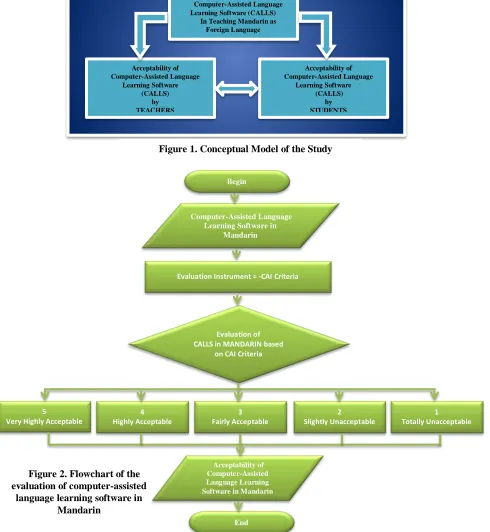
Computer-Assisted Language Learning Software (CALLS)
In Teaching Mandarin as Foreign Language
Acceptability of Computer-Assisted Language
Learning Software (CALLS)
by TEACHERS
Acceptability of Computer-Assisted Language
Learning Software (CALLS)
[image:2.612.133.474.210.364.2] [image:2.612.67.557.228.760.2]by STUDENTS
Figure 1. Conceptual Model of the Study
Figure 2. Flowchart of the evaluation of computer-assisted
language learning software in Mandarin
CONCEPTUALFRAMEWORK
The use of information technology to support teaching, training, learning, entertainment and education in general emerged several decades ago. Educational technologies continue to advance the ways in which we teach and learn. Many claims about the relative value of the educational courseware have been made. Although it has been difficult to prove the advantages of educational software over conventional teaching, training and learning, its use has increased anyway and many attempts have been made to develop instructional courseware products for
different subjects, in a wide variety of educational settings and of course different target groups.
In this context, this study determined the acceptability of the computer-assisted language learning software (CALLS) in teaching and learning Mandarin as foreign language based on CAI evaluation criteria as perceived by the students and the teachers. Figure 1 shows the conceptual model of the study. Figure 2 illustrates the flowchart of the evaluation of computer-assisted language learning software in Mandarin.
Begin
Computer-Assisted Language Learning Software in
Mandarin
Evaluation Instrument = -CAI Criteria
Evaluation of CALLS in MANDARIN based
on CAI Criteria
5
Very Highly Acceptable Highly Acceptable 4 Fairly Acceptable 3 Slightly Unacceptable 2 Totally Unacceptable 1
STATEMENT OF THE PROBLEM
The major concern of the study is to determine the perceived acceptability of Computer-Assisted Language Learning Software (CALLS) in teaching Mandarin.
Specifically, the study sought to answer the following:
1. How may the acceptability of Computer-Assisted Language Learning Software (CALLS) in teaching Mandarin be described among teachers and students?
2. What is the significant difference in the level of acceptability of CALLS between teachers and students?
Ho : There is no significant difference in the level of acceptability of CALLS between teachers and students?
Ha : There is significant difference in the level of acceptability of CALLS between teachers and students?
METHODOLOGY OF THE STUDY
Research Method
The study is descriptive in nature thus; the major concern is to delineate the acceptability of using computer-assisted language learning software (CALLS) in teaching and learning Mandarin in a state university. Specifically, this study utilized survey method. A survey is a data collection tool used to gather information about individuals. A survey may focus on factual information about individuals, or it might aim to collect the opinions of the survey takers. A survey can be administered in a couple of different ways. In one method known as a structured interview, the researcher asks each participant the questions. In the other method known as a questionnaire, the participant fills out the survey on his or her own. This study employed the latter method. Surveys are generally standardized to ensure that they have reliability and validity. Standardization is also important so that the results can be generalized to the larger population. There are many advantages of using survey. Surveys allow researchers to collect a large amount of data in a relatively short period of time. Surveys are less expensive than many other data collection techniques. Surveys can be created quickly and administered easily. Surveys can be used to collect information on a wide range of things, including personal facts, attitudes, past behaviors and opinions.
Participants
This study considered purposive sampling to select the respondents. It is also known as judgmental, selective or
subjective sampling for this sampling type relies on the judgment of the researcher when it comes to selecting the units that are to be studied. The main goal of purposive sampling is to focus on particular characteristics of a population that are of interest, which will best enable the researcher to answer the research questions.
Employing this sampling method, 130 total participants were selected in this study. The respondents were recruited from the classes in Foreign Language (Mandarin) conducted at the Bulacan State University, 1st semester SY 2014-2015. There were 125 student participants. The researcher also tapped a pool of five competent faculty members teaching the subject to use CALLS and scrutinize based on the given criteria. All the selected faculty members passed the international examination for Chinese language proficiency or HSK (Hanyu Shuiping Kaoshi). One passed HSK level 4, two passed level 3, and the other two passed level 2 and currently handling classes in Mandarin.
Instrument
There are seven criteria that were used to determine the acceptability of CALL software used in the Mandarin classes. CALL software was examined in terms of (1) instructional design, (2) program instructions, (3) program transition, (4) user interface, (5) user control, (6) phase control/branching and (7) error handling. There are several indicators for each criterion. The assessment of acceptability of the CALL software was achieved using the five-point Likert scale with corresponding description.
Data Gathering
Several sessions were scheduled for the use of the courseware in various topics in Mandarin. After the scheduled sessions, the faculty courteously allotted time during their classes for the students to participate and allowed them to evaluate the CALL software. Questionnaires were distributed to both the faculty and students. After explaining the criteria and the procedure to evaluate the courseware, the respondents started rating the language learning software. Questionnaires were collected for proper documentation and analysis.
Statistical Tool
DISCUSSION OF THE RESULT
Two sets of data were examined in the study, one from the teachers and the other set from the students.
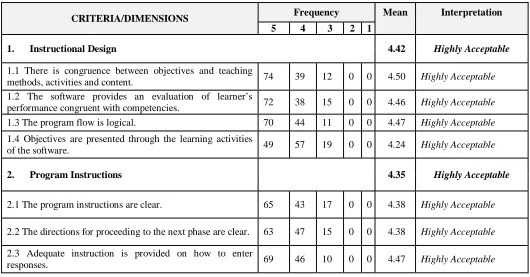
One hundred twenty five students participated in the study. This study group is consisted of 54 females and 71 males. The mean age was 19.50 with the standard deviation of 2.213. For the result of the evaluation, the means and interpretations for each indicator are shown in Table 1 Summary of Survey Responses of the Students. There are seven criteria/dimensions each with four indicators. The first dimension, instructional design, garnered the mean rating of 4.42 with all the four indicators yielding the same evaluation of “highly acceptable”. For the program instructions, 4.35 rating was obtained interpreted also as “highly acceptable”. In terms of the third criterion which is program transition, the students rated it 4.45 which can also be described as “highly acceptable”. In terms of user-interface and user-control, the students seemed these both”very highly acceptable” having the ratings of 4.61 and 4.55 respectively. Phase-control/branching dimension is also highly acceptable” with the rating of 4.41. The last dimension, error-handling is “very highly acceptable” since it obtained the mean rating 4.57. The overall mean of 4.48 indicates that the students perceived that the CALL software in Mandarin is “highly acceptable” and it is a valuable learning supplement.
Correspondingly, five teachers handling foreign language classes in Mandarin participated in this study, one male and four females. All the selected faculty members are credible and experienced in this field since they all passed the international
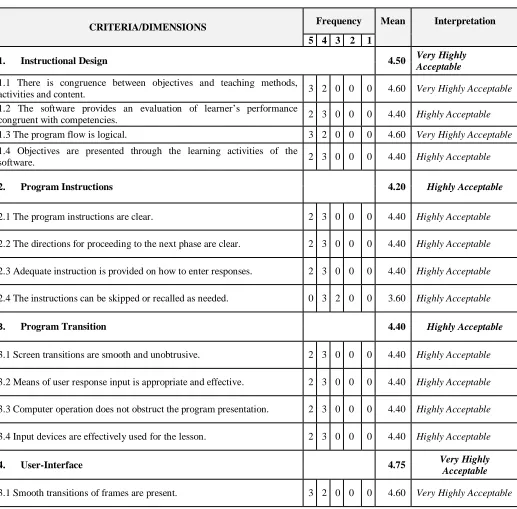
examination for Chinese language proficiency or HSK (Hanyu Shuiping Kaoshi). One passed HSK level 4, two passed level 3, and the other two passed level 2 and currently handling classes in Mandarin as foreign language. The results of their ratings were tabulated as presented in Table 2 Summary of Survey Responses of the Teachers.
The teachers seemed that the first dimension is “very highly acceptable”, 4.50. They considered that there is congruence between objectives and teaching methods, activities and contents and that the program flow is logical. On the other hand, the next two dimensions garnered the same descriptive rating as in the students’ evaluation. They both find CALLS “highly acceptable” in terms of program instructions and program transition. The teachers rated these dimensions 4.35 and 4.45 respectively. Similarly, user-interface dimension garnered the highest rating from the teachers, 4.75. Students and teachers both recognized the importance of graphics in learning motivations. User-control, 4.40 and phase-control/branching, 4.35 were both regarded “highly acceptable” by the teachers. With regards to error-handling, teachers, just like the learners, observed that the software is “very highly acceptable” giving it the rating of 4.55. The overall mean of 4.45 for the teachers’ evaluation proves that the faculty respondents regarded the computer-assisted language learning software as “highly acceptable” in teaching foreign language.
The overall means 4.48 and 4.45 which were obtained from the students and teachers’ evaluation respectively, both has the descriptive interpretation of “highly acceptable”.
[image:4.612.39.569.458.735.2]
Table 1. Summary of Survey Responses of the Students
CRITERIA/DIMENSIONS Frequency Mean Interpretation
5 4 3 2 1
1. Instructional Design 4.42 Highly Acceptable
1.1 There is congruence between objectives and teaching
methods, activities and content. 74 39 12 0 0 4.50 Highly Acceptable 1.2 The software provides an evaluation of learner’s
performance congruent with competencies. 72 38 15 0 0 4.46 Highly Acceptable 1.3 The program flow is logical. 70 44 11 0 0 4.47 Highly Acceptable
1.4 Objectives are presented through the learning activities
of the software. 49 57 19 0 0 4.24 Highly Acceptable
2. Program Instructions 4.35 Highly Acceptable
2.1 The program instructions are clear. 65 43 17 0 0 4.38 Highly Acceptable
2.2 The directions for proceeding to the next phase are clear. 63 47 15 0 0 4.38 Highly Acceptable
2.3 Adequate instruction is provided on how to enter
2.4 The instructions can be skipped or recalled as needed. 51 43 31 0 0 4.16 Highly Acceptable
3. Program Transition 4.45 Highly Acceptable
3.1 Screen transitions are smooth and unobtrusive. 65 45 15 0 0 4.40 Highly Acceptable
3.2 Means of user response input is appropriate and
effective. 67 49 9 0 0 4.46 Highly Acceptable
3.3 Computer operation does not obstruct the program
presentation. 72 41 12 0 0 4.48 Highly Acceptable
3.4 Input devices are effectively used for the lesson. 71 39 15 0 0 4.45 Highly Acceptable
4. User-Interface 4.61 Very Highly Acceptable
3.1 Smooth transitions of frames are present. 85 31 9 0 0 4.61 Very Highly Acceptable
3.2 The graphics, sounds and videos serve a clear purpose
appropriate to intended audience. 92 23 10 0 0 4.66 Very Highly Acceptable
3.3 Background and text color are appropriately combined. 81 33 11 0 0 4.56 Very Highly Acceptable
3.4 The sentence and vocabulary are suited for the
comprehension level of the learner. 85 34 6 0 0 4.63 Very Highly Acceptable
5. User-Control 4.55 Very Highly Acceptable
5.1 Adequate time to read and absorb text is provided if not
user controlled. 77 38 10 0 0 4.54 Very Highly Acceptable
5.2 Users can restart the program at any point where they left
off. 71 44 10 0 0 4.49 Highly Acceptable
5.3 User can easily exit the program at any time. 91 27 7 0 0 4.67 Very Highly Acceptable
5.4 User cannot get lost in the program. 80 26 19 0 0 4.49 Highly Acceptable
6. Phase-Control/Branching 4.41 Highly Acceptable
6.1 Program assesses content of responses rather than their
form. 50 41 34 0 0 4.13 Highly Acceptable
6.2 Program branches when user is recurrently encountering
error. 73 26 26 0 0 4.38 Highly Acceptable
6.3 When appropriate, program allows a variety of answers
as being correct. 65 48 12 0 0 4.42 Highly Acceptable
6.4 Program does not give negative feedback for incorrect
responses. 99 16 10 0 0 4.71 Very Highly Acceptable
7. Error –Handling 4.57 Very Highly Acceptable
7.2 There is no unexpected interruption due to wrong entries. 80 26 19 0 0 4.49 Highly Acceptable
7.3 User entry errors are handled with promptness. 95 30 0 0 0 4.76 Very Highly Acceptable
7.4 Incorrect entries will not cause the program to hang. 78 28 19 0 0 4.47 Highly Acceptable
OVERALL MEAN 4.48 Highly Acceptable
[image:6.612.48.565.223.732.2]
Table 2. Summary of Survey Responses of the Teachers
CRITERIA/DIMENSIONS Frequency Mean Interpretation
5 4 3 2 1
1. Instructional Design 4.50 Very Highly
Acceptable
1.1 There is congruence between objectives and teaching methods,
activities and content. 3 2 0 0 0 4.60 Very Highly Acceptable
1.2 The software provides an evaluation of learner’s performance
congruent with competencies. 2 3 0 0 0 4.40 Highly Acceptable
1.3 The program flow is logical. 3 2 0 0 0 4.60 Very Highly Acceptable
1.4 Objectives are presented through the learning activities of the
software. 2 3 0 0 0 4.40 Highly Acceptable
2. Program Instructions 4.20 Highly Acceptable
2.1 The program instructions are clear. 2 3 0 0 0 4.40 Highly Acceptable
2.2 The directions for proceeding to the next phase are clear. 2 3 0 0 0 4.40 Highly Acceptable
2.3 Adequate instruction is provided on how to enter responses. 2 3 0 0 0 4.40 Highly Acceptable
2.4 The instructions can be skipped or recalled as needed. 0 3 2 0 0 3.60 Highly Acceptable
3. Program Transition 4.40 Highly Acceptable
3.1 Screen transitions are smooth and unobtrusive. 2 3 0 0 0 4.40 Highly Acceptable
3.2 Means of user response input is appropriate and effective. 2 3 0 0 0 4.40 Highly Acceptable
3.3 Computer operation does not obstruct the program presentation. 2 3 0 0 0 4.40 Highly Acceptable
3.4 Input devices are effectively used for the lesson. 2 3 0 0 0 4.40 Highly Acceptable
4. User-Interface 4.75 Very Highly
Acceptable
3.2 The graphics, sounds and videos serve a clear purpose appropriate to
intended audience. 4 1 0 0 0 4.80 Very Highly Acceptable
3.3 Background and text color are appropriately combined. 4 1 0 0 0 4.80 Very Highly Acceptable
3.4 The sentence and vocabulary are suited for the comprehension level of
the learner. 4 1 0 0 0 4.80 Very Highly Acceptable
5. User-Control 4.40 Highly Acceptable
5.1 Adequate time to read and absorb text is provided if not user
controlled. 2 3 0 0 0 4.40 Highly Acceptable
5.2 Users can restart the program at any point where they left off. 1 4 0 0 0 4.20 Highly Acceptable
5.3 User can easily exit the program at any time. 5 0 0 0 0 5.00 Very Highly Acceptable
5.4 User cannot get lost in the program. 0 5 0 0 0 4.00 Highly Acceptable
6. Phase-Control/Branching 4.35 Highly Acceptable
6.1 Program assesses content of responses rather than their form. 1 4 0 0 0 4.20 Highly Acceptable
6.2 Program branches when user is recurrently encountering error. 1 4 0 0 0 4.20 Highly Acceptable
6.3 When appropriate, program allows a variety of answers as being
correct. 0 5 0 0 0 4.00 Highly Acceptable
6.4 Program does not give negative feedback for incorrect responses. 5 0 0 0 0 5.00 Very Highly Acceptable
7. Error –Handling 4.55 Very Highly
Acceptable
7.1 Program effectively traps inappropriate user entries. 3 2 0 0 0 4.60 Very Highly Acceptable
7.2 There is no unexpected interruption due to wrong entries. 1 4 0 0 0 4.20 Highly Acceptable
7.3 User entry errors are handled with promptness. 5 0 0 0 0 5.00 Very Highly Acceptable
7.4 Incorrect entries will not cause the program to hang. 2 3 0 0 0 4.40 Highly Acceptable
OVERALL MEAN 4.45 Highly Acceptable
Legend:
FINDINGS
The major concern of the study is to determine the perceived acceptability of Computer-Assisted Language Learning Software (CALLS) in teaching Mandarin. The study sought to answer the two specific questions. Based on the methods and techniques implemented on this study, the following findings are being presented:
(1) How may the acceptability of Computer-Assisted Language Learning Software (CALLS) in teaching Mandarin be described among teachers and students?
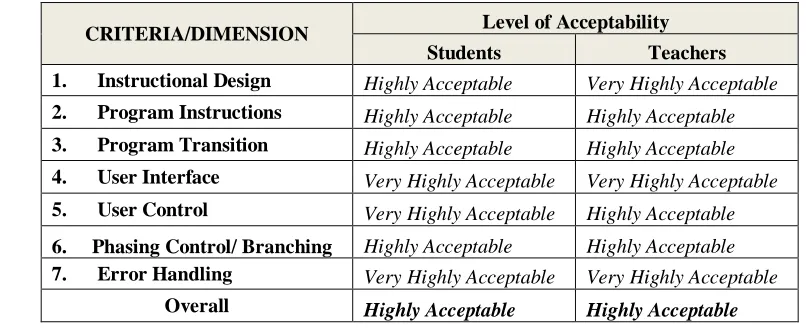
Table 3 presented the comparison of the descriptive interpretation for the students and teachers’ evaluation on the acceptability of CALLs in Mandarin.
The result of the survey shows that the students and the teachers almost have the same level of acceptance in five out of seven dimensions. They only vary in the level of acceptability in terms Instructional Design and
User Control criteria. The students rated the first dimensions as “highly acceptable” while the teachers rated it “very highly acceptable”. Pertaining to the fifth dimension, the students more likely appreciate the user control feature than the teachers.
(2) What is the significant difference in the level of acceptability of CALLS between teachers and students?
[image:8.612.73.477.400.566.2]
As shown in Table 3. Comparison of the Students and Teachers’ Evaluation of CALLS in Mandarin, the overall interpretation for both the students and teachers’ evaluation garnered the descriptive rating of “highly acceptable”.
Hence, this attests that there is no significant difference in the level of acceptability as perceived by the students and the teachers. This proves that both the learners and the teachers seemed that CALLS in Mandarin can be effectively utilized in teaching and learning Mandarin in Foreign Language subject.
Table 3. Comparison of the Students’ and Teachers’ Evaluation of CALLS in Mandarin
CRITERIA/DIMENSION Level of Acceptability
Students Teachers
1. Instructional Design Highly Acceptable Very Highly Acceptable
2. Program Instructions Highly Acceptable Highly Acceptable
3. Program Transition Highly Acceptable Highly Acceptable
4. User Interface Very Highly Acceptable Very Highly Acceptable
5. User Control Very Highly Acceptable Highly Acceptable
6. Phasing Control/ Branching Highly Acceptable Highly Acceptable
7. Error Handling Very Highly Acceptable Very Highly Acceptable
Overall Highly Acceptable Highly Acceptable
.
CONCLUSIONS
Based on the findings of this study, several conclusions were drawn. Adopting the locally constructed evaluation instrument, Computer-assisted language learning software in Mandarin language is “highly acceptable” as perceived by the students as well as the teachers in the Bulacan State University. CALL software is generally rated, by both the students and the teachers as highly acceptable in terms of (1) instructional design, (2) program instructions, (3) program transition, (4) user interface, (5) user control, (6) phase control/branching and (7) error handling. The respondents also positively considered that
CALLS can be used as teaching and learning supplement which primarily motivates learner through the effective use of graphics, animations and other interface elements.
RECOMMENDATIONS
Recommendations are presented based on the conclusions and findings of the study. It is recommended that CALLS in Mandarin be used as teaching and learning supplement in foreign language classes. It is also recommended that the access for the software be available at the reading centers and library for reference purposes. Future researchers may use this study as reference for conducting further researches regarding the effectiveness of the CALLS or develop more interactive and well-enhanced CALLS which will take full advantage of the use of various multimedia elements. Hence, the current study is very limited for it only focused on the acceptance and satisfaction level of foreign language students and teachers in one college. The future researchers may conduct related studies which will cover a broader aspect to which the CALLS can be maximized in providing optimal language learning.
REFERENCES
[1] Bin Zou (Xi’an Jiaotong-Liverpool University, China), Minjie Xing (University of Manchester, UK), Yuping Wang (Griffith University, Australia), Mingyu Sun(University of Wisconsin - Milwaukee, USA) and Catherine H. Xiang (The London School of Economics and Political Science, UK). 2013. “Computer-Assisted Foreign Language Teaching and Learning: Technological Advances”. http://www.igi-global.com/book/computer-assisted-foreign-language-teaching/69859 [2] Ellis, R The study of second language acquisition. Oxford applied
linguistics. OUP 2004
[3] Godwin-Jones, Robert (2005). EMERGING TECHNOLOGIES Skype and Podcasting: Disruptive Technologies for Language Learning. Language Learning & Technology http://llt.msu.edu/vol9num3/emerging/
[4] Kawabata, Takako (2006). The Use of Computer-assisted Language Learning. Aichi Gakuin University
[5] Levy, M. (1997). CALL: Context and Conceptualisation. Oxford: Oxford University Press.
[6] McMurry, Benjamin L., "Evaluation in Computer-Assisted Language Learning" (2012). Brigham Young University. All Theses and Dissertations. Paper 3306
AUTHORS
First Author – Josephine R. Bayonito, Associate Professor, College of Information and Communications Technology, Bulacan State University, Philippines, [email protected].
.