Citation:
Griggs, VM and Rae, J and Lawless, A and Holden, R (2013) Reflective Practice: A Critical Perspective on the complexities of transfer. In: 6th Annual Conference Critical Perspectives on Professional Learning, 17 Jun 2013, Leeds, UK.
Link to Leeds Beckett Repository record: http://eprints.leedsbeckett.ac.uk/1506/
Document Version:
Conference or Workshop Item
The aim of the Leeds Beckett Repository is to provide open access to our research, as required by funder policies and permitted by publishers and copyright law.
The Leeds Beckett repository holds a wide range of publications, each of which has been checked for copyright and the relevant embargo period has been applied by the Research Services team.
We operate on a standard take-down policy. If you are the author or publisher of an output and you would like it removed from the repository, please contact us and we will investigate on a case-by-case basis.
Reflective Practice: A Critical Perspective on the complexities of transfer Vivienne Griggs¹, Jan Rae², Rick Holden³, Aileen Lawless³, ,
Leeds Metropolitan University ¹, London Southbank University², Liverpool John Moores University³, ,
United Kingdom Introduction
Recent high profile management and organisational failings (the BBC; Mid-Staffs NHS Trust; News of the World) raise the question: ‘Could such management failings have been avoided?’ The sine qua non of reflective practice is its promise of ongoing
purposeful learning in relation to changing and demanding professional work. It also carries the promise that organisations may be able to harness reflective practice to manage change ethically, justly and humanely. Aligned to this notion, reflection and reflective practice are regarded by many as essential components of professional
practice (see for example, Bradbury et al, 2010; Finlay, 2008). It follows that
reflective learning is seen as an essential underpinning of both initial and continuous professional development (CPD). This is widely recognised and consequently taught on many professional post-graduate programmes e.g. nursing, social work and increasingly, in more recent years, within management (see, for example, Gray, 2007). However, at a time when the discourse of evidence based practice holds such sway there is minimal research that robustly demonstrates its effectiveness.
Fundamentally the evidence of the extent and nature of the transfer of learning into the workplace and its sustainability within ongoing professional development is both patchy and indicative of impoverished and prescriptive outcomes (Woodall, 2006; Mann et al, 2007).
This working paper reports on the development of a research initiative to address such concerns by investigating the transfer of reflective learning. It explores the impact of our efforts to teach reflective learning and reflective practice and the nature and extent of reflective practice beyond the classroom. The project started in
September 2012 and this paper discusses progress to date. It unfolds as follows: firstly we briefly position the issue in relation to other research in this field; the
both the tutors’ perspective in the analysis of our current teaching practice and
through the student discourse about reflective practice. Issues relating to transfer are then examined in three areas, namely, the learner characteristics, the training design factors and the work environment. This is followed by a brief discussion of the implications of our findings thus far, which suggest a potential dissonance in alignment between the aspirations of tutors, students, employers and the
professional body. This initial stage of research identifies issues that need further exploration, in particular the extent to which competing perspectives can impact on the teaching, assessing and transfer of reflective practice.
Reflective Learning and Reflective Practice
As a key component of many professional courses reflective learning is claimed to
improve both depth and relevance of learning for individuals (Moon, 2004). The concept is captured in the following statement, ‘Reflection involves thinking about
past or ongoing experience of events, situations or actions so as to make sense of them, potentially with a view to informing future choices, decisions or actions.’
Reynolds (2011, p.5). Consequently, the aim of teaching reflective learning is to develop reflective practitioners, which resonates with the work of Schon (1983), whose concept of ‘reflection-in-action’ is central to notions of a reflective practitioner.
Boud and Hager (2010) identify a type of reflective practice which they label ‘technical’ or ‘instrumental’ reflection and locate this in an acquisition and transfer
model of cpd. Notions of critical reflection go further, Rigg and Trehan (2008) define this as follows: ‘Critical reflection engages participants in a process of drawing from critical perspectives to make connections between their learning and work
experiences, to understand and change interpersonal and organisational practices.’
(p.374).
Increasingly the teaching of reflection is recognised as problematic and challenging, both within the professions generally (Bradbury et al, 2010) and more specifically within the HR and management fields (e.g. Corley and Eades, 2004; Rae and
(Halton, 2007). Professional bodies, or indeed workplaces, which require little more than a yearly update on courses attended hardly provides the context or
encouragement for the application and transfer of a more demanding and, potentially, more valuable form of reflective practice. Working through similar
tensions Rigg and Trehan (2008) ask if critical reflection in the workplace is just too difficult. Whilst the focus of their research is teaching reflective practice in a
corporate context, their findings are nonetheless important for highlighting such issues as organisational power relations and culture as significant constraints relating to application and transfer.
In a similar vein Russell (2006) asks whether indeed reflective practice can be taught. He concludes “The results of explicit instruction seem far more productive than simply advocating reflective practice ....”. However the important word here is ‘seems’ as the evidence base is thin and anecdotal. From a heath care perspective
Mann et al, (2007), for example, note that the evidence to support and inform reflective practice curriculum interventions “remains largely theoretical”, whilst Cole
(2010, p129) is emphatic in his identification of research failings:
At a time when the discourse of evidence based practice holds such sway there is very little in the way of research that robustly demonstrates its effectiveness.
In order to explore this further, we turn to the literature on transfer of learning, to identify the component which may support the transfer of this challenging activity.
Transfer of Learning
The concept of a reflective practitioner implies an approach to work that includes an inherent transfer of the learning to the workplace. Baldwin and Ford (1988, p.64) define positive transfer of learning as ‘the degree to which trainees effectively apply the knowledge, skills and attitudes gained in a training context to the job’. It
material from the learning context to the workplace. The basis of their model is that transfer is influenced by three areas, namely: the trainee characteristics, the training design factors and the work environment. Later work (for example, Holton, 2005) supports these themes, identifying the impact of motivation, ability and
environmental factors as key to transfer of learning. These factors will be explored in more detail later in the discussion.
Methodology and Methods
To investigate the complexities of transfer the project is pursuing a methodological strategy which is participative, inter-active and engaging. Action research enables us to meet this aspiration. Whilst the goal of an action research enquiry is principally the pursuit of practical solutions to issues of concern a key characteristic is that the
researchers are not separate or independent from the problem. We see both students and academics becoming ‘practitioners-as-researchers’ (Bensimon et al,
2004). This said, the problem of the transfer of reflective practice from the HE classroom into the workplace clearly embraces a wider group of stakeholders such as employers, professional bodies. Thus, as part of our methodology, the pursuit of a triangulation (students, teachers, employers / professional bodies) of data sources (Mills, 2003) will be central to the project.
The first phase of the research, which is reported here, has included an explorative open – ended questionnaire, with students (N=60) a series of critical research
conversations between the collaborating researchers and a detailed analysis of formal course documentation. Subsequent phases will involve dialogue with a wider range of stakeholders.
The research is set within the professional education provision of ‘HR, ‘HRM’ and ‘HRD’ within the three universities. In our earlier work, Holden and Griggs (2011)
noted that the challenges of teaching reflective practice, whilst not peculiar to the HR profession, assume poignancy given the unique interest and stake in workplace
independent from the problem. An action research enquiry enables us to pursue a collaborative research study where ultimately we are seeking practical solutions to issues of concern. The initial analysis was undertaken using Wordle, which enabled the identification of a number of themes; further content analysis then took place, working on the initial responses, recoding and referring back to the themes identified through Wordle where appropriate. Subsequent phases of the research will be informed by these emerging themes which will lead to specific interventions within the curriculum, an analysis of assessed student work and a number of exploratory interviews with a wider range of stakeholders.
Findings
In order to review issues pertaining to transfer of reflective practice, we needed to initially answer two key questions: firstly, what do we mean by reflective practice?
and, secondly how do we measure it? These questions are addressed from both the tutors’ perspective in the analysis of our current teaching practice and through the
student discourse about reflective practice. Focusing then on issues of transfer, these will be examined in the three areas specified by Baldwin and Ford’s (1988) model, namely, the trainee characteristics (although we use ‘learner’ for our
educational context rather than trainee), the training design factors and the work environment. This is followed by a brief discussion of the implications of our findings thus far and deliberation on the future development of the research.
What is Reflective Practice?
The Tutor Perspective
Before we could explore transfer to the workplace, we had first to explore the concept of reflective practice from our own perspectives and establish some common understanding and identification of differences. Whilst there were
differences in any specific conceptual anchors, all three institutions share a broadly
- someone who learns about themselves and develops an understanding of self
(vis others)
- someone who is comfortable critiquing behaviour (self and others in relation to
self)
- someone who identifies and questions assumptions
- someone who does not look at events and experience in isolation but sees or
tries to see the bigger picture
- someone who has developed a level of criticality in relation to themselves and
the world they live in
There was also agreement that reflective practice requires ‘conscious activity’ (cf Schon’s reflection in action, 1983). Hence reflective space is needed and a
deliberate set of reflective learning activities pursued. However, differences exist as to the extent to which reflective practice needs to involve ‘writing’ or whether it can
remain a largely cognitive exercise provided the so-what question is addressed; that is, the reflective practice process is not complete unless some action results from it (although to what extent this action needs to be tangible and able to be seen
remained unclear).
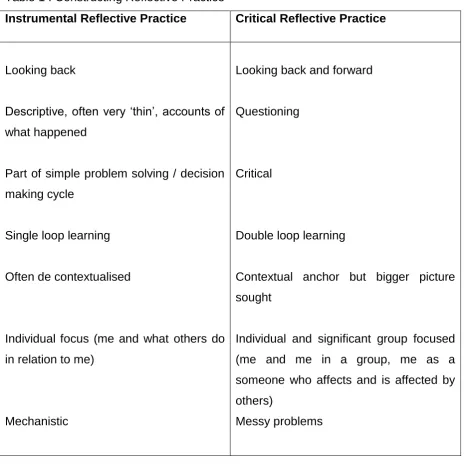
Table 1 : Constructing Reflective Practice
Instrumental Reflective Practice Critical Reflective Practice
Looking back
Descriptive, often very ‘thin’, accounts of
what happened
Part of simple problem solving / decision making cycle
Single loop learning
Often de contextualised
Individual focus (me and what others do in relation to me)
Mechanistic
Looking back and forward
Questioning
Critical
Double loop learning
Contextual anchor but bigger picture sought
Individual and significant group focused (me and me in a group, me as a someone who affects and is affected by others)
Messy problems
Thus, rhetorically at least, all institutions aspire to develop depth in student’s
reflective learning, aiming to move learners from simple, or instrumental reflecting to taking a more complex or critical perspective, and utitlising a variety of reflective frameworks to achieve this aim. Thus, for example, one course team utilised a framework with five levels (reporting, responding, relating, reasoning and
in the next section, through consideration of how students were beginning to think about, frame and understand reflective learning and reflective practice
The Student Perspective
In response to the question ‘What does the term ‘reflective practice’ mean to you?’ a
range of responses were produced, although there was some general consensus, the most common terms used being: looking back, what went well, do differently, practice, future and situations. Perhaps not surprisingly, given that the majority of the respondents were professional part-time students, the primary purpose of reflection was to support organisational effectiveness, and develop skills relating to ‘best practice’, with improvement as a dominant theme.
Thus, two typical responses reported reflective practice as the activity of,
... assessing my performance again pre-determined goals/targets and deciding upon a new way forward
and
... looking back on what you have done and seeing what went wrong, and what can be done better
Importantly, what the findings also illustrate is the clustering of responses around an individualistic perspective ; we illustrate this with three specific student responses:
... thinking about a situation and .... whether it was the best approach (or not) and why and see how you can improve things next time
Undertaking something (maybe in your work role) and then afterwards looking back what you did and how you did it, and thinking about how well it
went/how it could have been improved …
Thus when the students were asked if they had had opportunities to use the skills (of reflective practice) in the workplace, the responses further supported that generally an instrumental and pragmatic approach was being taken.
we implemented a new applicant tracking system – difficult implementation –
needed tweaks and improvements
I would like to apply reflective practice to a real workplace project and new application form.
Tends to be ER issues and policy for example, guidance, is it gross misconduct?
Furthermore, even where a more collective ownership of reflection is acknowledged
the focus remained firmly on specific workplace tasks as illustrated here:
.... when we have had issues with recruitment, we've resolved to identify what could be done next time and if any practices need to be introduced to prevent problem arising again
That is not to say that all students took this view – one student had taken a more ‘critical’ approach, that is, questioning assumptions, providing:
challenging the CEO viewpoint on organisational culture (successfully)
as an example of applying reflective practice and another cited ‘share and learn’
How do we measure reflective practice?
In order to assess whether transfer of learning has taken place we need to have some way of measuring what that practice looks like. Whilst some authors question if we should even seek to assess such practice (Bourner, 2003; Betts, 2004),the
requirements of the curriculum makes assessment a requirement. There was agreement by teaching teams that if the process of teaching and learning reflective practice is difficult, so is its assessment, particularly given the potentially different constructs provided by students and teaching teams. Furthermore, students are at different points in a cpd journey and if the assignment genuinely seeks to assess the individual’s application of reflective learning then this is a unique piece of work, but
any assessment criteria and/or marking scheme has to accommodate unique applications within clearly identified standards of performance. The work of Bain(1999), Moon(2004), Reynolds(1998) do help develop distinctions in different
levels of attainment in relation to reflective practice and these can be utilised (both within teaching and within any marking criteria) but this does not provide a simple user guide that avoids difficult problems of interpretation of student work.
However, there is broad agreement across the institutions that, although difficult, assessment of reflective practice is possible and thus provides something of a proxy measure of transfer. This assessment is assisted by
- the ‘anchor’ of the workplace (the context in which students are attempting to apply their reflective practice skills); or at very least ‘real’ situations
- a coherence between teaching programme and assignment brief
- students being taught the skills of reflective practice
- ownership and control remaining close to originators’ and designers’ of a module underpinned by reflective practice
All three universities use a variation on the requirement for students to produce a reflective portfolio, and, while specificity of instructions, such as length of the
However, the extent to which assessment is an accurate measure of transfer is open to challenge and two students suggested that the artificial nature of being forced to reflect for an assessment acted as a hindrance rather than an enabler of their reflective practice efforts.
[the assessment] forces me to reflect the way the college wants me to think and [therefore] not be honest.
Most people make up their college reflective work.
Although this comment was not typical, it leads to further questioning of the
appropriateness of a written assessment as a proxy for transfer and highlights the issue noted earlier of the individuality of reflective practice. While it is noted that there is a reliance on self-reported data rather than more objective measures of
transfer, nevertheless this initial stage of analysis highlights the tensions and ambivalence contained within the process of developing reflective practice skills within a formally assessed curriculum.
Thus, having explored how reflective practice is constructed and measured, we explore the transfer of learning factors identified earlier.
Trainee Characteristics
As all participants were on an approved Chartered Institute of Personnal and Development (CIPD) the emphasis on improvement and increasing organisational effectiveness was not surprising, given the CIPD understanding of the purpose of reflection as shown in Table 2, below.
Continuous Professional Development
Why is it important for me to reflect on my learning?
o To accept responsibility for your own personal growth.
activity and the benefits you get out of it.
o To help you see more value in each learning experience, by knowing why you’re doing it and what’s in it for you.
o To help you 'learn how to learn' and add new skills over time.
http://www.cipd.co.uk/cpd/aboutcpd/reflectlearn.htm
Table 2 : CIPD Guide to CPD
In terms of learner motivation, the students are generally working in HR and taking
the course to achieve professional accreditation by the CIPD. This is seen as an essential route to career progression in Human Resources. Our experience suggests some students are uncomfortable with the self-examination required for reflection and prefer modules with a focus on conventional knowledge. Many students are beginning their careers and working at relatively low levels within their organisations, which can compound their level of conformity and reluctance to challenge
established practices and power bases in their organisations. The intrinsic factors they cite in developing reflective practice skills provide an insight into their ability and self-efficacy. Their dialogue refers to the following factors as barriers: lack of
knowledge, poor time management skills, finding it difficult and struggling to analyse their own feelings, lack of understanding of both how to reflect and the importance of doing so, difficulty balancing workload and learning, lack of confidence, finding it hard to accept they have done a good job. Intrinsic enablers were somewhat more surprising, including issues such as anger-management and self-control as well as the more apparent self-awareness and understanding the value of reflection.
Interestingly, at one of the universities, for some students the response to the question about barriers to reflective learning indicated that they interpreted this question as being solely related to the development of their assessed reflection. This would suggest that they viewed reflection as being an ‘academic' exercise for the
purposes of assessment and, while they valued the skills development, and would
transfer those skills back to the workplace, the process of learning about reflection was of less significance.
The CIPD figure prominently in all three universities’ endeavours to address a
reflective learning curriculum, and, as the guardians of professional standards, the CIPD is influential in curriculum design and development. Reflective learning is located within the Business Skills part of the professional curriculum where a
distinctly ‘business’ orientation is evident. Whilst each course team has a degree of
freedom to determine how best to meet curriculum objectives we acknowledge the challenge of teaching reflective learning within a primarily functionalist management curriculum and in the context of a professional body perspective which may implicitly discourage and restrict critical reflection. The CIPD view of reflection might be
characterised as more instrumental rather than critical reflection as in Table 1 above. However, in contrast to this view, all of the institutions described a critical management philosophy underpinning their approach to critical reflection, revealing an evident tension here between the CIPD requirement for reflection to support students’ cpd (as noted in Table 2 above) and the tutors’ requirements for greater
depth and criticality.
The CIPD Developing Skills for Business Leadership requires assessment by a portfolio. Leeds and South Bank have taken steps to develop a module where reflective practice provides the underpinning for other skill areas which individual students might wish to pursue. The word ‘embedded’ is used. Here there is
agreement that the best way to assess is via some form of reflective portfolio / statement. Importantly this enables the student to use him/herself as the focal point of the reflection.. There is a strong recognition that if assessment is via a reflective portfolio then students need the skills of reflective practice. To some extent the situation at Liverpool is that students are expected to produce a reflective portfolio yet the time spent on reflective practice skills is accorded no more weight than that devoted to finance or IT skills.
More specifically, teaching and learning strategies in all three institutions reflect an attempt to develop the skill of reflection, not just theories about or an understanding of, reflection. Models, for example, Gibbs (1988) underpin teaching but with a clear focus upon the development of practice skills rather than simply knowledge
placed on techniques of or instruments of refection (learning log, diary, critical incident etc.) and while our dialogic discussions suggested opportunities for students to practice engaging in reflection (e.g. critical friend) has impact, this remains tentative and unsubstantiated.
The attempts to teach reflective practice skills were also illustrated in the students’
responses, noting some design factors which they felt supported the transfer of reflective practice. Respondents appeared to draw on a reasonably wide range of techniques to support their reflection which suggested input in class had provided a range of techniques which could be put to use; thus a number of ‘tried and tested’
learning techniques were cited, including learning cycles, the Johari window, MBTI, and similar self assessment activities. In addition, tutor feedback and support were regularly cited. One respondent reported ‘practising in a safe environment’, although
further exploration would be needed to consider whether this referred to skills
development or reflection (or both!). Role-plays, coaching session, tutor feedback, skills workshops and examples of best practice, provide an illustration of the types of activity that they perceived supported their learning.
It should be noted that formal module and programme evaluation provides very little in the way of meaningful data on the extent and nature of any transfer of learning, and, not uncommonly, none of the institutions engage in any post-programme evaluation. However, to varying degrees tutors agreed that the reflective portfolio provided some proxy measure of transfer of reflective learning/practice skills beyond the classroom (if not beyond the programme). Hence, student work does have the potential to make comparative assessments of impact and transfer across the three institutions.
A number of variables in module design emerge from these findings that warrant further investigation. These include the conceptual underpinning and teaching model, the relationship of teaching and assessment, the location on the programme and the ownership and control of the module.
Turning then to the final factor in Baldwin and Ford’s (1988) model, that of the
workplace. From the student perspective, as noted earlier, there was confirmation that for at least some students there are issues at work upon which they feel they can apply such learning, for example
[I have reflected on] large-scale projects whereby coordination of
business/other teams is key and can often be dealt with more efficiently if reviewed properly i.e. salary review for 1400 staff
A number of work place practices were noted where students consider reflection is most appropriately positioned, for example, appraisals, personal development plans and records, project management meetings. Similarly, some respondents felt their workplace had helped them develop reflective practice skills. They referred to
enablers such as, support from co-workers, discussions with their line manager, and reviewing with colleagues. Perhaps the most encouraging was one student who said
they saw reflection as an essential part of their job.
However, other students identified tensions within the workplace which presented difficulty in applying their learning:
... other things need to be completed following meetings i.e. letters, action plans
I find it hard to analyse feelings at work…it’s just difficult
Increased pressure to focus on measurable outcomes
I've reflected on work situations but mainly in my own time
The most commonly cited barrier was time factors, but there is clearly a need to probe further the exact nature of this perceived barrier and the extent to which it may be a convenient ‘easy’ response to a more complex problem as regards transfer.
experiences at work or not always the opportunity to reflect immediately after an event or that the environment at work was generally unsupportive of such activity.
From the current analysis sustainability remains the great unknown. All of the tutors agree that for the student who really ‘gets it’, where it has made a real difference the changes will endure. If it’s a different way of thinking, a different way of being, then
this should be evident in practice beyond the course. But there is difference in the belief about module impact, the more positive belief being that :
you can’t expose someone to that and it goes away…it will emerge at some point’,
compared with
‘most students don’t get it….it’s just one of the things they forget about once course is finished’.
It should however be noted that much of the data was generated from students in the early stages of the programme, and furthermore, as noted previously, was
self-generated. Perspectives over time (past students) and from other viewpoints (employers) will be pursued in later phases of the project to explore this issue in more depth and with a wider range of stakeholders.
Discussion
The data collected in the initial phase of this research raises a question about the requisite outcomes and expectations of different stakeholders. It could be suggested that the competing discourses of performance based reflection and critical
management reflection impedes rather than supports transfer. Corley and Eades (2006) suggest the language of critical education challenges other discourses in management and management learning, and Hagen et al (2003), in their review of teaching critical management to a group of MBA students, made significant changes
the professional body, the students and their employer? Similarly, to what extent is this critical stance appropriate on a business course with a largely functionalist managerial content as opposed to other disciplines such as nursing and social work? Rigg and Trehan (2008, p.375) assert that ‘dissonance is commonly, if not inevitably, generated by critical reflection’ and if critical reflection is not supported or
encouraged in the workplace to what extent is it appropriate for us to generate this dissonance?
This analysis raises further issues that need to be explored if transfer is one of our aspirations. However, it does not necessarily suggest our stance is incorrect merely because it diverges from some of our stakeholders. It has been argued that the majority of mainstream management theory offers descriptive or prescriptive theories which fail to meet managers real needs (Grey, 2005) while critical theory encourages the type of questioning needed to develop questioning insight and learning. Others
(Dehler , 2009) argue that critical management education offers a more appropriate skill set than does the mainstream and prepares managers for complexity,
uncertainty, equivocality, and value conflicts by raising their level of ‘complicated understanding’. However, a central concern for critical HRD is the ‘struggle to
reconcile the needs of the individual and the needs of the employing organisation, the tension between autonomy and community.’ (Elliott and Turnbull, 2003, p. 457).
This may have implications for the way we develop and support learning to
encourage transfer. If as tutors we uphold the need to challenge the performance and managerial standpoint we need to look for ways to facilitate the flow of learning and develop a common language with the workplace (see for example, Corley and Eades, 2006). Equally, we need to support ‘an emerging community of critically reflective practitioners by ensuring an open dialogue about values and practice.’
(Lawless and McQue, 2008, p.323). Crucially, transfer is not just about the
application of learning to the workplace but also the maintenance of learned material over time. Critical reflection may offer greater sustainability for career development because arguably progression cannot be achieved without challenging existing performance norms and this warrants further attention as the research progresses.
such difficulties in transfer of reflective practice are principally ones that alternative teaching and learning strategies might address or whether organisational cultures which deny the value of reflection, or the workplace itself which denies reflective opportunities, are major constraints. We need to explore the extent to which our exhortations to develop reflective practice skills are doomed to fail because a level of routinised and highly prescriptive HR practice may remove the legitimacy of our teaching aspirations.
Conclusion
Our research to date has surfaced a number of interesting issues concerning the transfer and sustainability of reflective practice. We have identified initial themes –
how students and tutors construct the development of reflective practice, the competing expectations of learners, tutors and professional bodies in relation to the
outcomes, and the extent to which the factors impacting on transfer of learning are applicable when what is being transferred is open to different interpretations. All these areas require more depth of exploration.
References
Bain, J., Ballantyne, R., Packer, J. & Mills, C. (1999). Using journal writing to enhance student teachers’ reflectivity during field experience placements. Teachers
and Teaching: Theory and Practice, 5 (1), 51-74
Baldwin, T., and Ford, J., 1988. Transfer of training: A review and directions for future research. Personnel Psychology 41, no. 1: 63–105.
Bensimon, E. M., Polkinghorne, D., Bauman, G., & Vallejo, E. 2004. Doing Research that Makes a Difference. The Journal of Higher Education 75(1): 104-126.
Betts, J (2004), Theology, therapy or picket line? What’s the good of reflective
practice in management education?, Reflective Practice, 5 (2)
Bourner, T. 2003, Assessing reflective learning, Education & Training, 45 (5)
Boud, D. and Hager, P. (2010) Conceptualising continuing professional development: compliance, pedestrianism and decontextualisation of richer notions of learning and practice? Paper presented to the Fourth Professional Lifelong Learning conference, 11 January, University of Leeds
Bradbury. H., Frost, N., Kilminster, S. and Zukas, M. (eds) (2010) Beyond Reflective Practice: new approaches to professional lifelong learning, Abingdon, Routledge
Cole, M. (2011), Rescuing reflection from reflective practice: defining the key skills in reflexivity for health care professionals, Paper presented to the Fourth Professional Lifelong Learning conference, 11 January, University of Leeds
Corley, A. and Eades, E., (2004), Becoming critically reflective practitioners: academics and students’ reflections on the issues involved, Human Resource
Corley,A. and Eades, E. (2006), Sustaining critically reflective practitioners: competing with the dominant discourse. International Journal of Training & Development, 10 (1)
Dehler, G.E. (2009), Prospects and Possibilities of Critical Management Education: Critical Beings and a Pedagogy of Critical Action. Management Learning, 40(1) :31-49
Elliott, C and Turnbull, S. (2003), Reconciling autonomy and community: the paradoxical role of HRD. Human Resource Development International. 6 (4) .
Finlay, L., (2008), Reflecting on ‘Reflective practice’, PBPL paper 52; A discussion
paper prepared for PBPL CETL (www.open.ac.uk/pbpl).
Gibbs, G. (1988) Learning by Doing: a guide to teaching and learning methods, London, FEU
Gray, D.E. (2007) Facilitating Management Learning – Developing Critical Reflection
through Reflective Tools, Management Learning, 38 (5)
Grey, C. (2005), Critical management studies: Towards a more mature politics, In D. Howcroft, E. Trauth (Eds.), Handbook of critical information systems research, Edward Elgar, Cheltenham, UK (2005), 174–194.
Halton, C. Murphy, M. and Dempsey, M. (2007), Reflective learning in social work education: researching student experiences, Reflective Practice, 8 (4)
Holden, R. and Griggs, V. (2011), Not more learning logs! A research based perspective on teaching reflective learning within HR professional education, Human Resource Development International, 14 (4)
Lawless, A. and McQue, L. (2008),Becoming a community of critically reflective HR practitioners. Journal of European Industrial Training, 2008, 32 (5) 323-335
Mann, K., Gordon, J. and MacLeod, A., (2007), Reflection and reflective practice in health professions: a systematic review, Advances in Health Science Education, 14, 595 – 621
Moon,J. (2004), A Handbook of Reflective and Experiential Learning, Routledge Falmer, London.
Rae, J. and Rowland, H. 2012, Using the arts in teaching reflective practice: a case study, 13th International Conference on HRD Research and Practice Across
Europe, Universidade Lusiada de Vila Nova de Familicao, May, 2012
Reynolds, M. (1998) Reflection and critical reflection in management learning, Management Learning, 29 (2), 183-100.
Reynolds, M. (2011) Reflective practice: origins and interpretations. Action Learning:
Research & Practice, 8 (1):5-13, ,
Rigg, C., and Trehan, K., (2008), Critical reflection the workplace: is it just too difficult? Journal of European Industrial Training, 32 (5), 374-384
Hagen, R., Miller, S., Johnson, M. (2003) The disruptive consequences of introducing a critical management perspective onto an MNS programme: the lecturers’ view Management Learning 32 (2), 241-257
Russell, T., (2006) Can reflective practice be taught? Reflective Practice, 6 (2) 199-204
Schön D. The Reflective Practitioner. Temple Smith, London 1983
Woodall, J. (2006), From individual learning to social learning – reframing HRD