Citation:
Stevens, RC and Renshaw, T and Denton, P (2009) ‘Towards understanding engage-ment in games: an eye-tracking study’. On the Horizon, 17 (4). 408 - 420. DOI: https://doi.org/10.1108/10748120910998425
Link to Leeds Beckett Repository record: http://eprints.leedsbeckett.ac.uk/1012/
Document Version: Article
The aim of the Leeds Beckett Repository is to provide open access to our research, as required by funder policies and permitted by publishers and copyright law.
The Leeds Beckett repository holds a wide range of publications, each of which has been checked for copyright and the relevant embargo period has been applied by the Research Services team.
We operate on a standard take-down policy. If you are the author or publisher of an output and you would like it removed from the repository, please contact us and we will investigate on a case-by-case basis.
TOWARDS UNDERSTANDING ENGAGEMENT IN GAMES: AN
EYETRACKING STUDY
AUTHORS
Dr Tony Renshaw1, Mr Richard Stevens1, and *Dr Paul D. Denton2
*Corresponding Author
BIOGRAPHICAL NOTES
1 Innovation North, Leeds Metropolitan University, Headingley Campus, Leeds,
West Yorkshire, UK, LS6 3QS.
Email: [email protected], Email [email protected], Tel: +44 (0) 113 812 0000, Fax: +44 (0) 113 283 3182
2 School of Computing and Engineering, University of Huddersfield,
Queensgate, Huddersfield, United Kingdom, HD1 3DH. E-mail: [email protected], Tel: +44 (0) 1484 473672, Fax: +44 (0) 1484 472252
Dr Tony Renshaw
Dr Tony Renshaw has been involved in research and consultancy using eyetracking and holds a PhD in this area. He has been responsible for the development of new and improved eyetracking metrics. Tony graduated from Loughborough University in Chemistry and Management Studies and has held a variety of senior positions within REACT Centre Limited and the Services Division of ICL. He is now Director of Usability North at Leeds Metropolitan University.
Richard Stevens
Richard Stevens is a Senior Lecturer and Teacher Fellow in the Music, Sound and Performance Academy at Leeds Metropolitan University. As a Composer, Sound Designer, and Sound Artist his work explores the connections between audio and visual perception. His research interests include film sound, sound and music in interactive games, and the use of eyetracking technology for game analysis and interaction.
Paul D. Denton
TOWARDS UNDERSTANDING ENGAGEMENT IN GAMES:
AN EYETRACKING STUDY
SUMMARY ABSTRACT
In today‟s fast moving consumer environment, electronic gaming through consoles, the Internet and Web 2.0 has fundamentally changed the way in which players expect to interact with and gain satisfaction from their media and entertainment sources. This paper aims to report research undertaken in developing improved understandings of games player interaction. The primary scope of this work is limited to obtaining new and unique insights into player involvement and experience within electronic gaming. From analysis using computerised eyetracking solutions, investigations into a range of techniques to determine which in addition, to providing signifiers of satisfaction, engagement or immersion, provide the evaluators with a detailed, re-playable record of how the player has interacted with the game. As well as the immediate applications for play testing this monitoring methodology also allows exploration of aspects related to usability, improved games level learning and recognition of new inherent commercial opportunities.
STRUCTURED ABSTRACT
Purpose – The purpose of this paper is to report research undertaken in developing
improved understandings of games player interaction, with scope limited to obtaining new and unique insights into player involvement and experience within electronic gaming.
Design/methodology/approach – The research presented within this paper is designed to
provide evaluators with a detailed eyetracking approach how a player interacts with a game. The research also explores a variety of techniques designed to explore user/player insights into interaction, through consideration of user satisfaction, engagement or immersion. It is postulated by the authors that from this methodology insights related to usability, improved games level learning commercial opportunities based around in-game advertising, will be better understood.
Findings – Whilst the data analysed in this limited pilot is it is perhaps too early to draw firm
conclusions, it is concluded that it is technically possible to configure the Eye-Tracker and ancillary equipment to record the eye movements of game players. This has uncovered further areas for investigation centred upon skill and experience assessment, together with the important area of key object identification within games.
Practical implications – The methodology presented within this paper shows that the
application of eyetracking solutions can be used to evaluate engagement in games. The findings provide interesting and innovative ways for the games designers and in-game advertisers to improve the gamers‟ experiences.
Originality/value – From an academic perspective, this research is innovative in the way it
has developed a methodology for analysis of player engagement within electronic games. This methodology offers valuable insights into game design improvement and in-game advertising opportunities.
KEYWORDS
INTRODUCTION
At least three factors provide the motivation for academic and enterprise interest in the nature of computer games interaction. Computer games are multimillion pound business; there is growing interest in using games as a vehicle for teaching and learning; and, thirdly interaction with computers permeates our lives both at work and play.
In a rapidly growing global electronic games market, where the US market alone is in valued excess of $7.4 Billion in 2006 (ESA, 2006), new schools of thought point to complementary design features which may create a „positive‟ user experience. Debates centred on learning, satisfaction, engagement and financial business purpose have more recently come to the fore. In a world where physical product designers have recognised for a long time that good product design should also elicit emotional and favourable responses to encourage higher and longer sales, the measurement of technological games interaction will is becoming an important challenge and future industry sustainability key.
Within the UK, the gaming market is the third largest in the world and is worth more than £2 Billion to the UK economy (making a £200 Million positive balance of trade in 2005) (ELSPA, 2005). The average UK adult woman plays games 7.4 hours per week and the average adult man plays 7.6 hours per week. Far from the stereotypical image of the teenage male the average age of a gamer is 33, with 25% of regular gamers over the age of 50 (ESA, 2006). Furthermore, for about 20 or more years games in digital format have been of interest to academics as a means of enabling learning (Hsiao, 2007); one of their strengths being that they are thought to encourage engagement and immersion.
“Enjoyment and fun as part of the learning process are important when learning new tools since the learner is relaxed and motivated and therefore more willing to learn.”
Bisson and Luckner (1996) as cited by Hsiao (2007) p 2
Despite this huge amount of human computer interaction that is taking place there has been little serious research into issues of games design and usability. Several researchers have long argued that usability evaluation needs to go beyond the engineering focus of efficiency and effectiveness stating it is the total user experience that is important (Dillon, 2001; Wright, 2003; Wright and McCarthy, 2004). This is particularly so in the evaluation of games where „fun‟ takes precedence over usability. Successful games are assessed by the degree to which they excite, entertain and challenge; and many researchers in the field have urged that more must be done to explore players‟ experiences and develop evaluation methodologies in order to evaluate the success of techniques deployed (Hsiao, 2007; Marsh, 2007).
How can experience1 be measured? The obvious answer is to ask the players, but when to do this: as they play, risking their distraction from the game or at the end of the game when memories might have already faded or been re-constructed?. Marsh et al (2006) describe how, using a combination of a tool based on activity theory and the automated collection of keyboard/joystick activity, he has been able to analyse player experience whilst playing games. The authors of the current paper describe their approach using eyetracking technology with similar ambitions. The authors believe that eyetracking players whilst they play games with a non-invasive Eye-Tracker may provide some insights into these questions. The nature of the eye, its close links with the brain and models of perceptual mechanisms, make it likely that eye movements have a contribution to make in the assessment of satisfaction. To date researchers involved with the assessment of satisfaction have used
1
interviews and questionnaires (Lindgaard and Dudek, 2003) making the results problematic and subjective as the results obtained may be unreliable due to memory degradation and/or rational reconstruction by the user. An objective measure of satisfaction which cannot be seriously influenced by the user would therefore be a useful addition to the usability evaluator‟s tool box.
Eyetracking is now considered to be a de-facto standard offering from commercial Human Computer Interaction (HCI) organisations and usability consultants. Eyetracking as a technique for measuring physiological responses to visual stimuli has the advantage that responses can be recorded in real time and, using the technology referred to in this paper, is non invasive. Video and audio recordings, overlaid with recordings of eye movements, are captured and can, by means of event time stamping, be integrated with player keyboard activity for subsequent analysis.
Success in achieving the next game level may depend upon the player locating a specific object visually, using such cue detection devices as saliency, movement, shape, colour and position in the presence of distracters. There is a balance to be struck between challenge and frustration, a player becoming „stuck‟. Can an awareness of the player‟s visual interaction with a scene of environment identify problem areas and additionally are there eye movement behaviours that can be correlated to the degree of success a game has in avoiding these frustrating situations?. Renshaw et al (2005) counted the number of eye regressions (back tracks to already seen areas) participants made as they worked with static displays. The results seemed to indicate a potential relationship between the incidence of regressions and satisfaction; they found the lower the number of regressions the higher the level of satisfaction. However, to measure the same things in mobile scenes in games is more complex and will be returned to later as an area of future research in the Research Conclusions section.
In the experiments reported in the current paper it was decided to consider the duration and distribution of fixations. Fixation duration is thought to relate to the cognitive effort being expended; the greater the fixation duration the greater the cognitive effort (Goldberg and Kotval, 1999) whereas, the distribution of fixations may be of interest to those wanting to generate funding for games development through advertising.
evaluate player‟s interaction and provide a foundation for further study and business model refinement.
In order to test the hypotheses and ideas described above it was decided to evaluate the players‟ experiences whilst they played two separate levels of the game „Tomb Raider‟. These levels were chosen because even expert players find it difficult to move onto the next level. It was anticipated that eyetracking may illuminate why this was and that the eye movements may provide indicators of increasing frustration or boredom. Players‟ reaction to both games was captured during play by aurally asking the players how they felt at one minute intervals increasing to once every second in the last 10 seconds of play. Questionnaires were also used to enable triangulation of any eye movement behaviour. The questionnaires captured the expertise and experience of players and their overall level of satisfaction with the last game of the two games they played.
RESEARCH OBJECTIVES
The techniques deployed in this research are designed to provide evaluators with detailed re-playable records of how a player interacts with a game. The research deploys a variety of techniques designed to explore user/player insights into interaction, through consideration of user satisfaction, engagement or immersion. It is postulated by the authors that information derived through this experiment will enhance knowledge of in-game behaviour leading to better game design, enhanced player experiences and that certain of the techniques described may have commercial value in respect of advertising placement.
The primary purpose of this work is to obtain detailed and deeper insights into player involvement and experience within electronic gaming.
The paper also reports research undertaken in developing improved understandings of games player interaction as players are put under time pressure at know sticking points in a game.
RESOURCES
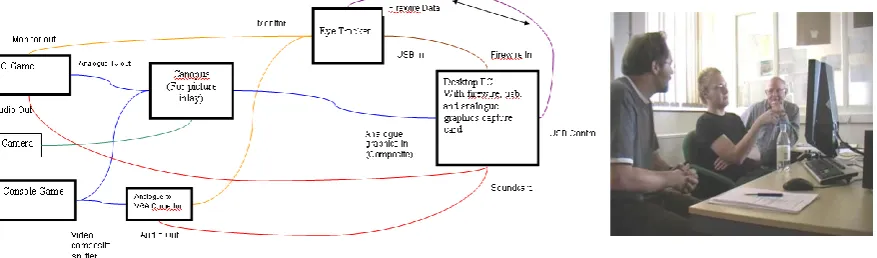
Tomb Raider Levels „Peru 12 ball puzzle‟ and „England 08 pool area‟ were selected prior to the experiment for comparison. In the first level „Peru 12‟ few attempts are made to attract or guide the player, whereas in the second „England 08‟ more obvious clues are given to the players as to where to interact with the scene. Notably a visual highlighting system for interactive objects, and an audio cue intended to specifically direct the players‟ attention to a specific usable object. Each player played the same game in the same order on a Pentium 4 PC using a Play station 2 Dualshock game controller. The images were displayed on a Tobii 1750 Eye-Tracker which can capture eye positions every 50th of a second. The eyetracking data was collected on a Shuttle Small Form Factor PC. An electronic switching device enabled the rapid switching of display between the games stimulus PC and the eyetracking PC. The eyetracking software was configured such that eye positions were aggregated into fixations if they occurred within 40 pixels of each other within 100 ms, the stimulus type used was external video. Figure 1 details the equipment configuration used in the experiments.
PARTICIPANTS
Seven participants were selected on the basis of their gaming skills and experience. i.e. The participants were considered to be proficient at game playing. They were familiar with the control interface and conventions of similar „3rd person action‟ games but were also
used in the experiment. All the participants were male, aged 20-29 and educated to degree level.
Figure 1: Equipment Configuration
METHODOLOGY
Upon arrival the participants were briefed as to the nature of the experiment and the experimental process to be deployed. They all completed a profile questionnaire giving details of themselves and their gaming experience. The Eye-Tracker was then calibrated to each participant‟s eyes. Prior to each game the participants were informed that they had to solve the puzzle presented by that level. They were also told that during the course of the experiment they would be asked how they felt at regular intervals during the game and that they were to reply using single word expressions such as, fine, great, frustrated etc. They were not told that the time to solve the puzzle was strictly limited to five minutes, nor that the frequency of probing would increase to one second intervals in the last 10 seconds of play. This strategy was employed to assist in building the tension the players were under during the experiment. Timing started from the start of the eyetracking data recording, the display was then electronically switched to show the game which the participant then activated.
The responses by the participants to the verbal pole as to how they were feeling were recorded manually. After a brief pause for the benefit of the players and to allow the set up of the second level an identical procedure was used for the second game. During both gameplay sessions the players‟ interactions in the game were captured to video simultaneously with the capture of the eyetracking data allowing a composite image of both to be made for later visual analysis. After both games had been completed the participants were asked to complete a questionnaire giving details of their feeling about the last game played. Finally an interview was conducted with each player about their experience of playing the second level. During this interview they also had the opportunity to view their interaction in the game along with overlaid eyetracking data.
RESEARCH FINDINGS
Analysis of Verbal In-Play Probes
Results From the Post Evaluation Questionnaires
Using a scale of 1(strongly disagree) to 5 (strongly agree) participants were asked to indicate the strength of their agreement to a series of 21 statements about their experience/feelings about the last Game played. The questions were grouped into two groups one group of positive statements about the game e.g. “I really liked the overall graphical design” and a group made up of negative statements e.g. “at times I felt bored”. The mode of the negative statement for all participants was 4 (agree) whereas the mode for the positive statements was 3 (neither agree nor disagree). The overall interpretation of these scores is that the players had neither a strongly positive or negative feeling about the game.
Analysis of Eye Movement Data
In the first level „Peru 12‟, the initial task was un-stated i.e. the participants were not told what to do. The object of the game was to manoeuvre a large stone ball into one of the three indentations present in the floor texture. This would cause a mechanism to move certain walls and allow the player to progress towards solving the puzzle. Within the first minute of play all the players had identified the ball and the indentation and instigated this mechanism, Figure 2 (A).
Participant Time taken to start the ball rolling
(seconds)
1 58
2 27
3 53
4 36
[image:8.595.219.354.76.282.2]5 39
Table 2: Time Taken for the Participants to Manoeuvre the Ball into the Floor Indentation
Word Used
Frequency
Frustrated 15
Bored 6
Confused 5
Lost 5
Annoyed 3
Puzzled 3
Guessing 1
Intrigued 7
Good 3
Wondering 3
Easy 2
Interested 1
[image:8.595.196.414.576.690.2]
[image:9.595.74.526.82.437.2]
Figure 2: Scenes from Tomb Raider Legend, „Peru‟ and „England‟ Levels
The further parts of the puzzle required more investigation and some advanced climbing/manoeuvring skills and none of the players advanced much beyond the initial interaction described above within the permitted time. Although they all stated their frustration at some point on this level, it is questionable whether they would do so within a more typically relaxed game playing environment. In this instance the addition of eyetracking overlay does not seem to inform us of anything additional to a normal analysis of gameplay footage, except to confirm the effective saliency of the ball, the affordances offered by perceived indentations and the importance of the central character (Lara) as objects with which to interact.
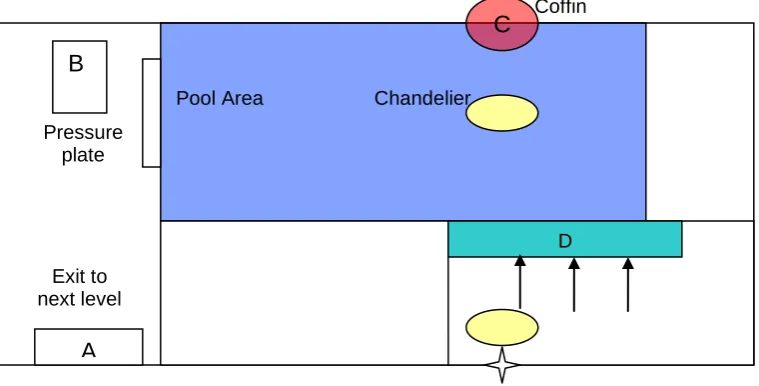
On the second level (England 08), a number of indicators and cue were put in place to help the player identify the object that would help them solve the physical puzzle. In order to open the door (A) to the next level, the player must find a large object to rest on the pressure plate (B). The object available is a coffin (C) that is resting on a shelf above the pool area (Figure 3). In addition to the use of visual indicators (twinkling lights) placed on all interactive objects within this level there is also an audio cue that is played when the player enters the box (D) from the direction indicated by the arrows. The audio cue is as follows:
Voice 1: You see that crate up on the shelf over there? You could use that on the pressure plate.
Voice 2: It’s not a crate, it’s a coffin. Someone’s revered ancestor is in there. A: Peru 12
It would seem a reasonable expectation that simultaneously with or soon after hearing this advice the player would seek the object being referred to. Indeed during the interview the players all confirmed that this was their sole aim once they had heard the audio cue. However, visual inspection of the eyetracking data determined that only one of the players fixated upon this key object and attempted to interact with it. The audio is only triggered when entering the area D from the direction indicated by the three arrows i.e. facing the item (C), the coffin, with which the players need to interact. The coffin location is encircled in red (C). However this overlooks the fact the due to the camera placement the player could have a totally different view of the scene to that assumed by the cue trigger. Consequently most players did not see the relevance of the audio cue and dismissed it not realising its significance. This omission contributed to the players‟ failure to move to the next level. By replaying the eyetracking video and noting the eye gaze location it is possible to infer why many players failed to progress beyond this point, confirming the potential of eyetracking in the analysis of player/game interactions.
Quantitative Analysis of the Eyetracking Movement Data
This analysis is based on the results from 5 out of 7 participants as the calibration of the equipment to the remaining two participants‟ eyes could not be completed satisfactorily. Fixations, their duration and location, are the principal output of the Eye-Tracker system. Their recorded attributes are now discussed. Figure 4 shows the variation in fixation durations every ten second time interval for both levels. Figure 4 also shows the near horizontal plot of the line of best fit for Game 1(Peru 12). Game 2 (England 08) shows a similar line (not shown). A t-test on the data showed no significant difference in mean fixation duration between the games (Table 3).
B
Pool Area Chandelier
C
D
A
Coffin
Pressure plate
[image:10.595.115.495.101.294.2]Exit to next level
Figure 4: Variation in Mean Fixations in Ten Second Intervals for Games 1 and 2
Game Mean Fixation
Duration (seconds)
Standard Deviation
Game 1 407.4 55.7
Game 2 410.5 58.3
T= 0.28 df 30 significance> 0.05
Table 3: Comparison of Mean Fixation Durations for Games 1 and 2
No relationship was found between the variations in mean fixation duration and the timing (once every 10 seconds) of the verbal probing as to the participants‟ feelings nor was there any significant variation in fixation durations during the 10 second countdown period at the end of each game. A visual inspection of a selection of the higher mean fixations and the game recordings indicated that higher fixations occurred, for example, when objects were being steered around or when the character in the game was climbing ladders. The data show there to be very little difference in the fixation durations of an individual player for each game. However, there are noticeable differences in mean fixation durations between players. There seems to be two distinct groupings of players 1, 2 and 3 and players 4, and 5 although further research will be needed to establish that these differences are due to skill levels or experience as the questionnaires completed by the participants were not sufficient to establish skill or experience level differences nor were there sufficient numbers of players taking part in the experiment. A 2 (Game) x 5 (Player) repeated measures ANOVA indicated no main effect of Game [F(1,4) = 0.076 sig>0.05] but a significant main effect of Player [ F(5,20) = 145.7 sig <0.05] and a significant interaction between Game and Player [F95,20) =6.58 sig <0.05].
Distribution of Mean Fixation Durations over the Screen Real-Estate
The Eye-Tracker records the position of each eye in terms of xy co-ordinates every 50th of a second. These positions are then aggregated into fixations if they fall within a certain radius of each other, within a certain time. The xy co-ordinates of a fixation are the mean of all the eye positions attributed to that fixation. In order to determine the distribution of fixations over the screen the screen was divided into a 10 by 8 cell matrix based on the 1024 x 768 pixel density of the screen resolution setting. Each fixation was then attributed to a cell in the matrix. For example a fixation with the co-ordinates 345, 568 would be allocated to cell 46. The total fixation duration for each cell can thus be computed. To standardise the results the
Variation of M e an Fixation Duration ove r tim e
200 250 300 350 400 450 500 550 600
1 3 5 7 9 11 13 15 17 19 21 23 25 27 29 31 Tim e s lots (10 s e cs )
[image:11.595.109.486.311.382.2]proportion of the total fixation duration was computed and the results for both games are shown in Figure 5. There were no fixations recorded in cells where x exceeded 7 or y exceeded 6.
In both games the greatest proportion of fixation durations fall in the central core of the display screen shown by the darkest coloured cell (Figure 5). To determine its statistical significance data from the central core (highlighted by the black border) was analysed by a Repeated Measure 2 (Game) by 9 (Cell) ANOVA. The results show no significant difference between games [F(1,5) = 0.03 p=0.868] but a main effect of cell [F(8,40) = 61.41 p=0.000] and a game/cell interaction [F(8,40) = 12.38 p=0.000]. The interaction means that there is a statistically significant difference in the patterns of mean proportions of fixations between the games. The high degree of statistical significance remains when standard adjustment is made for the fact that a Repeated Measures ANOVA is not fulfilling the usual General Linear Model assumptions of constant variance and independent errors.
The approach described above was repeated to include the means of the proportion of fixation durations immediately outside this core area (a 5 x 5 cell matrix) but no significant differences between the games were evidenced. A 2(Game) by 25(Cell) repeated measure ANOVA shows no main effect of Game [F(1,30) = 0.008 sig >0.05] but a main effect of Cell [F(1,30) = 133.733 sig <0.05] but no interaction between Game and Cell [F(1,30) = 1.974 sig >0.05].
Horizonal Cell Vertical
Cell 1 2 3 4 5 6 7
1 0.0 0.00 0.01 0.01 0.00 0.00 0.00
2 0.0 0.01 0.04 0.06 0.03 0.01 0.00
3 0.0 0.04 0.14 0.34 0.06 0.01 0.00
4 0.0 0.02 0.05 0.11 0.02 0.00 0.00
5 0.0 0.00 0.00 0.00 0.00 0.00 0.00
6 0.0 0.00 0.00 0.00 0.00 0.00 0.00
Game 1
Horizonal Cell Vertical
Cell 1 2 3 4 5 6 7
1 0.00 0.01 0.01 0.01 0.00 0.00 0.00
2 0.00 0.03 0.09 0.14 0.04 0.01 0.00
3 0.00 0.05 0.15 0.23 0.06 0.02 0.00
4 0.00 0.02 0.04 0.05 0.02 0.00 0.00
5 0.00 0.00 0.00 0.00 0.00 0.00 0.00
6 0.00 0.00 0.00 0.00 0.00 0.00 0.00
Game 2
0.05 - 0.15 0.16 - 0.25 0.26 - 0.35 Key: Proportion of
fixation duration
Figure 5: Distribution of Fixations (a) Game 1(Peru 12), (b) Game 2 (England 08)
RESEARCH CONCLUSIONS
The data analysed in this experiment comes from a very small sample of participants and it is perhaps too early to draw firm conclusions from just a limited series of experiments. However, we list below one or two indicators of where future research may bear fruit:
The capturing of the players‟ experience in terms of skills before the game, their experiences during play and their answers to post evaluation questionnaires all seemed problematic and have caused us to rethink the way we assess skill and experience. It has been suggested that instead of asking players to rate their own skill level it would be better to have them play a similar game or a game requiring similar techniques but which records the scores the players achieved. Players‟ skill could then be ranked using their scores.
difficulties there may be in determining how players feel using this method and indicates the importance of looking for alternative methods such as eyetracking or approaches advocated by Marsh et al (2006).
The eyetracking results indicated the majority of fixations seem to fall in the centre of the screen but that when players are not involved in controlling moving objects there is evidence that fixations may be more widely spread. We have indicated one way of assessing whether such variations are statistically different. This knowledge might be of interest to those wanting to optimise where to place information/instructions for players. The capturing of the players emotional reaction to the games using fixation duration as a metric seems to have not yielded the clear results anticipated, namely increases in frustration levels resulting in longer fixation durations.
The final questionnaire is in its early days of development and the results seem rather neutral. It is not possible to say at this stage if this is a true reflection of the player‟s feelings.
As well as building on the information derived from these experiments and verifying the process in respect of the analysis of fixation distribution. We intend to further explore how best eye movements can be attributed to significant objects (i.e. in-game advertisements) in games rather than rely on the distribution of fixations over a screen. If this can be automated we believe it will yield more pertinent information about object perception, its timing, the players‟ understanding and the objects importance. In addition to their use for analysis these techniques, once established, may also yield novel ways of game interaction. This change has created profound implications for games investors, production companies and designers, who strive to maximise user acceptance through new interactive narratives, compelling story-telling techniques and exciting game play which span over an entire game‟s life-cycle. Within an era where production costs and designer team sizes on console, PC games and mobile media continue to increase, applying valuable usability design principles to game development process early in the production process can potentially lead to substantial financial benefit.
SUMMARY AND CONSIDERATIONS
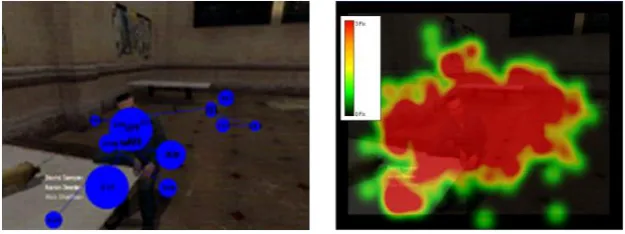
Figure 6: Gaze and Hot-spot Analysis
REFERENCES
ESA (2006) “Game Player Data”, Entertainment Software Association, Facts and Research, http://www.theesa.com/facts/gamer_data.php.
ELSPA (2005) “Computer and Video Games: A British Phenomenon Around The World”, Entertainment and Leisure Software Publishers Association.
Hsiao, H. (2007) “A Brief Review of Digital Games and Learning”, The First IEEE International Workshop on Digital Games and Intelligent Enhanced Learning, DIGITEL‟07, IEEE.
Dillon, A. (2001) “Beyond Usability: Process, Outcome and Affect in Human Computer Interactions”, Lazerow Lecture, University of Toronto.
Wright, P. C. (2003) “A Framework for Analysing User Experience”, Usability News, 2nd April, www.usabilitynews.com/news/article1008.asp.
Wright, P. C. and McCarthy, J. (2004) Technology as Experience, Cambridge MA: The MIT Press.
Marsh, T. (2007) “Informing Design and Evaluation Methodologies for Serious Games for Learning”, Learning with Games, Sophia Antipolis, France.
Marsh, T., Smith, S., Yang and K., Shahabi, C., (2006) “Continuous and Unobtrusive Capture of User-Player Behaviour and Experience to Assess and Inform Game Design and Development”, 1st World Conference for Fun 'n Games, UK.
Lindgaard, G. and Dudek, C. (2003) “What is this Evasive Beast We Call User Satisfaction?”, Interacting with Computers, Vol. 15, pp429-452.
Renshaw, J. A., Finlay, J. E., Ward, R. D. and Tyfa, D. (2005) “A Back-track to Satisfaction”, Proceedings of the 19th. British HCI Group Annual Conference, Vol. 2, pp73-76.
Goldberg, J. H. and Kotval, X. P. (1999) “Computer Interface Evaluation Using Eye Movements: Methods and Constructs”, International Journal of Industrial Ergonomics, Vol. 24, pp631-645.