Citation:
Caruana, V (2008) Internationalisation of HE in the UK: ’Where are we now and where might we go?’. Proceedings of the Education in a Changing Environment International Conference.
Link to Leeds Beckett Repository record: http://eprints.leedsbeckett.ac.uk/410/
Document Version: Article
The aim of the Leeds Beckett Repository is to provide open access to our research, as required by funder policies and permitted by publishers and copyright law.
The Leeds Beckett repository holds a wide range of publications, each of which has been checked for copyright and the relevant embargo period has been applied by the Research Services team.
We operate on a standard take-down policy. If you are the author or publisher of an output and you would like it removed from the repository, please contact us and we will investigate on a case-by-case basis.
Internationalisation of HE in the UK: ‘Where are we now and where might we go?’
Viv Caruana, University of SalfordIntroduction
This paper is based on a literature review commissioned by the Higher Education Academy in 2006 which aimed to identify existing published literature and current practices of direct relevance to the Internationalisa-tion of Higher EducaInternationalisa-tion in the UK. The review was based on the assumpInternationalisa-tion that a range of concerns exists, that there are emerging issues and that there are inconsistencies and gaps in the literature. The project focused on a number of questions including: what working definitions of internationalisation of higher education are in currency? what meanings are attributed to internationalisation of the curriculum? what models for institu-tional internainstitu-tionalisation are emerging? and, what curriculum models are emerging/being adopted?
The literature trawl identified in excess of 300 international sources of relevance, of which, more that 100 originated in the UK. This paper draws on the analysis of these sources to determine ‘where we are’ in the UK in comparison with our Western counterparts, particularly HEIs based in Australia.
Methodology
The literature search included a number of online bibliographical databases – British Education Index (BEI), Australian Education Index (AEI), Educational Resources Information Centre (ERIC), Educational Research Abstracts Online and Education-line. The Society for Research into Higher Education’s Research into Higher Education Ab-stracts was also analysed using the same key search terms applied to online databases. Websites of organisa-tions were trawled for relevant conference papers and reports available online including the Higher Education Research and Development Society of Australia (HERDSA), the Australian Association for Research in Education (AARE), the European Association for International Education (EAIE) and the International Association of Universities (IAU). Finally, a call for relevant literature and references was distributed to a number of mailing lists and was placed on the Higher Education Academy (HEA) website.
Reflecting resource constraints, the review of published literature was deliberately confined to scholarly peer-reviewed journals to the general exclusion of books and book chapters. The literature trawl identified 353 in-ternational sources of relevance of which 170 were classified as ‘grey’ (that is publications available in both print and electronic formats, but not controlled by commercial publishing interests and where publishing is not the principal driver). The ‘grey literature’ therefore included government documents, conference proceed-ings, supporting resources, briefing papers and other publications distributed free or available by subscription. Augur (1989) suggests that grey literature complements mainstream published material in offering a wider per-spective, quick access, greater flexibility and the opportunity to go into considerable detail where appropriate. The search of published and grey literature was initially based on broad themes developed from tacit knowl-edge. As the work progressed this focus became more ‘grounded’, that is it became directed by the ongoing findings. The approach was therefore iterative, with fairly strict demarcations and ground rules at the start, blurring as the search and review process progressed.
In reviewing the literature on internationalisation the aim was not to appraise the literature for quality. This reflects the nature of the field characterised as something of a ‘dogs breakfast’ – not in a derogatory sense – including relatively few empirical studies and assuming what Tight (2004) regards as a principal quality of the HE research literature in general, that is, an a-theoretical stance. Nonetheless, the review did incorporate an element of best evidence synthesis, in order to rise above the rhetoric which is another characteristic of much work in the field and to highlight the real stories from real colleagues and institutions that are likely to be most influential in informing and enhancing academic practice. This approach reflected the need to identify key messages.
Review Findings
Part One: Overview of the LiteratureGlobal sources: temporal and spatial characteristics
[image:3.595.68.401.173.466.2]The literature trawl identified 353 international sources of relevance, of which 170 were classified ‘grey’ litera-ture.
Table 1: Breakdown of total sources by year
Year Number of sources
1995 14
1996 10
1997 21
1998 16
1999 16
2000 24
2001 19
2002 17
2003 47
2004 56
2005 62
2006 40
Indeterminate 11
Total 353
The breakdown of international sources by year clearly shows the burst of interest and activity in this area since 2003. Having been on the agenda, but arguably barely visible ten years ago ‘Internationalisation’ has clearly ‘come of age’.
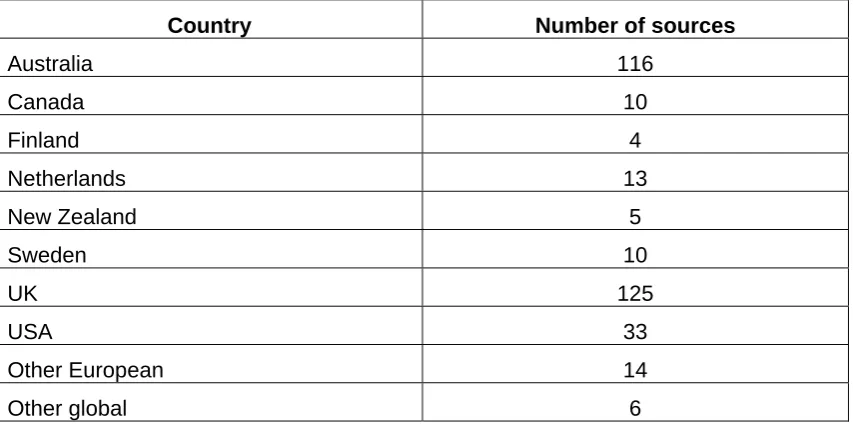
Table 2: Breakdown of total sources by country of origin
Country Number of sources
Australia 116
Canada 10
Finland 4
Netherlands 13
New Zealand 5
Sweden 10
UK 125
USA 33
Other European 14
[image:3.595.68.495.563.775.2]Multiple/western/global etc 17
Total 353
[image:4.595.68.495.256.547.2]The breakdown of sources by country of origin is particularly interesting. The most striking feature is the comparison between the UK and Australian-based literature. As an active researcher in the field, it was sur-prising to find that the level of activity in the UK was comparable to that of Australia, since my impression had always been one of internationalisation being somewhat side-lined by other agenda in the UK. Nonethe-less, a cursory glance at the Australian literature immediately suggests that it is probably better developed in particular areas suchas diversity, reflecting the relatively high profile of ethnic minority issues in the cultural context and transnational education reflecting its global location and outward orientation towards the Pacific Rim.
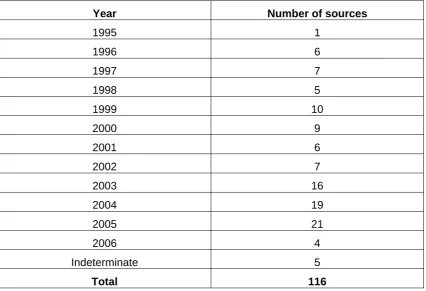
Table 3: Australian literature by date
Year Number of sources
1995 1
1996 6
1997 7
1998 5
1999 10
2000 9
2001 6
2002 7
2003 16
2004 19
2005 21
2006 4
Indeterminate 5
Total 116
Of the 116 sources originating in Australia, 71 were classified as ‘grey’ and a major source of this ‘grey’ litera-ture was the proceedings of the annual Higher Education Research and Development Society of Australia conference (HERDSA) which are available online. The literature search was completed before the 2006 HERDSA conference and this largely accounts for the low number of sources located for that year. Much of the published Australian literature appears in Higher Education Research and Development , the journal of HERDSA, although work is also published elsewhere. The Journal of Studies in International Education is rapidly assuming a high profile publishing the work of authors from across the globe who have long been active in internationalisation, such as Betty Leask, of UniSA, Australia, Hanneke Teekens of NUFFIC, the Nether-lands, Michael Paige of the University of Minnesota, USA and Bengt Nilsson, of Malmo, Sweden.
UK sources: the temporal, spatial and methodological
years and sometimes contributions are available online, there is an overwhelming tendency to publish ab-stracts only rather than full papers. The ground-breaking Education for Sustainable Development: Graduates as Global Citizens conference held at Bournemouth University in 2005 is a good case in point here. This event attracted 63 HEIs and DEA member organisations and about 100 participants many of whom contributed workshops and papers. Yet the report published after the event Graduates as Global Citizens, Quality education for life in the 21st century was limited to reporting only keynote presentations, seven workshops and Panel
[image:5.595.71.494.202.400.2]reflec-tions, conclusions and evaluation. It may be that contributions to these kinds of events are being worked up into full papers for submission to HE journals, but given the fairly high level of activity apparent from various conference websites this does not seem to be the case.
Table 4: Analysis of UK literature by Journal
Journal Number of sources
Comparative Education 2
Innovations in Education and Teaching International 3
Innovative Learning in Action (ILIA) 5
Journal of Geography in Higher Education 17
Journal of Studies in International Education 4
Studies in Higher Education 3
Teaching in Higher Education 3
Journals in which only one source of relevance 29
Total 66
Papers published in journals are located in a very wide spread of publications although the concentration within a few (particularly the Journal of Geography in Higher Education) is noteworthy.
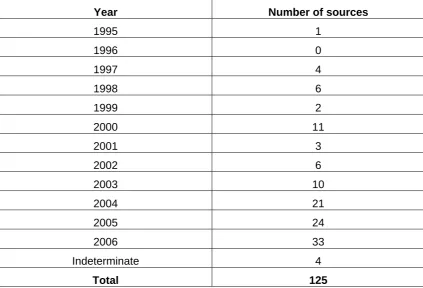
Table 5: Analysis of UK literature by date
Year Number of sources
1995 1
1996 0
1997 4
1998 6
1999 2
2000 11
2001 3
2002 6
2003 10
2004 21
2005 24
2006 33
Indeterminate 4
[image:5.595.67.491.485.773.2]Table 5 suggests a burst of activity around 2000 in the UK, which then subsides, with a relatively slow uptake in 2003 compared with elsewhere. However, it is also clear that the interest in internationalisation has some-what ‘snowballed’ over the last year or so. This could suggest that in some way the internationalisation agenda is indirectly being propelled by the interest in Education for Sustainable Development (ESD), which has as-sumed a high profile across the sector since the launch of the UN Decade in 2005.
Whilst some of the literature can be clearly categorised as small-scale and empirical conducted within the frame of an action research paradigm, many sources do not identify with any particular epistemological and ontological position. Clearly however, the general trend is in favour of the qualitative approach with statistical analysis, such as regression analysis and multi-level modelling being confined to issues of progression and final degree classification. The full range of qualitative and quantitative data collection instruments are deployed in triangulation in empirical studies. The empirical work sits alongside many discussion papers which address internationalisation in numerous contexts.
In common with much of the HE literature the ‘Internationalisation’ literature is almost devoid of theoretical framework. There is some evidence of the application of pedagogic models (although in reality these relate to the practice rather than the research) and Smith (2006) and Robinson (2004) are exceptional in couching their research in critical post-structuralist and feminist theories in the former case and critical management educa-tion and post-colonial theories in the latter.
Part Two: Key Messages in the UK literature
The influence of globalization on working definitions of Internationalisation of Higher
Education
The review identified several key pieces in conceptualising and defining internationalisation. The majority of selected pieces set out to explore possible approaches to internationalisation and/or to review current strate-gies and the status of the ‘global dimension’ (Bennell, 2005; Caruana and Hanstock, 2003, 2005; Haigh, 2002; HE Academy, 2006; Killick, 2006; Lunn, 2006; Maxey, 2006; Shiel, 2006). Halliday (1999) and De Vita and Case (2003), are exceptional in confronting the internationalisation agenda and the dominant discourse, whilst Koutsantoni (2006a) and Scott (2000) focus on the challenge posed by globalisation, internationalisation and related concepts (to both institutions in general and their leaders in particular), exploring significant barriers to change in order to inform the management process. Some sources which are primarily concerned with Educa-tion for Sustainable Development (ESD) and Equality and Diversity (E and D) are significant in implying a connection with the ‘global dimension’ of internationalisation (Bennell, 2005; Caruana and Hanstock, 2005; Haigh, 2005; HE Academy, 2005, 2006; HEFCE, 2005; Maxey, 2006; Scott, 2000; Thompson, 2005).
Much of the literature views internationalisation as the response to or an expression of changes brought about by globalisation, Globalising trends are variously characterised as on the one hand, being sources of dislocation, of dis-identifying and positioning as ‘other’ and on the other, as tending to make everything the same – key concepts being uniformity, standardisation, and homogenisation. Deem (2001) notes that ‘global-isation is a fashionable theoretical stance but care needs to be taken in applying it to education…because so-cial theorists cannot agree on definitions and implications’.
Globalisation has also been cited as the origin of a ‘marketisation discourse’ that pervades higher education as international competition has intensified and universities strive to maximise foreign earnings from interna-tional students through creating a favourable ‘brand’ in the marketplace. (Caruana and Hanstock 2003; De Vita and Case 2003; Edwards et al 1997; Haigh 2002; Koutsantoni, 2006a). It is argued that the ‘marketisation discourse’ has impacted negatively on the direction and thrust of internationalisation in the UK since in Fou-cauldian terms, the language and choice of vocabulary within the discourse has steered the sector away from any radical reassessment of HE purposes, priorities and processes that student diversity and multicultural in-teraction require. Furthermore, the quality of the international student experience may have deteriorated un-der the influence ofthe notion of ‘consumption of an educational commodity’ (De Vita, and Case 2003; Elli-ott, 1997: Halliday, 1999).
uni-versities’ efforts on the need to enable graduates to compete in an increasingly global world of work, to func-tion effectively in internafunc-tional and multicultural workplaces and to negotiate the uncertainties of Ronald Bar-nett’s (2000) world of super-complexity (Haigh, 2002; De Vita and Case 2003; Lunn, 2006). A consensus is emerging based on the following principles:
• Awareness that internationalisation entails a shift in thinking and attitudes to re-create globalisation in the form of social practices that confront homogenisation
• Recognition that internationalisation is about more than simply the presence of international students on UK campuses and sending UK students overseas
• Recognition that internationalisation is a long term process of ‘becoming interna-tional’ or developing a willingness to teach and learn from other nations and cul-tures as distinct from traditional definitions of ‘involving more than one country’
• Awareness that internationalisation in the context of higher learning and peda-gogy has social, cultural, moral and ethical dimensions that both transcend the narrow economic focus and establish a synergy with other agenda
(Koutsantoni, 2006a;Caruana and Hanstock 2005; Lunn, 2006; De Vita, 2003; Killick, 2006; Haigh, 2005; HE Academy, 2006; Caruana and Hanstock, 2003; Maxey, 2006; Bennell 2005; Shiel 2006) Meanings attributed to ‘Internationalisation of the Curriculum’: ‘Internationalisation at Home’, ‘Global Citizenship’ and ESD
Whilst the concept of internationalisation is rooted in traditional structures of UK HE and has evolved over recent years under the influence of globalisation ‘Internationalising the Curriculum’ is very much a new and often quite unfamiliar phenomenon. It presents particular issues of conceptualisation since its emergence co-incides with a period of rapid and complex change in HE and its meaning in practice tends to be blurred by the traditional distinctions drawn between the home and international student experiences. Whilst relatively new, the concept has nonetheless undergone fairly rapid evolution within a short space of time.
Internationalisation traditionally encompasses the development of knowledge about different places and cul-tures of the world but the global dimension has substantially broadened conception of what the international-ised curriculum means suggesting ‘a shift in approach, rather than a radical change of content’ (Shiel and Jones, 2004). The review suggests that global perspectives are increasingly being regarded as providing the ethical underpinning and values-based ethos for a focus on cross-cultural capability. Furthermore, studies of cross-cultural capability and global perspectives are taking place both at the institutional level and within par-ticular disciplines including business and management, logistics and social policy ((Irving et al 2005; Killick, 2006; Laughton and Ottewill, 2000, 2003; Lunn, 2006; Pyne et al 2006; Shiel, 2006)
As the concept of cross-cultural capability challenges notions of internationalising the curriculum simply through modification of content, it also influences thinking about the relationship between an international-ised curriculum and cross-border student mobility. More attention is being devoted to the means by which cross-cultural capability may be developed in those who are - for one reason or another – immobile and this has engendered some discussion in the literature of the notion of ‘Internationalisation at Home’ (Koutsantoni, 2006a; Caruana and Hanstock, 2005).
Concepts of global citizenship are also influential in effecting a shift of emphasis in Education for Sustainable Development (ESD) which has traditionally been regarded as the territory of geographers, scientists engineers and the like. (Azapagic et al 2005; Haigh 2006; Martin et al 2005, 2006; McGuinness et al, 2005). The literature suggests that from the 1990s a major shift of emphasis has taken place to include ethical issues alongside the continuing focus on environment. Scott (2002) quotes Hamm and Muttagi (1998) who maintain that sustain-ability is ‘…not about environment…but…the capacity of human society to enact permanent reform in order to safeguard the delicate balance between humans and their natural life-support system.’ And HEFCE (2005) refers to its commitment to ‘promoting a view of sustainable development which is ‘much wider than just environmental protection’ and to a ‘critical social agenda’.
solving in a holistic, non-reductionist manner; holistic thinking to support critical judgements; a high level of reflection to identify, understand, evaluate and adopt values conducive to sustainability; global thinking but local action and the initiation and management of change. (Haigh, 2005; HE Academy, 2006; Scott, 2002). Hence in effect, sustainability literacy, skills and knowledge are the literacy, skills and knowledge of the ‘Global Citizen’.
Embedding Internationalisation and Global Perspectives in Strategy and Curriculum across Institutions: emerging tensions
Koutsantoni (2006b) provides a comprehensive study of how HEIs address internationalisation strategically and practically. This research explores the websites of 133 universities and colleges and studies 51 strategies in-depth. The research found that for the vast majority (44/51) recruitment of international students was the main focus, enhancement of the international experience of home students was on the agenda of only six uni-versities and only two institutions acknowledged the importance of creating a culture of equality and diversity in internationalisation plans. Cross-cultural capability remains a major issue and there is evidence of a lack of understanding of the cultural aspects of ‘Internationalisation at Home’ (IaH) which seems to be viewed as simply ‘good housekeeping’ whereas internationalisation abroad is perceived as adventurous and potentially more profitable (Caruana and Hanstock, 2005; Koutsantoni, 2006b).
Studies assessing the current status of internationalisation and global perspectives in the institutional context suggest a significant gap between the rhetoric of policy statements and the reality of practice (Bennell, 2005; Lunn, 2006; Shiel, 2006). Lunn (2006) concludes that the ‘building blocks for global perspectives are in place’ including ‘a multiplicity of programmes specifically international or global in orientation’ and a range of com-pulsory and optional taught modules within programmes with a distinct, global, international or non-UK fo-cus. However, it was also noted that ‘there is often a gap between the perceived importance of global perspec-tives activities and the actual activity carried out’. In similar research the University of Wales, Bangor was found to have 166 undergraduate modules which dealt with aspects of sustainable development and global issues, but the research team concluded that ‘this provides no guarantee that students would be prepared for understanding the breadth of sustainable development and global issues (Bennell, 2005). Finally, recent re-search at Bournemouth University which was one of the first UK HEIs to formulate its global vision in 1999 (its Global Perspectives Group being pro-active in highlighting the importance of international perspectives and exploring the pedagogical issues of multicultural teaching), concluded that undergraduate programmes generally cater for UK students, missing the opportunity to encourage learning from other cultures - to quote ‘there is still a long way to go’ (Shiel, 2006). It may well be the case that the apparent lack of progress is rooted in institutional culture that presents constraints within HEIs - aims are often unclear, interpreted in numerous different ways by a variety of stakeholders and institutions are staffed by diverse professionals both academic and managerial who operate within the context of a rapidly changing external environment (Taylor, 2004). Internationalisation in the ‘market’ sense also creates tensions in universities that conceive themselves in purely national, sectional, or sectarian terms, conflicting with other agenda that are more locally focussed, for example, strategies that are geared to meeting the needs of regional communities and widening participation in HE. Indeed some authors have already suggested that there is some evidence albeit relatively limited, to sug-gest the emergence of a trend toward de-internationalisation in UK HE (Caruana and Hanstock, 2003; Haigh, 2005; Parsons and Fiddler, 2004). Internationalisation is similarly a major dilemma for HEIs that just happen to teach some international students. ‘Glossy recruitment brochures may attempt to portray an image that is friendly to international students whilst academic practices are overwhelmingly embedded in local traditions’ (Haigh, 2002). In effect the ‘…process of planning is about priorities, determining what will be done, but also what will not be done or what will be discontinued’ (Taylor, 2004) and this is perhaps the greatest challenge of internationalisation.
Trans-national Higher Education - the future shape of Institutional Internationalisation? Motives, issues and possibilities
Relative to say Australia, the extent and intensity of UK activity in trans-national education is limited tending to complement rather than substitute for international student mobility (Garrett, 2004; Garrett and Verbik 2004; Howe and Martin, 1998, Koutsantoni, 2006b).
classes figure prominently. For source countries the ‘revenue-generating approach’ whereby HE is offered on a full-fee basis without public subsidies in order to earn additional income, is prevalent not only in the UK, but also in the USA, Canada, New Zealand and Australia with little evidence to support any pseudo-development agenda based on mutual understanding (Garrett 2004; Garrett and Verbik 2004; De Vita and Case 2003; Koutsantoni, 2006a; 2006c). For the UK as a whole, tensions exist between current and predicted levels of trans-national activity and this is compounded at the institutional level by ambiguous trans-national agenda coupled with a lack of co-ordination between trans-national delivery and broader institutional goals (Garrett, 2004).
An abiding theme in the trans-national higher education literature is a concern surrounding the issues of qual-ity assurance processes and standards which on the face of it may be addressed by establishing branch cam-puses with attendant advantages in terms of heightened market profile accruing from a more visible and dis-tinctive presence in another country and the ability to circumvent regulations in host countries. However, it is suggested that such developments which remain essentially large-scale, resource-intensive and ‘high risk’ in terms of finance, operations and reputation are likely to be unattractive and more importantly, not feasible for the majority of HEIs currently engaged in trans-national higher education (Garrett, 2004; Middlehurst and Campbell, 2003; Verbik and Merkley, 2006).
In what is a relatively high-risk area then, distance learning offers institutions an alternative means to reach more students, achieve scale economies and tap into new sources of income. However, institutions still need to consider the implications of collaborative development and delivery of curricula, and the articulation of quality standards and certification agreements among participating institutions (Solem et al, 2006). The great-est challenge for designers of distance learning programmes is how to produce, arrange and deliver materials and content that are internationally acceptable, yet sufficiently integrated within a local context and responsive to local needs as to be relevant to students thereby maximising their motivation to study (Lees, 2004; Wisker et al, 2003).
In general, the literature suggests that positioning ICT at the centre of internationalisation strategy is unlikely to provide the panacea for a flagging internationalisation agenda. It may prove to introduce more dilemmas rather than provide solutions with practice becoming ad-hoc based on a few lead users whilst the majority continue to use ICT as a supplement to traditional teaching methods. Practitioners may remain infrequent users harbouring doubts about ICT as a pedagogical tool, and associating the use of computers exclusively with the self-access domain. Furthermore, information per se is not equivalent to knowledge and the ability to analyse and it has been argued that the ‘virtual’ as a discrete concept ‘cannot deliver the two things that will be most needed [in the twenty-first century] …to be self-critical and to be wise’ (Ashworth, 1995 quoted in Hal-liday, 1999; Jarvis, 2004; 2006).
Curriculum Models of Internationalisation: Challenging stereotypes
Many sources cite the prevalence of the ‘assimilationist’ model of pedagogy and lecturers’ stereotypical views of international students as passive, obedient learners, lacking in autonomy who memorise, are unfamiliar with UK academic culture and are therefore, academically ‘deficient’. However, cultural stereotypes are also being challenged as grounded in a view that culture is static, an assumption that seems quite banal and trite (De Vita, 2004; Hills and Thom, 2005; Kingston and Forland, 2004; Li et al 1998; Luzio-Lockett 1998; Morrison et al, 2005; Robson and Turner, 2006; Smith, 2006) . Rather than adhere to the cultural stereotype practitioners are actively exploring international students’ expectations and preferences. The insights gleaned from interviews, focus groups and other engagements may be summarised as follows:
• International students are looking for ‘something British’ and perceive the stan-dard of British education to be excellent, but that is not borne out when they ar-rive in the UK. Particularly in terms of content of courses they perceive a lack of awareness of their prior knowledge and of the circumstances in their country of origin (Kingston and Forland, 2004; Peters 2005)
• Although the majority of East Asian students may use rote-learning methods they feel for this to be successful it must be based in understanding, indicating ‘deep’ learning and furthermore they ‘value their own opinion’ (Cortazzi and Jin, 2006; Durkin, 2003: Kingston and Forland, 2004)
their work, their ideas and learning from each other and working co-operatively, motivating each other and building friendships. However, they expect more tutor support (Kingston and Forland, 2004; Nield and Thom, 2006; Robinson, 2004).
• The most valued teacher attribute is ‘heart’ – the teacher is a guide in helping to understand the topic but also an empathetic friend (Nield and Thom, 2006). Wu (2002) who offers an engaging account of cultural variations in conceptions of pedagogy based on personal experience and observation argues that being a tutor is about tapping into parenthood and particularly motherhood. The ‘mother sub-stitute’ is highly visible initially, but in time the tutor can be ‘internalised’ and in-dependence can develop as the ‘real person’ is left behind (Wu, 2002).
Complementing this discourse focussing on the nature and perspectives of the international student lecturers are examining the curriculum and developing innovative practice to encourage pedagogical autonomy and critical engagement with reading. This research emphasises a general need for ongoing dialogue and collabora-tion in the form of one-to-one support based on formative assessment to integrate, apply, extend and critique knowledge. Hands-on practice with input from a tutor is recommended to illustrate how students might ex-tend or alter what they are doing and assist them in drawing ideas from the literature and developing informed opinions (De Vita, 2004; Ridley, 2004).
Curriculum models of Internationalisation: Developing educational approaches and teaching, learning and assessment practices
Complementing the work on the international student experience is a trend towards new educational ap-proaches and models within curriculum design in general and teaching, learning and assessment strategies for the multicultural classroom in particular (be it real or virtual). A number of tools and models have been devel-oped to interrogate the existing curriculum and conceptualise the process of change that is required to trans-form it. For example, Killick (2006) offers a comprehensive tool for curriculum review developed at Leeds Metropolitan University. Haigh, (2002) identifies five models of curriculum internationalisation that could be applied to programmes of study to determine the level of engagement with internationalisation and intercul-tural learning. These include the remedial; culintercul-tural pluralist; benevolent multiculintercul-tural segregation; biculintercul-tural education and multicultural education. Warren in Warren and Fangharel (2005) also provides a model of edu-cational approaches to student cultural diversity in HE each defined in terms of ideological alignment, cultural stance towards diversity and pedagogical orientation, identifying the assimilative (‘melting pot’), the inclusive (‘salad bowl’) and the transformative (‘rainbow people’).
Undoubtedly these tools and models have their usefulness in both institutional and programme contexts but for the lecturer at the ‘chalk-face’ the overriding concern is likely to be with practicalities – what am I likely to encounter in the multicultural classroom? How can I adapt my existing practice? What can I do to introduce a multicultural dimension to what on the face of it is a unicultural learning environment? The literature suggests that those supporting learning are looking to ICT as an effective tool to develop cross-cultural capability through online collaboration across borders and they are also developing strategies to capture the richness of diversity that already characterizes many of the physical learning spaces of UK HE.
There seems to be a general consensus within the literature that whilst computer-mediated communication is no substitute for the rich cultural experience offered by student exchanges, it can complement exchanges and visits for students who travel abroad or host visiting students as part of their programme. (Bell et al, 2004; Caruana, 2004; Kooijman, 2004; Stainfield et al, 2000). Furthermore, Caruana (2004) cites the work of Ed-wards et al (2003) who have devised a model of curriculum development which differentiates between pro-gressive levels of international and intercultural literacy. The model recognises that ICT and online collabora-tion may play a crucial role in building teaching and learning strategies based upon experiential and problem-based learning engaging local and international students and faculty. In this context the online experience pro-vides the means of bridging the gap between international awareness and international expertise by developing international competence (Kooijman et al 2004; Caruana, 2004).
recog-nising the benefits the literature also discusses the complexity of organisation – working with different terms and semester times, different curricula and assessments and different group sizes – and the potentially heavy burden of administrative cost involved (Bell, 2003; Halliday, 1999; Kooijman et al 2004).
The challenge of the multicultural classroom in terms of teaching, learning and assessment strategies also re-ceives much attention in the literature. Multicultural group work is a key theme with authors highlighting benefits (developing a range of skills, creativity and lateral thinking) and identifying good practice in group formation, the design of tasks etc. Whilst it is argued that once multicultural groups have ‘settled down’ they will outperform mono-cultural groups in looking at problems in different ways and generating alternatives, authors also sound a word of caution in noting unintended consequences (Black, 2004; De Vita, 2001b; 2002a; Hills and Thom, 2005). Rather than understanding and transcending difference students may well be simply ‘dealing with it’ thereby possibly reinforcing cultural stereotypes. Furthermore, even when understanding is achieved, unequal dialogue may still be the outcome. ‘Marginalised’ groups may be granted a hearing because the dominant group seeks understanding, but the emergent dialogue is ‘a sort of colonisation’ rather than ‘empowering’. Concepts of ‘insiders’ and ‘outsiders’ may parallel cultural stereotyping leading to practices of ‘side-lining’ and ‘self-exclusion’ and this kind of ‘cultural silencing’ may be reinforced when the curriculum itself fails to encourage students to voice their life experiences. (Robinson, 2004; Warren in Warren and Fang-harel 2005)
In considering the attitudes and behaviours of home students in multicultural encounters Smith (2006) offers useful insights revealing that a factor in the ‘negative positioning’ of international team mates is the ‘non-traditional background’ of home students themselves. Seemingly, those students who feel negatively posi-tioned by wider discourses such as widening participation, feel the need to assert their own legitimacy and right to participate by highlighting their own ‘superior knowledge’ in the multi-cultural learning environment (Smith, 2006). The parallel here with experience at the strategic, institutional level where universities prioritise widening participation is striking.
In terms of assessment a number of sources explore a range of issues within the multi-cultural context, includ-ing possible points of confusion regardinclud-ing assessment, plagiarism and cultural bias in assessment, all of which at least in part, stem from practitioners’ almost ‘taken for granted’ approach to UK academic culture in multi-cultural settings (Barrett and Malcolm, 2006; De Vita, 2002, 2004; Hills and Thom, 2005; Ridley, 2004). Hills and Thom (2005) make a moot point regarding how teachers often assume prior experience, particularly in assessment. The teaching team involved in Hills and Thom’s (2005) work are described very aptly as ‘…in effect trying to teach the finer points of bowling googlies to people who had not played cricket…’ particularly when dealing with coursework, presentations and forms of group assessment.
Key issues emerging in relation to assessment in the multi-cultural classroom include the possibility of ‘intel-lectual self-censorship’ which may disadvantage students working in a second language and the notion of ‘only one right answer’ which goes against the spirit of the multi-cultural curriculum that values ‘…a variety of views that constitute truth and knowledge’ (De Vita, 2002). Interestingly, the issue of plagiarism which seems to be raising its profile at least in the HE press if not elsewhere, is relatively neglected although the work of Barrett and Malcolm (2006) in the use of plagiarism detection tools is noteworthy for its innovative shift of emphasis away from detection and towards enabling students to understand good academic practice through formative assessment processes.
Curriculum models of Internationalisation: a ‘pedagogy of recognition’?
It appears that in terms of teaching, learning and assessment strategies a tendency towards what has been de-scribed as ‘ethnocentric western didactism’ (De Vita and Case 2003) is being questioned. However, it could be argued that in practice ‘assimilation’ or rather ‘socialisation’ into the UK HE system has simply ‘shifted location’ from being an ‘add-on’ separate from the mainstream curriculum to now being embedded in the learning, teaching and assessment practice that characterises, at least some, of the learning spaces of UK uni-versities. Indeed some authors suggest that in order to provide a genuinely inclusive curriculum a more holis-tic approach needs to be developed moving pracholis-tice along a continuum from ‘infusion’ to an ‘international pedagogy’ or pedagogy of recognition’ Nield and Thom 2006; Warren 2005) .
and lecturers and the ‘linking’ of assessments (Caruana and Hanstock, 2003, 2005; De Vita and Case 2003; Warren, 2005). In considering the possibilities afforded by the process of infusion the work of Killick and Poveda (1998) goes some way towards challenging the concept based on their differentiation between culture with a large ‘C’ like art, history, literature etc. and culture with a small ‘c’ which, in the academic context, represents a set of attitudes and behaviours. In a sense then, cross-cultural capability may not be developed through a surface understanding of ‘culture bites’ alone as implied by the ‘infusion’ approach applied to course content alone. Rather, infusion needs to be transformed to embrace a ‘pedagogy of recognition’ which is student-centred and engages students in a critical relationship with texts and theories, enabling them to de-construct their own lives and to imagine alternatives. The process of dede-construction in pursuit of the ‘peda-gogy of recognition’ would also involve lecturers in exploring what they mean by critical thinking, thereby challenging over-simplified understandings of culturally-specific approaches to learning. In the process of de-construction the more open and democratic relationship between tutor and student evidenced in much of the literature reviewed here, may provide the key to the development of a curriculum that embraces student ex-perience as a resource, creating a ‘…stronger, richer educational exex-perience for all students,’ which challenges existing inequalities and yet does not compromise academic rigour. The alternative approach of dismissing ‘other’ academic cultures and focusing on ‘adjustment’ issues, may ultimately result in failure to recognise the extent to which what is actually taught in modern universities does not encourage skills of analysis and critical thinking. (De Vita and Case, 2003; Hills and Thom, 2005; Nield and Thom 2006; Smith, 2006; Warren, 2005).
Internationalisation: Identifying ‘the gaps’ in the UK Literature
Conceptualising the curriculum
Generally, there is relatively little discussion of exactly what ‘international’ means in the titles of HE pro-grammes offered up to an increasingly diverse student body with highly differentiated needs and aspirations. In particular, there is a paucity of small scale empirical research addressing how global citizenship and global perspectives are embedded in teaching and learning. This suggests that the global perspective in the curricu-lum continues to be perceived as an issue of content, rather than skills, attitudes and behaviours, despite its significance in terms of graduate employability. Moreover, there is relatively little evidence of research that explores graduate capability and employability in the context of internationalisation strategies. In framing no-tions of the ‘global citizen’ the literature demonstrates a fundamental connection between internationalisation, global citizenship and Education for Sustainable Development (ESD) in terms of the ethics, criticality and the tenor of the language used to define sustainability literacy, skills and knowledge. However, the connection remains implicit only. Finally, the concept of ‘Internationalisation at Home’ which is becoming quite firmly embedded in countries like the Netherlands receives little attention in the UK despite the fact that it provides the framework for developing cross-cultural capability in the ‘stay at home’ student and plays a significant part in preparing students for experiences abroad.
Key players and stakeholders
In general, the literature suggests a continuing pre-occupation with the ‘international student experience’ in the multi-cultural context, with relatively little evidence of research into ‘internationalising the curriculum’ for the home student. There is scant consideration of the UK student perspective on work and study abroad, particularly the challenge of engaging the non-traditional WP student in dialogue about their perceptions of the international experience in the context of their ‘graduateness’ and ‘employability’. A significant gap also emerges in the ‘international student experience’ whereby the extent to which the UK campus experience serves individual needs and those of the communities to which international students return is relatively ne-glected.
(professional bodies, employers) in driving and informing ‘internationalised’ curriculum design is conspicuous by its absence in the literature.
The institutional perspective
Whilst the literature explores various models for institutional change there is insufficient consideration of mechanisms by which the efforts of ‘champions’ in the field may be harnessed to ‘win hearts and minds’. Is-sues of cross-cultural engagement and diversity require further research particularly in relation to institutional strategy. Whilst strategies include phrases like ‘valuing’ diversity there seems to be little attempt to consider either the extent to which or how individual attitudes can be influenced to effect cultural change. Finally, and again in contrast to Australia, the area of trans-national education in general and the ‘branch-campus’ sce-nario in particular, is under-researched as is the experience of UK university teachers in trans-national settings.
Conclusions
The literature review of UK sources provides ample evidence of engagement with ‘Internationalisation’. Phi-losophical critique is complemented by quantitative large scale analyses across the UK HE sector and small-scale empirical research which serves to inform academic practice in a wide range of contexts. The conceptual debate is very much alive and the review explores an array of interventions that are representative of attempts on the part of educators to find ways of engaging with different pedagogical backgrounds and expectations that are encountered in the multicultural environment which is the UK University today. Although much of the literature still has a tendency towards, at least, the language of ‘deficit’ and ‘assimilation’ there is evidence of an approach to teaching and learning that aspires towards genuine ‘cultural inclusion’ rather than ‘manag-ing’ diversity via induction programmes and study skills courses.
In engaging with ‘Internationalising the Curriculum’ lecturers and programme teams are exploring the nature of the ‘expectations gap’ challenging the discourse of ‘deficit model’ and ‘assimilation’ through dialogue and within their own work. There is evidence of lecturers seeking to understand how culture influences learning styles and processes, in order that such understanding should inform and shape the learning experiences which they design for multicultural settings. There is also evidence of researchers engaging students in a dia-logue about their expectations of, for example, the UK HE system in general, psychological and socio-cultural adjustment, the influence of Confucian as opposed to Socratic heritage on learning, the most valued attributes of teachers, expectations of group work etc. There is a relatively substantial literature concerned with the mul-ticultural classroom which addresses a whole range of learning, teaching and assessment issues, based on the empirical study of specific interventions. This research provides evidence of an awareness of and willingness to ‘get to grips with’ the ‘expectations gap’ through a dialogue engaging students and lecturers alike. However, whilst this research signals positive re-alignment of teaching practice it may be the case that ‘assimilation’ or rather ‘socialisation’ into the UK HE system has simply shifted location from being an ‘add-on’ separate from the mainstream curriculum, to now being embedded in the learning, teaching and assessment practice. Al-though the review suggests that ‘Internationalisation of the Curriculum’ has credence within the HE sector and among its practitioners, to some degree the literature reflects the view articulated by Ninnes and Hellsten (2005) in Internationalising Higher Education – Critical Explorations of Pedagogy and Policy that instead of creating the international student experience internationalisation contributes to the ‘Westernisation’ of curriculum. It has to be said that the literature provides evidence of awareness of this scenario and suggests that many university teachers are actively seeking to challenge this position within their own teaching practice and in collaboration with their students and colleagues. Thus, it would be wholly inappropriate to conclude that ‘…a genuinely international student experience and a genuinely internationalised curriculum…is hard to find…’ (Ninnes and Hellsten, 2005). Nonetheless, whilst aspiring to the ideal of ‘cultural inclusivity’ there is a continuing need for dialogue and debate to address the tensions of cultural conflict between the Confucian and Socratic models of learning and to consider the dominant influence of the Western social and cultural environment.
References
Augur, C.P. (1989) Information Sources in Grey Literature London: Bowker-Saur
Azapagic, A., Pedan, S. and Shalcross, D. (2005) How much do engineering students know about sustainable development? The findings of an international survey and possible implications for the engineering curricu-lum European Journal of Engineering Education 30(1): 1-19
Barrett, R. and Malcolm, J. (2006) Embedding plagiarism education in the assessment process International Journal for Educational Integrity 2(1): 38-45
Bell, F., Whatley, J. and Zakrzewska, D. (2004). Trans-National Online Activities For Students - A Pragmatic Approach Networked Learning Conference, Lancaster University, England, UK
Bell, F. and Whatley, J. (2004). Trans-national online activities for students - a pragmatic approach ILIA Inno-vative Learning in Action, (1): 13-17, University of Salford, England, UK
Bell, F. (2006) Communities of Practice’ Online? The case for ‘going Feral’ in Academic Development ILIA Innovative Learning in Action (5): 3-16
Bennell, S. (2005) Education for Sustainable Development and Global Citizenship, Towards an Integrated Approach in North Wales, Higher Education and Teacher Continuing Professional Development elements, September 2004-August
2005, Final Project Report, available at:http://www.bangor.ac.uk/addysgbyd/WAGDAFWEC%20Finalreport.pdf
Black, K. (2004) A Review of Factors which Contribute to the Internationalisation of a Programme of Study Journal of Hospitality, Leisure, Sport and Tourism Education 3(1): 5-18
Bournemouth University UK, Global Perspectives Group , http://www.bournemouth.ac.uk/about/the_global_dimension/global_perspectives/global_perspectives.html
Caruana, V. (2004) International Mission Impossible? ICT and Alternative Approaches to Internationalising the Curriculum Networked Learning Conference. Lancaster UK
Caruana, V. and Hanstock, H.J. (2003) Internationalising the Curriculum: From Policy to Practice Education in a Changing Environment Conference, University of Salford UK
Caruana, V. and Hanstock, H.J. (2005) Internationalising the Curriculum – at home or far away? Making con-nections through a holistic approach based on inclusivity. Education for Sustainable Development - Graduates as Global Citizens Conference Bournemouth University, UK.
Cortazzi, M. and Jin, L. (2006) Changing Practices in Chinese Cultures of Learning Language, Culture and Cur-riculum 19(1):15-20
Development Education Association (2005) Graduates as Global Citizens: Quality education for life in the 21st century
Report of a conference held on 13 April 2005, London:DEA
De Vita, G. (2000) Inclusive approaches to effective communication and active participation in the multicul-tural classroom: An international business and management context Active Learning in Higher Education 1(2): 168-180
De Vita, G. (2001b) The use of group work in large and diverse business management classes: Some critical issues The International Journal of Management Education 1(3): 27-35
De Vita, G. (2001a) Learning styles, culture and inclusive instruction in the multicultural classroom: a business and management perspective Innovations in Education and Teaching International 38(2): 165-174
De Vita, G. (2002) Cultural equivalence in the assessment of home and international business management students: A UK exploratory study Studies in Higher Education 27(2): 221-231
De Vita, G. (2004) Integration and independent learning in a business synoptic module for international credit entry students Teaching in Higher Education 9(1): 69-81
De Vita, G and Case, P (2003) Rethinking the internationalisation agenda in UK higher education Journal of Further and Higher Education 27(4): 383-398
Deem, R. (2001) Globalisation, new managerialism, academic capitalism and entrepreneurialism in universi-ties: is the local dimension still important Comparative Education 37(1): 7-20
Durkin, K. (2003) Challenges Chinese Students Face in Adapting to Academic Expectations and Teaching/Learning Styles of UK Masters Courses available at:
http://www.bournemouth.ac.uk/cap/documents/CAP Publications
Elliott, D. (1997) United Kingdom, in National Policies for the Internationalisation of Higher Education in Europe. The Hague, The Netherlands Organisation for International Co-operation in Higher Education. Garrett, R. (2004) Transnational Delivery by UK Higher Education, Part 2: Innovation and competitive advantage, briefing note no. 19 available at: http://www.obhe.ac.uk/products/reports/pdf/HESA_TNE_briefing_note.pdf Garrett, R. and Verbik, L. (2004) Transnational Delivery by UK Higher Education, Part 1: data and missing data, brief-ing note no. 18 available at: http://www.obhe.ac.uk/products/reports/pdf/ukTNEpt1.pdf
Haigh, M. J. (2002) Internationalisation of the Curriculum: designing inclusive education for a small world Journal of Geography in Higher Education 26 (1)
Haigh, M. J. (2005) Greening the University Curriculum: Appraising an International Movement Journal of Ge-ography in Higher Education 29(1): 31-48
Haigh, M. J. (2006) Promoting Environmental Education for Sustainable Development: The Value of Links between Higher Education and Non-Governmental Organizations (NGOs)
Halliday, F. (1999) The chimera of the 'International University International Affairs 75(1): 99-120 HEFCE (2005) Sustainable development in higher education, HEFCE UK
Higher Education Academy (2005) The Higher Education Academy Consultation Response to HEFCE 2005/01 Sus-tainable development in higher education: consultation on a support strategy and action plan, Higher Education Academy, UK
Higher Education Academy (2006) Sustainable development in higher education, current practice and future developments: A progress report for Senior Managers in higher education, Higher Education Academy, UK
Hills, S. and Thom, V. (2005) Crossing a Multicultural Divide: Teaching Business Strategy to Students from Culturally Mixed Backgrounds Journal of Studies in International Education X(X): 1-21
Howe, W. S. and Martin, G. (1998) Internationalisation Strategies for Management Education Journal of Man-agement Development 17(5): 447-62
Irving, Z., Yeates, N. and Young, P. (2005) What Can Global Perspectives Contribute to Curriculum Devel-opment in Social Policy? Social Policy & Society 4(4): 1-10
Jarvis, H. (2004) Investigating the classroom applications of computers on EFL courses at Higher Education Institutions in UK Journal of English for Academic Purposes 3: 111-137
Jarvis, H. (2006) Issues of computer-mediated communication for English Language Teaching British Journal of Educational Technology 37(4): 643-645
Killick, D. (2006) World-Wide Horizon: Cross-Cultural Capability & Global Perspectives
Guidelines for Curriculum Review available at: http://www.lmu.ac.uk/lsif/RefreshingTheCurriculumFinal.doc. Killick, D. and Poveda, J. (1998) Cross-cultural capability: good citizenship in the global village Capability 3(4): 35-38
Kingston, E. and Forland, H. (2004) Bridging the gap in expectations between international students and academic staff - "At home the teachers feed me with knowledge, but in the UK they help me to pick up the spoon and learn to feed myself!", European Conference on Educational Research Postgraduate and New Researcher Pre-Conference available at: http://www.leeds.ac.uk/educol/documents/00003751.htm
Kooijman, J., Davies, J., Berg-Cross, L., Copier, L. and Asby, A. (2004) International education, the Internet and the Three Kings experiment Journal of Studies in International Education 8(2): 207-223.
Koutsantoni, D. (2006a) Internationalisation in the UK Paper at the Leadership Summit 2006 The Leadership and Development Challenges of Internationalisation and Globalisation, The Leadership Foundation for Higher Education, UK
Koutsantoni, D. (2006c) What is internationalisation? Paper at Leadership Summit, 2006 The Leadership and Devel-opment Challenges of Internationalisation and Globalisation, Leadership Foundation for Higher Education, UK Laughton, D. and Ottewill, R. (2000) Developing cross-cultural capability in undergraduate business educa-tion: implications for the student experience Education and Training 42(6): 378-386
Laughton, D. and Ottewill, R. (2003) Developing corporate leadership skills in a cross-cultural setting: the contribution of Action Research Educational Action Research 11(3): 429-446
Lees, M. (2004) Internationalising the Curriculum - an e-Learning Case Study. Networked Learning Conference, Lancaster, UK
Li, R. Y. and Kaye, M (1998) Understanding overseas students' problems and concerns Journal of Higher Educa-tion Policy and Management 20(1): 41-50
Lunn, J. (2006) Global Perspectives in Higher Education, Royal Geographic Society with IBG, DfID funded project 2004-6 Project summary, Royal Geographical Society
Luzio-Lockett, A. (1998) The squeezing-effect: the cross-cultural experience of international students British Journal of Guidance and Counselling 26(2): 209-223.
Martin, S., Brannigan, J. and Hall, A. (2005) Sustainability, Systems Thinking and Professional Practice Journal of Geography in Higher Education 29(1): 79-89
Martin, S. and Jucker, R. (2005) Educating Earth-literate Leaders Journal of Geography in Higher Education 29 (1): 19-29
Maxey, L. J. Education for Sustainable Development and Global Citizenship, Sustainability and Global Citizenship Training for Higher Education (Welsh Assembly funded project) available at: http://www.esd-wales.org.uk/english/higher_ed/higher_ed.htm
Mcguinness, M. and Simm, D. (2005) Going Global? Long-Haul Fieldwork in Undergraduate Geography Journal of Geography in Higher Education 29(2): 241-253.
Middlehurst, R. and Campbell, C. (2003) Quality Assurance and Borderless Higher Education: finding path-ways through the maze The Observatory on borderless higher education.
Morrison, J.O.; Merrick, B.; Higgs, S. and Le Metais, J. (2005) Researching the performance of international students in the UK Studies in Higher Education 30(3): 327-337
Nield, K. and Thom, V. (2006) International Students - Opening Hearts and Minds: Creating a New Frame-work for Teachers and Learners (unpublished)
Parsons, C. and Fidler, B. (2004) De-internationalisation in higher education: the case of UK plc Higher Educa-tion Review 36(3): 13-22
Peters, H. (2005) Higher education as a global project: how international students and the lecturers who teach them perceive themselves in one UK university, 35th Annual SCUTREA Conference, Sussex, England
Pyne, R., Dinwoodie, J and Roe, M. (2006) Enhancing intercultural competence in postgraduate logisticians Logisitics Research Network Annual Conference
Ridley, D. (2004) Puzzling experiences in higher education: critical moments for conversation Studies in Higher Education 29(1): 91-107
Robinson, S. (2004) Reflecting on the 'International Group Working Experience': a study of two MBA programmes, BEST available at: http://www.business.heacademy.ac.uk/resources/reflect/conf/2004
Robson, S. and Turner, Y (2006) Conceptions of internationalization and their implications for academic en-gagement and institutional action: a preliminary case study Second International Chinese and Asian Learners confer-ence, July, Portsmouth.
Robson, S. and Turner, Y (2006). Enhancing the quality of the international postgraduate student experience Higher Education Academy conference, Nottingham UK
Scott, P. (2000) Globalisation and higher education: challenges for the twenty first century Journal of Studies in International Education 4(1): 3-10
Shiel, C. (2006) Managing Diversity in Teaching and Learning BMAF Subject Centre Conference 2006
Shiel, C. and Jones, D. (2004) Global Perspectives and Higher Education: taking the agenda forward in a Business School The Development Education Journal 10(3): 10-12
Shiel, C., Williams, A. and Mann, S. (2005) Global Perspectives and Sustainable Development in the Curricu-lum: Enhanced Employability, More Thoughtful Society? In Enhancing Graduate Employability: The role of learning, teaching, research and knowledge transfer Proceedings of the Bournemouth University Learning and Teaching Con-ference.
Smith, K. (2006) Facilitating dialogue for a more inclusive curriculum Reflecting Education 2(1): 103-120
Solem, M., Chalmers, L., Dibiase, D., Donert, K. and Hardwick,S (2006) Internationalizing Professional De-velopment in Geography through Distance Education Journal of Geography in Higher Education 30(1): 147-160 Stainfield, J., Fisher, P., Ford, B. and Solem, M. (2000) International Virtual Field Trips: a new direction? Jour-nal of Geography in Higher Education 24(2): 255-262
Taylor, J. (2004) Towards a strategy for internationalisation: lessons and practice from four universities Journal of Studies in International Education 8(2): 149-171
Thompson, J. (2005) Planning for change: First steps and other Barriers Sustainability in Higher Education confer-ence, Bournemouth University, UK Presentation available at:
http://www.bournemouth.ac.uk/about/the_global_dimension/downloads/4
Verbik, L. and Merkley, C. (2006) The International Branch Campus- Models and Trends, The Observatory on Borderless Higher Education
Warren, D. (2005) Approaches to the Challenge of Student Cultural Diversity: Learning from scholarship and practice in Warren, D. and Fangharel, J. (eds) International Conference on the Scholarship of Teaching and Learning: Proceedings 2003 and 2004, London: Education Development Centre, City University.: 237-253
Wisker, G., Waller, S., Richter, U., Robinson, G., Trafford, V., Wicks, K. and