Volume 2008, Article ID 251298,19pages doi:10.1155/2008/251298
Research Article
The Attractors of the Common Differential
Operator Are Determined by Hyperbolic and
Lacunary Functions
Wolf Bayer
Hans und Hilde Coppi Gymnasium, R¨omerweg 32, 10318 Berlin, Germany
Correspondence should be addressed to Wolf Bayer,[email protected]
Received 27 July 2008; Accepted 2 November 2008
Recommended by Marco Squassina
For analytic functions, we investigate the limit behavior of the sequence of their derivatives by means of Taylor series, the attractors are characterized byω-limit sets. We describe four different
classes of functions, with empty, finite, countable, and uncountable attractors. The paper reveals that Erdelyi´es hyperbolic functions of higher order and lacunary functions play an important role for orderly or chaotic behavior. Examples are given for the sake of confirmation.
Copyrightq2008 Wolf Bayer. This is an open access article distributed under the Creative Commons Attribution License, which permits unrestricted use, distribution, and reproduction in any medium, provided the original work is properly cited.
1. Historical Remarks
In 1952, MacLane 1 presented a strongly pioneering article, which studied sequences of derivatives for holomorphic functions and their limit behavior. He acted with sequences in a function space, generated by the common differential operator. When describing convergent and periodic behaviors, he found functions which Erd´elyi et al. 2have called hyperbolic
functions of higher order. Besides he constructed a function whose limit behavior nowadays is
called chaotic.
Lacunary functions, that is, L ¨ucken-functions have been studied already by Hadamard
1892, he proved his Lacuna-theorem, see3.
Li and Yorke4introduced the idea of chaos in the theory of dynamical systems 1975; they described periodic and chaotic behaviors of orbits in finite-dimensional systems. In 1978, Marotto5introduced snap-back repellers, the so-called homocline orbits, to enrich dynamics by a sufficient criterion for chaos. In 1989, Devaney gave a topological characterization of chaos by introducing sensitivy, transitivy, and the notion dense periodical points.
near to the definition of homocline orbits. In 1991, Godefroy and Shapiro 6 connected these two lines. Based on results of Rolewicz 7, they proved that common integral- and differential operators are hypercyclic. A widespread research activity followed. A quite good survey on the theory of hypercyclic operators has been given in 1999 by Grosse-Erdmann8 and too in the conference report of the Congress of Mathematics in Zaragoza 2007, see9.
In 1999, respectively, 2000 the author of the present article verified the chaos properties of Devaney and of Li and Yorke for the common differential operator, see10,11.
This paper continues the article of MacLane1. It gives more insight into the limit behavior of sequences of derivatives characterizing them by convergence properties of their Taylor coefficients. It gives predictions for their attractors, describing these by means of the concept Omega-limit sets, see Alligood et al.12.
For our investigations, we choose the supremum norm, although in the topology of that norm the differential operator is discontinuous. By this, we can prove convergence properties very easily. Moreover, we focus our attention only on the cardinality of the Omega-limit sets.
2. Introduction
We investigate the dynamical system generated by the common differential operatorDwhich maps a function f to its first derivative f. Let its domain be the function space A of all functions which are analytic on the complex unit disc E : {x ∈ C : |x| ≤ 1}. An analytic function f means in complex analysis that the Taylor series off exists and is absolutely convergent for allx∈E. Thus, all derivatives offare contained inAtoo. They are continuous and differentiable. Forf ∈ A andD : A → A, Df f, we consider the sequence of functions
f0:f, fn 1:Dfn forn∈N0{0,1,2,3, . . .}. 2.1
Hence, we have forf ∈ A, fx ∞i0aixi/i!, ai∈C,the relation
fnx
∞
i0
an ix i
i! 2.2
holds. The sequenceaii∈N0 of coefficients of the Taylor series
∞
i0aixi/i!we call Taylor sequence. Equipped with the supremum normf : maxx∈E{|fx|} the set A, · is a normed linear space, and in the topology of this norm,2.1is a regular dynamical system with the linear operator D. For each function f ∈ A, there is an orbit fn
n∈N0 of this
dynamical system2.1.
Due to results in 6, 10, we conclude that the common differential operator D is chaotic in the sense of Devaney13, and from11in the sense of Li and Yorke4.
3. Hyperbolic functions
For the reason of self-containedness, we inform on hyperbolic functions. Exponential functions of the type
are fixed points or fixed elements of the dynamical system 2.1, whereas the so-called
hyperbolic functions of ordernare periodic elements of system2.1. Withn∈N, i:√−1, ω:e2π/ni Erd´elyi et al. defined in2 H
n:C → C
Hnx:
1
n
n
ν1
eωνx 1 n
eωx eω2x eω3x · · · eωnx 3.2
∞ ν0
xνn νn! 1
xn n!
x2n 2n!
x3n
3n! · · ·. 3.3
For the real parthnofHn, we know from14thathn:ReHn:R → Rfor realx, using the abbreviationαν: 2π/nν,
hnx: 1
n
n−1
ν0
excosαν·cosxsinα
ν 3.4
∞ i0
xνn νn! 1
xn n!
x2n 2n!
x3n
3n! · · ·. 3.5
The Taylor series 3.3 and 3.5 reveal that hyperbolic functions coincide with their nth derivative, that is,
HnnHn, hnn hn. 3.6
With3.1,3.2, and3.4, we find that
H1e1, H2cosh, H4
1
2cosh cos 3.7
and, see14,
h3x 1
3
ex 2e−1/2xcos √
3 2 x
,
h5x 1
5
ex 2excos2π/5cos
xsin2π 5
2excos4π/5cos
xsin4π 5
,
h6x 1
3
coshx 2 cos √
3 2 x
cosh
1 2x
.
3.8
Proposition 3.1. The statements (A) and (B) are equivalent.
A p∈ Ais a linear combination ofHnandHn1, Hn2, . . . , Hnn−1:
p
n−1
ν0
ανHnνα0Hn α1Hn1 · · · αn−1Hnn−1, αν∈C. 3.9
B The sequencepn
n∈N0is a periodic orbit of the dynamical system2.1.
Hence, the orbit ofpin3.9move in circles planet-like in the function spaceA.
4. Preliminaries
LetX, · be a normed linear space andxnn∈N0a sequence inX.
Definition 4.1Li/Yorke-property. One callsxnn∈N0 an aperiodic sequence or a chaotic orbit if
it is bounded but not asymptotically periodic, that is, for each periodic sequenceynn∈N0 ⊂
X,one has
0<lim sup
n→ ∞ xn−yn<∞. 4.1
Hence, an aperiodic sequence has at least two cluster points.
According to Alligood et al.12, one defines attractors of an orbit by the Omega-limit
setωfof an elementf∈ A. It contains all cluster points of the orbitfn
n∈N0. Thus, for the
functions3.1and3.7,
ωeα {eα}, ωcosh {cosh,sinh}, ωsin {sin,cos,−sin,−cos}. 4.2
Proposition 4.2. Theω-operator is linear in the following sense. Letf ∈ Aandeαdefined in3.1.
Then
ωαf αωf, ωf eα eα ωf. 4.3
For Taylor sequencesaii∈N0of type
. . . , α, α, α, . . . , α, α, α, α, . . . , α, α, α, α, α, . . ., 4.4
one introduces the concept of lacuna cluster.
Definition 4.3. Let the Taylor sequenceaii∈N0 off ∈ Ahave the cluster pointα∈C, and let
I⊂N0be the index set defined byI:{ni:ani/α}.Thenαis called lacuna cluster ofaii∈N0,
Forα 0,this definition coincides with the classical definition of lacunary functions used by Hadamard, Polya, and so on. Thus, an analytic function is lacunary function, if its Taylor sequence has the lacuna cluster 0. Hence, the flutter functionΦ:E → C, introduced in11,
Φx:1 x 1!
x4 4!
x9 9!
x16 16!
x25 25!
x36
36! · · · 4.5
is lacunary function, its Taylor sequence has the lacuna cluster 0.
Lacunary functions have been already discussed by Weierstraß and Hadamard; Polya 1939proved that functions of this type possess no extension to any point on their periphery, see3. In recent time, lacunary functions with unbounded Taylor sequence play a role in complex analysis again.
Next, we introduce for each sequenceaii∈N0its cluster sequenceaii∈N0by identifying
elements of convergent subsequences by their limit point. Note thataii∈N0is bounded, thus
cluster points existBolzano-Weierstraß.
Definition 4.4. Let {α0, α1, α2, . . .} be the set of cluster points of the sequence aii∈N0. One
constructs inductively a mappingai → ai∈ {α0, α1, α2, . . .}.
1Due toα0is cluster point, there is a subsequenceaii∈I0, I0⊂N0,converging toα0.
Fori∈I0,we defineai:α0.
2IfN0\I0is a finite set, one defines fori∈N0\I0 ai:α0. Otherwise there is a cluster point α1/α0 and a subsetaii∈I1, I1 ⊂ N0\ I0,converging to α1. Fori ∈ I1,one definesai:α1.
3Continuing inductively fork0,1,2,3, . . . .
IfN0\ k
j0Ijis a finite set, one definesai:αk,otherwise there is a cluster pointαk 1different fromαjforj0,1,2, . . . , k,and a subsetaii∈Ik1, Ik 1 ⊂N0\
k
j0Ij,converging toαk 1. For
i∈Ik 1,one definesai:αk 1.
Note that the set of indices{Ik : k0,1,2, . . .}are pairwise disjoint and their union is
N0.
The cluster sequenceaii∈N0reveals the asymptotical behavior of an orbitf n
n∈N0,
PropertyCwill be very useful.
Proposition 4.5. Forf∈ A, fx ∞i0aixi/i! andfx: ∞
i0aixi/i!,one has
A |ai−ai| −→0 for i−→ ∞.
B fn−fn −→0 for n−→ ∞.
C ωf ωf.
4.6
5. Finite attractors
fn
n∈N0 for n → ∞. The following theorem deals with empty and finite attractors, it
reveals the role of Erdelyi’s hyperbolic functionsHnfor the attractorsωfof the differential operator.
Theorem 5.1. Letf ∈ A, fx ∞i0aixi/i!forx∈E.
AIfaii∈N0 is unbounded and contains no lacuna cluster, thenf n
n∈N0is unbounded too andωfis empty.
BIfaii∈N0is convergent toα∈C, thenf n
n∈N0converges toeαandωf {eα}.
CIf aii∈N0 is asymptotically periodic to {β0, β1, . . . , βn−1} ⊂ C, then f n
n∈N0 is asymptotically periodic too, and
ωf p, p1, p2, . . . , pn−1, where p:
n−1
k0
βkHnn−k. 5.1
We give some examples as follows.
1The function tan 1/cos∈ Apossess for|x|< π/2 with the Bernoulli numbersBν and the Euler numbersEνthe Taylor series
tanx 1
cosx
∞
ν1
4ν4ν−1 2ν Bν
x2ν−1 2ν−1! 1
∞
ν1
Eν
x2ν 2ν!
1 x x
2
2! 2
x3 3! 5
x4 4! 16
x5 5! 61
x6 6! 272
x7 7! 1385
x8 8! · · ·.
5.2
Its Taylor sequence{1,1,1,2,5,16,61,272,1385, . . .}is unbounded without any cluster point, hence ωtan 1/cos ∅.
2For each polynomial q∈ A,we have ωq {e0}{0}. 3Letf:E → Cdefined by
fx:
⎧ ⎪ ⎨ ⎪ ⎩
1, ifx0,
sinx
1 1
x
, else. 5.3
Then
fx 1 x− x
2
3·2!−
x3 3!
x4 5·4!
x5 5! −
x6 7·6!−
x7 7!
x8 9·8!
x9
9! · · ·. 5.4
Its Taylor sequence 1,1,−1/3,−1,1/5,1,−1/7,−1,1/9,1,−1/11, . . . is asymptotically peri-odic to the periperi-odic sequence {0,1,0,−1,0,1,0,−1,0,1,0,−1, . . .}.Using5.1,3.7, and sin
10 50 n ||q3||
||q2|| 1
[image:7.600.198.403.93.227.2]||Φn||
Figure 1: The sequenceΦn n∈N0.
6. Countable attractors
We now consider chaotic orbits of the differential operator. The next theorem shows that these are characterized by aperiodic Taylor sequences.
Theorem 6.1. Letf ∈ A, fx ∞i0aixi/i!forx ∈ E. Then the statements (A) and (B) are
equivalent as follows.
AThe Taylor sequenceaii∈N0is aperiodic.
BThe sequence of derivativesfnn∈N0is a chaotic orbit of the system2.1.
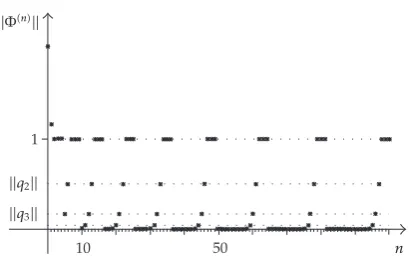
Figure 1 presents the sequence Φn
n∈N0 of the flutter function Φ, see 4.5,
graphically. Imagine a chicken that wants to escape the kitchen. It flutters up to a window one meter high, it bumps against the window and crashes down to the bottom. Then it starts the same procedure again, but it has lost energy, so it needs a longer way to flutter up again. There is no periodicity, the time difference between “downs” and “ups” increases. This fluttering upward and crashing down may be seen inFigure 1.
The next theorems reveal the part of lacunary functions and exponential functionseα for chaotic orbits of the differential operator and its attractor.
Theorem 6.2. Letf ∈ A, fx ∞i0aixi/i!forx∈Eandaii∈N0aperiodic. Then
Aifaii∈N0possesses only a finite number of cluster points, then the cluster sequenceaii∈N0 contains at least one lacuna cluster.
BIfα∈Cis a lacuna cluster of the cluster sequenceaii∈N0, then for the exponential function
eα,one has eα∈ωf.
We introduce abbreviations splitting the exponential function e1 into a Taylor polynomialTnand its remainderRn:
Tnx : n
i0
xi
i!, Rnx :
∞
in 1
xi
i!, qnx :
xn
n!. 6.1
Theorem 6.3. Let f ∈ A, fx ∞i0aixi/i!forx ∈ E and the Taylor sequenceaii∈N0 be aperiodic. Then
Afor each lacuna cluster β in the cluster sequence aii∈N0, infinitely often followed by a lacuna clusterγ /β, one has with Un:βTn γRn,
{eβ, eγ} ∪ {Un:n∈N0} ⊂ωf. 6.2
BFor each tupel b0, b1, . . . , bk−1 ⊂ Ck in the cluster sequence aii∈N0, which appears infinitely often between the lacuna clustersβandγ, one has withSn:βTn−1
k−1 j0bjqn j
γRn k−1
{eβ, eγ} ∪ {Sn:n∈N0} ⊂ωf. 6.3
CIf the cluster sequence aii∈N0 contains arbitrary many lacuna clusters but only a finite number of nonlacuna clusters, then the attractorωfis a countably infinite set.
Example for statement (A)
To define the functionΛ∈ A,we chooseaiaiaccording to the rule
ai: ⎧ ⎪ ⎪ ⎪ ⎪ ⎪ ⎨ ⎪ ⎪ ⎪ ⎪ ⎪ ⎩
0, if for k∈N0:
k
23k 3≤i≤
k
23k 5, 1, if k
23k 5< i <
k 1
2 3k 4, 2, otherwise.
6.4
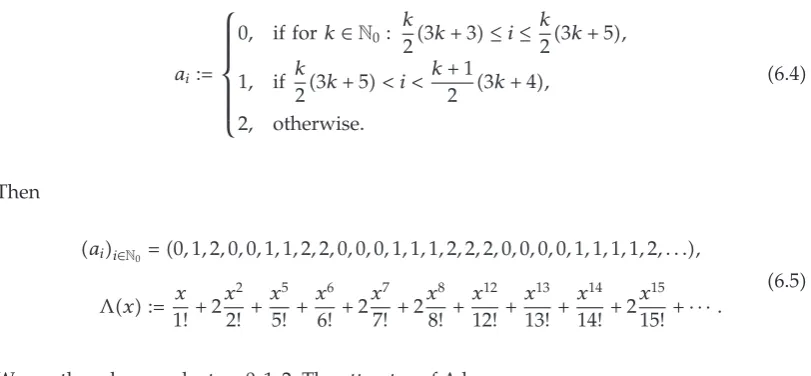
Then
aii∈N0 0,1,2,0,0,1,1,2,2,0,0,0,1,1,1,2,2,2,0,0,0,0,1,1,1,1,2, . . .,
Λx: x
1! 2
x2 2!
x5 5!
x6 6! 2
x7 7! 2
x8 8!
x12 12!
x13 13!
x14 14! 2
x15 15! · · ·.
6.5
We see three lacuna clusters 0,1,2. The attractor ofΛbecomes
[image:8.600.99.505.410.598.2]ωΛ {e0, e1, e2} ∪ {Rn:n∈N0} ∪ {Tn 2Rn:n∈N0} ∪ {2Tn:n∈N0}. 6.6
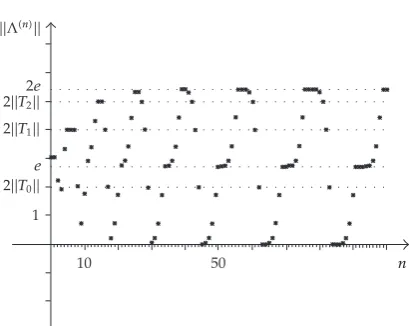
Figure 2 presents the sequence Λn
n∈N0 graphically, Figure 3 shows schematically the
orbitΛn
n∈N0 and its attractorωΛin the function spaceA. In both figures, we see the
10 50 n 2||T0||
2||T1|| e 2e
[image:9.600.197.402.90.253.2]1 2||T2|| ||Λn||
Figure 2: The sequenceΛn
n∈N0of the lacunary functionΛ.
2T1
2T0
2T2
e0 Λ2
Λ Λ1
R0
R3 R2
R1 e1 e1 R3
e1 R2 e1 R1
[image:9.600.179.421.295.444.2]e2
Figure 3: Orbit andω-limit set of the lacunary functionΛ.
Example for statement (B)
Is given by the flutter functionΦdefined in4.5, withk1, b01, βγ0.It leads to the attractor ofΦ:
ωΦ {e0} ∪ {qn:n∈N0}. 6.7
Figure 1shows the stairway{qn:n∈N0}.
Example for statement (C)
ann∈N0:
1,1
2,1,1, 1 2, 1 2, 1 3, 1 3,1,1,1,
1 2, 1 2, 1 2, 1 3, 1 3, 1 3, 1 4, 1 4, 1
4,1,1,1,1,
1 2, 1 2, 1 2, 1 2, 1 3, 1 3, 1 3, 1 3, 1 4, 1 4, 1 4, 1 4, 1 5, 1 5, 1 5, 1
5,1,1,1,1,1, . . .
.
6.8
Mathematical research on lacunary functions deals usually with unbounded coef-ficients. In addition to Theorem 5.1A, we give an example of a lacunary function with unbounded Taylor sequence, whoseω-limit set is nonempty. Forf :E → C, given by
fx:1 x
1! 1! x4 4! 3! x9 9! 5! x16 16! 7! x25 25! 9! x36
36! · · ·
1 x
∞
i2
2i−3! x
i2
i2!,
6.9
we showe0∈ωf. Thek2th derivative offis
fk2x
∞
ik
2i−3! x
i2−k2
i2−k2! 2k−3! ∞
ik 1
2i−3! x
i2−k2
i2−k2!. 6.10
Because 0∈E,we have fk2
≥2k−3!,which means that the orbit is unbounded. We consider its successorfk2 1
andfk2 1 :
fk2 1x
∞
ik 1
2i−3! x
i2−k2−1
i2−k2−1!
2k−1! x
2k
2k!
∞
ik 2
2i−3! x
i2−k2−1
i2−k2−1!
x2k 2k
∞
ik 2
xi2−k2−1
i2−k2−1 j2i−2 j
,
fk2 1 1
2k
∞
ik 2 1 i2−k2−1
j2i−2 j
< 1
2k
∞
ik 2
1 2i−2i−12−k2
.
6.11
Hence,fk2 1
→ 0 withk → ∞. We conclude the exponential functione0∈ωf.
7. Uncountable attractors
Finally, we demonstrate that not only lacunary functions may have chaotic orbits. We use the Cantor sequence
cii∈N0
1 1, 1 2, 2 2, 1 3, 2 3, 3 3, 1 4, 2 4, 3 4, 4 4, 1 5, 2 5, 3 5, 4 5, 5 5, 1 6, 2 6, 3 6, 4 6, 5 6, 6 6, 1 7, . . .
1 x 5
[image:11.600.201.398.97.254.2]Cx
Figure 4: Graph of the Cantor functionCfor real arguments.
to define an analytic functionC ∈ A. It has countably infinitely many cluster points, but no lacuna cluster:
Cx:
∞
i0
ci
xi
i! 1 1 2x
x2 2!
1 3
x3 3!
2 3
x4 4!
x5 5!
1 4
x6 6!
1 2
x7 7!
3 4
x8
8! · · ·. 7.2
With the abbreviation
sn : n
2n 1, n∈N0, 7.3
the elements of the Cantor sequencecii∈N0maybe given by
ci:
i 1−sn
n 1 for sn≤i < sn 1. 7.4
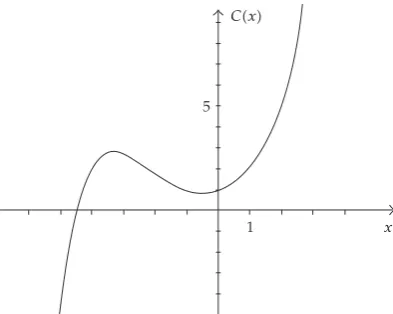
InFigure 4, we see the graph ofCfor real values.Figure 5shows the sequenceCn
n∈N of the orbit ofC. It is bounded from below by 0 and from above by the Euler numbere. It increases apparently linear in some subintervals, followed by a descent at the values
1T0, 2T1, 2.5T2, 2.6T3, 2.7083T4, . . . . 7.5
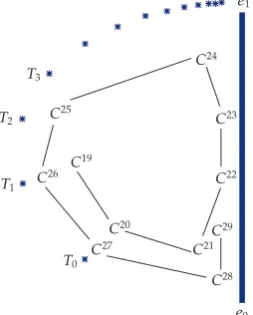
Figure 6showsωCand a subset of the orbit schematically. Like a squirrel runs up a tree, the orbit runs up along the stick {eα : α ∈ 0; 1}. After that the orbit jumps to a Taylor polynomialTmthe squirrel jumps to a branch, and to another one, lower oneTm−1, and then toTm−2, . . . , T0. Then it starts again to run upward along the stick, with one step more than before, at each circulation it reaches a higher level. It climbs up nearer and nearer to the top of the sticke1.
100 1000 n ||T1||
e
1
[image:12.600.193.410.92.238.2]||T2|| ||Cn||
Figure 5: SequenceCn
n∈Nof the Cantor functionC.
T3
T2
T1
T0
e0 e1
C27 C20
C21 C29
C28 C22 C23 C24
C25
C26 C 19
Figure 6: Orbit andω-limit set of the Cantor functionC.
Theorem 7.1. For the orbitCn
n∈N0of the Cantor functionC,one has
ACsn → 0 forn → ∞;
Bformwith 0≤m < n: Csn−m−1−T
m → 0 for n → ∞;
Cfor eachα ∈ 0; 1, there is a subsequenceCnj
nj∈I, I ⊂ N, of the orbitC n
n∈Nwith
Cnj−e
α → 0 forj → ∞;
Dlim supn→ ∞Cne1, lim infn→ ∞Cn0;
EωC {Tn:n∈N0}∪{eα:α∈0; 1}, containing uncountably many different elements.
[image:12.600.238.365.279.437.2]8. Proofs
8.1. Proof ofTheorem 5.1
Property (A)
Using2.2,
fn max x∈E
∞
i0
an i
xi
i! maxx∈E
an
∞
i1
an i
xi
i!
≥ |an| 8.1
because 0∈E. Thus,|an|n∈N0is an unbounded minorizing sequence.
Property (B)
It follows fromCwithn1 andβ0α.
Property (C)
By assumption the cluster sequenceaii∈N0 of the Taylor sequence becomes ai βimodn.
Considerp∈ Adefined by
px:
∞
i0
ai
xi
i!
∞
i0
βimodn
xi
i!
n−1
k0
βk ∞
i0
xin k in k!
n−1 k0
βkHnn−k.
8.2
Proposition 3.1 implies that the orbit pn
n∈N0 is a periodic orbit. Using 4.6, the orbit
fn
n∈N0is asymptotically periodic to its attractorωf
p, p1, p2, . . . , pn−1.
8.2. Proof ofTheorem 6.1
Using the Li/Yorke-property4.1.
A⇒BLetbii∈N0 ⊂ Cbe a periodic sequence. ThenTheorem 5.1Cimplies that
the sequencepn
n∈N, defined bypx ∞
i0bixi/i!,is a periodic orbit of system2.1. Let δ:lim supi→ ∞|ai−bi|, assumingδ >0. Using2.2,
fn−pn max x∈E
∞
i0
an i
xi
i! − ∞
i0
bn i
xi
i! maxx∈E
∞
i0
an i−bn i
xi
i!
≥ |an−bn|
because 0∈E. For infinitely manyn,we have|an−bn|> δ/2. Thus,
lim sup n→ ∞
fn−pn ≥ δ
2 >0, 8.4
wherefn
n∈Nandpnn∈Nare bounded, and hencefn−pnn∈N0is bounded too.
B⇒ALetpn
n∈N0 be a periodic orbit of system2.1. Because f n
n∈N0 and
pn
n∈N0are bounded,f
n−pn
n∈N0 is bounded too, hence we have the right part of
relation4.1. The left part follows indirectly withTheorem 5.1C.
8.3. Proof ofTheorem 6.2
Statement (A)
It can be proved directly from elementary combinatorics.
Statement (B)
1Forα0, letI ⊂N0 be the set of indices, where a block of zeros in the cluster sequence aii∈N0starts. Then forn∈I,
ai0 forn≤i < n kn, kn∈N, kn−→ ∞ for n−→ ∞. 8.5
Using2.2and4.6, we have forn∈I,
fn max x∈E
∞
i0
an i
xi
i! maxx∈E
∞
ikn
an i
xi
i! ≤
∞
ikn |an i|
1
i!. 8.6
The Taylor sequence is bounded bya∈ R . Thus,8.5guarantees that it is the case for its cluster sequence too. The latter estimate
≤a
∞
ikn
1
i! −→0 forn−→ ∞. 8.7
Hence,fn → e0 forn → ∞ande0∈ωf ωf.
2Forα /0,the functiong : f−eα is lacunary function. Thus, its Taylor sequence has the lacuna cluster 0. Using4.3and the caseα0 above imply
e0∈ωg ωf−eα −eα ωf⇐⇒eα e0eα∈ωf. 8.8
8.4. Proof ofTheorem 6.3
Statement (A)
Letm ∈ N. ForUm βTm γRm,we construct a subsequence f n
n∈I, I ⊂ N0, of the orbit fnn∈N
As assumed, the cluster sequenceaii∈N0of the Taylor sequence is of type
aii∈N0 . . . , β, γ, . . . , β, β, γ, γ, . . . , β, β, β, γ, γ, γ, . . .. 8.9
The lastβin a row ofβ’s defines an indexn∈I, where
I:{n∈N:aiβforn−m≤i≤nand aiγ forn < i≤n k withk≥m}. 8.10
Note thatIis an infinite set. Using2.2, we find for the derivativefn−m,
fn−m
−Um max x∈E
∞
i0
an−m ix i
i! −β m
i0
xi i! −γ
∞
im 1
xi i!
max x∈E
∞
in k 1
an−m i−γ
xi
i! ≤
∞
in k 1
|an−m i−γ| 1
i!.
8.11
As assumed, the sequenceaii∈N0is bounded, thus|ai−γ|i∈N0is bounded by a real number
c∈R , thus,
fn−m
−Um ≤ c ∞
in k 1 1
i! −→0 forn−→ ∞, n∈I. 8.12
Hence,fn−m → Umforn → ∞, n∈I andUm∈ωf ωf.
Statement (B)
Let m ∈ N. For Sm, we construct a subsequencef
n
n∈I, I ⊂ N0, of the orbitf
n
n∈N0,
converging toSm. At indexnstarts a row ofβ’s, at indexn mthe tupel, and atn m ka row ofγ’s, which has its end at index n m k Mn−1. We define the setIby
I :{n∈N0 :an iβfor 0≤i < m, an ibi−mform≤i < m k,
an iγ form k≤i < m k Mn,
an i/γ forim k Mn},
8.13
whereIcontains infinitely many elements. Becauseγis a lacuna cluster, we have
Forn∈I, we consider thenth derivativefn, using2.2and the abbreviationM:Mn,
fn
∞
i0
an iqi
β
m−1
i0
qi mk−1
im
bi−mqi γ
m kM−1
im k
qi ∞
im k M
an iqi
βTm−1 k−1
j0
bjqm j γRm k−1−Rm k M−1 ∞
im k M
an iqi.
8.15
ToSm,it has the distance
fn
−Sm ∞
im k M
an iqi−γRm k M−1
∞ im k M
an i−γqi
≤ ∞
im k M
|an i−γ|qi ∞
im k M
|an i−γ| 1
i!.
8.16
The sequence|ai−γ|i∈Nis bounded byc∈R , thus the latter term
≤c
∞
im k M 1
i!. 8.17
Because of8.14, the sum converges to 0 forn → ∞. Thus,
fn−Sm −→0 for n−→ ∞, n∈I, Sm∈ωf ωf. 8.18
Statement (C)
If there is only one lacuna cluster in the cluster sequence, then statementBimplies with
βγthat the attractor is countably infinite.
If there are infinitely many lacuna clustersα1, α2, α3, . . .in the cluster sequence, then statement A implies for each couple αj, αj 1 countably infinitely many elements of the attractor. Using countable×countable = countable, we concludeC.
8.5. Proof ofTheorem 7.1
From7.4, we find fork1,2, . . . , n
csn
1
n 1, csn k
k 1
n 1, csn−k
n 1−k
Statement (A)
Using8.19and 0< ci≤1, we have for sufficiently largen,
Csn
n
i0
i 1 n 1 xi i! ∞
in 1
csn i
xi i! ≤ 1 n 1 n
i0
i 1x
i
i! ∞
in 1
csn i
xi i! < 1 n 1 ∞
i0
i 11 i!
∞
in 1
xi i!
2e1
n 1 Rn −→0 forn−→ ∞.
8.20
Statement (B)
Letn, m∈N0, m < n. ForTm, see6.1and7.5, using2.2and8.19, we have
Csn−m−1x ∞
i0
csn−m−1 i
xi
i!
m i0
n−m i
n xi
i!
nm 1
im 1
i−m
n 1
xi
i! ∞
in m 2
csn−m−1 i
xi
i!
Tmx 1
n
m
i0
i−mx
i
i! 1
n 1
nm 1
im 1
i−mx
i
i! ∞
in m 2
csn−m−1 i
xi
i!.
8.21
This leads to
Csn−m−1−T m ≤
1
n
m
i0
i−mx
i i! 1 n 1 nm 1
im 1
i−mx
i
i!
∞ in m 2
csn−m−1 i
xi i! ≤ 1 n m
i0
|i−m| i!
1
n 1
nm 1
im 1
|i−m|
i! Rn m 1 −→0 for n−→ ∞.
8.22
Statement (C)
Statement A implies the statement is valid for α 0. From statement B, we conclude
Tm∈ωC for eachm∈N0. Because of limm→ ∞Tme1andTheorem 5.1, we finde1 ∈ωC. Thus, the statement is true forα1.
Let 0< α <1 andε >0.Due to the fact thatQis dense inR, we find a rational number
Forε >0,we choosek∈Nsuch that
e k <
ε
3, Rk<
ε
3. 8.23
We definem:kp−1 andn:kq−1.
This leads to n−mkq−p≥k and
Rn−m ≤ Rk<
ε
3. 8.24
Furthermore, we have
mn 11−αp
q−α
< ε
3e. 8.25
Using2.2,8.19,8.23,8.24,8.25, we deduce
Csn m−e α
∞
i0
csn m i
xi
i! −α ∞
i0
xi
i!
n−m i0
m i 1
n 1
xi
i! −α n−m
i0
xi
i! ∞
in−m 1
csn m i
xi
i! −α ∞
in−m 1
xi
i!
n−m i0
m 1
n 1 −α
xi
i! n−m
i0
i n 1 xi i! ∞
in−m 1
csn m i−α
xi
i!
≤n−m
i0
mn 11 −α1 i!
n−m
i1 1
n 1
1 i−1!
∞
in−m 1
csn m i−α
1
i!
< ε
3e
n−m
i0 1
i! 1
kq
n−m
i1 1 i−1!
∞
in−m 1 1
i! <
ε
3ee
1 1
kqe
1 R
n−m< ε3 ε3 ε3 ε. 8.26
Thus, we have proved statementC. Statements DandEfollow by usingA,B, and C.
Acknowledgment
The author would like to thank Rudolf GorenfloFree University of Berlinfor discussions.
References
1 G. R. MacLane, “Sequences of derivatives and normal families,” Journal d’Analyse Math´ematique, vol. 2, no. 1, pp. 72–87, 1952.
3 R. Remmert, Funktionentheorie. II, vol. 6 of Grundwissen Mathematik, Springer, Berlin, Germany, 1995. 4 T.-Y. Li and J. A. Yorke, “Period three implies chaos,” The American Mathematical Monthly, vol. 82, no.
10, pp. 985–992, 1975.
5 F. R. Marotto, “Snap-back repellers imply chaos in Rn,” Journal of Mathematical Analysis and
Applications, vol. 63, no. 1, pp. 199–223, 1978.
6 G. Godefroy and J. H. Shapiro, “Operators with dense, invariant, cyclic vector manifolds,” Journal of
Functional Analysis, vol. 98, no. 2, pp. 229–269, 1991.
7 S. Rolewicz, “On orbits of elements,” Studia Mathematica, vol. 32, pp. 17–22, 1969.
8 K.-G. Grosse-Erdmann, “Universal families and hypercyclic operators,” Bulletin of the American
Mathematical Society, vol. 36, no. 3, pp. 345–381, 1999.
9 “Hypercyclic and chaotic operators,” in Proceedings of the 1st French-Spanish Congress of Mathematics, Zaragoza, Spain, July 2007.
10 W. Bayer and R. Gorenflo, “Devaney chaos in iterated differentiation of analytic functions,” Preprint FU Berlin Nr. A-21-99,http://www.math.fu-berlin.de/publ/index.html.
11 W. Bayer, “A flutter function reveals the chaos of differential calculus,” Archiv der Mathematik, vol. 75, no. 4, pp. 272–279, 2000.
12 K. T. Alligood, T. D. Sauer, and J. A. Yorke, Chaos: An Introduction to Dynamical Systems, Textbooks in Mathematical Sciences, Springer, New York, NY, USA, 1997.
13 R. L. Devaney, An Introduction to Chaotic Dynamical Systems, Addison-Wesley Studies in Nonlinearity, Addison-Wesley, Redwood City, Calif, USA, 2nd edition, 1989.
14 W. Bayer, “Hyperbolische Funktionen und die Zyklen der Differenzialrechnung,” Der