SEQUENTIAL PAGING TECHNIQUE in the FORUTH GENERATION
COMMUNICATION SYSTEM
Mudathir A. O. Fagiri*1 and Mohamed H. M. Nerma*2
*
Assistant Professor at Sudan University of Science and Technology – College of Engineering – School of Electronic Engineering, Khartoum, SUDAN. Eastern Diems,
ABSTRACT
The process of finding a unit in a mobile communication system is called paging and requires the user of limited network resources, although it is understood how to minimize the use of network resources. As analysis for Sequential paging procedure in LTE cellular communications system for number of users requesting services from different track areas. By studying and analysis of sequential paging to determine the user equipment location when there is an incoming data arrived to user equipment, determine number of polling cycle in sequential paging, and determine the average delay time. To solve the problem of delay time to find the user, has been studied sequential paging by designed a simulation code in MATLAB to be studied And simulations have been obtained the results of paging it was a table includes ten users where each user's number of Track area and No. page Zone and number of cell in page Zone and the probability of occurrence in other page Zone and number of polling cycle, And the average delay time to find this user, was obtained graphics to explain that table more precisely.
Keywords: LTE, Paging, Paging Probability, Polling Cycle, Delay Time.
1. Introduction
The process of finding a unit in a mobile communication system is called paging and
requires the user of limited network resources, although it is understood how to minimize the use
When a call arrives for a mobile user in a cellular network, it is necessary to determine
the location of this user in order to route the call appropriately. In the earliest cellular systems,
this was accomplished by paging all the cells in the network [1]. Such an approach incurs a
significant cost in radio bandwidth utilization and is cost-effective only in small networks. The
second generation networks introduced the notion of location updates, whereby the system is
divided into a number of location areas (LA’s), and the mobile unit notifies the network when it moves from one location area to another. Upon arrival of a call, all the cells within the user’s
current location area are paged [2].
In a mobile telecom network, the locations of the User Equipment’s (UEs) are tracked so
that incoming calls can be delivered to the UEs. Typical mobility management procedures
include location update and paging. When a UE moves from one location to another location, the
UE reports its new location to the network through the location update procedure. When an
incoming call to the UE arrives, the network identifies the location of the UE via the paging
procedure [3], [4].
Long Term Evolution (LTE) promises higher data rates, 100Mbps in the downlink and
50Mbps in the uplink in LTE’s first phase, and will reduce the data plane latency and supports
interoperability with other technologies such as GSM, GPRS and UMTS. Plus, LTE has support
for scalable bandwidth, from 1.25MHz to 20MHz. All these features make LTE a very attractive
technology for operators as well as the subscribers [4].
Paging is usually considered to be the “low end" of mobile communications or the poor
man's mobile communications. The paging concept was first conceived in 1939. The first
practical and commercial unit was created in 1950 by Al Gross. The first commercial unit was
licensed by the FCC in 1952. Paging is less expensive than other mobile communications
systems because it was and still is primarily a one-way system. The paging receiver alerts the
user to the call but does not verify or respond in any way to the base station. The cost and bulk of
a typical mobile transceiver is due to the transmit portion, which is missing from a paging
receiver, therefore, it can be small and cheap [5].
Paging has become a part of the mainstream consumer market. Executives and teenagers
alike now use pagers that allow them to communicate wherever they are. This trend has given
Paging systems to date have satisfied most requirements for tone, numeric, and short
alphanumeric messaging with sufficient subscriber capacity for the service providers. Cellular
and PCs service providers are already integrating paging capabilities into their handsets. The
challenge facing paging service providers is differentiating them. Pagers can either integrate
low-quality voice messaging or expand their existing messaging and data capabilities [5].
The paging procedure is initiated by the MSC when it needs to communicate with the Ms
(for an incoming call for instance). It then sends a Paging command to the BSC which, in
turn, broadcasts it over a number of cells [6].
In this type, the user is paged sequentially in groups of cells in the LA. The
sub-groups are ordered in their estimated probabilities of having the user located in them [7].
A sequential paging scheme is one where the cells in a location area are partitioned into indexed
groups referred to as paging zones on the basis of the cell-wise user location probabilities. Let
{Z1, Z2, ….. , Zw} be the w-partition of the set C (i.e. a partition of C into w groups), where each
Zi is non-empty and corresponds to a distinct paging zone. When a call arrives for a user, the
cells in paging zone Z1 are paged simultaneously in the first round, then if the user is not found
in Z1, all the cells in paging zone Z2 are paged, and so on [8]. Example of location area and
paging zones is shown in figure 1.
Let the number of cells in the i'th paging zone be denoted by ni= |Zi|, and let pi be the
corresponding zone location probability of the user:
i Z j i jP (1)
That {Z1, Z2 . . . , Zw} is a non-increasingly ordered partition of C if for all i (part of) Zk and j
(part of) Zl such that (k <= l), it is true that (pi I >= pij). Note that if we have a non-increasingly
ordered partition, then each paging zone will consist of contiguously numbered cells. Thus,
Z1 = {1, 2 . . . n1}, Z2 = {n1 +1 . . . n1 +n2}, and so on.
We now have the following observations:
• The total number of paging zones into which the location area is partitioned, w, represents
the worst case delay in locating the mobile user.
• The average paging delay (number of paging rounds) in locating a mobile, D', can be
w
i i
iP D
1
(2)
Figure 1 Location area and paging zones
The following concepts are used in paging of LTE:
- Tracking Area is a logical concept of an area where a user can move around without updating
the MME [9].
- A blocked page is a page that cannot be transmitted over the air interface at the first valid
Paging Occasion (PO) due to lack of resources [10].
- Page is the message sent by the Mobility Management Entity (MME) to the User Equipment
(UE) during paging [8].
- Paging is the procedure in which the MME notifies an idle UE about an incoming data
connection, the procedure includes sending a paging message over the S1 Application Protocol
(S1-AP) and the air interface [8].
- Paging capacity is the average number of pages per second that a node can handle; Paging
capacity incorporates various margins to manage conditions like traffic fluctuations [8].
- Paging Frame (PF) is the radio frames where UE paging can take place [11].
- Paging load is the fraction of resources required for paging [11].
- Paging Occasion (PO) is the sub frames where UE paging can take place [11].
- Paging record is Pages to different UEs can be multiplexed in the same Radio Resource Control
(RRC) paging message. A paging record is the information associated with one of those pages
[11].
2. Simulation Parameters
1- n = 5 cells in location area, C = {1, 2, 3, 4, 5}
i 1 2 3 4 5
i 0.3 0.3 0.25 0.1 0.05
3- Number of paging zones w = 2
4- Paging zones: Z1 = {1, 2}, Z2 = {3, 4, 5}
5- Number of cells in each paging zone:
n1 = |Z1| = 2, n2 = |Z2| = 3
6- Zone location probabilities:
p1= 0.3 + 0.3 = 0.6, p2= 0.25 + 0.1 + 0.05 = 0.4
7- Average paging delay:
D = 1p1+ 2p2= 1 × 0.6 + 2 × 0.4 = 1.4
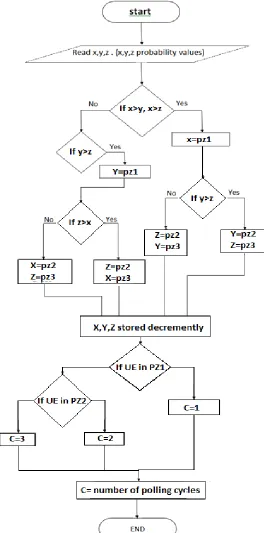
As study in sequential paging procedure there is a system including nine tracking areas,
and each Track area have three page zone and each page zone have three cells, each a page zone
and cells have a specific property that paged the paging zones by the highest probability firstly
and paged the cells on the highest paged zone sinuously if it found the user in first page zone this
called round one (one polling cycle) and if the user not found them in first page zone, thin paged
the second page zone if the user found in the second page zone this called round two (two polling
cycle) if it’s not found them in a second page zone, then paged the last third page zone in this
Figure 2 the flow chart of sequential paging
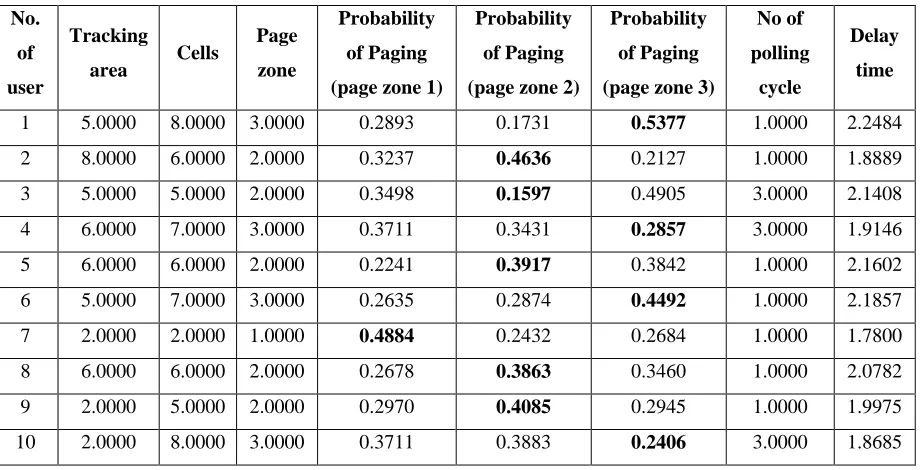
The number of tracking area, the number of cells, the number of page zone, the probability of
Table 1 paging probability for ten users:
No.
of
user
Tracking
area Cells
Page
zone
Probability
of Paging
(page zone 1)
Probability
of Paging
(page zone 2)
Probability
of Paging
(page zone 3)
No of
polling
cycle
Delay
time
1 5.0000 8.0000 3.0000 0.2893 0.1731 0.5377 1.0000 2.2484
2 8.0000 6.0000 2.0000 0.3237 0.4636 0.2127 1.0000 1.8889
3 5.0000 5.0000 2.0000 0.3498 0.1597 0.4905 3.0000 2.1408
4 6.0000 7.0000 3.0000 0.3711 0.3431 0.2857 3.0000 1.9146
5 6.0000 6.0000 2.0000 0.2241 0.3917 0.3842 1.0000 2.1602
6 5.0000 7.0000 3.0000 0.2635 0.2874 0.4492 1.0000 2.1857
7 2.0000 2.0000 1.0000 0.4884 0.2432 0.2684 1.0000 1.7800
8 6.0000 6.0000 2.0000 0.2678 0.3863 0.3460 1.0000 2.0782
9 2.0000 5.0000 2.0000 0.2970 0.4085 0.2945 1.0000 1.9975
10 2.0000 8.0000 3.0000 0.3711 0.3883 0.2406 3.0000 1.8685
3. Results and Discussion
Figure 3 represent the first column of the results called Tracking area and show the number of
[image:7.612.181.431.458.656.2]tracking area for all users, and the values are restricted from 1to 8.
Figure 4 Number of cells for users for paging
Figure 4 show the second column of results cells Number and the value of the cells is limited
from 1 to 9. The results of the graphs number of cells, found that the first user in cells number
eight, the second user was found in cells number six, the third user was found in cells number
[image:8.612.193.418.382.565.2]five, and the other users like shown in Figure 4.
Figure 5 Number of page zone for paging
Figure 5 show the page zone Number and the value of the page zone is limited from 1 to 3.
The results of the graphs for number of page zone, found that the first user in page zone number
three, the second user was found in page zone number two, the third user was found in page zone
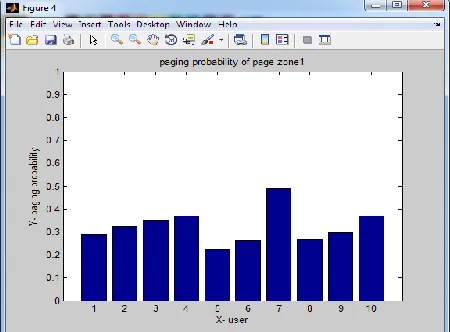
Figure 6 Paging Probability of page zone One for paging
Figure 6 represented in fourth column of results paging probability of page zone one and the
value of the paging probability is limited from 0 to 1. The results of the graphs for Paging
Probability of page zone one, found there is one user located in page zone one, that user is
number seven because the paging probability of users it’s the same to the paging probability of
[image:9.612.202.424.384.570.2]page zone number one, the paging probability for user number seven is 0.4884.
Figure 7 Paging Probability of page zone two for paging
Figure 7 show the results of paging probability of page zone two and the value of the paging
probability is limited from 0 to 1. The results of the graphs for Paging Probability of page zone
two, found there are five users located in page zone two, that users are (two, three, five, eight,
nine) because the paging probability of users it’s the same to the paging probability of page zone
user number three is 0.1597, and the paging probability for user number five is 0.3917, and the paging probability for user number eight is 0.3863, and the paging probability for user number nine is 0.4085, and in the second case found there are no paging probability for any users in page zone two.
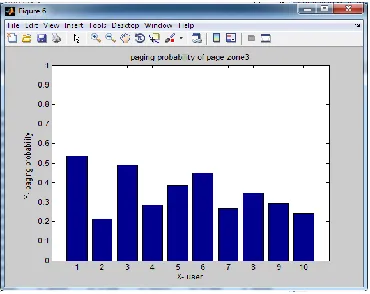
Figure 8 Paging Probability of page zone three for paging
Figure 8 show the results of paging probability of page zone three and the value of the paging
probability is limited from 0 to 1. The results of the graphs for Paging Probability of page zone
three, found there are four users located in page zone three, that users are (one, four, six, ten)
because the paging probability of users it’s the same to the paging probability of page zone
[image:10.612.199.427.485.659.2]number three, the paging probability for user number one is 0.5377, and the paging probability for user number four is 0.2857, and the paging probability for user number six is 0.4492, and the paging probability for user number ten is 0,2406.
In Figure 9 the results represent the number of polling cycle and the value of the polling cycle
is limited from 1 to 3.
The results of the graphs for number of polling cycle, found that the first user is found with one
polling cycle, the second user in the first case was found with one polling cycle, and the third
[image:11.612.206.419.189.358.2]user was found with three polling cycle, and the other users like shown in Figure 9.
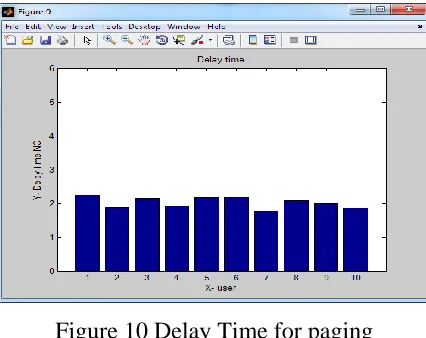
Figure 10 Delay Time for paging
Figure 10 that contain eight columns of results of delay time for any users and the value of the
delay time it is rand and depends on the paging probability. The results of the graphs for Delay
time, the average delay time shown in column eight in the Table 1.
4. Conclusion:
In the LTE networks with limited radio resources, it is desirable to minimize the radio
costs when locating mobile users during call arrival. Sequential paging schemes permit a
reduction in paging costs at the expense of potentially greater delay. It presented a how search a
user to solve the problem of minimizing the average paging cost under the constraint on average
delay. This problem had previously been considered computationally intractable. The results
show that the task of determining the users by using sequential paging scheme.
REFERENCES
[1] ANSI/EIA/TIA, “Mobile station-land station compatibility specification,” EIA/TIA
Technical Report 553, 1989.
[2] R. Jain, Y-B Lin, and S. Mohan, “Location Strategies for Personal Communications
[3] 3GPP. 3rd Generation Partnership Project; Technical Specification Group Services and
System Aspects, General Packet Radio Service (GPRS) enhancements for Evolved
Universal Terrestrial Radio Access Network (E-UTRAN) access. Technical Specification
3GTS 23.401 version 10.0.0 (2010-06), 2010.
[4] 3GPP. 3rd Generation Partnership Project, Technical Specification Group Radio Access
Network, Evolved Universal Terrestrial Radio Access (E-UTRA) and Evolved Universal
Terrestrial Radio Access Network (E-UTRAN), Overall description, Stage2. Technical
Specification 3G TS 36.300 version 10.1.0 (2010-09), 2010.
[5] P.J.Louis, “Telecommunication Internetworking,” McGraw-Hill, Mar. 2000.
[6] Nishit Narang and Sumit Kasera, “2G Mobile Network: GSM and HSCSD,” Tata
McGraw-Hill Education, Dec 2006.
[7] G. Wan and E. Lin, “A Dynamic Paging Scheme for Wireless Communication Systems,”
Proceedings of the ACM/IEEE International Conference on Mobile Computing and
Networking, MOBICOM 1997, p. 195-203.
[8] A. Abutaleb and V.O.K. Li, “Paging strategy optimization in personal communication
systems,” Wireless Networks, vol. 3, no. 3, p. 195-204, 1997.
[9] http://lte-concepts.blogspot.com/2011/06/paging-concepts-in-lte.html#uds-search-results.
[10] http://www.sharetechnote.com/html/Handbook_LTE_Tracking_Area.html.
[11] B.Krishnamachari, R.-H. Gau, S. Wicker, and Z. Haas, “On the Performance of
Sequential Paging for Mobile User Location,” IEEE Vehicular Technology Conference