IMPLEMENTATION OF WDR-ROI (WAVELET DIFFERENCE
REDUCTION-REGION OF INTEREST) ALGORITHM FOR IMAGE
COMPRESSION
Priyanka Singh,
Research Scholar Amity University, Gurgaon, ECE Department, Gurgaon, Haryana, India.
Dr. Priti Singh,
Professor, ECE Department, Amity University, Gurgaon, Haryana, India.
ABSTRACT
This paper shows the comparative analysis of WDR (Wavelet Difference Reduction) and WDR-ROI (Wavelet Difference Reduction- region of interest). One of the defects of SPIHT is that it only implicitly locates the position of significant coefficients. This makes it difficult to perform operations which depend on the position of significant transform values, such as region selection on compressed data. Region selection, also known as region of interest (ROI), means a portion of a compressed image that requires increased resolution. Using MATLAB Toolbox we have calculated CR, PSNR and BPP and compared their results. We have analyzed that Wavelet Difference Reduction using Region of interest algorithm given best results comparatively normal Wavelet Difference Reduction. WDR-ROI algorithm is best suited algorithm for Medical images and satellite images which requires increase resolution area.
Keywords: Image Compression, WDR, WDR-ROI, CR, PSNR, BPP.
1 Introduction
embedded image coder. In both SPIHT and WDR techniques, the zero tree data structure is precluded, but the embedding principles of lossless bit plane coding and set partitioning are preserved. The only difference between WDR and bit-plane encoding is the significant pass. In WDR, the output from the significance pass consists of the signs of significant values along with sequences of bits which concisely describe the precise locations of significant values.
2 Theory
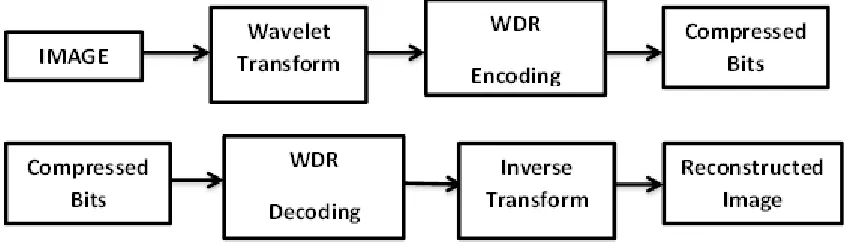
[image:2.612.70.495.334.457.2]In the WDR algorithm, instead of employing the zero trees, each coefficient in a decomposed wavelet pyramid is assigned a linear position index. The output of the WDR encoding can be arithmetically compressed [1, 2]. The method that they describe is based on the elementary arithmetic coding algorithm described in [2]. Figure 1.1 shows the compression and decompression system of WDR Algorithm.
Fig. 1 WDR Compression & Decompression System
The WDR algorithm is a remarkably simple procedure. A wavelet transform is applied to the image. Then, the bit-plane encoding procedure for the transform values, described in [5] and [3], is carried out. This bit-plane encoding procedure consists of a significance pass and a refinement pass.
3 WDR Algorithm
3.1 Initialization
bands, column based scanning is used in the vertical sub bands, and zigzag scanning is used for the diagonal and low-pass sub bands. As the scanning order is made, an initial threshold T0 is
chosen so that all the transform values satisfy |Xk|< T0 and at least one transform value satisfies
|Xk|>= T0 / 2.
3.2 Significance pass
In this part, transform values are deemed significant if they are greater than or equal to the threshold value. Then their index values are encoded using the difference reduction method of Tian and Wells [4]. The difference reduction method essentially consists of a binary encoding of the number of steps to go from the index of the last significant value to the index of the current significant value. The output from the significance pass includes the signs of significant values along with sequences of bits, generated by difference reduction, which describes the precise locations of significant values.
3.3 Refinement pass
The refinement pass is to generate the refined bits via the standard bit-plane quantization procedure like the refinement process in SPHIT method [3]. Each refined value is a better approximation of an exact transform value. Repeat steps (2) through (4) until the bit budget is reached
4 Methodology
4 Results
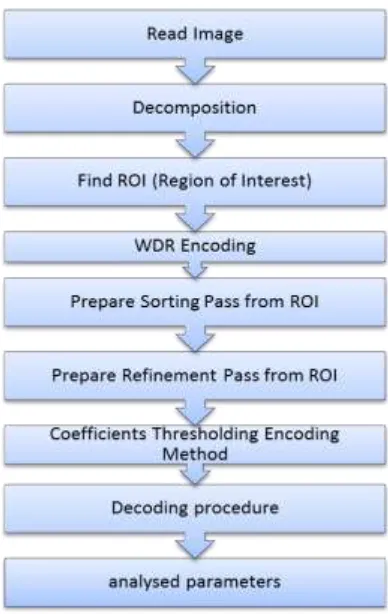
We have implemented a new improved WDR Algorithm with Region of interest concept on rice image to calculate CR, MSE, BPP, and PSNR. We have used MATLAB 2011 wavelet toolbox for implementing these methods. Figure 2 shows an original Natural image compressed by WDR Algorithm Figure 3 shows an original Natural image and compressed image using our proposed (WDR-ROI) Algorithm.
[image:4.612.208.402.84.391.2]50 100 150 200 250 50 100 150 200 250
Compression Ratio: 47.37 % BPP: 3.79
50 100 150 200 250
50 100 150 200 250
50 100 150 200 250
50
100
150
200
250
Compression Ratio: 47.37 % BPP: 3.79
50 100 150 200 250
50
100
150
200
250
Fig 2: Original Natural image compressed image using WDR
[image:5.612.89.525.520.656.2]
Fig.3 Compressed image using WDR algorithm and WDR-ROI concept
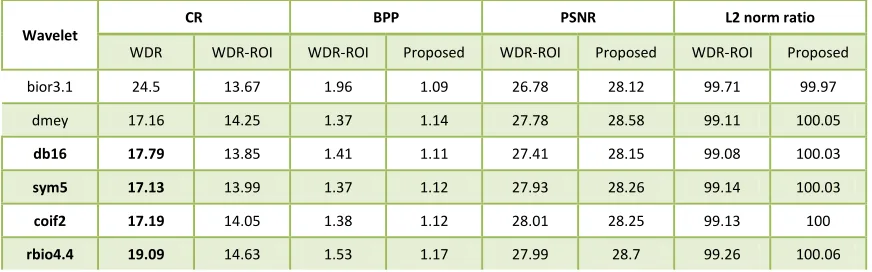
Table 1 Following table shows the various calculated parameters for rice image using WDR Algorithm and using WDR-ROI concept.
Wavelet
CR BPP PSNR L2 norm ratio
WDR WDR-ROI WDR-ROI Proposed WDR-ROI Proposed WDR-ROI Proposed
bior3.1 24.5 13.67 1.96 1.09 26.78 28.12 99.71 99.97
dmey 17.16 14.25 1.37 1.14 27.78 28.58 99.11 100.05
db16 17.79 13.85 1.41 1.11 27.41 28.15 99.08 100.03
sym5 17.13 13.99 1.37 1.12 27.93 28.26 99.14 100.03
coif2 17.19 14.05 1.38 1.12 28.01 28.25 99.13 100
rbio4.4 19.09 14.63 1.53 1.17 27.99 28.7 99.26 100.06
Fig. 4: Comparison Chart of CR and PSNR of an image using WDR and WDR-ROI Algorithm
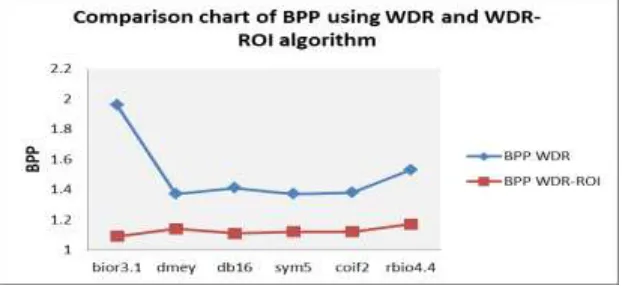
Fig. 5: Comparison Chart of BPP of an image using WDR and WDR-ROI Algorithm
5 Conclusion
[image:6.612.152.463.285.428.2]from all results we can say that bior3.1 provides best results. Its main application is now a day in telemedicine and in tele consultation where a lot of medical images are sent on-line in India or out of India for the super specialist doctors to proper digonisis.so at the receiving end picture should be very clear. It is expected that the volume of uncompressed data produced by hospitals will exceed capacity and drive up costs even as the capacity of storage media continues to increase. However, unlike many other compression applications, medical imaging application demands lossless or high-fidelity image compression. It is clear that lossless compression is a legal technical approach by ensuring perfect reconstruction of the original. But after decades of active research on lossless compression, the achievable compression ratio remains low. As in telemedicine, videos and the medical images are transmitted through advanced telecommunication links, so the help of medical image compression to compress the data without any loss of useful information is immense importance.
References
1. T.Ramaprabha, Dr M.Mohamed Sathik, “A Comparative Study of Improved Region Selection
Process in Image Compression using SPIHT and WDR” International Journal of Latest Trends in
Computing (E-ISSN: 2045-5364) Volume 1, Issue 2, December (2010).
2. S.P.Raja, Dr. A. Suruliandi “Performance Evaluation on EZW & WDR Image Compression
Techniques”, IEEE Trans on ICCCCT, (2010).
3. James S. Walker “Wavelet-based Image Compression” CRC Press book Transforms and Data
Compression.
4. S. Mallat. A Wavelet Tour of Signal Processing. Academic Press, New York, NY, (1998).
5. Stuart Lawson and Jian Zhu “Image compression using wavelets and JPEG2000: A Tutorial” journal
of ECEJ, (2003).
6. Adnan Khashman, and Kamil Dimililer, “Comparison Criteria for Optimum Image Compression”,