A FIRST PRINCIPLES STUDY OF DEFECTS IN A-SI
R.Khatri,
Department of Physics, DAV College, Abohar, India.
ABSTRACT
The structural and electronic properties of vacancies in a fully tetrahedral model of amorphous
silicon have been investigated by ab initio calculations. A very rich behavior was observed after
the atomic relaxation, from the complete rearrangement of the atoms (self-healing) to the
creation of stable vacancies. We have observed that the vacancy internal relaxation volume is
negative. After relaxation, the vacancy formation energies were found to be smaller than that of
the crystal, and the deep gap levels either disappear or move towards the band edges.
Introduction
Amorphous silicon (a-Si) has been the subject of extensive experimental and theoretical
investigations over decades and it is the prototype of disordered covalent semiconductors [1,2].
From the structural point of view, a-Si is considered to have the atoms tetrahedrally coordinated
and covalently bonded [1,2]. However, recent experimental [3,4] and theoretical results [5–7]
have suggested that vacancy-like defects could be stable and play an important role in the
electronic and structural properties of a-Si. These experiments indicate that structural relaxations
in a-Si generated by ion bombardment are quite similar to the annealing of point defects in
crystalline silicon (c-Si) [3,4]. Up to now, to our knowledge, theoretical studies have been
carried out using either empirical potentials [5] or tight binding simulations [6,7].
The aim of this work is to study the electronic and structural properties of vacancies in a-Si using
ab initio methods. In particular, we are interested in investigating aspects such as the range of
structural relaxation and vacancy annihilation. Furthermore, we would like to determine the
differences and similarities between vacancies in a-Si and in c-Si.
In order to investigate the effects of isolated vacancies, we adopt the fully tetrahedral continuous
network with 216 Si atoms in the simulation supercell generated by the Wooten, Winer and
Weaire (WWW) scheme [8]. This supercell is large enough to avoid interactions between the
neighboring image defects. This structural model has been tested and its physical properties
(Raman spectrum, radial distribution function, vibrational density of states, etc.) are in good
agreement with the experimental data [9].
By removing an atom of the WWW structure one generates the vacancy-like defect,
consequently creating a dangling bond in each one of the four neighboring atoms. Since in the
amorphous material there are nonequivalent sites, we have chosen 10 different atoms with
distinct local environments (bond lengths and bond angles) in order to have a representative
sampling.
The electronic structure calculations are based on the density functional theory within the local
density approximation [10]. The Kohn–Sham orbitals are expanded in a localized basis function
of double-zeta-pluspolarization (DZP) quality [11], using the SIESTA code [12]. For each one of
the 10 studied cases, the structure with a vacancy was relaxed employing the conjugate gradient
method. The norm-conserving pseudopotentials of Troullier–Martins were used in this study
[13].
Furthermore, systems were considered fully relaxed when the Hellmann–Feymann forces were
smaller than 0.01 eV/Å. The point has been used for the Brillouinzone sampling and the
supercell volume was fixed during the calculations.
Results and discussion
The vacancy formation energy (EF) is defined as EF =𝐸𝑇𝑂𝑇𝑁−1 − (𝑁 − 1)/𝑁𝐸𝑇𝑂𝑇𝑁 , where 𝐸𝑇𝑂𝑇𝑁−1 and
𝐸𝑇𝑂𝑇𝑁 are the total energies for the calculations with (N - 1 sites) and without (N sites) the
vacancy, respectively. This quantity was calculated before and after the atomic relaxation and
compared with that of a relaxed vacancy in crystalline Si (3.44 eV). Before relaxation, the
eV. After relaxation, they always decrease, and in all cases except one the final formation
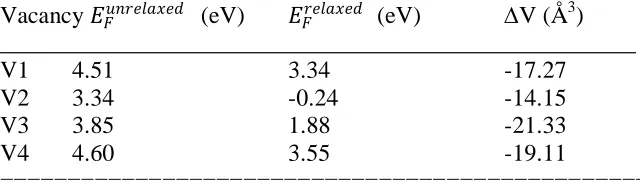
energies are smaller than that of c-Si. The results for four typical sites are described in Table 1.
As can be seen, even a negative formation energy (after relaxation) has been observed for one
site (V2).
We have also investigated the internal volume of these vacancies using the definition of internal
volume as suggested by Kim et al. in reference [6]. As observed for the bulk Si, the internal
volume of vacancies in a-Si decreases with the atomic relaxation. It is means that for all sites
studied, the nearest-neighboring atoms move towards the vacancy site. These results are in
disagreement with tight-binding calculations, where both positive and negative variations of
internal volume have been reported [6]. During the structural relaxation only the local
environment close to the vacancy has significantly changed. This observation suggests that the
relaxations in a-Si are more closely related to point-like defects relaxations rather than global
network changes.
Regarding the electronic structure properties, we find that the overall density of states (DOS) for
the a-Si with and without a vacancy are rather similar. Obviously, before the structural
relaxation, there are deep impurity levels in the gap, related to the four dangling bonds of the
[image:3.612.72.392.521.611.2]neighboring atoms to the vacancy. After relaxation, basically four different cases were observed
Table 1
Physical properties of single vacancies in a-Si WWW model _____________________________________________________
Vacancy 𝐸𝐹𝑢𝑛𝑟𝑒𝑙𝑎𝑥𝑒𝑑 (eV) 𝐸𝐹𝑟𝑒𝑙𝑎𝑥𝑒𝑑 (eV) V (Å3)
_____________________________________________________
V1 4.51 3.34 -17.27
V2 3.34 -0.24 -14.15
V3 3.85 1.88 -21.33
V4 4.60 3.55 -19.11
================================================ Table displays: a vacancy label; the formation energies before (𝐸𝐹𝑢𝑛𝑟𝑒𝑙𝑎𝑥𝑒𝑑 and after 𝐸
𝐹𝑟𝑒𝑙𝑎𝑥𝑒𝑑 the atomic relaxation; the change
of the vacancy internal volume (V = Vrelax - Vunrelaxed).
for the behavior of these gap levels: (i) a full vacancy reconstruction with the disappearance of
conduction band; (iii) partial reconstruction (dangling bonds) with the gap states shifted to the
top of the valence band; and (iv) stable vacancies, with the gap states shifted both to the top of
the valence band and to the bottom of the conduction band.
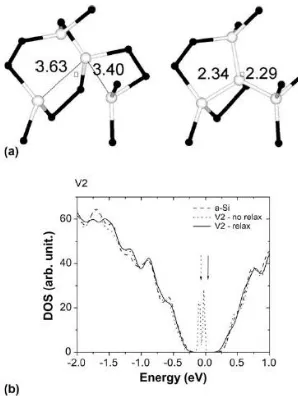
The case (i) above (V1 in Fig. 1) is related to sites where all atoms became tetrahedrally bonded
after the structural relaxation, as can be seen in Fig. 1(a). The DOS curves (obtained from the
calculated eigenvalues with a Gaussian line broadening of 0.01 eV inside, and 0.1 eV outside,
the gap region) clearly show that this vacancy, with a negative formation energy and full lattice
reconstruction (self-healing), does not present any gap states. The bond lengths between atoms
near to the vacancy site become smaller than the average bond length obtained for the a-Si
(2.347 Å). In summary, this case can be considered as a full annihilation of the vacancy after the
atomic relaxation.
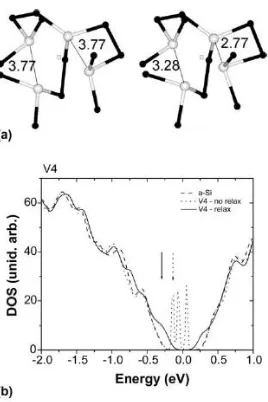
Now we turn to a situation (V4 in Fig. 2) where all atoms remain tri-coordinated after the
[image:4.612.230.379.387.585.2]relaxation. Nevertheless, the DOS (see Fig. 2(b)) shows that the
Fig. 1. Structural and electronic properties of vacancy V2 (see Table 1). (a) Local structures of
the unrelaxed vacancy (left) and after the atomic relaxation (right). The large white (small black)
spheres represent the first (second) nearest neighbors of vacancy site (square). Distances between
atoms are in _A. (b) Electronic density of states (DOS) near the gap region. The presented DOS
are the a-Si without the vacancy (dashed line), a-Si with the vacancy, before (dotted line) and
curve.
Fig. 2. Structural and electronic properties of vacancy V4 (see Table 1). Same legend as 1.
deep levels in the gap are shifted to the top of the valence band and to the bottom of the
conduction band. The bond lengths and the angular distortions are higher than the average in
a-Si. From Table 1, we also observe that the vacancy formation energy in this case is higher than
that for a vacancy in crystalline Si. This V4 case also suggests that only a geometrical and
topological analysis can lead to incorrect conclusions regarding the interaction between vacancy
neighbor atoms in a-Si. A ‘stable’ vacancy from a topological point of view, with all the atoms
around the vacancy site tri-coordinated (which would, in principle, result in four possible
dangling bonds), does not present energetically deep gap levels, but only tail states appearing
close to the band edges. This electronic structure result suggests that atoms close to the vacancy
site can be (weakly) bonded.
Conclusion
In summary, we have presented first principles calculation of single vacancies in a-Si. Our
results indicate that the structural relaxations are basically related to point-like defects, with
significant atomic changes occurring only in the local environment close to the vacancy site.
volume). After relaxation, in some cases we observed a vacancy annihilation (self-healing). This
could either lead to a full disappearance of gap states or to their dislocation towards the band
edges. We have also concluded that there can be stable configurations where the atoms remain
tri-coordinated. However, even in these cases the original deep gap states tend to move towards
the band edges. This indicates that, in order to fully understand the behavior of vacancies in a-Si,
the knowledge of structural properties is not enough, and an electronic structure study is
necessary.
References :
[1] K. Morigaki, Physics of Amorphous Semiconductors, Imperial College Press and World Scientific, 1999.
[2] S.R. Elliott, Physics of Amorphous Materials, Longman Publishing Group, Burnt Mill, Harlow, Essex, 1983.
[3] Laaziri et al., Phys. Rev. Lett. 82 (1999) 3460.
[4] G.N. van den Hoven, Z.N. Liang, L. Niesen, J.S. Custer, Phys. Rev. Lett. 68 (1992) 3714. [5] R. Lutz, L.J. Lewis, Phys. Rev. B 47 (1993) 9896.
[6] E. Kim, Y.H. Lee, C. Dhen, T. Pang, Phys. Rev. B 59 (1999) 2713. [7] E. Kim, Y.H. Lee, Phys. Rev. B 51 (1995) 5429.
[8] F. Wooten, K. Winer, D. Weaire, Phys. Rev. Lett. 54 (1985) 1392; B.R. Djordjevic, M.F. Thorpe, F. Wooten, Phys. Rev. B 52 (1995) 5685.
[9] G. Allan, C. Delerue, M. Lannoo, Phys. Rev. B 61 (2000) 10206. [10] W. Kohn, L.J. Sham, Phys. Rev. 140 (1965) A1133.
[11] E. Anglada, J.M. Soler, J. Junquera, E. Artacho, Phys. Rev. B 66 (2002) 205101. [12] J.M. Soler et al., J. Phys.: Condens. Matter 14 (2002) 2745.