PII. S0161171204302085 http://ijmms.hindawi.com © Hindawi Publishing Corp.
ON LINEAR DIFFERENCE EQUATIONS OVER
RINGS AND MODULES
JAWAD Y. ABUHLAIL
Received 8 February 2003
We develop a coalgebraic approach to the study of solutions of linear difference equations over modules and rings. Some known results about linearly recursive sequences over base fields are generalized to linearly (bi)recursive (bi)sequences of modules over arbitrary com-mutative ground rings.
2000 Mathematics Subject Classification: 16W30, 39A99.
1. Introduction. Although the theory of linear difference equations over base fields is well understood, the theory over arbitrary ground rings and modules is still under development. It is becoming more interesting and is gaining increasingly special impor-tance mainly because of recent applications in coding theory and cryptography (e.g., [10,15]).
In a series of papers, Taft et al. (e.g., [17, 22, 24]) developed a coalgebraic aspect for the study of linearly recursive sequences over fields. Moreover, Grünenfelder et al. studied in [8,9] the linearly recursive sequences overfinite-dimensionalvector spaces. Linearly recursive (bi)sequences over arbitrary rings and modules were studied inten-sively by Nechaev et al. (e.g., [16,20,21]); however, the coalgebraic approach in their work was limited to the field case. Generalization to the case of arbitrary commuta-tive ground rings was studied by several authors including Kurakin [12,13, 14] and eventually Abuhlail, Gómez-Torrecillas, and Wisbauer [4].
In this paper, we develop a coalgebraic aspect for the study of solutions of linear difference equations overarbitrary rings and modules. For some of our results, we assume that the ground ring is Artinian. Besides the new results, this paper extends results in [4] and “Kapitel 4” of my doctoral thesis [2]. A standard reference for the theory of linearly recursive sequences over rings and modules is the comprehensive work of Mikhalev et al. [16]. For the theory of Hopf algebras, the reader may refer to any of the classical references (e.g., [1,19,23]).
By R we denote a commutative ring with 1R≠0R and withU (R)= {r ∈R|r is invertible}the group ofunits ofR. The category ofR-(bi)modules will be denoted by ᏹR. For anR-moduleM, we call anR-submoduleK⊂Mpure(in the sense of Cohn) if for everyR-moduleN, the induced mapιk⊗idN:K⊗RN→M⊗RNis injective.
A-moduleMthefinite dualrightA-module
M◦:=f∈M∗|Ke(f )⊃IM
for someA-idealIwithA/Ifinitely generated overR. (1.1)
ByN(resp.,Z) we denote the set of natural numbers (resp., the ring of integers). More-over, we setN0:= {0,1,2,3, . . .}. For ann×nmatrixMoverR, we denote the
charac-teristic polynomial byχ(M). The identity matrix of ordernoverR is denoted byEn. For anm×nmatrixAand ak×lmatrixB, theKronecker product(tensor product) of AandBis themk×nlmatrix
A⊗B:=
a11·B a12·B ··· ··· a1n·B a21·B a22·B ··· ··· a2n·B
..
. ... ... ... ... am1·B am2·B ··· ··· amn·B
. (1.2)
2. Preliminaries. LetMbe anR-module and
M[x]:=M x1, . . . , xk, M x,x−1:=M x1, x1−1, . . . , xk, xk−1
. (2.1)
We consider thepolynomial ringR[x]and thering of Laurent polynomialsR[x,x−1]as
commutativeR-algebras with the usual multiplication and the usual unity. For everyR -moduleM,M[x](resp.,M[x,x−1]) is anR[x]-module (resp., anR[x,x−1]-module) with
action induced from theR-module structure onM and we have, moreover, canonical R-module isomorphisms
M[x]M⊗RR[x]M(N k
0), M x,x−1M⊗RR x,x−1M(Zk). (2.2)
Forn=(n1, . . . , nk)∈Nk0 (resp.,z=(z1, . . . , zk)∈Zk), we setxn:=xn11, . . . , x
nk k (resp.,
xz:=xz1
1 , . . . , x
zk k ).
2.1. LetM be anR-module,l=(l1, . . . , lk)∈Nk0, and consider thesystem of linear
difference equations(SLDE)
xn+(l1,0,...,0)+ l1
i=1
p(1,l1−i)(n)xn+(l1−i,0,...,0)=g1(n),
xn+(0,l2,0,...,0)+ l2
i=1
p(2,l2−i)(n)xn+(0,l2−i,0,...,0)=g2(n),
.. .
xn+(0,...,0,lk)+ lk
i=1
p(k,lk−i)(n)xn+(0,...,0,lk−i)=gk(n),
(2.3)
where thepjl’s areR-valued functions and thegj’s areM-valued functions defined for alln∈Nk
0. If thegj’s are identically zero, then (2.3) is said to be ahomogenousSLDE.
2.2. For anR-moduleMandk≥1, let
kM :=
u:Nk
0 →M
MNk0 (2.4)
be theR-module ofk-sequencesoverM. IfM(resp.,k) is not mentioned, then we mean thatM=R(resp.,k=1). Forf (x)=iaixi∈R[x]andw∈Mk, define
f (x) w=u∈k
M , u(n):=
i
aiw(n+i)∀n∈Nk0. (2.5)
With this action,Mk is anR[x]-module. For subsetsI⊂R[x]andL⊂ k
M , consider the annihilator submodules
Ank M (I)=
w∈kM |f w=0 for everyf∈I
,
AnR[x](L)=
h∈R[x]|h u=0 for everyu∈L. (2.6)
Note that AnkM(I)⊂k
M is anR[x]-submodule and AnR[x](L) R[x]is an ideal.
2.3. A polynomialf (x)∈R[x]is called monic if its leading coefficient is 1R. For every monic polynomialf (x)=xl+al−
1xl−1+ ··· +a1x+a0∈R[x], thecompanion
matrixoffis defined to be thel×lmatrix
Sf :=
0R 0R ··· 0R −a0
1R 0R ··· 0R −a1
0R 1R ··· 0R −a2
..
. ... ... ... ... 0R 0R ··· 1R −al−1
. (2.7)
In factSf is a matrix that hasf (x)as its characteristic polynomial as well as its mini-mum polynomial (see [11, Theorem 4.18]).
Definition2.1. An idealI R[x]will be calledmonic, if it contains a nonempty subset of monic polynomials
fjxj=xljj+a(j)l j−1x
lj−1
j +···+a (j)
1 xj+a
(j)
0 |j=1, . . . , k
. (2.8)
In this case, the polynomials (2.8) are calledelementary polynomials and(f1(x1), . . . ,
fk(xk)) R[x] an elementary ideal. A monic polynomial q(x)∈ R[x] is called re-versibleifq(0)∈U (R). An idealI R[x,x−1]will be calledreversibleif it contains a
subset of reversible polynomials{q1(x1), . . . , qk(xk)}.
2.4. LetMbe anR-module. We callu∈kM alinearly recursivek-sequence(resp., a linearly birecursivek-sequence) if AnR[x](u)is a monic ideal (resp., a reversible ideal).
Note that ak-sequenceu∈k
M is linearly recursive if and only if it is a solution of a homogenous SLDE with constant coefficients of the form (2.3). If AnR[x](u)contains a
set of monic polynomials{f1(x1), . . . , fk(xk)}, wherefj(xj)is of ordermj,j=1, . . . , k,
are calledminimal polynomialsofuandn:=(n1, . . . , nk)is called therank ofu. The
subsetsᏸkM ⊆kM of linearly recursivek-sequences andᏮkM ⊆kM of linearly birecur-sivek-sequences are obviouslyR[x]-submodules.
2.5. Thelexicographical linear order()onNk0is defined as follows: fori=(i1, . . . , ik)
andn=(n1, . . . , nk)∈Nk0, we sayinif the first number in the sequence of integers
n1+···+nk−i1+···+ik, n1−i1, . . . , nk−ik (2.9)
that is different from zero is positive (see [18, page 170]).
LetMbe anR-module,F:= {f1(x1), . . . , fk(xk)} ⊂R[x]a subset of monic polynomials
with deg(fj(xj))=ljforj=1, . . . , k,l:=(l1, . . . , lk),1:=(1, . . . ,1), andIF:=(f1, . . . , fk)
R[x]. Note that the natural order “≤” onN0 induces on Nk0 a partial order and we
define thepolyhedronΠF=Π(l):= {i∈Nk0|i≤l−1}. Theinitial polyhedron of values
ofω∈k
M is defined asω(ΠF):= {ω(i)|i∈ΠF}. Forl=l1, . . . , lk, the points of the
polyhedronΠFbuild a chain0=i0i1 ··· il−1and we can writeω(ΠF)as aninitial
vector of values(ω(0), ω(i1), . . . , ω(il−1))∈Ml.
Letω∈An
Mk(f1(x1), . . . , fk(xk)), wherefj(xj)is monic forj=1, . . . , nand write, for everyn=(n1, . . . , nk)∈Nk0,
xjnj=hjxjfjxj+rjxj, degrjxj< lj. (2.10)
If we set
g(n)(x):=
k
j=1
rjxj=
i∈ΠF
a(in)xi, v:=xn ω=g(n)(x) ω, (2.11)
then
ω(n)=v(0)=
i∈ΠF
a(in)ω(i) for everyn∈Nk
0. (2.12)
Consequently,ωis completely determined by the initial polyhedron of valuesω(ΠF).
Fort∈ΠF, define the sequenceetF∈Ank
R (IF)with initial polyhedron of valuese
F t(i)=
δi,tfor alli∈ΠF. The sequenceeFl−1is called theimpulse sequenceof Ank R (IF).
3. Examples. We now give some examples of linearly recursive sequences. For more examples, the reader may refer to [16].
Example3.1(geometric progression). LetM be anR-module,m∈M,r ∈R, and considerw∈M given by
w(n):=rnm for everyn∈N0. (3.1)
Example3.2(arithmetic progression). LetMbe anR-module,{p, q} ⊂M, and con-siderw∈M given by
w(n):=p+nq for everyn∈N0. (3.2)
Thenw∈ᏸM with initial vector(p, p+q)and elementary characteristic polynomial f (x)=(x−1)2. If AnR(q)=0, thenf (x) is a unique minimal polynomial of w. If
r∈AnR(q), thenfr(x)=(x−1)2+r (x−1)is another minimal polynomial ofw.
Remark3.3. An example of a nonrecursive sequence overZis the sequence of prime positive numbers{2,3,5,7, . . .}.
Example3.4. LetE= {f1(x), . . . , fk(x)} ⊂R[x]be a subset of monic polynomials. (1) LetM be anR-module,ui ∈AnM(fi) fori=1, . . . , k, and consider u:=u1
·
+ ···+·uk∈k
M defined byu(n)=u1(n1)+ ··· +uk(nk). Thenu∈Ank
M (g1(x1), . . . , gk(xk)), where fori=1, . . . , k,
gixi=
fixi, fi1R
=0R, fixixi−1R, otherwise.
(3.3)
(2) LetM1, . . . , Mk beR-modules,ui∈AnMi(fi)fori=1, . . . , k,M:=M1⊕ ··· ⊕Mk,
and consideru∈kM defined byu(n):=(u1(n1), . . . , uk(nk)). Thenu∈Ank
M (g1(x1), . . . , gk(xk)), where thegi’s are defined as in (3.3).
(3) Let ui ∈ AnR(fi) for i= 1, . . . , k and consider u ∈ k
R defined by u(n):= u1(n1), . . . , uk(nk). Thenu∈Ank
R (f1(x1), . . . , fk(xk))and
Ank R
f1
x1
, . . . , fkxkAnR
f1
⊗R···⊗RAnR
fk. (3.4)
(4) LetM1, . . . , MkbeR-modules,ui∈AnMi(fi)fori=1, . . . , k,M:=M1⊗R···⊗RMk,
and consideru∈k
M defined byu(n):=u1(n1)⊗···⊗uk(nk). Thenu∈Ank
M (f1(x1), . . . , fk(xk))and
Ank M
f1
x1
, . . . , fkxkAnM 1
f1
⊗R···⊗RAnMkfk. (3.5)
4. AdmissibleR-bialgebras and HopfR-algebras. For everyR-coalgebra(C,∆C, εC), there is adualR-algebraC∗:=HomR(C, R)with the so-calledconvolution product mul-tiplication
(f∗g)(c):=fc1
gc2
∀f , g∈C∗, c∈C, (4.1)
Definition 4.1. Let A be an R-algebra (resp., an R-bialgebra, a Hopf R-algebra). ThenAis called
(1) anα-algebra(resp., anα-bialgebra, aHopf α-algebra) ifAis a filter andA◦⊂RA is pure;
(2) cofinitaryifAis afilter and, for everyI∈A, there exists anA-ideal ¯I⊆Iwith A/¯Ifinitely generated and projective.
4.1. LetHbe anR-bialgebra and consider the class ofR-cofiniteH-idealsH. We call HanadmissibleR-bialgebraifHis cofinitary andHsatisfies the following axioms:
(A1) for allI, J∈H, there existsL∈H, such that∆H(L)⊆Im(I⊗RH)+Im(H⊗RJ), (A2) there existsI∈H, such that Ke
εH⊃I.
We call a HopfR-algebraH anadmissible Hopf R-algebra ifH is cofinitary andH satisfies (A1), (A2), and
(A3) for everyI∈H, there existsJ∈H, such thatSH(J)⊆I.
Remark4.2. It follows from the proof of [3, Proposition 4.2.] that every cofinitary R-algebra (resp.,R-bialgebra, HopfR-algebra) is anα-algebra (resp., anα-bialgebra, a Hopfα-algebra). By [2, Lemma 2.5.6.], every cofinitary bialgebra (Hopf algebra) over a Noetherianground ring is admissible.
Proposition4.3(see [2, Propositions 2.4.13 and 2.5.7]). (1)IfAis a cofinitary R-algebra, thenA◦is anR-coalgebra. IfHis an admissibleR-bialgebra (resp., an admissible HopfR-algebra), thenH◦is anR-bialgebra (resp., a HopfR-algebra).
(2)LetRbe Noetherian. IfAis anα-algebra (resp., anα-bialgebra, a Hopfα-algebra), thenA◦is anR-coalgebra (resp., anR-bialgebra, a HopfR-algebra).
Proposition4.4. LetAbe anα-algebra (resp., anα-bialgebra, a Hopfα-algebra), Ba cofinitaryR-algebra (resp.,R-bialgebra, HopfR-algebra), and consider the canonical mapσ:A◦⊗RB◦→(A⊗RB)◦. Then
(1) σ is injective,
(2) ifRis Noetherian, thenσis an isomorphism ofR-coalgebras (resp.,R-bialgebras, HopfR-algebras).
Proof. (1) The proof is along the lines of the proof of [14, Proposition 5]. (2) The proof is along the lines of the proof of [3, Theorem 4.10].
The proof of [3, Lemma 4.12] can be generalized to prove the following lemma.
Lemma4.5. For any set of reversible polynomials{q1(x1), . . . , qk(xk)} ⊆R[x], there is an isomorphism ofR-algebras
R[x]/q1x1, . . . , qkxkR x,x−1/q1(x1, . . . , qkxk. (4.2)
(2)An idealI R[x,x−1]isR-cofinite if and only if it is reversible. Consequently, every
R-cofiniteR[x,x−1]-ideal contains an idealI R[¯ x,x−1]such thatR[x,x−1]/¯I is free of
finite rank. In particular,R[x,x−1]is cofinitary.
5. Linearly (bi)recursive sequences. In this section, we study thelinearly(bi) recur-sivek-sequencesoverR-modules, whereRis an arbitrary commutative ground ring.
5.1. Let(G, µG, eG)be a (commutative) monoid. Considering the elements of the basis Gasgroup-like elements, the monoid algebraRGbecomes a (commutative) cocommu-tativeR-bialgebra(RG, µ, η,∆g, εg), where
∆g(x)=x⊗x, εg(x)=1R for everyx∈G. (5.1)
IfGis a group, thenRGis a HopfR-algebra with antipode
Sg:RG →RG, x→x−1 for everyx∈G. (5.2)
5.2. Bialgebra structures onR[x]. Consider the commutative monoidGgenerated by{xj|j=1, . . . , k}. ThenR[x]=RGhas the structure of acommutative cocommutative R-bialgebraR[x;g]=(R[x], µ, η,∆g, εg), where µis the usual multiplication, ηis the usual unity, and for alln≥0, j=1, . . . , k,
∆g:R[x]→R[x]⊗RR[x], xjn→xnj⊗xnj,
εg:R[x] →R, xjn→1R. (5.3)
On the other hand,R[x;p]=(R[x], µ, η,∆p, εp)is acommutative cocommutativeHopf R-algebra, whereµ is the usual multiplication,ηis the usual unity, and for alln≥0, j=1, . . . , k,
∆p:R[x]→R[x]⊗RR[x], xjn→ n
t=0
n t
xjt⊗xjn−t,
εp:R[x] →R, xnj →δn,0,
Sp:R[x] →R[x], xn
j →(−1)nxnj.
(5.4)
Remarks5.1. (1) LetRbe an integral domain, then it follows by [7, Theorem 1.3.6] that for every setG, the class of group-like elements of theR-coalgebraRGisGitself. Then one can show, as in the field case [6], thatR[x;g]andR[x;p]are the only possible R-bialgebra structures onR[x]with the usual multiplication and the usual unity.
(2) TheR-bialgebraR[x;g]has no antipode because the group-like elements in a Hopf R-algebra should be invertible.
The proof of the following result depends mainly on the arguments of [14, Theorem 2].
Proof. Denote by(R[x],∆, ε)either of the cofinitaryR-bialgebrasR[x;g]andR[x;p]. LetI, J R[x]beR-cofinite ideals and assume without loss of generality thatR[x]/I andR[x]/Jare free of finite rank (seeLemma 4.6). Letβbe a basis of the freeR-module B:=R[x]/I⊗RR[x]/Jand consider theR-algebra morphism ¯∆:=(πI⊗πJ)◦∆:R[x]→ R[x]/I⊗RR[x]/J. Forj=1, . . . , k, letMjbe the matrix of theR-linear map
Tj:B →B, b→∆¯xjb, (5.5)
with respect toβ, andχj(λ)its characteristic polynomial. Thenχj(∆¯(xj))=0 forj= 1, . . . , k. Since ¯∆is an R-algebra morphism, it follows thatχj(xj)∈Ke(∆¯)=∆−1(I⊗
R R[x]+R[x]⊗RJ)forj=1, . . . , k. If we setL:=(χ1(x1), . . . , χk(xk)) R[x], then∆(L)⊆
I⊗RR[x]+R[x]⊗RJ, that is, R[x] satisfies axiom (A1). Note that R[x]/Ke(ε)R, henceR[x]satisfies axiom (A2). Consequently,R[x;g]andR[x;p]are admissibleR -bialgebras. Consider now the Hopf R-algebra R[x;p]with the bijectiveantipode Sp. For every ideal I R[x], S−1
p (I) R[x;p] is an ideal and we have an isomorphism ofR-modulesR[x]/S−1
p (I)R[x]/I, henceR[x;p] satisfies axiom (A3). Consequently, R[x;p]is an admissible HopfR-algebra. The last statement follows now byProposition 4.3.
If M is an arbitrary R-module, then we have obviously an isomorphism ofR[x] -modules
ΦM:M[x]∗ →kM∗, → n→ m→
mxn, (5.6)
with inverseu[mxnu(n)(m)].
Proposition5.3. LetMbe anR-module. Then (5.6) induces an isomorphism ofR[x ]-modules
M[x]◦ᏸkM∗. (5.7)
Proof. Consider theR[x]-module isomorphismM[x]∗ΦM kM∗, see (5.6). Let∈ M[x]◦. Then there exists anR-cofiniteR[x]-idealIsuch thatI =0. SoI ΦM()=
ΦM(I )=0, that is,I⊂AnR[x](ΦM()). ByLemma 4.6(1),Iis monic, that is,ΦM()∈ ᏸMk∗.
On the other hand, letu∈ᏸk
M∗. By definition,J:=AnR[x](u)is a monic ideal and it
follows byLemma 4.6(1) thatJ R[x]isR-cofinite. For:=Φ−1
M (u), we haveJ = J Φ−1
M (u)=ΦM−1(J u)=0, that is,∈M[x]◦.
5.3. The coalgebra structure onᏸk. ByLemma 4.6(1),(R[x], µ, η)is a cofinitaryR -algebra, whereµis the usual multiplication andηis the usual unity. Hence,(R[x]◦, µ◦, η◦)is (byProposition 4.3) anR-coalgebra, where
µ◦:R[x]◦ →R[x]◦⊗RR[x]◦, f→ xis⊗x t j→f
xisxtj, s, t≥0, i, j=1, . . . , k,
η◦:R[x]◦ →R, f→f1R
.
SoᏸkR[x]◦has the structure of anR-coalgebra with counity
εᏸk:ᏸk →R, u→u(0), (5.9)
and comultiplication described as follows (see [16, Proposition 14.16]).
Letu∈ᏸk,{f1(x1), . . . , fk(xk)} ⊆AnR[x](u)a subset of elementary characteristic polynomials with deg(fj(xj))=lj, andl:=(l1, . . . , lk). So we have for alln,i∈Nk0,
u(n+i)=xi u(n)=
t≤l−1
xi u(t)·eF t
(n)=
t≤l−1
xt u(i)·eF
t(n). (5.10)
The comultiplication ofᏸkis given then by
∆ᏸk:ᏸk →ᏸk⊗Rᏸk, u→
t≤l−1
xt u⊗eF
t. (5.11)
Example5.4. Consider the Fibonacci sequence=(0,1,1,2,3,5, . . .). Clearly, is given by
(0)=0, (1)=1, (n+2)=(n+1)+(n) ∀n≥0, (5.12)
that is,∈ᏸZwith initial vector(0,1)and elementary characteristic polynomialf (x)=
x2−x−1∈Z[x]. By (5.11), one can easily calculate
∆ᏸZ()=⊗Z(x )+(x )⊗Z−⊗Z. (5.13)
5.4. TheR-bialgebra(ᏸkR ;g). Consider theR-bialgebraR[x;g]. ThenkRN k 0
R[x;g]∗is anR-algebra with multiplication given by theHadamard product
∗g:k⊗Rk →k, u⊗v→[n→u(n)v(n)], (5.14)
and the unity
ηg:R →k, 1
R→ n→1R
for everyn∈Nk
0. (5.15)
By Propositions5.2and5.3,(ᏸkR ;g)R[x;g]◦has the structure of anR-bialgebra with the coalgebra structure described inSection 5.3, the Hadamard product (5.14), and the unity (5.15).
5.5. The HopfR-algebra(ᏸk
R ;p). Consider the HopfR-algebraR[x;p]. Thenk RNk0R[x;p]∗is anR-algebra with multiplication given by theHurwitz product
∗p:k⊗Rk →k, u⊗v→
n→
t≤n
n
t
u(t)v(n−t)
, (5.16)
and the unity
By Propositions5.2and5.3,(ᏸk
R ;p)R[x;p]◦ has the structure of a HopfR-algebra with the coalgebra structure described inSection 5.3, the Hurwitz product (5.16), the unity (5.17), and the antipode
Sᏸk:ᏸk →ᏸk, u→ i→(−1)iu(i). (5.18)
Proposition5.5(see [14, Theorem 3]). Letuandvbe linearly recursive sequences overRof ordersm,nand with characteristic polynomialsf (x),g(x), respectively. Then (1) u∗gv is a linearly recursive sequence overR of orderm·nand characteristic
polynomialχ(Sf⊗Sg);
(2) u∗pv is a linearly recursive sequence overRof orderm·nand characteristic polynomialχ(Sf⊗En+Em⊗Sg).
Example5.6. LetR be any ring and let{xn}∞n=0,{yn}∞n=0∈Rbe solutions of the difference equations
xn+3−xn+2+xn−1−xn=0; x0=0, x1=1, x2=2;
yn+2−yn+1+yn=0; y0=1, y1=0.
(5.19)
Then{xn}∞n=0is a linearly recursive sequence over R with characteristic polynomial
f (x)=x3−x2+x−1 and{yn}∞
n=0is a linearly recursive sequence overRwith
charac-teristic polynomialg(x)=x2−x+1.
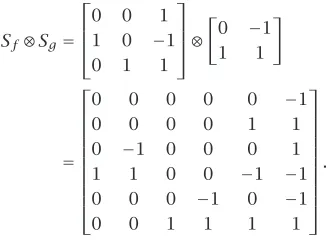
Notice that
Sf⊗Sg=
0 0 1
1 0 −1
0 1 1
⊗
0 −1
1 1
=
0 0 0 0 0 −1
0 0 0 0 1 1
0 −1 0 0 0 1
1 1 0 0 −1 −1
0 0 0 −1 0 −1
0 0 1 1 1 1
.
(5.20)
Hence, {zn}∞
n=0 := {xn}∞n=0∗g{yn}∞n=0 is by Proposition 5.5 a linearly recursive
se-quence overRwith characteristic polynomial
χSf⊗Sg=x6−x5+x3−x+1, (5.21)
that is,{zn}∞
n=0is a solution of the difference equation
[image:10.468.152.316.368.488.2]zn+6−zn+5+zn+3−zn+1+zn=0 with initial vector(0,0,−2,−1,0,1). (5.22)
Table5.1
n 0 1 2 3 4 5 6 7 8 9 10
xn 0 1 2 1 0 1 2 1 0 1 2
yn 1 0 −1 −1 0 1 1 0 −1 −1 0
zn 0 0 −2 −1 0 1 2 0 0 −1 0
Example5.7. Consider the sequences{xn}∞n=0and{yn}∞n=0ofExample 5.6. Then
Sf⊗E2+E3⊗Sg=
0 −1 0 0 1 0
1 1 0 0 0 1
1 0 0 −1 −1 0
0 1 1 1 0 −1
0 0 1 0 1 −1
0 0 0 1 1 2
. (5.23)
ByProposition 5.5,{zn}∞
n=0= {xn}∞n=0∗p{yn}∞n=0:= { n
j=0 n
j
xj·yn−j}∞
n=0is a linearly
recursive sequence overRwith characteristic polynomial
χSf⊗E2+E3⊗Sg=x6−5x5+14x4−25x3+28x2−15x+3. (5.24)
Hence,{zn}∞
n=0is a solution of the difference equation
zn+6−5zn+5+14zn+4−25zn+3+28zn+2−15zn+1+3zn=0 (5.25)
with initial vector(0,1,2,−2,−16,−29).
Table 5.2gives the first 9 terms of the sequence{zn}∞ n=0.
Table5.2
n 0 1 2 3 4 5 6 7 8
xn 0 1 2 1 0 1 2 1 0
yn 1 0 −1 −1 0 1 1 0 −1
zn 0 1 2 −2 −16 −29 −12 29 0
5.6. Cofree comodules. Let C be an R-coalgebra. A right C-comodule (M, M) is calledcofreeif there exists anR-moduleKsuch that(M, M)(K⊗RC, idK⊗∆C)as rightC-comodules. Note that ifKR(Λ), a freeR-module, thenMR(Λ)⊗
RCC(Λ)as rightC-comodules (this is one reason for the terminologycofree).
As a direct consequence ofLemma 4.6, we get the following corollary.
Corollary5.8. LetMbe anR[x]-module. Then there are isomorphisms ofR[x]◦ -comodules
ᏸkM∗M[x]◦M∗⊗RR[x]◦M∗⊗RᏸkR . (5.26)
In particular,M[x]◦(ᏸk
M∗) is a cofreeR[x]◦-comodule (ᏸ k
[image:11.468.53.417.89.137.2]6. Linearly (bi)recursive bisequences. In this section, we consider thelinearly( bi)re-cursivek-bisequencesand thereversiblek-sequencesoverR-modules, whereRis an ar-bitrary commutative ground ring. We generalize the results of [16,17] concerning the bialgebra structure of the linearly recursive sequences over a base field to the case of arbitraryArtinianground rings.
6.1. LetM be anR-module,l=(l1, . . . , lk)∈Nk0, and consider the system of linear
bidifference equations (SLBE):
xz+(l1,0,...,0)+ l1
i=1
p(1,l1−i)(z)xz+(l1−i,0,...,0)=g1(z),
xz+(0,l2,0,...,0)+ l2
i=1
p(2,l2−i)(z)xz+(0,l2−i,0,...,0)=g2(z),
.. .
xz+(0,...,0,lk)+ lk
i=1
p(k,lk−i)(z)xz+(0,...,0,lk−i)=gk(z),
(6.1)
where thepjl’s areR-valued functions and thegj’s areM-valued functions defined for allz∈Zk. If thegj’s are identically zero, then (6.1) is said to be ahomogenousSLBE. If thepjl’s are constants, then (6.1) is said to be an SLBEwith constant coefficients.
6.2. Bisequences. For anR-moduleMandk≥0, let
k M :=
ν:Zk →MMZk
(6.2)
be the R-module of k-bisequences over M. IfM (resp.,k) is not mentioned, then we meanM=R(resp.,k=1). Forw∈k
M andf (x)=
iaixi∈R[x,x−1], define
f (x) w=ν∈k
M , whereν( z):=
i
aiw(z+i)∀z∈Zk. (6.3)
With this action,kM becomes anR[x,x−1]-module. For subsetsI⊂R[x,x−1]andY ⊂
k
M , consider
Ank M (I)=
w∈k
M |g w=0 for everyg∈I
,
AnR[x,x−1](Y )=
h∈R x,x−1|h ν=0 for everyν∈Y. (6.4)
Obviously, Ank M (I)⊂
kM is anR[x,x−1]-submodule and AnR[x,x−1](Y ) R[x,x−1]is an ideal.
Definition 6.1. Let M be anR-module. We call w∈Mk a linearly recursive k-bisequence(resp., alinearly birecursivek-bisequence) if AnR[x](w)is a monic ideal (resp.,
7. Reversible sequences over modules
7.1. LetM be anR-module. Ak-bisequenceu is said to be areverseofu∈k M if
u|Nk
0 =uand AnR[x](u) =AnR[x](u). A linearly recursivek-sequenceuwill be called reversibleifuhas a reverseu∈ᏸkM . WithkM ⊂ᏸkM , we denote theR[x]-submodule of reversiblek-sequences overM.
Lemma7.1(cf. [16, Proposition 14.11]). LetRbeArtinian.
(1)Every monic idealI R[x]contains a subset of monic polynomials
xjdjqjxj|qjxjis reversible forj=1, . . . , k. (7.1)
(2)LetMbe anR-module. Then every linearly recursivek-bisequence overMis linearly birecursive (i.e.,ᏮkM =ᏸkM ).
Proof. (1) By [5, Theorem 8.7] every commutative Artinian ring is (up to isomor-phism) a direct sum of local Artinian rings. Without loss of generality, letRbe a local Artinian ring. The Jacobson radical ofR,
J(R)= {r∈R|ris not invertible inR}, (7.2)
is nilpotent, hence there exists a positive integern such that J(R)n =0. LetI be a monic ideal with a subset of monic polynomials{g1(x1), . . . , gk(xk)} ⊂I. Ifgj(xj)≡
fj(xj)(modJ(R)[xj])for j =1, . . . , k, thengj(xj)|fj(xj)n, where nis the index of
nilpotency of the idealJ(R). Hence,fj(xj)n∈I. If we writefj(xj)n=xdj
j qj(xj)with (xj, qj(xj))=1, thenqj(0)∈U (R), that is,qj(xj)is a reversible polynomial forj= 1, . . . , k.
(2) Let u be a linearly recursivek-bisequence overM. IfR is Artinian, then by (1) AnR[x](u) contains a subset of monic polynomials{x
dj
j qj(xj)|qj(xj)is reversible for j=1, . . . , k}. Then for everyz∈Zk, we have(qj(xj) u)(z
1, . . . , zj, . . . , zk)=(x
dj j qj(xj) u)(z 1, . . . , zj−dj, . . . , zk) = 0. Hence, {qj(xj) | i= 1, . . . , k} ⊂ AnR[x](u) , that is,
AnR[x](u) is a reversible ideal.
7.2. Backsolving. LetMbe anR-module. Letube a linearly recursive sequence over Mand assume that AnR[x](u)contains some monic polynomial of the formxdq(x)= xd(a
0+a1x+···+al−1xl−1+xl),a0∈U (R). Then
a0u(j+d)+a1u(j+d+1)+···+al−1u(j+d+l−1)+u(j+d+l)=0 ∀j≥0 (7.3)
and we get bybacksolvingauniquelinearly birecursive bisequence u∈AnM(q(x)) withu(n) =u(n)for alln≥d. In case l=0, The bisequenceu≡0 and is given for l≠0 by
u(z):=
u(z), z≥d,
−a−01
a1u(z +1)+···+al−1u(z +l−1)+u(z +l)
, z < d. (7.4)
If there are two bisequencesv, w∈An
AnR[x](u) =AnR[x](u). It is obvious that AnR[x](u) ⊆AnR[x](u). On the other hand, assume thatg(x)=m
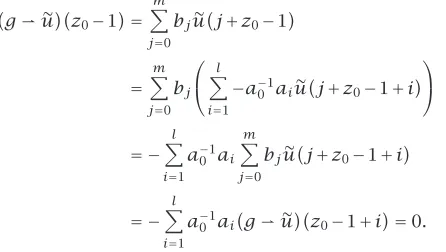
j=0bjxj∈AnR[x](u). We prove by induction that(g u)(z) =0
for allz∈Z. First of all, note that for allz≥d, we have(g u)(z) =(g u)(z)=0. Now, letz0< dand assume that(g u)(z) =0 forz∈ {z0, z0+1, . . . , z0+l−1} ⊆Z.
Then we have, forz=z0−1,
g uz0−1
=
m
j=0
bjuj+z0−1 = m j=0 bj l
i=1 −a−1
0 aiu
j+z0−1+i = − l i=1
a−1 0 ai
m
j=0
bjuj+z0−1+i
= −
l
i=1
a−1 0 ai
g uz0−1+i=0.
(7.5)
Ifuis a linearly recursivek-sequence overM withk >1 and AnR[x](u)contains a
set of monic polynomials{xjdjqj(xj)|qjis reversible forj=1, . . . , k}, then we get by backsolvingthroughqj(xj)along thejth row forj=1, . . . , ka unique linearly birecur-sivek-bisequenceu∈Ank
M (q1(x1), . . . , qk(xk))withu( n)=u(n)for alln≥dand it follows moreover that AnR[x](u) =AnR[x](u).
Lemma7.2. LetMbe anR-module.
(1)Every birecursivek-sequence overM is reversible with unique reverse (which we denote byRev(u)). Moreover,ᏮkM becomes a structure of anR[x,x−1]-module through f u:=(f Rev(u))|Nk
0.
(2)IfRis Artinian, then every reversiblek-sequence overMis birecursive as well (i.e., Ꮾk
M = k M ).
Proof. (1) If u∈ ᏮMk, then AnR[x](u) contains a set of reversible polynomials {qj(xj)|j=1, . . . , k}and we get by backsolving (seeSection 7.2) auniquelinearly bire-cursivek-bisequenceu ∈An
Mk(q1(x1), . . . , qk(xk))with u( n)=u(n)for alln∈N k
0.
For the bisequenceu, we have as shown above AnR[x](u) =AnR[x](u), that is, u is a
reverse ofu. The last statement is obvious. (2) By (1),Ꮾk
M ⊆ k
M . IfRis Artinian andu∈ k
M with reverseu, then AnR[x](u)=
AnR[x](u) is, byLemma 7.1(2), reversible, that is,u∈ᏮMk.
Example7.3. The Fibonacci sequence=(0,1,1,2,3,5, . . .)has elementary charac-teristic polynomialf (x)=x2−x−1. Sincef (0)= −1 is invertible inZ, we conclude
thatis reversible with reverse
Rev()(z)=
(z), z≥0,
[image:14.468.126.349.146.272.2]Rev()(z+2)−Rev()(z+1), z <0. (7.6)
Table7.1
z −4 −3 −2 −1 0 1 2 3 4
Rev()(z) −3 2 −1 1 0 1 1 2 3
Lemma7.4. There is an isomorphism ofR[x,x−1]-modules
Ꮾk M Ꮾ
k
M . (7.7)
Proof. ByLemma 7.2, we have the well-definedR[x,x−1]-linear map
Rev(−):ᏮMk →Ꮾ k
M , u→Rev(u), (7.8)
where Rev(u)is the linearly birecursive sequence defined in (7.4). It is easy to see that Rev(−)is bijective with inverseuu|Nk
0.
7.3. LetM be anR-module. We call a k-sequenceu∈Mk periodic (resp., degen-erating) if xd(xt u)=0 for somed∈Nk
0 and t∈Nk (resp.,xd u=0 for some d∈Nk
0). It is clear that the subsetsᏼ
k M ⊆ᏸ
k
M of periodick-sequences andᏰ k M ⊆ᏸ
k M of degeneratingk-sequences areR[x]-submodules.
Remark7.5 (see [16, Proposition 5.2]). IfMis afiniteR-module, then every linearly recursive sequence overMis periodic (i.e.,ᏼM1=ᏸ
1 M ).
Proposition 7.6(see [16, Proposition 5.27]). LetR be an arbitrarycommutative ring, M anR-module, and denote by ᏼk
M the set of reversible periodick-sequences overM. Then there is an isomorphism ofR[x]-modules
ᏼkM ᏰkM ⊕ᏼkM . (7.9)
The following result generalizes Proposition 7.6 and describes the R[x]-module structure of arbitrary linearly recursivek-sequences ofR-modules, whereRis an Ar-tiniancommutative ground ring.
Proposition7.7. LetMbe anR-module. IfRis Artinian, then there are isomorphisms ofR[x]-modules
ᏸk M Ᏸ
k M ⊕ᏸ
k M =Ᏸ
k M ⊕Ꮾ
k M Ᏸ
k M ⊕Ꮾ
k M =Ᏸ
k M ⊕
k
M . (7.10)
Proof. If uis a linearly recursive sequence over M, then AnR[x](u)contains, by Lemma 7.1(1), a set of monic polynomials {xdjqj(xj)|qj(xj) is reversible for j = 1, . . . , k}. Bybacksolving(see Section 7.2), we have a well-defined morphism ofR[x] -modules
γ:ᏸkM →ᏸkM , u→u, (7.11)
whereuis theuniquelinearly birecursive bisequenceu∈AnM(q1, . . . , qk)withu( n)= u(n)for alln≥d. It is clear that Ke(γ)=Ᏸk
ofR[x]-modules
β=ᏸk M →ᏸ
k
M , w→w|Nk 0
. (7.12)
It is obvious thatγ◦β=idᏸk
M , hence the exact sequence
0 →ᏰkM →ᏸkM γ
→ᏸkM →0, (7.13)
ofR[x]-modules splits, that is,ᏸkM ᏰkM ⊕ᏸkM . SinceRis Artinian, we have by Lem-mata7.1(2) and7.2(2)ᏸk
M =Ꮾ k M andᏮ
k M =
k
M . We are done now by the isomorphism ofR[x]-modulesᏮMkᏮ
k
M (Lemma 7.4).
7.4. The HopfR-algebraR[x,x−1]. Consider the commutative groupGgenerated by {xj|j=1, . . . , k}. Then the ring of Laurent polynomials R[x,x−1]=RGhas the
struc-ture of acommutative cocommutativeHopfR-algebra(R[x,x−1], µ, η,∆, ε, S), whereµ
(resp.,η) is the usual multiplication (resp., the usual unity) and for allz∈Z, j=1, . . . , k,
∆:R x,x−1→R x,x−1⊗
RR x,x−1, xjz→xzj⊗xjz, ε:R x,x−1 →R, xz
j→1R,
S:R x,x−1 →R[x,x−1], xjz→x−jz.
(7.14)
Proposition7.8. LetRbe an arbitrary commutative ring. ThenR[x,x−1]is an ad-missible HopfR-algebra andR[x,x−1]◦is a HopfR-algebra.
Proof. Notice thatR[x,x−1]is a cofinitary HopfR-algebra byLemma 4.6(2). Con-sider the proof ofProposition 5.2and replaceR[x]withR[x,x−1]. Then the map
Tj:B →B, b→∆xjb (7.15)
is invertible with inverse
Tj:B →B, b→∆¯
xj−1b. (7.16)
Then the matrixMjofTjis invertible andχj(0)∈U (R)forj=1, . . . , k. Consequently, R[x,x−1]satisfies axiom (A1). SinceR[x,x−1]/Ke(ε)R,R[x,x−1]satisfies axiom (A2). Consider thebijectiveantipode S ofR[x,x−1]. For every idealI R[x,x−1],S−1(I)
R[x,x−1] is an ideal and we have an isomorphism ofR-modulesR[x,x−1]/S−1(I)
R[x,x−1]/I. Hence,
R[x,x−1]satisfies axiom (A3). Consequently,R[x,x−1]is an admis-sible HopfR-algebra. The last statement follows now byProposition 4.3.
For everyR-moduleM, we have an isomorphism ofR[x,x−1]-modules
ΨM:M x,x−1∗ →Mk∗, ϕ→ z→ m→ϕ
mxz (7.17)
with inverseu[mxzu( z)(m)].
Proposition7.9. LetRbe an arbitrary ring andManR-module. Then (7.17) induces an isomorphism ofR[x,x−1]-modules
M x,x−1◦ᏮkM∗. (7.18)
Proof. Consider the isomorphism of R[x,x−1]-modules M[x,x−1]∗ ΨM kM∗, see (7.17). Let∈M[x,x−1]◦. ThenI =0 for someR-cofiniteR[x,x−1]-idealI R[x,x−1]
and so I ΨM()=ΨM(I )=0. ByLemma 4.6(2), I is a reversible ideal and so AnR[x](u)⊃I∩R[x]is a reversible ideal, that is,ΨM()is linearly birecursive.
On the other hand, letu∈ᏮkM∗. Then AnR[x](u) is, by definition, a reversible ideal,
that is, it contains a subset of reversible polynomials{qj(xj),j=1, . . . , k}. Note that for arbitraryg∈R[x,x−1], we havegqjΨ−1
M (u) =ΨM−1(gqju) =ΨM−1(g (qju)) = 0 forj=1, . . . , k. ByLemma 4.6(2), the reversible ideal(q1(x1), . . . , qk(xk)) R[x,x−1]
isR-cofinite, that is,Ψ−1
M (u) ∈M[x,x−1]◦.
7.5. The HopfR-algebra structures onᏮkandᏮk. LetRbe an arbitrary ring and consider the HopfR-algebra R[x,x−1]. ThenkRZk
R[x,x−1]∗ is anR-algebra with theHadamard product
∗:k⊗
Rk →k, u⊗v→ z→u( z)v( z), (7.19)
and the unity
η:R →k, 1
R→ z→1R
for everyz∈Zk. (7.20)
ByProposition 7.8,R[x,x−1]◦is a HopfR-algebra. SoᏮkR[x,x−1]◦inherits the struc-ture of a HopfR-algebra(Ꮾk,∗g, ηg,∆
Ꮾk, εᏮk, SᏮk), where∗gis the Hadamard prod-uct (5.14),ηgis the unity (5.15), and
∆Ꮾk:Ꮾk →Ꮾk⊗RᏮk, u→
t≤l−1
xt u⊗eF t,
εᏮk:Ꮾk →R, u→u(0),
SᏮk:Ꮾk →Ꮾk, u→ n→Rev(u)(−n).
(7.21)
Moreover,ᏮkR[x,x−1]◦becomes a HopfR-algebra(Ꮾk,∗g,ηg,∆
Ꮾk,εᏮk,SᏮk), where∗is the Hadamard product (7.19),ηis the unity (7.20), and
∆Ꮾk:Ꮾk →Ꮾk⊗RᏮk, u→
t≤l−1
Rev !
xtu
|Nk 0
"
⊗ReveF t
,
εᏮk:Ꮾk →R, u→u( 0),
SᏮk:Ꮾk →Ꮾk, u→ z→u( −z).
(7.22)
Note that with these structures the isomorphismᏮkᏮkofLemma 7.4turns to be an isomorphism of HopfR-algebras.
Theorem7.10. IfRis Artinian, then there are isomorphisms ofR-bialgebras
ᏸkᏰk⊕ᏸk=Ᏸk⊕ᏮkᏰk⊕Ꮾk=Ᏸk⊕k. (7.23)
Proof. Consider the isomorphismᏸk Ᏸk⊕ᏸk, see (7.10). With the help of Lemmata4.5and7.1, one can show, as in [17, page 123], thatγ:ᏸk→ᏸk, see (7.11), and β:ᏸk→ᏸk, see (7.12), are in fact bialgebra morphisms. Obviously, Ke(γ)= Ᏸk⊂ᏸkis anᏸk-subbialgebra and we are done.
As an analog toCorollary 5.8, we get the following corollary.
Corollary 7.11. LetM be an R[x,x−1]-module. Then there are isomorphisms of R[x,x−1]◦-comodules
ᏸk
M∗M x,x−
1◦M∗⊗
RR x,x−1
◦M∗⊗
RᏸRk. (7.24)
In particular,M[x,x−1]◦(ᏸk
M∗) is a cofreeR[x,x−1]◦-comodule (ᏸ k
R -comodule).
As a consequence of [2, Theorem 2.4.7] and [2, Corollaray 2.5.10], we get the following corollary.
Corollary7.12. LetRbe Noetherian and consider theR-bialgebraR[x;g]◦(resp., the HopfR-algebraR[x;p]◦, the HopfR-algebraR[x,x−1]◦). IfAis anα-algebra (resp., anα-bialgebra, a Hopfα-algebra), then there are isomorphisms ofR-coalgebras (resp., R-bialgebras, HopfR-algebras)
A[x;g]◦A◦⊗RR[x;g]◦, A[x;p]◦A◦⊗RR[x;p]◦,
A x,x−1◦A◦⊗
RR x,x−1
◦. (7.25)
7.6. Representative functions. Let G be a monoid (a group) and consider the R -algebraB=RGwith pointwise multiplication. ThenBis anRG-bimodule under the left and right actions
(yf )(x)=f (xy), (f y)(x)=f (yx) ∀x, y∈G. (7.26)
We callf∈RG anR-valued representative functionon the monoidGif(RG)f (RG)is finitely generated as anR-module. IfR is Noetherian, then the subset(G)⊂RG of all representative functions onGis anRG-subbimodule. Moreover, we deduce from [4, Theorem 2.13 and Corollary 2.15] that in case(RG)◦⊂RGis pure, we have an isomor-phism ofR-bialgebras (HopfR-algebras)(G)(RG)◦.
Corollary7.13. LetRbe Noetherian. (1)Considering the monoid(Nk
0,+), there are isomorphisms ofR-bialgebras
Nk
0
(2)Considering the group(Zk,+), there are isomorphisms of HopfR-algebras
ZkR x,x−1◦Ꮾk R Ꮾ
k
R . (7.28)
Acknowledgments. I am so grateful to my advisor Professor Robert Wisbauer for his wonderful supervision and continuous encouragement and support. The author is also grateful to the referees for helpful suggestions and for drawing his attention to [12,13] by Kurakin.
References
[1] E. Abe,Hopf Algebras, Cambridge Tracts in Mathematics, vol. 74, Cambridge University Press, Cambridge, 1980.
[2] J. Y. Abuhlail, Dualitätstheoreme für Hopf-Algebren über Ringen, Ph.D. Dissertation, Heinrich-Heine Universität, Düsseldorf, Germany, 2001, http://www.ulb.uni-duesseldorf.de/diss/mathnat/2001/abuhlail.html.
[3] J. Y. Abuhlail, J. Gómez-Torrecillas, and F. J. Lobillo,Duality and rational modules in Hopf algebras over commutative rings, J. Algebra240(2001), no. 1, 165–184.
[4] J. Y. Abuhlail, J. Gómez-Torrecillas, and R. Wisbauer,Dual coalgebras of algebras over commutative rings, J. Pure Appl. Algebra153(2000), no. 2, 107–120.
[5] M. F. Atiyah and I. G. Macdonald,Introduction to Commutative Algebra, Addison-Wesley Publishing, Massachusetts, 1969.
[6] W. Chin and J. Goldman,Bialgebras of linearly recursive sequences, Comm. Algebra 21 (1993), no. 11, 3935–3952.
[7] L. Grünenfelder,Über die Struktur von Hopf-Algebren, Ph.D. Dissertation, Eidgenössische Technische Hochschule, Zürich, 1969.
[8] L. Grünenfelder and T. Košir,Koszul cohomology for finite families of comodule maps and applications, Comm. Algebra25(1997), no. 2, 459–479.
[9] L. Grünenfelder and M. Omladiˇc,Linearly recursive sequences and operator polynomials, Linear Algebra Appl.182(1993), 127–145.
[10] T. Honold and A. Nechaev,Weighted modules and representations of codes, Problems In-form. Transmission35(1999), 205–223.
[11] B. W. Jones,Linear Algebra, Holden-Day, San Francisco, 1973.
[12] V. Kurakin,Hopf algebras of linear recurring sequences over commutative rings, Proceed-ings of the 2nd Mathematical Workshop of MSSU (Moscow, 1994), 1994, pp. 67–69 (Russian).
[13] ,Hopf algebras of linear recurring sequences over rings and modules, preprint, 2000. [14] ,A Hopf algebra dual to a polynomial algebra over a commutative ring, Mat. Zametki
71(2002), no. 5, 677–685.
[15] V. L. Kurakin, A. S. Kuzmin, V. T. Markov, A. V. Mikhalev, and A. A. Nechaev,Linear codes and polylinear recurrences over finite rings and modules (a survey), Applied Algebra, Algebraic Algorithms and Error-Correcting Codes (Honolulu, HI, 1999) (M. Fossorier, H. Imai, S. Lin, and A. Poli, eds.), Lecture Notes in Comput. Sci., vol. 1719, Springer-Verlag, Berlin, 1999, pp. 365–391.
[16] V. L. Kurakin, A. S. Kuzmin, A. V. Mikhalev, and A. A. Nechaev,Linear recurring sequences over rings and modules, J. Math. Sci.76(1995), no. 6, 2793–2915.
[17] R. G. Larson and E. J. Taft,The algebraic structure of linearly recursive sequences under Hadamard product, Israel J. Math.72(1990), no. 1-2, 118–132.
[18] A. V. Mikhalev and A. A. Nechaev,Linear recurring sequences over modules, Acta Appl. Math.42(1996), no. 2, 161–202.
[20] A. Nechaev,Linear recurrent sequences over quasi-Frobenius modules, Russian Math. Sur-veys48(1993), 209–210.
[21] ,Polylinear recurring sequences over modules and quasi-Frobenius modules, 1st In-ternational Tainan-Moscow Algebra Workshop (Tainan, 1994) (Y. Fong, U. Knauer, and A. V. Mikhalev, eds.), de Gruyter, Berlin, 1996, pp. 283–298.
[22] B. Peterson and E. J. Taft,The Hopf algebra of linearly recursive sequences, Aequationes Math.20(1980), no. 1, 1–17.
[23] M. E. Sweedler,Hopf Algebras, Mathematics Lecture Note Series, W. A. Benjamin, New York, 1969.
[24] E. J. Taft,Linearly recursive tableaux, Congr. Numer.107(1995), 33–36.
Jawad Y. Abuhlail: Mathematics Department, Birzeit University, P.O. Box 14, Birzeit, West Bank, Palestine
Current address: Box # 281 KFUPM, 31261 Dhaharan, Saudia Arabia