PARENTS VERSUS STUDENTS ATTITUDES: DYNAMICS AND IMPLICATIONS FOR STUDENTS ACADEMIC ACHIEVEMENT IN BASIC SCIENCE
JOSEPH, Endurance Ayibatonye Department of Integrated Science
Ignatius Ajuru University of Education, Port Harcourt
OWO, Wisdom James Ph.D Department of Integrated Science
Ignatius Ajuru University of Education, Port Harcourt
Abstract
The study main purpose was to establish the role parental attitude plays on students’ attitude and academic achievement in secondary schools. The study being a survey exclusively investigated the interplay of the parents’ attitude and students’ positive attitude. The population consisted of all the students from all the selected secondary schools and their parents. From this population a sample size of two hundred (200) students alongside their parents were selected through stratified random sampling techniques. Two research questions guided the study, while two (2) null hypotheses were raised and tested at 0.05 levels of significance. Data were collected for analysis through a structured researchers’ made instrument, Parents and Students Attitudes and Academic Achievement Questionnaire (PSAAAQ). The instrument was validated, it reliability was established before administering to the respondents. The Cronbach alpha was employed to determine the coefficient r= 78. The research questions were answered using the descriptive statistics of mean and standard deviation while the null hypothesis were tested using the independent T-test, and ANOVA. The findings of the study revealed that parents’ attitude towards science promoted the attitude of the students. Parents concerns for their students’ process contributed to the student attitude, the age of the students also was a strong determinant of students’ attitude and achievement in science. It was based on the findings that some recommendations were made.
Keywords: Parent attitude, Student attitude, academic achievement, secondary school, basic science, dynamics, implication.
Introduction
The role or contribution of the affective domain on the academic achievement of students has very dearth information. The domain which has to do with the feelings, likeness, interest and attitude of students and parents toward science and science learning is a very critical components in the overall academic process of the students at whatever level of education. However, how this component- affective domain, contributes to the students’ academic progress has not been well understood. There are strong indications that attitude whether that of the students or that of their parents may possibly influence students’ positively or negatively achievement recorded in recent times as x-rayed by different examiners. Thus, it is important to gain indebt knowledge on how attitude of both parents and students contributes to the students’ success in science generally and Basic science in particular in secondary schools.
The concept of attitude
Attitude, to Papanastasiou & Papanastasiou, (2004) is an emotional orientation of a person to respond either favourably or unfavourably to concepts or ideas, that is, the likeness and or the acceptance one displays toward a subject or object which propels a motivation for passion and absolute commitment. Simon and Collins,( 2003) investigated the relationship between the students attitude and academic achievements and found a positive correlation between teachers attitudes toward science and students higher levels of science achievement. The findings were similar to the findings of George, (2006) and Liu, (2006) which corroborated the former. More importantly, several studies have suggested that the relationship between parents attitude and students’ academic achievement is not spurious. Indeed, there is strong evidence that attitudes themselves have a significant and direct effect on students’ academic achievement (ogbonana, 2016). Since positive attitudes toward science predict higher scientific achievement and literacy, it is essential that science education programmes are structured in such a way that will captivates students from an early age and continues to actively engage them in ways that these attitude will be sustained. Studies show, however, that while students in secondary school report generally positive attitudes toward science, these positive attitudes fall as students’ progress through middle and high school (George, 2006; Papanastasiou et al, 2004)
Parents Attitude and students’ Academic Achievement
Parental involvement can take the form of direct and indirect participations in science activities which help to boost students’ achievement. Direct participation in science may be such as taking children to library and science museum or sacred grooves and other important scientific sites or indirect support, providing at home academic supports by helping students to handle homework and supplying students the necessary scientific aids and buying more science text books which would support their understanding of scientific concepts (Sun et al., 2012). More the parents show a positive parental involvement in children’s science studies the more it promotes students positive attitude thereby influencing on students science test scores, (Ratelle et al. 2005; Tare et al. 2011).
child’s achievement in science. However, their findings were based on limited studies in North Carolina, using a multi-level analytical approach and PISA data, Sun et a!. (2012) also studied the factors that influenced students science achievement in Hong Kong, and found that parents attitude towards science was statistically significant to students achievement after controlling for other student and school variables. Nevertheless, her study did not address whether parental attitudes affect their children’s science achievement. According to Sun et al. (2012) one way which parent attitude towards science could affect their children’s science achievement is by influencing their children’s attitudes. They asserted that within social groups, children tend to develop certain tastes, academic motivations and preferences based on the experiences provided by parents. Therefore, it is against this backdrop that Simpson and Oliver (1990) explained that even though school factors have a dominant effect on student attitudes towards science, parental attitudes towards science was more prominent and also have more positive influence.
To Tenenbaurn and Leaper (2003) one sure way of positively influencing children attitude was parental beliefs about science. They found that parents’ beliefs about science did not only significantly influence children’s achievement but increase their attitude, arouse interest and self-efficacy in science. Therefore they concluded that the more positive parent attitudes towards science, the higher students are associated with higher science test scores.
Another way Parental attitude towards science influences students’ science achievement was the involvement of parent in their children’s science studies. Parental involvement can be either direct participation in science activities such as taking students to science museum, visits to ecological sites or sacred groves and indirect support by helping their children with homework. Whichever way, George and Kaplan (1998) found that parental attitude has a positive relationship with students’ attitude and achievement in science. One other way parents influenced students’ attitude and achievement as revealed by Szechter and Carey (2009) is their views of science and scientists, which propelled them to take their children to a number of museums, science exhibitions and increase visits to other scientific sites.. Corroborating the former, Tare et al. (2011) noted those parents’ views on the importance and understanding of science increase educational quality of the museum visit.
In terms of indirect support, it has been shown that parents who have a negative attitude towards school science learning tend to remain uninvolved in their children’s science homework and other activities but rather discourage them (Kaya & Lundeen, 2010) and the resultant effect is that students keep performing poorly and eventually lose interest in the subject. Therefore the various studies have demonstrated that greater parental involvement in children’s science learning, directly or indirectly, promote students attitude and lead to better science achievement (Ho, 2010; Szechter & Carey, 2009; Tare et al, 2011). To this end, one of possible ways of increased enrolment in science subjects, and also influence science achievement and interest in science careers is encourage parents’ positive attitude toward science.
achievement; the extent has been the desire. Using data from a longitudinal project, DeWitt et al. (2013) found that students reported that parents with more positive attitudes towards science do appear to have higher educational and occupational science aspirations. Therefore, parental attitudes towards science can positively influence their children’s attitudes, which in turn are associated with higher science test scores.
While parent attitude towards science does appear to be important for students’ science achievement, there is little empirical evidence to support this hunch. Since the study by Sun et al. (2012) focused only on a cohort, it would be interesting to extend the analysis to include more countries from different regions to observe whether the relationship still holds. Therefore, the present study aims at identifying whether there would be any relationship between parent attitudes towards science and their children’s attitude and achievement in secondary schools in Rivers State..
Research Questions
The following research questions will guide the study:
i. What are the effects of parental attitude on student towards science?
ii. What are the effects of students factors on parental attitude towards science Hypotheses
The following null hypotheses were formulated and tested at 0.05 levels of significance. Ho1: There is no significant different in student mean rating of effects of parental attitude on student attitude towards science.
Ho2 There is no significant difference on effects of students’ factors on parental attitude towards science and achievement.
Methodology
The study adopted a survey research design to investigate the impact of parents’ attitude on students’ attitude and their academic achievement. The population consisted of two thousand secondary school students and their parents drawn from junior secondary schools (UBE) section in Rivers State, from which a sample size of 200 students and their parents were drawn through the stratified random sampling techniques. All the parents of the students selected were automatic participants. Data were collected from the respondents through a researcher’s structured and validated instrument- Parents and Students Attitude and Academic Achievement Questionnaire (PSAAAQ) in addition, the result of the students. The instrument consists of three sections, A B, and C. Section A identified the demographic data of students and parents, section B dealt with parents attitude, toward science and how that in turn influences students attitude towards science and academic achievement and section C dealt on the effect of the various students factors that attitude .
The instrument was validated, both for face and construct validity, while the reliability was determined using test-retest method and the Cronbach alpha was used to determine the coefficient r=76. The instruments were distributed to the students. The completed copies of the questionnaire were retrieved a day later. They were sorted and collated, analyzed using the T-test and ANOVA for the null hypotheses while the mean and standard deviation were used to answer the research questions facilitated by the SPSS
Results and Discussion
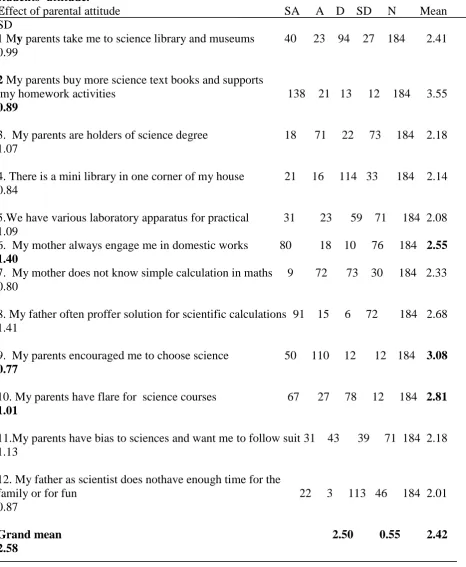
Table 1: Mean, standard deviation on the effect of parental attitude towards science on students’ attitude.
Effect of parental attitude SA A D SD N Mean
SD
1My parents take me to science library and museums 40 23 94 27 184 2.41 0.99
2 My parents buy more science text books and supports
my homework activities 138 21 13 12 184 3.55 0.89
3. My parents are holders of science degree 18 71 22 73 184 2.18 1.07
4. There is a mini library in one corner of my house 21 16 114 33 184 2.14 0.84
5.We have various laboratory apparatus for practical 31 23 59 71 184 2.08 1.09
6. My mother always engage me in domestic works 80 18 10 76 184 2.55 1.40
7. My mother does not know simple calculation in maths 9 72 73 30 184 2.33 0.80
8. My father often proffer solution for scientific calculations 91 15 6 72 184 2.68 1.41
9. My parents encouraged me to choose science 50 110 12 12 184 3.08 0.77
10. My parents have flare for science courses 67 27 78 12 184 2.81 1.01
11.My parents have bias to sciences and want me to follow suit 31 43 39 71 184 2.18 1.13
12. My father as scientist does nothave enough time for the
family or for fun 22 3 113 46 184 2.01 0.87
Grand mean 2.50 0.55 2.42 2.58
that their parents have flare for science courses (M=2.81, SD=1.01) while the least mean was that their mother always engaged them in domestic works (M=2.55, SD=1.40).
Ho2 There is no significant difference in the effects of students’ factors on parental attitude towards science
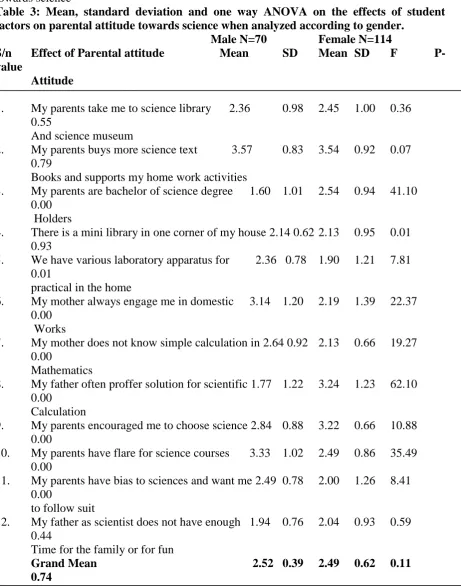
Table 3: Mean, standard deviation and one way ANOVA on the effects of student factors on parental attitude towards science when analyzed according to gender.
Male N=70 Female N=114
S/n Effect of Parental attitude Mean SD Mean SD F P-value
Attitude
1. My parents take me to science library 2.36 0.98 2.45 1.00 0.36 0.55
And science museum
2. My parents buys more science text 3.57 0.83 3.54 0.92 0.07 0.79
Books and supports my home work activities
3. My parents are bachelor of science degree 1.60 1.01 2.54 0.94 41.10 0.00
Holders
4. There is a mini library in one corner of my house 2.14 0.62 2.13 0.95 0.01 0.93
5. We have various laboratory apparatus for 2.36 0.78 1.90 1.21 7.81 0.01
practical in the home
6. My mother always engage me in domestic 3.14 1.20 2.19 1.39 22.37 0.00
Works
7. My mother does not know simple calculation in 2.64 0.92 2.13 0.66 19.27 0.00
Mathematics
8. My father often proffer solution for scientific 1.77 1.22 3.24 1.23 62.10 0.00
Calculation
9. My parents encouraged me to choose science 2.84 0.88 3.22 0.66 10.88 0.00
10. My parents have flare for science courses 3.33 1.02 2.49 0.86 35.49 0.00
11. My parents have bias to sciences and want me 2.49 0.78 2.00 1.26 8.41 0.00
to follow suit
12. My father as scientist does not have enough 1.94 0.76 2.04 0.93 0.59 0.44
Time for the family or for fun
Grand Mean 2.52 0.39 2.49 0.62 0.11 0.74
[image:6.595.77.539.91.677.2]result of the one way ANOVA showed that there is no significant difference in students mean rating of effects of parental attitude on student attitude towards science when analyzed according to gender (F=0.11, p>.05). The null hypothesis was upheld at 0.05 alpha level.
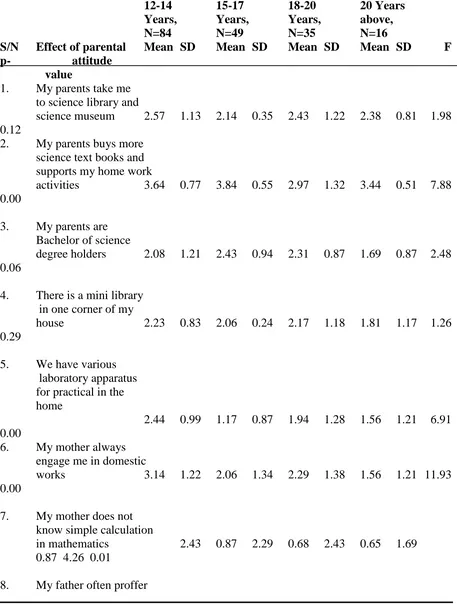
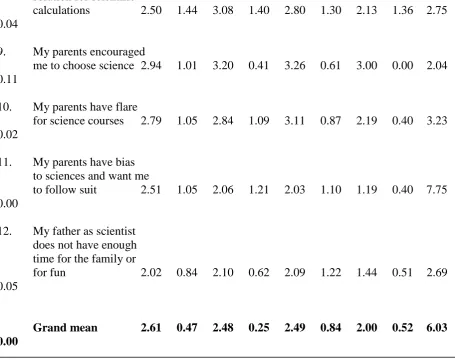
Table 4: Mean, standard deviation and one way ANOVA on the difference in student mean rating of the effects of parental attitude towards science when analyzed according
to age.
12-14 15-17 18-20 20 Years
Years, Years, Years, above,
N=84 N=49 N=35 N=16
S/N Effect of parental Mean SD Mean SD Mean SD Mean SD F
p- attitude
value
1. My parents take me to science library and
science museum 2.57 1.13 2.14 0.35 2.43 1.22 2.38 0.81 1.98 0.12
2. My parents buys more science text books and supports my home work
activities 3.64 0.77 3.84 0.55 2.97 1.32 3.44 0.51 7.88
0.00
3. My parents are Bachelor of science
degree holders 2.08 1.21 2.43 0.94 2.31 0.87 1.69 0.87 2.48 0.06
4. There is a mini library in one corner of my
house 2.23 0.83 2.06 0.24 2.17 1.18 1.81 1.17 1.26
0.29
5. We have various laboratory apparatus for practical in the home
2.44 0.99 1.17 0.87 1.94 1.28 1.56 1.21 6.91 0.00
6. My mother always engage me in domestic
works 3.14 1.22 2.06 1.34 2.29 1.38 1.56 1.21 11.93
0.00
7. My mother does not know simple calculation
in mathematics 2.43 0.87 2.29 0.68 2.43 0.65 1.69
0.87 4.26 0.01
solution for scientific
calculations 2.50 1.44 3.08 1.40 2.80 1.30 2.13 1.36 2.75 0.04
9. My parents encouraged
me to choose science 2.94 1.01 3.20 0.41 3.26 0.61 3.00 0.00 2.04 0.11
10. My parents have flare
for science courses 2.79 1.05 2.84 1.09 3.11 0.87 2.19 0.40 3.23 0.02
11. My parents have bias to sciences and want me
to follow suit 2.51 1.05 2.06 1.21 2.03 1.10 1.19 0.40 7.75 0.00
12. My father as scientist does not have enough time for the family or
for fun 2.02 0.84 2.10 0.62 2.09 1.22 1.44 0.51 2.69
0.05
Grand mean 2.61 0.47 2.48 0.25 2.49 0.84 2.00 0.52 6.03 0.00
Table 4 showed the mean, standard deviation and one way ANOVA on the difference in
student mean rating of the factors responsible for their attitude towards science when
analyzed according to age. It showed that those within 12-14 years had a mean of M=3.02,
SD=0.45, those within 15-17 years had a mean of M= 3.17, SD=0.75, within 18-20 had mean
of M=3.38, SD= 0.44 while those above 20 years had a mean of 3.12, SD=0.26. The result of
the one way ANOVA showed that there is a significant difference in student mean rating of
the factors responsible for their attitude towards science when analyzed according to age
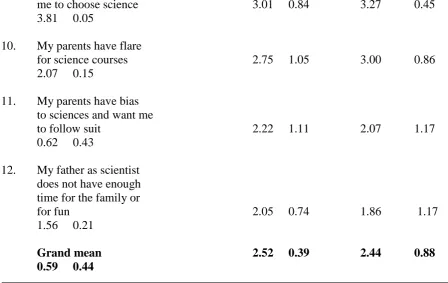
[image:8.595.75.531.47.408.2]Table 5: Mean, standard deviation and one way ANOVA on the difference in student mean rating of the effects of parental attitude towards science when analyzed according
to religion.
Christian, Muslim, N=140 N=44
S/n Effect of Parental
Attitude Mean SD Mean SD F P-value
1.
My religion permits women Be educated 2.32 0.89 2.71 1.21 5.15 0.02
2. My parents buys more science text books and supports my home work
activities 3.66 0.74 3.18 1.19 10.4 0.00
3. My parents are Bachelor of Science
Degree holders 2.24 1.07 2.00 1.08
1.73 0.19
4. There is a mini library in one corner of my
house 2.11 0.60 2.20 1.36
0.38 0.54
5. We have various laboratory apparatus for practical in the
home 2.04 0.96 2.20 1.42
4.72 0.03
6. My mother always engage me in domestic
works 2.68 1.37 2.16 1.43
4.72 0.03
7. My mother does not know simple calculation
in mathematics 2.33 0.78 2.32 0.88
0.01 0.94
8. My father often proffer solution for scientific
calculations 2.78 1.40 2.36 1.42
2.91 0.09
me to choose science 3.01 0.84 3.27 0.45 3.81 0.05
10. My parents have flare
for science courses 2.75 1.05 3.00 0.86
2.07 0.15
11. My parents have bias to sciences and want me
to follow suit 2.22 1.11 2.07 1.17
0.62 0.43
12. My father as scientist does not have enough time for the family or
for fun 2.05 0.74 1.86 1.17
1.56 0.21
Grand mean 2.52 0.39 2.44 0.88
[image:10.595.71.520.39.322.2]0.59 0.44
Table 5 showed mean, standard deviation and one way ANOVA on the difference in student mean rating of the effects of parental attitude towards science when analyzed according to religion. . It showed that the Christians had a mean of M=2.52, SD=0.39 while the Muslims had a mean of M=2.44, SD=0.88.The result of the one way ANOVA showed that there is no significant difference in student mean rating of effects of parental attitude on student attitude towards science when analyzed according to religion (F=0.59, p>.05). The null hypothesis was upheld at 0.05 alpha level.
Discussion
The result of findings revealed that parent attitude towards science plays a significant role in students’ attitude towards the learning of science and academic achievement in Basic Science. the study further show that the attitudes of parents that crop up the attitude of students include, parents providing science text books for their children, taking them to scientific sites such as sacred groves, museums, ecological sites and artifacts. That stimulates their interest, involving in their academic activities which encourage them to both do and learn science. Their flare for science one to the enormous benefit they believe their children will gain from learning science. Consequently these parents “attitudes” motivate them to study science as carriers. The findings of this study agrees with the finding of Sun el et al, (2012) which explained that the more the parents a show their children positive parental involvement in their science study, the more it promote their children attitude towards learning science. Although, it seems to be somewhat new findings in this area of study. Tenenbaurn and Leaper (2000) found that one sure way of parents positively influencing their children attitude towards science was the parental beliefs about science, its relevance to the study and the impact on human society. The finding of the current study therefore confirmed assertion.
create any difference. There are male as well female students whose attitudes were positive and the same time male and female whose attitude towards science learning was negative. The study has provided evidence that what matters most is the interest. The findings of the study agreed with the findings of Okachi (2016), who also found no significant difference in the rating of students’ factors responsible for students’ attitude towards Basic science Awang et al 2013 also reinforce the finding that joyful learning atmosphere created by the teacher is necessary to attract students and thus they show a positive attitude (ii)On the age of the students as a factor, the study revealed that the age either promotes or discourages the built up of students attitude towards the learning of science. The higher the age the more positive attitude students have towards learning science. The reasons may be hinged on interest, maturity, influence from the parents and the benefit, therefore the study revealed that there is a significant difference between parental involvement based on the students age.(iii)While on religion, the finding revealed the same trend, whether your religious beliefs proved science or not, the students’ attitude towards learning of science does not differ.
Conclusion
The paper has practically exposed us to how parents’ attitude helps in building positive attitude in students and its contribution to achievement. It also revealed on the other hand, how student factors which also affect their attitude. Therefore from the findings it was concluded that: Teachers involvement in their children academic activities such as assisting them in their homework, taking them to relevant science sites that propels them to study sciences helped in developing positive attitude. Again, Parents view of the benefits emanating from the knowledge of science also shaped the students attitude. Parents view of the entrepreneurial benefit that their children would acquire, interest in science disciplines which parents wants their children to turn out as scientist from the university programme, promotes deep interest on their children’s progress which in turn promote the attitude of the students. The study also revealed that students factor such as the students’ age is prime in shaping their attitude towards learning science. Furthermore, the findings disentangled the notion that religious beliefs influenced the attitude of students in learning science. Contrary to the above perception, the study has shown clearly that religion does not determine student attitude. Consequently, from the findings of this study, which corroborated the findings of researchers from other climes we conclude that the attitude of parents towards science significantly influenced students attitude and also improve their academic achievement in basic science in the secondary schools in Rivers State.
References
Afuwape, O.M. and Oludipe, D.I. (2008). Students’ self-concept and their achievement in Basic Science. Educational Research and review 3(7), 242-245.
Dewitt, J., Osborne, J., Archer, L., Dillion, J., Willis, B., & Wong, B. (2013). Young children’s aspirations in science: the unequivocal, the uncertain and the unthinkable. International Journal of Science Educaion, 35(6), 1037-1063. Federal Republic of Nigeria (FRN) (2004). National Policy on Education (4th Ed), NERDC
Lagos: Federal Ministry of Education.
George, R. (2006). A cross-domain analysis of change in students’ attitudes toward science and attitudes about the utility of science. International Journal of Science Education, 28(6), 571-589.
George, R., & Kaplan, D. (1998). A structural model of parent and teacher influences on science attitudes of eight graders: Evidence from NELS: 88. Science Education, 82(1), 93-109.
Gunderson, E.A., Ramirez, G., Levine, S.C., & Beilock, S.L., (2012). The role of parents and teachers in the development of gender-related math attitudes. Sex Roles, 66(3-4), 153-166.
Kaya, S., & Lundeen, C. (2010). Capturing parents’ individual and institutional interest toward involvement in science education. Journal of Science teacher Education, 21(7), 825-841.
Kolawole, E.B. (2007). Effects of Competitive and cooperative learning strategies on academic performance of Nigerian students in Mathematics. Educational Research Review, 3,(1), 33-37.
Linn, M.C. & Songer, N.B. (1993). How do students make sense of science? Merrill-Palmer Quarterly, 39, 47-73.
Liu, M. (2006). The effect of hypermedia learning environment on middle school students’ motivation, attitude, and science knowledge. Computers In The Schools. 22(3-4), 159-171.
McNeely, C., Nonnemaker, J., & Blum, R. (2002). Promoting school connectedness: evidence from the National Longitudinal study of adolescent health. Journal of School Health, 72, 138-146. http://dx.doi.org/10.1111/j.1746-1561.2002.tb06533.x
Millar, M.G. and Tesser. A. (1986). Effects of affective and cognitive focus on the attitude-behaviour relation. Journal of Personality and Social Psychology, 51, 270-276. Muller, P.A., Stage, F.K., & Kinzie, J. (2001). “Science achievement growth trajectories:
understanding factors related to gender and racial-ethnic differences in precollege science achievement”. American educational Research Journal: 38(4), 981-1012.
Neathery, M.F. (1997). Elementary and secondary students’ perceptions toward science: Correlations with gender, ethnicity, ability, grade, and science achievement. Electronic Journal of Science Education, 2(1), 2-11.
Ogbonna, I.J. (2015). Students attitude towards science and effect on students’ academic achievement in secondary school in Kelga, Rivers State. A B.Sc.Ed project submitted to Ignatius Ajuru University of Education Port Harcourt.
Oguniyi, M.B. (1982). An analysis of prospective science teachers understanding of the nature of science teaching. Journal of science teachers’ association of Nigeria 19(1)25-32.
Okachi, J.U.S. (2016). Influence of teachers attitude and gender on the academic achievement of students in Basic science in secondary schools in EMOLGA, Rivers State, A B.Sc.Ed Project University of education Port Harcourt.
Oliver, J.S. and Simpson, R.D. (1988). Influences of attitude toward science, achievement motivation, and science self concept on achievement in science: a longitudinal study, Science education, 72, 143-155.
Ololube, N.P. (2009). Understanding teachers professional competencies for Education Effectiveness. Owerri: Springfield Publisher Ltd.
Oludipe, D.I., 2008. Gender difference in Nigerian Junior Secondary Students’ Academic Achievement in Basic Science Journal of Educational and Social Research 2,1. Osborne, J., Simon, S., & Collins, S. (2003). Attitudes toward science: A review of the
literature and its implications. International Journal of science Education: 25(9) 1049-1079
Osborne, J.F. and Collins, S. (2000). Pupils’ and parents; views of the school science curriculum (London: King’s College London).
Papanastastiou, C. & Papanastastiou, E.C. (2004). Major influences on attitudes toward science. Educational Research and Evaluation: 48(6), 469-484
Papanastastiou, C. & Papanastastiou, E.C. (2004). Major influences on attitudes toward science. Educational Research and Evaluation: 10(3), 239-257.
Ratelle, C.F., Larose, S., Guay, F., & Senecal, C. (2005). Perceptions of parental involvement and support as predictors of college students’ persistence in a science curriculum. Journal of Family Psychology, 19(2), 286.
Schibeci, R.A. (1984). Attitudes to science: an update. Studies in Science Education, 11, 26-59.
Simpson, R.D., & Oliver, J.S. (1990). A summary of major influences on attitude toward and achievement in science among adolescent students. Science Education, 74(1), 1-18.
Sun, L., Bradley, K.D., & Akers, K. (2012). A multilevel modeling approach to investigating factors impacting science achievement for secondary school students: PISA Hong Kong sample. International Journal of Science Education, 34(14), 2107-2125. Tare, M., French, J., Frazie, B.N., Diamond, J., & Evans, E.M. (2011). Explanatory
parent-child conversation predominates at an evolution exhibit. Science Education, 95(4), 720-744.