6
II
February 2018
Ultrasonic sensor Height Detector
O.Sreeja1, Vineesha2, Pallavi3
1, 2, 3
B V Raju Institute of Technology
Abstract: With the advancement of technology in every walk of life the importance of embedded system has been increased. It is an emerging technology where a human can design a system which is portable. This paper presents a portable embedded system which can be used to measure the height using ultrasonic sensor. The height detector is basically designed to tackle the problem of ‘accurate’ height measurement. An ultrasonic sensor is the brain of this device, detecting the accurate distance of any object whose height or any other dimension needs to be determined. It also includes a microcontroller, an analog to digital converter, and a liquid crystal display (LCD). This method of measurement is efficient way to measure small distances precisely. The device will be created for people to use it on their own with ease without requiring help. The objective is to make it both aesthetically pleasing, easy to use, and as cost effective as possible.
Keywords: Ultra sonic sensor, LCD, Micro controller
I. INTRODUCTION
Today’s the developing world shows various adventures in every field. In each field the small requirements are very essential to develop big calculations. By using different sources we can modify it as our requirements and implement in various field. In earlier days the measurements are generally occur through measuring devices. But now a day’s digitalization as is on height. Therefore we use a proper display unit for measurement of distance. We can use sources such as sound waves which are known as ultrasonic waves using ultrasonic sensors and convert this sound wave for the measurement of various units such as distance, speed. This technique of distance measurement using ultrasonic in air includes continuous pulse echo method, a burst of pulse is sent for transmission medium and is reflected by an object kept at specific distance. The time taken for the sound wave to propagate from transmitter to receiver is proportional to the distance of the object. In this distance measurement system we had ultrasonic sensor HC-SR04 interfaced with arduino Uno. Ultrasonic sensors are very versatile in distance measurement. They are also providing the cheapest solutions. Ultrasound waves are useful for both the air and underwater. Ultrasonic sensors are also quite fast for most of the common applications. In simpler system a low cost version of 8- bit microcontroller can also be used in the system to lower the cost. Programming and hardware part of ultrasonic sensor interfacing with arduino Uno.
II. RELATED WORK
H. He, et al. had designed distance measurement device using S3C2410. The temperature compensation module had also been used to improve the precision. Y. Jang, et al. had studied a portable walking distance measurement system having 90% accuracy. C. C. Chang, et al. had studied the ultrasonic measurement system for underwater applications. It uses ultrasonic system, laser system as well as camera based system for 3-D position control of underwater vehicles. A new method of timing is described by D. Webster in 1994. He used binary frequency shift-keyed signal (BSFK) which has noise immunity.
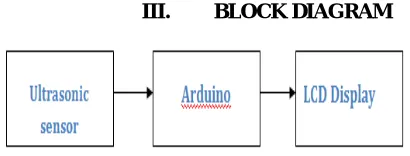
[image:2.612.200.405.563.641.2]III. BLOCK DIAGRAM
Fig 1: Block Diagram
A. Arduino Uno
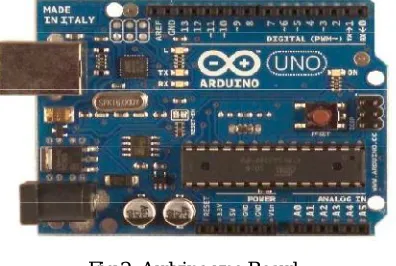
[image:3.612.210.408.142.275.2]The Arduino Uno is a microcontroller board based on the ATmega328 (datasheet). It has 14 digital input/output pins (of which 6 can be used as PWM outputs), 6 analog inputs, a 16 MHz crystal oscillator, a USB connection, a power jack, an ICSP header, and a reset button.
Fig 2: Arduino uno Board
It contains everything needed to support the microcontroller; simply connect it to a computer with a USB cable or power it with a AC-to-DC adapter or battery to get started.
B. Ultrasonic sensor
Ultrasonic sensors are great tools to measure distance without actual contact and used at several places like water level measurement, distance measurement etc. This is an efficient way to measure small distances precisely. Ultrasonic sensor HC-SR04 is used here to measure distance in range of 2cm-400cm with accuracy of 3mm. The sensor module consists of ultrasonic transmitter, receiver and the control circuit. The working principle of ultrasonic sensor is as follows:
1) High level signal is sent for 10us using Trigger.
2) The module sends eight 40 KHz signals automatically, and then detects whether pulse is received or not.
3) If the signal is received, then it is through high level. The time of high duration is the time gap between sending and receiving the signal.
Distance= (Time x Speed of Sound in Air (340 m/s))/2
Here we have divided the product of speed and time by 2 because the time is the total time it took to reach the obstacle and return back. Thus the time to reach obstacle is just half the total time taken
Fig 3: Ultrasonic sensor
C. LCD Display
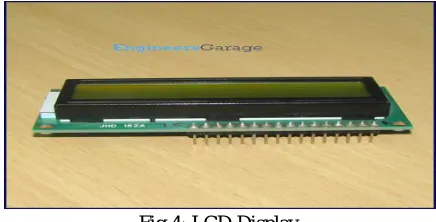
To make the system user friendly a set of instructions are displayed on the LCD. Also the results are to be displayed after every measurement. For this purpose we use a 16*2 LCD.
[image:3.612.226.390.509.601.2]Fig 4: LCD Display
D. Potentiometer
Potentiometer is a device used to measure the internal resistance of a cell, to compare the e.m.f. of two cells and potential difference across a resistor. It consists of a long wire of uniform cross sectional area and of 10 m in length. The material of wire should have a high resistivity and low temperature coefficient. The wires are stretched parallel to each other on a wooden board. The wires are joined in series by using thick copper strips. A metre scale is also attached on the wooden board. It works on the principle that when a constant current flows through a wire of uniform cross sectional area, potential difference between its two points is directly proportional to the length of the wire between the two points.
IV. IMPLEMENTATION
This system is mainly designed to detect or measure the height. Ultrasonic sensor measures the distance from reference level. Here reference level is taken as ground. By taking input from the sensor it is given to the Arduino controller. It converts analog data to digital data. After that microcontroller gives this output to LCD display. LCD displays measured height in cms. This measured output should be converted to fts. to know the height.
A. Software Module
In this Arduino IDE is used for programming.
B. Algorithm
1) Step1: Start
2) Step2: Initialize all the modules
3) Step3: Enter into while loop(o/p=high)
4) Step4: Read ADC
5) Step5: Compute height using multiplication
6) factor
7) Step6: Display the height
8) Step7: Stop
V. CONCLUSION
Thus by properly interfacing the sensor to the Arduino board, and after digital conversion was done, the proposed model could then carry out measurement of height successfully.
We compiled the results over various instances and have successfully measured and displayed the heights of various objects. The input signal received by the receiver in the IR sensor is conditioned. It is then used to pass values to the preprogrammed microcontroller that generates the required output. This is then displayed on the LCD. Instant display without added delay further adds to itsbenefits and the automatic measurement removes human intervention all together and improves efficiency.
REFERENCES
[1] P. Cheng and Zhi Ping, “Portable Human Height Measuring Device” Patent US 6847586, Google patents and applications
[2] Sanoner, H. (2008). Distance measuring device for acoustically measuring distance. The Journal of the Acoustical society of America,123(2), 583. doi:10.1121/1.2857655
[3] G. Benet, J. Albaladejo, A. Rodas, P.J. Gil, An intelligent ultrasonic sensor for ranging in an industrial distributed control system, in: Proceedings of the IFAC Symposium on Intelligent Components and Instruments for Control Applications, Malaga, Spain, May 1992, pp. 299–303.
International Symposium on Industrial Electronics, ISIE’99, Vol. III, Bled, Slovenia, July 1999, pp. 990–995.
[6] V. Colla, A.M. Sabatini, A composite proximity sensor for target location and color estimation, in: Proceedings of the IMEKO Sixth International Symposium on Measurement and Control in Robotics, Brussels, 1996, pp. 134–139.